Quick answer
Pakistani IT employers mostly hire for full-stack JavaScript, .NET and Python web development, React Native and Flutter for mobile, Oracle, MySQL and MS SQL databases, AWS cloud and software testing, according to P@SHA's 2025 survey of 256 companies. Pick one stack, learn SQL alongside it, and prove it with finished projects.
Key takeaways
- • P@SHA's 2025 survey of 256 companies counted 32,685 technical job openings across Pakistan's IT sector.
- • Full-stack JavaScript, .NET and Python lead web demand; React Native and Flutter lead mobile.
- • Oracle, MySQL and MS SQL dominate entry-level database demand, so learn SQL with any track.
- • Close to 72% of hiring demand was for experienced staff, so build projects before you apply.
- • On Upwork, demand for AI-related skills grew 109% in 2025, led by AI video work and AI integration.
- • Choose one core skill, prove it, then specialize; switching tracks every month wastes time.
Table of contents 12 sections
- How the P@SHA Survey Was Put Together
- The IT Skills in Demand, Area by Area
- Web and Mobile Stacks: Where Most Developers Start
- Databases, Cloud and Testing: Quieter Entry Points
- Where Does AI Fit in Local Job Openings?
- What Do Freelance Clients Pay For?
- Why Do Graduates Still Struggle to Get Hired?
- The Soft Skills and Certifications That Tip the Decision
- How to Choose One Skill: A Four-Level Build Order
- Matching a Skill to Your Starting Point
- Starting From Zero? How PSTA's DIT Covers Level 1
- Pick One Stack and Test It for 14 Days
"Which IT skill should I learn to get a job in Pakistan?" Students ask me this almost every week, usually right after Matric, Intermediate or a BS degree. The most reliable answer doesn't come from YouTube. It comes from employers. P@SHA's Skills Survey 2025 asked 256 software and IT services companies what they hire for, and the IT skills in demand in Pakistan cluster around a handful of clear stacks rather than dozens of trendy tools.
This report turns that survey, along with fresh freelance and export data, into a plan you can follow. Here's what you'll take away:
- Which technical stacks Pakistani employers named in each area, from web to cloud
- Where AI tools such as OpenAI's models and TensorFlow appear in local job openings
- What freelance clients on Upwork paid for most in 2025
- Why so many graduates still miss out, and which gaps you can close yourself
- A four-level build order for choosing one skill and proving it
How the P@SHA Survey Was Put Together
P@SHA, the Pakistan Software Houses Association, surveyed 256 IT and IT-enabled services companies across the country for its 2024-25 skills report. Small companies made up about 41% of respondents and medium firms about 32%. Large and very large firms added roughly 14% between them. So the results reflect the ordinary software houses where most graduates land their first job, not only the big names.
The headline figures are large. Responding companies reported 32,685 technical job openings and 1,969 non-technical ones. They also said 61,515 existing roles need upskilling and that 46,530 IT certifications are required. You can read the full P@SHA Skills Survey 2025 yourself.
One caveat before we go further. The report ranks skills by demand in charts but doesn't publish a percentage for each one. So this guide tells you which skills lead each category, not their exact share. Treat it as a map of where employers are looking, not a league table.
The IT Skills in Demand, Area by Area
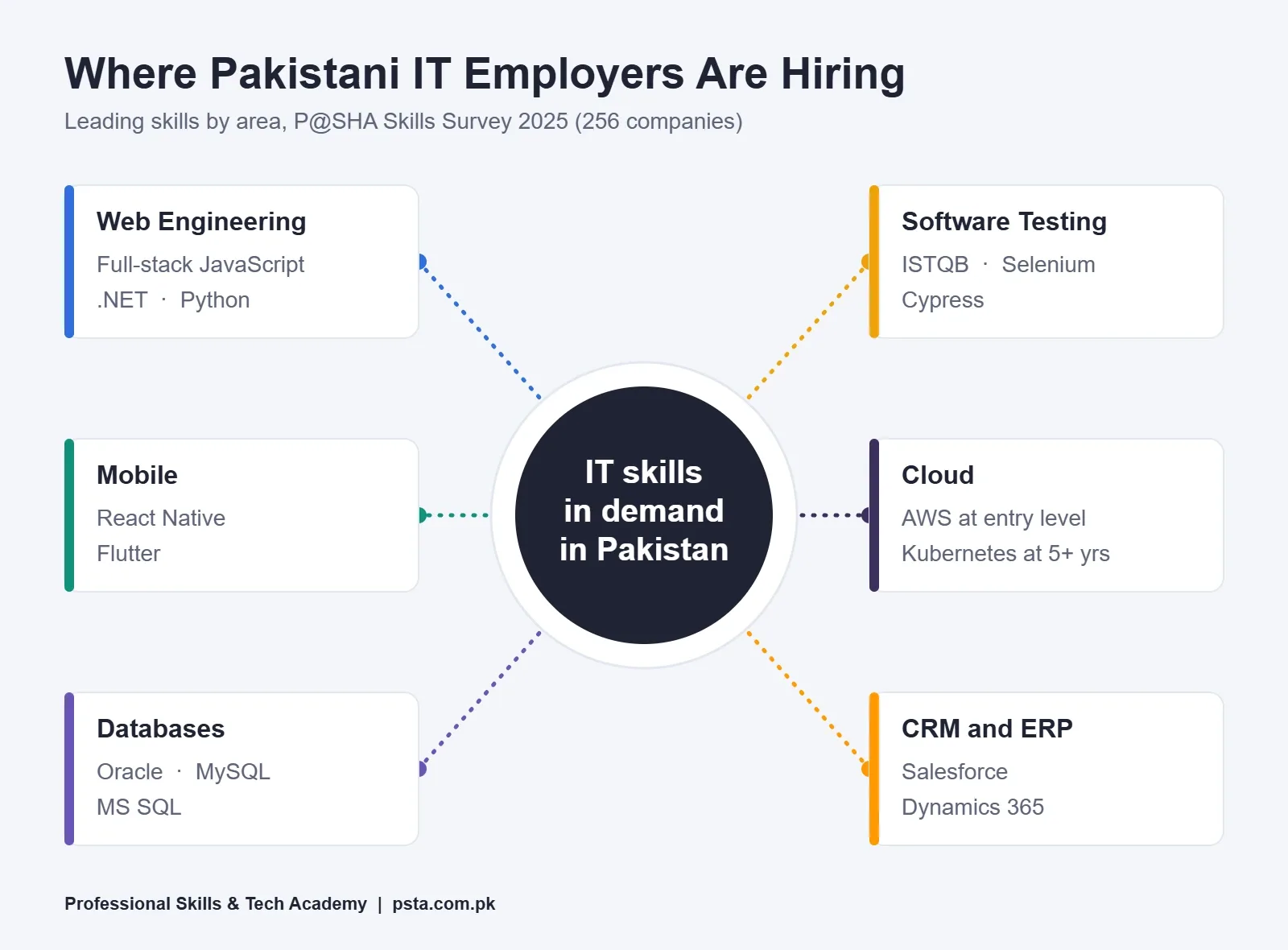
The survey splits demand into technology areas. The table lists the IT skills in demand within each area and what that means if you're just starting.
| Area | Skills employers named most | What it means for a beginner |
|---|---|---|
| Web engineering | Full-stack JavaScript, .NET, Python | Pick one language and build complete apps with it |
| Mobile | React Native, Flutter | Strong at entry level; React Native follows naturally from JavaScript |
| Databases | Oracle, MySQL, MS SQL | Relational SQL leads entry-level demand |
| Cloud | AWS developer certifications; Kubernetes at 5+ years | Start with AWS basics; containers at scale come later |
| Software testing | ISTQB, Selenium, Cypress | A realistic first job for careful, detail-minded people |
| CRM and ERP | Salesforce, Microsoft Dynamics 365 | A specialist route, often after some work experience |
| Integration | MuleSoft | Mostly mid-level and senior roles |
Two points stand out. First, the survey treats .NET demand as higher than full-stack JavaScript, which surprises students who only see JavaScript tutorials online. Second, nearly every row rests on the same base: one programming language, SQL, and the ability to ship a working project.
Web and Mobile Stacks: Where Most Developers Start
If you want to write code for a living, web development opens the widest set of doors to IT jobs in Pakistan. Employers in the survey named full-stack JavaScript, .NET and Python as the leading web skills. Any of the three can get you hired, but each tends to lead toward a different kind of team.
- Full-stack JavaScript (React on the front end, Node.js and Express on the back end) is common in startups and agencies building products for foreign clients.
- .NET with C# tends to appear in enterprise software and in companies serving corporate clients.
- Python with Django or Flask suits data-heavy back ends and teams that also do automation or machine learning.
On mobile, React Native and Flutter lead, and the report says they're especially wanted at entry level. If you already know JavaScript, React Native is the shorter step. Flutter uses Dart, a new language for most learners, though it's well documented.
Among the IT skills in demand, web development is also one of the easiest to practice for free, since a laptop and a browser are enough to start. A realistic timeline is about six months of steady practice to build and deploy two or three complete web apps, studying two to three hours a day. That's the length of PSTA's Full-Stack Web Development course, which teaches the MERN stack.
Databases, Cloud and Testing: Quieter Entry Points
Not every IT job is a developer job, and some less glamorous areas are easier to enter. The survey found that relational databases such as Oracle, MySQL and MS SQL dominate, particularly at entry level. That's good news for you. SQL can be learned in weeks, and it comes up in almost every technical interview, whether you apply as a developer, an analyst or a support engineer.
If databases interest you, work through our SQL interview guide for freshers to see what employers actually test. PSTA's Oracle Database 19c course covers SQL, PL/SQL and administration over 12 weeks.
Cloud follows a clear ladder. AWS developer certifications are strongest at entry level, while Kubernetes is mostly asked of people with five or more years of experience. So don't jump into container orchestration in month one. Learn Linux basics, networking and one cloud provider first.
Software testing is the route I suggest most to careful students who don't enjoy heavy coding. Employers named ISTQB certification, Selenium and Cypress as the leading testing skills. Manual testing teaches you how software breaks. Automation with Selenium or Cypress then adds the coding side a little at a time.
Where Does AI Fit in Local Job Openings?
AI is the skill everyone asks about, so actual counts help. The P@SHA survey tallied openings that named specific AI and machine learning platforms. OpenAI's tools appeared in 638 openings, spread evenly across experience levels. TensorFlow appeared in 511, peaking at two to five years of experience. DataRobot, a niche automated machine learning platform, appeared in 398.
The report also notes that AI tools have reduced openings in some roles. Employers increasingly want people who can do a core job and use AI to do it faster. That's a healthier way to think about AI than treating it as a separate career. A web developer who can connect an app to a language model is worth more than someone who only knows prompt tricks.
The global picture points the same way. The World Economic Forum's Future of Jobs Report 2025, based on more than 1,000 employers, names AI and big data, networks and cybersecurity, and technology literacy as the three fastest-growing skills up to 2030. It also expects 39% of workers' current skill sets to be transformed or outdated by 2030.
If you'd like an applied AI route without a computer science degree, workflow automation is a practical start. PSTA's AI Automation course runs for eight weeks and shows you how to connect AI models to everyday business tools.
What Do Freelance Clients Pay For?
Many Pakistani students plan to earn through freelancing instead of a local job, and the money coming in is real. State Bank of Pakistan data reported by Profit shows freelancers brought in a record $1.76 billion in FY2025-26, up from $984 million a year earlier. IT freelancers accounted for more than $1.16 billion of that. Total IT exports reached a record $4.6 billion in FY2026, up 20.7% from $3.81 billion, according to SBP figures reported by Nukta.
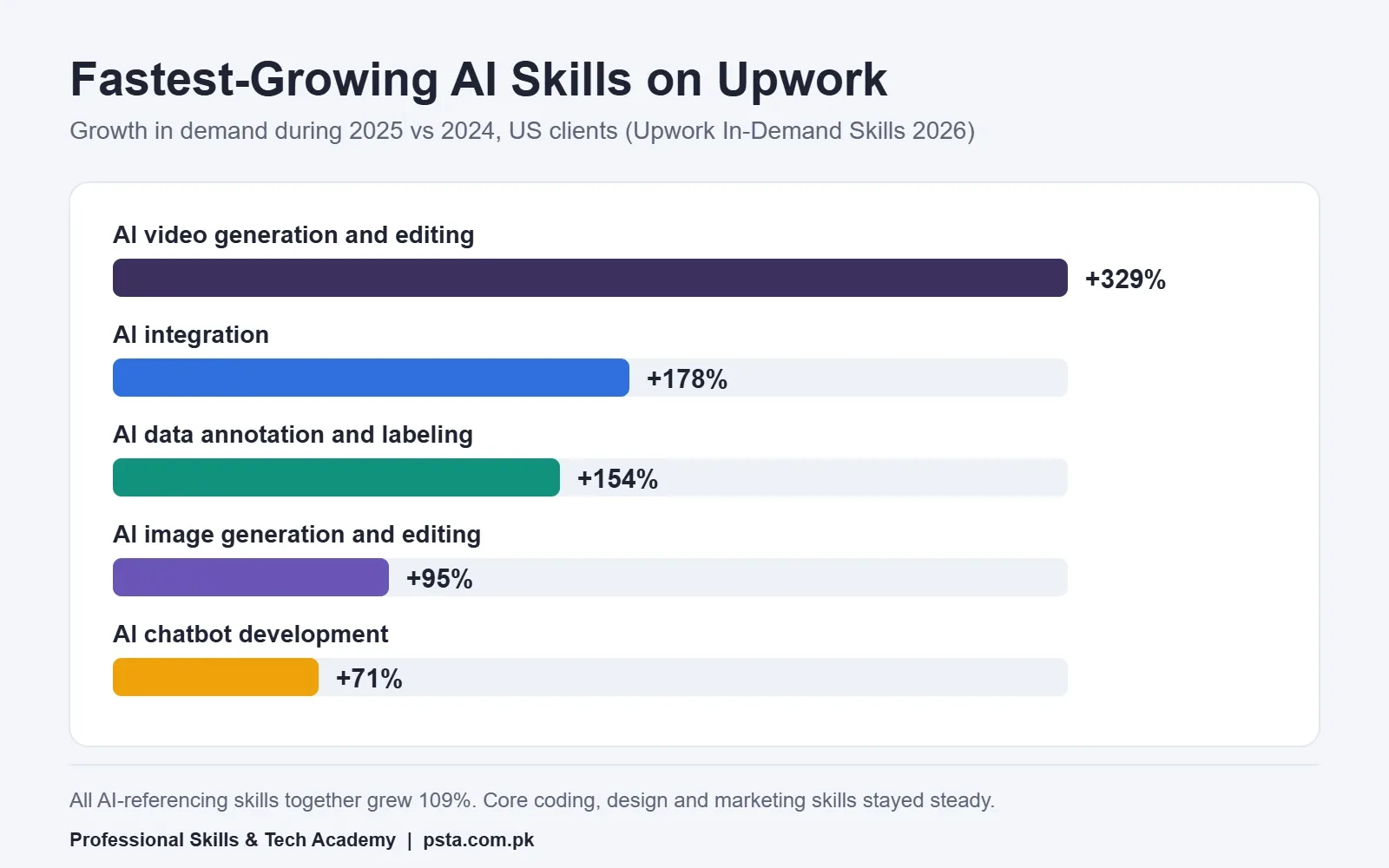
For choosing freelancing skills, the data in Upwork's In-Demand Skills 2026 report is more useful. It's based on completed jobs from US clients on Upwork during 2025. Demand for skills that mention AI grew 109% year over year, while core skills in coding, design, marketing and support held steady. In coding and web development, the top skills were full-stack development, web design, front-end development and mobile app development.
The fastest-growing AI skills were:
- AI video generation and editing: up 329%
- AI integration: up 178%
- AI data annotation and labeling: up 154%
- AI image generation and editing: up 95%
- AI chatbot development: up 71%
Read these as growth rates, not market size. A skill can grow 300% from a small base and still offer fewer jobs than steady full-stack work. The safer plan is a core skill with an AI layer on top, such as a video editor who uses AI tools or a developer who builds chatbots.
Why Do Graduates Still Struggle to Get Hired?
Here's the uncomfortable part of the IT skills in demand story. P@SHA estimates that universities produce about 72,952 CS and IT graduates a year, counting accredited and non-accredited institutions together. Its member companies hired 13,350 graduates in the last calendar year, about 18.3% of that output. And close to 72% of last year's hiring demand was for experienced professionals, not freshers.
The report names the causes plainly: weak curriculum relevance, poor industry alignment, low career readiness, and graduate output below industry quality thresholds. Brain drain also shrinks the experienced pool.
What this means for you:
- A degree alone isn't the filter. Employers screen for what you can build and explain in an interview.
- You can earn experience honestly before your first job. Internships, open-source contributions, small freelance projects and real work for local shops all count.
- Depth beats a long list. A CV with one stack and three finished projects reads stronger than ten half-learned tools.
The Soft Skills and Certifications That Tip the Decision
When two candidates have similar technical ability, softer factors decide. The survey lists five soft skills employers want: verbal and written communication, team collaboration, client engagement and problem-solving, adaptability in multicultural and remote settings, and work ethics and professionalism.
English tops the language list as the main business language, with Arabic noted for Gulf clients. If your English slows you down in interviews or client calls, work on it alongside your technical skill, not after. PSTA's English Spoken and Grammar course is built for exactly that.
If you're comparing IT certifications for beginners, start with what employers asked for. The most requested were Professional Scrum Master, Azure Fundamentals and CISA, with QA certifications and PMP also in strong demand. For entry level, the survey named AWS developer certifications, ISTQB and foundational VMware or ITSM courses. Here's one way to read that:
| Your stage | Certifications worth considering | Why they help |
|---|---|---|
| Beginner, no job yet | Azure Fundamentals, AWS entry-level, ISTQB Foundation | Low barrier; proves basic cloud or QA knowledge |
| Junior, 1 to 2 years | Professional Scrum Master, AWS developer | Matches how software teams work every day |
| Experienced | PMP, ITIL, CISA, CISSP | Leads toward management, service and security roles |
A certificate helps you pass a CV filter. It won't replace a portfolio, so plan for both.
How to Choose One Skill: A Four-Level Build Order
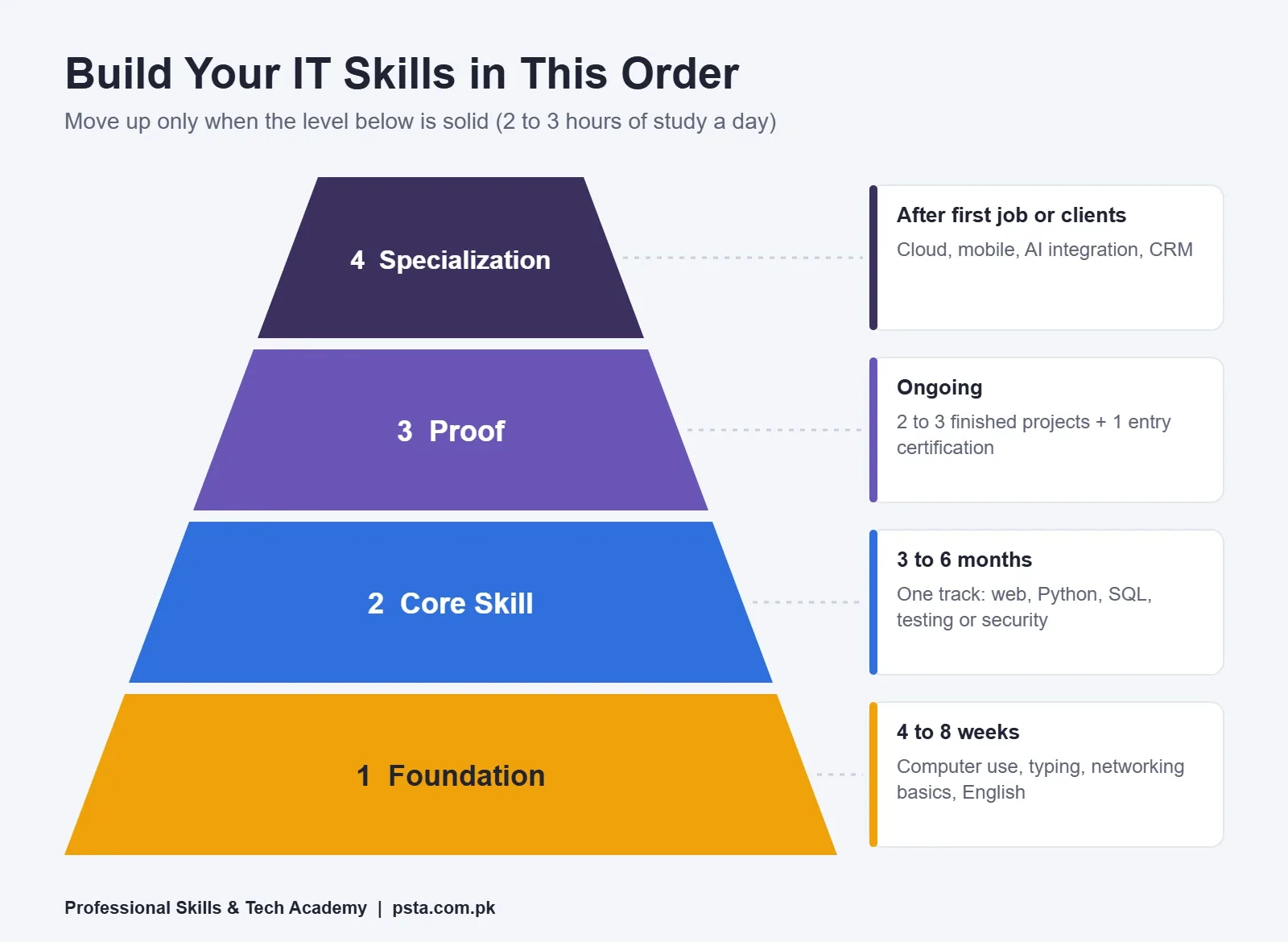
Deciding which IT skill to learn is usually harder than learning it. Most students I teach don't fall short from lack of effort. They fall short because they switch tracks every month. Use this build order instead, and move up only when the level below is solid. It works for any of the high-demand skills above.
- Level 1, Foundation (4 to 8 weeks): confident computer use, typing, file management, basic networking ideas and working English. Without this, every later course feels harder than it should.
- Level 2, Core skill (3 to 6 months): one track from the survey's lists, such as full-stack JavaScript, Python, SQL with Oracle or MySQL, software testing, or cyber security basics.
- Level 3, Proof (ongoing): two or three finished projects on GitHub or a portfolio site, plus one entry-level certification if your track has an obvious one.
- Level 4, Specialization (after your first job or clients): cloud, mobile, AI integration or CRM platforms such as Salesforce, added on top of the core.
These timelines are estimates for someone studying two to three hours a day, not promises. Some students move faster, and working students often take longer. That's fine.
Matching a Skill to Your Starting Point
Where you start matters as much as where you want to go. Find your row below.
| Your situation | Sensible first track | First milestone |
|---|---|---|
| Just passed Matric or Intermediate | A broad one-year foundation, then one track | A small website and a Python program |
| BSCS or BSIT student | Full-stack JavaScript, .NET or Python, plus SQL | One deployed app before final year |
| Office worker or computer operator | SQL and Power BI, or software testing | One report or task automated at work |
| Freelancer on Fiverr or Upwork | Your current service plus an AI layer | One AI-assisted offer on your profile |
| Interested in security | Networking basics, then cyber security | A documented home practice lab |
If you're weighing diploma lengths, our article on choosing between a one-year and two-year DIT sets out the trade-offs, and our guide to jobs after DIT lists the posts that ask for one.
Starting From Zero? How PSTA's DIT Covers Level 1
If you aren't sure which track suits you, PSTA's Diploma in Information Technology is designed as the Level 1 step with an early taste of Level 2. It lasts one year over two semesters. Semester 1 covers ICT, computer networking, operating systems, Python basics and office automation. Semester 2 moves to Photoshop, Illustrator and Canva, Premiere Pro, online selling models, HTML5, CSS3 and JavaScript for the web, and MySQL.
The fee is Rs. 2,000 per month, against a regular Rs. 2,500. You can study at our Mandian campus on Old College Road, opposite FIMS College in Abbottabad, join live classes online from any city, or combine the two. Batches open every month. You finish with hands-on projects in web, Python, networking and design, which makes it far easier to see which specialist track fits you. The diploma doesn't promise a job, but it does give you work to show.
Already sure of your track? Compare specialist options on the courses page.
Pick One Stack and Test It for 14 Days
Reading about IT skills in demand only helps if you test one yourself. Choose one row from the skills table near the top. For the next 14 days, spend an hour a day on free beginner material for that stack and build one tiny thing: a to-do app, a set of SQL queries on a sample database, or a test plan for a website you use. On day 14, ask yourself one question. Did I want to keep going? If yes, commit to that track for six months. If not, try a second row before you pay for anything.
When you want structured classes and feedback, you can apply on the admission page, or send a message on WhatsApp (+92 314 5424399) to ask which batch timing works for you.
Frequently asked questions
Which IT skill is most in demand in Pakistan in 2026?
P@SHA's 2025 survey of 256 companies shows web development leading, with full-stack JavaScript, .NET and Python named most often. Relational databases such as Oracle, MySQL and MS SQL dominate entry-level demand. The survey ranks skills in charts rather than percentages, so treat web development plus SQL as the safest broad combination for a beginner.
Is AI replacing IT jobs in Pakistan?
The P@SHA report says AI tools have reduced openings in some roles, and employers now prefer people who can do a core job and use AI to work faster. AI also created new demand: OpenAI tools appeared in 638 openings in the survey. Learning a core skill with an AI layer is a sensible response.
Can I get an IT job in Pakistan without a degree?
Some roles, such as junior web development, software testing and IT support, care more about what you can show than your degree. A portfolio of finished projects, a relevant certificate and clear communication in interviews help a lot. Larger companies and government posts may still ask for a formal qualification, so check each advert carefully.
How long does it take to learn an in-demand IT skill?
For most beginners studying two to three hours a day, a solid foundation takes four to eight weeks and a core skill such as web development or SQL takes three to six months. Building two or three portfolio projects continues alongside. These are estimates, and working students often need longer, which is completely normal.
Which IT skill is best for freelancing from Pakistan?
Upwork's 2026 report lists full-stack development, web design and front-end development as top coding skills, while AI video generation grew 329% in 2025. A good approach is to choose a core service you can deliver well, such as web development or video editing, then add AI tools that make you faster.
Which IT certification should a beginner do first?
The P@SHA survey names AWS developer certifications, ISTQB and foundational VMware or ITSM courses for entry-level candidates, and lists Azure Fundamentals among the most requested overall. Pick the one that matches your chosen track: a cloud certificate for cloud work, ISTQB for testing. A certificate supports a portfolio but never replaces it.
Is a one-year DIT enough to start an IT career?
A one-year DIT gives you a broad base in computers, networking, office software, Python, web basics and design, which suits office, support and junior roles. For developer jobs, most students follow it with a specialist track such as full-stack development or Python and build a portfolio before applying.
Sources & references
- P@SHA Skills Survey 2025 pasha.org.pk
- World Economic Forum: Future of Jobs Report 2025 Digest weforum.org
- Upwork In-Demand Skills 2026 investors.upwork.com
- Profit: Pakistan's freelancer earnings hit record $1.76 billion in FY26 profit.pakistantoday.com.pk
- Nukta: Pakistan's IT exports reach record high in FY26 nukta.com
Last reviewed & updated on by Umar Qureshi. Written by the PSTA team in Abbottabad, Pakistan.

Umar Qureshi

Diploma in Information Technology (DIT) – 1 Year Certified Program
Turn this guide into a career: hands-on training with real projects, online across Pakistan or on-campus in Abbottabad · 1 Year.

Comments
No comments yet — ask a question or share your experience.