Quick answer
Choose the 1-year DIT if you already have, or are studying for, FA, FSc or ICS and want IT skills quickly. Choose the 2-year DIT if you stopped after Matric: it adds English, Urdu, Pak Studies and electives, and Punjab reports describe it as equivalent to ICS. Confirm equivalence in writing.
Key takeaways
- • Both KPBTE versions share the same Year 1 IT subjects, worth 1,000 marks.
- • The 2-year DIT adds an academic year of English, Urdu, Pak Studies, Islamiat and electives.
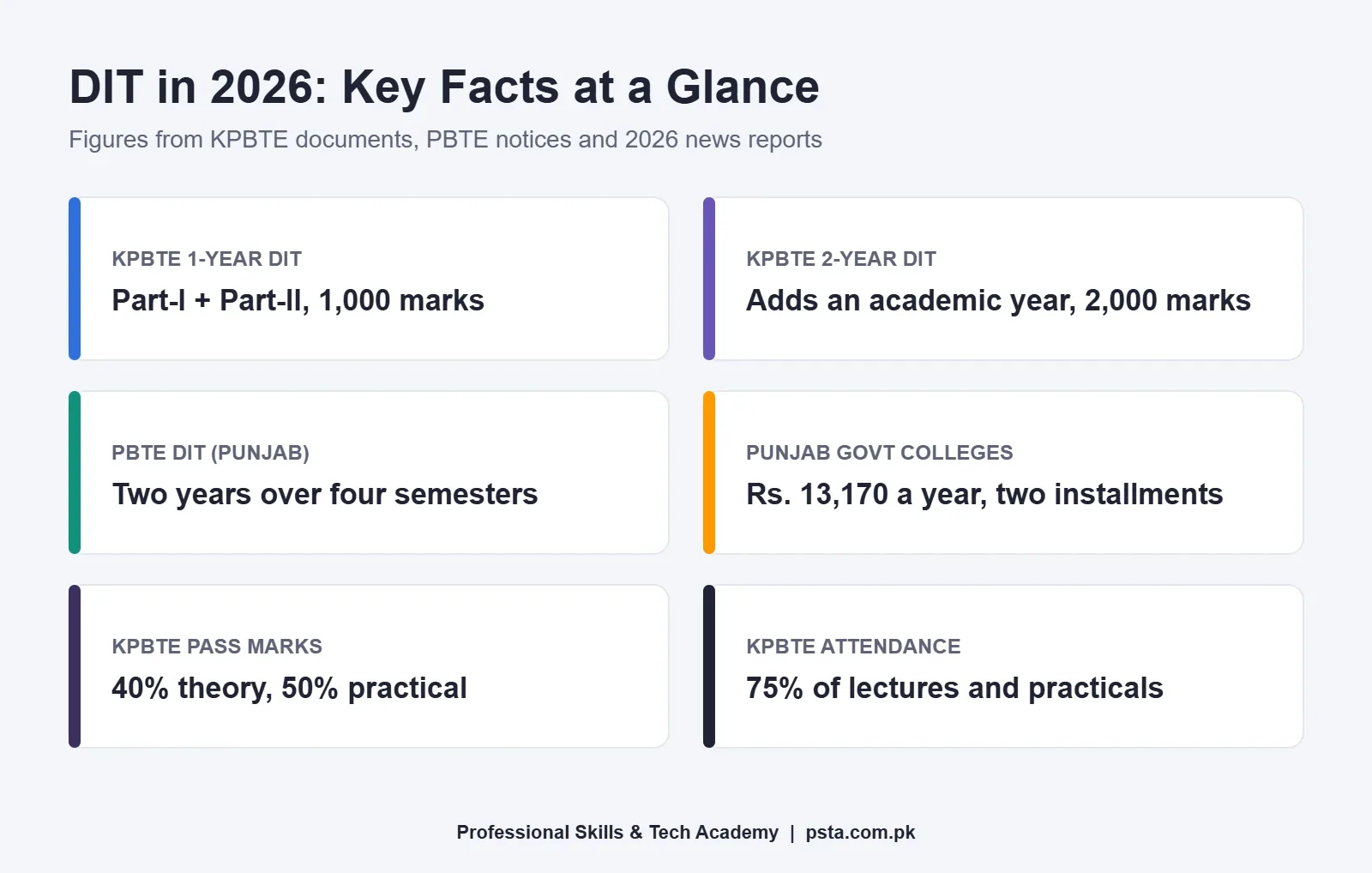
- • Punjab's government colleges charge Rs. 13,170 a year for the new 2-year DIT, run with PBTE.
- • KPBTE requires 40% in each theory paper, 50% in each practical and 75% attendance.
- • A board DIT matters when an ad names a board; skills and projects matter everywhere else.
Table of contents 14 sections
- What Is a DIT, and Who Awards It?
- 1-Year vs 2-Year DIT: The Side-by-Side Comparison
- What Does the First Year Cover?
- Part-I: Foundations
- Part-II: Applied Skills
- What Does the Second Year Add?
- How Is Punjab's New 2-Year DIT Different?
- Admission Rules, Pass Marks and Attendance
- Which DIT Should You Choose?
- Is a Board DIT Better Than a Private IT Diploma?
- Questions to Ask Before You Pay Any Fee
- What Can You Do After a DIT?
- Learning DIT Skills at PSTA
- Your Next Step: Read One Ad Before You Register
The 1-year vs 2-year DIT choice comes down to one question: do you already have intermediate-level subjects on your record? Punjab's government colleges now offer the 2-year version for Rs. 13,170 a year, according to a ProPakistani report from August 2026. Pick the 1-year DIT if you have, or are studying for, an intermediate qualification and want computer skills fast. Pick the 2-year DIT if you stopped after Matric and want IT plus academic subjects in one program.
In this comparison, you'll find:
- How the two versions differ in subjects, marks and time
- What KPBTE and PBTE have changed for 2026
- The pass marks, attendance and age rules that catch students out
- A simple way to decide which version fits your situation
- How a board diploma compares with a private institute diploma
What Is a DIT, and Who Awards It?
DIT stands for Diploma in Information Technology. It's a post-Matric program that teaches practical computer work: operating systems, MS Office, networking, basic programming, databases, web pages, graphics and video.
In Pakistan, the board-level DIT is examined by the technical boards. In Khyber Pakhtunkhwa, that is the Khyber Pakhtunkhwa Board of Technical and Commerce Education (KPBTE). In Punjab, it's the Punjab Board of Technical Education (PBTE). Affiliated colleges and institutes teach the course, and the board sets the papers and issues the result.
If you search for a DIT course in Pakistan, you'll also find many private academies running their own DIT-style diplomas. These follow a similar subject list, but the certificate comes from the institute, not from a board. Both have a place. You just need to know which one you are paying for before you register.
1-Year vs 2-Year DIT: The Side-by-Side Comparison
KPBTE publishes course outlines for both versions. The one-year outline calls it a "post matric one year program." The two-year outline keeps the same first-year IT subjects and adds a full academic second year. Here's how they line up.
| Feature | 1-Year DIT (KPBTE) | 2-Year DIT (KPBTE) |
|---|---|---|
| Structure | Part-I and Part-II | Part-I to Part-IV |
| IT subjects | Nine subjects plus a capstone project | The same nine subjects plus a project, all in Year 1 |
| Academic subjects | None | English, Urdu, Islamiat, Pak Studies, Mutalae Quran and an elective pair |
| Total marks | 1,000 | 2,000 |
| Practical weight | 25 practical marks per IT subject, 100 for the project | Practical work in Year 1 only; Year 2 papers are theory |
| Best suited to | Intermediate students and graduates who want IT skills | Matric-pass students who want IT and academic study in one program |
The first year is almost identical in both. The real decision is whether you need the second, academic year.
What Does the First Year Cover?
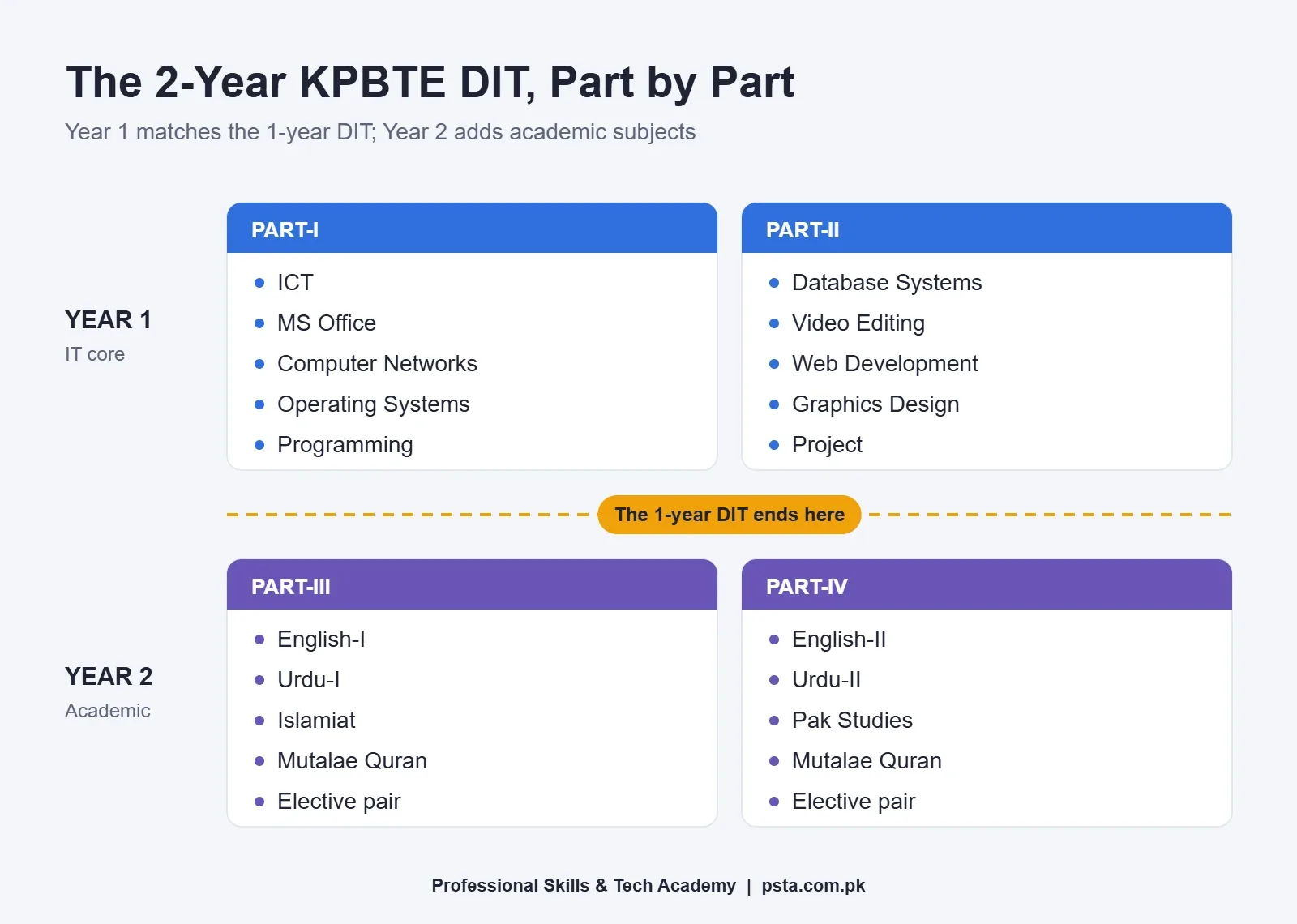
Year 1 is the IT core, and it's the same skill set in both versions. KPBTE splits it into two parts of five subjects each. Every IT subject carries 100 marks: 75 for theory and 25 for practical.
Part-I: Foundations
- Introduction to Information and Communication Technologies (ICT)
- Introduction to MS Office
- Computer Networks
- Operating Systems
- Introduction to Programming
Part-II: Applied Skills
- Database Systems
- Video Editing
- Web Development Essentials
- Graphics Design
- A project worth 100 marks
The two-year outline lists most of these subjects at 120 contact hours each. Most of those hours are practical, so expect to spend more time at a keyboard than at a desk with notes.
What Does the Second Year Add?
The 2-year DIT turns Year 2 into an academic year. Parts III and IV are all theory papers, and they look much like an intermediate syllabus.
- Languages: English-I and English-II, plus Urdu-I and Urdu-II, at 100 marks each.
- Compulsory subjects: Islamiat or Religious Education, Pak Studies and Mutalae Quran-e-Hakeem.
- Elective pair: 200 marks a year from a combination such as mathematics with economics, statistics or physics.
So the extra year doesn't teach more IT. It adds the general subjects that a Matric-pass student would otherwise study in FA, FSc or ICS. If you already have those subjects on your record, the second year mostly repeats what you've done.
How Is Punjab's New 2-Year DIT Different?
Punjab moved to a two-year model during 2026. Dawn reported in January 2026 that PBTE introduced a structured two-year DIT run over four semesters, with subjects related to artificial intelligence. The PBTE DIT registration notice for the 2026 session, covered by Result.pk, also describes the diploma as a two-year program.
In August 2026, the Punjab Higher Education Department approved the same diploma for government colleges. ProPakistani reported three points worth noting:
- The annual fee in government colleges is Rs. 13,170, payable in two installments.
- The program runs with PBTE, which handles exams and certification.
- The qualification is described as equivalent to Intermediate in Computer Science (ICS).
Equivalence is the line students care about most, because it decides what you can apply for next. News reports are a starting point, not a final word. Before you enroll, ask the college to show you the official notification, and check the entry rules of the degree program you plan to join later.
Admission Rules, Pass Marks and Attendance
The rules are where students lose time, so read them before the first class. KPBTE's assessment and promotion rules for the two-year DIT set these conditions:
| Rule | KPBTE Requirement |
|---|---|
| Minimum entry marks | 33% in SSC (Matric) or an equivalent qualification |
| Age limit | 25 years maximum in normal conditions |
| Theory pass mark | 40% in each theory subject |
| Practical pass mark | 50% in each practical |
| Attendance | 75% of lectures and practicals; the principal may condone up to 10% |
| Exams | Twice a year, as 1st Term and 2nd Term papers |
Theory and practical are passed separately. A strong theory score won't rescue a weak practical, so treat lab time as seriously as the written paper.
Deadlines and fees matter too. For the KPBTE DIT 1st Term 2026 exams, which began on February 10, 2026, the normal exam fee was Rs. 2,650, according to Result.pk's summary of the schedule. In Punjab, the single-fee online deadline for the 2026 session was April 25, 2026. PBTE also required your name and father's name to match your Matric certificate, a blue-background photo and a scanned CNIC or B-Form.
Which DIT Should You Choose?
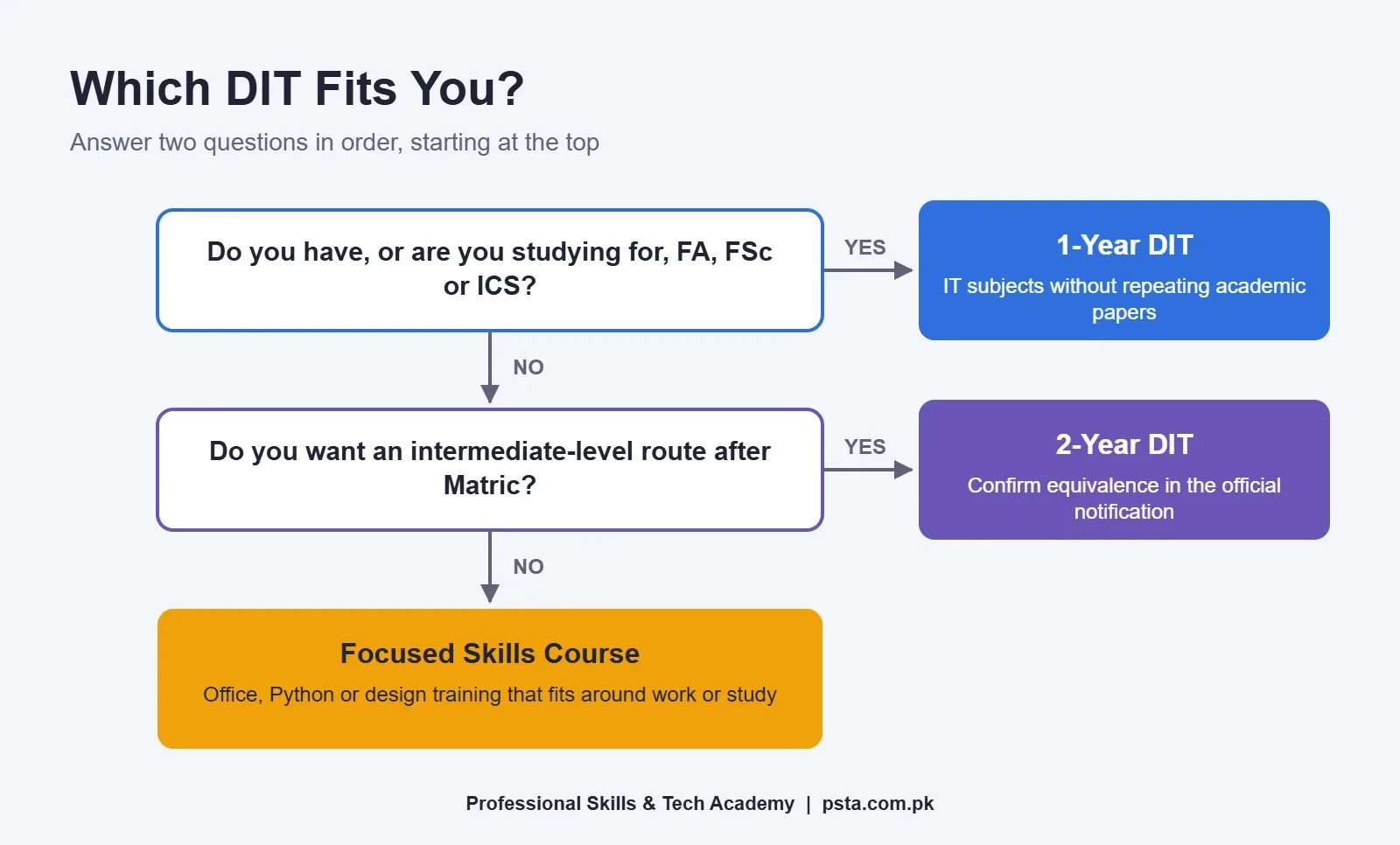
Most students can settle the 1-year vs 2-year DIT choice with three questions. Answer them in order.
- Do you already have an intermediate qualification, or are you studying for one? If yes, the 1-year DIT gives you the IT subjects without repeating English, Urdu and Pak Studies.
- Did you stop after Matric and want an intermediate-level route? For a DIT after Matric with no other college plans, the 2-year DIT is built for you, especially in Punjab, where reports describe it as equivalent to ICS. Confirm that in writing first.
- Do you mainly want job skills while working or studying elsewhere? Then a shorter, flexible program may suit you better than either board version. The next section explains the trade-off.
Here's an example. A student in Abbottabad who is in the first year of FA has no need for a second set of language papers. A 1-year DIT in the evening adds computer subjects to the same two years. A Matric-pass student who left college, on the other hand, gets more from one 2-year program than from two separate ones.
Is a Board DIT Better Than a Private IT Diploma?
Neither is better in every case. They solve different problems.
A board DIT gives you a certificate from KPBTE or PBTE, a fixed syllabus and external exams. That matters when a job ad or an admission office asks for a diploma from a recognized board. Read the ad's wording carefully. If it names a board, a private certificate may not meet the condition.
A private diploma usually offers monthly admissions, flexible timings, online classes and room to teach newer tools. The certificate comes from the institute, so its value rests on your skills and the work you can show. For freelancing, small business work and many private office jobs, that portfolio often counts for more than the certificate's issuer.
Some students do both: a board diploma for the paperwork and focused practical training for the skills. If you're unsure, ask the employer or college which certificate they accept before you pay any fee.
Questions to Ask Before You Pay Any Fee
Whether you choose a board college or a private academy, ask these questions at the front desk:
- Which body issues the final certificate, and can I see a sample?
- Is the institute currently affiliated with the board for this session?
- How many hours a week happen in the computer lab, and how many students share a PC?
- What is the full fee, including registration and exam fees?
- What happens if I miss a deadline or fail one subject?
Clear, written answers are a good sign. Vague replies about "recognition" are a reason to slow down.
What Can You Do After a DIT?
A DIT is a foundation, not a specialism. The subjects touch many areas, so the smart move is to notice which one you enjoy and go deeper. Here are the usual directions, with the subject that leads to each:
- Office work: MS Office and typing lead to computer operator and data entry roles. Our guide on typing speed for jobs in Pakistan shows what recent ads ask for.
- IT support: operating systems and networks lead to lab assistant and help desk work.
- Programming: the programming and database subjects prepare you for a Python or web development course. Try our Python projects for beginners to test your interest.
- Creative work: graphics design and video editing lead to freelance design and editing jobs.
Whichever direction you take, build two or three small projects during the diploma. A working website, a cleaned-up spreadsheet or an edited video tells an interviewer more than a marks sheet. Spoken English helps in interviews, too, and our list of English interview questions and answers is a good place to practice.
Learning DIT Skills at PSTA
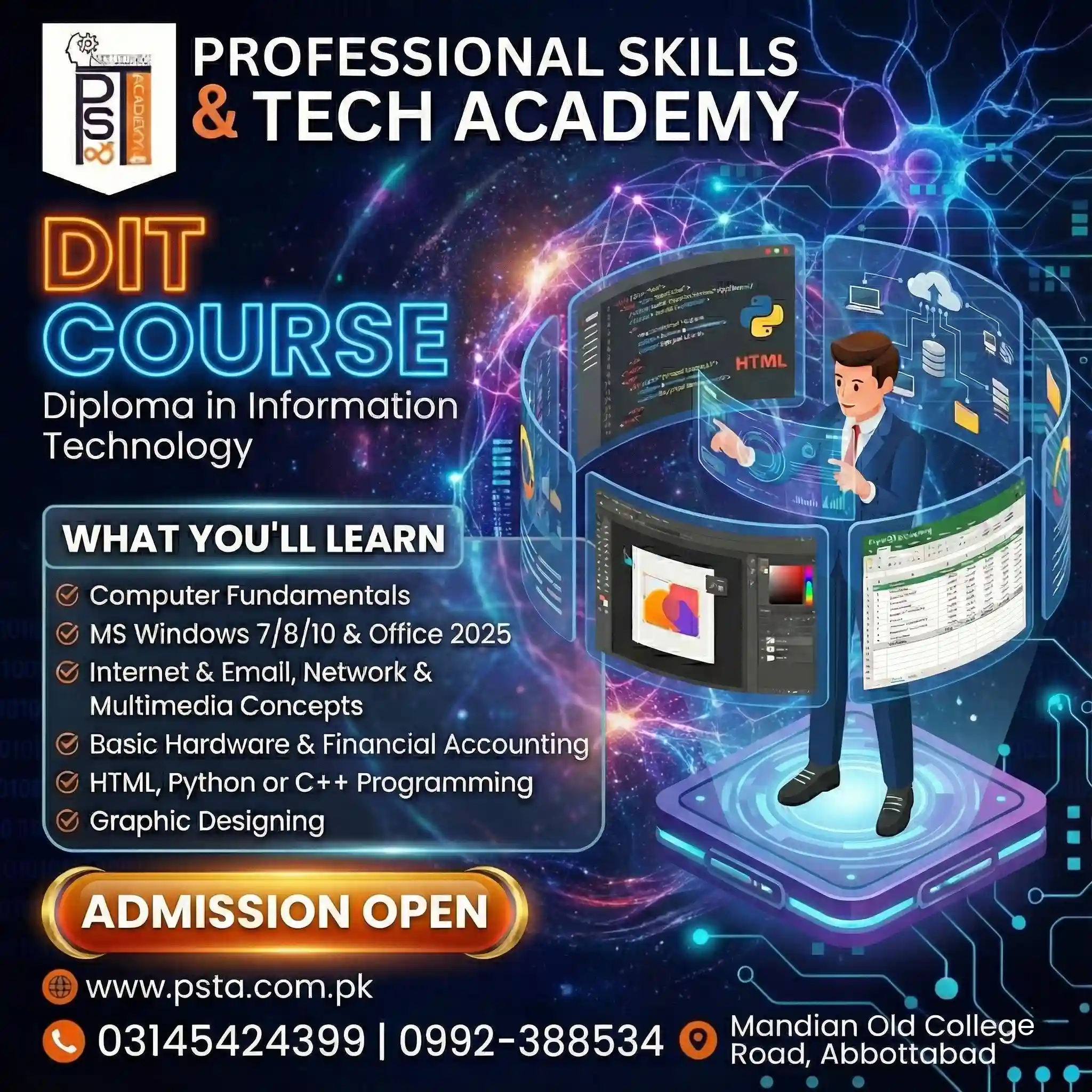
At PSTA, our Diploma in Information Technology is a one-year program taught over two semesters of five modules each. To be clear, it's a PSTA diploma, not a KPBTE or PBTE board exam. You receive a PSTA certificate that anyone can verify at psta.com.pk/certificate.
Here's what the course page lists today:
- Semester 1: ICT, computer networking, operating systems, Python programming and office automation.
- Semester 2: graphic designing, video editing in Premiere Pro, eCommerce models, web development with HTML, CSS and JavaScript, and MySQL databases.
- Fee: Rs. 2,000 per month (regular Rs. 2,500), paid monthly.
- Mode: on campus in Abbottabad, live online across Pakistan, or hybrid, with a new batch every month.
- Entry: Matric or above, with no previous computer study needed.
If you only need one part of the syllabus, a single course may fit better. The Office Automation course covers MS Office and computer basics, and the Advanced Python course goes deeper into programming. You can compare everything on our courses page.
Your Next Step: Read One Ad Before You Register
Before choosing between a 1-year and a 2-year DIT, find one job ad or degree admission notice you'd like to apply for next year. Note exactly what qualification it asks for and whether it names a board. That single line usually settles the choice.
If you'd like help reading it, send the ad on WhatsApp to +92 314 5424399 and we'll tell you which route fits. When you're ready, the admission page explains the steps, or you can visit our campus in Mandian on Old College Road, opposite FIMS College, Abbottabad.
Frequently asked questions
Is the 2-year DIT equivalent to intermediate?
News reports on Punjab's new government-college program describe the 2-year DIT as equivalent to Intermediate in Computer Science (ICS). KPBTE's documents for its 2-year DIT list intermediate-style academic subjects but don't state equivalence. Before you rely on it for a degree admission, ask the college for the official notification and check the entry rules of the university program you plan to join.
What marks do I need in Matric to join a DIT?
KPBTE's assessment rules for the two-year DIT ask for at least 33% marks in SSC or an equivalent qualification. Private institutes set their own entry rules, and many accept any Matric pass. Colleges with limited seats may still admit students on merit, so a higher Matric score can help you get a place at a popular government college.
Can I study a 1-year DIT alongside FA or FSc?
Yes, many students do. The 1-year DIT has no academic papers, so it doesn't repeat the English, Urdu and Pak Studies you already study in college. The main limits are time and attendance. KPBTE expects 75% attendance in lectures and practicals, so choose an evening or weekend batch that fits your college timetable.
Is there an age limit for DIT admission?
KPBTE's rules for the two-year DIT set a maximum age of 25 years in normal conditions. Rules can differ between boards and sessions, so check the current admission notice. Private institute diplomas usually have no upper age limit, which makes them a practical option for working adults and people returning to study.
How much does the 2-year DIT cost in Punjab government colleges?
ProPakistani reported in August 2026 that the annual fee is Rs. 13,170, payable in two installments, under a fee schedule issued by DPI Colleges. Board registration and exam fees may be separate. Ask the college for a written list of every charge before you deposit the first installment.
Is a private DIT certificate accepted for jobs?
It depends on the employer. If a job ad asks for a diploma from a recognized board, a private institute certificate may not meet that condition. Many private offices, small businesses and freelance clients care more about what you can do, so a strong portfolio of projects often carries more weight there.
What happens if I pass theory but fail the practical?
Under KPBTE's rules, theory and practical are passed separately. You need 40% in each theory paper and 50% in each practical, so a good theory score doesn't cover a weak practical. Treat lab work as seriously as written exams, and ask your instructor how the board handles re-appearing in a failed component.
Sources & references
- KPBTE: DIT One-Year Course Outline (Revised 2022) kpbte.edu.pk
- KPBTE: Course Contents for the Two-Year DIT kpbte.edu.pk
- KPBTE: Assessment and Promotion Rules (DIT 2-Year) kpbte.edu.pk
- ProPakistani: Punjab Approves 2-Year IT Diploma for Govt Colleges propakistani.pk
- Dawn: Two-Year Diploma in IT dawn.com
- Result.pk: PBTE Revised DIT Admission and Registration Schedule 2026 result.pk
- Result.pk: KPBTE DIT Technical Examinations Schedule 2026 result.pk
Last reviewed & updated on by Umar Qureshi. Written by the PSTA team in Abbottabad, Pakistan.
Umar Qureshi
Diploma in Information Technology (DIT) – 1 Year Certified Program
Turn this guide into a career: hands-on training with real projects, online across Pakistan or on-campus in Abbottabad · 1 Year.
Comments
No comments yet — ask a question or share your experience.