
Quick answer
PSEB registration for freelancers costs Rs. 1,000, with a Rs. 2,000 yearly renewal. You need your CNIC, a personal NTN from FBR's IRIS portal and a bank maintenance certificate. Approval takes up to one working day. Share the certificate with your bank and use purpose code 9186 so IT export receipts are taxed at 0.25%, not 1%.
Key takeaways
- • PSEB charges Rs. 1,000 for a new freelancer certificate and Rs. 2,000 for each renewal.
- • You need three documents: CNIC, personal NTN (with no business) and a bank account maintenance certificate.
- • PSEB says freelancer applications are processed within one working day of submission.
- • Registered exporters pay 0.25% on IT export receipts, a rate kept until 2029 in the 2026-27 budget.
- • Share your certificate with your bank and make sure client payments carry purpose code 9186.
- • Renewal needs your latest FBR tax return (Form 114), so file your return first.
Table of contents 15 sections
- What Does PSEB Registration Actually Change for a Freelancer?
- Who Should Register, and Who Can Wait?
- Registered vs Unregistered: The Tax Gap in Numbers
- Documents to Prepare Before You Open the Portal
- Getting Your NTN on IRIS
- Getting the Bank Certificate
- PSEB Registration for Freelancers: Seven Steps on the Portal
- How Do You Get the 0.25% Rate Applied at Your Bank?
- Check Your First Credit Advice
- Payoneer, Wise or Direct Transfer: Does the Route Matter?
- Renewal: Why Your Tax Return Comes First
- Common Reasons Applications Stall
- What PSEB Registration Won't Do for You
- Building Exportable Skills at PSTA
- Before Your Next Payment Lands
PSEB registration for freelancers costs Rs. 1,000 for a new certificate and Rs. 2,000 for each renewal, according to the Pakistan Software Export Board's own industry facilitation page. In return, your bank can deduct 0.25% tax on IT export receipts instead of the higher rate charged to unregistered exporters. For most people who earn from foreign clients, the fee pays for itself within the first few transfers.
This guide walks through the whole process in the order you'll actually do it. In the sections below, you'll find:
- What the certificate changes, and what it leaves untouched
- The three documents PSEB asks for, and where to get each one
- The registration steps on the PSEB portal, with timings
- How to make sure your bank applies the lower rate
- Why renewal depends on filing your tax return first
One note before we start: I teach freelancing and technical skills, not tax law. Treat this as a practical walkthrough, and confirm anything specific to your income with a qualified tax practitioner.
What Does PSEB Registration Actually Change for a Freelancer?
The Pakistan Software Export Board is a government body that supports IT and IT-enabled services (ITeS) exporters. A freelancer who builds websites, designs logos, runs ad campaigns or writes code for clients abroad is, in tax terms, an IT services exporter. Registering tells the system that your incoming dollars are export earnings, not unexplained deposits.
The practical change shows up at the bank. When a client payment lands in your Pakistani account, the bank withholds income tax at the moment it credits the money. With a valid PSEB certificate on file, that deduction is 0.25%. Without it, Befiler's freelancer tax guide puts the rate at 1%.
This is the heart of freelancer tax in Pakistan for most people: the 0.25% tax rate versus the default. The lower rate is also secure for a while. Business Recorder reported on June 12, 2026, that the government kept the 0.25% final tax regime for the IT industry and freelancers. The Finance Bill 2026-27 extends it for three years, to 2029. TechJuice's budget coverage confirmed the reduced rate applies to exporters registered with PSEB.
Who Should Register, and Who Can Wait?
PSEB registration for freelancers isn't compulsory, but it suits some situations far better than others.
Register now if any of these describe you:
- You receive client payments from abroad at least every month or two.
- Your earnings arrive in a Pakistani bank account, directly or through Payoneer or Wise.
- You plan to keep freelancing for at least the next year.
- You want a clean paper trail for loans, visas or a future company.
You can reasonably wait if you've completed one or two small orders and aren't sure freelancing will continue. Even then, get your NTN sorted early. An NTN for freelancers takes little time to set up, and it's the first document PSEB asks for.
Take a hypothetical example: a graphic designer in Abbottabad receives $300 to $500 a month from two overseas clients. She has a bank account and a CNIC but has never filed a return. Her first move is enrolling on IRIS, not PSEB. Everything else follows from that.
Registered vs Unregistered: The Tax Gap in Numbers
The table below compares the two positions using rates from the sources linked in this guide. The dollar figures are simple arithmetic, so you can check them yourself.
| Item | PSEB-Registered Freelancer | Unregistered Freelancer |
|---|---|---|
| Tax withheld on IT export receipts | 0.25% | 1% |
| Tax on $1,000 received | $2.50 | $10 |
| Tax on $10,000 received in a year | $25 | $100 |
| Certificate cost | Rs. 1,000 new, Rs. 2,000 per renewal | None |
| Proof the bank relies on | PSEB certificate plus purpose code | Purpose code only |
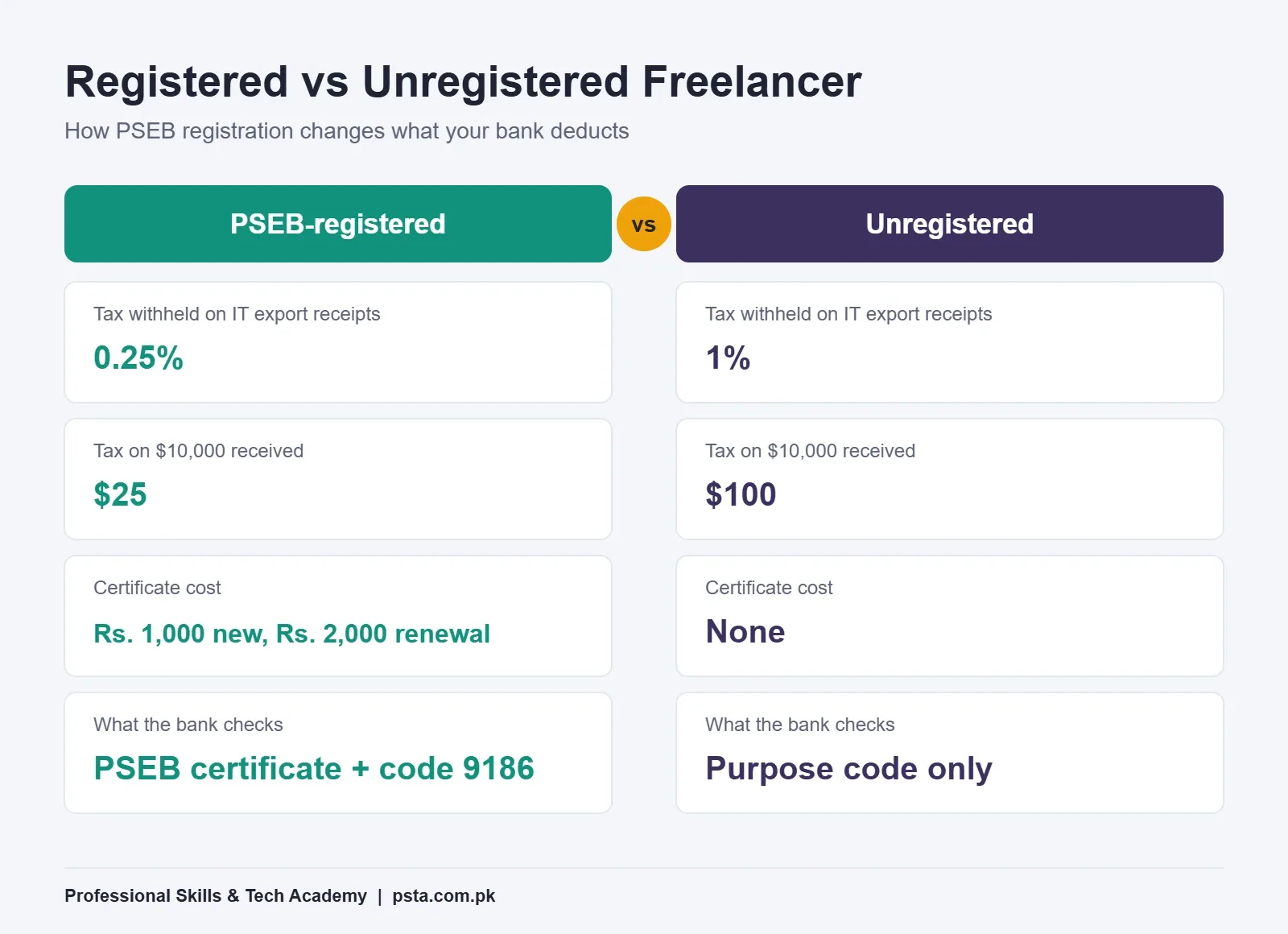
At small volumes the saving is modest. Once you're receiving a few thousand dollars a year, though, the difference covers the renewal fee several times over. The bigger benefit is often the record itself: a registered exporter with matching bank credits has a much easier time explaining income later.
Documents to Prepare Before You Open the Portal
PSEB's facilitation page lists exactly three documents for a new freelancer registration. Get all three ready as clear PDF or image scans before you log in, so you can finish in one sitting.
| Document | Where You Get It | Practical Tip |
|---|---|---|
| CNIC | NADRA | Scan both sides, and check the expiry date first. |
| Personal NTN (with no business) | FBR's IRIS portal | For individuals, FBR uses your 13-digit CNIC as the NTN. |
| Bank account opening or maintenance certificate | Your bank branch | Ask for it in your own name, matching your CNIC spelling. |
Getting Your NTN on IRIS
FBR's registration page explains that an individual counts as registered once e-enrolled on IRIS, and that the 13-digit CNIC serves as the NTN. Enrollment gives you a password for IRIS, which you'll also need every year to file your return. Use a mobile number and email address registered in your own name, because verification codes go to both.
Getting the Bank Certificate
Your branch can issue an account maintenance certificate on request; ask at the counter whether a charge applies. While you're there, check that the account can receive foreign remittances. PSEB's banking FAQ notes that some banks, including HBL, Meezan and Faysal Bank, offer accounts aimed at freelancers, though requirements differ.
PSEB Registration for Freelancers: Seven Steps on the Portal
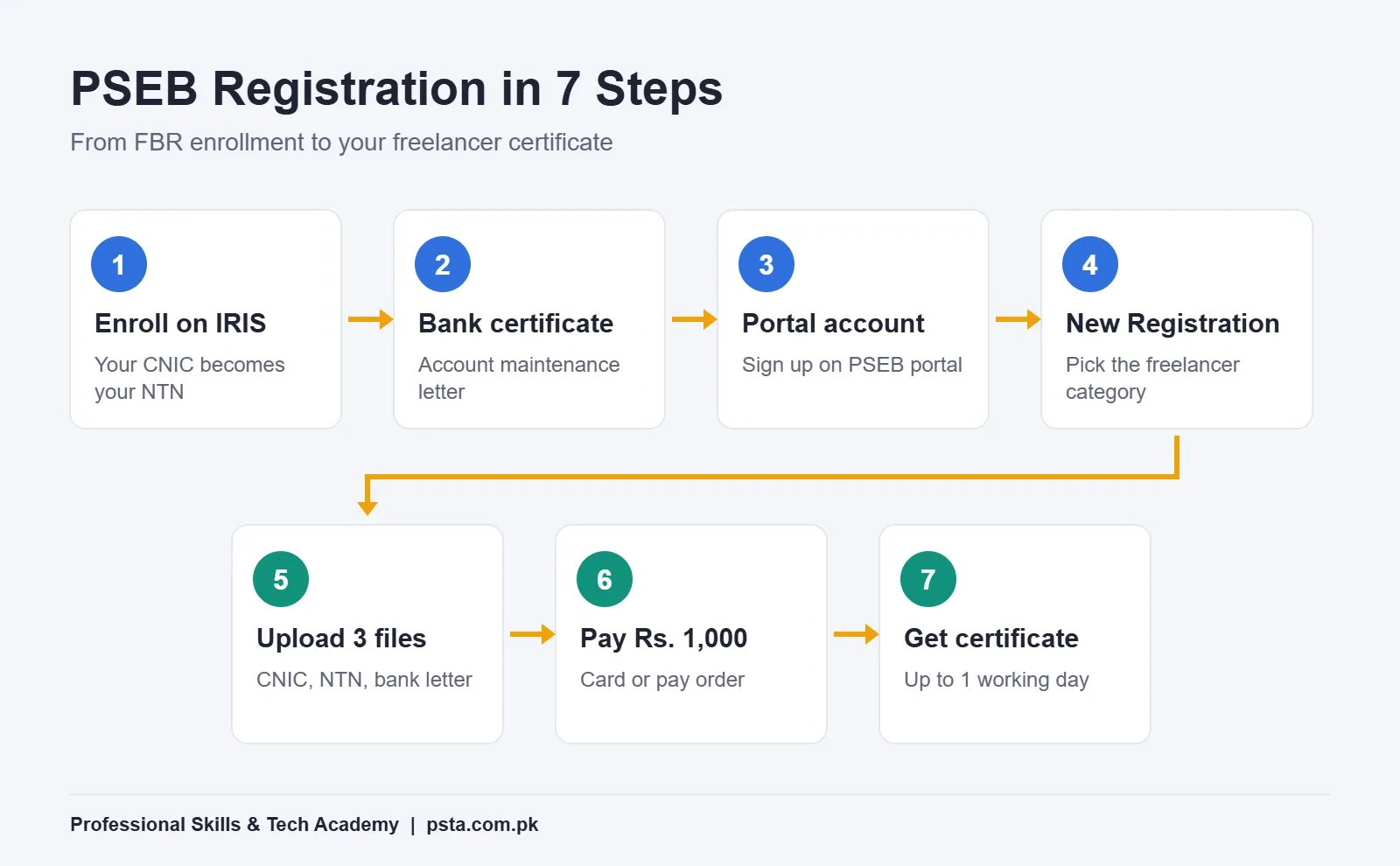
PSEB now runs its member services through the Tech Destination portal. The flow below matches what PSEB publishes for non-company applicants.
- Enroll on IRIS. Complete your FBR e-enrollment if you haven't already, and note your NTN.
- Collect the bank certificate. Pick it up from your branch and scan it.
- Create a portal account. Go to the PSEB member portal and sign up with your email.
- Choose New Registration. Select the freelancer category, not company or call center.
- Upload your documents. Add your CNIC, NTN and bank certificate, then review every field for spelling.
- Pay Rs. 1,000. PSEB accepts payment by debit or credit card on the portal, or by pay order from any bank.
- Download your certificate. PSEB says non-SECP applications take up to one working day after submission.
If something goes wrong with login or registration, PSEB runs a helpline on 0800-01010. Keep your application reference handy before you call, because it speeds things up.
How Do You Get the 0.25% Rate Applied at Your Bank?
Holding a PSEB certificate doesn't change anything until your bank knows about it. Visit your branch or contact your relationship manager and share a copy of it. Ask them to confirm, in writing if possible, that future IT export credits will be taxed at the registered rate.
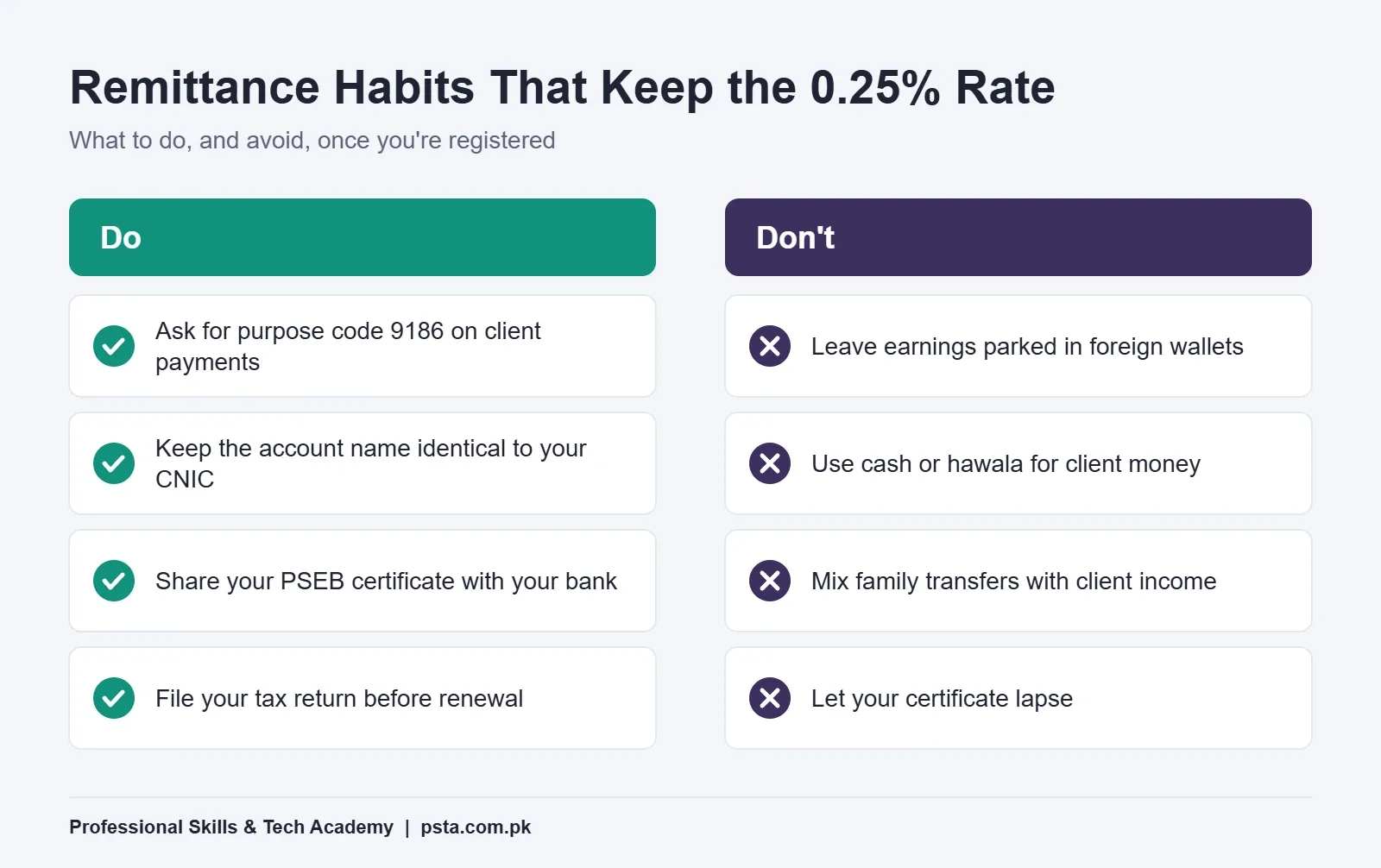
The purpose code matters just as much. PSEB's banking FAQ says freelancer remittances should carry the IT/ITeS code, purpose code 9186. A wrong code can stop the bank recognizing the money as IT export income, which defeats the point of registering.
Befiler's guide adds a condition worth planning around: the reduced rate depends on receiving at least 80% of your export income in Pakistan through banking channels during the tax year. Money left sitting in a foreign wallet for months doesn't help you here.
Check Your First Credit Advice
After your next client payment, download the bank's credit advice or ask for a proceeds realization record. Check three things: the purpose code, the tax deducted, and your name. If the deduction is still 1%, raise it with the bank immediately, before more payments arrive.
Payoneer, Wise or Direct Transfer: Does the Route Matter?
For IT export remittance purposes, the route matters less than where the money ends up. PSEB's banking FAQ points out that PayPal isn't available in Pakistan, so most freelancers here use Payoneer, Wise or a direct SWIFT transfer from the client's bank. All three can land in a Pakistani account.
What changes between them is cost and paperwork. Each platform charges its own conversion and withdrawal fees, so compare the amount that reaches your account, not the advertised rate. The FAQ also advises that the receiving account name should match your name exactly and that the correct purpose code travels with the payment.
A sensible approach for most beginners:
- Withdraw platform earnings to your own Pakistani bank account regularly, rather than letting balances pile up abroad.
- Keep client money in banking channels; cash handovers and hawala leave no export record.
- Use one bank account for client income, separate from family transfers, so your records stay clean.
- Save every withdrawal confirmation alongside the matching bank credit advice.
These habits make your PSEB certificate useful in practice and keep your annual return simple to prepare.
Renewal: Why Your Tax Return Comes First
This is the step that catches people. For renewal, PSEB states that only your latest tax return, Form 114 from FBR, is required. In other words, you can't renew cleanly unless you've filed your return.
Two more details from PSEB's page are useful. The freelancer renewal fee is Rs. 2,000, and the fee table shows no late surcharge for freelancers, unlike companies and call centers. PSEB also says a late renewal doesn't change your certificate's registration date; only the year is updated.
A simple yearly routine keeps everything aligned:
- Keep invoices and bank credit advices in one folder through the year.
- File your income tax return on IRIS before the annual deadline.
- Download the filed Form 114 as a PDF.
- Log in to the PSEB portal, choose renewal, upload the return and pay Rs. 2,000.
- Send the renewed certificate to your bank.
Common Reasons Applications Stall
Most delays come from small mismatches rather than eligibility problems. Watch for these:
- Name mismatch. Your name on the bank certificate differs from your CNIC by a letter or a missing middle name.
- Wrong category. You selected a company or startup option instead of freelancer.
- Unreadable scans. Phone photos with glare or cropped edges get sent back.
- No IRIS profile. You tried to register before your NTN existed.
- Expired CNIC. Renew it first; nothing else will go through.
On the bank side, PSEB's FAQ also lists incorrect IBAN or SWIFT details and missing documents as common causes of delayed remittances. Copy your IBAN directly from your bank app instead of typing it by hand.
What PSEB Registration Won't Do for You
It's worth being clear about the limits, so you don't expect the wrong things.
- It won't bring you clients. Your skills, portfolio and reviews still do that work.
- It doesn't replace your annual tax return. You still need to file, and renewal depends on it.
- It doesn't cover income that never enters Pakistan through banking channels.
- It isn't a business license for a company. Firms and call centers have separate categories and fees.
Think of PSEB registration for freelancers as basic housekeeping for an export business, much like keeping invoices. It removes friction; it doesn't create income.
Building Exportable Skills at PSTA
Registration only matters once you have something to sell abroad. PSTA's six-month full-stack web development course, which also teaches AI coding tools, moves from HTML and CSS through JavaScript and React to Node.js, MongoDB, MySQL, PHP and WordPress. Module 8 is a freelance bootcamp on Upwork and Fiverr profiles and bidding. Fees currently stand at Rs. 45,000, split into two installments, and classes run in Abbottabad, over live video, or as a mix of both.
If design or marketing suits you better, look at our Graphic Designing course or the Advanced Digital Marketing course. For a full list with durations, browse all PSTA courses.
Already freelancing? Our guides on Fiverr withdrawal in Pakistan and Upwork for beginners cover getting paid in the first place. When you're ready to join a batch, fill in the form on our admission page. Questions about batch timings can go to our WhatsApp line, +92 314 5424399. Classes on campus take place in Mandian, Abbottabad, across the road from FIMS College on Old College Road.
Before Your Next Payment Lands
Open your banking app and find the last foreign credit you received. Check the tax deducted and the purpose code on the advice. If you see 1% or a code other than 9186, start with IRIS enrollment today, then apply on the PSEB portal. The whole process can be finished within a week, and every payment after that is cheaper and easier to explain.
Frequently asked questions
Is PSEB registration free for freelancers?
No. PSEB's facilitation page lists a fee of Rs. 1,000 for a new freelancer registration and Rs. 2,000 for each renewal. You can pay by debit or credit card on the portal or by pay order from any bank. Some websites still claim registration is free, so check the fee table on PSEB's own page before you pay anyone to apply for you.
Do I need an NTN before applying to PSEB?
Yes. A personal NTN with no business attached is one of the three documents PSEB asks for, along with your CNIC and a bank account certificate. For individuals, FBR uses the 13-digit CNIC as the NTN once you e-enroll on the IRIS portal. Finish IRIS enrollment first, then start your PSEB application.
How long does PSEB take to approve a freelancer?
PSEB says applications from non-SECP applicants, which includes individual freelancers, take up to one working day after submission. Delays usually come from unclear scans, a name that differs between documents, or choosing the wrong registration category. Check each upload carefully before submitting to avoid a back-and-forth.
Will my bank apply the 0.25% rate automatically?
Not always. Give your bank a copy of your PSEB certificate and ask them to confirm the registered rate will apply to IT export credits. Then check the credit advice on your next client payment. If the deduction is still 1% or the purpose code is not 9186, raise it with the branch before more payments arrive.
What is purpose code 9186?
It is the purpose code PSEB's banking FAQ names for IT and IT-enabled services remittances, which covers most freelance work for foreign clients. The code tells the bank the money is export income for IT services. A different code can stop the payment being recognized as an IT export, which affects the tax treatment.
What happens if I renew my PSEB certificate late?
PSEB's fee table shows no late surcharge for freelancers, unlike companies and call centers. It also says a late renewal does not change your original registration date; only the year is updated. Until you renew, though, your bank may not treat you as registered, so renew soon after filing your annual tax return.
Do PSEB-registered freelancers still file a tax return?
Yes. Registration lowers the tax withheld on export receipts, but it does not replace your annual income tax return on IRIS. PSEB also asks for your latest return, Form 114, when you renew. Filing on time keeps your renewal simple and keeps your records consistent with your bank credits.
Sources & references
- PSEB Industry Facilitation: Fees, Documents and FAQs techdestination.com
- PSEB Member Portal portal.techdestination.com
- FBR: Register for Income Tax fbr.gov.pk
- Business Recorder: IT Exporters and Freelancers on the 0.25% Final Tax Regime brecorder.com
- TechJuice: Pakistan Budget 2026-27 and IT Tax Measures techjuice.pk
- Befiler: Freelancers in Pakistan and Budget 2026-27 Tax Rates befiler.com
Last reviewed & updated on by Umar Qureshi. Written by the PSTA team in Abbottabad, Pakistan.

Umar Qureshi

Full-Stack Web Development Course with AI Tools
Turn this guide into a career: hands-on training with real projects, online across Pakistan or on-campus in Abbottabad · 6 Months.

Comments
No comments yet — ask a question or share your experience.