Quick answer
If your WhatsApp account is hacked, keep your SIM in your phone, switch off call forwarding, reinstall WhatsApp and enter the SMS code yourself. If it asks for a PIN you never set, wait seven days. Then add a passkey, a two-step password with a recovery email, and report the case on 1799.
Key takeaways
- • National CERT says most hijacks in Pakistan rely on tricks such as sharing codes, not on breaking WhatsApp.
- • Re-registering your number with the SMS code you receive ends the attacker's session.
- • An unknown two-step PIN without a recovery email means a seven-day wait before you can get back in.
- • Warn contacts by SMS or call, and check your bank and wallet apps for strange payments.
- • Report the case to the NCCIA on 1799 with screenshots, numbers and transaction details.
- • A passkey and a two-step password with a recovery email make a repeat attack far harder.
Table of contents 18 sections
- Why Are So Many WhatsApp Accounts Being Hacked in Pakistan?
- The Four Tricks Behind Most Hijacked Accounts
- 1. The Verification Code Request
- 2. The Call Forwarding Code
- 3. The Fake Login Page
- 4. The Malicious QR Code
- Is My WhatsApp Account Hacked? The Warning Signs
- Recovery Checklist: The First 15 Minutes
- What If WhatsApp Asks for a PIN You Never Set?
- Protect Your Contacts and Your Money
- How Do You Report a WhatsApp Hack to the NCCIA?
- Lock-Down Checklist: Settings That Stop a Repeat Attack
- Add a Passkey
- Use a Stronger Two-Step Password With a Recovery Email
- Review the Rest Every Month
- If Your Shop or Office Runs on WhatsApp
- Turning This Problem Into a Skill
- Do This Tonight: Add a Passkey
WhatsApp account hacked, or just acting strangely? Take this 30-second self-test before you do anything else. Answer yes or no to each question below. Even one "yes" means you should start the recovery checklist in this guide right now, not tomorrow.
- Were you logged out of WhatsApp without doing anything yourself?
- Has a friend asked why "you" sent them a money request or a strange link?
- Did a six-digit code arrive by SMS that you never asked for?
- Does Linked Devices show a laptop or browser you don't recognize?
- Did someone on a call ask you to dial a code or read out a number from your screen?
I teach cyber security in Abbottabad, and this is the problem students, parents and shopkeepers bring to me more than any other. The good news is that a WhatsApp account hacked through a trick can usually be taken back with the phone and SIM you already own. The order of your steps matters. Here is what this checklist covers:
- The four tricks attackers in Pakistan use most, so you can see which one hit you
- A numbered recovery checklist for the first 15 minutes
- What to do if WhatsApp asks for a PIN or password you never set
- How to report the case to the NCCIA, with the evidence they ask for
- The settings that make a repeat attack far harder
Why Are So Many WhatsApp Accounts Being Hacked in Pakistan?
Hijacking has become common enough that Pakistan's National Cyber Emergency Response Team (National CERT) issued a nationwide advisory in January 2026. ProPakistani's report on that advisory says the team described the threat as "widespread and active."
The advisory makes one point that every user should hear: these attacks rely on tricking people rather than breaking WhatsApp's technology. TechJuice's summary notes that attackers pose as WhatsApp support, telecom staff or people you already know.
In July 2026, the Director General of the National Cyber Crime Investigation Agency (NCCIA), Khurram Ali, said much the same thing. According to Geo News, he named OTP sharing as the biggest reason accounts are taken. He also said cases of hacked WhatsApp and bank accounts have risen in Pakistan.
That is useful to know. If the weak point is a conversation, you can fix it with habits and a few settings, without buying any software.
The Four Tricks Behind Most Hijacked Accounts
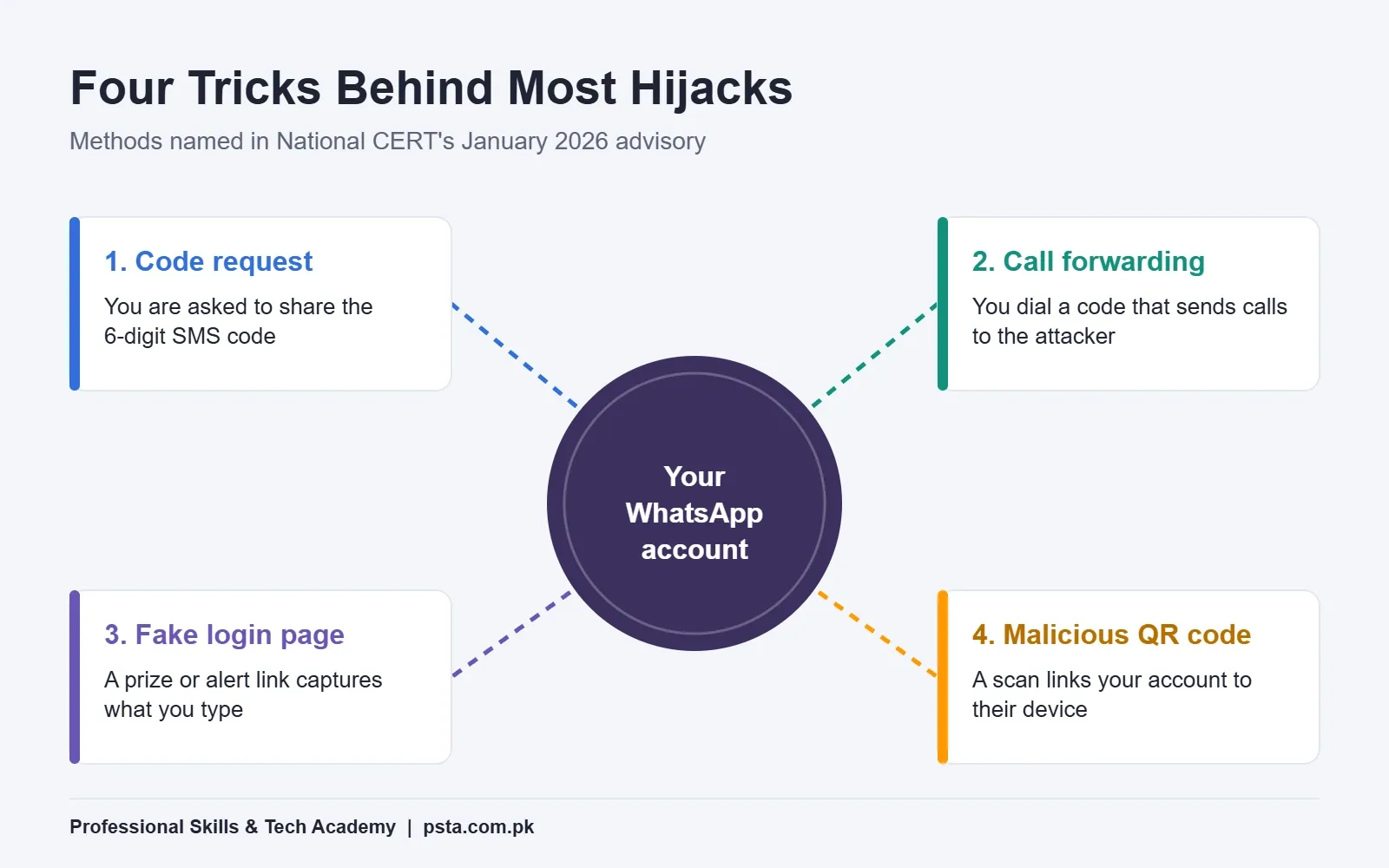
National CERT's advisory lists four methods. Knowing which one was used on you helps you close the same door afterwards.
1. The Verification Code Request
The attacker starts registering your number on their own phone. WhatsApp sends the six-digit code to you by SMS. Then a message or call arrives, often from a hacked friend's account. It says the code was "sent by mistake" or is needed for a prize, a parcel or a job form. Once you share it, the account moves to their phone.
2. The Call Forwarding Code
Here the caller asks you to dial a short code that starts with a star or a hash sign. That code quietly forwards your calls to the attacker. When WhatsApp offers a voice call to deliver the verification code, the call lands on their phone instead of yours.
3. The Fake Login Page
A message about a prize, a blocked account or a "security update" leads to a page that looks official. Whatever you type there goes straight to the attacker.
4. The Malicious QR Code
Scanning a QR code with WhatsApp's linking feature can connect your account to a device the attacker controls. National CERT lists this under QR code fraud. You keep using your phone normally while someone else reads your chats from a browser.
Is My WhatsApp Account Hacked? The Warning Signs
Some hijacks are loud and others are quiet. A WhatsApp account hacked through a linked device, for example, may keep working normally on your phone. The advisory, as reported by ProPakistani and TechJuice, lists these signs:
- You are suddenly logged out and asked to verify your number again.
- Contacts receive messages from you that you never wrote.
- An unknown device appears under Linked Devices.
- You get two-step verification prompts you didn't trigger.
- Call forwarding is switched on and you didn't do it.
- A verification code arrives that you didn't request.
Treat that last sign as an attempt in progress. Nothing has been lost yet, so don't share the code with anyone. The person asking for it is the attacker, even if the message comes from your cousin's number.
Recovery Checklist: The First 15 Minutes
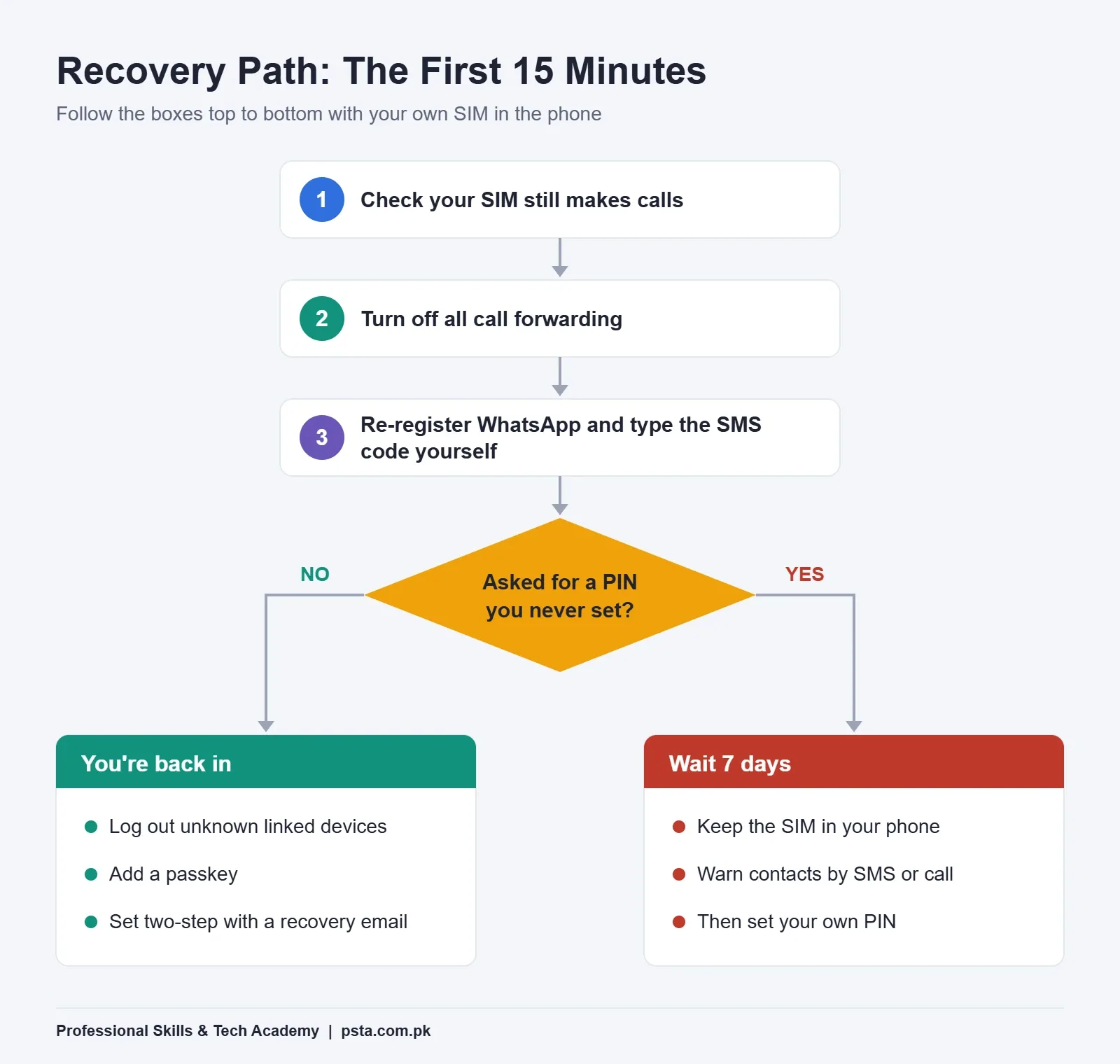
Work through these steps in order. Keep the SIM in the phone you normally use, and stay on Wi-Fi or mobile data the whole time.
- Check that your SIM still works. Make a normal call or send an SMS. If the SIM shows no service, visit your network's franchise with your CNIC first, because you need the SIM to receive WhatsApp's code.
- Switch off any call forwarding. Open your phone's call settings and turn off every forwarding option. If you're unsure, call your mobile network's helpline and ask them to confirm it is off.
- Open WhatsApp and register your number again. If WhatsApp is logged out, enter your number. If it still opens, delete and reinstall it, then register. Both National CERT and WhatsApp's security page point to re-registering your phone number as the way back in.
- Enter the six-digit SMS code yourself. Type it into WhatsApp only. Once your number is verified on your phone, the attacker's session on their device ends.
- Check Linked Devices. Go to Settings, then Linked devices, and log out of every computer or browser you don't recognize.
- Turn on protection before you go back to chatting. Set up two-step verification with a recovery email, and add a passkey if your phone offers one. The lock-down section below shows where.
What If WhatsApp Asks for a PIN You Never Set?
This is the moment most people panic, and it's the most common question I get about a WhatsApp account hacked in Pakistan. The attacker may have switched on two-step verification while they held your account. WhatsApp now asks for their PIN, and you don't have it.
According to National CERT's advisory, if the attacker turned it on without adding a recovery email, you face a mandatory seven-day wait. During that week, neither you nor the attacker can read your messages from a new device. When the week ends, you can register again and set your own PIN.
A few things help while you wait:
- Keep the SIM in your phone and don't let anyone "help" you with codes.
- Tell your contacts through other channels, such as SMS, a call or Facebook, that your account is not in your hands.
- Note the date and time you were locked out, so you know when the seven days end.
- Ignore anyone offering to "reopen" the account for a fee. No outside agent can skip WhatsApp's waiting period for you.
If you had set your own two-step PIN with a recovery email before the attack, things are simpler. The advisory notes that accounts with a recovery email can reset access straight away.
Protect Your Contacts and Your Money
When a WhatsApp account is hacked, the attacker's goal is rarely your chats. National CERT says hijacked accounts are used to ask contacts for money, spread phishing links and pass on malicious content. Your friends trust your name and photo, and that is what the attacker is selling.
So, while you recover the account, send a short message to your family and close contacts by SMS or a phone call. Something like this works: "My WhatsApp was hacked today. Don't send money or codes to anyone using my number until I call you."
Then check your money. If you use the same phone for mobile banking or a wallet app, review recent transactions. Did you share a banking OTP, or do you see a payment you don't recognize? Call your bank's official helpline at once and ask them to block the account or card.
How Do You Report a WhatsApp Hack to the NCCIA?
The NCCIA now handles cybercrime complaints in Pakistan. ProPakistani reported that Interior Minister Mohsin Naqvi inaugurated the agency's 1799 cybercrime helpline in June 2025. You can call 1799 to start a complaint.
In September 2026, the NCCIA shared guidance on making complaints useful. ARY News summarized it: attach evidence, and for social media cases include screenshots. Add contact numbers and transaction details too.
Collect this before you call:
| Evidence | How to Capture It | Why It Helps |
|---|---|---|
| Scam messages and call logs | Screenshots showing the number, date and time | Shows how the attacker approached you |
| Messages sent from your account | Ask contacts to screenshot what they received | Proves impersonation and any money requests |
| Phone numbers used | Write them down exactly, including country code | Lets investigators trace the numbers |
| Payment details, if money was sent | Transaction ID, amount, account or wallet number | Needed to follow and possibly freeze funds |
| Timeline | A short note of what happened, minute by minute | Makes your complaint clear and quick to act on |
Geo News also reported that the NCCIA was setting up a dedicated helpline to guide victims through account recovery, alongside an awareness campaign with Meta in local languages.
Lock-Down Checklist: Settings That Stop a Repeat Attack
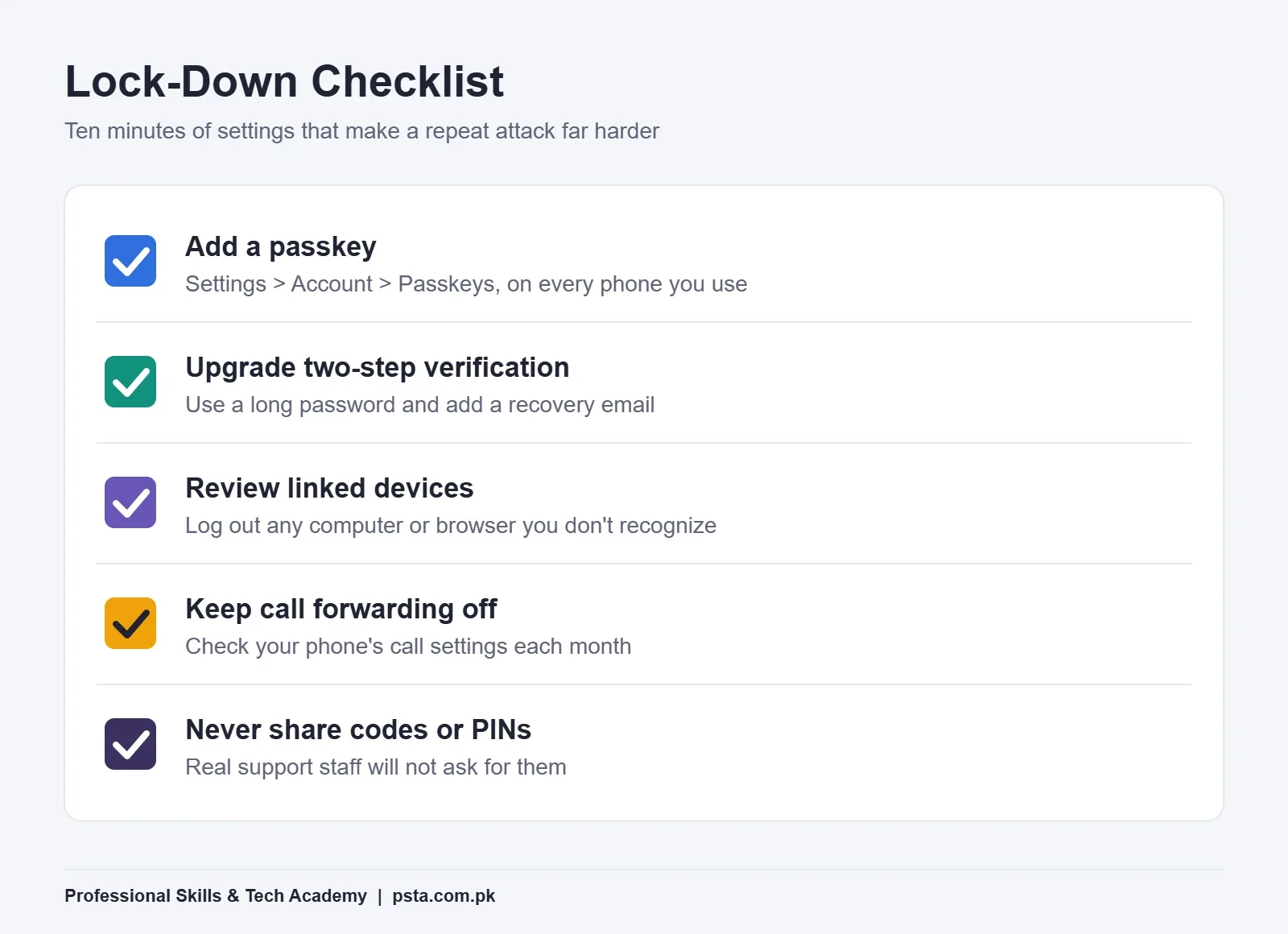
Once you're back in, spend ten minutes on these settings. For this kind of attack, they do more than any antivirus app.
Add a Passkey
WhatsApp announced in August 2026 that more than one billion people use passkeys to log back in, as reported by BleepingComputer. A passkey opens with your fingerprint, face or screen lock, so there is no code for a caller to talk you out of. Go to Settings, then Account, then Passkeys. If you use both an Android phone and an iPhone, you can now add one on each.
Use a Stronger Two-Step Password With a Recovery Email
The same August update replaces the old six-digit PIN with a longer password that can include letters, numbers and symbols. Malwarebytes notes that the change isn't automatic, so older accounts keep their PIN until the user upgrades. Add a recovery email at the same time. It's the only way to reset a forgotten password, and it spares you the seven-day lockout.
Review the Rest Every Month
| Setting | Where to Find It | What to Do |
|---|---|---|
| Passkey | Settings > Account > Passkeys | Add one on every phone you use |
| Two-step verification | Settings > Account > Two-step verification | Use a long password and add a recovery email |
| Linked devices | Settings > Linked devices | Log out anything you don't recognize |
| Call forwarding | Phone app > Call settings | Keep it off unless you set it up yourself |
| App source | Play Store or App Store | Use only the official WhatsApp app |
That last row is not a small point. WhatsApp's security page warns that fake versions of the app pose serious privacy and security risks to your account and data.
If Your Shop or Office Runs on WhatsApp
Many businesses in Abbottabad and across Pakistan take orders, share invoices and confirm payments on a single WhatsApp number. A hijack there costs more than embarrassment. National CERT compares it to business email compromise on a messaging app.
The advisory suggests three measures for organizations, which I'd put into practice like this:
- Train staff once, then remind them. Ten minutes in a staff meeting on the four tricks above goes a long way.
- Verify every payment request through a second channel. If "the owner" asks the accountant on WhatsApp to transfer money, the accountant calls the owner on a known number before acting.
- Write a one-page incident plan. List who re-registers the number, who informs customers and who calls 1799.
National CERT also suggests that businesses consider more controlled options, such as the WhatsApp Business API, for official communication.
Turning This Problem Into a Skill
A WhatsApp account hacked by a fake caller is an everyday example of social engineering. That is a core topic in cyber security work. Protecting a phone account uses the same habits a security analyst applies to a company network. You spot the trick, contain it, keep the evidence and harden the system.
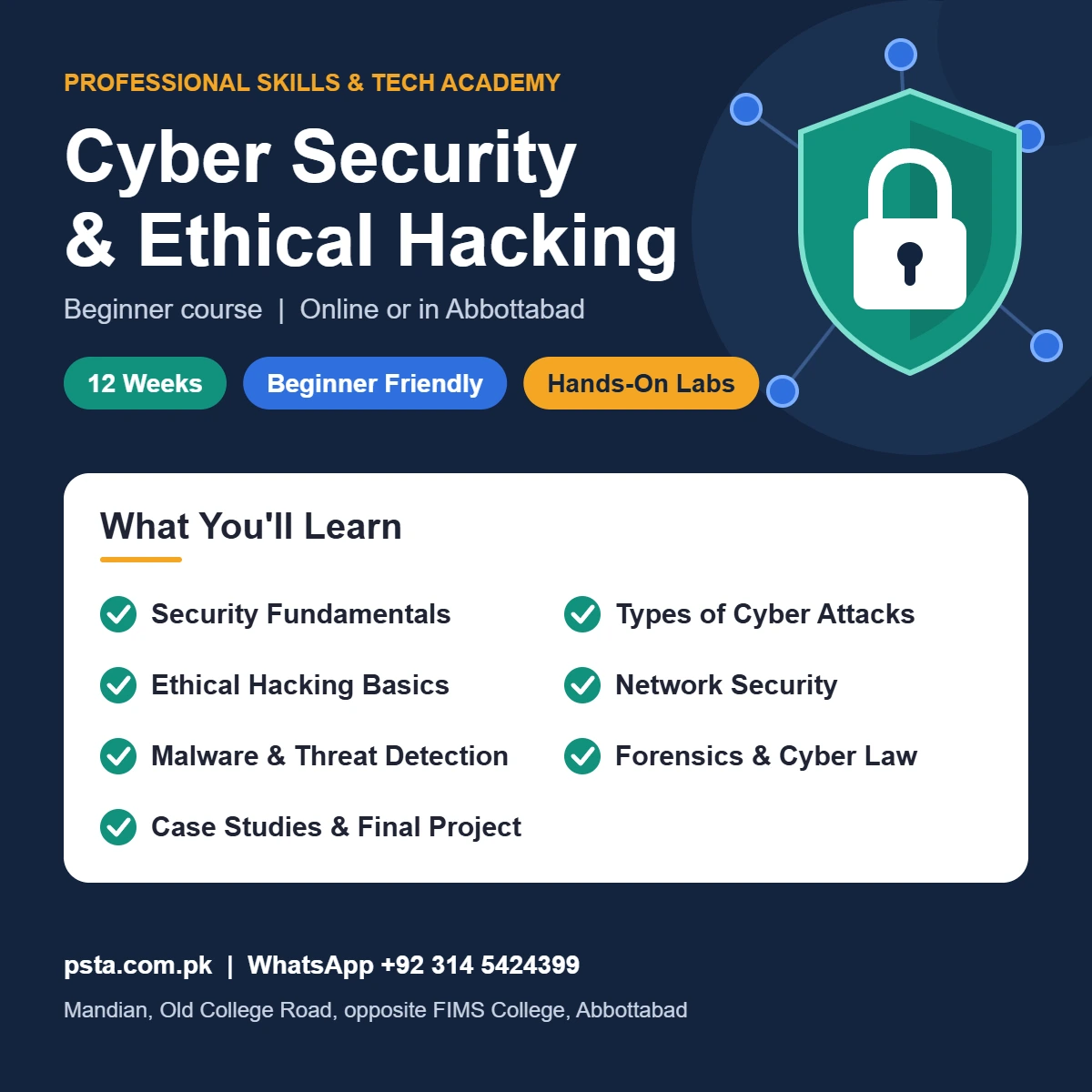
PSTA's Cyber Security & Ethical Hacking course is a 12-week beginner program. The course page lists seven modules. They cover phishing and social engineering, network security, incident response, digital forensics and Pakistan's cyber laws, including PECA. You can attend on campus in Abbottabad, join live online from any city, or mix both.
If you want hands-on practice first, our ethical hacking lab setup checklist shows how to build a safe practice environment. To plan credentials, read which cyber security certification to take first. Students who later want offensive testing can move on to the Advanced Ethical Hacking & Penetration Testing course.
Browse the full list on our courses page, or apply through the admission page when you're ready. For batch dates and timings, send a WhatsApp message to +92 314 5424399, or drop by the Mandian campus on Old College Road, across from FIMS College.
Do This Tonight: Add a Passkey
If your account is safe right now, protect it before anyone asks you for a code. Open WhatsApp, go to Settings, then Account, then Passkeys, and follow the prompts. It only takes a few taps.
Then do the same for one older relative. Parents and grandparents are often the ones who read out a code because a familiar name asked for it. A few minutes on their phone could save the whole family a week of lockout.
Frequently asked questions
Can I recover a hacked WhatsApp account without my SIM?
Not easily. WhatsApp sends the verification code to your phone number, so you need a working SIM to register again. If the SIM is lost, blocked or swapped, visit your mobile network's franchise with your CNIC and get a replacement on the same number first. Once it works, reinstall WhatsApp and enter the SMS code yourself.
Will I lose my old chats after the account is hacked?
Usually not. WhatsApp's security page says past conversations stay on your phone and cannot be read by someone who takes over your account. The attacker sees new messages that arrive while they hold it. Re-register quickly to stop that, and keep your chat backup turned on.
Why does WhatsApp make me wait seven days?
If the attacker switched on two-step verification without a recovery email, you cannot enter their PIN. National CERT says this triggers a seven-day lockout in which neither side can read your messages. After it ends you can register again and set your own PIN or password.
Is it safe to pay someone who promises to recover my WhatsApp?
No. Recovery depends on your SIM receiving WhatsApp's code, and no outside agent can skip the seven-day waiting period. People offering paid recovery on social media often ask for your code or PIN, which hands them the account. Follow the official steps and report the case to the NCCIA instead.
How do I report WhatsApp hacking in Pakistan?
Call the NCCIA's cybercrime helpline on 1799. The agency asks you to attach evidence, so collect screenshots of scam messages, the phone numbers used, messages sent from your account and any transaction details. A short written timeline also helps investigators act faster.
Is a passkey better than two-step verification?
They do different jobs, so use both. A passkey lets you log back in with your fingerprint, face or screen lock, which means there is no code for a scammer to request. Two-step verification adds a password on top, and a recovery email lets you reset it if you forget.
Sources & references
- National CERT warning on WhatsApp hijacking (ProPakistani) propakistani.pk
- National CERT warns of widespread WhatsApp account hijacking (TechJuice) techjuice.pk
- NCCIA chief reveals major reason behind WhatsApp hacking (Geo News) geo.tv
- Cybercrime helpline 1799 launched (ProPakistani) propakistani.pk
- NCCIA guidelines for registering cybercrime complaints (ARY News) arynews.tv
- WhatsApp adds stronger two-step verification and multiple passkeys (BleepingComputer) bleepingcomputer.com
- Protect your WhatsApp account with new passkey and 2FA upgrades (Malwarebytes) malwarebytes.com
- WhatsApp Security whatsapp.com
Last reviewed & updated on by Umar Qureshi. Written by the PSTA team in Abbottabad, Pakistan.

Umar Qureshi
Cyber Security & Ethical Hacking Course in Abbottabad - PSTA
Turn this guide into a career: hands-on training with real projects, online across Pakistan or on-campus in Abbottabad · 12 Weeks.

Comments
No comments yet — ask a question or share your experience.