Quick answer
To reduce COD returns, confirm every order on WhatsApp or by phone before booking it, give risky orders a second check, reward buyers who pay in advance, send delivery reminders and track your return rate weekly. Prepaid sales also face 1% withholding tax, against 2% on COD.
Key takeaways
- • DHL Pakistan puts the average COD return rate at roughly 18% to 20%.
- • A returned parcel costs you delivery, return charges, packaging and the ad spend that won the order.
- • Confirming orders on WhatsApp or by phone before booking stops most fake and impulse orders.
- • Prepaid orders cannot be refused for lack of cash and carry 1% withholding tax instead of 2%.
- • Track parcels returned divided by parcels booked every week to see whether the fixes work.
Table of contents 14 sections
- Why Do So Many COD Parcels Come Back?
- Meet the Example Store
- What Does One Returned Parcel Really Cost?
- Step 1: Confirm Every Order Before It Leaves the Shelf
- Step 2: Screen Risky Orders With a Points Rule
- Step 3: Give Buyers a Reason to Pay in Advance
- The Tax Difference Between COD and Prepaid
- Setting Up COD and Prepaid Options in Shopify
- Step 4: Keep the Buyer Informed Until the Rider Arrives
- Step 5: Choose and Monitor Your Courier
- How to Reduce COD Returns Without Losing Genuine Buyers
- Which Number Should You Track Each Week?
- What PSTA's E-Commerce Course Teaches About Order Operations
- Pull Last Month's Courier Report First
Why do so many cash on delivery parcels come back unopened, and how can a small seller reduce COD returns without dropping COD altogether? New sellers usually raise this within a month of their first sales, once the courier starts sending back boxes they already paid to ship.
The short version: most returns are decided before the parcel leaves your shelf. A confirmation step, a simple risk check, a reason to pay in advance and steady delivery updates will cut the number of refused parcels far more than any change of courier.
In this guide you will follow one example store through each fix, with the arithmetic shown. You will come away with:
- A clear picture of why COD parcels return to origin in Pakistan
- A way to work out what one returned parcel costs your own store
- A five-step routine for confirming, screening and dispatching orders
- The tax difference between COD and prepaid orders that most beginners miss
- A weekly number to track so you know whether the fixes are working
Why Do So Many COD Parcels Come Back?
Cash on delivery is still the default for Pakistani shoppers. In a TGM Research e-commerce survey from November 2022, 69% of Pakistani respondents said they prefer COD, and only 5% said they buy mainly with a credit card. A Karandaaz study on Raast for e-commerce makes the same point: card payments make up about 5% of e-commerce volume.
The cost of that habit is the return to origin, or RTO: a parcel the courier carries to the buyer's door and then brings back. DHL Pakistan's July 2026 guide for sellers puts the national average at roughly one in five COD parcels, or 18% to 20%, and advises keeping your own rate below 20%.
When you sit with a seller's courier report and read the reasons line by line, the returns usually fall into six groups:
- Wrong or partial address. The rider can't find the house, or the street name is missing.
- Phone switched off or not answered. The rider gives up after one or two attempts.
- Impulse orders. The buyer tapped "order" late at night and changed their mind by morning.
- Fake or prank orders. Someone uses a friend's number, or a competitor places orders to waste your stock.
- No cash on hand. The buyer is home but the delivery arrives before payday.
- Slow delivery. The parcel arrives after the buyer has bought the same item elsewhere.
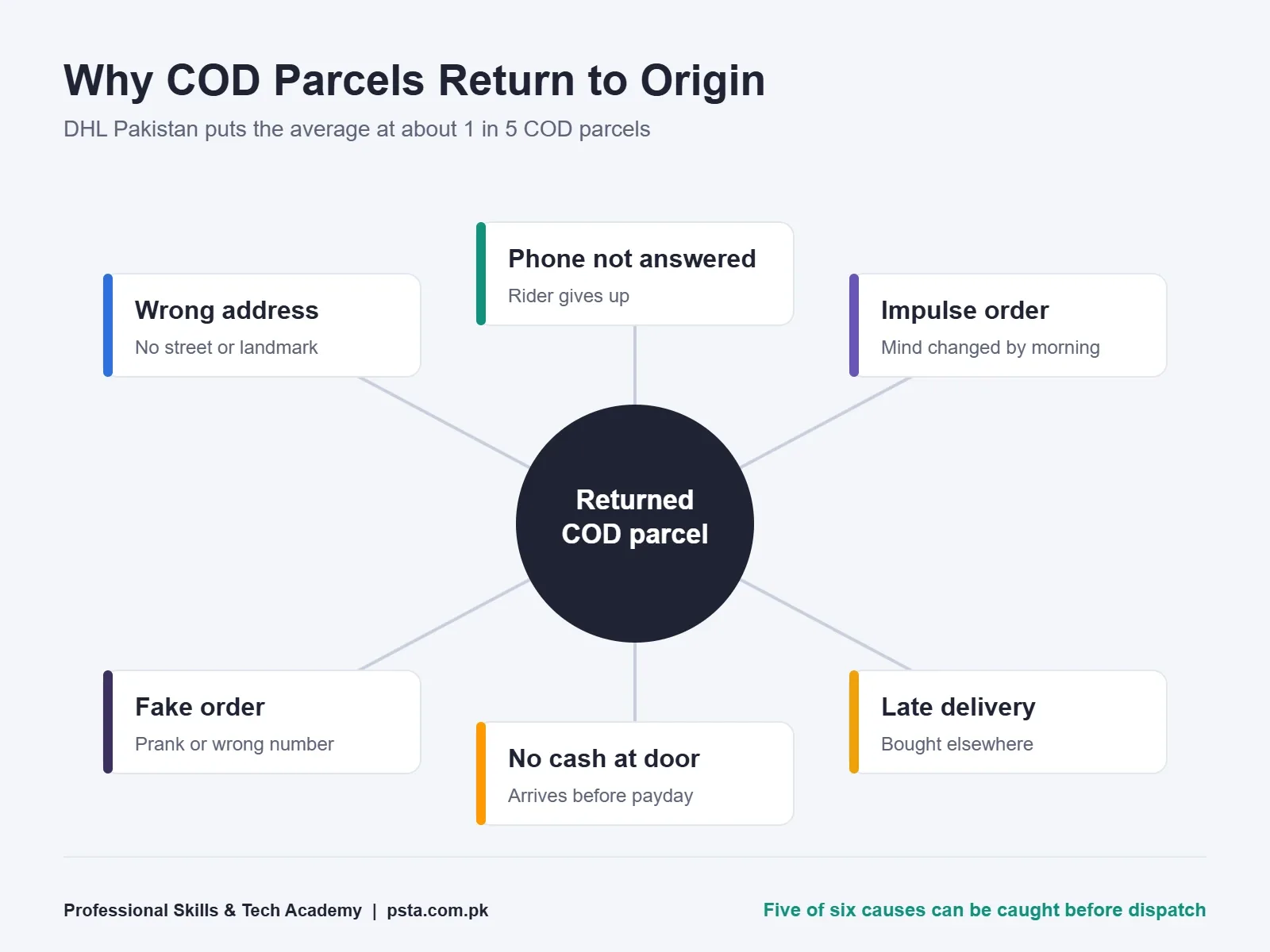
Only the last reason belongs mainly to the courier. The other five can be caught by you, at your desk, before dispatch. That's the whole idea behind the walkthrough below.
Meet the Example Store
To keep the numbers concrete, picture a small online clothing store run from Abbottabad. This is an illustrative example, not a real business, and the costs are assumptions you should replace with your own courier's rate card.
| Item | Example figure | Where you'd find yours |
|---|---|---|
| COD orders per month | 400 | Shopify or WooCommerce orders report |
| Average order value | Rs. 3,000 | Orders report, total sales divided by orders |
| Delivery charge per parcel | Rs. 250 | Courier rate card for your weight slab |
| Return charge per parcel | Rs. 200 | Courier agreement, return or RTO section |
| Packaging per parcel | Rs. 50 | Your flyer and tape purchase bills |
| Ad spend per order | Rs. 300 | Meta Ads Manager, cost per purchase |
| Current return rate | 20% | Courier portal, returned divided by booked |
The owner ships every order the same day it arrives. There's no confirmation call, and every buyer gets COD by default. That is how most new stores start, and it's why their return rate drifts up toward the national average.
What Does One Returned Parcel Really Cost?
Many sellers count only the return charge. The true loss per refused parcel includes everything you spent to win and ship that order:
- Forward delivery: Rs. 250
- Return charge: Rs. 200
- Packaging you can't reuse: Rs. 50
- Ad spend that produced the order: Rs. 300
That's Rs. 800 per returned parcel in this example, before you count stock that comes back creased, damaged or out of season. DHL's guide also points out the hidden labour: every returned item has to be checked, repacked and entered back into stock before you can sell it again.
At 400 orders and a 20% return rate, 80 parcels come back each month. Multiply 80 by Rs. 800 and the store loses Rs. 64,000 a month on parcels that earned nothing. Run the same sum with your own figures before reading further. The number tells you how much effort it's worth spending to reduce COD returns at your store.
Step 1: Confirm Every Order Before It Leaves the Shelf
The fastest way to reduce COD returns is a confirmation step between "order received" and "parcel booked". DHL recommends a call, a WhatsApp message or an SMS one-time password to confirm the number and address, and cancelling orders that don't respond.
A practical routine for a small team:
- Send a WhatsApp message within an hour of the order with the item, size, total in rupees and full address.
- Ask the buyer to reply "Yes" to confirm or correct the address.
- If there's no reply by the next morning, call once.
- If the call isn't answered either, move the order to an "Unconfirmed" tag and don't book it.
- Cancel unconfirmed orders after 48 hours and send a polite message saying they can reorder any time.
Back to the example store. Suppose the confirmation step catches 40 of the 400 orders as unreachable, fake or no longer wanted. Those 40 orders still cost the ad spend (40 × Rs. 300 = Rs. 12,000), but they no longer cost delivery, return charges or packaging.
Step 2: Screen Risky Orders With a Points Rule
Confirmation catches most problems, but some buyers say "Yes" and still refuse. A simple points rule helps you decide which confirmed orders need a second look. DHL lists the warning signs: incomplete addresses, large first orders, unreachable numbers and repeat customers who often cancel. Turn those into points:
| Warning sign | Points |
|---|---|
| Address missing a street, block or landmark | 2 |
| First order and well above your average order value | 1 |
| Phone unreachable on the first attempt | 2 |
| Refused a parcel from you before | 3 |
| Several items in sizes that don't match each other | 1 |
The weights above are a starting suggestion, not an industry standard. Adjust them after a month of data. Any order scoring 3 or more gets a second call. For a score of 4 or more, ask for the delivery charge in advance through a bank app or wallet before you book. Genuine buyers rarely mind paying Rs. 250 up front. Prank orders disappear.
Step 3: Give Buyers a Reason to Pay in Advance
A prepaid order can't be refused for lack of cash. DHL suggests rewards such as a 5% to 10% discount, cashback, loyalty points or free delivery for prepaid orders. In the example store, a 5% discount on a Rs. 3,000 order is Rs. 150. That's far less than the Rs. 800 a refused parcel costs.
Paying from a phone is no longer unusual in Pakistan. The State Bank of Pakistan's payment systems review for October to December 2025 reports that 92% of 3.4 billion retail transactions were digital, and Raast handled 33.6 million person-to-merchant payments in that quarter. Many of your buyers already send money through a banking app every week. Your job is to make the option visible at checkout.
The Tax Difference Between COD and Prepaid
Since 1 July 2025, tax is withheld on e-commerce sales at the point where money changes hands. As Business Recorder reported on the FBR circular, payment intermediaries such as banks and gateways withhold 1% when they pay the seller, while couriers collecting COD withhold 2% of the gross amount. The FBR's stated aim is to push sales toward digital payment.
On a Rs. 3,000 order, that's Rs. 30 withheld on a prepaid sale against Rs. 60 on a COD sale, for a seller on the Active Taxpayer List. Rates for sellers not on the list are higher, and the rules have been amended since, so confirm your own position with a tax adviser. Profit also reported an FBR limit of Rs. 200,000 on cash payments for retail sales and COD e-commerce orders, which matters if you sell high-value items.
Setting Up COD and Prepaid Options in Shopify
Shopify treats COD as a manual payment method. According to Shopify's help page on manual payments, you activate it under Settings, then Payments, and Shopify charges no third-party transaction fee on manual payments. Each COD order sits as "Pending" until you mark it paid. Mark it paid only when the courier's remittance reaches your account, not when the parcel is delivered. That keeps your sales report honest about how much cash you actually hold.
For prepaid orders, add a bank transfer or wallet option as a second manual method, with clear instructions and the discount mentioned in the method's name.
Step 4: Keep the Buyer Informed Until the Rider Arrives
A buyer who knows exactly when the parcel is coming is far more likely to be home with cash. DHL recommends stating delivery times at checkout, sending an SMS time slot the day before with a way to reschedule, a reminder on the day, and live tracking alerts.
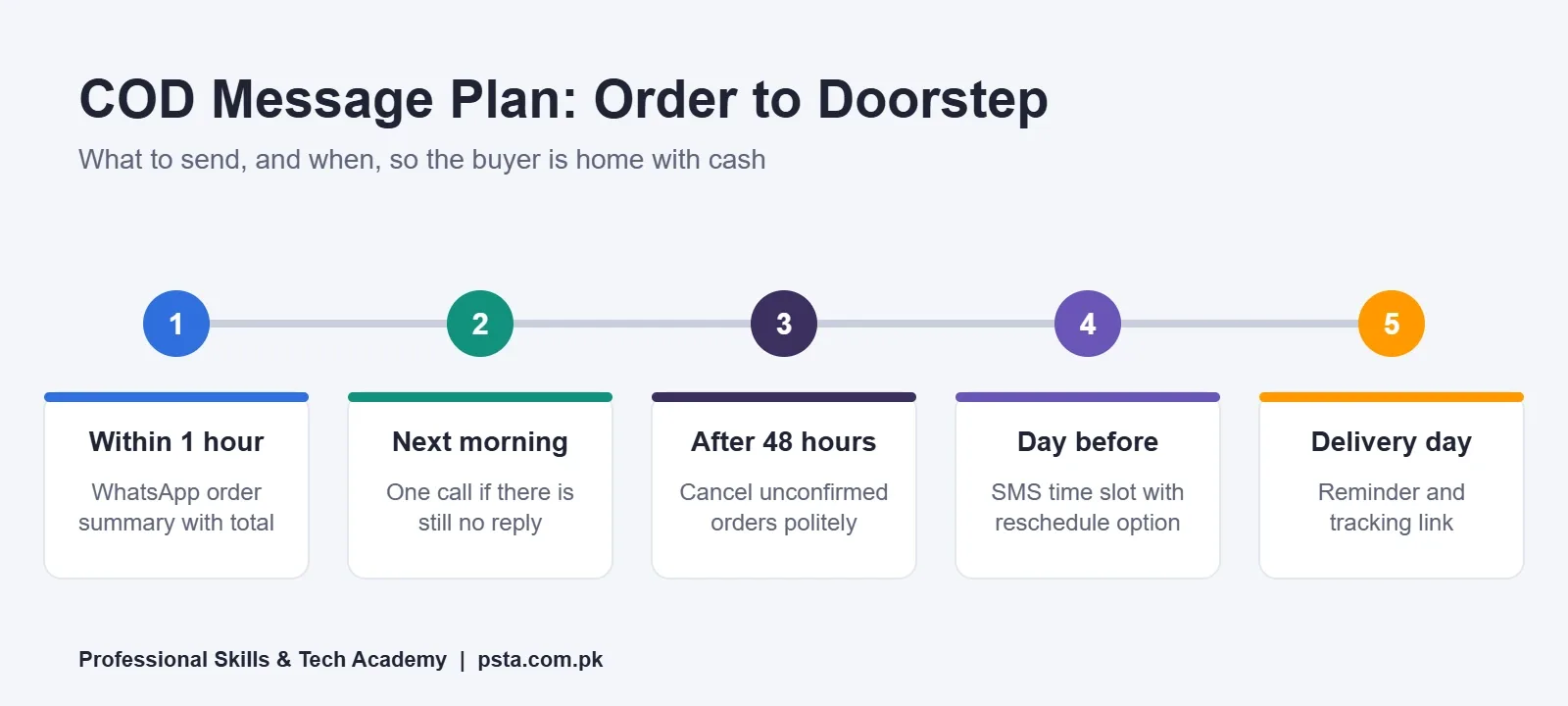
Keep each message short and write it the way your buyers write to you, whether that's English, Urdu or Roman Urdu. Always include the rupee amount the rider will collect, so nobody is surprised at the door.
Step 5: Choose and Monitor Your Courier
Couriers differ in coverage, tracking, how they contact buyers and how quickly they bring returns back. DHL's checklist for picking a delivery partner covers those same points plus rescheduling options. Before you sign, ask each courier these questions:
- How many delivery attempts do you make before marking a parcel for return?
- Does the rider call the buyer before arriving?
- How many days does a return take to reach me, and is the return charge fixed?
- How often do you remit COD cash, and is the 2% withholding shown on the statement?
After a month, compare return rates by city. If one city returns far more parcels than the rest, test a second courier there before blaming your buyers.
How to Reduce COD Returns Without Losing Genuine Buyers
The risk with every fix above is overdoing it. If you demand advance payment from everyone, you'll lose the buyers who only trust COD. Here's how the example store balances the two:
- COD stays available on every order. Advance payment is only asked for on high-score orders.
- Exchanges are offered before refunds. DHL notes that a quick, simple exchange process keeps buyers loyal.
- Unconfirmed orders are cancelled politely, never with a warning or blame.
- Repeat buyers with clean records skip the confirmation call and get a thank-you message instead.
Now run the example store's numbers again. After confirmation, 360 orders ship instead of 400. Suppose the points rule and delivery messages bring the return rate on those 360 parcels down to 10%. That's 36 returns at Rs. 800, or Rs. 28,800, plus the Rs. 12,000 of ad spend on the 40 cancelled orders. The monthly loss falls from Rs. 64,000 to Rs. 40,800, a difference of Rs. 23,200.
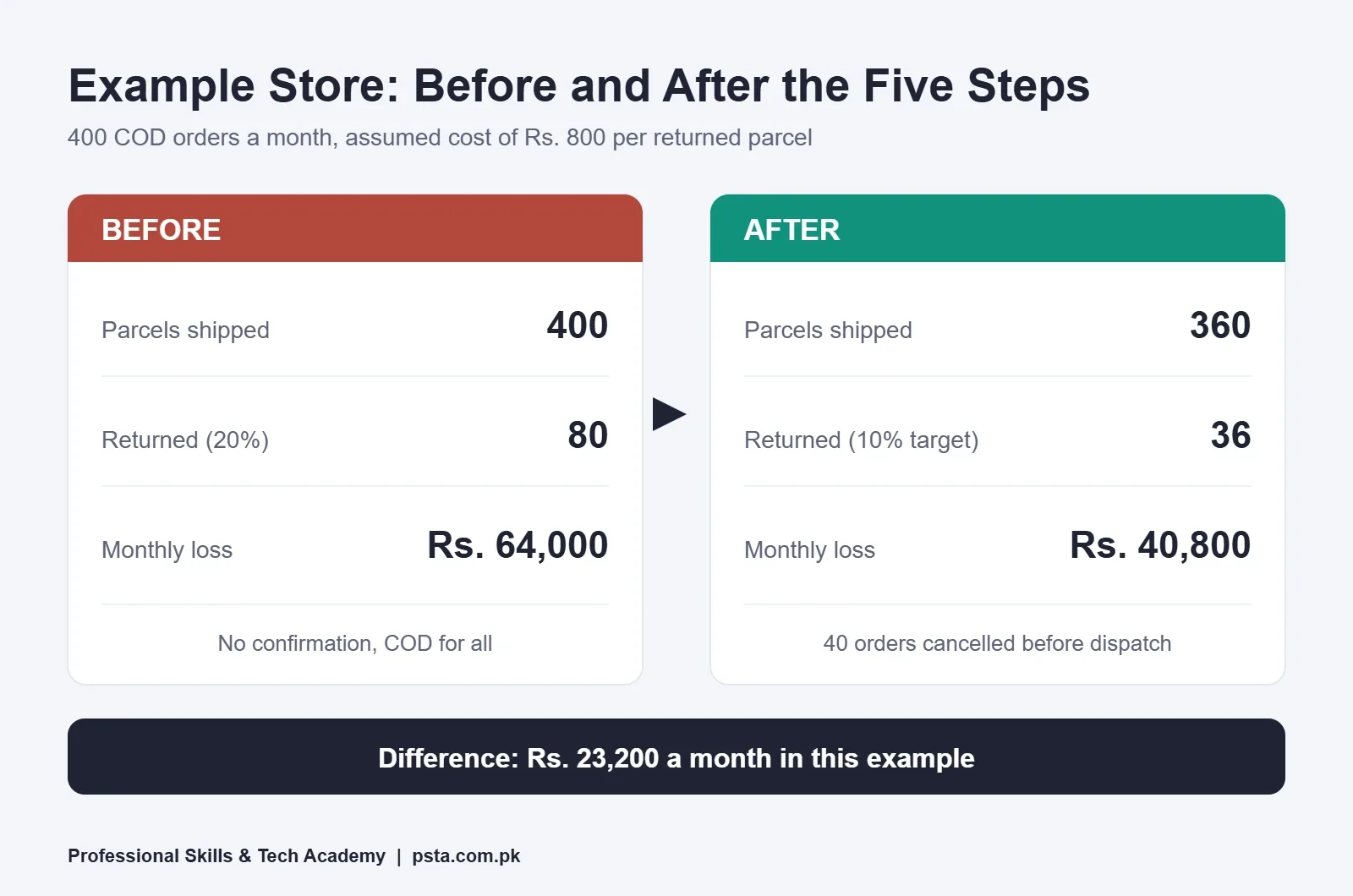
The 10% is a target used for the sum, not a promised result. Your own figure will depend on what you sell, where your buyers live and how strictly you follow the routine.
Which Number Should You Track Each Week?
Any plan to reduce COD returns needs one number to judge it by. Track one rate: parcels returned divided by parcels booked, for the past seven days. Keep it in a simple sheet with four columns: week, booked, returned and return rate. Add a fifth column for the top return reason from the courier report.
Look for two patterns. A rising rate after a new ad campaign usually means the targeting is pulling in impulse buyers, which is a common issue covered in our post on Meta Ads mistakes. A rising rate in one city usually points to the courier. If you sell through Amazon as well, the margin habits in our guide to calculating Amazon FBA fees apply here too: know your cost per order before you scale.
What PSTA's E-Commerce Course Teaches About Order Operations
Learning to reduce COD returns sits where store setup, payments and logistics meet, and that's how we teach it. PSTA's Master E-Commerce course (Amazon FBA, Shopify and Dropshipping) is a 12-week beginner program. Its modules include building Shopify and WooCommerce stores, dropshipping, Facebook and Google Ads, and a full module on payment gateways, logistics and supply chain management. The current fee shown on the course page is Rs. 25,000.
Classes run in Abbottabad at our Mandian campus on Old College Road, live online for students anywhere in Pakistan, or as a mix of both. A new batch starts every month. If your ads bring in the wrong buyers, our Meta Ads and social media marketing course goes deeper into audience targeting. You can compare every program on the courses page or apply through the admission form. For batch dates or a quick question about the syllabus, send a message on WhatsApp (+92 314 5424399).
Pull Last Month's Courier Report First
Before you change anything, download last month's booking and return report from your courier's portal. Count the returns, sort them by reason and work out your own cost per returned parcel with the four items from the example. That one page shows you where to reduce COD returns first and which of the five steps to start with. It also gives you a baseline to measure every change against.
Frequently asked questions
What is a normal COD return rate in Pakistan?
DHL Pakistan puts the national average at roughly 18% to 20% of COD parcels, or about one in five. It advises sellers to keep their own rate below 20%. Your rate depends on your product, price point and cities, so compare yourself with your own past months rather than with other stores, and aim to bring the number down steadily.
Does Shopify charge a fee on cash on delivery orders?
Shopify lists COD as a manual payment method and says it charges no third-party transaction fee on manual payments. You still pay your normal Shopify plan, and your courier charges its delivery and COD handling fees. Each COD order shows as Pending until you mark it paid, which you should do once the courier remits the cash.
How much tax is deducted from COD orders in Pakistan?
Since July 2025, couriers collecting cash withhold 2% of the gross amount on COD sales, while banks and payment gateways withhold 1% on digital payments, according to Business Recorder's report on the FBR circular. Sellers not on the Active Taxpayer List face higher rates. Rules have changed since, so check your position with a tax adviser.
Should I stop offering cash on delivery to cut returns?
For most Pakistani stores, no. A TGM Research survey found 69% of Pakistani respondents prefer COD, so removing it can cost you more sales than it saves. Keep COD, confirm orders before booking, and ask for advance payment only on high-risk orders. Offer a small discount to buyers who choose to pay in advance.
How do I confirm COD orders without hiring extra staff?
Batch the work. Twice a day, send a saved WhatsApp message to every new order with the item, total and address, and ask for a Yes reply. Call only the buyers who haven't replied by the next morning. For a store with a few dozen orders a day, this usually takes less than an hour of one person's time.
Is there a limit on cash payments for COD orders?
Yes. Profit reported that the FBR set a Rs. 200,000 limit on cash payments for retail sales and cash on delivery e-commerce orders. If you sell expensive items such as phones, appliances or furniture, ask buyers to pay larger orders through a bank transfer or wallet and explain the reason clearly at checkout.
Can I ask buyers to pay the delivery charge in advance?
Yes, and many sellers do this for risky orders. Tell the buyer the exact amount, how to pay through a bank app or wallet, and what happens if they cancel. Keep the rest of the order on COD so they don't feel they are taking the full risk. Genuine buyers usually agree once the reason is clear.
Sources & references
- DHL Pakistan: How Pakistani E-Commerce Sellers Can Reduce COD Returns dhl.com
- TGM Research: E-commerce Survey Results in Pakistan tgmresearch.com
- Karandaaz: Digitizing E-Commerce Payments Using Raast karandaaz.com.pk
- State Bank of Pakistan: Payment Systems Review, Q2 FY26 sbp.org.pk
- Business Recorder: FBR circular on e-commerce withholding tax brecorder.com
- Profit: FBR sets Rs 200,000 cash limit for retail, e-commerce CoD payments profit.pakistantoday.com.pk
- Shopify Help Center: Manual payment methods help.shopify.com
Last reviewed & updated on by Umar Qureshi. Written by the PSTA team in Abbottabad, Pakistan.

Umar Qureshi

Master E-Commerce & Build Your Online Empire: Amazon FBA, Shopify & Dropshipping
Turn this guide into a career: hands-on training with real projects, online across Pakistan or on-campus in Abbottabad · 12 Weeks.
Comments
No comments yet — ask a question or share your experience.