Quick answer
Amazon FBA fees include a selling plan ($39.99 a month for Professional), a category referral fee (15% in many categories), a per-unit fulfillment fee, and storage and inventory charges. Add your product, freight, ad and currency costs, then recheck profit at a 15% lower price before you order stock.
Key takeaways
- • Amazon's Professional plan costs $39.99 a month; the Individual plan charges $0.99 per item sold.
- • Referral fees are a share of the sale price: 8% for electronics and 15% for many home categories.
- • Take the fulfillment fee from Amazon's Revenue Calculator, not from old fee tables.
- • Aged inventory charges apply to units stored for more than 181 days.
- • In our worked example, a $24.99 sale leaves about $5.10 profit after all costs.
- • Run every product through a 15% price-cut test before you pay a supplier.
Table of contents 15 sections
- What Are Amazon FBA Fees, Exactly?
- Before You Start: Gather Six Numbers
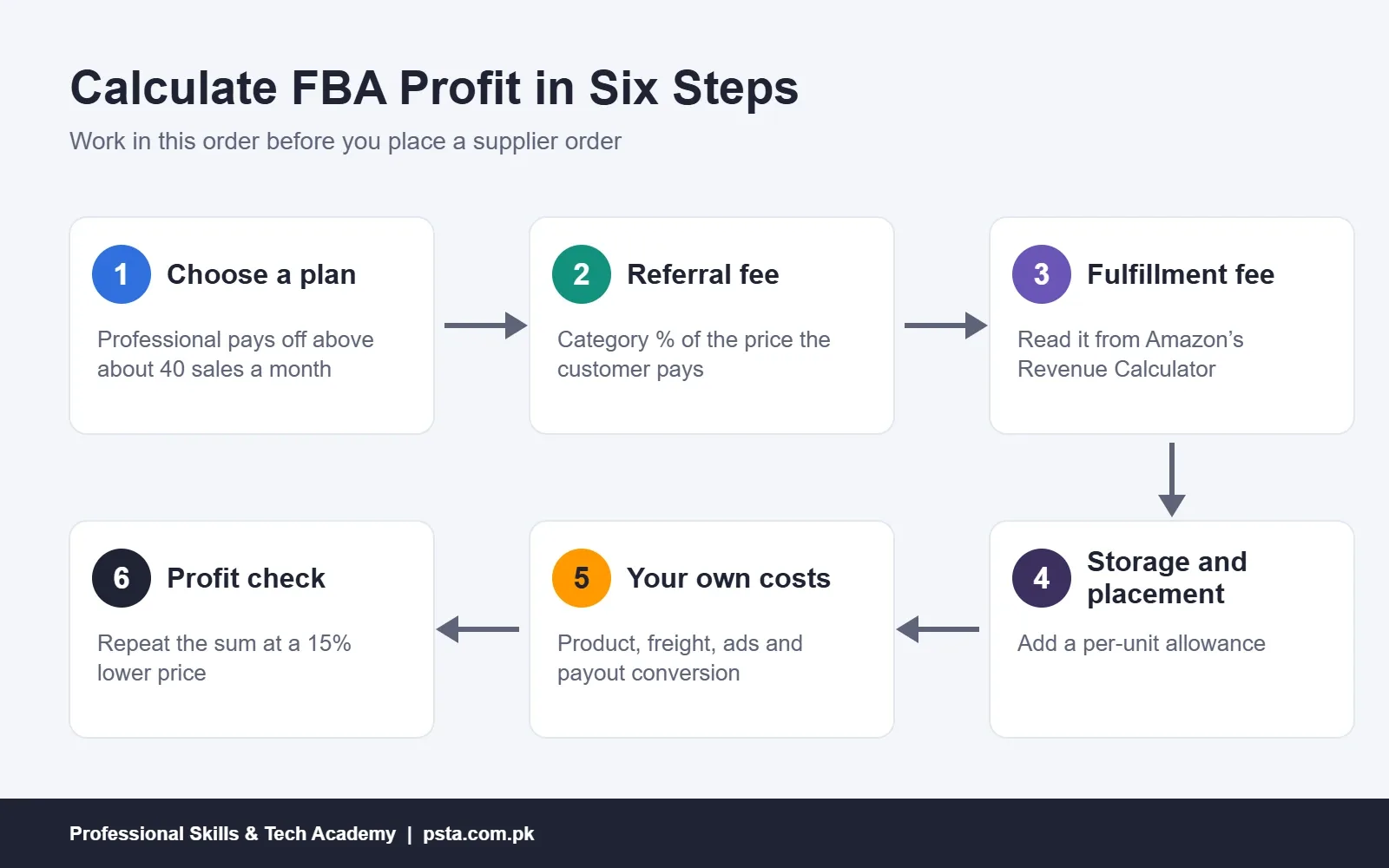
- Step 1: Choose Your Selling Plan
- Step 2: Work Out the Amazon Referral Fee
- Step 3: Get the Fulfillment Fee From Amazon's Calculator
- Step 4: Add Storage, Placement and Aged Inventory Costs
- Monthly Storage
- Inbound Placement and Aged Inventory
- Step 5: Count the Costs Amazon Doesn't Charge
- Step 6: Run the Full Profit Calculation
- Three Calculation Errors to Avoid
- How Much Margin Is Safe Enough?
- Can You Sell on Amazon From Pakistan?
- Learning Amazon FBA at PSTA
- Your Next Step: Price One Product Today
A common belief among new sellers is that Amazon FBA fees come down to one number: the 15% referral cut. Take a silicone kitchen utensil set selling for $24.99 on Amazon.com. On that belief, about $21 reaches your account. In the worked example below, Amazon's own charges take roughly $9 instead, before you pay for the product, the freight or a single ad.
That gap is why experienced sellers calculate fees first and contact suppliers second.
Here is what this guide covers:
- The fee families Amazon charges, and which ones change every month
- A six-step method to estimate profit before you place a supplier order
- A complete worked example with every line shown
- A simple test to decide whether a margin is safe enough
- What changes when you sell from Pakistan and get paid in rupees
What Are Amazon FBA Fees, Exactly?
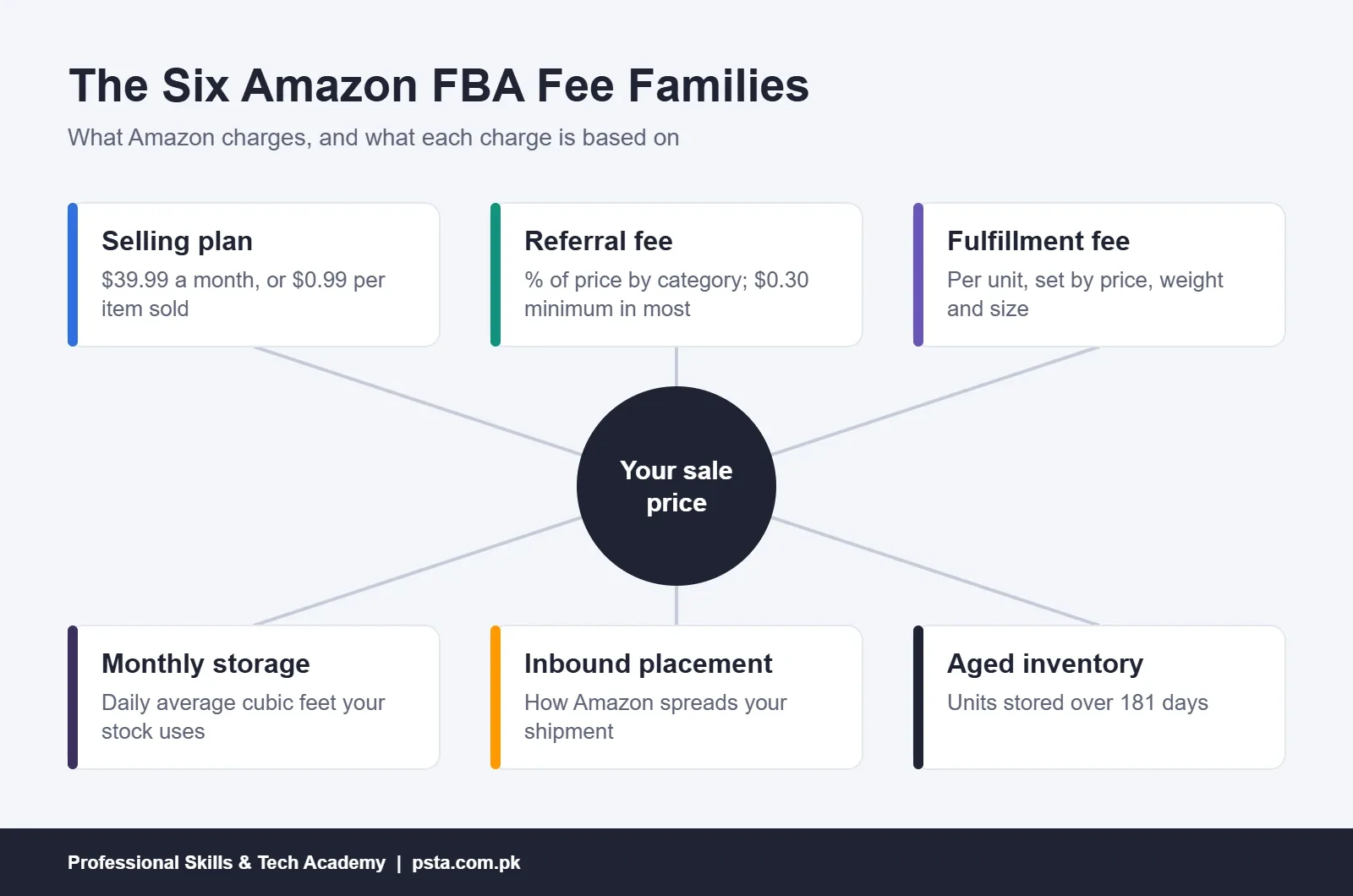
When you use Fulfillment by Amazon (FBA), you send stock to Amazon's warehouses. Amazon stores it, packs each order, delivers it and handles customer service and returns. You pay for that work through several separate charges, not one bill.
It helps to sort Amazon seller fees into two groups. Selling fees apply to every seller, whether or not you use FBA. Fulfillment and inventory fees apply only because Amazon holds and ships your stock.
- Selling plan: a monthly subscription or a per-item charge.
- Referral fee: a percentage of each sale, set by product category.
- Fulfillment fee: a per-unit charge for picking, packing and shipping.
- Monthly storage fee: based on the space your units occupy.
- Inbound placement, aged inventory, returns and removal fees: smaller charges that depend on how you manage stock.
Amazon's FBA program page explains the basis for each one. Fulfillment fees depend on the product's price, weight and dimensions. Storage is billed monthly on your daily average volume in cubic feet. Aged inventory charges apply to items held in a fulfillment center for more than 181 days.
Prices also move. Amazon's 2026 fee update for US sellers said FBA fees would rise by an average of $0.08 per unit sold, effective January 15, 2026, with no new FBA fee types this year. Small changes like that add up across a few thousand units, so recheck your numbers at least once a quarter.
Before You Start: Gather Six Numbers
You can't calculate profit with guesses. Collect these figures first and keep them in one spreadsheet row per product:
- The price you expect to sell at, based on what similar listings charge today.
- The product's category on Amazon, which decides the referral rate.
- The packed weight and the packed dimensions of one unit.
- The supplier's price per unit, including packaging and labels.
- The freight cost per unit to get stock into Amazon's warehouse.
- A realistic advertising cost per unit sold during the first few months.
Measure the packed product, not the bare item. A box that is two centimeters too tall can move a product into a more expensive size tier.
Step 1: Choose Your Selling Plan
Amazon's pricing page lists two plans. The Individual plan costs $0.99 per item sold. The Professional plan costs $39.99 a month plus selling fees.
The break-even point is easy to find: $39.99 divided by $0.99 is a little over 40 units. If you expect to sell more than about 40 units a month, the Professional plan costs less. It also gives you access to advertising and bulk listing tools, which most serious FBA sellers need anyway.
If you plan to use FBA seriously, open an Amazon Professional seller account from the start. For your per-unit calculation, spread the monthly fee across expected sales. At 200 units a month, the Professional plan adds about $0.20 to each unit.
Step 2: Work Out the Amazon Referral Fee
The Amazon referral fee is a percentage of the total sale price, or a minimum amount, whichever is greater. Most categories have a $0.30 minimum. The rate depends on the category you list in, so check it before you fall in love with a product.
| Category (US store) | Referral fee | What it means for a $25 sale |
|---|---|---|
| Computers, consumer electronics | 8% | $2.00 |
| Home and kitchen, toys and games, tools | 15% | $3.75 |
| Clothing and accessories | 5% to 17%, by price | Depends on price band |
| Jewelry | 20% up to $250, then 5% | $5.00 |
| Books and other media | 15% plus a $1.80 closing fee | $5.55 |
Rates are from Amazon's US pricing page at the time of writing. Notice how much the category matters: the same $25 sale costs $2.00 in one category and $5.55 in another.
One common error is calculating the referral fee on your profit or on your cost. It's always based on the price the customer pays.
Step 3: Get the Fulfillment Fee From Amazon's Calculator
Among all Amazon FBA fees, the fulfillment fee is the line beginners most often get wrong, because it depends on size tier, weight and price together. Don't copy a figure from an old video or a blog table. Rates are updated, and third-party tables sometimes disagree with each other.
Use Amazon's free Revenue Calculator instead. Search for a similar product already on Amazon, or enter your own dimensions, weight and price. The calculator shows the current FBA fee for that exact profile.
Run it twice: once at your target price and once at a lower price. Since the fee can change with price, you want to see both numbers before you commit.
Step 4: Add Storage, Placement and Aged Inventory Costs
These charges don't show up on every order, so beginners skip them. Amazon FBA storage fees and the related inventory charges still come out of your payout, so spread them across units instead.
Monthly Storage
Storage is billed every month on the cubic feet your stock occupies. A bulky product that sells slowly costs far more to store per unit than a small product that sells daily. Amazon also notes that going over your restock limit can raise storage costs.
Inbound Placement and Aged Inventory
Inbound placement covers how Amazon distributes your shipment across its network. Aged inventory surcharges start once units sit for more than 181 days. The practical fix for both is the same: send smaller batches that you expect to sell within a few months.
For a first estimate, set aside a small per-unit allowance for these costs. In our example we use $0.40 per unit, then replace it with real figures once your account shows actual charges.
Step 5: Count the Costs Amazon Doesn't Charge
Amazon's fees are only half the picture. Your own costs come next:
- Product cost: the supplier's unit price, plus packaging and labels.
- Freight: shipping from the factory to the Amazon warehouse, divided by units.
- Advertising: most new listings need Sponsored Products ads to get their first sales.
- Payout conversion: the cost of moving dollars into a bank account in another currency.
Advertising is the line people underestimate most. Budget a realistic cost per unit for the launch period, not the lower cost you hope to reach after six months of reviews.
Step 6: Run the Full Profit Calculation
Here's the utensil set from the opening, worked through line by line. The selling plan, referral rate and conversion rate come from Amazon's published pages. The fulfillment fee, product cost, freight, ad cost and storage allowance are example assumptions, so swap in your own figures.
| Line | Basis | Per unit |
|---|---|---|
| Selling price | Target price | $24.99 |
| Referral fee | 15% of price | −$3.75 |
| Fulfillment fee | Example figure; check the Revenue Calculator | −$5.00 |
| Storage and placement allowance | Example figure | −$0.40 |
| Amazon payout | Price minus Amazon fees | $15.84 |
| Currency conversion | 1.5% of payout | −$0.24 |
| Product cost | Example supplier price | −$5.50 |
| Freight to warehouse | Example figure | −$1.80 |
| Advertising | Example launch cost | −$3.00 |
| Professional plan share | $39.99 ÷ 200 units | −$0.20 |
| Profit per unit | About 20% of price | $5.10 |
You can copy this table into Excel or Google Sheets and use it as your own FBA profit calculator. Change one input and every line below it updates.
Look at the gap between the first and last lines. A $24.99 sale leaves about $5 after everything. Amazon's three charges alone take $9.15, or roughly 37% of the price.
Now drop the price by 15% to $21.24, which happens often when a competitor starts a sale. The referral fee falls to $3.19, but almost every other cost stays the same. Profit falls to about $1.96 per unit. That single test tells you more about a product than any amount of sales data.
Three Calculation Errors to Avoid
- Using the bare item size: the packed box decides the size tier, so measure it after packaging.
- Leaving out ads: a listing with no reviews rarely sells on organic traffic alone in its first weeks.
- Converting the sale price to rupees: convert only the final profit, or the numbers will look far better than they are.
How Much Margin Is Safe Enough?
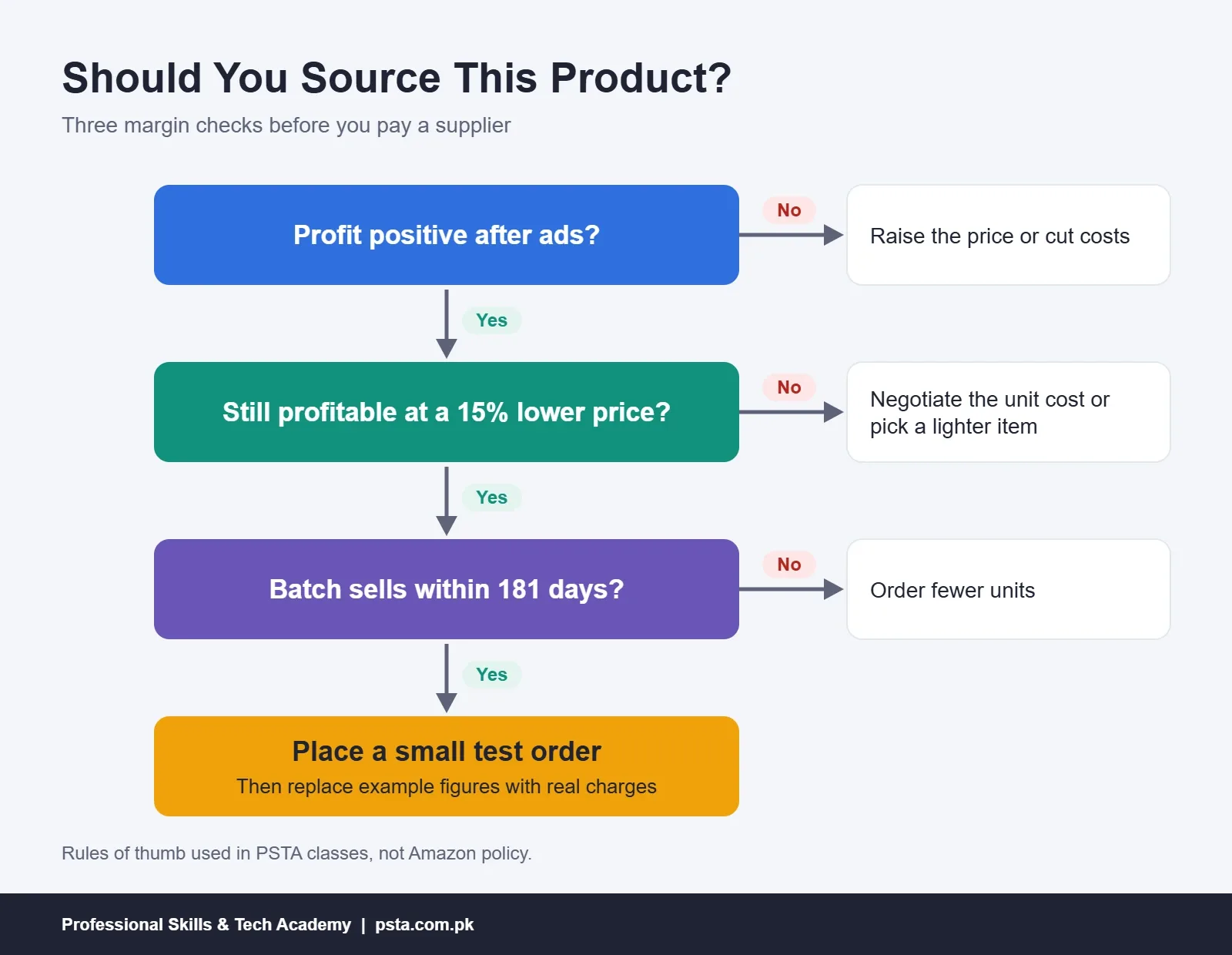
There is no official number. When I run these sums with students, we use three checks before any supplier order. They're rules of thumb, not Amazon policy.
- Profit stays positive after ads, not only before them.
- Profit survives a 15% price cut without turning negative.
- You can sell the batch well within 181 days, so aged inventory fees never start.
If a product fails the first check, the price is too low or the costs are too high. If it fails the second, it's fragile, so negotiate a better unit price or look for a lighter, smaller version. If it fails the third, order fewer units.
Can You Sell on Amazon From Pakistan?
Yes. In May 2021, Dawn reported that Amazon had decided to add Pakistan to its sellers' list, so Pakistani businesses could register with Pakistani details and banks instead of setting up offices abroad.
When you sell on Amazon from Pakistan, you calculate Amazon FBA fees with the same six steps. What changes is one extra cost line: getting your dollars home. Compare two options.
- Amazon Currency Converter for Sellers: Amazon's converter page lists a 1.50% fee for sellers with under $100,000 in cross-currency proceeds over 12 months. Check the supported countries and currencies list in Seller Central before you rely on it.
- A payment service such as Payoneer: fees vary by country. Payoneer's pricing page also lists a $29.95 annual fee for accounts that receive less than $2,000 in 12 months, which matters during a slow first year.
Whichever route you pick, put its real percentage into your spreadsheet. Then convert the final profit, not the sale price, into rupees at the rate your bank actually gives you.
Learning Amazon FBA at PSTA
Fee calculation is one part of the E-Commerce course (Amazon FBA, Shopify and Dropshipping) at PSTA. It's a beginner-level program lasting 12 weeks, and you can take it on campus in Abbottabad, through live online classes from anywhere in Pakistan, or as a hybrid of both. PSTA's course page shows a fee of Rs. 25,000, down from Rs. 30,000.
The modules include product hunting and market research, global and local sourcing, Amazon FBA for private label and wholesale, Shopify and WooCommerce stores, and payment gateways, logistics and supply chain. You build the same kind of profit sheet shown above for products you research yourself.
If you want to drive your own traffic to a Shopify store as well, our Advanced Digital Marketing course covers paid ads in depth. Our guide to Meta ads mistakes beginners make is a useful free starting point. If you'd rather start with service work while you save stock money, read Upwork for beginners in Pakistan.
You can compare all programs on the courses page or apply through admission. For questions about batch timings, reach us on WhatsApp at +92 314 5424399. You can also visit us in person: the campus faces FIMS College on Old College Road, Mandian, Abbottabad.
Your Next Step: Price One Product Today
Pick one product you've been thinking about. Open the Revenue Calculator, find a similar listing and note its FBA fee. Then fill in the six numbers from this guide and run the 15% price-cut test.
Keep a copy of the sheet and update it whenever Amazon FBA fees change. If the profit still looks healthy, you have a product worth researching further. If it doesn't, you've just saved yourself a supplier order, and that's a good result too.
Frequently asked questions
How much does it cost to start selling with Amazon FBA?
The selling plan is the only fixed Amazon charge: $39.99 a month for Professional or $0.99 per item sold on the Individual plan. Everything else depends on your product. You pay for stock, freight to Amazon's warehouse, per-unit fulfillment fees, storage and launch ads, so build a cost sheet for one product before you set a budget.
What is the Amazon referral fee for most products?
Many popular categories, including home and kitchen, toys and games, and tools, charge 15% of the sale price. Computers and consumer electronics charge 8%. Most categories also have a $0.30 minimum per item. Always check the exact category on Amazon's pricing page, because the rate is set by where your product is listed.
Should a new FBA seller choose the Individual or Professional plan?
Compare the two at your expected volume. The Individual plan charges $0.99 per sale, while Professional is a flat $39.99 a month, so Professional becomes cheaper once you pass roughly 40 sales a month. Most FBA sellers also need the advertising and bulk listing tools that come with the Professional plan.
How can I find the exact FBA fulfillment fee for my product?
Use Amazon's free Revenue Calculator. Search for a similar listing, or enter your packed dimensions, weight and price, and it shows the current fulfillment fee. Check it at your target price and at a lower price, because the fee can change with price as well as size. Avoid copying figures from older blog tables.
Did Amazon FBA fees go up in 2026?
Yes, slightly. Amazon said US FBA fees would rise by an average of $0.08 per unit sold from January 15, 2026, and that no new FBA fee types would be added this year. The effect on your product may be higher or lower than the average, so rerun your calculation after any fee announcement.
Can sellers in Pakistan receive Amazon payments?
Yes. In 2021 Amazon added Pakistan to its sellers' list, which allowed registration with Pakistani details and banks. To bring money home, compare Amazon Currency Converter for Sellers, which lists a 1.50% fee for smaller sellers where your currency is supported, with a payment service such as Payoneer. Check current fees for your account before you choose.
What happens if my FBA stock does not sell for six months?
Amazon charges aged inventory surcharges on units held in a fulfillment center for more than 181 days, on top of normal monthly storage. You can also pay per-item fees to remove or dispose of stock. The safer approach is to send smaller batches that you expect to sell within a few months.
Sources & references
- Selling on Amazon: Pricing and Fees sell.amazon.com
- Fulfillment by Amazon: Program Overview and Costs sell.amazon.com
- Amazon: Update to U.S. Referral and FBA Fees for 2026 sellingpartners.aboutamazon.com
- Amazon Currency Converter for Sellers sell.amazon.com
- Dawn: Amazon Adds Pakistan to Sellers' List (May 2021) dawn.com
- Payoneer: Pricing and Fees payoneer.com
Last reviewed & updated on by Umar Qureshi. Written by the PSTA team in Abbottabad, Pakistan.

Umar Qureshi

Master E-Commerce & Build Your Online Empire: Amazon FBA, Shopify & Dropshipping
Turn this guide into a career: hands-on training with real projects, online across Pakistan or on-campus in Abbottabad · 12 Weeks.



Comments
No comments yet — ask a question or share your experience.