Quick answer
Most C++ interview questions for freshers cover five areas: language basics, OOP, memory management, the STL and modern C++. Learn short spoken answers for each, practice the common written-test programs with and without the STL, and run a mock interview before the real one. Two weeks of daily practice is enough to refresh a semester.
Key takeaways
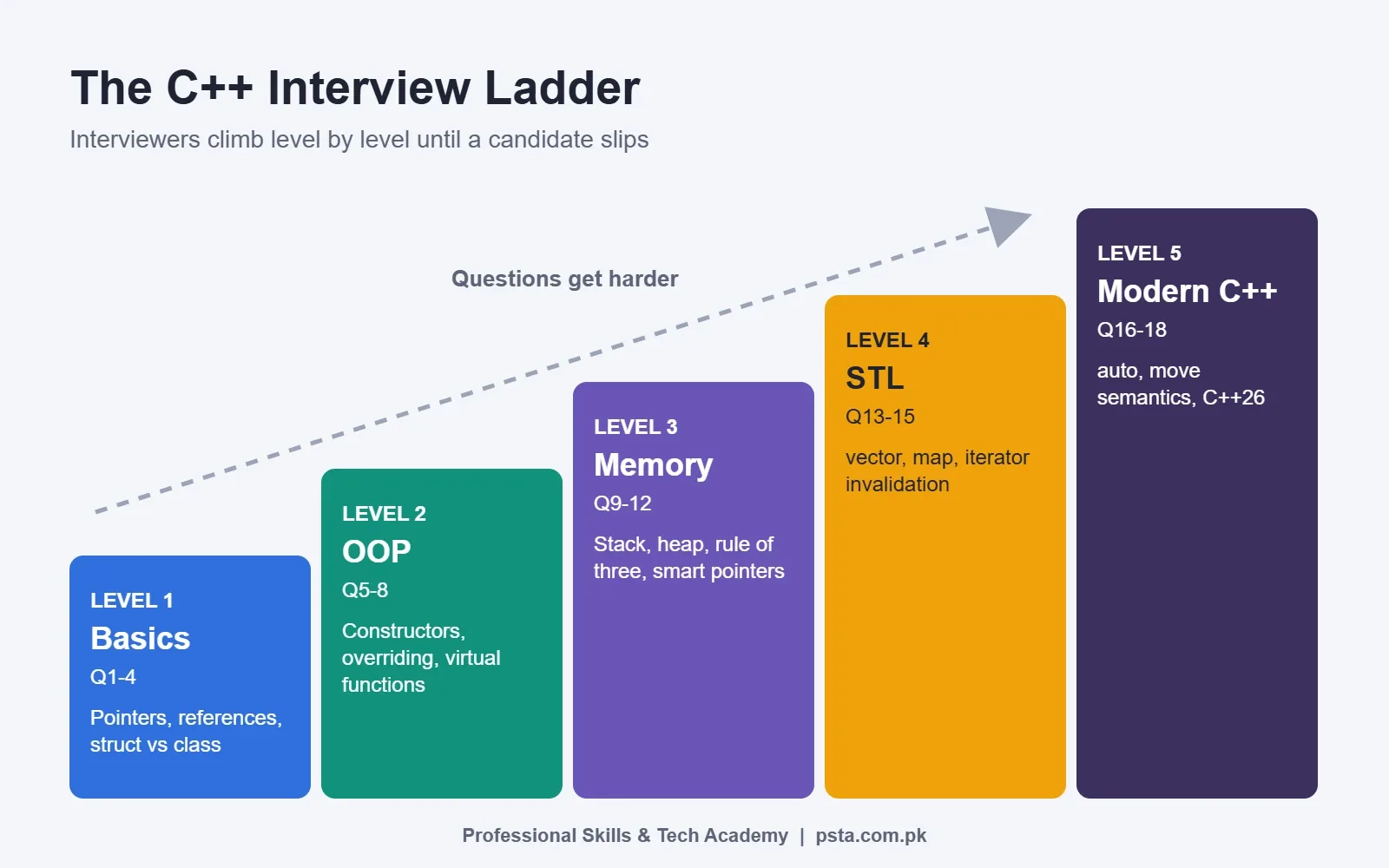
- • Interviewers climb from basics to OOP, memory, the STL and modern C++ until a candidate slips.
- • Know why virtual destructors, the rule of three and smart pointers exist, not just their definitions.
- • Choose map for sorted output and unordered_map for fast average lookups.
- • Answer with one clear sentence, one example from your own code and the trade-off.
- • A 14-day plan of about an hour a day, ending in a mock interview, refreshes a full semester of C++.
Table of contents 30 sections
- How Are C++ Interview Questions Asked in a Fresher Interview?
- Level 1: Language Basics (Questions 1 to 4)
- 1. What Is the Difference Between C and C++?
- 2. What Is the Difference Between a Pointer and a Reference?
- 3. What Is Pass by Value vs Pass by Reference?
- 4. What Is the Difference Between a struct and a class?
- Level 2: OOP Interview Questions in C++ (Questions 5 to 8)
- 5. What Kinds of Constructors Does C++ Have?
- 6. How Is Overloading Different From Overriding?
- 7. What Is a Virtual Function, and How Does It Work?
- 8. What Goes Wrong Without a Virtual Destructor?
- Level 3: Memory and Resource Questions (Questions 9 to 12)
- 9. What Is the Difference Between the Stack and the Heap?
- 10. What Is a Memory Leak, and How Do You Prevent It?
- 11. What Is a Shallow Copy vs a Deep Copy, and What Is the Rule of Three?
- 12. What Is the Difference Between unique_ptr and shared_ptr?
- Level 4: STL Questions (Questions 13 to 15)
- 13. When Would You Use a vector Instead of an Array?
- 14. What Is the Difference Between map and unordered_map?
- 15. What Is Iterator Invalidation?
- Level 5: Modern C++ Questions (Questions 16 to 18)
- 16. What Does auto Do, and When Should You Avoid It?
- 17. What Is Move Semantics?
- 18. Which C++ Standard Do You Use, and What's New in C++26?
- Which Coding Tasks Come Up in a C++ Written Test?
- How Should You Answer So the Interviewer Trusts You?
- A 14-Day C++ Interview Prep Plan
- Is C++ Still Worth Learning for Jobs in Pakistan?
- Preparing for C++ Questions With PSTA
- Say Three Answers Out Loud Before Bed
Most C++ interview questions for freshers come from five areas: language basics, object-oriented programming, memory, the Standard Template Library (STL) and a little modern C++. Employers still ask them because the language is still everywhere. On the TIOBE Index for October 2026, C++ ranked third with a rating of 8.87%, behind only Python and C.
This page gives you 18 C++ interview questions in the order an interviewer usually climbs, from easy to hard. Each answer is short enough to say out loud in under a minute, with code where code makes the point faster.
Here is what you will take away:
- How a typical fresher C++ interview is structured, and where students lose marks
- Model answers to 18 questions, grouped into five levels of difficulty
- The small coding tasks that show up in written tests, and the STL tool for each
- How to phrase an answer so it sounds like understanding, not memory
- A 14-day preparation plan you can start this week
How Are C++ Interview Questions Asked in a Fresher Interview?
For a junior role, you'll usually face three stages. First comes a written or online test with MCQs and one or two small programs. Then a technical round where someone asks you to explain concepts and trace code on paper. Last is a short HR conversation. University lab exams follow a similar pattern, so these answers also work as C++ viva questions.
The technical round is where most C++ interview questions live. Interviewers rarely want textbook definitions. They want to see whether you know why a feature exists and what goes wrong without it.
Job ads tell you what to expect. A C++ Developer listing from Avanza Solutions in Karachi, seen on Indeed Pakistan, asks for OOP, design patterns, data structures and algorithms, databases and Git. That mix matches the levels below quite closely.
Think of the questions as a ladder. Interviewers start at the bottom and keep climbing until you slip. Your goal is to answer the first three rungs cleanly and handle the top two calmly, even if you don't know every detail.
Level 1: Language Basics (Questions 1 to 4)
1. What Is the Difference Between C and C++?
C is a procedural language. You organize a program as functions that work on data. C++ started as an extension of C and adds classes, function and operator overloading, references, templates, exceptions and the STL.
A strong answer adds one practical point: most valid C code also compiles as C++, but not all of it. For example, C lets you assign the result of malloc to an int* without a cast, while C++ demands the cast.
2. What Is the Difference Between a Pointer and a Reference?
A pointer is a variable that stores an address. It can be null, and you can point it somewhere else later. A reference is another name for an existing object. It must be bound when it is created, and it cannot be re-seated.
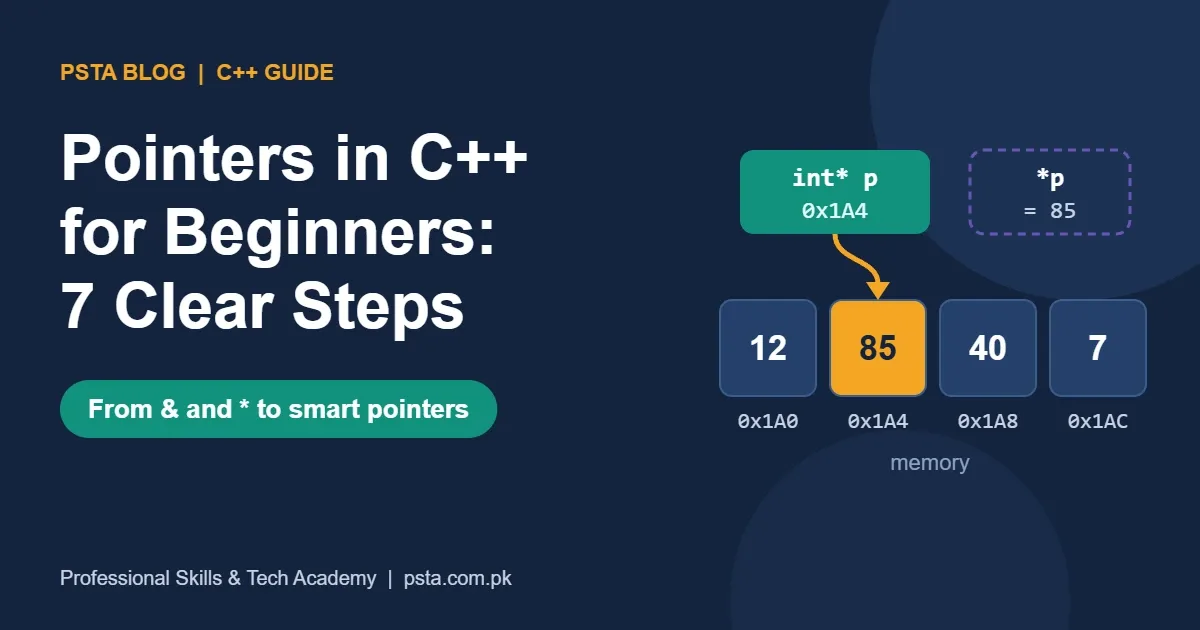
Say which one you'd pick and why: use a reference when something must always exist, and a pointer when "nothing" is a valid state. If pointers still feel shaky, our step-by-step pointers guide walks through them with diagrams.
3. What Is Pass by Value vs Pass by Reference?
Pass by value gives the function its own copy. Changes stay inside the function. Pass by reference gives the function access to the caller's variable, so changes are visible outside.
void addBonus(int marks)  { marks += 5; }   // caller sees no change
void addBonusRef(int& marks) { marks += 5; } // caller's variable changes

// For large objects you only read, avoid the copy:
void printReport(const std::string& text);
The const reference in the last line is the detail interviewers listen for. It avoids copying a long string while promising not to change it.
4. What Is the Difference Between a struct and a class?
In C++, there is only one technical difference. Members and base classes are public by default in a struct and private by default in a class. Both can have member functions, constructors and base classes.
By convention, many teams use struct for plain bundles of data and class when there are rules to protect. Mentioning that convention shows you've read real code.
Level 2: OOP Interview Questions in C++ (Questions 5 to 8)
5. What Kinds of Constructors Does C++ Have?
The three you must know are the default constructor (no arguments), the parameterized constructor (takes values) and the copy constructor (builds an object from another object of the same type). Since C++11, there is also the move constructor, covered in question 17.
Also mention the member initializer list, such as Student(int r) : roll(r) {}. It initializes members directly instead of assigning them afterwards, and it is required for const and reference members.
6. How Is Overloading Different From Overriding?
| Point | Overloading | Overriding |
|---|---|---|
| Where it happens | Same scope, usually the same class | Derived class replaces a base class function |
| Signature | Same name, different parameters | Same name and same parameters |
| Decided at | Compile time | Run time, through a virtual function |
| Keyword to mention | None needed | virtual in the base, override in the derived class |
Add that override makes the compiler check your work. If the signature doesn't match a base function, you get an error instead of a silent new function.
7. What Is a Virtual Function, and How Does It Work?
A virtual function in C++ lets a call through a base class pointer or reference reach the derived class version. That is run-time polymorphism.
Most compilers implement it with a table of function addresses per class (often called a vtable) and a hidden pointer to that table in each object. The standard doesn't require this design, so phrase it as "usually implemented as." That small hedge tells the interviewer you know the difference between the language rule and a compiler detail.
8. What Goes Wrong Without a Virtual Destructor?
If you delete a derived object through a base pointer and the base destructor is not virtual, the behavior is undefined. In practice, the derived part is usually never cleaned up.
class Shape {
public:
    virtual ~Shape() = default;   // without virtual, Circle's cleanup is skipped
    virtual double area() const = 0;
};

class Circle : public Shape {
    double r;
public:
    explicit Circle(double radius) : r(radius) {}
    double area() const override { return 3.14159 * r * r; }
};
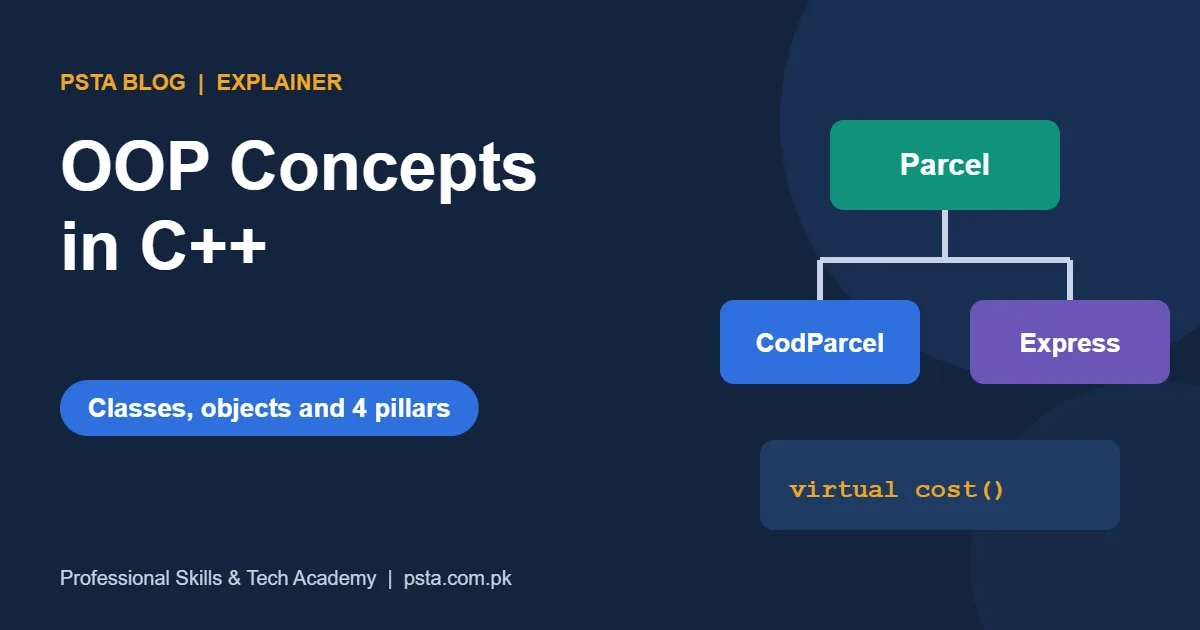
The rule of thumb: if a class has any virtual function, give it a virtual destructor. For a full program that uses all four OOP pillars, see our OOP concepts in C++ walkthrough.
Level 3: Memory and Resource Questions (Questions 9 to 12)
9. What Is the Difference Between the Stack and the Heap?
Local variables live on the stack. They are created when a function starts and destroyed automatically when it ends, which makes them fast and safe. The heap is memory you request at run time with new, and it stays until something releases it.
Use the stack by default. Reach for the heap when the size is only known at run time, when an object must outlive the function that made it, or when it is too large for the stack.
10. What Is a Memory Leak, and How Do You Prevent It?
A leak happens when heap memory is never released, often because a function returns early or throws an exception before reaching delete. In a long-running program, such as a server or a billing system that runs all day, the leak keeps growing.
The C++ answer is RAII: tie each resource to an object whose destructor releases it. Containers like std::vector and smart pointers already do this, so modern code rarely needs a bare delete.
11. What Is a Shallow Copy vs a Deep Copy, and What Is the Rule of Three?
A shallow copy copies a pointer, so two objects end up sharing one block of memory. When both destructors run, the same memory is freed twice. A deep copy allocates new memory and copies the contents.
That leads to the rule of three, described on cppreference: if a class needs its own destructor, copy constructor or copy assignment operator, it almost certainly needs all three. The rule of five adds the two move operations. The rule of zero is the best answer for most classes: hold resources in standard types and write none of the five yourself.
12. What Is the Difference Between unique_ptr and shared_ptr?
Smart pointers in C++ come up in almost every memory round. std::unique_ptr has a single owner. It cannot be copied, only moved, and it deletes its object when it goes out of scope. According to cppreference, it arrived in C++11, and std::make_unique followed in C++14.
std::shared_ptr allows several owners and keeps a reference count. The object is deleted when the last owner goes away. That count costs a little time and memory, so pick unique_ptr first and switch only when ownership really is shared.
#include <memory>

auto report = std::make_unique<Report>();      // one owner
auto moved  = std::move(report);                 // report is now empty
auto config = std::make_shared<Settings>();     // shared owners
auto copy   = config;                            // count is now 2
Level 4: STL Questions (Questions 13 to 15)
13. When Would You Use a vector Instead of an Array?
A built-in array has a fixed size known at compile time and doesn't know its own length. A std::vector grows as needed, knows its size and frees its memory automatically.
Use std::vector by default. If you need a fixed size with container features, mention std::array. Keep raw arrays for very low-level code or when an older API demands them.
14. What Is the Difference Between map and unordered_map?
std::map keeps keys sorted. Search, insertion and removal are logarithmic, and it is usually built as a red-black tree, as described on cppreference's std::map page. std::unordered_map, added in C++11, stores keys in hash buckets with no order and gives average constant-time operations.
A good example to give: to count how often each product appears in a day's orders, unordered_map is the natural pick. To print a report sorted by product name, choose map.
15. What Is Iterator Invalidation?
An iterator is a position inside a container. Some operations make existing iterators unsafe to use. For example, when a vector grows past its capacity, it moves its elements to new memory, and old iterators, pointers and references into it become invalid.
The classic bug is erasing items from a vector inside a loop. Use the iterator that erase returns, or use the erase-remove approach, and say so in the interview.
Level 5: Modern C++ Questions (Questions 16 to 18)
16. What Does auto Do, and When Should You Avoid It?
auto asks the compiler to work out a variable's type from its initializer. It shortens long iterator types and avoids mistakes when a type changes later.
The trap is that auto drops references and top-level const. Writing auto x = bigVector[0]; makes a copy. If you wanted a reference, write const auto&. Showing that you know this detail is worth more than the definition.
17. What Is Move Semantics?
Copying a large object duplicates its data. Moving transfers the internal resources, such as the pointer to a buffer, from an object that is about to be discarded. The source is left valid but unspecified, usually empty.
std::move doesn't move anything by itself. It is a cast that says "you may take this object's resources." The move constructor or move assignment operator then does the actual work.
18. Which C++ Standard Do You Use, and What's New in C++26?
Name the standard you actually compile with, such as C++17 or C++20, and the compiler. Then show you follow the language. Herb Sutter, a long-time member of the ISO C++ committee, reported that technical work on C++26 finished in March 2026. Its headline features include compile-time reflection, contracts (preconditions and postconditions), the std::execution framework for concurrency, and safety changes such as a hardened standard library.
You don't need to have used C++26. One accurate sentence about it is enough to show curiosity.
Which Coding Tasks Come Up in a C++ Written Test?
Alongside spoken C++ interview questions, written tests for freshers tend to repeat the same small problems. They check whether you can turn logic into working code under time pressure. Practice each one twice: once with plain loops, once with the STL.
| Task | What it checks | STL tool worth knowing |
|---|---|---|
| Reverse a string or array | Loops and index handling | std::reverse |
| Check whether a word is a palindrome | Two-pointer thinking | std::equal with reverse iterators |
| Find the largest and second-largest number | Edge cases such as duplicates | std::max_element |
| Count how often each word appears | Choosing a data structure | std::unordered_map |
| Remove duplicates from a list | Sorting and searching | std::sort then std::unique |
| Swap two numbers through a function | Pointers vs references | std::swap |
| Simple class with a constructor and a method | Basic OOP syntax | None, write it by hand |
If you have built a few small programs already, you'll find these easier. Our list of C++ projects for beginners gives you practice that doubles as interview material.
How Should You Answer So the Interviewer Trusts You?
Two candidates can know the same facts and leave very different impressions. The difference is almost always in how they answer.
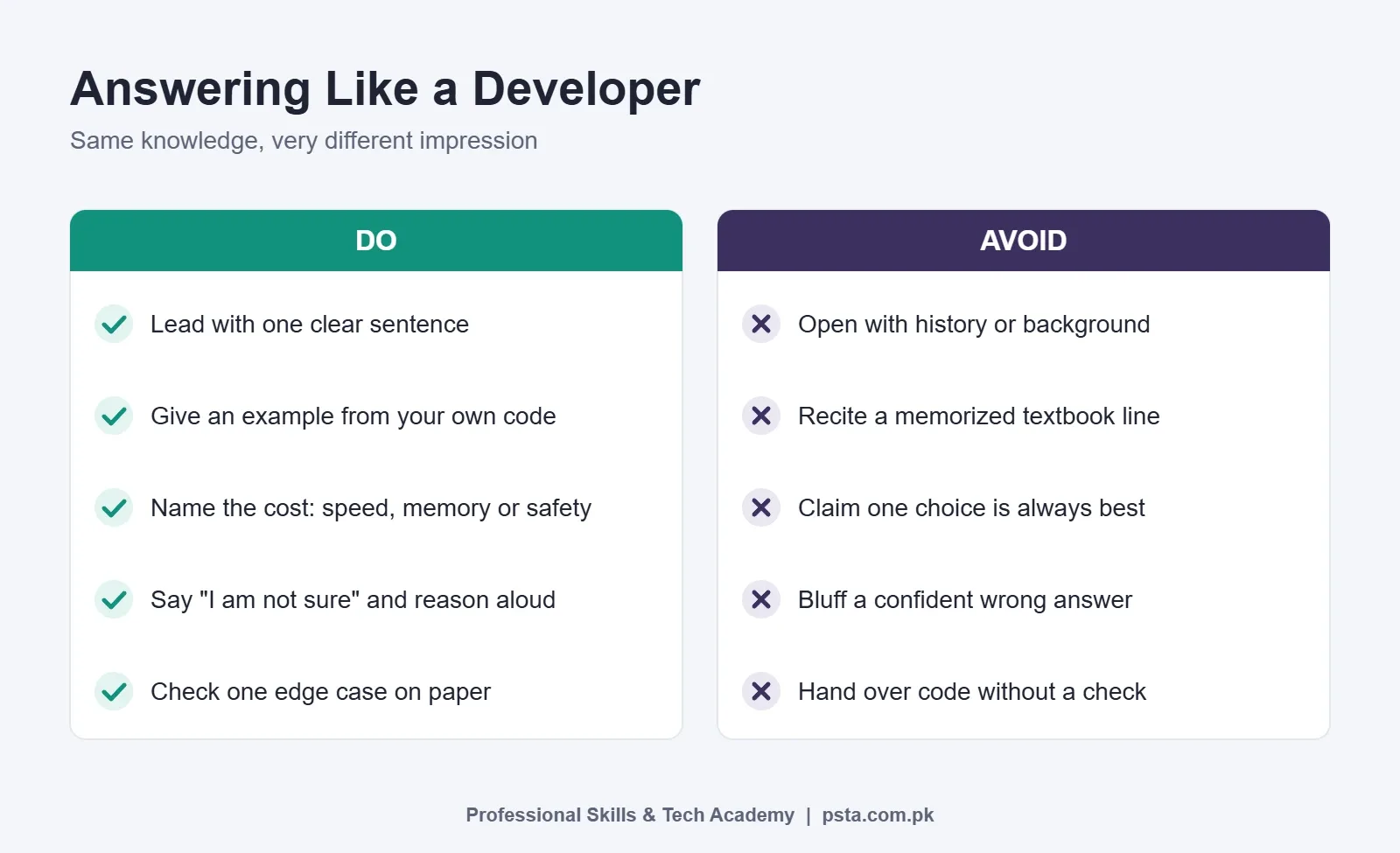
- Start with one clear sentence. Give the definition first, then expand. Don't begin with history.
- Add one example from code you wrote. "In my library project, I used a map so the book list printed in order" beats a memorized line.
- Name the trade-off. Every C++ choice costs something: speed, memory or safety. Saying what it costs shows judgment.
- Say "I'm not sure" when you aren't. Then reason aloud. Interviewers respect honest reasoning far more than a confident wrong answer.
- Write code neatly on paper. Use clear names, indent properly and check one edge case before you say you're done.
A 14-Day C++ Interview Prep Plan
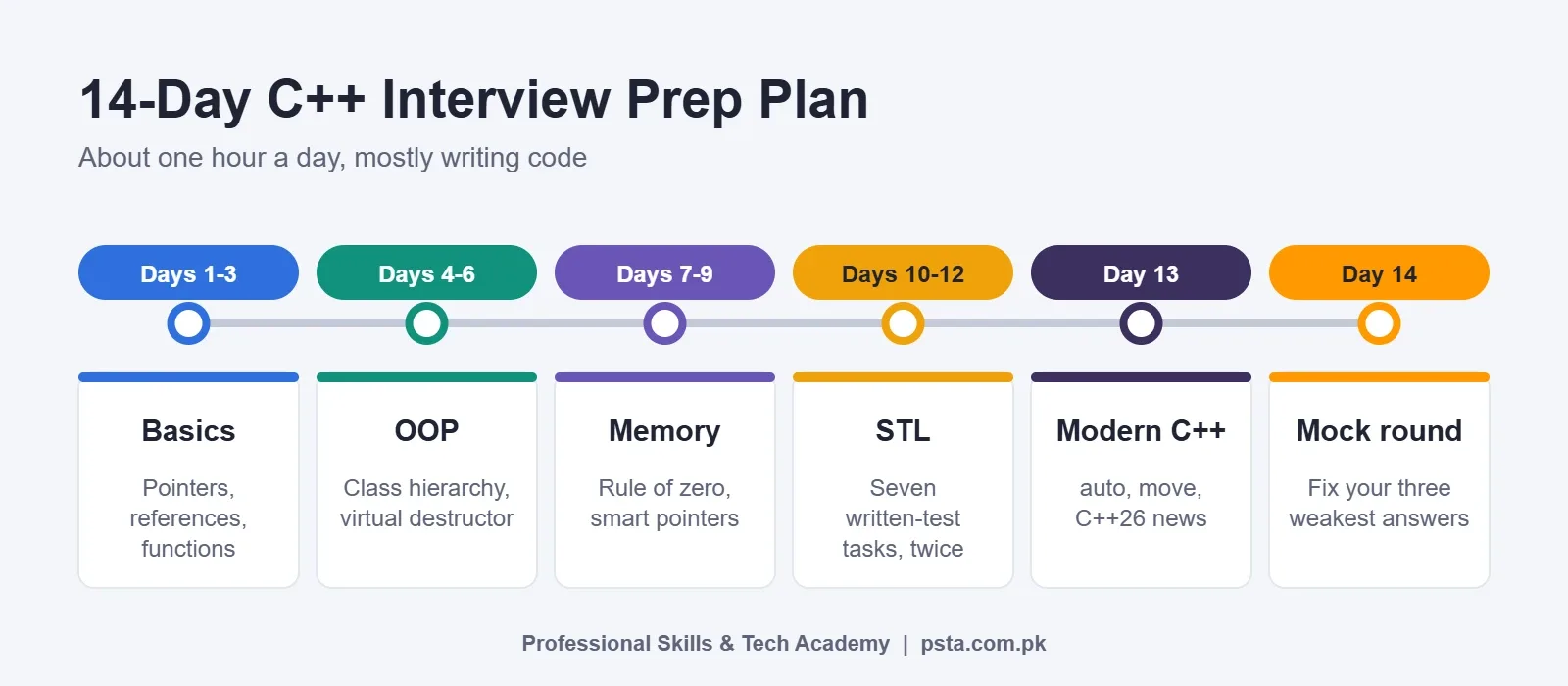
Two weeks of steady work, about an hour a day, is enough to refresh a semester of C++ and prepare for common C++ interview questions. Spend most of that hour writing code, not reading.
| Days | Focus | Output by the end |
|---|---|---|
| 1 to 3 | Basics: types, functions, pointers, references | Questions 1 to 4 answered aloud, three short programs |
| 4 to 6 | OOP: constructors, inheritance, virtual functions | One class hierarchy with a virtual destructor |
| 7 to 9 | Memory: stack, heap, copying, smart pointers | A class that follows the rule of zero |
| 10 to 12 | STL: vector, map, unordered_map, algorithms | All seven written-test tasks solved twice |
| 13 | Modern C++: auto, move semantics, C++26 news | Questions 16 to 18 answered in your own words |
| 14 | Mock interview with a friend | A list of the three weakest answers to fix |
Keep a single notebook or document for the whole plan. Every time you get stuck, write the question and the fix. By day 14, that page becomes your revision sheet for the morning of the interview.
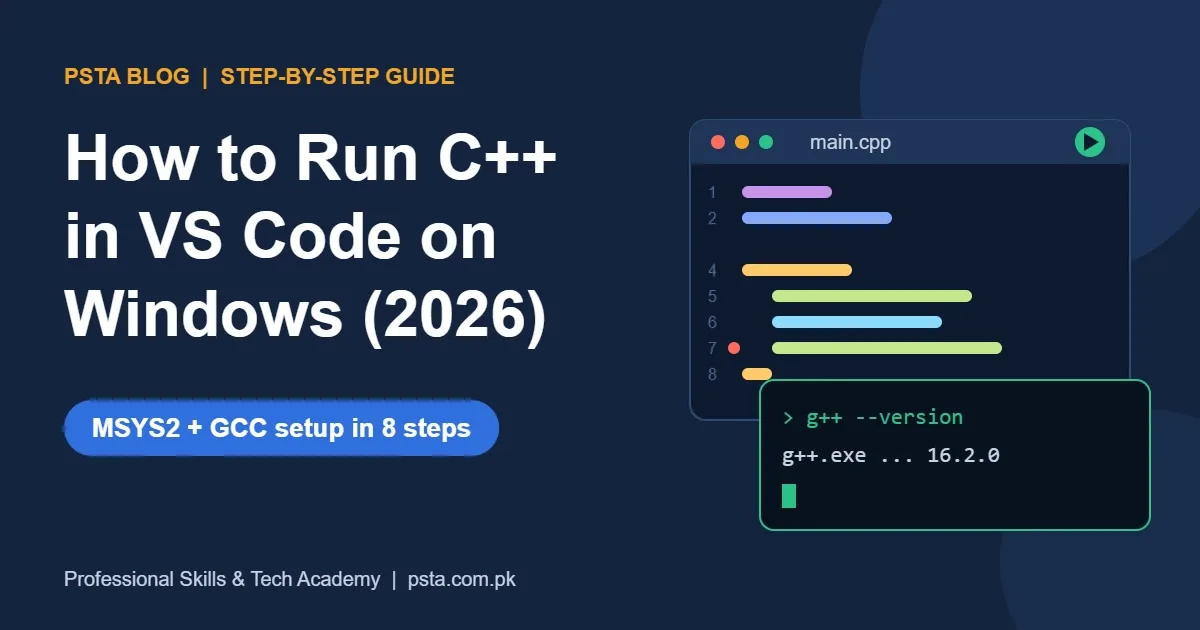
If you haven't set up a compiler on your laptop yet, follow our guide on running C++ in VS Code before day 1.
Is C++ Still Worth Learning for Jobs in Pakistan?
For the right roles, yes. The 2025 Stack Overflow Developer Survey found that 23.5% of all respondents and 21.8% of professional developers had used C++ in the past year. It shows up in systems software, embedded devices, games, finance and developer tools.
C++ jobs in Pakistan are fewer than web development roles, and many ask for experience. When we checked Indeed Pakistan for this article, the listings included the Avanza role in Karachi and senior C++ engineering roles at Skylabs AI in Islamabad, focused on tooling and systems work. That pattern is useful: a fresher who knows C++ well often enters through a general software role, a graduate program or a company that also uses C#, Python or Go.
C++ also gives you something that carries over. Once you understand memory, copying and data structures in C++, learning Python or JavaScript is much quicker. That is a big reason we often suggest C++ as a first language for students heading into BSCS or BSSE.
Preparing for C++ Questions With PSTA
The beginner C++ course at PSTA takes 12 weeks and assumes no coding background. Its current listed fee is Rs. 12,000, down from a regular Rs. 16,000. Classes run on campus in Mandian, Abbottabad, live online for students anywhere in Pakistan, or as a mix of both, and a new batch starts every month.
Across eight modules, you install your tools and write first programs with cin and cout, then learn decisions, loops, functions, arrays and strings. The last stretch introduces classes and objects and ends with a small project you build from scratch. That covers Level 1 of this guide well and gives you a solid start on Level 2.
To be clear about scope: smart pointers, the STL and modern C++ go beyond a beginner course. Once your foundations are solid, use Levels 3 to 5 here as your next study list, and ask your instructor to review your practice code.
You can compare options on the full course list, or read how enrollment works on the admission page. If you'd like to ask about batch timings first, send a message on WhatsApp at +92 314 5424399.
Say Three Answers Out Loud Before Bed
Pick three C++ interview questions from this list: numbers 2, 8 and 14. Close the page, set a one-minute timer and explain each one aloud as if a senior developer were sitting across the table. Wherever you hesitate, that is tomorrow's study topic.
Frequently asked questions
How many C++ questions are asked in a fresher interview?
There is no fixed number. In a 30 to 45 minute technical round, expect roughly eight to fifteen spoken questions plus one or two small programs on paper or a laptop. Interviewers usually start with basics and keep going deeper until you hesitate, so the count depends on how well you answer the early ones.
Are C++ interview questions harder than Python interview questions?
They usually go deeper into how memory works. Python interviews focus more on data types, libraries and problem solving, while C++ interviews often add pointers, copying, destructors and smart pointers. The coding tasks are similar in both. If you understand memory in C++, Python questions tend to feel easier afterwards.
Do I need to know data structures and algorithms for a C++ fresher job?
Yes, at a basic level. Most junior C++ roles expect arrays, linked lists, stacks, queues, sorting, searching and simple time complexity. The Karachi job ad mentioned in this guide, for example, lists data structures and algorithms next to OOP. You do not need advanced competitive programming for most fresher roles, but you should solve standard problems confidently.
Which compiler should I mention in a C++ interview?
Mention the one you actually use, such as GCC through MinGW on Windows, Clang, or the Microsoft Visual C++ compiler in Visual Studio. Also say which standard you compile with, for example C++17 or C++20. Being specific shows you have written and built real programs, not only read about them.
Can I answer C++ interview questions in Urdu or mixed English?
That depends on the company. Many local software houses accept a mix, but most technical interviews are conducted in English, and client-facing roles almost always are. Practice saying your key answers in simple, clear English. Short sentences with correct technical terms matter more than perfect grammar.
Is a C++ certificate enough to get a programming job?
A certificate helps show you studied the language, but employers mostly judge what you can build and explain. Pair any course certificate with two or three small projects on GitHub, such as a library manager or a billing program, and be ready to walk through your own code during the interview.
How long does it take to prepare for a C++ interview from scratch?
If you have never programmed, plan on about three months to learn the basics properly before interview practice. If you studied C++ in a semester already, two weeks of daily revision, about an hour a day, is usually enough to refresh the core topics and practice the common coding tasks.
Sources & references
- TIOBE Index (October 2026) tiobe.com
- Stack Overflow Developer Survey 2025: Technology survey.stackoverflow.co
- C++ Developer Jobs on Indeed Pakistan pk.indeed.com
- Herb Sutter: C++26 Is Done, March 2026 Trip Report herbsutter.com
- cppreference: The Rule of Three/Five/Zero en.cppreference.com
- cppreference: std::unique_ptr en.cppreference.com
- cppreference: std::map en.cppreference.com
Last reviewed & updated on by Umar Qureshi. Written by the PSTA team in Abbottabad, Pakistan.

Umar Qureshi
Best C++ Programming Course for Beginners in Pakistan
Turn this guide into a career: hands-on training with real projects, online across Pakistan or on-campus in Abbottabad · 12 Weeks.
Comments
No comments yet — ask a question or share your experience.