Quick answer
Good house wiring in Pakistan starts with a load list. Each phase gives about 230 V and two phases together about 400 V, so circuits are split between phases but two phases never share a switchboard. The DB needs a main switch, a 30 mA RCCB and a correctly sized MCB and cable for every circuit, plus a tested earth.
Key takeaways
- Phase to neutral is about 230 V, phase to phase is about 400 V
- Two phase means two of the three phases with one neutral, not a separate system
- Make a load list and check the sanctioned load before wiring or upgrading a house
- Every DB needs a main switch, a 30 mA RCCB and a correctly sized MCB per circuit
- Typical pairs: 1.5 mm² with 10 A for lights, 2.5 mm² with 16 to 20 A for sockets, 4 mm² with 20 to 25 A for a 1.5 ton AC
- Never mix two phases in one switchboard or borrow a neutral from another circuit
Table of contents 9 sections
- What "phase" actually means
- Single phase: one live wire and a neutral
- Two phase: common in Pakistan, but not a separate system
- Three phase: for heavy load and motors
- Planning house wiring in Pakistan: start with the load
- Inside the distribution board
- Five house wiring mistakes we see again and again
- Safety before any of this
- Learning this properly
House wiring in Pakistan has its own local habits: two phase connections, phase selectors for low voltage, a UPS on almost every DB, and summer AC loads that the original cables were never sized for. Ask three electricians in Abbottabad how a house should be wired and you may get three different answers. This guide walks through it from the meter onward: what single, two and three phase mean, how circuits are split between phases, what goes inside the distribution board, and the mistakes we see most often when students bring photos of their own homes to class.
What "phase" actually means
The power company sends electricity on three live wires, called phases, plus a neutral. In Pakistan each phase gives about 230 volts against neutral (most people still call it 220), at 50 Hz, the same standard used across most of Asia and Europe. Between any two phases you get about 400 volts. That 400 volt figure is the reason phase mistakes are so dangerous: a normal fan, bulb or charger is built for 230 V, and if it ends up across two phases it burns, sometimes with a flash.
So when someone says a house is "single phase", "two phase" or "three phase", they mean how many of those three live wires come into the house from the meter. If you are still deciding which connection to get, our post on single phase vs three phase myths goes into that choice in more detail.
Single phase: one live wire and a neutral
Most small and medium houses run on one phase. Every light, fan, socket and AC is fed from the same live wire through the distribution board (DB). It is simple and cheap, and it works well as long as the total load stays within what the meter and cable can carry.
The weak point shows up in summer. Two or three ACs, a water pump and an iron on the same phase can push the current high enough to heat cables and trip breakers, and if that one phase goes low or off, the whole house goes with it.
Two phase: common in Pakistan, but not a separate system
There is no true "two phase" supply in our grid. What people call two phase is simply two of the three phases brought into the house with one neutral. Each circuit inside is still a normal 230 V single phase circuit. The electrician just splits the circuits, for example lights, fans and one AC on the first phase, and the kitchen, pump and second AC on the second phase.
The two benefits are a lighter load on each phase, and a backup: with a phase selector switch you can move important circuits to the other phase when one goes low. The catch is that the two phases must never meet inside a switchboard or a socket, because that is where 400 V appears.
Three phase: for heavy load and motors
A three phase connection brings all three phases into the building. Houses usually move to three phase when they add several ACs, and workshops, tube wells, flour mills and plazas need it for three phase motors, which run smoother and draw less current per wire than single phase motors of the same size.
Inside a three phase house, the electrician's main job is balancing: spreading the ACs and heavy loads across all three phases so that no single phase carries most of the current. A badly balanced three phase house can trip and overheat just like an overloaded single phase one, and it also overloads the shared neutral.
Planning house wiring in Pakistan: start with the load
A careful electrician starts with a load list, not a guess. Write down every heavy appliance and its running power. A 1.5 ton inverter AC can draw roughly 1.5 to 2 kW when it is working hard, a water pump about 0.75 kW, an electric iron around 1 kW. Add the lights, fans and sockets, and you have a realistic picture of what the house pulls in the worst summer hour.
Then you look at what the power company has sanctioned on the meter. If the real load is well above the sanctioned load, the right step is to apply to the power company (PESCO in our area) for more load or a three phase meter. That paperwork and the meter connection are the company's job. Everything after the meter, from the main switch to the last socket, is yours.
Inside the distribution board
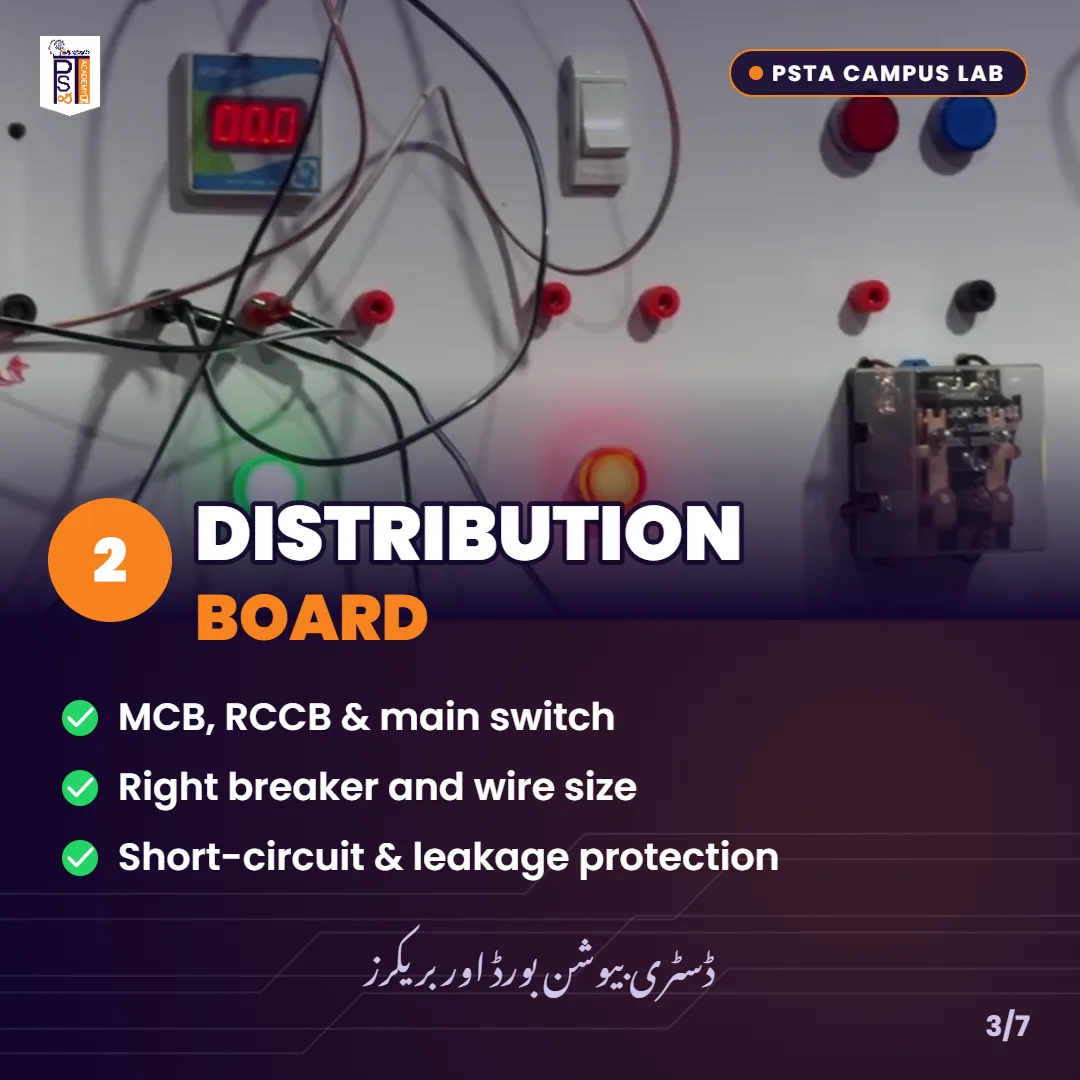
Whatever the supply, a good DB has the same parts: a main switch, an RCCB that trips if current leaks to earth (30 mA is the usual rating for homes), and a separate MCB for each circuit. Typical pairings that our students practise are a 1.5 mm² cable with a 10 A MCB for lighting, 2.5 mm² with a 16 or 20 A MCB for socket circuits, and 4 mm² with a 20 to 25 A MCB for a 1.5 ton AC. Long runs and hot roofs can call for one size bigger, which is why we teach students to check, not to copy a chart.
In two and three phase houses each phase gets its own group of MCBs, the groups are clearly labelled, and the neutral link is sized for the combined load.
Five house wiring mistakes we see again and again
- Two phases in one switchboard. If one board has switches from two different phases, anyone working on it can touch 400 V. Keep each board on one phase.
- Borrowed neutrals. Taking the neutral for a circuit from a different circuit makes the RCCB trip for "no reason" and can overload a thin neutral wire.
- No earth, or a fake earth. A green wire that goes nowhere is worse than no wire, because it gives false confidence. Earth must go to a proper earth pit and be tested.
- Undersized cable for ACs. A thin cable on an AC circuit heats up slowly over a summer until the insulation cracks. Size the cable for the load and the length.
- Running a three phase motor on two phases. If one phase drops, a three phase motor hums, draws several times its normal current and burns unless an overload relay trips it. A correctly set overload relay is cheap protection.
Safety before any of this
Switch off, prove the circuit dead with a tester, and make sure nobody can switch it back on while you work. Never work on the meter or the company's side of the supply. If you are not sure which phase a circuit is on, find out with a meter before you touch anything.
Learning this properly
Reading about phases helps, but the confidence comes from wiring them yourself. In the PSTA Electrical course at our Mandian campus in Abbottabad, students wire single, two and three phase boards, build distribution boards, wire water pumps, UPS and phase selectors, and finish with motor starters and panel wiring on real training boards. The course runs for three months, Monday to Saturday, and a new batch starts every month. If you also want to read panel drawings, our guide to electrical symbols for control panel drawings is a good next step.
You are welcome to visit the lab first. Come to PSTA, Mandian, Old College Road, opposite FIMS College, or send a WhatsApp message to 0314-5424399.
Frequently asked questions
Is two phase better than single phase for a house?
Two phase spreads the load over two of the three phases, so each phase carries less current, and a phase selector lets you move important circuits when one phase goes low. It does not raise the voltage. Each circuit is still a normal 230 V circuit, and the two phases must never meet in one switchboard.
When does a house need a three phase connection?
Usually when the load list shows more than one phase can comfortably carry, for example several ACs running together in summer, or when you need three phase motors. Check the sanctioned load on your meter, and apply to your power company (PESCO in Hazara) for a three phase meter if your real load is higher.
What happens if a 220 V appliance gets connected across two phases?
It receives about 400 V instead of 230 V. Most appliances burn out within seconds, and the flash can injure whoever is nearby. This usually happens when switches from two different phases end up in the same board, which is why each board should stay on one phase.
Can I learn single, two and three phase wiring in Abbottabad?
Yes. The PSTA Electrical course at our Mandian campus covers house wiring, distribution boards, single, two and three phase connections, phase selectors, water pumps, UPS, motor starters and panel wiring on real training boards. It runs for three months, Monday to Saturday, with a new batch every month.
Sources & references
- Mains electricity by country (voltage and frequency) en.wikipedia.org
- Peshawar Electric Supply Company (PESCO) pesco.gov.pk
Last reviewed & updated on by Psta. Written by the PSTA team in Abbottabad, Pakistan.

Master Industrial Automation: Single & Three-Phase Panel Wiring, PLC & VFD Certification
Turn this guide into a career: hands-on training with real projects, online across Pakistan or on-campus in Abbottabad · 3 Months (12 Weeks).




Comments
No comments yet — ask a question or share your experience.