Quick answer
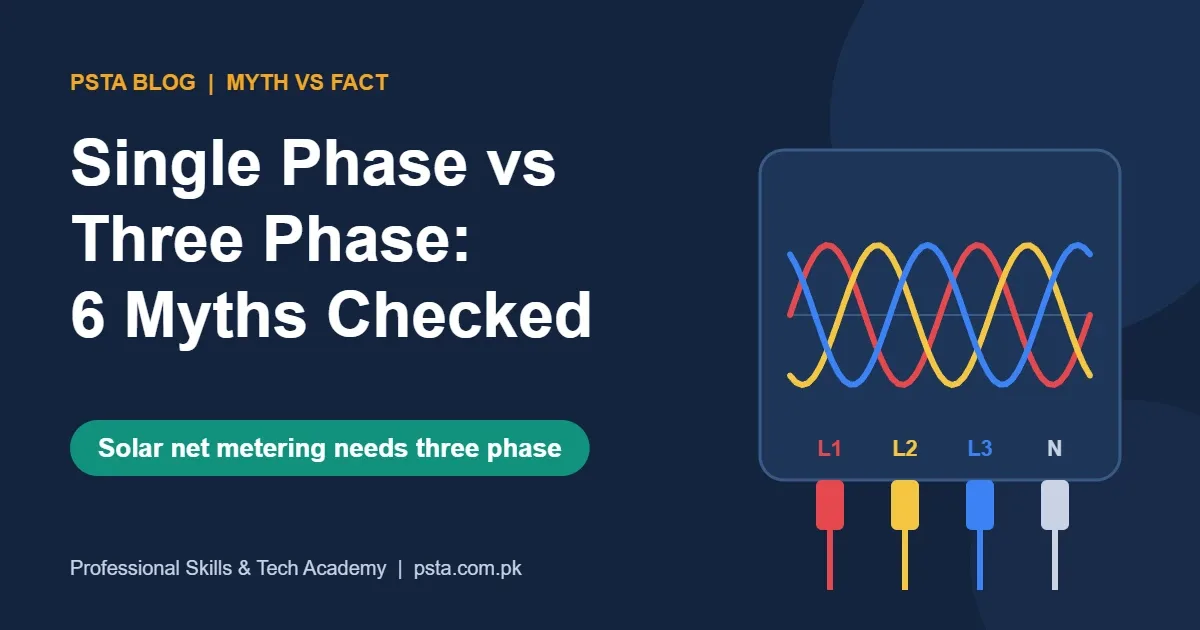
Single phase uses one live wire at 230 V; three phase uses three, with 400 V between them, and carries the same load at much lower current per wire. In Pakistan you need three phase for solar net metering or three-phase machinery. It does not lower your per-unit rate.
Key takeaways
- • Sockets on a three-phase supply still get 230 V; 400 V exists only between phases.
- • K-Electric sizes single-phase meters up to 4 kW and three-phase meters up to 40 kW.
- • The Power Division says net metering needs a three-phase connection and a three-phase inverter.
- • Your bill depends on units, tariff and sanctioned load, not the number of phases.
- • Upgrading is a load-extension case with a test report and a revised security deposit.
Table of contents 17 sections
- Single Phase vs Three Phase: What Actually Differs?
- A Side-by-Side Table for Pakistani Connections
- Myths About Bills and Voltage
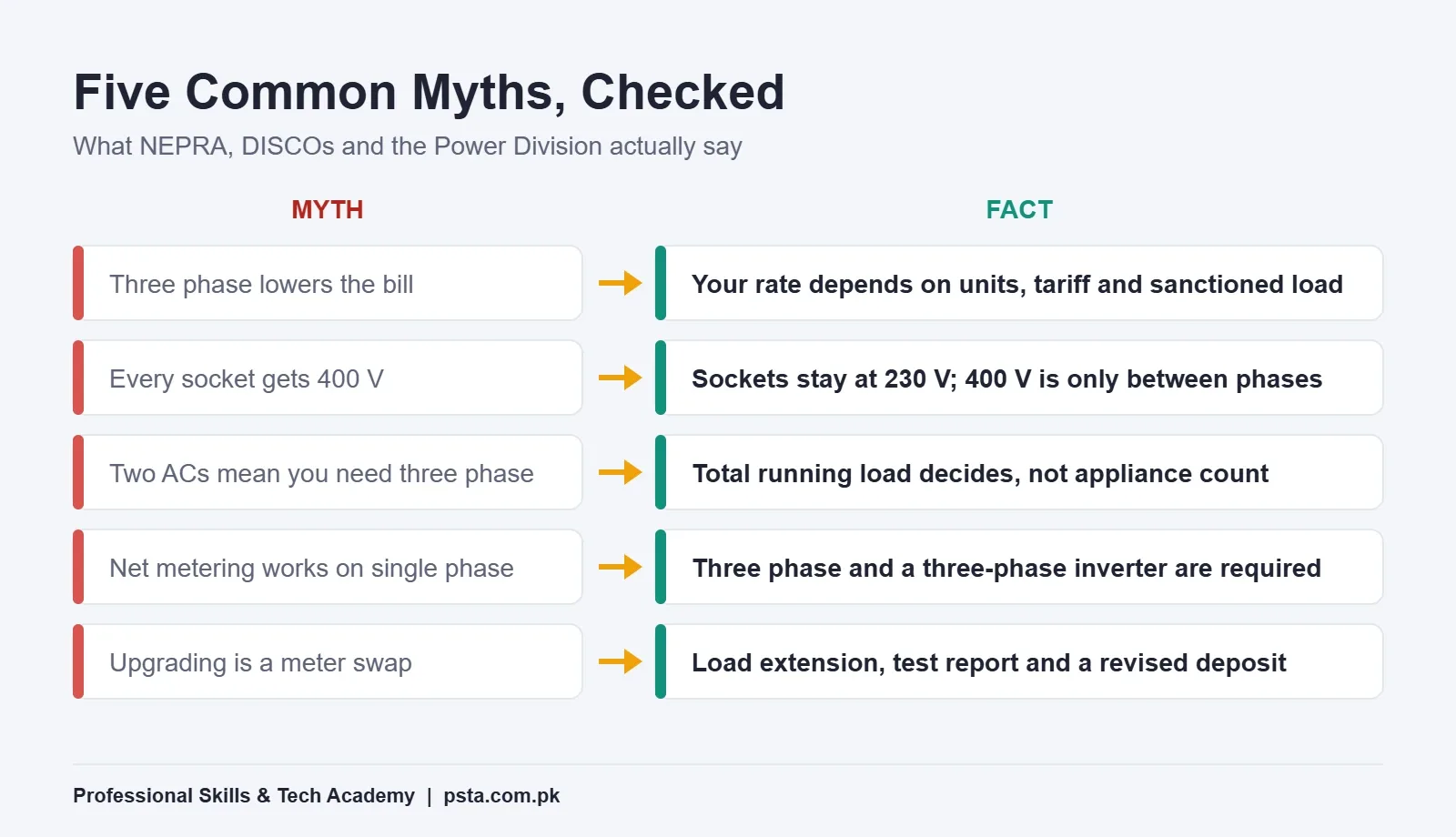
- Myth 1: A Three-Phase Connection Lowers Your Bill
- Myth 2: Three Phase Means 400 V at Every Socket
- Myths About ACs, Motors and Heavy Loads
- Myth 3: Two ACs Automatically Mean You Need Three Phase
- Myth 4: A Single-Phase Board Can Run Any Motor
- Do You Need Three Phase for Solar Net Metering?
- Myth 5: Net Metering Works on a Single-Phase Meter
- Myths About Upgrading Your Connection
- Myth 6: Upgrading Is Just a Meter Swap
- Why Does Load Balancing Matter on a Three-Phase Supply?
- How Can You Tell Which Supply You Have Now?
- A Quick Decision Guide Before You Apply
- Learn Phase Wiring Hands-On at PSTA
- Check Your Sanctioned Load Before You Call an Electrician
Single phase vs three phase: which connection does your home actually need? The question usually surfaces when a family plans rooftop solar, a third inverter AC or a small workshop downstairs. Most of the advice heard at the meter shop is half right, and the wrong half can cost you a rejected application or a bigger bill.
This guide checks six common beliefs against what NEPRA, the Power Division and the distribution companies have actually published. By the end, you will know:
- What changes electrically when you move from one phase to three
- Which supply your load and your solar plans call for
- Why the number of phases does not set your per-unit rate
- What the upgrade involves on paper and at the pole
- How to read your own bill and meter before you call anyone
Single Phase vs Three Phase: What Actually Differs?
A single-phase supply reaches your house on two conductors: one live wire and a neutral. Pakistan's household voltage is 230 V at 50 Hz, according to WorldStandards' Pakistan page. A three-phase supply brings three live wires plus a neutral. Each live wire still measures 230 V to neutral, while the voltage between any two live wires is about 400 V. NEPRA's Consumer Service Manual lists low-voltage supply as 230/400 V for loads up to 500 kW, which is exactly this pair of figures.
The three live wires peak one after another, 120 degrees apart. That overlap is why a three-phase motor gets a steady push instead of a pulsing one. WorldStandards puts the advantage simply: three wires can carry far more power than two without thicker cable. For a home, the practical result is more capacity spread over more conductors, not a different kind of electricity at the switchboard.
A Side-by-Side Table for Pakistani Connections
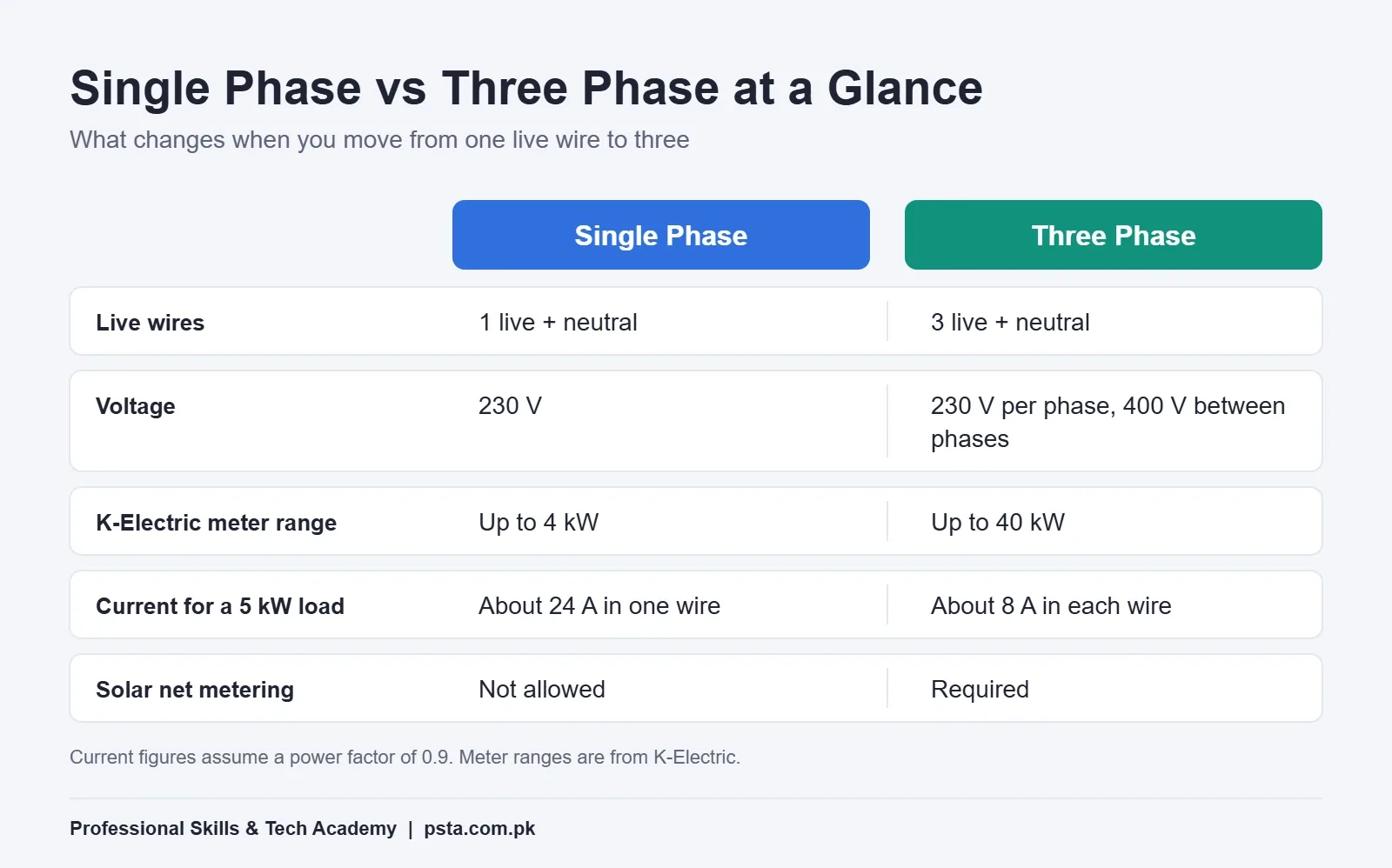
The table below collects the figures that matter when you weigh single phase vs three phase for a home or shop. The meter limits are K-Electric's, from its new connection FAQs. The cost lines are the Power Division's own worked example for a house 80 meters from the pole, published on its electricity billing FAQ page. Treat those rupee figures as an illustration, since charges are revised and differ by company.
| Point | Single Phase | Three Phase |
|---|---|---|
| Live wires | 1 live + neutral | 3 live + neutral |
| Voltage | 230 V | 230 V per phase, 400 V between phases |
| K-Electric meter range | Up to 4 kW | Up to 40 kW (CT-operated meter above that) |
| Ministry example load | 3 kW | 5 kW |
| Material cost, first 40 m | Rs. 4,000 | Rs. 15,000 |
| Extra cable, 40 to 100 m | Rs. 200 per meter | Rs. 260 per meter |
| Security deposit (urban / rural) | Rs. 3,660 / Rs. 1,830 | Rs. 6,100 / Rs. 3,050 |
| Solar net metering | Not allowed | Required |
Work out the ministry's example and the gap is clear. For that 80-meter run, single-phase material comes to Rs. 12,000, while three-phase material comes to Rs. 25,400, before the deposit.
Myths About Bills and Voltage
Myth 1: A Three-Phase Connection Lowers Your Bill
Fact: the phase count does not set your rate per unit. Your bill comes from the units you use, your tariff category and, under the 2026 tariff, your sanctioned load. Dawn reported in February 2026 that fixed charges for homes would be tied to sanctioned load, at Rs. 200 to 675 per kW a month, regardless of how much you consume. Its own example: a 5 kW home at Rs. 500 per kW pays Rs. 2,500 a month in fixed charges alone.
That matters because people often raise their sanctioned load when they apply for three phase. IESCO's current tariff guide places residential connections of 5 kW and above under a time-of-use tariff, with separate peak and off-peak rates. A larger sanctioned load can therefore raise the fixed part of your bill, even if your usage stays the same.
Myth 2: Three Phase Means 400 V at Every Socket
Fact: your sockets still get 230 V. An electrician splits the house circuits across the three phases, and each circuit runs between one phase and neutral. The 400 V appears only between two live wires, which is why a three-phase board must be wired and labeled with care. Mixing two phases on one circuit is a serious fault, not a shortcut.
Myths About ACs, Motors and Heavy Loads
Myth 3: Two ACs Automatically Mean You Need Three Phase
Fact: in the single phase vs three phase choice, total load decides, not the number of appliances. K-Electric's FAQ sizes a single phase meter for loads up to 4 kW and a three phase meter for loads up to 40 kW. Add up the rated wattage of what runs together on a June afternoon: ACs, the water pump, the iron, the geyser if it is electric. If that realistic total sits well under your sanctioned load, a second inverter AC may not change anything. If it regularly goes above, the issue is load, and three phase is one answer to it.
Here is why current matters. The standard formula for balanced three-phase power, as set out by Electricity Forum, is P = √3 × line voltage × line current × power factor. Run a 5 kW load at a power factor of 0.9 and compare:
- Single phase: 5,000 ÷ (230 × 0.9) gives about 24 A through one live wire.
- Three phase: 5,000 ÷ (1.732 × 400 × 0.9) gives about 8 A in each of three wires.
Lower current per wire means less heating in cables, breakers and the meter. That is the real reason heavy users move up, not a lower bill.
Myth 4: A Single-Phase Board Can Run Any Motor
Fact: industrial three-phase motors are designed for three-phase supply. Small single-phase motors exist for pumps and fans, but a workshop with a lathe, a large compressor or a flour chakki often needs three phase. Most motor control you see in factories, from star-delta starters to VFDs and soft starters, assumes a three-phase feed.
Do You Need Three Phase for Solar Net Metering?
Myth 5: Net Metering Works on a Single-Phase Meter
Fact: it does not, under the current rules. The Power Division's FAQ states that a three-phase connection is mandatory for net metering, and that a single-phase inverter is not allowed. It describes eligible consumers as three-phase (400 V to 11 kV) with a minimum sanctioned load of 5 kW. It also says a second, low-tariff single-phase meter is not allowed at a net-metered premises.
So if you plan to export solar units, the three phase connection is part of the solar project, not an optional extra. Budget for it, and ask your installer to quote a three-phase grid-tie inverter from the start. Changing inverters after installation is an expensive way to learn this rule.
Myths About Upgrading Your Connection
Myth 6: Upgrading Is Just a Meter Swap
Fact: it is a load-extension case with paperwork, possible reinforcement and a revised deposit. K-Electric asks customers moving from single-phase to three-phase meters to apply under its reinforcement option. NEPRA's manual lists the documents for load extension, including a test report from the Electric Inspector or an authorized wiring contractor. It also says the security deposit is updated at prevailing rates for the entire load, not just the added kilowatts.
There is another side to this. If you already use more than your sanctioned load, the manual lets the company issue a notice, and you must apply for extension within 15 days of receiving it. Getting ahead of that notice is cheaper than reacting to it.
Before you apply, gather these:
- A recent paid bill showing your reference number and sanctioned load
- A load list of the appliances that run together
- The wiring test report the company asks for
- CNIC and ownership or tenancy documents, as your company's form specifies
Why Does Load Balancing Matter on a Three-Phase Supply?
Three phases only help when the load is shared fairly between them. Electricity Forum notes that the √3 formula applies to a balanced system, where each phase carries similar current. In a house, an unbalanced board is common: all the ACs land on one phase because that circuit was nearest.
The result is one phase running hot while the other two idle. You may see one breaker tripping on summer afternoons, or one set of lights dimming when the AC compressor starts. A good electrician lists each circuit's load and spreads the heavy ones, so each phase carries roughly a third. Keep that list taped inside the distribution board. It saves the next technician a lot of guesswork. If you are choosing protection for those circuits, our guide to MCB vs MCCB vs RCCB covers the basics.
How Can You Tell Which Supply You Have Now?
You do not need tools for a first check. Start with the bill and the meter, then the board.
- Read the bill. Note the sanctioned load in kW and your tariff category.
- Look at the meter. Three-phase meters are usually labeled as such and show four incoming conductors. Single-phase meters take two.
- Check the main board. A three-phase board normally has a three-pole or four-pole main breaker. UK Power Networks offers a similar quick test for British homes: a single-phase supply usually has one main fuse, three phase has three.
- Ask a licensed electrician to confirm before you change anything. Do not open the meter or the service cable yourself.
A Quick Decision Guide Before You Apply
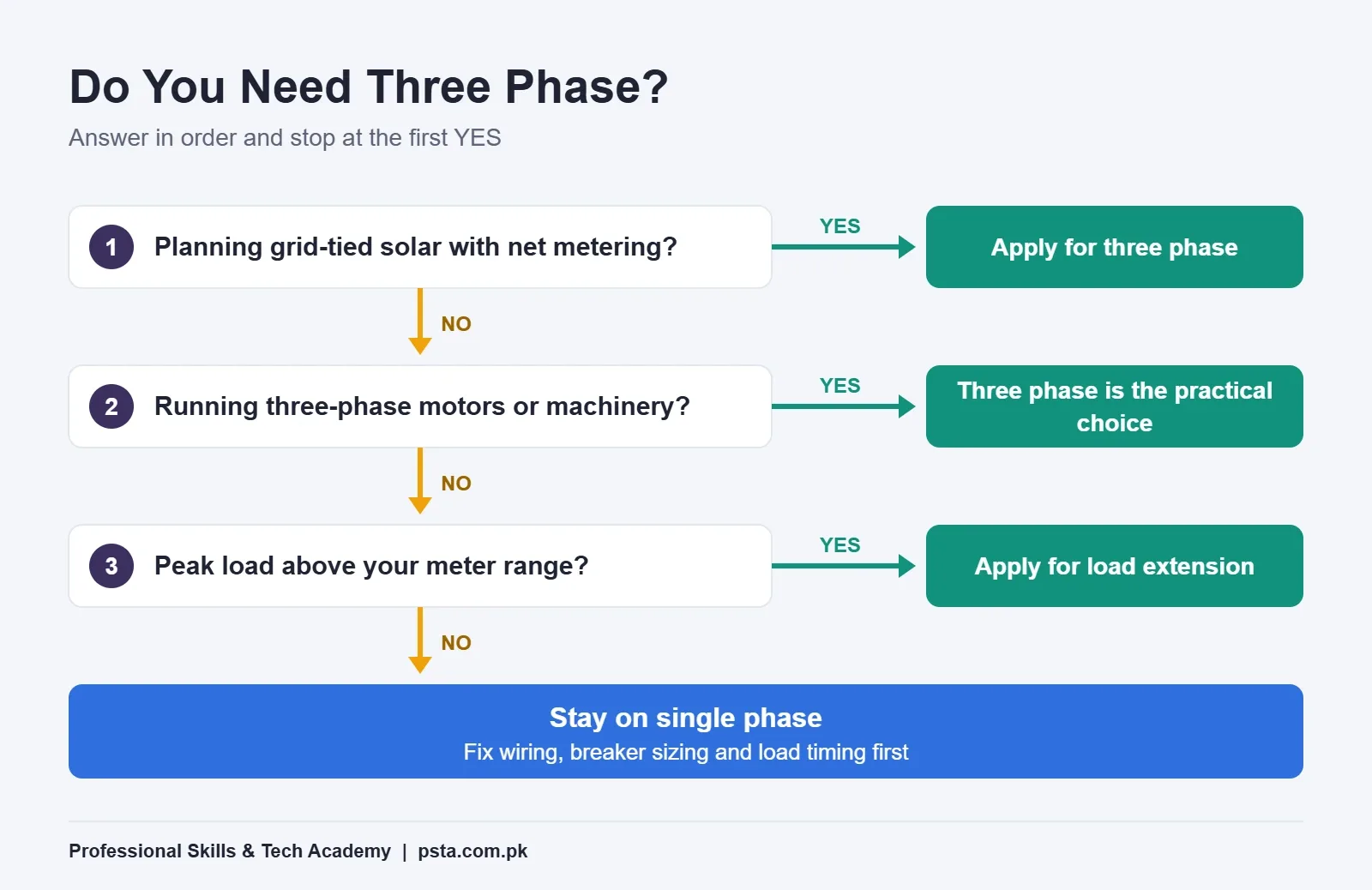
Use these questions in order to settle single phase vs three phase for your premises. Stop at the first one that gives a clear answer.
- Planning grid-tied solar with net metering? Apply for three phase. The rules require it.
- Running three-phase motors or machinery? Three phase is the practical choice.
- Is your realistic peak load above your single-phase meter's range? Apply for load extension, and discuss three phase with your company.
- None of the above? Stay on single phase. Fix wiring, breaker sizing and appliance timing first, and spend the difference on efficient equipment.
Whichever way you go, confirm current charges with your own distribution company before paying anyone. Rates and procedures change, and agents' quotes are not official.
Learn Phase Wiring Hands-On at PSTA
If this topic interests you beyond your own meter, it is the first layer of a skilled trade. Our Industrial Automation course runs for 3 months (12 weeks) at beginner level. You start with industrial electricity and safety, then wire single and three-phase control panels, motor starters, sensors, VFDs and soft starters, and finish with PLC basics and fault finding on training rigs. Right now the listed fee for this course is Rs. 28,000.
You can attend in person in Mandian, Abbottabad (Old College Road, across from FIMS College), or join live online classes from anywhere in Pakistan. New batches start monthly. If drawings confuse you, our post on electrical symbols is a good warm-up. You can compare other options on the courses page, or send a message on WhatsApp at +92 314 5424399 to ask about the next batch.
Check Your Sanctioned Load Before You Call an Electrician
Take ten minutes today. Find your latest bill, note the sanctioned load, and list what runs together on your hottest day. That single comparison settles most single phase vs three phase debates. It tells you whether you need a bigger connection, better load sharing or nothing at all. When you are ready to turn this into a skill, the admission page explains how to join.
Frequently asked questions
What is the main difference between single phase and three phase supply?
A single-phase supply has one live wire and a neutral at 230 V. A three-phase supply has three live wires and a neutral, with 230 V from each phase to neutral and about 400 V between phases. Three phase carries more power at lower current per wire, which suits heavy loads, motors and solar net metering.
How much load can a single-phase meter handle?
K-Electric's new connection FAQs size single-phase meters for loads up to 4 kW and three-phase meters for loads up to 40 kW. Other distribution companies set their own procedures, so check your company's current rules and your sanctioned load on the bill before adding heavy appliances such as extra air conditioners.
Is three phase required for solar net metering in Pakistan?
Yes. The Power Division's FAQ says a three-phase connection is mandatory for net metering and a single-phase inverter is not allowed. It describes eligible consumers as three-phase with a minimum sanctioned load of 5 kW. Plan the connection and a three-phase grid-tie inverter together before you buy any solar equipment.
Does a three-phase connection increase the electricity bill?
The number of phases does not set your per-unit rate. Your bill depends on units used, your tariff category and your sanctioned load, which now drives fixed charges. If you raise your sanctioned load to 5 kW or more when you upgrade, IESCO's tariff guide places that home on a time-of-use tariff, so compare both before applying.
How do I change my single-phase connection to three phase?
Apply to your distribution company for load extension. K-Electric calls this its reinforcement option. NEPRA's manual lists the documents, including a wiring test report from the Electric Inspector or an authorized contractor, and says the security deposit is updated for the entire load. Expect cable and meter charges as well.
Will my home appliances work on a three-phase supply?
Yes. A three-phase board is split into circuits, and each circuit runs between one phase and neutral at 230 V, so fans, ACs, fridges and chargers work as before. The electrician's job is to spread heavy loads evenly across the three phases and label the board, so no phase is overloaded.
What happens if I use more than my sanctioned load?
NEPRA's Consumer Service Manual allows the distribution company to issue a notice when your load goes beyond the sanctioned figure. You then have 15 days from receiving it to apply for load extension. Applying before the notice arrives gives you time to plan wiring, deposits and any meter change calmly.
Sources & references
- NEPRA Consumer Service Manual (January 2021) nepra.org.pk
- Power Division: Electricity Billing and Net Metering FAQs power.gov.pk
- K-Electric New Connection FAQs ke.com.pk
- IESCO Tariff Guide iesco.com.pk
- Dawn: Fixed power charge to be levied per kW, not per connection dawn.com
- WorldStandards: Pakistan plugs, voltage and frequency worldstandards.eu
- Electricity Forum: 3 Phase Power Formula electricityforum.com
- UK Power Networks: Single phase vs three phase supply ukpowernetworks.co.uk
Last reviewed & updated on by Umar Qureshi. Written by the PSTA team in Abbottabad, Pakistan.

Umar Qureshi

Master Industrial Automation: Single & Three-Phase Panel Wiring, PLC & VFD Certification
Turn this guide into a career: hands-on training with real projects, online across Pakistan or on-campus in Abbottabad · 3 Months (12 Weeks).

Comments
No comments yet — ask a question or share your experience.