
Quick answer
A star delta starter runs a three-phase motor in star at about 58% winding voltage, then a timer switches it to delta. Starting current and torque both fall to about one-third of direct-on-line values. Use it only on 400/690 V motors with six leads driving light-starting loads such as pumps and fans.
Key takeaways
- • Star starting cuts line current and torque to about one-third of DOL values.
- • On Pakistan's 400 V supply, the motor nameplate must read 400/690 V.
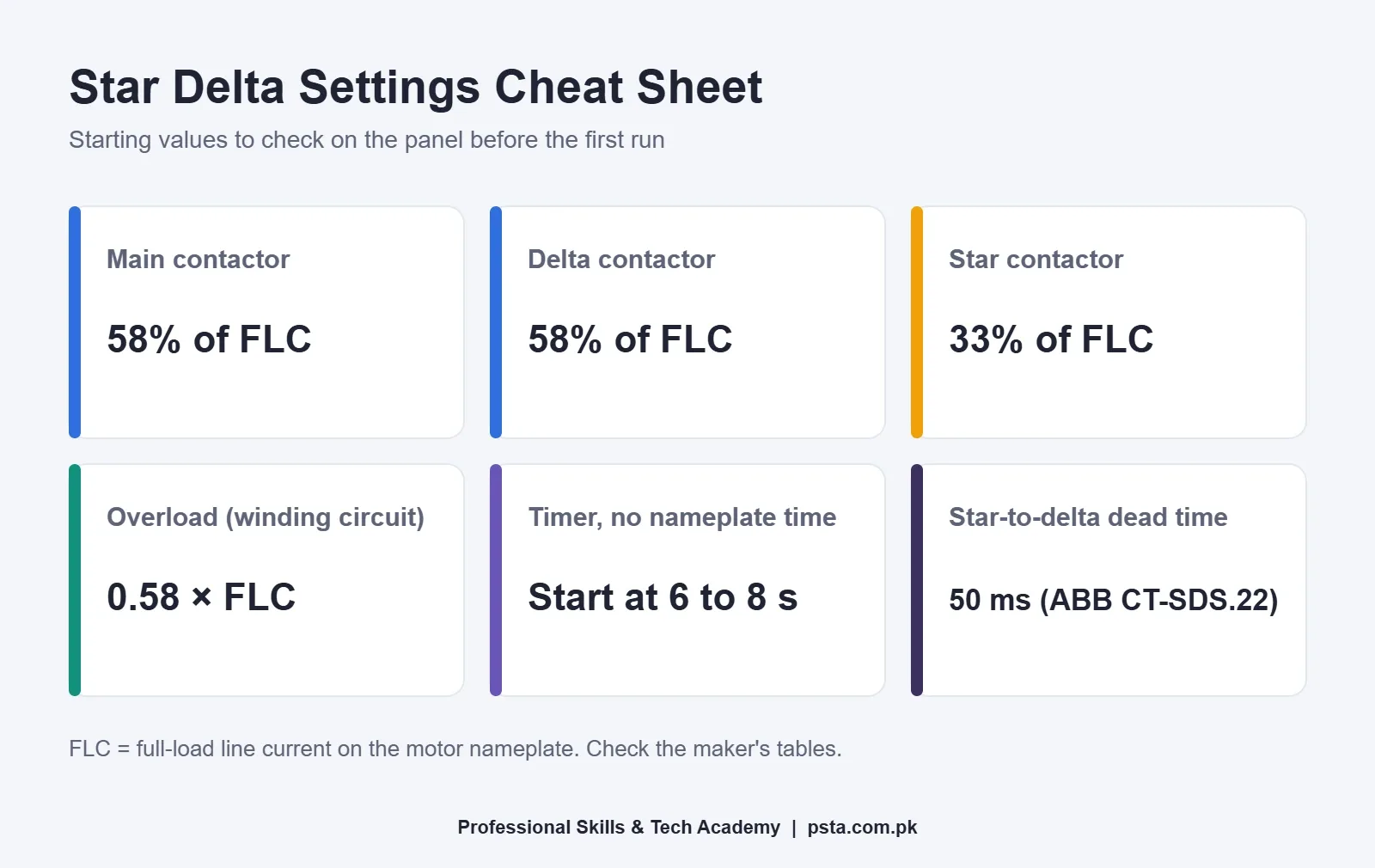
- • Set the timer to the nameplate starting time, or begin at 6 to 8 seconds.
- • An overload relay in the winding circuit is set near 0.58 times full-load current.
- • Main and delta contactors are sized at 58% of full-load current, the star contactor at 33%.
Table of contents 18 sections
- What Is a Star Delta Starter?
- Why Not Switch the Motor On Directly?
- Star vs Delta: What Changes Inside the Motor
- Check the Nameplate Before Anything Else
- Star Delta Starter Wiring: The Five Main Parts
- How the Star Delta Starter Sequence Runs, Step by Step
- How Do You Set the Star Delta Timer?
- A Simple Commissioning Habit
- Overload Relay Setting in a Star Delta Starter
- Star Delta Contactor Sizing With a Worked Example
- Which Motors and Loads Suit a Star Delta Starter?
- What Faults Do Technicians See Most Often?
- The Motor Trips on Overload Every Few Days
- The Motor Hums in Star but Never Changes Over
- A Loud Bang or Breaker Trip at Changeover
- The Motor Runs Backward or Jerks After Changeover
- Where PSTA's Panel Wiring Course Fits In
- Trace One Panel Before Your Next Shift
A star delta starter cuts the current a three-phase motor pulls from the mains at switch-on to one-third of what direct-on-line starting would draw, as Electrical4U explains. It starts the motor with its windings in star, then a timer swaps them to delta once the shaft is close to running speed. The trade-off is that starting torque drops by the same one-third, so it only suits loads that start light.
This explainer covers what happens inside the panel, in the order a technician meets it on the job:
- What star and delta mean for the voltage across each winding
- The five parts of a star delta panel and the job each one does
- The switching sequence, the timer and the 50 ms gap between contactors
- Overload relay setting and contactor sizing, with a worked example
- The faults you will be called out for most often, and how to check them
What Is a Star Delta Starter?
A star delta starter is a reduced-voltage starting method for three-phase induction motors. It uses three contactors, a timer and an overload relay. During starting, the motor windings are joined in star. After a set time, the windings are reconnected in delta and the motor runs at full voltage.
Electrical4U describes the effect as equal to an autotransformer with a 57.7% tapping. In plain terms, each winding sees about 58% of its normal voltage while the motor accelerates. Less voltage means less current, and less current means a smaller dip on the supply when a large pump or fan kicks in.
You will find this starter in tube well panels, water supply schemes, air compressors, cooling tower fans and many factory machines across Pakistan. It is cheap, it uses common parts, and almost every panel builder stocks the components.
Why Not Switch the Motor On Directly?
A direct-on-line (DOL) starter connects the motor straight to full voltage. That is fine for small motors. On a bigger motor, the surge at switch-on can trip the upstream breaker, dim lights on the same feeder and stress the cables and couplings.
The star delta starter is a compromise. Line current and torque both fall to about one-third of the DOL figures, according to Electrical4U. If the load can still turn at one-third torque, you get a gentler start for very little money. If it can't, the motor will stall or crawl in star, and DOL, a soft starter or a drive is the better choice.
Our industrial automation explainer compares the main starting methods in more depth if you want the wider picture first.
Star vs Delta: What Changes Inside the Motor
A three-phase motor has three windings. Each winding has a start lead and an end lead, so a motor built for this kind of starting brings all six leads out to the terminal box. How you join those six leads decides the voltage across each winding.
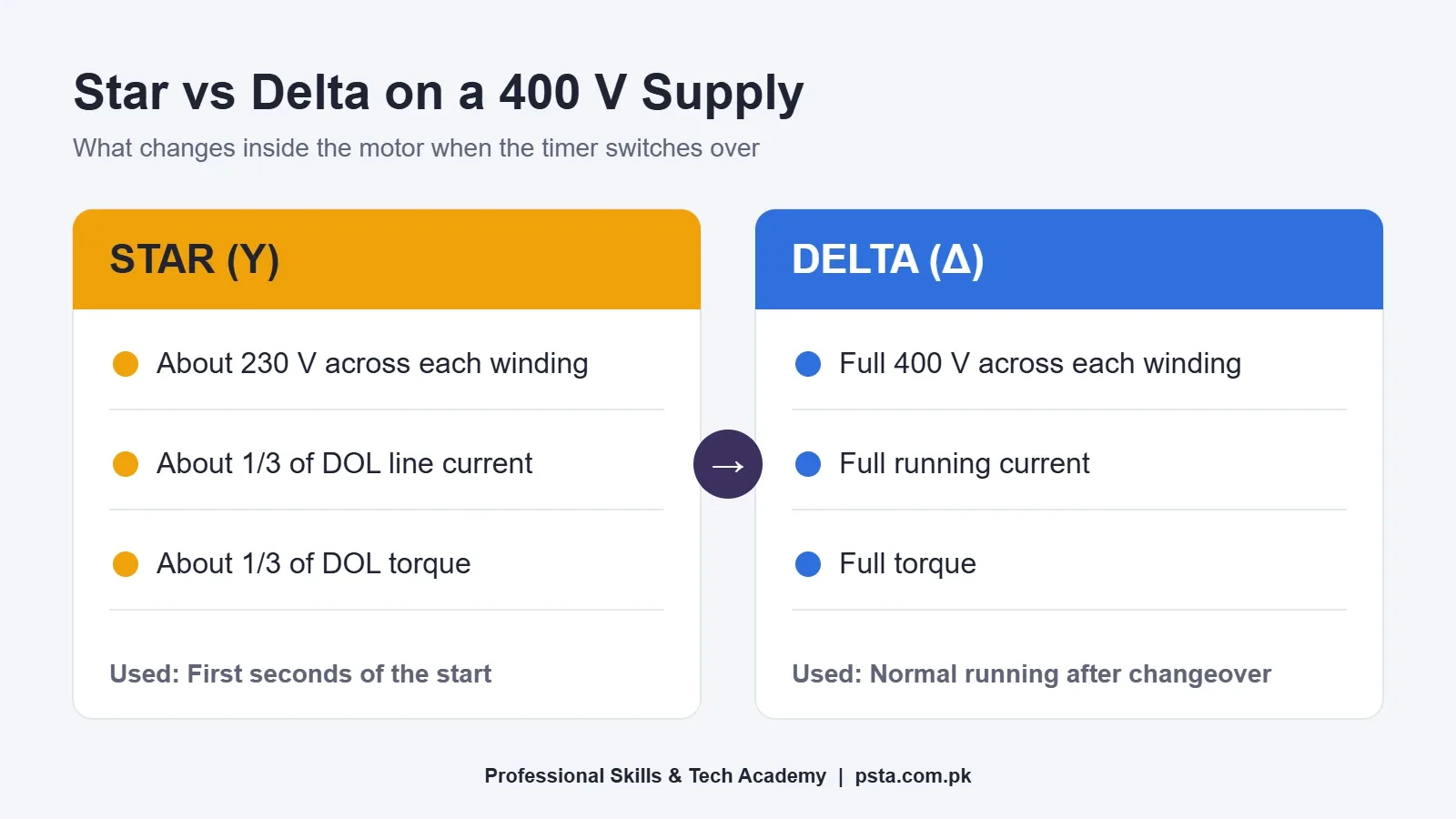
Pakistan's three-phase supply is 400 V at 50 Hz, according to the WorldStandards voltage table. Here is what that means for a 400 V supply:
| Point | Star (Y) Connection | Delta (Δ) Connection |
|---|---|---|
| How the ends join | All three winding ends tied at one point | Windings joined end to start in a closed loop |
| Voltage across each winding | About 230 V (400 V ÷ 1.732) | The full 400 V |
| Line current while starting | About one-third of DOL | Full DOL inrush if switched on directly |
| Torque available | About one-third of DOL torque | Full torque |
| When it is used | The first few seconds of acceleration | Normal running |
Check the Nameplate Before Anything Else
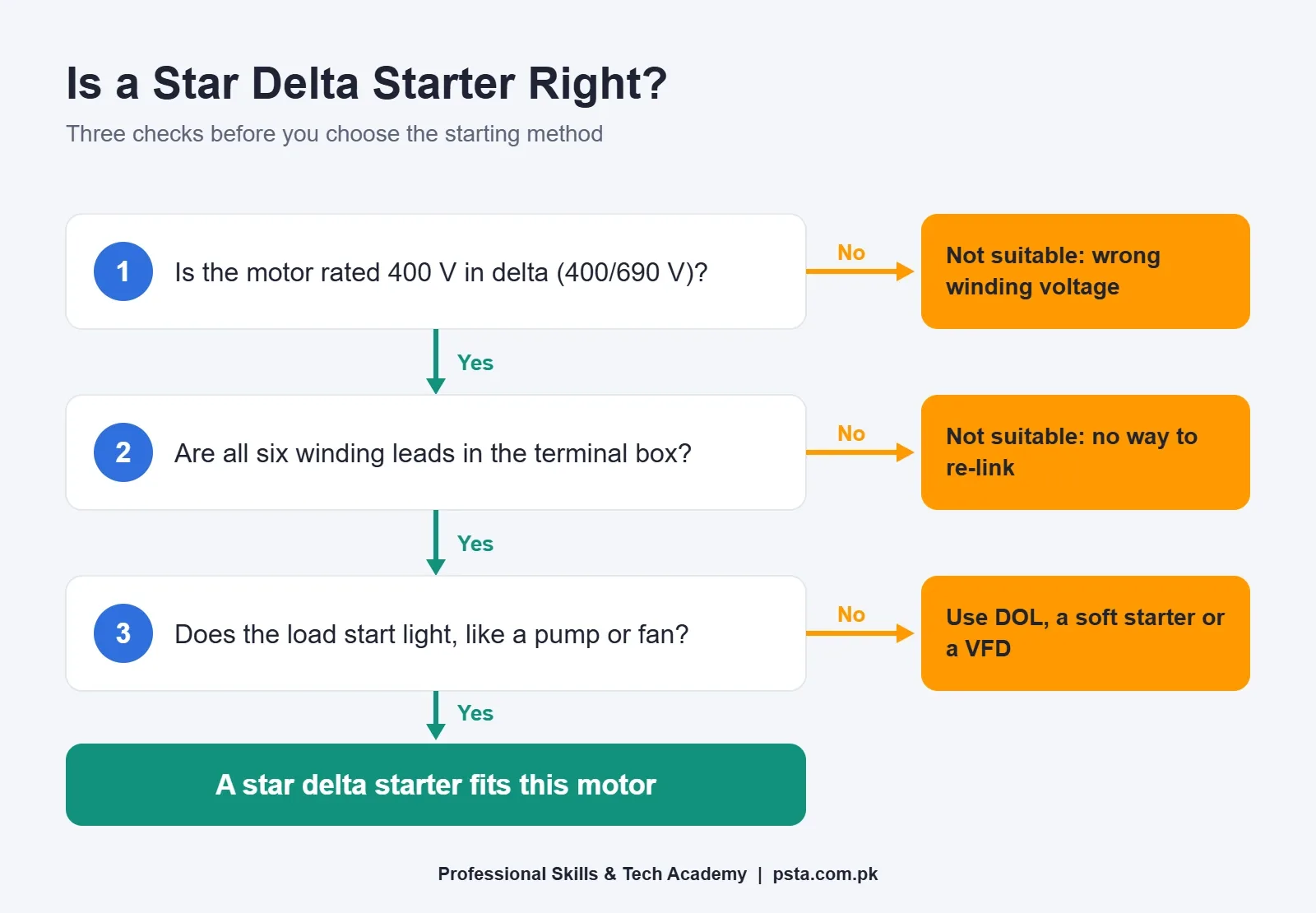
Electrical4U lists one firm condition: the motor must be rated for delta at the line voltage. On a 400 V supply, that means a nameplate reading 400/690 V. Inverterdrive's motor guide notes that motors of 4 kW and above are typically rated 400/690 V and run in delta on 400 V, while motors up to 3 kW are usually 230/400 V and run in star on 400 V.
A 230/400 V motor already runs in star on our supply. If you wire it into a star delta starter, the changeover puts 400 V across windings built for 230 V, and the motor will overheat or burn. Read the plate first, every time.
Star Delta Starter Wiring: The Five Main Parts
Open any star delta panel and you will find the same core set of parts, whichever brand built it:
- Main (line) contactor: connects the supply to the start leads of all three windings. It stays closed for the whole time the motor runs.
- Star contactor: shorts the three winding ends together during starting.
- Delta contactor: joins each winding end to the next phase, forming the delta loop for running.
- Star delta timer: decides how long the motor stays in star and controls the changeover.
- Overload relay: trips the control circuit if the motor draws too much current for too long.
Most panels also carry a breaker or fuses, start and stop push buttons and indicator lamps. Better-built panels add a phase monitoring relay. The Siemens RAJA+ starter guide describes a line monitoring relay that protects against phase loss, phase reversal, undervoltage, overvoltage and phase unbalance.
How the Star Delta Starter Sequence Runs, Step by Step
The timer's data sheet is the clearest place to see the sequence. ABB's CT-SDS.22 star delta timer data sheet sets it out, and most timers follow the same logic:
- You press Start. The main contactor and the star contactor close together, and the timer begins counting.
- The motor accelerates in star, drawing roughly one-third of DOL current.
- When the set time ends, the timer drops out the star contactor.
- A short dead time follows. On the ABB timer it is fixed at 50 ms, with a tolerance of 2 ms either way.
- The delta contactor closes. The motor now runs at full voltage and full torque.
- Pressing Stop, or an overload trip, opens the control circuit and drops both the main and delta contactors.
That dead time matters. If the star and delta contactors were ever closed at the same moment, they would short the supply phases together. Panels add a second layer of protection by wiring a normally closed auxiliary contact of each contactor into the coil circuit of the other. This electrical interlock is standard practice, and you should check it on every panel you service.
Electrical4U also points out that this is an open transition. The motor is briefly disconnected during the changeover, so a second current spike appears when delta closes. Switching at a sensible speed keeps that spike small.
How Do You Set the Star Delta Timer?
The star delta timer setting is where many panels go wrong. Too short, and the motor changes to delta while still slow, which brings back much of the inrush you were trying to avoid. Too long, and the motor labors in star with low torque and runs hot.
The Siemens RAJA+ guide gives a practical rule. Set the timer to the starting time on the motor nameplate if one is listed. If not, start at about 6 to 8 seconds. Then, during commissioning, time how long the motor takes to reach near rated speed, which you will hear as a steady hum, and set the timer to that figure.
The range on the timer itself is wide. The ABB CT-SDS.22 offers seven ranges, from 0.05 to 1 second at the short end up to 0.5 to 10 minutes at the long end. A fan with a heavy impeller needs more time than a small centrifugal pump. Set every star delta starter for its own machine, not from the last panel you wired.
A Simple Commissioning Habit
Put a clamp meter on one phase and watch it during a start. In star, the reading rises and then falls as the motor picks up speed. When the reading has settled near its lowest point, the motor is ready for delta. Note that time and set the timer to it, with a small margin.
Overload Relay Setting in a Star Delta Starter
New technicians ask about this more than anything else. The answer depends on where the overload relay sits, and the factor you will hear is 0.58.
In most star delta starter panels, the overload relay is wired after the main contactor, in series with the windings. In that position it measures phase current, not line current. In delta, phase current is the line current divided by 1.732, which is about 0.58 of the full-load current on the nameplate.
The Siemens guide says to set the relay initially to 0.58 times the rated motor current, then fine-tune it to the measured phase current, and never set it higher than the phase current. PolyPump's note on pump panels gives the same factor for overloads in the winding circuit, with an example: a 15 A pump gets an overload setting of about 8.7 A.
If the overload sits in the incoming line instead, before the split to the windings, it sees full line current and is set to 100% of full-load current. EEPower's star delta sizing article lists both cases. Trace the wiring before you touch the dial.
Star Delta Contactor Sizing With a Worked Example
Because current splits between the contactors, none of them carries full line current for the whole cycle. EEPower's sizing article uses these factors of the motor's full-load line current (FLC):
| Part | Factor of Line Full-Load Current | Example: 30 A Nameplate Current |
|---|---|---|
| Main contactor | 58% | 17.4 A or more |
| Delta contactor | 58% | 17.4 A or more |
| Star contactor | 33% | 9.9 A or more |
| Overload relay (in winding circuit) | 58% | Set near 17.4 A |
The 30 A motor here is an example for practice, not a specific product. Treat these factors as a minimum. In practice, panel builders often pick a size or two larger for hot rooms, frequent starts and dusty sites, and they follow the contactor maker's own selection table. EEPower's article does not cite a standard for the 58% and 33% factors, so manufacturer tables should have the final word.
Which Motors and Loads Suit a Star Delta Starter?
Use this starter when three things are true. The motor is rated for delta at 400 V. It has six leads in the terminal box. And the load needs little torque to get moving.
Centrifugal pumps, fans, blowers and unloaded compressors fit well, because their torque demand rises with speed. Electrical4U gives a centrifugal compressor as a typical example. Loads that need a hard push from standstill are a poor match. A loaded conveyor, a crusher or a positive displacement pump against pressure may never reach changeover speed in star. Electrical4U warns that a heavily loaded motor may stall before the switch to delta.
When a star delta starter is the wrong fit, the usual alternatives are:
- DOL starter: for small motors and loads that need full torque at once.
- Soft starter: ramps voltage smoothly with no open transition, useful where the changeover spike causes trouble.
- VFD: when you also need to vary speed, not just start the motor gently.
What Faults Do Technicians See Most Often?
Most callouts trace back to a short list of causes. Work through them in this order with the panel isolated and locked off.
The Motor Trips on Overload Every Few Days
Check the dial first. A relay in the winding circuit set to full nameplate current gives too little protection. One set below phase current trips on every start. Measure the running phase current and compare it with the setting. The Siemens guide notes the relay on its starters needs about 4 minutes before it can be reset after a trip.
The Motor Hums in Star but Never Changes Over
Look at the timer and the delta contactor coil. A burned coil, a loose control wire or a failed timer output will keep the motor in star. If the timer works but the motor is still slow at changeover, the load may be too heavy for star starting.
A Loud Bang or Breaker Trip at Changeover
This usually points to a missing interlock, a welded star contactor or a timer with no dead time. Inspect the star contactor tips for welding before you restart.
The Motor Runs Backward or Jerks After Changeover
If the delta links are wired to the wrong phases, the motor can reverse or brake when delta closes. Recheck the delta wiring against the drawing. The Siemens guide also notes its starters stop working when the voltage difference between any two phases exceeds 50 V, a check worth making on rural feeders.
Where PSTA's Panel Wiring Course Fits In
Reading about a star delta starter helps. Real confidence comes from wiring one, timing it with a clamp meter and finding a fault someone else planted. That is how the Master Industrial Automation course at PSTA is built.
Here is what the course page lists today:
- Duration: 3 months (12 weeks)
- Fee: Rs. 28,000, shown on the page against a previous Rs. 35,000
- Relevant modules: Motor Control Circuits (Hardwired Logic), Industrial Control Components and Protection, Motor Drives and Soft Starters, and Industrial Fault Finding and Troubleshooting
- Practical work: DOL, forward-reverse and star delta starter circuits, VFD setup and basic PLC logic
- Suited to: DAE and B-Tech graduates, working electricians moving into industry, and factory maintenance staff
Classes run at the Abbottabad campus on Old College Road in Mandian, facing FIMS College, and online for students outside Hazara. If you also need to read and draw electrical layouts, the AutoCAD course pairs well with panel work. Preparing for factory interviews? Our PLC interview questions guide covers what shift in-charges tend to ask.
Other programs are listed on the courses page. When you are ready, fill in the admission form or send the admissions team a note on WhatsApp at +92 314 5424399 with questions about batch dates.
Trace One Panel Before Your Next Shift
Pick one star delta starter at your workplace, isolate it properly and follow each wire with the drawing in hand. Mark the main, star and delta contactors, find where the overload relay sits and note its setting. Then compare that setting with 0.58 times the nameplate current. Ten minutes of tracing will teach you more than any diagram, and you may catch a wrong setting before it costs a motor.
Frequently asked questions
Can I use a star delta starter on a single-phase motor?
No. Star and delta are ways of joining the three windings of a three-phase motor, so the method has no meaning for a single-phase motor. Single-phase motors use their own starting parts, such as a start capacitor and a centrifugal switch, and small ones are usually switched on directly.
Why does my motor run fine in star but trip when it switches to delta?
The usual causes are a timer set too short, so the motor changes over while still slow, a missing or faulty interlock, or delta links wired to the wrong phases. Check the timer against the real run-up time, inspect the star contactor for welded tips and compare the delta wiring with the panel drawing.
What happens if I leave the motor running in star permanently?
Each winding gets only about 58% of its rated voltage, so the motor produces about one-third of its normal torque. Under real load it will slow down, draw more current than it should for the work done and run hot. The overload relay may trip, or the windings may age early if the setting is wrong.
Is a star delta starter cheaper than a VFD?
For a basic start, usually yes. A star delta starter uses three standard contactors, a timer and an overload relay, all widely stocked. A VFD costs more but also gives speed control and a smooth start with no open transition. Compare quotes for the exact motor size, because prices for both change often.
Do I need a phase monitoring relay in a star delta panel?
It is not part of the basic circuit, but it is a sensible addition on rural or unstable supplies. The Siemens RAJA+ guide describes a line monitoring relay that guards against phase loss, phase reversal, undervoltage, overvoltage and phase unbalance, all supply faults that can harm a motor on a long feeder.
How long should a three-phase motor stay in star?
Use the starting time on the motor nameplate if one is listed. If not, the Siemens RAJA+ guide suggests about 6 to 8 seconds as a first setting. Then time the actual run-up with a clamp meter or by ear during commissioning, and set the timer to match that machine.
Can a soft starter replace a star delta starter on the same motor?
In most cases, yes. A soft starter ramps the voltage smoothly and needs only three motor leads, so the motor can stay linked in delta. It removes the current spike at changeover. Check the soft starter's rating against the motor's full-load current and the number of starts per hour.
Sources & references
- Star Delta Starter: Circuit Diagram, Working Principle & Theory (Electrical4U) electrical4u.com
- Electronic Timer CT-SDS.22 Star-Delta Data Sheet (ABB) library.e.abb.com
- Installation, Maintenance & Troubleshooting Guide for RAJA+ Starters (Siemens) assets.new.siemens.com
- Motor Starters Part 4: Selecting and Sizing Star-Delta Parts (EEPower) eepower.com
- Star-Delta Overload Settings Explained for Pump Control Panels (PolyPump) polypump.co.uk
- AC Induction Motor Star and Delta Connections Explained (Inverterdrive) inverterdrive.com
- Three-Phase Electric Power by Country (WorldStandards) worldstandards.eu
Last reviewed & updated on by Umar Qureshi. Written by the PSTA team in Abbottabad, Pakistan.

Umar Qureshi

Master Industrial Automation: Single & Three-Phase Panel Wiring, PLC & VFD Certification
Turn this guide into a career: hands-on training with real projects, online across Pakistan or on-campus in Abbottabad · 3 Months (12 Weeks).


Comments
No comments yet — ask a question or share your experience.