Quick answer
Industrial automation means using control devices to run machines with little direct human effort. Inside a control panel, breakers, contactors, overload relays, VFDs and a PLC start, protect and sequence motors. Learn the panel first, then starters, then PLC logic, and you can work across textile, steel and food plants.
Key takeaways
- • Industrial automation runs machines through a control panel, not constant human effort.
- • A big motor needs a starter because direct-on-line current is 300% to 800% of full-load.
- • A VFD varies frequency and voltage; a fan at half speed uses about 12.5% of the power.
- • A PLC replaces relays with software, written in the five IEC 61131-3 languages.
- • Safety comes first: lockout/tagout and a megger test protect you and the motor.
- • The skill travels, with demand in Pakistani estates and the Gulf.
Table of contents 15 sections
- What Is Industrial Automation?
- Where Is Industrial Automation Used in Pakistan?
- What Is Inside a Control Panel?
- The Switching and Protection Group
- The Control and Automation Group
- Why Can't You Just Switch a Big Motor On?
- What Does a VFD Actually Do?
- What Is a PLC, and How Is It Programmed?
- What Is an HMI?
- How Do Technicians Find Faults Safely?
- Key Numbers Every Technician Should Know
- What Do Industrial Automation Jobs Pay, and Where Are They?
- Common Beginner Mistakes to Avoid
- Learn Industrial Automation With PSTA
- Your First Step This Week
Here is a situation you will meet on day one of a factory job (this is an example, not a real client). A conveyor motor in a Hattar textile unit trips every time it starts. The line stops, and the shift in-charge looks at you. To fix it, you need to know what industrial automation is: the components in that control panel, why a big motor cannot just be switched straight on, and how to find the fault without guessing.
This guide explains industrial automation in plain words, built around the control panel you will actually wire and repair. No deep math, just the parts, the ideas and the jobs behind them.
Read on and you will be able to:
- Explain what industrial automation means and where Pakistan uses it
- Name every main component inside a control panel
- Say why motors need starters, and what a VFD adds
- Describe what a PLC does and which languages program it
- Follow how technicians find faults safely, and see where the jobs are
What Is Industrial Automation?
Industrial automation means using control devices to run machines with little direct human effort. Instead of a worker standing at a switch, a panel of components starts, stops, protects and sequences the motors for you. A person still sets the targets and watches the screen. The panel handles the second-by-second work.
Think of three layers. At the bottom are the field devices: motors, valves and sensors that do the physical work. In the middle is the control panel, which decides when each device runs. At the top is the operator, who gives instructions and reads results. Industrial automation is mostly about that middle layer.
Where Is Industrial Automation Used in Pakistan?
You will find it anywhere motors run a process. Textile mills in Faisalabad and Hattar use it for spinning and weaving lines. Steel and cement plants use it for crushers, kilns and conveyors. Food and beverage factories use it for filling and packing. Water treatment and tube wells use it for pumps.
The common thread is a three-phase motor driving something, with a panel protecting and controlling it. Learn the panel, and you can move between all of these industries. That flexibility is a big reason the skill travels well, including to the Gulf.
What Is Inside a Control Panel?
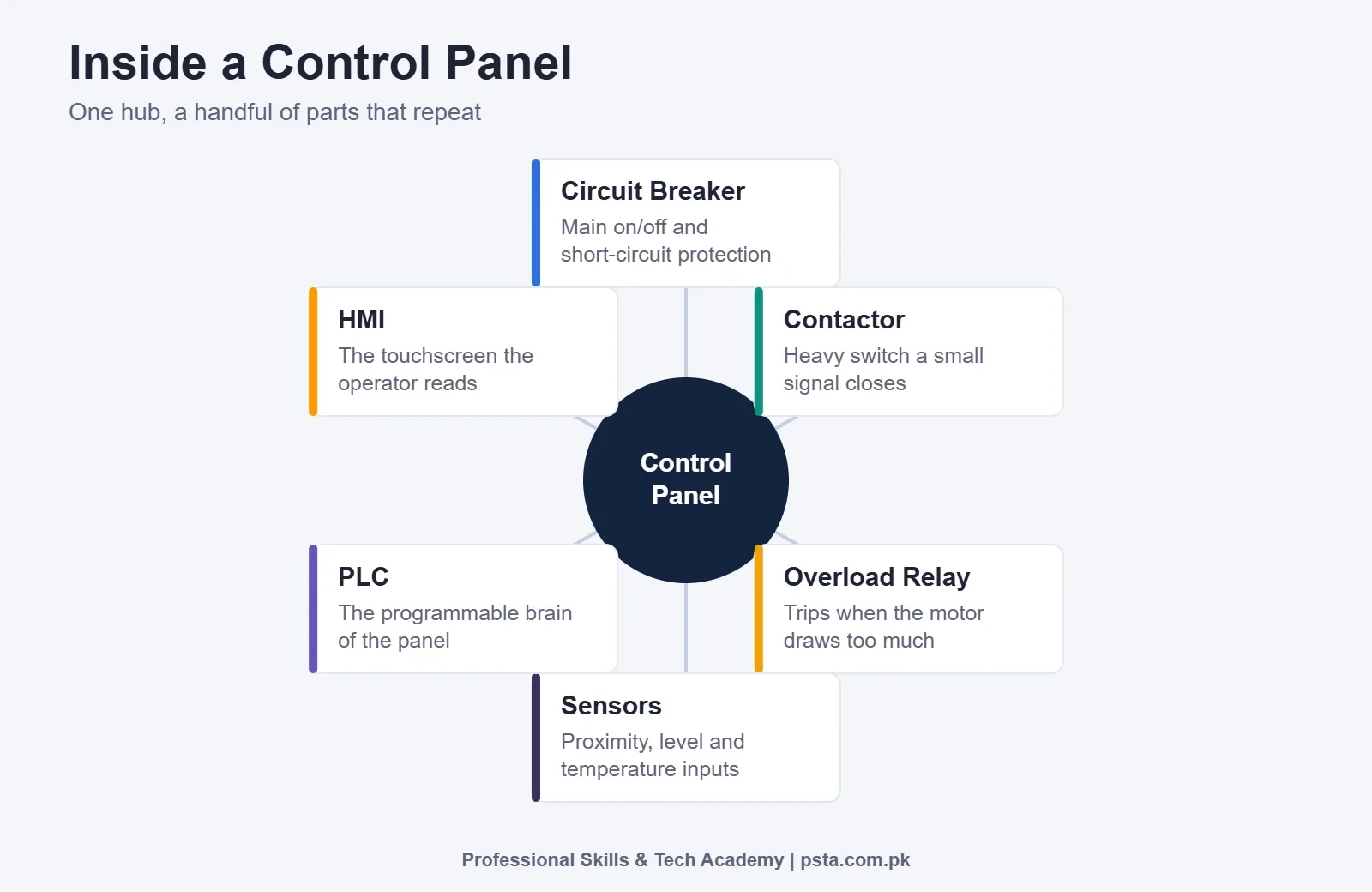
A control panel looks confusing at first, but it is a small number of parts repeated. Here is each one in plain language, grouped by what it does.
The Switching and Protection Group
- Circuit breaker (MCB or MCCB): the main on/off and the first line of protection. It cuts power on a short circuit or heavy overload.
- Contactor: a heavy-duty, electrically operated switch. A small control signal makes it close large contacts that carry the motor current. This is how a tiny push button can control a large motor.
- Overload relay: watches the motor current and trips if the motor draws too much for too long, which saves the windings from burning.
- Control transformer and fuses: supply a safe, lower voltage to the control circuit and protect it.
The Control and Automation Group
- Push buttons and selector switches: the operator's start, stop and mode controls.
- Relays and timers: small switches and delays that build simple logic, such as "wait six seconds, then change over."
- Sensors: proximity, level and temperature devices that tell the panel what the machine is doing.
- PLC and HMI: the programmable brain and its touchscreen, covered in their own sections below.
Why Can't You Just Switch a Big Motor On?
A three-phase induction motor pulls a large surge of current the instant it starts, far more than it uses when running. For direct-on-line starting on small motors, that surge is typically "300% to 800% of the full-load current or even higher," according to the Electrical Engineering Portal. On a large motor, that surge dims lights, trips breakers and stresses the machine.
So technicians pick a starting method that fits the motor size:
- Direct-on-line (DOL): the simplest. A contactor connects the motor straight to full voltage. Fine for small motors.
- Star-delta: starts the motor in a star connection, then switches to delta once it is moving. The same source notes star-delta gives "a low starting current of only about one third of that found with direct-on-line starting," though it also cuts starting torque to about a third.
- Soft starter and VFD: electronic methods that ramp the motor up smoothly, covered next.
Knowing which method a motor needs, and how to wire it, is core panel work. The conveyor in the opening example was almost certainly a starter or overload problem.
What Does a VFD Actually Do?
A Variable Frequency Drive (VFD) controls the speed of an AC motor by changing the frequency and voltage it receives. A standard motor on 50 Hz mains runs at one fixed speed. Feed it 25 Hz through a VFD and it runs at roughly half speed, smoothly and under control.
Inside, a VFD works in three stages, as VFDs.com explains: a rectifier turns incoming AC into DC, a DC bus with capacitors smooths it "in a similar fashion to a reservoir," and an inverter switches that DC back into AC at whatever frequency you set.
The payoff on fans and pumps is large. Because of the affinity laws, the same source notes that if "you cut a fan's speed to 50% of its original speed, you would generate only 25% of the pressure and use only 12.5% of the power." For a factory running fans and pumps all day, that energy saving is a strong reason to install VFDs, and a strong reason employers want technicians who can set them up.
What Is a PLC, and How Is It Programmed?
A Programmable Logic Controller (PLC) is a rugged industrial computer that replaces racks of relays and timers with software. Instead of rewiring the panel to change how a machine behaves, you change the program. That is the heart of modern industrial automation.
PLC programming follows an international standard, IEC 61131-3, which defines five languages. As Real Time Automation describes them, three are graphical (Ladder Diagram, Function Block Diagram and Sequential Function Chart) and two are textual (Structured Text and Instruction List, the latter "deprecated in recent standard updates").
Beginners almost always start with Ladder Diagram. It looks like the relay wiring diagrams technicians already read, so it bridges from hardwired panels to software. Once you can write a ladder rung for "start, seal-in and stop," you understand the idea behind most PLC logic.
What Is an HMI?
An HMI (Human-Machine Interface) is the touchscreen on the panel. It shows the operator what the PLC is doing, such as line speed, counts and alarms, and lets them change settings without opening the panel. PLC and HMI are learned together because one controls and the other displays.
How Do Technicians Find Faults Safely?
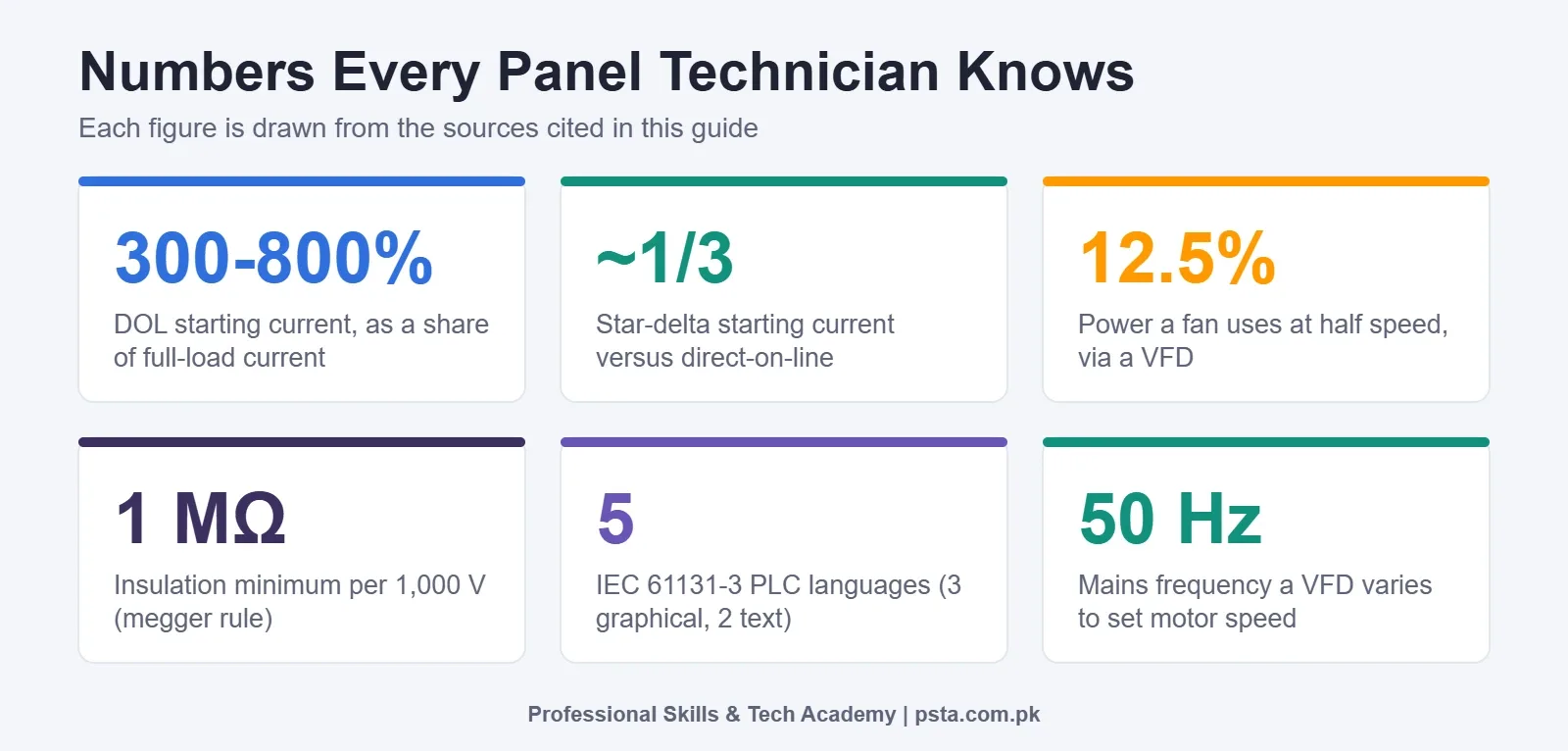
Most industrial work is not building new panels. It is fixing ones that have stopped, often with a production line waiting. The order of work matters, and safety comes first every time.
The international rule is Lockout/Tagout (LOTO). Under the US standard 29 CFR 1910.147, described by OSHA, you isolate the energy source and lock it so no one can switch it on while you work. Pakistani factories supplying export buyers increasingly expect the same discipline.
Three instruments do most fault finding:
- Multimeter: checks voltage, continuity and whether a control circuit is live.
- Clamp meter: reads the current a motor draws without breaking the circuit, so you can spot an overloaded motor.
- Megger (insulation tester): checks whether motor windings or cables have leaked to earth.
For the megger, learn the one-megohm rule. The Megger insulation guide states that insulation resistance "should be approximately one megohm for each 1,000 volts of operating voltage, with a minimum value of one megohm." A reading well below that points to damaged insulation before the motor fails completely.
Key Numbers Every Technician Should Know
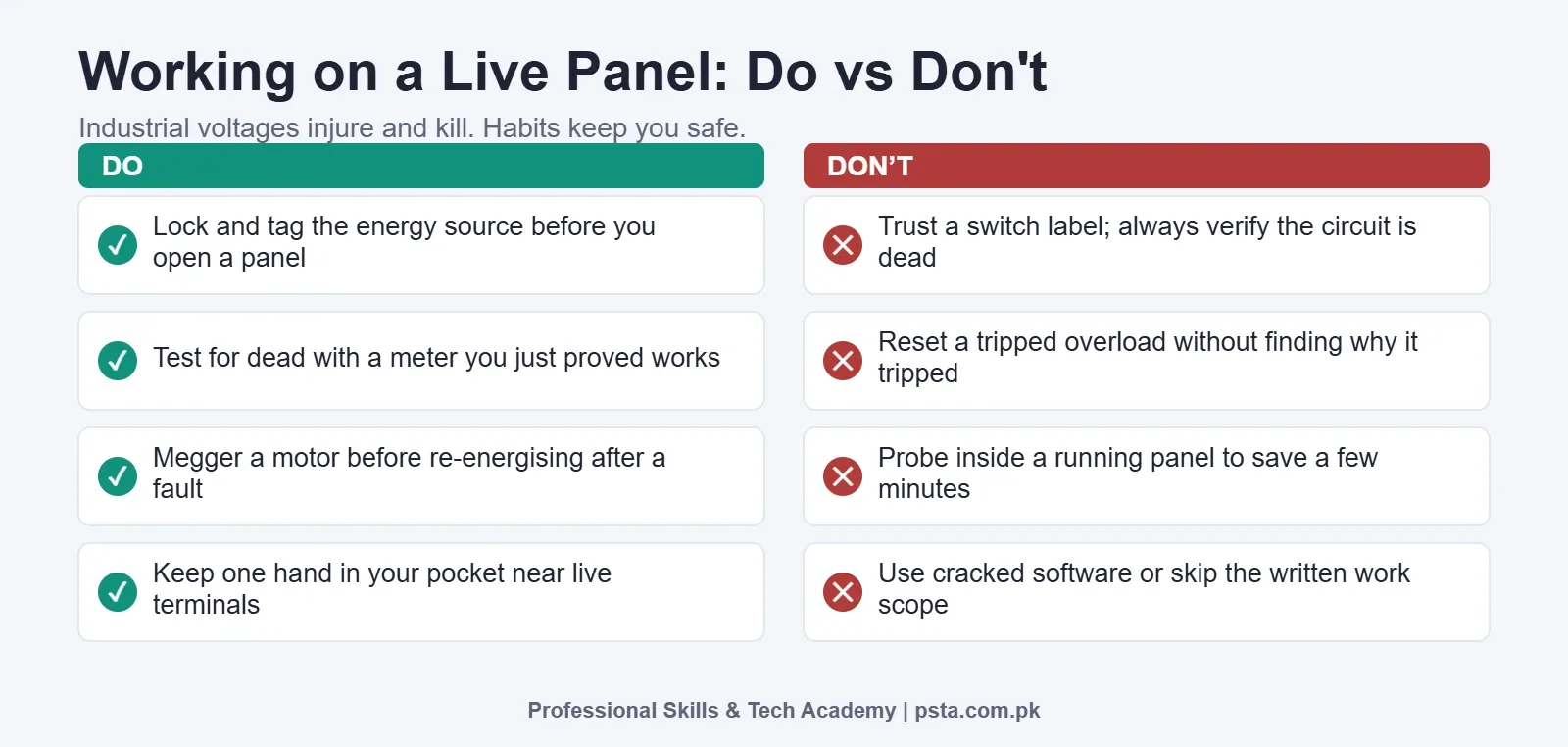
These figures come up constantly on the job. Each one is verified from the sources linked in this guide.
| Idea | The Number | Why It Matters |
|---|---|---|
| DOL starting current | 300% to 800% of full-load current | Why large motors need a softer start |
| Star-delta starting current | About one third of DOL | A cheap way to reduce the surge |
| VFD energy at half fan speed | About 12.5% of full power | The main money-saving case for VFDs |
| Insulation minimum | 1 megohm per 1,000 V, at least 1 megohm | The pass/fail line for a megger test |
| IEC 61131-3 languages | 5 (3 graphical, 2 textual) | The standard behind PLC programming |
What Do Industrial Automation Jobs Pay, and Where Are They?
Honest answer: pay depends on your skill and the plant, and I will not quote a salary I cannot verify. What I can tell you is where demand sits. Inside Pakistan, industrial estates like Hattar and Gadoon Amazai, plus textile, steel and food plants, hire panel technicians and automation staff.
Abroad, the Gulf is the bigger prize. Saudi Arabia now runs a Skill Verification Program for workers coming from Pakistan, and the trades it tests include building electrician and auto electrician, as TechJuice reported. A candidate who can prove real panel and motor-control skill, rather than theory alone, is exactly what that test is built to find. Solid hands-on training is how you pass it.
Common Beginner Mistakes to Avoid
- Skipping the basics for the PLC. Students want to jump to programming. If you cannot wire a DOL starter or read a schematic, PLC work will not stick.
- Treating safety as optional. Industrial voltages injure and kill. LOTO and insulation testing are not paperwork, they are why you go home safe.
- Guessing instead of measuring. A multimeter answers in seconds what an hour of guessing cannot.
- Learning only on paper. You cannot learn panel wiring from videos alone. You need to build and break real circuits under supervision.
Learn Industrial Automation With PSTA
If you want hands-on practice with instructors who have factory experience, PSTA's Industrial Automation and Panel Wiring course covers everything in this guide. It runs for 3 months (12 weeks) at beginner level, online across Pakistan or on campus in Abbottabad. The course page lists the fee at Rs. 28,000 (reduced from Rs. 35,000).
The eight modules follow the same path as this guide:
- Fundamentals of industrial electricity and safety
- Control components and protection, then hardwired motor control circuits (DOL, reverse-forward, star-delta)
- Sensors and input devices
- Motor drives and soft starters (VFDs)
- Introduction to PLC and HMI integration
- Industrial fault finding and troubleshooting, then a final project and certification
Training is on live rigs, so you wire real panels rather than watch slides. If you are weighing technical paths, you can also look at our AutoCAD course for design work, or read our guide on how to learn AutoCAD in Pakistan to compare. Browse everything on the courses page.
Your First Step This Week
You do not need a lab to start. Find one photo of a three-phase control panel online and name every part you can: breaker, contactor, overload relay, terminals. The parts you cannot name are your first lesson. That small habit, naming before touching, is how safe technicians think.
When you want real rig time and guidance, you can apply for admission online or message us on WhatsApp at +92 314 5424399 to ask about the next batch. Our campus is on Mandian, Old College Road, opposite FIMS College, Abbottabad.
Frequently asked questions
What is industrial automation in simple words?
It is using control devices to run machines so a worker does not have to stand and operate them by hand. A panel of parts starts, protects and sequences the motors, while a person sets the targets and watches the screen. You see it on conveyors, pumps and production lines.
Do I need a diploma to learn industrial automation?
No. A DAE in electrical helps and many students have one, but it is not required to begin. What matters is understanding basic electricity and being willing to do hands-on practice. Beginners start with safety and simple motor control, then move to drives and PLCs step by step.
What is the difference between a PLC and a VFD?
They do different jobs. A VFD controls the speed of one motor by changing the frequency and voltage it receives. A PLC is the programmable brain that decides when motors, valves and drives should run, based on inputs from sensors and buttons. A panel often uses both together.
Which PLC programming language should a beginner learn first?
Ladder Diagram. It is one of the five IEC 61131-3 languages and it looks like the relay wiring diagrams technicians already read, so it is the easiest bridge from hardwired panels to software. Once you can build a start, seal-in and stop rung, most other logic makes sense.
Is industrial automation a good career in Pakistan?
Demand is steady wherever motors run a process, such as textile, steel, cement and food plants, and in estates like Hattar and Gadoon Amazai. The skill also travels to the Gulf. Pay depends on your skill and the employer, so treat any fixed salary promise with caution and focus on proven hands-on ability.
What tools do I need to start practising panel wiring?
At the basic level, a multimeter, a clamp meter and an insulation tester (megger) cover most work, along with hand tools and the panel components themselves. More important than owning tools is practising on real, de-energised rigs under supervision so you learn safe habits before you touch anything live.
How long does it take to learn industrial automation?
A focused beginner course of about three months can take you from safety basics to simple PLC logic, as PSTA's 12-week program does. Becoming confident on the job takes longer and comes from repeated practice. Treat the course as the foundation, then keep building on real panels.
Sources & references
- Comparison of DOL and Star-Delta Motor Starting electrical-engineering-portal.com
- What is a Variable Frequency Drive? vfds.com
- What are IEC 61131-3 and PLCopen rtautomation.com
- Control of Hazardous Energy (Lockout/Tagout) osha.gov
- Megger Guide to Insulation Testing instrumart.com
- Saudi Skilled Worker Verification in Pakistan techjuice.pk
Last reviewed & updated on by Umar Qureshi. Written by the PSTA team in Abbottabad, Pakistan.

Umar Qureshi
Master Industrial Automation: Single & Three-Phase Panel Wiring, PLC & VFD Certification
Turn this guide into a career: hands-on training with real projects, online across Pakistan or on-campus in Abbottabad · 3 Months (12 Weeks).


Comments
No comments yet — ask a question or share your experience.