
Quick answer
Most PLC interview questions for fresh technicians cover six areas: the scan cycle, IEC 61131-3 languages, sinking and sourcing I/O, 4-20 mA scaling, timers and motor control, and safe troubleshooting. Practice explaining each out loud, sketch a seal-in rung from memory, and answer honestly when you are unsure.
Key takeaways
- • A PLC reads inputs, runs its program, writes outputs, then does housekeeping, in a repeating scan.
- • A normally closed stop button uses a normally open contact in the program.
- • PNP sensors pair with sinking inputs; NPN sensors pair with sourcing inputs.
- • 4 mA is a live zero, so 0 mA signals a fault; 12 mA on a 0 to 100 psi range is 50 psi.
- • Troubleshoot from the PLC outward and lock out before opening a power circuit.
- • Name only the PLC software you have actually used.
Table of contents 11 sections
- What Do PLC Interview Questions Usually Cover?
- Basic PLC Interview Questions on Logic and the Scan Cycle
- Which PLC Programming Languages Should You Know?
- Wiring and I/O Questions
- How Do You Answer 4-20 mA Signal Questions?
- Timer, Counter and Motor Control Questions
- Troubleshooting and Safety Questions
- Which PLC Software Questions Come Up?
- What If You Don't Know the Answer?
- Preparing With PSTA's Industrial Automation Course
- Practice One Answer Tonight
What does a factory interviewer actually ask a fresh PLC technician? Most PLC interview questions for entry-level jobs fall into six areas: PLC basics and the scan cycle, programming languages, input and output wiring, 4-20 mA analog signals, timers and motor control, and safe troubleshooting. If you can explain each area in plain words and sketch a simple rung on paper, you can handle most first-round panels.
This guide gives you 20 questions for a PLC technician interview, with model answers written the way a working technician would say them. Read each answer, then close the page and try saying it out loud in your own words. That habit matters more than memorizing.
Here's what you'll be able to do after reading:
- Explain the scan cycle and why it changes how a program behaves
- Name the five IEC 61131-3 languages and pick the right one for a job
- Match PNP and NPN sensors to sinking and sourcing inputs
- Convert a 4-20 mA reading into a real pressure or level value
- Talk through a motor fault and lockout/tagout without guessing
What Do PLC Interview Questions Usually Cover?
PLC interview questions for maintenance, panel and junior automation roles in textile, cement, food and pharma plants tend to follow the same pattern. A senior engineer asks a few theory questions, then hands you a pen and asks you to draw something. Some plants add a practical test on a trainer kit. Expect ladder logic questions on paper, and VFD interview questions if the plant runs many drives.
The interviewer isn't looking for a walking textbook. They want to see three things. First, do you understand how a PLC thinks? Second, can you read a field device and wire it correctly? Third, will you stay safe and calm when a line stops? Every question below tests one of those three.
| Question Area | What It Tests | Questions in This Guide |
|---|---|---|
| Basics and logic | How a PLC thinks | Q1 to Q4 |
| Programming languages | Choosing the right tool | Q5 and Q6 |
| I/O wiring | Reading field devices | Q7 to Q9 |
| Analog signals | Scaling and fault finding | Q10 to Q12 |
| Timers, counters, motors | Everyday machine logic | Q13 to Q17 |
| Troubleshooting, safety, software | Working on a live plant | Q18 to Q20 |
Basic PLC Interview Questions on Logic and the Scan Cycle
Q1. What is a PLC, and why do factories use one instead of relays?
A PLC is an industrial computer that reads inputs such as push buttons and sensors, runs a stored program, and switches outputs such as contactors, valves and lamps. Factories prefer it because changing the logic means editing software, not rewiring a panel. It also shows the live status of every input and output, which makes fault finding much faster.
Q2. Explain the PLC scan cycle.
The PLC repeats four stages in a loop. It reads all inputs and stores them in an input image. It runs the user program using that stored image. It writes the results to the outputs. Then it handles housekeeping such as communication and diagnostics. Crouzet's guide to the scan cycle notes that scan time is measured in milliseconds and the loop can run hundreds or even thousands of times per second.
Add one line to stand out: because inputs are read only at the start of each scan, a very short pulse can be missed if it starts and ends in the middle of one.
Q3. A stop button is wired as normally closed. Which contact do you use in the program?
This is a classic trap. The physical stop button is normally closed, so the input is ON while nobody presses it. In the program you use a normally open (examine-if-closed) contact on that input. When someone presses stop, the input goes OFF, the contact opens and the motor drops out. Plants wire stop buttons this way so that a broken wire also stops the machine instead of leaving it running with no way to stop it.
Q4. What is a seal-in (latching) circuit?
It's a rung where the motor output holds itself on after you release the start button. You place a contact of the output in parallel with the start button, and the stop contact in series with both. Press start and the output turns on, then its own contact keeps the rung true. Press stop and the rung breaks. Draw it if they hand you paper. A clean sketch says more than a long explanation.
Which PLC Programming Languages Should You Know?
Q5. Name the IEC 61131-3 programming languages.
The standard defines five: ladder diagram, function block diagram, sequential function chart, structured text and instruction list. Control.com's overview of PLC languages describes the first three as graphical and the last two as text-based. It also notes that instruction list was deprecated in the third edition of the standard, so you'll rarely see it in new projects.
| Language | Type | Good For |
|---|---|---|
| Ladder Diagram (LD) | Graphical | On/off logic that electricians can read like a relay drawing |
| Function Block Diagram (FBD) | Graphical | Logic built from blocks, common in process control |
| Sequential Function Chart (SFC) | Graphical | Step-by-step sequences such as batch mixing |
| Structured Text (ST) | Text | Math, loops, arrays and data handling |
| Instruction List (IL) | Text | Older code only; deprecated in the third edition |
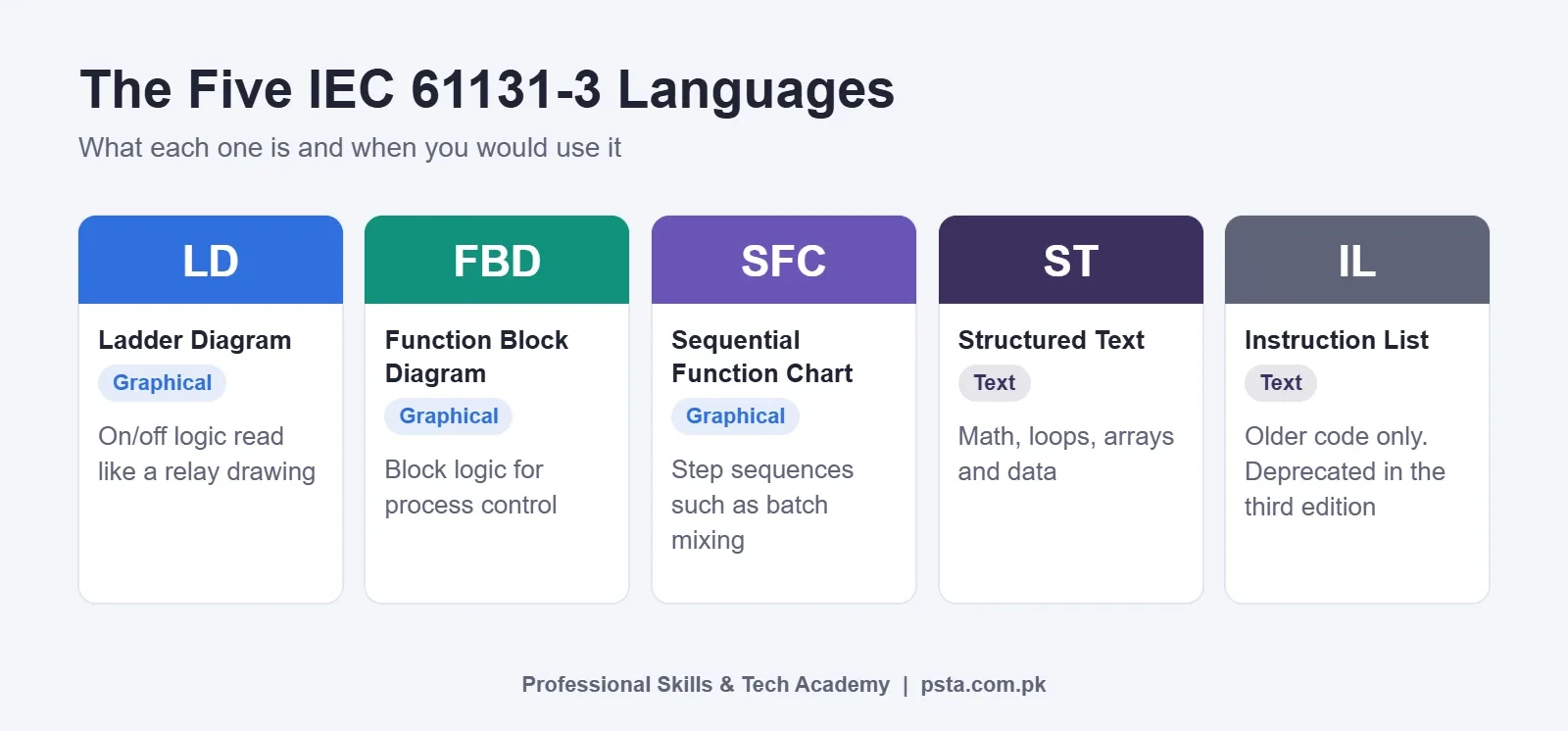
Q6. Which language would you choose for a batch mixing tank, and which for a flow calculation?
For the mixing tank, sequential function chart fits best because the process moves through clear steps: fill, heat, mix, drain. For a flow calculation with scaling and averaging, structured text is cleaner than a long ladder of math blocks. Saying why you'd choose each one shows judgment, which is what this question really tests.
Wiring and I/O Questions
Q7. What is the difference between sinking and sourcing?
Sourcing means providing the positive supply. Sinking means providing the return path to negative. According to Control.com's sinking and sourcing guide, sinking inputs are the more common style. Most outputs are sourcing, so they supply 24 V to the load when they switch on.
Q8. Which sensor goes with a sinking input, PNP or NPN?
A PNP sensor switches the +24 V side, so it sources current and pairs with a sinking input. An NPN sensor switches the 0 V side and pairs with a sourcing input. Industrial Monitor Direct's wiring note points out that a mismatched pair means the input simply never turns on. That's a fault you'll meet on site, so mention it.
Q9. What is the difference between digital and analog I/O?
Digital I/O has two states, on or off: a limit switch, a proximity sensor, a contactor coil. Analog I/O carries a range of values: a pressure transmitter, a level sensor or a speed reference to a drive. Analog signals usually arrive as 4-20 mA or 0-10 V, and the PLC converts them to a number your program can use.
How Do You Answer 4-20 mA Signal Questions?
Q10. Why does the standard start at 4 mA and not 0 mA?
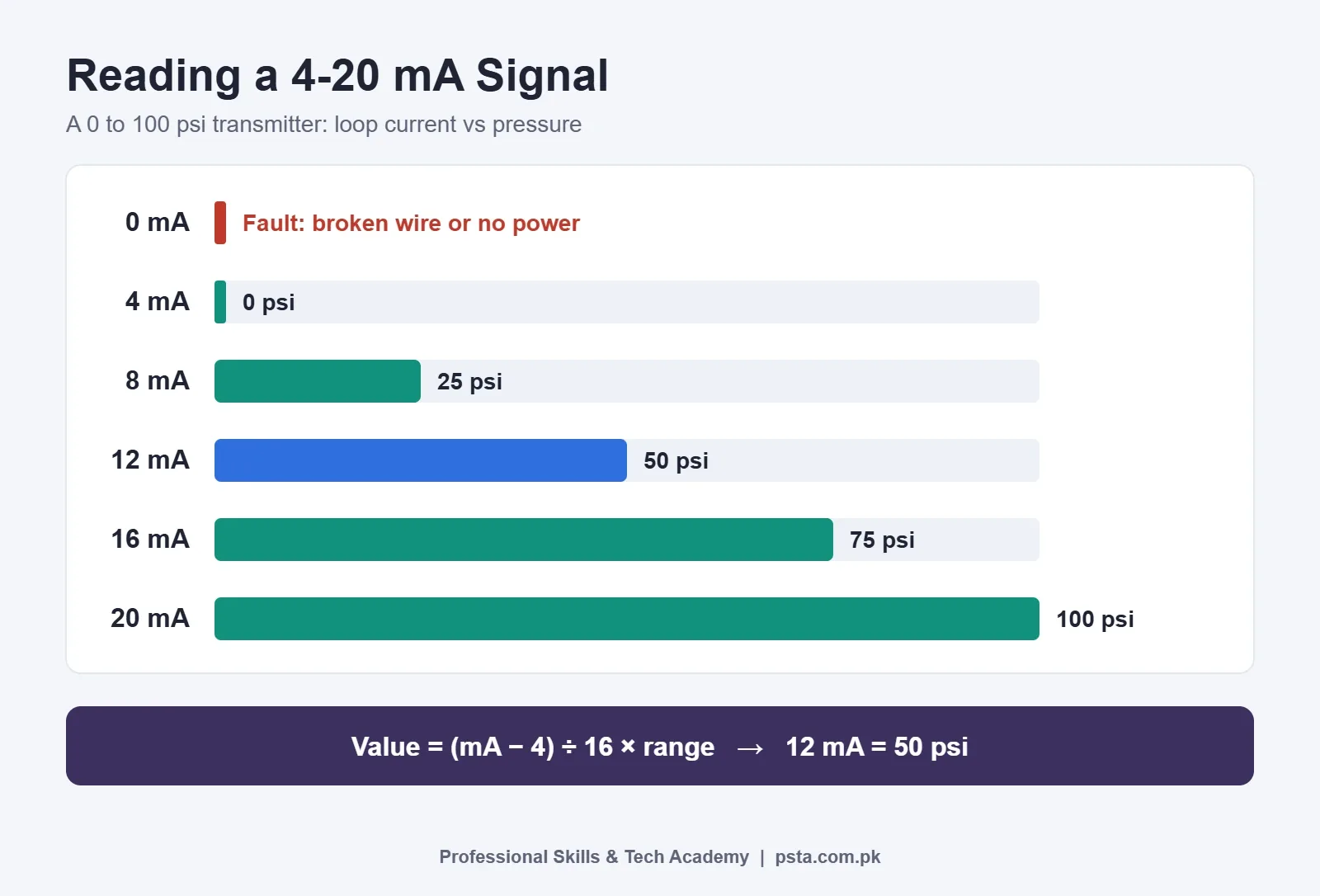
Because 4 mA is a "live zero." A healthy loop always carries at least 4 mA, so the PLC can tell an empty tank (4 mA) from a broken wire or dead transmitter (0 mA). Fabrico's 4-20 mA explainer adds that some systems flag readings below about 3.6 mA or above about 21 mA as faults, following NAMUR NE43.
Q11. A 0 to 100 psi transmitter reads 12 mA. What is the pressure?
The live span is 16 mA (20 minus 4). Subtract the offset, divide by the span, and multiply by the range: (12 − 4) ÷ 16 × 100 = 50 psi. Interviewers often change the numbers, so practice the method, not the answer. On the same transmitter, 8 mA means 25 psi, 16 mA means 75 psi and 20 mA is the full 100 psi. Now try a new one: a 0 to 5 meter level transmitter reading 8 mA gives (8 − 4) ÷ 16 × 5 = 1.25 meters.
Q12. Why use current instead of voltage over long cable runs?
A current loop is a series circuit, so the same current flows through every part of it. Cable resistance doesn't change the reading the way it would drop a voltage signal. Current receivers also have low impedance, which keeps induced noise small. In a large mill where a transmitter sits far from the panel, that matters.
Timer, Counter and Motor Control Questions
Q13. What is the difference between TON and TOF timers?
A TON (on-delay) timer starts timing when its input turns on and switches its output on after the preset time. A TOF (off-delay) timer switches its output on immediately, then keeps it on for the preset time after the input turns off. A cooling fan that runs for two minutes after a motor stops is a typical TOF job. If asked about a retentive timer, explain that it keeps its accumulated time when the input drops, and only a reset clears it.
Q14. What happens if you use the same output coil in two different rungs?
The rung scanned last decides the output, because the PLC writes outputs only after the whole program runs. The first rung's result gets overwritten every scan. It's a common reason a machine behaves "randomly." The fix is to drive each output from one rung only and combine the conditions there.
Q15. How does a counter work, and what resets it?
An up counter adds one each time its input changes from off to on. When the count reaches the preset, the done bit turns on. A separate reset instruction clears the count, often triggered by an operator button or the end of a batch. A bottle line that diverts every 24th bottle into a carton is a simple example to give.
Q16. Why do larger motors use a star-delta starter?
Switching a big three-phase motor straight onto full voltage pulls a very high starting current. Star-delta starts the motor in star, at reduced voltage, then changes over to delta once it picks up speed. That softens the current surge on the supply. Our industrial automation explainer covers starting methods in more detail.
Q17. What are the first settings you check on a new VFD?
Start with the motor nameplate: rated voltage, current, frequency and speed. Copy these exactly, because the drive uses them to protect the motor. Then set acceleration and deceleration times, and choose where the start command and speed reference come from: keypad, terminals or the PLC. Mention that you'd test the motor at low speed first, with the load uncoupled where possible.
Troubleshooting and Safety Questions
Q18. The PLC output LED is on, but the motor won't run. How do you find the fault?
Walk the interviewer through a calm, ordered method:
- Confirm the PLC side: the output LED is on, so the program has done its job.
- Measure 24 V at the output terminal and at the contactor coil.
- Check whether the contactor actually pulls in. If not, suspect the coil, a loose wire or a blown control fuse.
- If it pulls in, check the overload relay and the main breaker.
- Isolate and lock out before you open anything carrying three-phase power, then test the motor and its cable.
The order matters. Working from the PLC outward shows you won't swap parts at random.
Q19. What is lockout/tagout?
Lockout/tagout means isolating every energy source before you work on a machine, fitting your own lock, and tagging it so nobody can switch it back on. OSHA's hazardous energy page sets this out under standard 29 CFR 1910.147. Even if a Pakistani plant doesn't follow OSHA by law, interviewers respect a candidate who mentions verifying zero energy with a tester after locking out.
Which PLC Software Questions Come Up?
Q20. Which PLC software have you used?
Answer honestly. Name the software and the hardware you actually practiced on, such as Siemens TIA Portal with an S7-1200, or another brand's tool from your training. If you know a recent change, mention it briefly. Siemens presented TIA Portal V21 on 12 November 2025, according to Plant Automation Technology. One headline feature is an export format that lets teams track ladder and block changes in Git.
If you've only used one brand, say so and add that the logic carries across. Contacts, coils, timers and counters work the same way in every major platform. Only the menus change.
What If You Don't Know the Answer?
Even well-prepared candidates meet PLC interview questions they can't answer. Interviewers expect that. What they watch is your reaction. Don't bluff. Say what you do know, explain how you would find the rest, and move on.
Say you're asked about a PID loop you've never tuned. You could explain that it compares a setpoint with a measured value and corrects the error. Then add that you'd start from the controller manual and change one setting at a time. That answer is honest and shows a safe working habit.
Preparing With PSTA's Industrial Automation Course
Most PLC interview questions are easier to answer once you've wired the circuit yourself. PSTA's Industrial Automation course (PLC, VFD and panel wiring) is a 12-week, beginner-level program in Abbottabad, also offered live online and in a hybrid format. The current listed fee is Rs. 28,000.
The eight modules start with industrial electricity and safety, control components and hardwired motor control. They then cover sensors, drives and soft starters, PLC and HMI integration, fault finding and a final project. That order mirrors the question areas above, so you practice seal-in circuits, star-delta starters and VFD setup on real rigs rather than only on paper.
If you also draw panel layouts, the AutoCAD course pairs well with this one. For the spoken side of the interview, see our English interview questions guide. You can compare every program on the courses page.
Practice One Answer Tonight
Pick Q3 or Q11, two PLC interview questions that catch many candidates. Write the answer on a page, then explain it out loud to a friend without looking. Draw the seal-in rung from memory. If you can do that, you're further ahead than most applicants walking into a plant interview.
When you're ready for hands-on training, the admission page lists the steps. Questions about batch timings can go to PSTA on WhatsApp (+92 314 5424399), or drop by the campus opposite FIMS College on Old College Road in Mandian, Abbottabad.
Frequently asked questions
How should I prepare for a PLC interview if I have no work experience?
Focus on explaining basics clearly rather than listing tools. Practice the scan cycle, a seal-in rung, sinking and sourcing, and 4-20 mA scaling until you can explain each without notes. If you trained on a kit, describe one small project you wired and programmed yourself. Interviewers for fresh technicians mostly test understanding and safe habits, not years on a plant.
Do I need an engineering degree for a PLC technician job?
Not always. Requirements differ from plant to plant, so read each job ad carefully before you apply. Some technician roles ask for a DAE or B-Tech, while others weigh hands-on electrical skill more heavily. Whatever your qualification, being able to wire a starter, read a drawing and explain basic PLC logic will carry real weight in the interview.
Which PLC brand should I learn first?
Learn whichever brand you can practice on regularly, because hands-on time matters more than the logo. The core ideas, such as contacts, coils, timers, counters and the scan cycle, carry across platforms. Before you apply, read job ads in the area you want to work in and note which brands come up, then spend some extra time on that software.
Is knowing ladder logic enough to get hired?
Ladder logic is usually the starting point, and for many entry-level maintenance roles it covers most daily work. Still, you should be able to name the other IEC 61131-3 languages and say when each one fits. Pair ladder skills with wiring, motor control and safe fault finding, because plants hire technicians to keep machines running, not just to write code.
What kind of practical test might I face?
Common tests include wiring a direct-on-line or star-delta starter, drawing a start-stop seal-in rung, connecting a proximity sensor to a PLC input, or finding a fault that the examiner has added to a trainer panel. Work slowly, check your connections, and explain what you are doing. A careful, tidy job usually scores better than a fast, messy one.
Will they ask about HMIs and VFDs as well as PLCs?
Often, yes. Many plants run motors through drives and operators through touchscreens, so interviewers like candidates who know the basics. For a VFD, know which nameplate values to enter and how to set acceleration and deceleration times. For an HMI, be ready to explain that it shows machine status and lets operators give commands that the PLC then acts on.
How long does it take to get interview-ready?
It depends on your starting point and practice time. If you already understand basic electricity, a structured course with regular hands-on lab work can cover the key areas in about three months. PSTA's Industrial Automation course, for example, runs for 12 weeks. Daily practice of explaining answers out loud shortens the time noticeably.
Sources & references
- PLC Scan Cycle Explained (Crouzet) blog.crouzet.com
- An Overview of Software Languages for PLCs (Control.com) control.com
- Sinking vs. Sourcing for Control System Modules (Control.com) control.com
- Sinking and Sourcing PLC I/O: PNP vs NPN Wiring (Industrial Monitor Direct) industrialmonitordirect.com
- 4-20 mA Current Loop Explained (Fabrico) fabrico.io
- Control of Hazardous Energy (Lockout/Tagout) (OSHA) osha.gov
- TIA Portal V21 Announcement (Plant Automation Technology) plantautomation-technology.com
Last reviewed & updated on by Umar Qureshi. Written by the PSTA team in Abbottabad, Pakistan.

Umar Qureshi

Master Industrial Automation: Single & Three-Phase Panel Wiring, PLC & VFD Certification
Turn this guide into a career: hands-on training with real projects, online across Pakistan or on-campus in Abbottabad · 3 Months (12 Weeks).



Comments
No comments yet — ask a question or share your experience.