Quick answer
You don't need a paid tool to start Amazon product hunting. Shortlist ideas with Amazon search, Best Sellers pages, reviews and Google Trends, then check demand in Product Opportunity Explorer once you have a Professional account. Pay for Helium 10 or Jungle Scout only when you research every week or sell research to clients.
Key takeaways
- • Judge every idea on steady demand, beatable competition, real margin and simple shipping.
- • Amazon search, Best Sellers pages, reviews and Google Trends cover the first shortlist for free.
- • Product Opportunity Explorer is included with a Professional seller account, listed at $39.99 a month.
- • Helium 10 Platinum costs $129 a month, or $99 a month billed annually; a limited free plan exists.
- • Jungle Scout offers no free trial but gives new Catalyst customers a 7-day money-back guarantee.
- • Third-party sales figures are estimates, so use them to compare products rather than forecast sales.
Table of contents 14 sections
- What Is Amazon Product Hunting?
- What Makes a Product Worth Selling?
- The Free Toolkit: How Far Can You Get Without Paying?
- Amazon Product Opportunity Explorer: Data Straight From Amazon
- Helium 10: Plans and What Beginners Actually Use
- Jungle Scout: How Is It Different?
- Amazon Product Hunting Tools Compared
- Should You Pay for a Research Tool Yet?
- Free Tools vs Paid Tools: The Trade-Offs
- A Product Hunting Routine for Your First Month
- Three Traps to Avoid
- Is Product Hunting a Useful Freelance Skill in Pakistan?
- Learning Product Research in PSTA's E-Commerce Course
- Score Three Niches Before Spending a Dollar
Do you need to pay for Helium 10 or Jungle Scout before you can start Amazon product hunting? It's one of the first questions new e-commerce students ask, and the short answer is no. You can shortlist and test your first ideas with free sources, then pay for a tool once you're checking products every week.
This guide compares the free and paid options on what they show you and what they cost in 2026. It also explains when each one earns its place. It's written for sellers and freelancers in Pakistan who are working on a tight budget and paying in dollars.
Here's what you'll come away with:
- A clear definition of product hunting and the criteria that matter
- The free toolkit, including Amazon's own Product Opportunity Explorer
- Current Helium 10 and Jungle Scout pricing, and what beginners use
- A simple test for deciding when a paid tool is worth it
- A first-month routine you can follow without guessing
What Is Amazon Product Hunting?
Amazon product hunting is the work of finding a product you can sell profitably before you spend money on stock. In Pakistan, the term is also used for the freelance service: search Fiverr for "Amazon product hunting" and you'll find many freelancers offering researched product lists to private label clients.
Either way, the job is the same. You look for a product with steady demand, competition you can realistically beat, and enough margin left after Amazon's fees, shipping and advertising. A tool doesn't do this thinking for you. It only speeds up the data collection.
What Makes a Product Worth Selling?
Before comparing tools, agree on what you're measuring. A practical check runs each product through four questions:
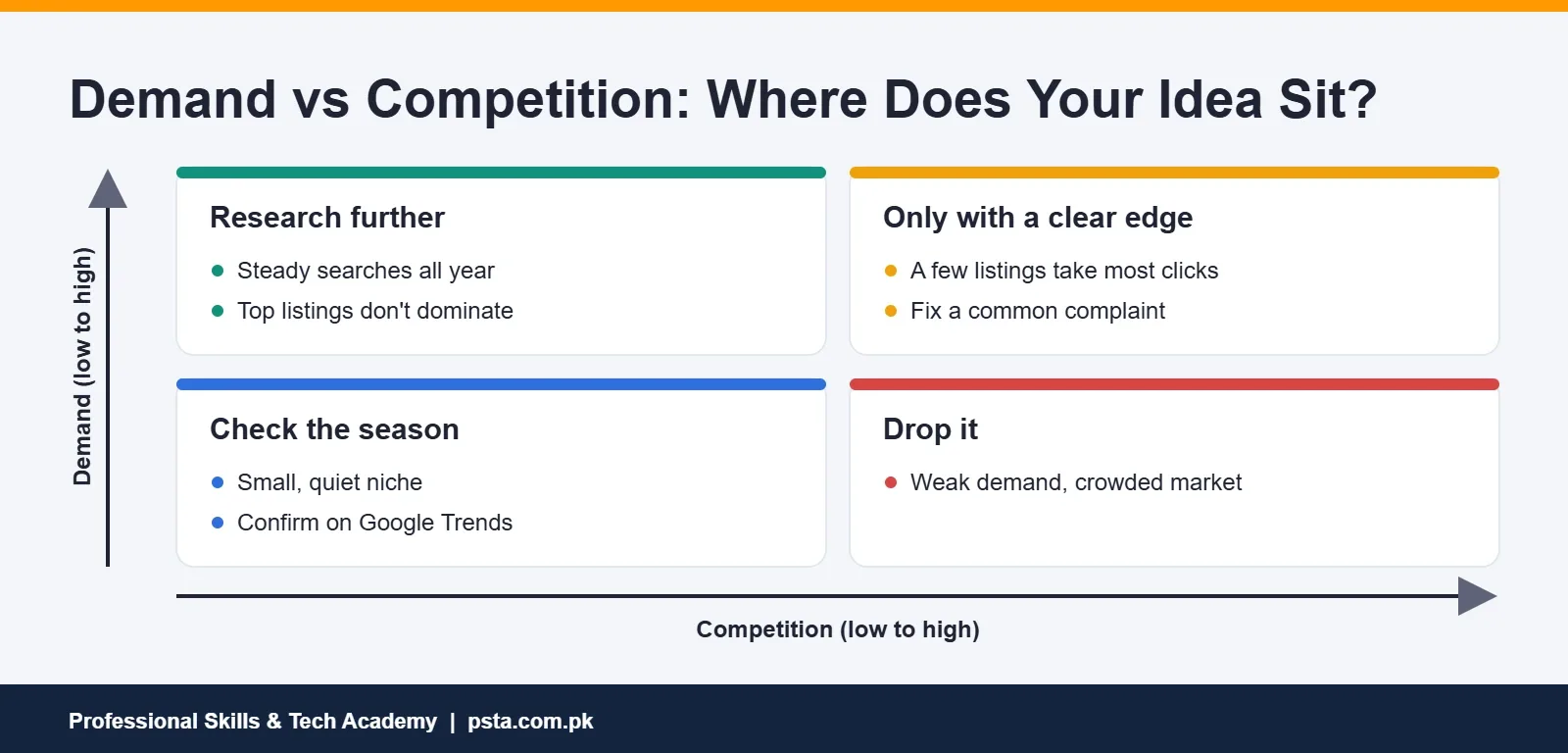
- Is demand steady? Look for search volume that holds across the year, not a spike that disappears after one season.
- Can a new listing compete? If a few listings with thousands of reviews take most of the clicks, a newcomer will struggle.
- Is the margin real? Subtract landed cost, referral and fulfillment fees, returns and launch ads from the selling price. What's left has to justify the risk.
- Is it allowed and simple to ship? Some categories need approval, and size, weight or hazmat status can change your fees and your options.
These criteria aren't fixed rules with magic numbers. Treat them as filters. A product that passes all four is worth deeper research. One that fails two is usually worth dropping early.
The Free Toolkit: How Far Can You Get Without Paying?
Further than most beginners expect. These free sources cover the first round of Amazon product hunting:
- Amazon's search bar. Type a word slowly and note the autocomplete suggestions. They show what shoppers type, in their own words.
- Best Sellers and Movers & Shakers pages. Browse category lists for products that sell well, then study the listings below the top few.
- Review pages. Read the three-star and one-star reviews of leading products. Repeated complaints point to an improvement you could offer.
- Google Trends. Check whether interest in a product is stable, growing or seasonal over the last five years.
The limit of free browsing is numbers. You can see that a product sells, but not roughly how many units a month or how search volume is changing. That's where Amazon's own tool comes in.
Amazon Product Opportunity Explorer: Data Straight From Amazon
Product Opportunity Explorer sits inside Seller Central under Growth. Amazon's tool page says it draws on customer search, browse and purchase behavior, plus pricing, reviews and returns, to show niches with unmet demand. There's no separate charge, but you need a selling account, and Amazon lists the Professional plan at $39.99 a month plus selling fees.
A Seller Labs walkthrough of the tool describes what each niche page shows:
- Search volume for the period and its direction, which also reveals seasonality
- The average selling price band in the niche
- Return rate and average customer rating
- How many products and sellers compete
- How much of the clicks and purchases the top products take
- The search terms linked to the niche and how well each converts
The same guide notes that access can depend on your selling plan and, in some marketplaces, on Brand Registry. If you don't have an account yet, practice the method with free sources first, and use the tool once your account is live.
Helium 10: Plans and What Beginners Actually Use
Helium 10 is a suite of research and operations tools. Its pricing page lists these plans in October 2026:
- Platinum (for sellers up to $100K in yearly sales): $129 a month, or $99 a month billed annually
- Diamond ($100K to $10M in yearly sales): $359 a month, or $279 a month billed annually
- Enterprise (over $10M): from $1,499 a month, billed annually
There's also a free plan with limited Chrome extension access. For a beginner, that's enough to see estimated sales on a few search pages and decide whether the paid plan would save you time. Prices exclude taxes, which are added at checkout. When you pay with a Pakistani card, also expect your bank's own charges on foreign-currency transactions.
Plans renew automatically, and monthly plans can be cancelled from the billing section of your account. If you buy a month to research intensively, set a reminder to cancel before renewal.
Jungle Scout: How Is It Different?
Jungle Scout covers similar ground: product and keyword databases, a browser extension and supplier research. Its plans page names three Catalyst plans for sellers (Starter, Growth Accelerator and Brand Owner) and an enterprise product called Cobalt.
Two policies matter for a beginner on a budget. Jungle Scout says it does not offer a free trial. Instead, new customers on standard Catalyst plans get a 7-day money-back guarantee if they cancel within that period. The page also lists added seats at $49 a month for the larger plans, so a two-person team costs more than one login.
Base plan prices change with promotions. Check the page on the day you buy rather than relying on a figure from a blog post, including this one.
Amazon Product Hunting Tools Compared
This table sums up what each option gives a beginner. Use it to decide where to start, not as a ranking.
| Option | Cost (USD) | Best for | Main limit |
|---|---|---|---|
| Amazon search, Best Sellers, reviews | Free | First shortlist of ideas | No sales or search numbers |
| Google Trends | Free | Checking seasonality | Shows Google searches, not Amazon |
| Product Opportunity Explorer | Included with a $39.99/month Professional account | Niche demand, returns and conversion | Needs a live seller account |
| Helium 10 Free | $0 | Trying the extension | Limited extension access |
| Helium 10 Platinum | $129/month or $99/month yearly | Weekly research at volume | Expensive before you sell |
| Jungle Scout Catalyst | See pricing page; 7-day money-back | Sellers who want a guarantee | No free trial |
Should You Pay for a Research Tool Yet?
A paid tool makes sense when it saves you more than it costs. For most beginners, that point comes later than the advertising suggests. Work through these questions in order:
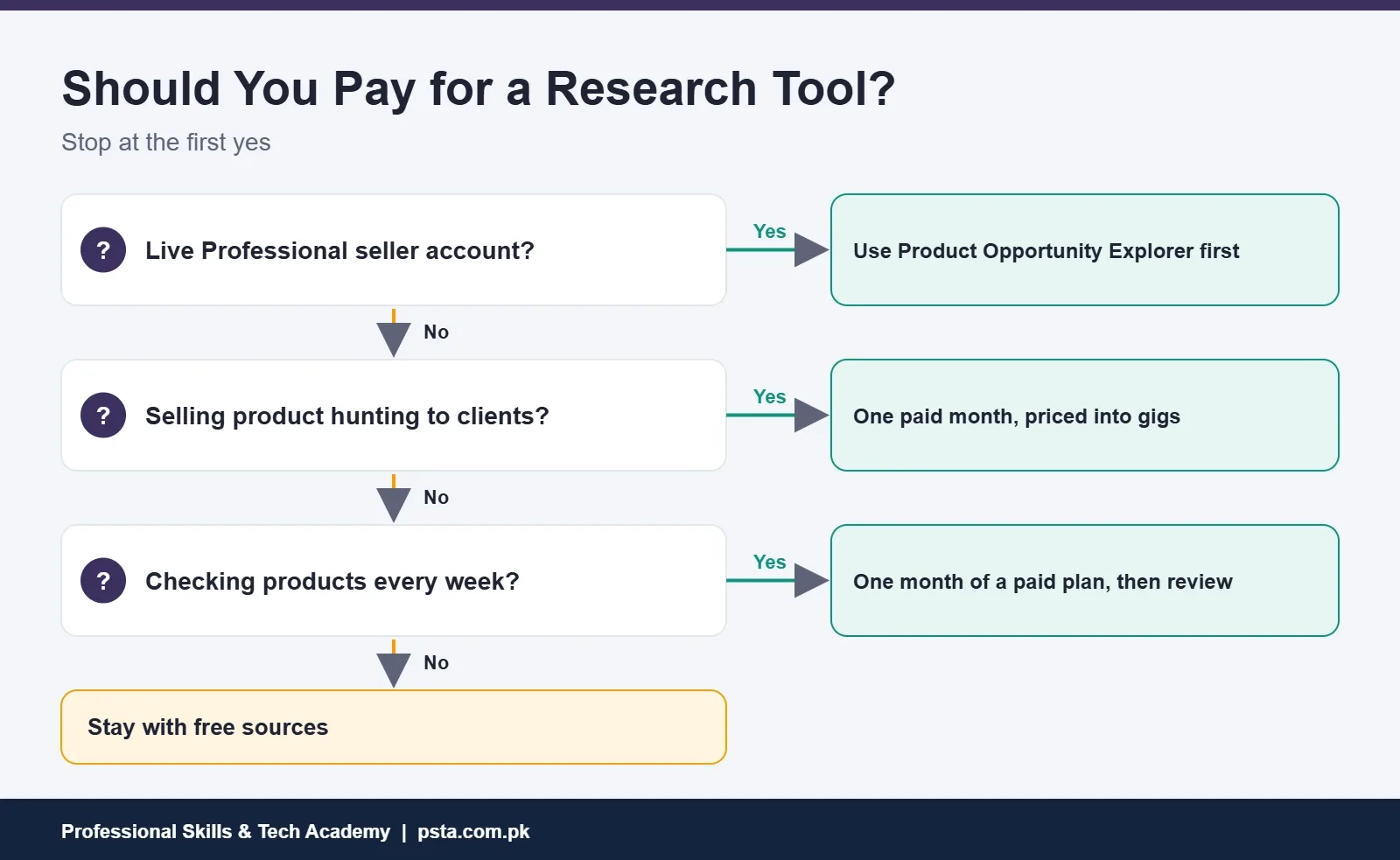
If you're offering product hunting as a Fiverr or Upwork service, the answer changes sooner. Clients expect estimates of sales and search volume, and a paid plan becomes a business expense you can price into your gigs. Even then, start with one month and see how many orders it supports.
Free Tools vs Paid Tools: The Trade-Offs
Paid tools don't find better products by themselves. They give you faster estimates across more products. Free sources are slower but teach you to read a market, which is the skill clients actually pay for.
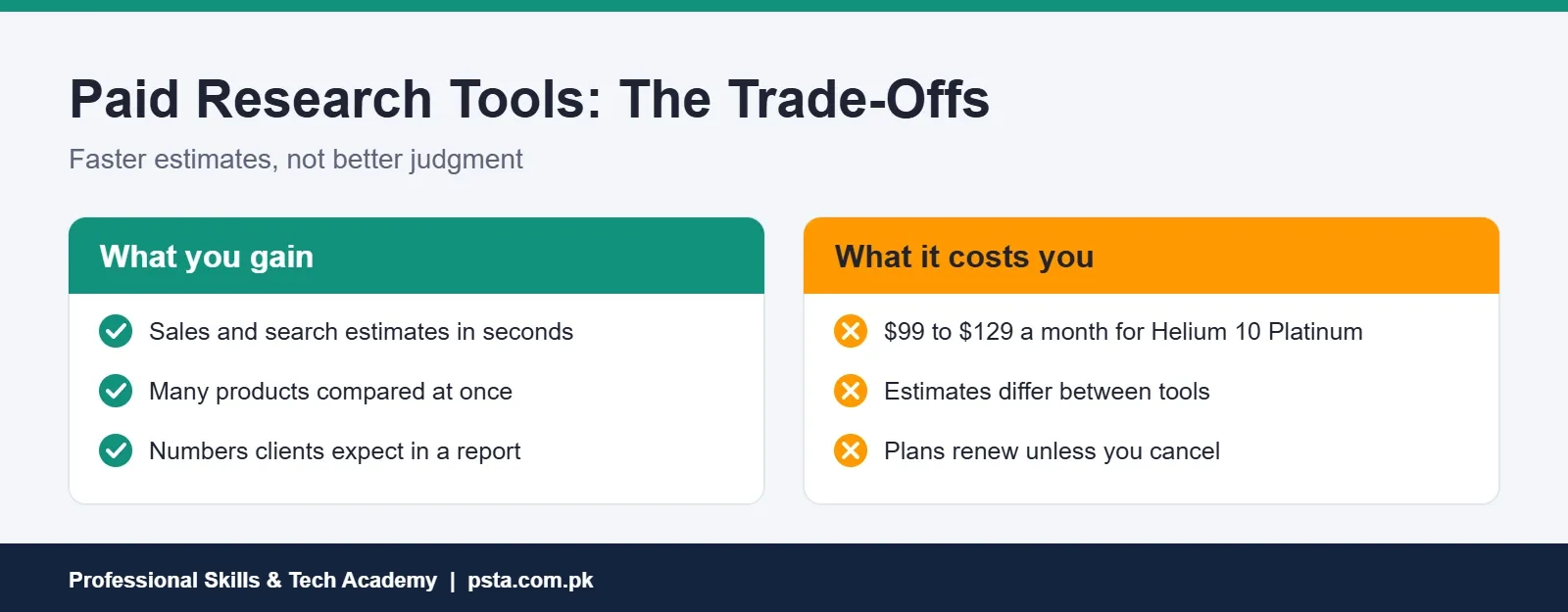
One caution applies to every tool: sales figures from third-party tools are estimates, not Amazon's own numbers. Two tools can show different monthly sales for the same product. Use them to compare products against each other, not as a forecast of your own sales.
A Product Hunting Routine for Your First Month
Here's a routine that works on a small budget. Adjust the pace to your schedule.
- Week 1: Collect 30 ideas. Use autocomplete, Best Sellers pages and problems you notice in reviews. Write each idea in a sheet with the category and a typical price.
- Week 2: Cut to 10. Drop anything seasonal on Google Trends, anything fragile or oversized, and anything in a category that needs approval you don't have.
- Week 3: Check numbers. Use Product Opportunity Explorer if your account is live, or a free extension plan, to compare demand and how concentrated the top sellers are.
- Week 4: Run the margin math. Get two supplier quotes for each of your top three. Our guide to calculating Amazon FBA fees walks through the fee side.
At the end of the month, you'll have one product worth a small first order, or a clear reason why none of your ideas worked. Both are useful results.
Three Traps to Avoid
- Copying a "winning product" list. If a product appears on a public list, many other beginners have seen it too. Use such lists only to learn how others reason.
- Trusting one number. A single sales estimate from one tool isn't enough. Check demand, competition and margin together before you decide.
- Ignoring the landed cost. A supplier's price per unit isn't your cost. Freight, duties, packaging and inspection all come before Amazon's fees.
Is Product Hunting a Useful Freelance Skill in Pakistan?
It can be, as long as you sell research quality rather than promises. Clients buying product hunting want a short list of products with demand, competition, price band, fee estimate and the reasoning behind each pick. A spreadsheet with clear sources is worth more than a long list of "winning products."
A solid product research deliverable usually includes:
- The product, its category and the typical selling price band
- Demand evidence, such as search trend and seasonality
- Competition notes: review counts and how dominant the top listings are
- A rough margin after fees, with the assumptions written down
- Risks: category approval, fragile packaging or a short season
If you plan to sell this as a service, our guide on how to create a Fiverr gig covers packaging and pricing your offer.
If you're planning to sell on your own account instead, our guide to opening an Amazon seller account from Pakistan covers the documents and plans. For local selling, the same research habits carry over to selling on Daraz and to Shopify stores.
Learning Product Research in PSTA's E-Commerce Course
PSTA's E-Commerce course (Amazon FBA, Shopify and Dropshipping) includes a module called Advanced Product Hunting & Market Research. Later modules cover product sourcing, Amazon FBA private label and wholesale, store building and payment gateways. It's a 12-week, beginner-level course, and the course page currently lists the fee as Rs. 25,000.
Students attend at the Abbottabad campus, join live classes online from other cities, or combine the two. To see how it compares with other programs, open the full course list. When you've picked a batch, the admission page has the form, and questions about timings can go to our team on WhatsApp (+92 314 5424399).
Score Three Niches Before Spending a Dollar
Open a blank sheet tonight. Pick three product ideas and score each one against the four questions from this guide: steady demand, beatable competition, real margin and simple shipping. Use only free sources. If an idea survives that first pass, it's earned a closer look with paid data. If none do, you've just saved a month's subscription.
Frequently asked questions
Can I do Amazon product hunting without Helium 10?
Yes. You can build a first shortlist with Amazon's search suggestions, Best Sellers pages, customer reviews and Google Trends, all of which are free. Once you have a Professional seller account, Product Opportunity Explorer adds demand, pricing and return data from Amazon itself. A paid tool mainly saves time when you check many products every week.
Is Product Opportunity Explorer free?
Amazon doesn't charge separately for it, but you need a selling account to use it. Amazon lists the Professional plan at $39.99 a month plus selling fees. You'll find the tool in Seller Central under the Growth menu. Access can also depend on your plan and, in some marketplaces, on Brand Registry.
How much does Helium 10 cost in 2026?
Helium 10's pricing page lists Platinum at $129 a month, or $99 a month billed annually, for sellers with up to $100K in yearly sales. Diamond costs $359 a month, or $279 a month annually. Taxes are added at checkout, and a free plan with limited Chrome extension access is available.
Does Jungle Scout have a free trial?
No. Jungle Scout's plans page says it doesn't offer a free trial. Instead, new customers on its standard Catalyst plans get a 7-day money-back guarantee if they cancel within that period. Check the current base price on the day you buy, because promotions change it.
Are sales estimates from research tools accurate?
They're estimates, not Amazon's own figures, and two tools can show different monthly sales for the same product. Use them to compare products against each other and to spot big differences in demand. Don't treat any single number as a forecast of what your own listing will sell.
Can I offer Amazon product hunting as a freelance service from Pakistan?
Yes, many freelancers sell product research on platforms like Fiverr. Clients expect a short, well-reasoned list: each product's demand, competition, price band, rough margin after fees and key risks. Clear sources and honest assumptions matter more than long lists, and a paid tool becomes worthwhile once you have regular orders.
How many product ideas should I research at once?
A practical routine is to collect around 30 ideas in the first week, cut them to 10 using simple filters such as seasonality and size, then compare numbers and margins on the strongest few. Working in rounds keeps you from spending hours on products that fail a basic check.
Sources & references
- Product Opportunity Explorer (Amazon) sell.amazon.com
- Product Opportunity Explorer: Validating Demand Before You Source (Seller Labs) sellerlabs.com
- Helium 10 pricing helium10.com
- Jungle Scout plans and pricing junglescout.com
Last reviewed & updated on by Umar Qureshi. Written by the PSTA team in Abbottabad, Pakistan.

Umar Qureshi

Master E-Commerce & Build Your Online Empire: Amazon FBA, Shopify & Dropshipping
Turn this guide into a career: hands-on training with real projects, online across Pakistan or on-campus in Abbottabad · 12 Weeks.

Comments
No comments yet — ask a question or share your experience.