Quick answer
Most common English mistakes Pakistani speakers make come from Urdu sentence habits: adding -ing to verbs like have and know, dropping do or did in questions, skipping a and the, and adding extra prepositions. Learn the correct pattern, catch it in your own recordings, and fix one error group each week.
Key takeaways
- • Tense errors such as "I am having two brothers" are the slips interviewers notice first.
- • In direct questions, put the helper verb before the subject: "Why are you late?"
- • "Discuss," "combat" and "return" need no extra preposition or "back."
- • Words like "revert" and "prepone" are South Asian usage, so use "reply" and "bring forward" with international readers.
- • EF's 2025 data puts Pakistan's listening score (470) well below speaking (517), so train your ear as well as your grammar.
- • Fix one error group a week by recording yourself, correcting five sentences and re-recording on day seven.
Table of contents 26 sections
- Why Do Pakistani Learners Repeat the Same Errors?
- Is Pakistani English Wrong, or Just Different?
- Common English Mistakes With Verbs and Tenses
- 1. Adding "-ing" to State Verbs
- 2. Using the Present Perfect With a Finished Time
- 3. Present Tense With "Since"
- 4. A Past-Tense Verb After "Did"
- Questions and Articles: Small Words That Change Everything
- 5. Questions Without a Helper Verb
- 6. Missing "A" or "An" Before Jobs and Single Things
- 7. An Extra "The" Before Countries and General Ideas
- Prepositions You Add, Drop or Swap
- 8. Extra Words After Verbs That Don't Need Them
- 9. "Look Forward To" Followed by a Base Verb
- 10. "Interested To" Instead of "Interested In"
- Make, Do, Take and Give: Word Partners That Trip People Up
- 11. Mixing Up Common Verb-Noun Pairs
- Which Local Words Confuse International Listeners?
- 12. "Revert" When You Mean "Reply"
- 13. "Prepone" for an Earlier Time
- 14. Local Phrases With International Swaps
- What About Pronunciation and Listening?
- All 15 Fixes in One Table
- How Do You Stop Making the Same Mistake?
- Getting Live Correction in PSTA's English Class
- Tomorrow Morning: Record One Minute and Count
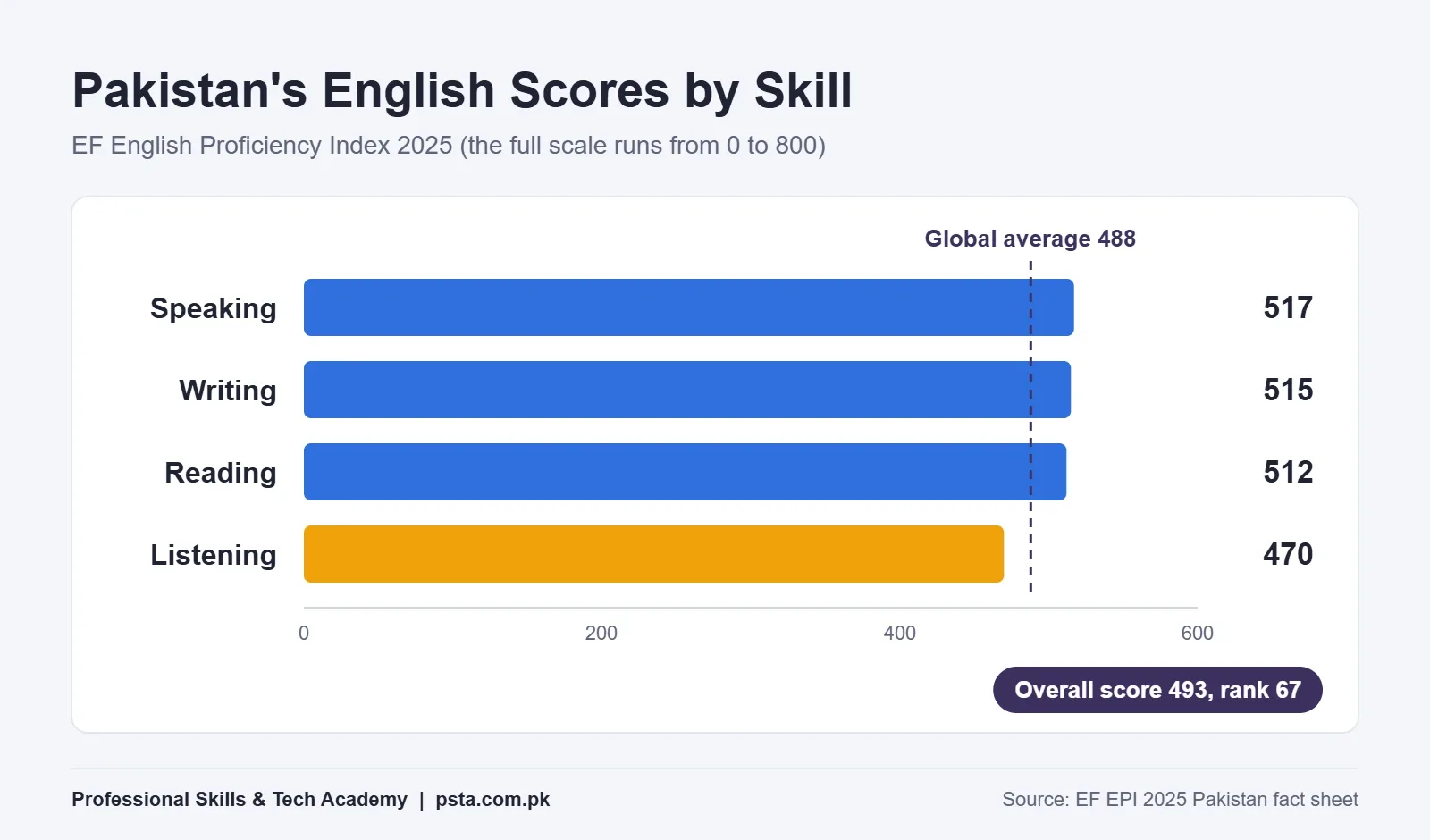
On the EF English Proficiency Index 2025, which runs from 0 to 800, Pakistan's overall result was 493. That put it 67th in EF's ranking and just above the global average of 488. Its weakest skill was listening, at 470. Those scores come from people who chose to take EF's online English test, so read them as a rough signal. They still match what shows up in a typical spoken English class: most learners know enough words, and the common English mistakes that hold them back are a handful of small patterns carried over from Urdu.
This guide covers 15 of those patterns, each with a corrected sentence you can copy. Here's what you'll take away:
- The tense and question errors that make you sound unsure in an interview
- Article and preposition slips that keep appearing in office emails
- Local words that confuse clients abroad, and plain swaps for each
- When a "mistake" is really standard Pakistani English and fine to keep
- A four-week routine for retiring one error group at a time
Why Do Pakistani Learners Repeat the Same Errors?
Most common English mistakes are not random. They come from Urdu sentence habits that feel correct because you have used them since childhood. Urdu usually signals a question with a question word or a rising tone, so the English rule of moving a helper verb in front of the subject ("Where are you going?") takes practice. Urdu also has no word that works exactly like "a" or "the," which is why articles go missing or appear in odd places.
EF's 2025 country fact sheet breaks Pakistan's score down by skill. Speaking (517), writing (515) and reading (512) sit close together, while listening trails at 470. The same sheet puts Khyber Pakhtunkhwa at 501 and Islamabad at 529. A weak listening score matters more than it looks. If you can't catch how a native speaker phrases something, you never notice the gap between their sentence and yours, so the error survives for years.
Is Pakistani English Wrong, or Just Different?
Linguists treat Pakistani English as a variety of its own, much like Australian or Nigerian English. A course handout on Pakistani English from the University of Groningen lists several of the features in this article, including "-ing" with state verbs, questions without inversion, different article use and words such as "cent percent." Inside Pakistan, most listeners understand these forms without effort.
The trouble starts when your audience changes. An IELTS examiner, a recruiter at a multinational or a client in Dubai or Manchester will judge you against international English. The official IELTS Speaking band descriptors say a Band 7 speaker produces frequent error-free sentences, while at Band 6 errors often appear in complex structures. So the goal here is code-switching: keep your local English for home, and use the international form when the stakes are higher.
Common English Mistakes With Verbs and Tenses
Among common English mistakes, tense errors are the ones interviewers notice first, because they show up in nearly every answer about your studies and work history.
1. Adding "-ing" to State Verbs
Instead of: "I am having two brothers." "I am not understanding this point."
Say: "I have two brothers." "I don't understand this point."
Verbs that describe a state rather than an action usually stay in the simple form: have (for owning), know, understand, believe, want, need, belong and seem. You can say "I'm having lunch," because eating is an action happening now.
2. Using the Present Perfect With a Finished Time
Instead of: "I have completed my BS in 2024."
Say: "I completed my BS in 2024."
When the sentence names a finished time, such as yesterday, last month or in 2024, use the simple past. Keep "have completed" for results that still matter now with no time given: "I have completed three internships."
3. Present Tense With "Since"
Instead of: "I am working at this shop since 2023."
Say: "I have been working at this shop since 2023."
"Since" and "for" connect the past to the present, so English wants the present perfect continuous here.
4. A Past-Tense Verb After "Did"
Instead of: "I didn't went to class." "Did you sent the file?"
Say: "I didn't go to class." "Did you send the file?"
"Did" already carries the past tense. The main verb goes back to its base form.
Questions and Articles: Small Words That Change Everything
5. Questions Without a Helper Verb
Instead of: "Why you are late?" "What you did on Sunday?"
Say: "Why are you late?" "What did you do on Sunday?"
In a direct question, the helper verb (is, are, do, did, have, can) comes before the subject. Indirect questions flip the rule. "Can you tell me where is the office?" should be "Can you tell me where the office is?" That second version matters on calls, where polite indirect questions are common.
6. Missing "A" or "An" Before Jobs and Single Things
Instead of: "My father is lecturer." "I want to become engineer."
Say: "My father is a lecturer." "I want to become an engineer."
A singular countable noun almost never stands alone in English. Use "an" before a vowel sound: an engineer, an hour, an MBA.
7. An Extra "The" Before Countries and General Ideas
Instead of: "I want to study in the England." "The cricket is my passion."
Say: "I want to study in England." "Cricket is my passion."
Most country names, sports and general ideas take no article. The exceptions are names built from a common noun or a plural: the UK, the USA, the UAE and the Netherlands.
Prepositions You Add, Drop or Swap
Preposition slips rarely confuse anyone, yet they are the English grammar mistakes that make a cover letter look careless.
8. Extra Words After Verbs That Don't Need Them
Instead of: "Let's discuss about the budget." "We must combat against poverty." "Please return back the form."
Say: "Let's discuss the budget." "We must combat poverty." "Please return the form."
"Discuss," "combat," "attend," "enter" and "order" take a direct object with no preposition in between. "Return" and "reply" already contain the idea of "back."
9. "Look Forward To" Followed by a Base Verb
Instead of: "I am looking forward to meet you."
Say: "I look forward to meeting you."
The "to" in this phrase is a preposition, not part of an infinitive, so the next verb takes "-ing." The same applies to "used to" in the sense of being familiar: "I'm used to working late."
10. "Interested To" Instead of "Interested In"
Instead of: "I am interested to join your company."
Say: "I am interested in joining your company."
This one appears in almost every first job application. Put it on your list if you are writing a job application email this week.
Make, Do, Take and Give: Word Partners That Trip People Up
English pairs certain verbs with certain nouns, and the pairs don't follow a logic you can work out. You simply learn them. The Cambridge Dictionary blog lists the classic ones, and several match what Pakistani students say.
11. Mixing Up Common Verb-Noun Pairs
- Make: a mistake, an effort, progress, a decision, friends
- Do: research, homework, an experiment, your work
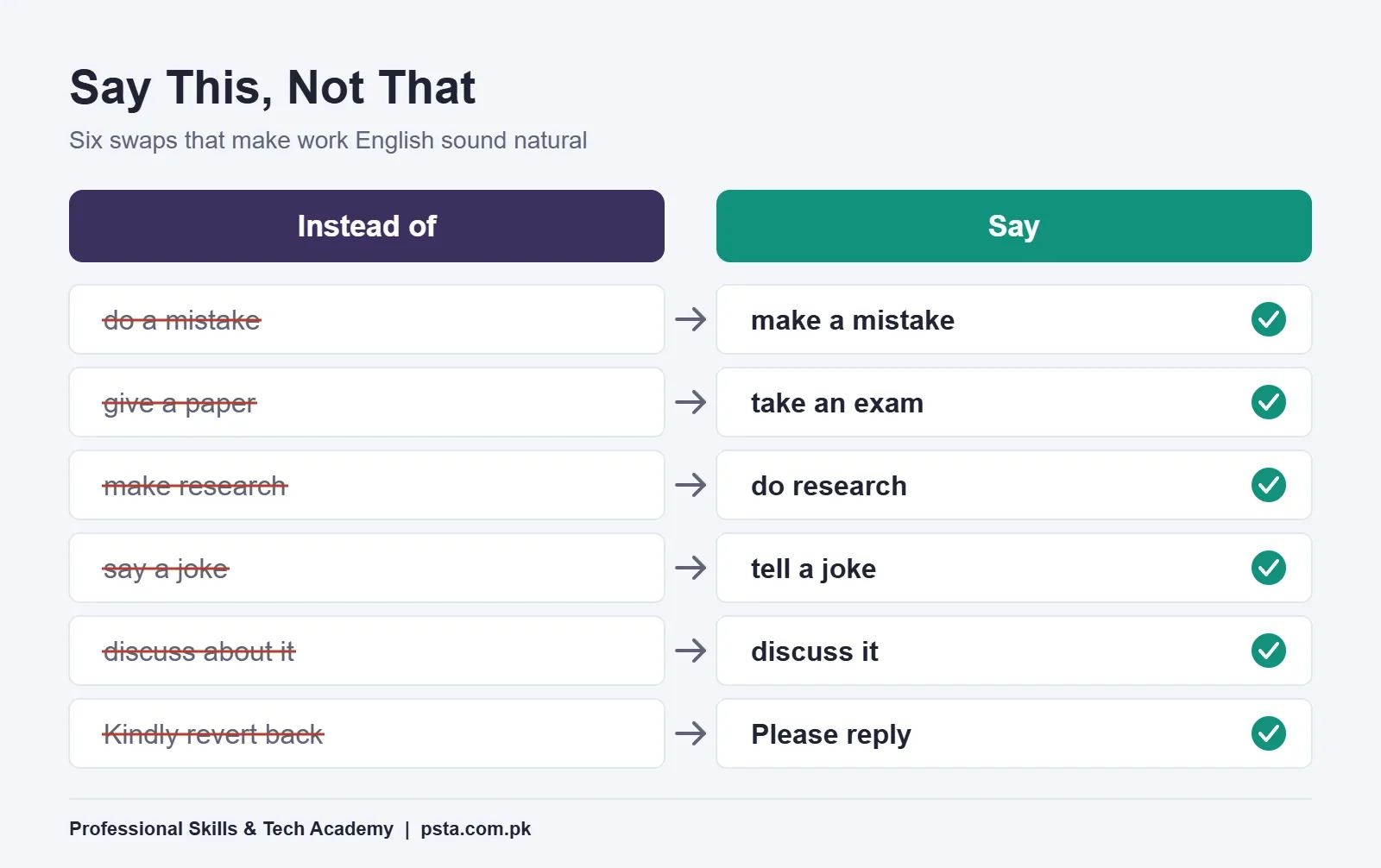
- Take: an exam, a test, a photo. "Give a paper" is a local phrase; examiners and clients abroad expect "take an exam" or, in British English, "sit an exam."
- Tell: a joke, a lie, the truth. "Say" doesn't pair with these.
- Give: an example, a presentation, advice
Which Local Words Confuse International Listeners?
Not all common English mistakes are grammar. Some words are perfectly normal in Lahore or Abbottabad offices but stop a conversation with someone from outside South Asia.
12. "Revert" When You Mean "Reply"
The Oxford Learner's Dictionary lists "revert" in the sense of "reply" as especially Indian English and rather formal. Washington State University's Common Errors in English Usage advises using "reply" with readers outside South Asia. With a foreign client, write "Please reply by Friday" or "I'll get back to you tomorrow." Drop "back" from "revert back" in every case.
13. "Prepone" for an Earlier Time
Oxford labels "prepone" as informal Indian English. Colleagues in Pakistan will understand it, but a British or American manager may not. Say "The meeting has been brought forward to Monday" or "moved up to Monday."
14. Local Phrases With International Swaps
| Local phrase | International version | When the local one is fine |
|---|---|---|
| cent percent | 100 percent | Chats with friends and local colleagues |
| cousin brother / cousin sister | cousin (add "my uncle's son" if it matters) | Family conversations |
| out of station | out of town, traveling | Local office messages |
| passed out from university | graduated from university | Rarely, since abroad it can sound like fainting |
| What is your good name? | May I have your name? | Informal local settings |
What About Pronunciation and Listening?
The last fix on the list, number 15, is about sound rather than grammar. Spoken English mistakes in this area are the hardest to catch on your own, because you can't hear yourself the way a listener does.
The EF listening score of 470 suggests many test-takers find spoken English harder to follow than to read. Two pronunciation habits make this worse because they also change how you hear words. Some speakers add a short vowel before words that start with "s" plus a consonant, so "school" becomes "ischool" and "student" becomes "istudent." Others don't separate "v" and "w," which makes "vest" and "west" sound the same. Neither will cost you a job by itself, but both reduce clarity on phone and video calls.
The fix is listening first. Choose a two-minute clip of clear English, such as a news report or a recorded lecture, and repeat each sentence straight after the speaker. This "shadowing" trains your ear and mouth together.
All 15 Fixes in One Table
Save this table of common English mistakes on your phone and check one row before each call or email.
| # | Instead of | Say | Rule in brief |
|---|---|---|---|
| 1 | I am having two brothers | I have two brothers | State verbs stay simple |
| 2 | I have completed my BS in 2024 | I completed my BS in 2024 | Finished time = simple past |
| 3 | I am working here since 2023 | I have been working here since 2023 | "Since" needs present perfect |
| 4 | I didn't went | I didn't go | Base verb after "did" |
| 5 | Why you are late? | Why are you late? | Helper verb before subject |
| 6 | My father is lecturer | My father is a lecturer | Singular nouns need a/an |
| 7 | study in the England | study in England | No "the" for most countries |
| 8 | discuss about the budget | discuss the budget | No preposition after "discuss" |
| 9 | looking forward to meet you | looking forward to meeting you | "-ing" after "forward to" |
| 10 | interested to join | interested in joining | "Interested in" + "-ing" |
| 11 | do a mistake / give a paper | make a mistake / take an exam | Learn fixed verb-noun pairs |
| 12 | Kindly revert back | Please reply | "Revert" is regional |
| 13 | The meeting is preponed | The meeting is brought forward | "Prepone" is regional |
| 14 | cent percent | 100 percent | Use the global form abroad |
| 15 | ischool, vest for west | school, west | Shadow clear audio daily |
How Do You Stop Making the Same Mistake?
Reading a list of common English mistakes changes very little by itself. You have said "discuss about" hundreds of times, and the habit won't break because you read one paragraph. What works is a short loop of English speaking practice, about ten minutes a day, repeated for a few weeks.
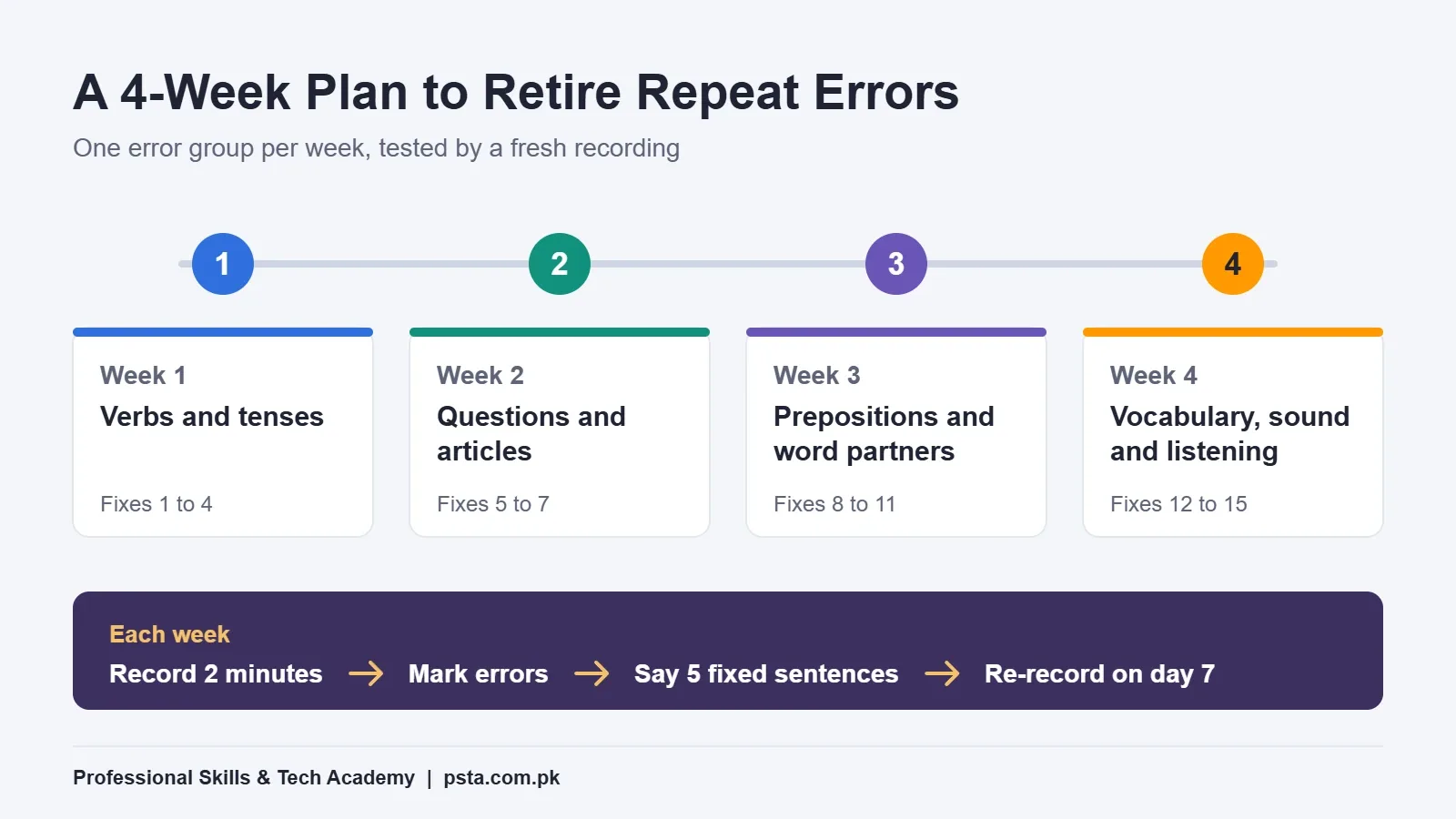
- Record yourself. Speak for two minutes on your phone about your day, your studies or your work.
- Listen back with this list open. Mark each error you hear, and note which group it belongs to.
- Pick one group for the week. Don't fix everything at once. One group is enough.
- Write five correct sentences about your own life using that pattern, then say them aloud ten times.
- Record again on day seven and count how often the error returns.
Spread across four weeks, the plan looks like this. Week 1 covers verbs and tenses (fixes 1 to 4). Week 2 handles questions and articles (5 to 7). Week 3 deals with prepositions and word partners (8 to 11). Week 4 is for local vocabulary, pronunciation and listening (12 to 15). If you are also preparing for job interviews, pair this plan with the answer patterns in our post on English interview questions and answers, and check your written CV against these fresh graduate CV fixes.
Getting Live Correction in PSTA's English Class
If you need English for job interviews, a visa file or client calls, timing matters, and self-study only catches the errors you can hear. A teacher catches the ones you can't, which is often the bigger list. Our English Spoken & Grammar course runs for 12 weeks and starts from beginner level. Its modules include tenses and grammar for speaking, pronunciation and accent training, listening and repeating drills, formal versus informal English, and email, CV and message writing. It ends with a final presentation and a certification assessment.
The course page currently lists the fee as Rs. 12,000, reduced from Rs. 14,000. You can attend at our Abbottabad campus on Old College Road, join live from anywhere in Pakistan, or combine both. A new batch starts every month, with class times between 9:00 AM and 9:30 PM from Monday to Saturday. If your work involves a lot of email and documents, the Office Automation course pairs well with it. Fees and durations for every program sit on the courses page. Applying takes a few minutes through our admission form, or you can send a WhatsApp message to +92 314 5424399 and we will suggest a batch that fits your timetable.
Tomorrow Morning: Record One Minute and Count
Before you open anything else tomorrow, record a one-minute answer to "What did you do yesterday?" Play it back and count only two things: missing "did" or "are" in questions, and any "-ing" on a state verb. Write the number down. Repeat the same recording seven days later. A smaller number is real progress, and it's the kind you can measure yourself.
Frequently asked questions
What are the most common English mistakes Pakistani students make?
The ones teachers hear most are "-ing" on state verbs ("I am having a car"), questions without a helper verb ("Why you are late?"), missing articles ("He is doctor"), and extra prepositions ("discuss about"). Most come from Urdu sentence patterns, so they feel natural. Once you know the rule behind each one, you can catch it in your own speech within a few weeks of practice.
Is "revert back" correct English?
"Revert back" repeats itself, because revert already means going back. Using "revert" to mean "reply" is regional: the Oxford Learner's Dictionary marks that sense as especially Indian English. Colleagues in Pakistan will understand it, but with international clients or recruiters, write "Please reply" or "I'll get back to you" instead.
Should I say "discuss about" or "discuss"?
Say "discuss" with the topic straight after it: "We discussed the budget." The verb already includes the idea of "about." You can use "about" after the noun form, as in "a discussion about the budget," which is correct. The same pattern applies to "combat" and "attend," which take a direct object.
Can I improve my spoken English at home without a course?
Yes, if you practice with a method. Record yourself for two minutes a day, compare what you said with a list of known errors, and rewrite five sentences correctly. Shadowing short clips of clear English also helps your listening. A course adds what self-study can't: a teacher who hears mistakes you don't notice and corrects them as they happen.
How long does it take to stop making basic grammar mistakes?
It depends on how often you practice, but working on one error group per week means you can cover the main patterns in about a month. Expect old habits to return when you are nervous or tired, such as in an interview. Keep re-recording yourself every few weeks so the corrected form becomes automatic.
Do these mistakes affect my IELTS Speaking score?
They can. Grammatical range and accuracy is one of four criteria in the official IELTS Speaking band descriptors. At Band 7, error-free sentences are frequent, while at Band 6 errors often appear in complex structures. Repeated basic slips, such as wrong tense after "did," make it harder for an examiner to place you in the higher band.
Is Pakistani English accepted internationally?
Pakistani English is a recognized variety, and most of its features are understood by other South Asian speakers. Some words, such as "prepone" or "cousin brother," may confuse listeners elsewhere. For exams, international clients and multinational employers, switch to the international form, and keep local usage for conversations where everyone shares it.
Sources & references
- EF EPI 2025 Fact Sheet: Pakistan ef.com
- Pakistani English handout, University of Groningen let.rug.nl
- IELTS Speaking Band Descriptors ielts.org
- Oxford Learner's Dictionaries: revert oxfordlearnersdictionaries.com
- Oxford Learner's Dictionaries: prepone oxfordlearnersdictionaries.com
- Common Errors in English Usage (WSU): revert / reply brians.wsu.edu
- Cambridge Dictionary blog: avoiding common errors with collocations dictionaryblog.cambridge.org
Last reviewed & updated on by Umar Qureshi. Written by the PSTA team in Abbottabad, Pakistan.

Umar Qureshi

English Spoken & Grammar Course in Pakistan – Build Confidence, Speak Fluently (Online & Campus)
Turn this guide into a career: hands-on training with real projects, online across Pakistan or on-campus in Abbottabad · 12 Weeks.
Comments
No comments yet — ask a question or share your experience.