Quick answer
Most English interview questions follow a few patterns. Answer "Tell me about yourself" in 30 to 90 seconds using present, past and future. Use STAR for "tell me about a time" questions, giving the action half your time. Learn phrases for asking a repeat, and practice aloud for 14 days.
Key takeaways
- • Use Present, Past, Future for "Tell me about yourself" and keep it to 30 to 90 seconds.
- • Answer behavioral questions with STAR and spend about half your time on the Action.
- • Prepare four or five true stories; one story can answer several questions.
- • Listening was Pakistan's weakest English skill in EF EPI 2025, so practice asking politely for a repeat.
- • Give a researched salary range instead of a single number.
- • Record yourself and run a full mock interview before the real one.
Table of contents 24 sections
- Why Do Interviewers in Pakistan Ask Questions in English?
- The Two Answer Structures That Cover Most Questions
- Frame 1: Present, Past, Future
- Frame 2: STAR for "Tell Me About a Time" Questions
- English Interview Questions About You, With Sample Answers
- "Tell me about yourself."
- "What are your strengths?"
- "What is your biggest weakness?"
- "Why should we hire you?"
- How Should You Answer Questions About Gaps, Marks and Changing Fields?
- Behavioral Questions: "Tell Me About a Time When..."
- Questions About the Job, the Company and Salary
- "Why do you want to work here?"
- "Where do you see yourself in five years?"
- "What are your salary expectations?"
- Quick Reference: What Each Question Is Really Testing
- What Should You Ask at the End of the Interview?
- Phrases That Help When You Get Stuck
- When You Need Time to Think
- When You Didn't Hear or Understand
- When You Make a Mistake Mid-Answer
- How Can You Practice English Interview Questions in 14 Days?
- Practice Spoken English for Interviews With PSTA
- One Thing to Do Tonight
Try a quick self-test before you prepare for English interview questions: set a one-minute timer, say "Tell me about yourself" out loud, and answer without stopping. If you froze, repeated "basically" five times or ran out of ideas after 20 seconds, the problem is usually structure, not vocabulary. Most interview questions follow a handful of patterns, and once you know the pattern, simple English is enough to give a clear, confident answer.
This guide is written for students, fresh graduates and job seekers in Pakistan who can read English well but feel stuck when they have to speak it under pressure. Inside, you will find:
- The two answer structures that cover most interview questions
- Sample answers to common questions, written in plain English you can adapt
- How to handle tricky topics such as gaps, low marks and salary
- Ready phrases for buying time, asking the interviewer to repeat and fixing a mistake
- A 14-day practice plan you can follow at home
Why Do Interviewers in Pakistan Ask Questions in English?
For many office, bank, IT, sales and customer service roles, the interview itself is a sample of the job. The panel wants to see whether you can explain an idea, listen to a client and write a clear email. English is the language most of those tasks happen in, so English interview questions test it directly.
The competition is real. The Pakistan Bureau of Statistics Labour Force Survey 2024-25 puts national unemployment at 7.1% and unemployment among young people aged 15 to 24 at 9.6%. A separate analysis of the same survey by Gallup & Gilani Pakistan found that 23.8% of women with a university degree were unemployed. When dozens of people with similar degrees apply, a calm, well-organized answer can be what separates you.
There is also good news in the data. Pakistan scored 493 on the EF English Proficiency Index 2025, ranking 67th and sitting in the "moderate" band. Its speaking score (517) was higher than its listening score (470), which was the weakest skill. In an interview, that gap shows up when a candidate can form good sentences but misses part of a fast or accented question, then answers the wrong thing. That is why this guide spends time on listening and on polite ways to ask for a repeat.
The Two Answer Structures That Cover Most Questions
You don't need a memorized speech for every possible question. You need two simple frames and a few true stories from your own life.
Frame 1: Present, Past, Future
Use this for "Tell me about yourself" and similar opening questions. Harvard's career services office describes a three-part answer that covers your background, where you are now and where you want to go, and suggests keeping it to roughly 30 to 90 seconds. Once you go past two minutes, it starts to feel long.
- Present: who you are and what you do now, in one or two sentences.
- Past: one or two achievements that connect to this job.
- Future: why this role is the logical next step for you.
Frame 2: STAR for "Tell Me About a Time" Questions
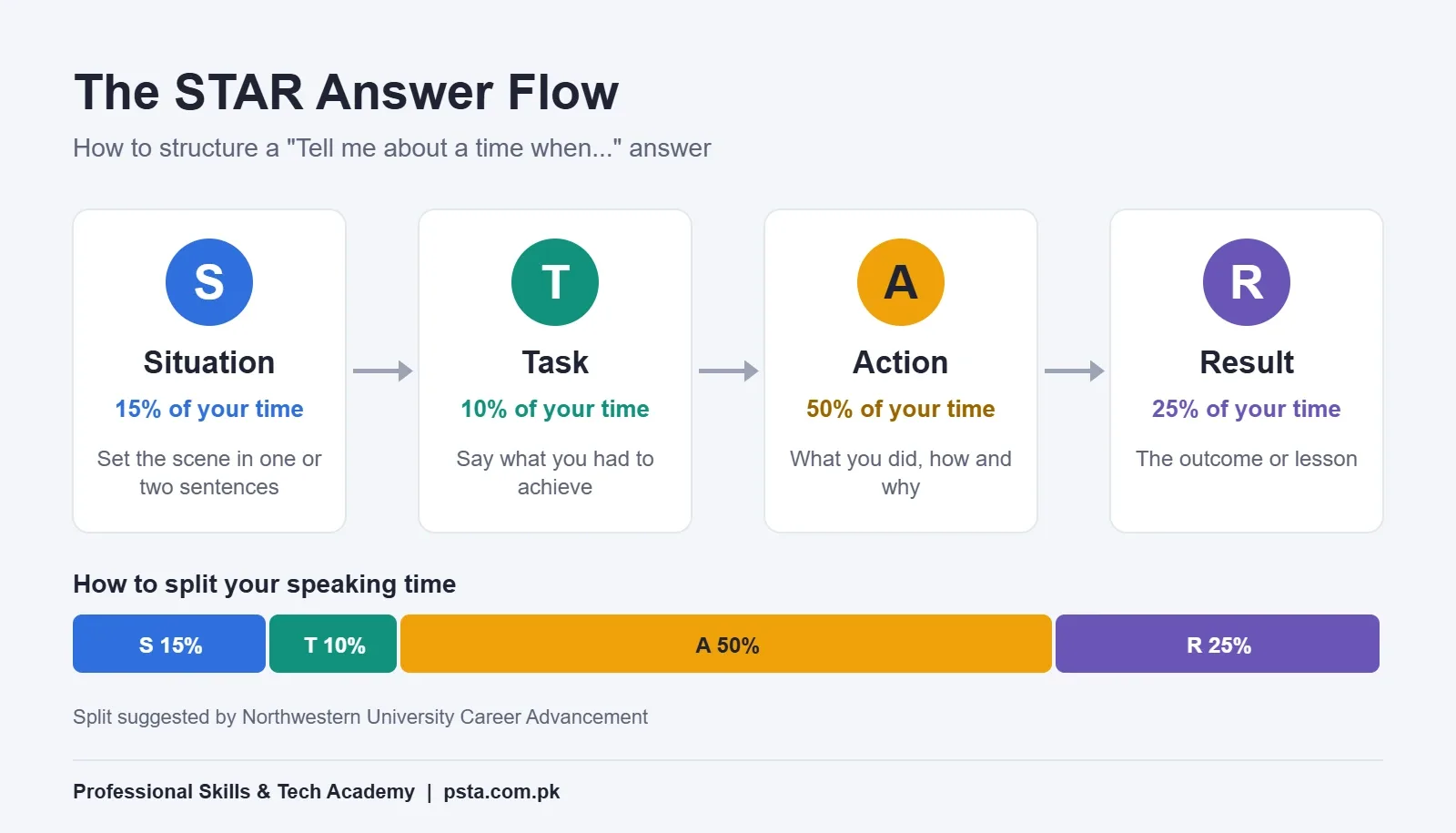
Behavioral questions ask you to prove a skill with a real example. The STAR method is the standard answer pattern, and the Northwestern University career office even suggests how to split your time: about 15% on the Situation, 10% on the Task, 50% on the Action and 25% on the Result. The action deserves the most words, because that is the part that shows what you can do.
Penn State Behrend's career services adds a useful detail: set the situation in one or two sentences, then explain what you did, how you did it and why. Candidates who skip the "why" sound like they followed orders. Candidates who include it sound like they can think.
English Interview Questions About You, With Sample Answers
These opening English interview questions often set the mood of the whole conversation. The sample answers below are examples written for this guide, not real candidates. Change every detail to match your own life, or the panel will notice.
"Tell me about yourself."
Example for a fresh BBA graduate applying for a customer service role at a bank:
"I recently finished my BBA with a major in marketing from a university in Abbottabad. During my final year, I worked part-time at my uncle's mobile accessories shop, where I handled customer complaints and kept daily sales records in Excel. I enjoyed solving problems for people face to face, and that's why I'm applying for this customer service role. I'd like to grow into a branch operations position over the next few years."
Notice what it leaves out: your full name (they have your CV), your father's job, your hobbies and your matric marks. Every sentence points toward the job.
"What are your strengths?"
Name one or two strengths, then prove each with a short example. "I'm hardworking" means little on its own. "I'm reliable with deadlines. In my final-year project, I was the one who kept our group's timeline and we submitted a week early" gives the panel something they can believe.
"What is your biggest weakness?"
Pick a real weakness that won't block you from doing the job, then explain what you are doing about it. Avoid fake weaknesses like "I work too hard." A better pattern is: "I used to get nervous when speaking in meetings, so I joined a spoken English class and now I volunteer to present in group work."
"Why should we hire you?"
Match three things in the job advert to three things you have done. Read the advert again the night before and underline its key requirements. Your answer can be as simple as: "You need someone who can handle customers, use MS Office and work in shifts. I've done all three, and I can start immediately."
How Should You Answer Questions About Gaps, Marks and Changing Fields?
These are the questions candidates fear most, but they are easier than they look. The panel is rarely trying to reject you for the gap itself. They want to see whether you can talk about it honestly and calmly.
- "Why is there a gap in your CV?" Give the reason in one sentence, then move to what you learned or did during that time. "I spent a year helping with a family responsibility, and during that time I completed an Office Automation course and practiced typing every day."
- "Your marks are low. Why?" Don't blame teachers or the system. Accept it briefly and point to evidence of improvement: a better final semester, a certificate or a project.
- "You studied one subject. Why this field?" Explain the moment your interest changed and what you have done since then to build the new skill.
Keep each of these answers under 45 seconds. Long explanations make a small issue sound bigger.
Behavioral Questions: "Tell Me About a Time When..."
Common versions include a time you faced a conflict, made a mistake, worked under pressure or helped a team member. Prepare four or five true stories from university, part-time work, volunteering or family business. One good story can often answer two or three different questions.
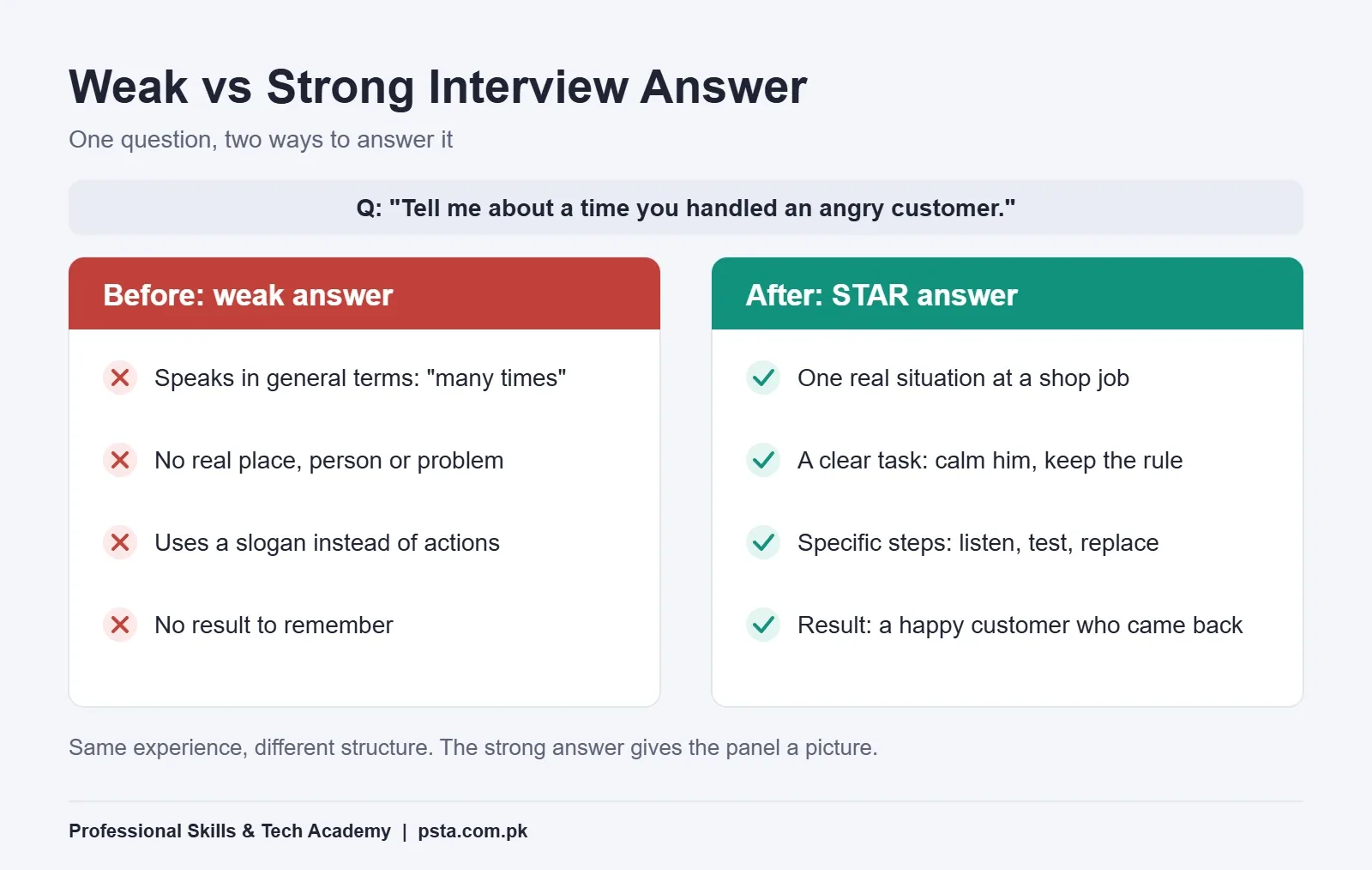
Here is the difference between a weak answer and a strong one to "Tell me about a time you handled an angry customer."
Weak: "Yes, many times customers get angry. I always stay calm and handle them properly. Customer is always right, so I solve their problem."
Strong (example, using STAR): "At my part-time shop job, a customer came back shouting that his new charger had stopped working after two days. My task was to calm him down and keep the shop's return rule. I listened without interrupting, tested the charger in front of him and showed him the fault. I then replaced it on the spot and gave him my number in case it happened again. He left satisfied, and later he brought his brother to buy a power bank from us."
The weak answer is general and could belong to anyone. The strong one has a place, a problem, specific actions and a result the panel can picture.
Questions About the Job, the Company and Salary
"Why do you want to work here?"
Spend 15 minutes on the company's website and social media pages before the interview. Mention one specific thing, such as a new branch, a product or a training program. "I saw that you opened two new branches in Hazara this year, and I'd like to be part of a team that's growing" is far stronger than "Your company is very good."
"Where do you see yourself in five years?"
Show ambition that fits inside the company. Talk about skills and responsibility, not job titles you can't control. Saying you plan to move abroad next year may be true, but it gives the panel a reason to choose someone else.
"What are your salary expectations?"
This is the one question where an exact number can hurt you. Before the interview, look at similar roles on job sites and ask people working in the same field, so you know a realistic range for your city. Then answer politely: "Based on similar roles in this area, I'm expecting a range of Rs. X to Rs. Y, but I'm open to discussing the full package." If you truly have no idea, it's fine to say you'd like to hear the company's range first.
Quick Reference: What Each Question Is Really Testing
Use this table of common English interview questions as a revision sheet the night before your interview.
| Question | What the Panel Is Checking | Structure to Use | Target Length |
|---|---|---|---|
| Tell me about yourself | Can you summarize clearly and stay relevant? | Present, Past, Future | 30 to 90 seconds |
| What are your strengths? | Self-awareness backed by evidence | Claim plus short example | About 45 seconds |
| What is your weakness? | Honesty and willingness to improve | Weakness plus action taken | About 45 seconds |
| Tell me about a time when... | Proof of a real skill | STAR | 1 to 2 minutes |
| Why is there a gap in your CV? | Calm, honest explanation | Reason plus what you did | Under 45 seconds |
| Why do you want to work here? | Did you research the company? | One specific fact plus your fit | About 45 seconds |
| Salary expectations | Are you realistic? | Researched range, open to discussion | Two sentences |
What Should You Ask at the End of the Interview?
Almost every interview ends with "Do you have any questions for us?" Saying "No, sir, everything is clear" wastes your last chance to leave a good impression. Prepare two or three of these:
- "What would a typical day look like in this role?"
- "What skills would help someone succeed here in the first three months?"
- "Is there any training for new staff?"
- "What are the next steps after this interview?"
Avoid asking about leave, salary increments or timings in a first interview unless the panel raises the topic.
Phrases That Help When You Get Stuck
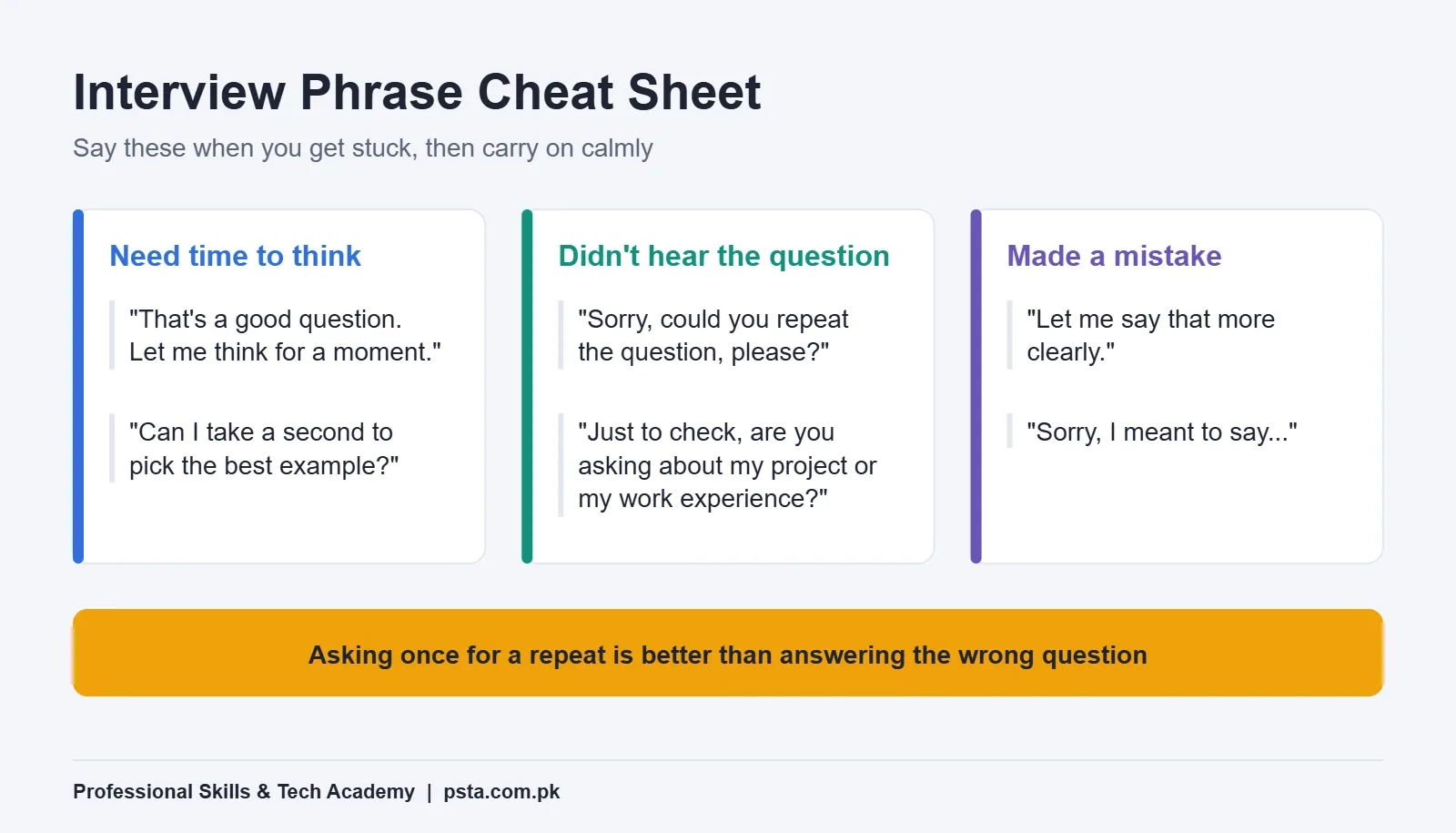
Freezing for a moment is normal. What matters is how you recover. Memorize a few of these phrases until they come out automatically, because under stress your brain reaches for whatever it has practiced most.
When You Need Time to Think
- "That's a good question. Let me think for a moment."
- "Can I take a second to pick the best example?"
When You Didn't Hear or Understand
- "Sorry, could you repeat the question, please?"
- "Just to check, are you asking about my project or my work experience?"
When You Make a Mistake Mid-Answer
- "Let me say that more clearly."
- "Sorry, I meant to say..."
Asking for a repeat is not a weakness. Given that listening is the lowest-scoring English skill in Pakistan's EF results, it's one of the most useful habits you can build. Answering the wrong question confidently does far more damage than asking once.
How Can You Practice English Interview Questions in 14 Days?
Reading answers is not the same as saying them. Your mouth needs practice, and so does your ear. Here is a realistic plan if you can spare 30 to 40 minutes a day:
- Days 1 to 2: Write your "Tell me about yourself" answer using Present, Past, Future. Read it aloud ten times, then try it without the paper.
- Days 3 to 5: Write four STAR stories from your own life. Keep the Action part the longest.
- Days 6 to 7: Record yourself on your phone answering five questions from the table above. Listen back and count filler words such as "basically," "actually" and "you know."
- Days 8 to 10: Ask a friend or family member to read the questions in random order, with a few follow-ups. Practice asking them to repeat at least once.
- Days 11 to 12: Research two companies you want to apply to and prepare your "Why here?" answer for each.
- Days 13 to 14: Hold a full mock interview, dressed as you would be on the day, sitting at a table. Time every answer.
If you only manage the recording step, you'll still improve. Hearing your own voice is uncomfortable, but it shows you exactly where you hesitate.
Practice Spoken English for Interviews With PSTA
Some people can follow a plan like this alone. Others need a teacher who corrects them in the moment and a group that makes speaking feel normal. That's where a structured class helps.
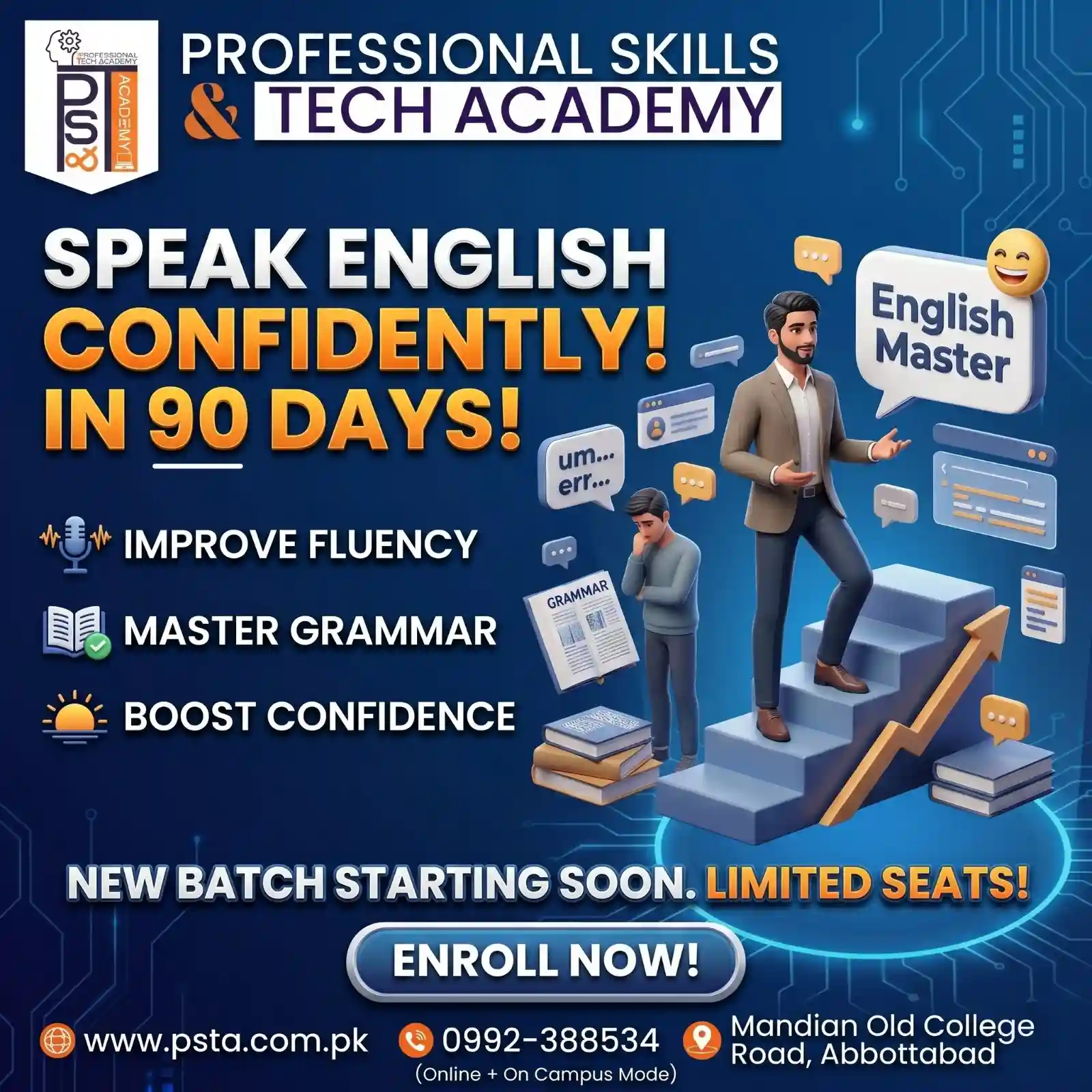
The English Spoken & Grammar course at PSTA is a 12-week, beginner-level program you can join in person in Abbottabad or attend online from anywhere in Pakistan. The course page lists modules that map directly to interview skills, including:
- Pronunciation and accent training
- Fluency drills with listening and repeating exercises
- Speaking confidence for interviews, meetings and social talk
- Role plays, group discussions and public speaking practice
- Email, CV and message writing
- A final presentation and certification assessment
The listed course fee is Rs. 12,000 (shown reduced from Rs. 14,000 on the course page at the time of writing). Many office roles also expect basic computer skills, so you may want to pair it with the Office Automation course, or look at the one-year DIT diploma if you want a broader IT qualification on your CV. If you're applying for marketing roles, our guide on building a digital marketing portfolio with no clients gives you real projects to talk about in your STAR stories.
You can browse all PSTA courses, apply through the online admission page, or reach the admissions team on WhatsApp (+92 314 5424399) if you have questions about batch timings. Our campus sits opposite FIMS College on Old College Road, Mandian, Abbottabad.
One Thing to Do Tonight
Go back to the self-test at the top of this page. Write your "Tell me about yourself" answer in three short parts, record it on your phone and listen once. Aim for 30 to 90 seconds with no filler words. Do it again tomorrow. By the end of the week, the English interview questions you feared most will feel like ones you're ready for.
Frequently asked questions
How long should my answer to "Tell me about yourself" be?
Aim for roughly 30 to 90 seconds, which is the range Harvard's career services office suggests. That is enough time to cover where you are now, one or two relevant achievements and why you want this role. Once an answer goes past two minutes, it usually starts to feel like a speech, and the panel may stop listening.
Should I memorize my interview answers word for word?
No. Memorized answers often sound flat, and if the interviewer changes the wording slightly, you can lose your place. Instead, memorize the structure and three or four key points for each answer. Practice saying them aloud in slightly different words each time. This keeps your English natural while making sure you never run out of things to say.
What is the STAR method in simple words?
STAR is a way to tell a short work story. You describe the Situation, the Task you had to complete, the Action you took and the Result. Northwestern University's career office suggests spending about half your answer on the Action, because that part shows the interviewer what you can actually do. Use it for any question that starts with "Tell me about a time when..."
How should a fresh graduate answer the salary question?
Avoid naming a single figure without research. Check similar job adverts and ask people working in the same field so you understand a realistic range for your city. Then give that range politely and say you are open to discussing the full package. If you have no information at all, it is acceptable to ask the company to share its range first.
What should I do if I don't understand the interviewer's accent?
Ask once, politely: "Sorry, could you repeat the question, please?" You can also confirm what you heard, for example by asking whether they mean your project or your work experience. Interviewers prefer this to an answer that misses the point. Listening was the lowest-scoring English skill for Pakistan in the EF English Proficiency Index 2025, so this is a common challenge.
Can I switch to Urdu if I forget a word in an English interview?
Try to stay in English if the interview is being held in English. If a word slips away, describe the idea in simpler English instead, such as "the person who checks the accounts" rather than a technical title. Some panels may be relaxed about a mixed answer, but you should not assume that. Simple, clear English is safer than switching languages.
How can I practice interview English at home without a partner?
Record yourself on your phone answering five common questions, then listen back and note filler words and long pauses. Write four STAR stories from your own life and say them aloud daily. Read job adverts and practice matching your answers to their requirements. In the final days, run a timed mock interview at a table, dressed as you would be on the day.
Sources & references
- Pakistan Bureau of Statistics: Key Insights of Labour Force Survey 2024-25 pbs.gov.pk
- Gallup & Gilani Pakistan: Higher Education, Higher Unemployment (LFS 2024-25) gallup.com.pk
- EF English Proficiency Index 2025: Pakistan ef.edu
- Harvard FAS Career Services: How to Answer Tell Me About Yourself careerservices.fas.harvard.edu
- Northwestern Career Advancement: The STAR Approach northwestern.edu
- Penn State Behrend Career Services: STAR Technique behrend.psu.edu
Last reviewed & updated on by Umar Qureshi. Written by the PSTA team in Abbottabad, Pakistan.
Umar Qureshi
English Spoken & Grammar Course in Pakistan – Build Confidence, Speak Fluently (Online & Campus)
Turn this guide into a career: hands-on training with real projects, online across Pakistan or on-campus in Abbottabad · 12 Weeks.
Comments
No comments yet — ask a question or share your experience.