Quick answer
Choose a DIT if you want computer and office skills in one or two years, or if your Matric was not in science. Choose a DAE if you passed Matric with Physics, Chemistry and Maths and want a three-year technician route that TEVTA Punjab treats as equal to FSc Pre-Engineering.
Key takeaways
- • A DIT teaches computer and office skills in 1 or 2 years; a DAE trains engineering technicians over 3 years.
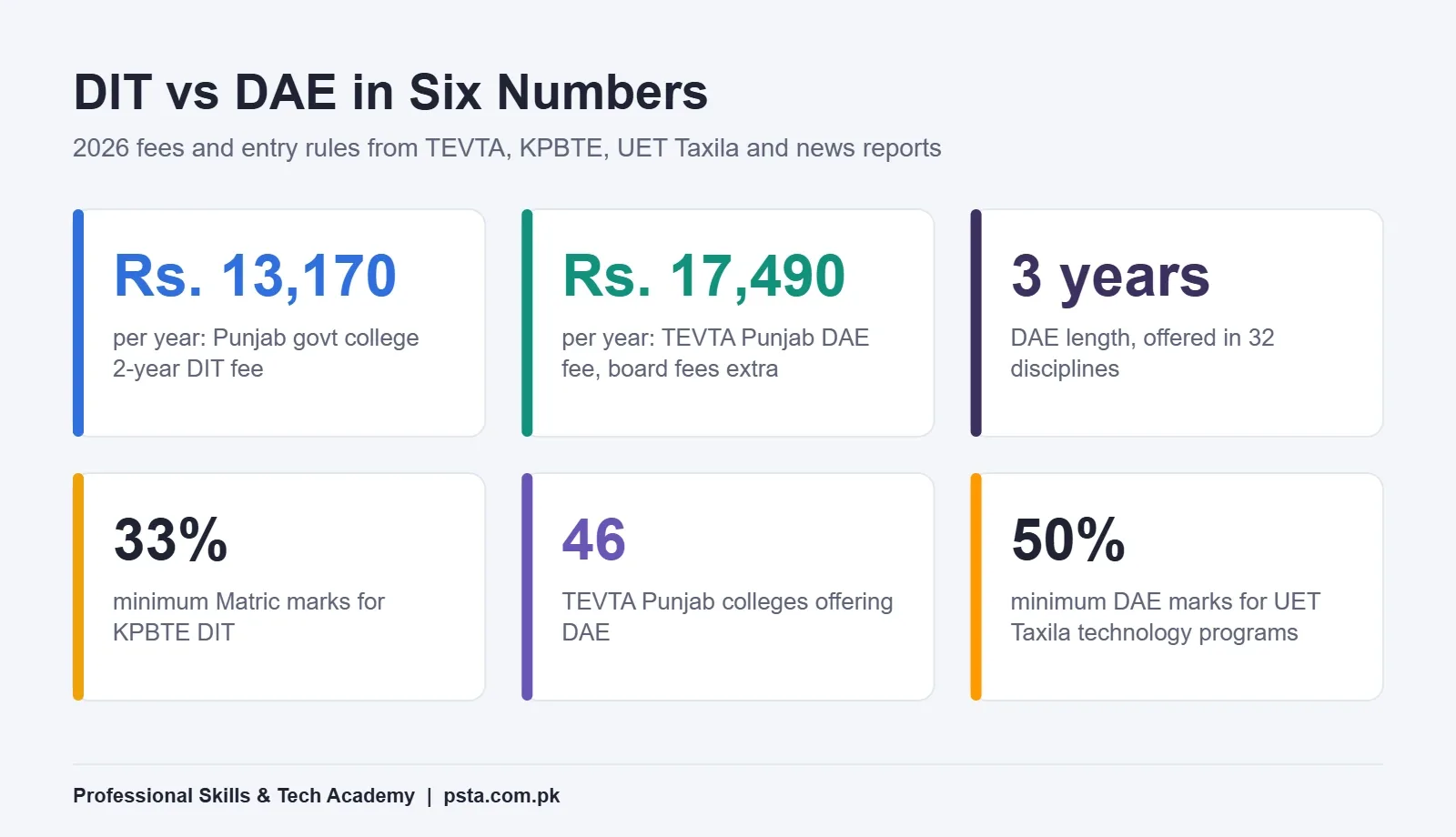
- • TEVTA Punjab DAE admission needs Matric with Physics, Chemistry and Maths; KPBTE DIT asks for 33% in Matric.
- • 2026 government fees: Rs. 13,170 a year for Punjab's 2-year DIT and Rs. 17,490 a year for a TEVTA Punjab DAE.
- • TEVTA treats the DAE as equal to FSc Pre-Engineering; Punjab's 2-year DIT is reported as equal to ICS.
- • DAE holders can apply to engineering programs such as UET Taxila's, competing on open merit with FSc students.
Table of contents 15 sections
- What Do DIT and DAE Actually Stand For?
- DIT vs DAE: The Side-by-Side Comparison
- Who Can Get Admission to Each Diploma?
- DIT Entry Rules
- DAE Entry Rules
- DIT vs DAE Fees: What Do They Cost in 2026?
- What Will You Study Day to Day?
- What Does Each Diploma Count As for Further Study?
- Which One Can Lead to Engineering or a BS Degree?
- Jobs and Work After Each Diploma
- Where Does DAE Computer Information Technology Fit?
- Settling DIT vs DAE: Four Questions to Answer Tonight
- DIT vs DAE Mistakes Families Make
- If DIT Is Your Pick: How PSTA Teaches It
- Before You Fill Any Form, Compare Two Prospectuses
Myth: in the DIT vs DAE decision, you are picking between two versions of the same computer diploma, so the cheaper one wins. Fact: you are really choosing between two different careers. A DIT trains you for computer and office work in one or two years. A DAE is a three-year engineering technician diploma that the Punjab TEVTA treats as equal to FSc Pre-Engineering.
The two names sound alike, both start after Matric, and technical boards examine both. That's why families mix them up every admission season. This DIT vs DAE comparison puts the rules, fees and next steps side by side so you can choose with the facts in front of you.
Here's what this guide covers:
- What each diploma is, who awards it and how long it takes
- Entry rules, age limits and 2026 government college fees
- What each one counts as for further study
- Which one can lead to engineering or a BS degree
- A four-question test to settle your own choice
What Do DIT and DAE Actually Stand For?
DIT is the Diploma in Information Technology. It teaches practical computer skills: operating systems, MS Office, networking, programming basics, databases, web pages, graphics and video. Technical boards examine it, such as KPBTE in Khyber Pakhtunkhwa and the Punjab Board of Technical Education (PBTE).
DAE is the Diploma of Associate Engineer, sometimes written as Diploma of Associate Engineering. It trains technicians in a single engineering field, such as civil, electrical, mechanical or computer information technology. The Punjab TEVTA website describes it as a 3-year diploma offered in 32 different disciplines, with graduates usually working as supervisor-level technicians in industry.
So a DIT is about using computers well at work. A DAE is about building, wiring, running and maintaining technical systems. That one difference explains almost everything else in this guide.
DIT vs DAE: The Side-by-Side Comparison
The table below uses the 2026 rules and fees published by the boards, TEVTA and news reports linked in this article. Private institutes charge their own fees, so treat the fee row as the government college benchmark.
| Point | DIT | DAE |
|---|---|---|
| Full name | Diploma in Information Technology | Diploma of Associate Engineer |
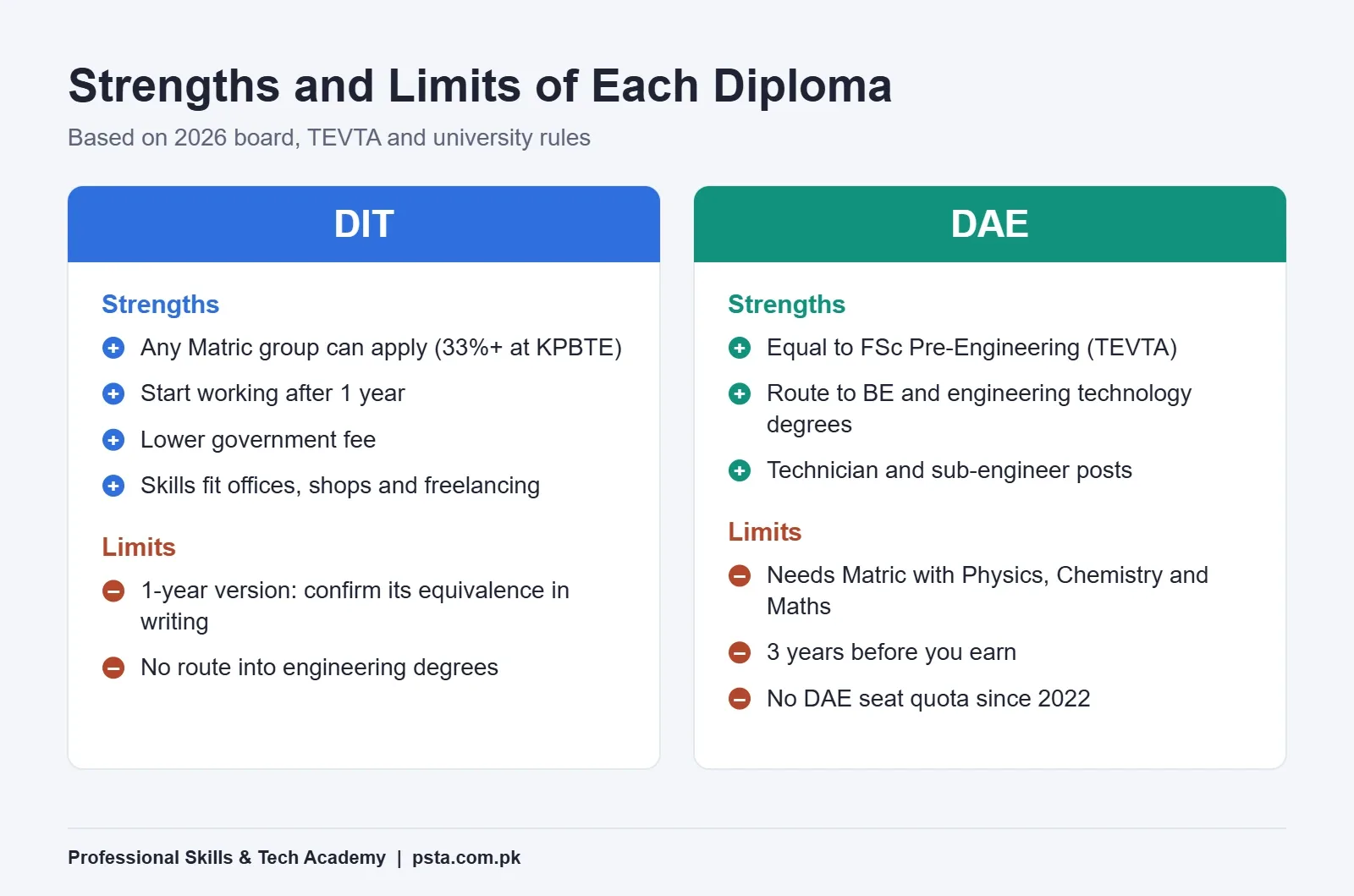
| Length | 1 year (KPBTE), or 2 years (KPBTE and PBTE 2-year versions) | 3 years |
| Main focus | Computer, office and digital skills | One engineering technology, such as civil, electrical or mechanical |
| Entry (2026) | At least 33% in Matric for the KPBTE DIT | Matric with Physics, Chemistry and Maths for TEVTA Punjab |
| Upper age limit | 25 years (KPBTE, normal conditions) | 25 years morning shift, 45 years second shift (TEVTA Punjab) |
| Government fee | Rs. 13,170 a year for Punjab's 2-year DIT | Rs. 17,490 a year at TEVTA Punjab, board fees extra |
| Counts as | Punjab's 2-year DIT: reported as equal to ICS | Equal to FSc Pre-Engineering (TEVTA) |
| Typical first work | Computer operator, office assistant, IT support | Technician, supervisor or sub-engineer in one field |
If you only remember one row, make it "Main focus." Fees and years matter, but the field you will spend your working life in matters more.
Who Can Get Admission to Each Diploma?
Entry rules settle many DIT vs DAE choices before fees even come up, so check these before you buy a prospectus.
DIT Entry Rules
KPBTE's assessment and promotion rules for the 2-year DIT set the entry bar at 33% marks in Matric (SSC) or an equivalent exam. The normal upper age limit is 25 years. The rules don't name required Matric subjects, so arts and computer group students can apply too. Once you're in, you need 75% overall attendance to sit the exams, and a pass needs 40% in theory and 50% in practicals, subject by subject.
DAE Entry Rules
The DAE is stricter about subjects. For 2026 admissions to TEVTA Punjab's Government Colleges of Technology, Result.pk reported that applicants need Matric with Physics, Chemistry, Mathematics and English. Merit is worked out from those subjects. The age limit is 25 years for the morning shift and 45 years for the second shift.
That means a student who passed Matric in the arts group can usually apply for a DIT but not for a TEVTA DAE. If you're in that position, the choice is already made for you, and that's fine.
In Khyber Pakhtunkhwa, colleges under KP TEVTA run the same three-year DAE. For the 2026-27 session, Government College of Technology Nowshera advertised Civil, Electrical and Mechanical Technology, with online forms due by August 21. With dates like these, it pays to start checking college websites by July.
DIT vs DAE Fees: What Do They Cost in 2026?
Government fees for both are low compared with private colleges. Here are the two published figures we could verify:
- DIT: Punjab's Higher Education Department fixed the annual fee for the 2-year DIT in government colleges at Rs. 13,170, paid in two instalments, according to The Express Tribune on August 15, 2026.
- DAE: TEVTA Punjab's 2026-27 fee table lists Rs. 17,490 a year for a DAE, made up of Rs. 5,869 admission and tuition, Rs. 8,866 pupil funds and a refundable Rs. 2,756 security. Board and exam fees are extra, as Pakera's TEVTA admission guide explains.
Strong Matric results cut the DAE bill further. Students with 90% or more get a full tuition waiver, and those with 80% to 89% get half, based on the TEVTA details Result.pk published.
Don't compare one year against one year, though. Multiply by the number of years. Two years of the Punjab DIT comes to about Rs. 26,340 before board fees, while three years of a TEVTA DAE comes to about Rs. 52,470, part of which is the refundable security. The real cost of a DAE is also the extra year before you can earn.
What Will You Study Day to Day?
A DIT week looks like a computer lab. You'll install Windows, format documents in Word, build spreadsheets in Excel, write small programs, set IP addresses on a network, design a poster and edit a short video. Under KPBTE's 2-year rules, the first year (Parts I and II) carries the IT subjects. Students who finish those two parts can take a one-year diploma, while the second year (Parts III and IV) adds academic papers.
Punjab's version is changing. Dawn reported in January 2026 that PBTE moved the DIT to a two-year, four-semester system that includes subjects related to artificial intelligence.
A DAE week looks like a workshop. Depending on your technology, you'll draw plans, wire panels, run lathes, test circuits or survey a site. Classes mix theory papers, lab practicals and workshop jobs over three years. The maths and physics load is heavier, which is why the entry rules ask for science subjects.
Ask yourself a simple question. When you picture a good day at work, do you see a screen and a keyboard, or tools, drawings and machines?
What Does Each Diploma Count As for Further Study?
In any DIT vs DAE discussion, this is the question parents ask most, because it decides what comes next.
- DAE: TEVTA Punjab's website states that the DAE is equivalent to FSc Pre-Engineering. That's why DAE holders can apply to engineering and engineering technology programs.
- 2-year DIT (Punjab): Result.pk reported that the new 2-year DIT in government colleges is equivalent to Intermediate in Computer Science (ICS), with PBTE handling standards and exams.
- 1-year DIT: treat it as a skills qualification. If you plan to go on to a BS degree, ask the college for the written notification that states its equivalence before you pay.
Equivalence rules come from notifications, not from admission posters. Keep a copy of the notification with your documents, because a university admission office may ask for it.
Which One Can Lead to Engineering or a BS Degree?
If your long-term goal is a BE, a BSc Engineering Technology or a BS in a technical field, the DAE gives you a clearer route.
Take UET Taxila as an example. Its undergraduate eligibility page accepts a DAE in the relevant technology for its engineering programs. For its engineering technology programs, it asks for a diploma in the relevant technology from a provincial technical board with at least 50% marks. All applicants also sit an entry test such as ECAT or TCAT.
Notice the word "relevant." A DAE in Civil Technology leads toward civil programs, not software engineering. Pick your DAE technology with your degree plan in mind.
There's also no special quota to count on. In 2022, the Supreme Court struck down the Pakistan Engineering Council's 2% reserved seats for DAE holders in BSc Engineering, The Express Tribune reported. The court held that DAE and FSc students should compete on open merit. So your DAE marks and entry test score are what count.
A DIT on its own is not an engineering route. The 2-year Punjab DIT's reported ICS equivalence may open computing degrees that accept ICS, but check each university's rules for that year.
Jobs and Work After Each Diploma
On jobs, the DIT vs DAE gap is about where you work, not whether you can work.
DIT holders usually start in offices, schools, shops and small businesses. Common first roles are computer operator, data entry, office assistant, lab assistant and junior IT support. Many also use the design, video or web skills from the course to take small freelance jobs. Our guide to jobs after DIT walks through government posts and what the ads actually ask for.
DAE holders usually start in factories, construction sites, power and telecom companies, workshops and maintenance teams. TEVTA describes them as supervisor-level technicians. In Pakistan, they're often called sub-engineers or associate engineers.
A DIT gets you earning sooner. A DAE takes longer but leads into technical posts that a computer diploma can't reach.
Where Does DAE Computer Information Technology Fit?
This is the option that blurs the line. Some colleges offer a DAE in Computer Information Technology (CIT), which is a three-year engineering-style diploma built around computers. Mir Chakar Khan Rind University of Technology in D.G. Khan, for instance, describes its DAE CIT program as covering hardware, software development, networking, databases, web technologies and cybersecurity.
Compared with a DIT, a DAE CIT goes deeper into hardware and systems and takes a year or two longer. It also needs a science Matric. Choose it if you want a technical computing career and a DAE-style route into further study. Choose a DIT if you want office and digital skills you can use within a year.
Settling DIT vs DAE: Four Questions to Answer Tonight
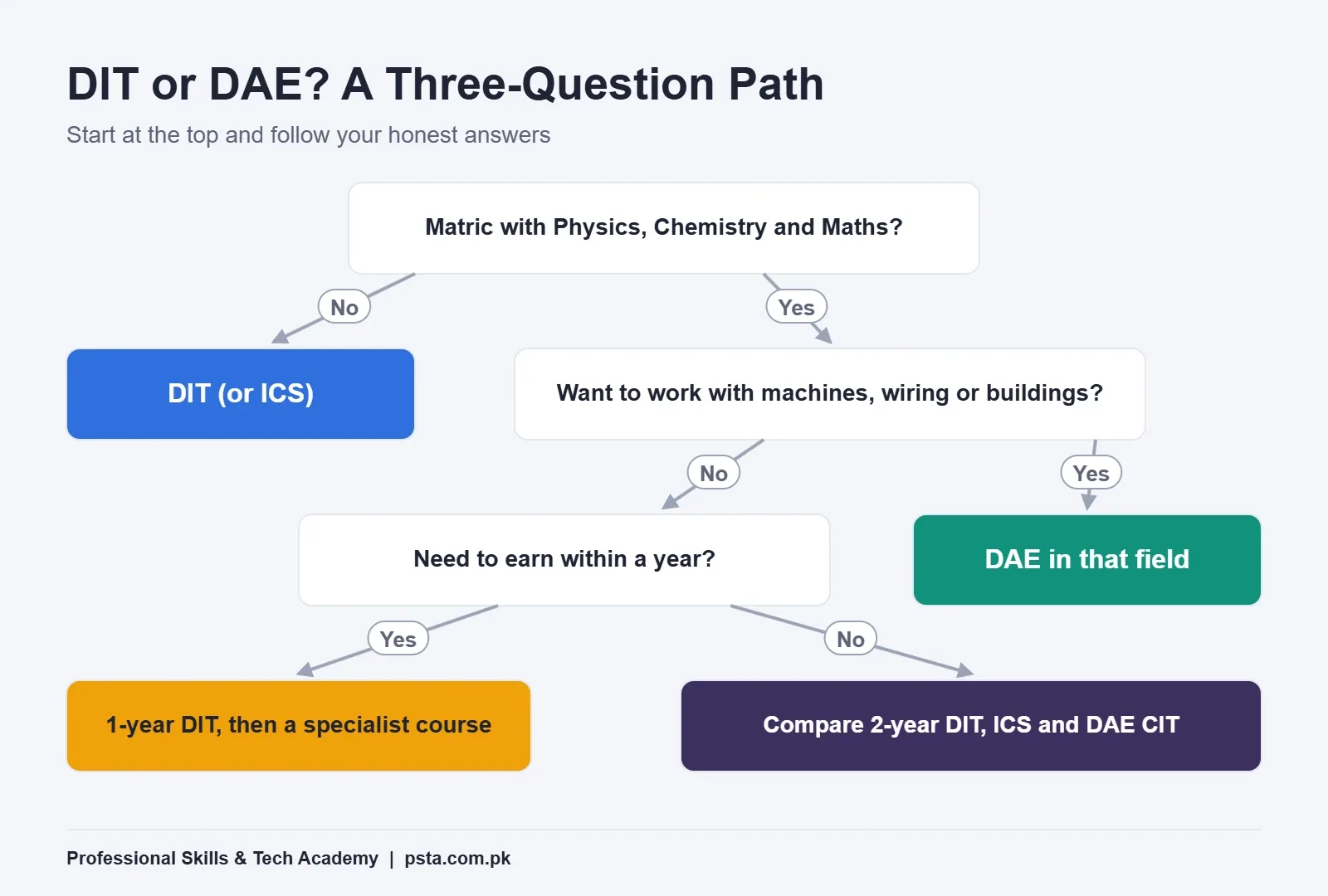
Sit down with your Matric result card and answer these in order. Write your answers down.
- Did you pass Matric with Physics, Chemistry and Maths? If not, a TEVTA DAE is closed to you. Go for a DIT, or ICS if you want a regular intermediate.
- Do you want to work with machines, wiring, buildings or industrial systems? If yes, a DAE in that technology fits better than any computer diploma.
- Can your family support three more years of study before you earn? If money is tight, a 1-year DIT lets you start working sooner. You can add a specialist course later.
- Do you plan to study for a degree later? If it's engineering, choose a DAE. If it's computing, compare the 2-year DIT, ICS and DAE CIT against the entry rules of the university you have in mind.
For many students, question 1 or 2 settles it. If you're still unsure after question 4, speak to a current student from each program. Ten minutes with someone in their second year will tell you more than any brochure.
DIT vs DAE Mistakes Families Make
- Treating DIT vs DAE as a fee question. The cheaper option per year isn't cheaper if it leads to a job you don't want.
- Ignoring the subject rule. Arts-group students lose weeks applying for DAE seats they can't get.
- Trusting an advert's equivalence claim. Ask for the board or department notification in writing.
- Picking a DAE technology at random. Electrical, civil and mechanical lead to very different jobs and degrees.
- Thinking a diploma is the finish line. Employers still look for portfolio work, typing speed and practical skill.
For a wider look at options after Matric, including typing, design and programming, see our guide to computer courses after Matric.
If DIT Is Your Pick: How PSTA Teaches It
PSTA runs a one-year Diploma in Information Technology over two semesters. Classes run at the Abbottabad campus, as live online sessions you can join from any city, or as a mix of both. The fee is Rs. 2,000 a month (regular Rs. 2,500), and a new batch starts every month.
Semester 1 covers ICT, networking, operating systems, Python and office automation. Semester 2 moves to graphic design, video editing and e-commerce, then MySQL databases and web pages built with HTML, CSS and JavaScript. You finish with projects such as a Windows installation, a small office network, a website with a database form and a short edited video.
Be clear about one point: this is a PSTA diploma, verifiable at psta.com.pk/certificate, not a board DIT. If you specifically need a board certificate for an equivalence or a government post, register with the relevant board as well. Our explainer on the 1-year vs 2-year DIT covers the board side in detail.
If you lean toward a DAE in electrical work, our industrial automation course on panel wiring, PLCs and VFDs pairs well with it during holidays. Civil students may find our AutoCAD course useful for drawing work.
Other programs, including typing and office skills, are listed on our courses page, and you can apply online through the admission form. Questions about batch slots go to +92 314 5424399 on WhatsApp. You can also stop by the campus in Mandian, Old College Road, opposite FIMS College.
Before You Fill Any Form, Compare Two Prospectuses
Get one DIT prospectus and one DAE prospectus from colleges you could actually reach. Put them side by side and check four lines: entry subjects, total years, total fee including board charges, and the equivalence notification. If one of them can't show you that last item in writing, you have your answer about which college to trust.
Frequently asked questions
Is DAE better than DIT?
Neither is better for everyone. A DAE suits you if you passed Matric with Physics, Chemistry and Maths and want technician work or an engineering degree later. A DIT suits you if you want computer and office skills quickly, or if your Matric was in the arts group. Pick the diploma that matches the work you want to do, not the one with the bigger name.
Can I do DAE after Matric in the arts group?
Usually not at government colleges in Punjab. For 2026, TEVTA Punjab asked DAE applicants for Matric with Physics, Chemistry, Mathematics and English, and merit was based on those subjects. Arts-group students can still apply for a DIT, which KPBTE opens to anyone with at least 33% marks in Matric, or they can take ICS or FA first.
Is DIT equal to intermediate?
It depends on the version. In August 2026, Result.pk reported that Punjab's new 2-year DIT in government colleges is equivalent to ICS. For a 1-year DIT, treat it as a skills qualification unless the college shows you a written notification stating otherwise. Always keep a copy of that notification for university admissions.
What is the DAE fee in Punjab government colleges?
TEVTA Punjab's 2026-27 fee table lists Rs. 17,490 a year for a DAE. That covers Rs. 5,869 admission and tuition, Rs. 8,866 pupil funds and a refundable Rs. 2,756 security. Board and exam fees are extra. Students with 90% or more in Matric get a full tuition waiver, and those with 80% to 89% get half.
Can a DAE holder get admission to BSc engineering?
Yes. Universities such as UET Taxila accept a DAE in the relevant technology for engineering programs, and ask for at least 50% marks for engineering technology programs. You also need an entry test such as ECAT. Since a 2022 Supreme Court ruling, DAE holders compete on open merit with FSc students rather than through a reserved quota.
How long does a DIT take?
A DIT takes one or two years. KPBTE's rules let students who finish Parts I and II take a one-year diploma, while the full program adds a second, academic year. Punjab's PBTE moved its DIT to a two-year, four-semester system in 2026, according to Dawn. Private institutes run their own one-year diplomas.
Should I choose DIT or DAE Computer Information Technology for an IT career?
Choose DAE CIT if you have a science Matric, can study for three years and want deeper hardware, networking and systems training with a DAE-style route to further study. Choose a DIT if you want practical office, design and web skills within a year so you can start working or freelancing sooner, and add a specialist course later.
Sources & references
- TEVTA Punjab official website tevta.gop.pk
- TEVTA DAE Admissions 2026 Details (Result.pk) result.pk
- TEVTA Admission in Punjab: How to Apply and 2026-27 Fees (Pakera) pakera.pk
- IT Diploma Introduced in Punjab Colleges (The Express Tribune) tribune.com.pk
- Punjab 2 Years IT Diploma 2026 for Govt Colleges (Result.pk) result.pk
- KPBTE Assessment and Promotion Rules, DIT 2-Year kpbte.edu.pk
- UET Taxila Undergraduate Admission Eligibility admissions.uettaxila.edu.pk
- Top Court Undoes 2% Quota for DAE Holders (The Express Tribune) tribune.com.pk
Last reviewed & updated on by Umar Qureshi. Written by the PSTA team in Abbottabad, Pakistan.

Umar Qureshi

Diploma in Information Technology (DIT) – 1 Year Certified Program
Turn this guide into a career: hands-on training with real projects, online across Pakistan or on-campus in Abbottabad · 1 Year.
Comments
No comments yet — ask a question or share your experience.