Quick answer
An English tenses chart crosses three times (past, present, future) with four aspects (simple, continuous, perfect, perfect continuous) to give 12 forms. Learn two building blocks: be + -ing for continuous and have + V3 for perfect. Skip -ing with state verbs like know, and practice one form a day.
Key takeaways
- • English has two true tenses; the 12-tense chart combines time with aspect.
- • Continuous forms use be + -ing, and perfect forms use have + V3.
- • Once you name a finished time like yesterday or in 2023, use the past simple.
- • State verbs such as know, like and own usually do not take -ing.
- • Ask three questions while speaking: when, still going, and linked to a later point.
- • Practice one form a day for 14 days, recording and correcting five sentences.
Table of contents 15 sections
- Why Do Books Say There Are 12 Tenses?
- The English Tenses Chart: All 12 Forms at a Glance
- Present Forms: Facts, Now and Up to Now
- Present Simple
- Present Continuous
- Present Perfect
- Present Perfect Continuous
- Which Verbs Don't Take -ing?
- Past Forms: Telling Events in the Right Order
- Future Forms: Will, Going To and More
- What Tense Mistakes Do Urdu Speakers Make Most?
- How Do You Choose the Right Tense While Speaking?
- A 14-Day Practice Plan for the Whole Chart
- Practicing Tenses With a Teacher at PSTA
- Start Tonight With Five Sentences
Before you look at any English tenses chart, try a two-minute test. Fix the verb in each sentence below, then check your answers at the end of this section.
- I am knowing Ali since 2022.
- I have passed my intermediate exams in 2024.
- Yesterday the manager call me for an interview.
- Don't phone at 8 tonight. I will watch the match then.
- By the time I reached the bank, it already closed.
Answers: I have known Ali since 2022. I passed my intermediate exams in 2024. Yesterday the manager called me. I will be watching the match then. It had already closed. If you got all five, you only need the chart for revision. If you missed two or more, this guide is for you.
Here's what this guide covers:
- The full chart of 12 tense forms, with one formula and one example for each
- Why grammar books call them "12 tenses" and why that label helps you
- Which verbs never take -ing, and the five slips Pakistani speakers repeat most
- A three-question method to pick a tense while you are speaking
- A 14-day practice calendar that takes about 20 minutes a day
Why Do Books Say There Are 12 Tenses?
Strictly speaking, English has two tenses that change the verb itself: present (work) and past (worked). Everything else comes from adding helper verbs that show aspect, which is how an action sits in time. Is it complete? Still going on? Both?
The British Council's LearnEnglish team makes this point in its lesson on the future continuous and future perfect. It notes that "future tenses" are really the modal will plus an infinitive, though the familiar names are kept because learners find them useful.
So why learn a chart of 12? Because it is a tidy map. Three time frames (past, present, future) multiplied by four aspects (simple, continuous, perfect, perfect continuous) gives 12 cells. Once you see the pattern, you stop memorizing 12 separate rules and start building each form from the same few parts.
In Pakistani schools you may also have learned the older names: present indefinite for present simple and past indefinite for past simple. They mean the same thing. A 2019 study in the journal English Language Teaching by Muhammad Din and Mamuna Ghani tested 200 fourth-year B.Sc. students on translating present and past indefinite sentences from Urdu into English, which shows how much attention even these "easy" forms still need.
The English Tenses Chart: All 12 Forms at a Glance
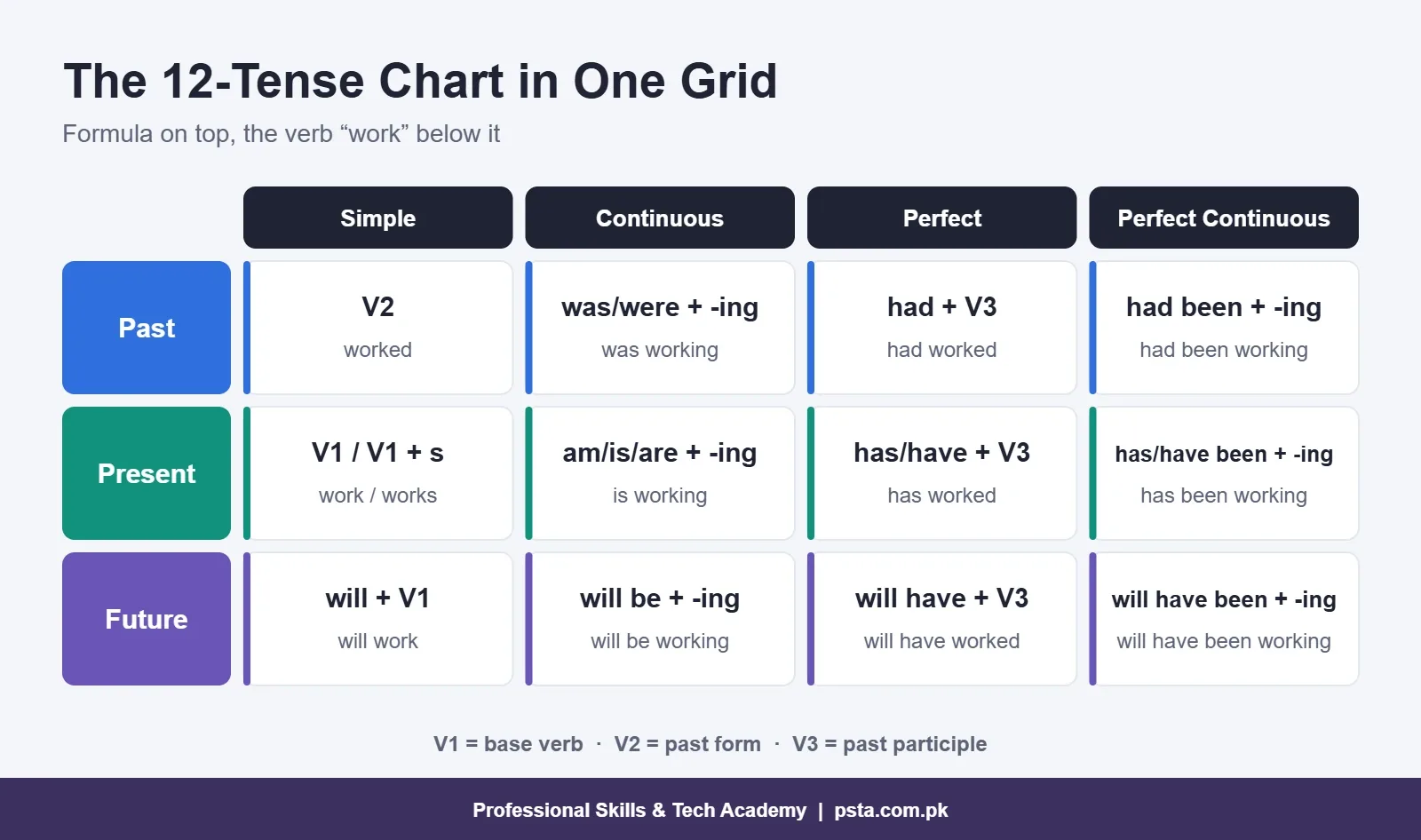
Use this table as your main reference. It puts all the tense formulas side by side, so come back to it whenever you're unsure. V1 is the base verb (go), V2 is the past form (went) and V3 is the past participle (gone). Regular verbs use -ed for both V2 and V3, which is why the example verb here is work.
| Time | Aspect | Formula | Example | Typical use |
|---|---|---|---|---|
| Present | Simple | V1 / V1 + s | She works in a bank. | Facts, habits, timetables |
| Present | Continuous | am/is/are + V-ing | She is working from home today. | Action in progress now, or a fixed arrangement |
| Present | Perfect | has/have + V3 | She has worked here for two years. | Past action linked to now |
| Present | Perfect continuous | has/have been + V-ing | She has been working since 9 a.m. | Activity running up to now |
| Past | Simple | V2 | She worked late yesterday. | Finished action at a known time |
| Past | Continuous | was/were + V-ing | She was working when the power went. | Background action in a story |
| Past | Perfect | had + V3 | She had worked there before she joined us. | The earlier of two past events |
| Past | Perfect continuous | had been + V-ing | She had been working for hours before the break. | Duration before a past point |
| Future | Simple | will + V1 | She will work on Saturday. | Decisions made now, predictions |
| Future | Continuous | will be + V-ing | She will be working at 10 tomorrow. | Action in progress at a future time |
| Future | Perfect | will have + V3 | She will have worked here a year by March. | Finished before a future point |
| Future | Perfect continuous | will have been + V-ing | By June she will have been working here for five years. | Duration up to a future point |
Notice the building blocks. Every continuous form uses some form of be plus -ing. Every perfect form uses some form of have plus V3. The perfect continuous simply joins the two: have + been + -ing. If you can remember those two pieces, you can rebuild the whole English tenses chart from memory.
Present Forms: Facts, Now and Up to Now
Present forms carry most of your daily speaking: introducing yourself, describing your job, explaining what you are doing this week. Get these four right and interviews feel much easier.
Present Simple
Use it for things that are generally true or happen regularly. "I live in Abbottabad." "The office opens at 9." Watch the third-person -s: he works, she teaches, it costs. Negatives and questions need do or does, and after does the main verb loses its -s: "Does he work on Fridays?"
Present Continuous
Use it for an action happening now or around now. "I'm preparing for my NTS test this month." The British Council's guide to future forms adds a second job: plans already arranged with someone else, such as "I'm meeting the HR officer on Monday."
Present Perfect
This is the form most learners avoid, and the one examiners listen for. It links a past action to the present. According to the British Council's present perfect lesson, its main uses are life experience ("Have you ever used Excel?"), unfinished time periods ("I haven't checked my email today"), states that continue with for or since, and past actions with a result now ("I've lost my CNIC copy, so I can't submit the form").
The rule that saves most marks: once you name a finished time, such as yesterday, last year or in 2023, switch to the past simple.
Present Perfect Continuous
Use it for an activity that started in the past and is still going on or has only just stopped. The Oxford Learner's Dictionaries grammar page also lists explaining a present situation: "Your eyes are red. Have you been studying all night?" It usually answers a How long question.
Which Verbs Don't Take -ing?
Some verbs describe states, not actions, and they usually refuse the continuous forms. The British Council's stative verbs page groups them into four families:
- Thoughts and opinions: know, believe, understand
- Feelings: like, hate, prefer
- Senses: hear, seem, taste
- Possession and measurement: own, weigh
So say "I don't understand the question," not "I am not understanding." A few verbs change meaning and can go either way. "I have a laptop" is possession, so no -ing. "I'm having lunch" describes an action, so -ing is fine.
This matters in the perfect continuous too. The Oxford page gives a clear pair: "I've known Jack for five years" is correct, while "I've been knowing Jack" is not.
Past Forms: Telling Events in the Right Order
Past forms let you tell a story, explain a gap in your CV or report what happened at work. Each one answers a different question about the event.
- Past simple answers "What happened?" Use it for a finished action at a known time: "I completed my DIT in 2025."
- Past continuous answers "What was going on?" It sets the background: "I was filling the form when the website crashed."
- Past perfect answers "What happened first?" The British Council's past perfect lesson says it marks the earlier of two connected past events: "The bus had left when we reached the stop."
- Past perfect continuous answers "For how long, before that?" "We had been waiting for 40 minutes when the bus finally came."
One caution from the same lesson: don't use the past perfect for a single event, however long ago it happened. "The Mughals built the Badshahi Mosque" needs only the past simple, because nothing else is being compared with it.
Future Forms: Will, Going To and More
English gives you several ways to talk about the future, and each carries a slightly different message. The British Council separates the three most common:
- will for a decision made at the moment of speaking: "The printer is jammed? I'll fix it."
- be going to for a plan you decided earlier: "I'm going to apply for the data entry post."
- present continuous for an arrangement others already know about: "We're leaving for Islamabad at 7."
The two longer forms are less common but useful in formal writing and interviews. The future continuous describes something in progress at a future time: "At 11 tomorrow I'll be sitting my typing test." The future perfect describes something finished by a deadline, and it usually comes with by or by the time: "By December I will have completed the course."
The future perfect continuous adds duration: "By next June, she will have been teaching for ten years." You will hear it rarely in conversation, so learn to recognize it before you worry about using it.
What Tense Mistakes Do Urdu Speakers Make Most?
In our spoken English classes in Abbottabad, the same handful of slips comes up in nearly every new batch. They are not signs of weak English. They usually come from translating an Urdu sentence word by word, where one verb pattern covers what English splits into two forms.
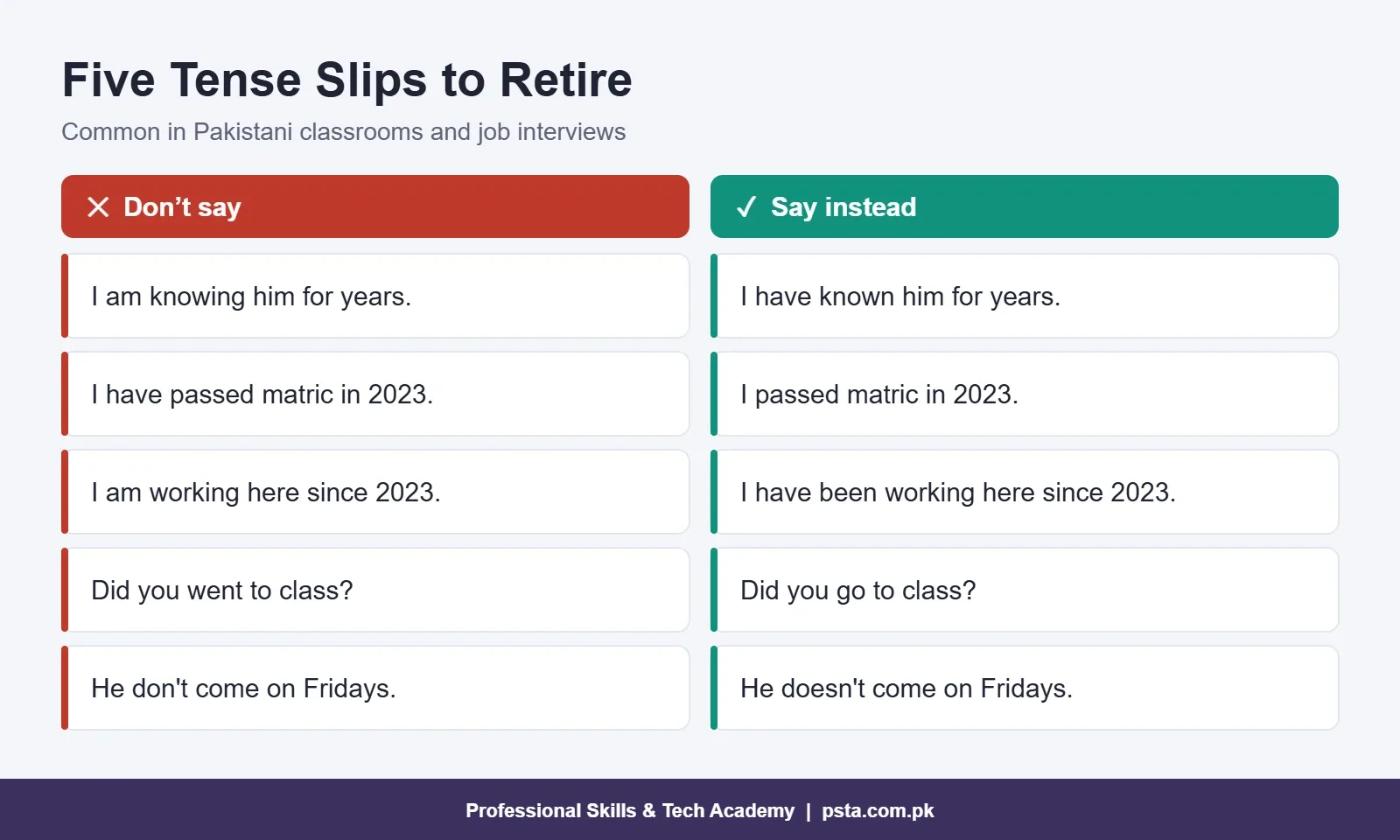
The image below shows the five I correct most often. Each fix links back to a rule in the English tenses chart: stative verbs, finished time with the past simple, since with a perfect form, the base verb after did, and does for third person.
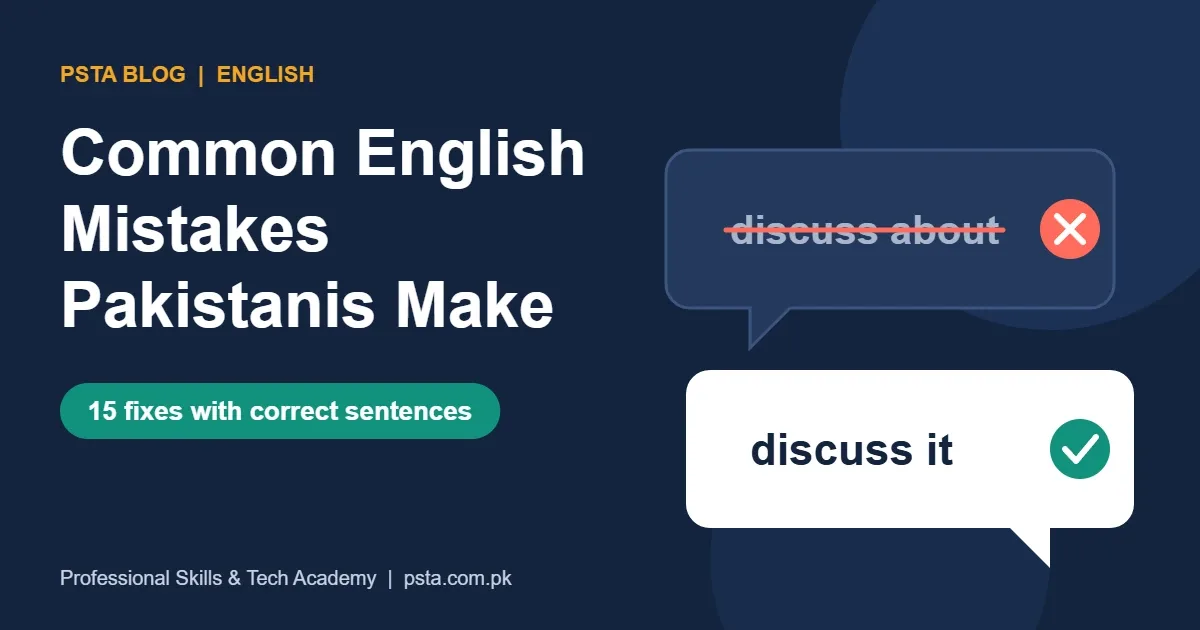
If you want more examples of this kind, our guide to common English mistakes Pakistanis make covers articles, prepositions and local words as well.
How Do You Choose the Right Tense While Speaking?
A printed English tenses chart is useful at a desk. In a live conversation, you need something faster. Ask yourself three questions, in this order:
- When? Is the time past, present or future? This picks the row.
- Finished or still going? If the action is in progress at that time, you need a continuous form. This picks the column.
- Linked to a later point? If the action connects to a later moment (now, a past event or a future deadline), add the perfect.
Try it with "I ___ (teach) here since 2021." When? It started in the past and continues now. Still going? Yes. Linked to now? Yes. That points to the present perfect continuous: "I have been teaching here since 2021." If the verb were a state like know, you would drop the -ing and say "I have known him since 2021."
At first this takes a few seconds per sentence. After two weeks of practice, most learners do it without thinking.
A 14-Day Practice Plan for the Whole Chart
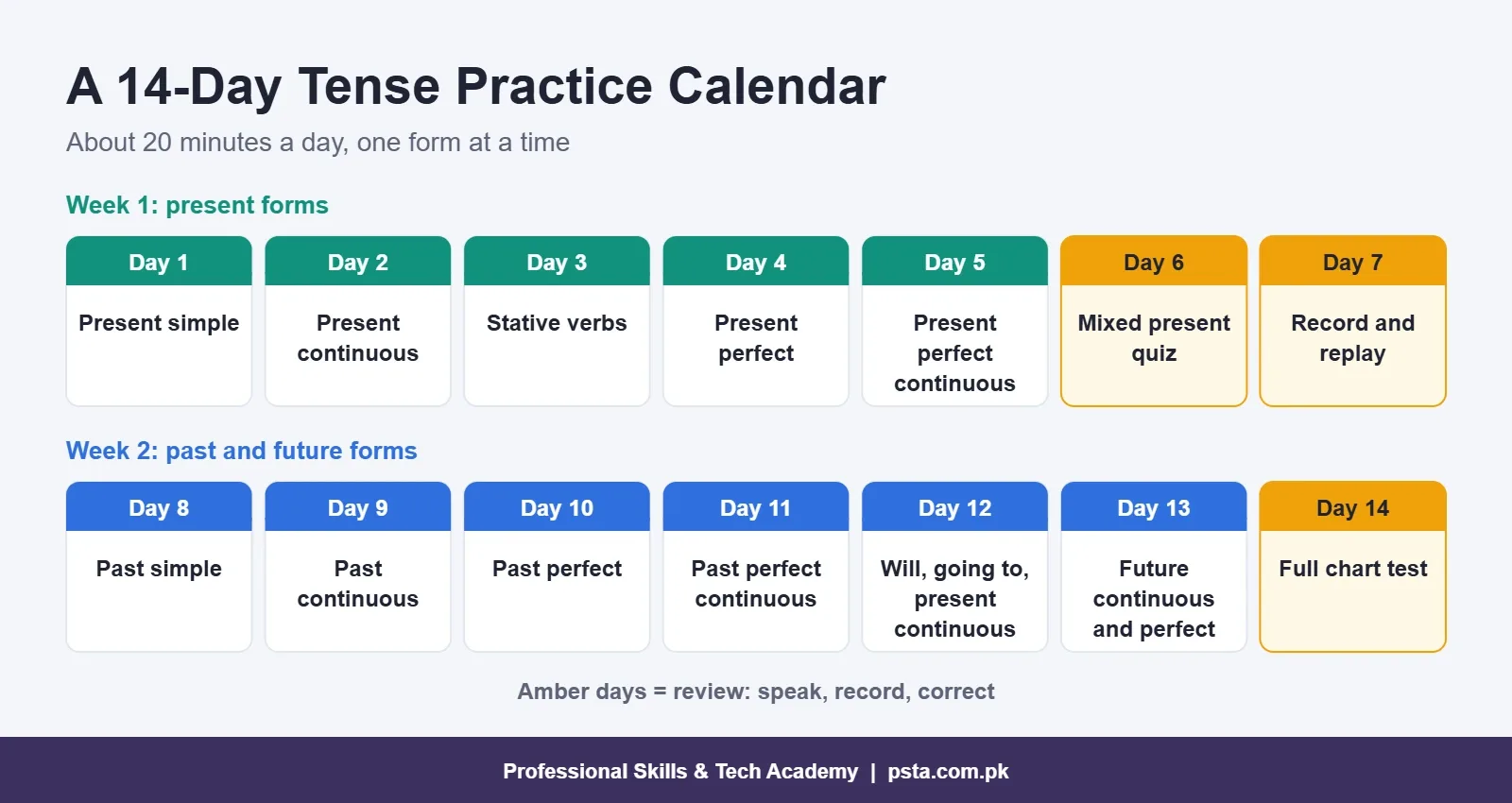
Reading an English tenses chart once won't change how you speak. Short daily practice will. This plan covers one form per day in about 20 minutes, with review days built in.
For each new form, follow the same routine:
- Read the formula and the example from the English tenses chart above.
- Write five true sentences about your own life using that form.
- Say them aloud and record them on your phone.
- Listen back, mark any wrong verb, and record again.
Week one covers present forms and stative verbs, then a mixed quiz and a recording day. Week two covers past and future forms and ends with a full chart test, where you write all 12 formulas from memory and one sentence for each.
If speaking is your bigger worry, pair this calendar with the routine in our 30-day plan to improve English speaking at home. Before an interview, practice tense-heavy answers with the sample replies in our English interview questions guide.
Practicing Tenses With a Teacher at PSTA
Self-study takes you a long way, but most people need someone to catch the errors they can't hear themselves. Our English Spoken and Grammar course runs for 12 weeks, and "Tenses and Grammar Usage in Speaking" is one of its core modules. Other modules cover sentence formation, pronunciation, interview and meeting practice, role plays, and email and CV writing.
At the time of writing, the course page shows a fee of Rs. 12,000, reduced from Rs. 14,000. Classes meet at our Abbottabad campus, and students elsewhere in Pakistan attend the same sessions live online. If you also handle office documents, our Office Automation course builds the Word and email skills that go with clear written English.
Browse the full course list to see what else fits, fill in the form on the admission page, or ask a question on WhatsApp at +92 314 5424399. If you prefer to visit, our building faces FIMS College, Mandian, Abbottabad.
Start Tonight With Five Sentences
Don't wait for day one of a plan. Tonight, write five sentences about your day: one present simple, one present continuous, one present perfect, one past simple and one future with going to. Check each one against the English tenses chart, read them aloud once, and save the recording. Tomorrow, do the same with five new sentences and compare the two recordings. That small habit is how the chart moves from paper into your speech.
Frequently asked questions
How many tenses are there in English?
Grammar books usually teach 12 tense forms: past, present and future, each in simple, continuous, perfect and perfect continuous. Linguists say English has only two true tenses, present and past, because the other forms are built with helper verbs. For learning and exams in Pakistan, the 12-form chart is the practical way to study them.
What is the easiest way to memorize the tenses chart?
Learn two building blocks instead of 12 rules. Continuous forms always use a form of be plus -ing, and perfect forms always use a form of have plus the past participle. Perfect continuous joins both. Then change only the helper verb for past, present or future, and you can rebuild every cell from memory.
What is the difference between present perfect and past simple?
Use the present perfect when a past action is linked to now and you do not say exactly when it happened, as in "I have visited Lahore." Use the past simple when you name a finished time, such as yesterday, last month or in 2023: "I visited Lahore last month." Mixing these two is a very common interview slip.
Why is "I am knowing" wrong?
Know is a stative verb. It describes a state of mind, not an action in progress, so it normally does not take the -ing form. Say "I know the answer" or "I have known him for years." Other common state verbs include believe, understand, like, prefer, own and seem.
Which tenses are used most in spoken English?
Day-to-day conversation leans heavily on the present simple, present continuous, past simple, present perfect, and future forms with will and going to. The perfect continuous forms appear less often, mostly when you talk about duration. Getting the common five right will improve your speaking far more than polishing the rare forms.
Are present indefinite and present simple the same?
Yes. Present indefinite and past indefinite are older names still used in many Pakistani school books for the present simple and past simple. The rules and examples are identical. Modern grammar resources, including British Council materials, use simple, so it helps to recognize both names.
How long does it take to learn all 12 tenses?
You can understand the full chart in a few days, but using tenses correctly while speaking takes regular practice. A focused 14-day plan of about 20 minutes daily covers every form once. Most learners need a few more weeks of speaking with correction before the right tense comes without thinking.
Sources & references
- British Council LearnEnglish: Present perfect learnenglish.britishcouncil.org
- British Council LearnEnglish: Past perfect learnenglish.britishcouncil.org
- British Council LearnEnglish: Future forms (will, be going to, present continuous) learnenglish.britishcouncil.org
- British Council LearnEnglish: Future continuous and future perfect learnenglish.britishcouncil.org
- British Council LearnEnglish: Stative verbs learnenglish.britishcouncil.org
- Oxford Learner's Dictionaries: Present perfect continuous oxfordlearnersdictionaries.com
- Din and Ghani (2019), English Language Teaching 12(5): Urdu-to-English tense translation study ideas.repec.org
Last reviewed & updated on by Umar Qureshi. Written by the PSTA team in Abbottabad, Pakistan.

Umar Qureshi

English Spoken & Grammar Course in Pakistan – Build Confidence, Speak Fluently (Online & Campus)
Turn this guide into a career: hands-on training with real projects, online across Pakistan or on-campus in Abbottabad · 12 Weeks.

Comments
No comments yet — ask a question or share your experience.