Quick answer
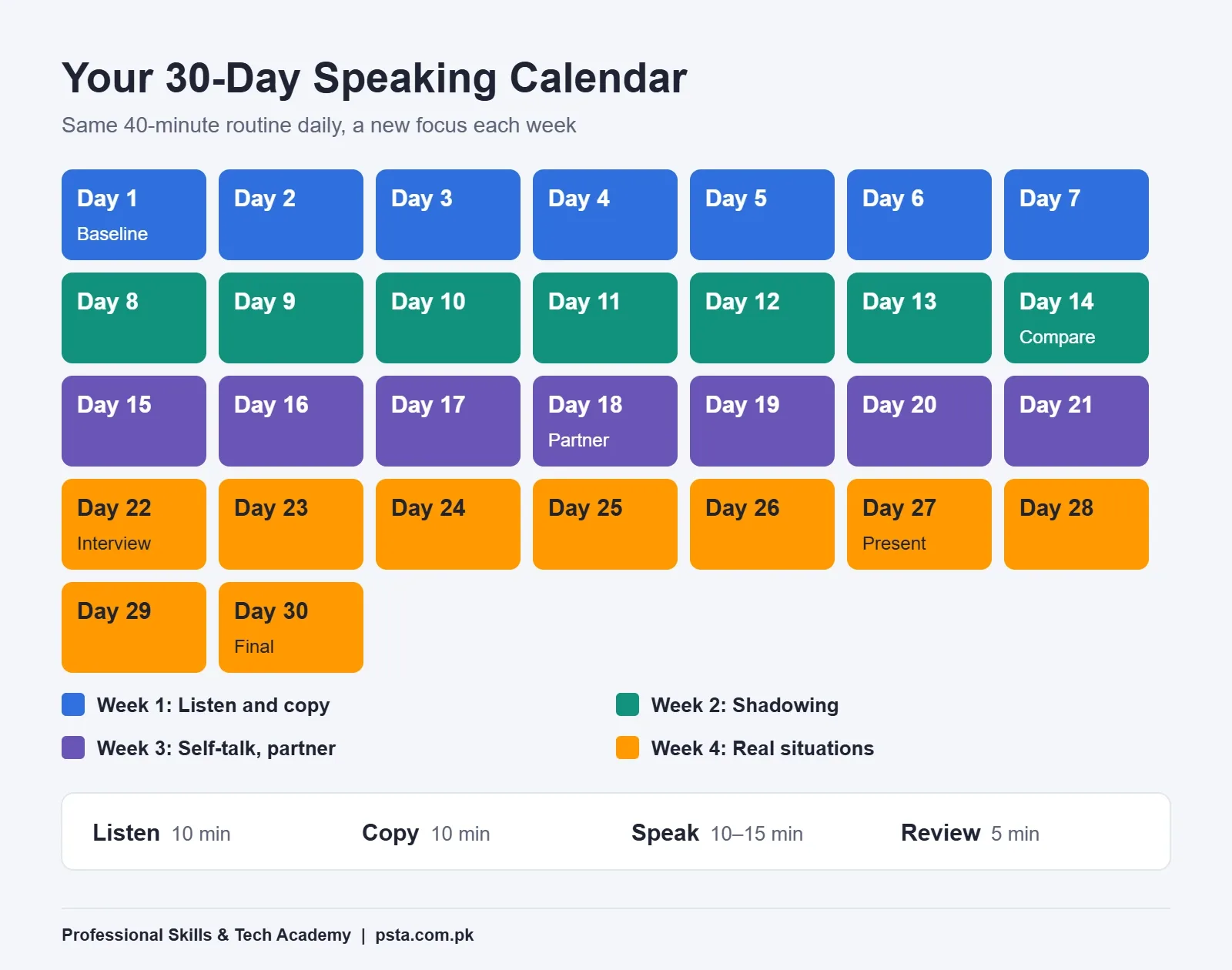
To improve English speaking at home, practise 30 to 40 minutes daily: listen to a short clip with a transcript, repeat it aloud, answer one prompt on a recording, then note one fix. Spend week one on listening, week two on shadowing, week three on self-talk and a partner, and week four on interviews and calls.
Key takeaways
- • Pakistan's EF EPI 2025 listening score (470) trails speaking (517), so train your ears before drilling grammar.
- • Cambridge estimates about 200 guided hours per CEFR level; 30 days at 40 minutes is roughly 20 hours.
- • Use one fixed daily routine: listen, copy, speak and review.
- • Shadowing short clips with transcripts builds rhythm and fluency.
- • Record the same prompt on Day 1 and Day 30 and count pauses, fillers and Urdu words.
Table of contents 14 sections
- Why Do So Many Pakistanis Read English Well but Freeze When Speaking?
- How Long Does It Take to Improve English Speaking?
- Set Up Your Home Practice Kit Before Day 1
- The 30-Day Plan at a Glance
- Week 1 (Days 1–7): Listen Closely and Copy the Sounds
- Week 2 (Days 8–14): Shadowing and Clear Pronunciation
- How to Shadow in Four Steps
- Sounds Worth Extra Attention
- Week 3 (Days 15–21): Talk to Yourself, Then to a Partner
- Week 4 (Days 22–30): Practise Real Situations
- How Can You Measure Progress Without a Teacher?
- Five Habits That Slow Home Practice Down
- When Home Practice Needs a Teacher: PSTA's Spoken English Classes
- Record Your Day 1 Baseline Tonight
A lot of students tell me they will start speaking once they finish a grammar book. That's a myth, and it keeps capable people silent for years. If you want to improve English speaking, treat it as a physical skill: you listen, copy sounds and talk out loud every day. You can start at home this week with a phone and 30 to 40 minutes a day.
This plan gives you:
- A clear reason why reading English well doesn't turn into speaking it
- An honest estimate of how much practice moves you up a level
- A free home practice kit you can set up in one evening
- A day-by-day 30-day routine split into four weekly goals
- A simple way to measure progress without a teacher
Why Do So Many Pakistanis Read English Well but Freeze When Speaking?
Pakistan ranked 67th out of 123 countries and territories in the EF English Proficiency Index 2025, with a score of 493 and a "low proficiency" band. The more useful detail sits inside the country breakdown.
The EF EPI 2025 fact sheet for Pakistan lists four skill scores. Speaking is 517, writing 515 and reading 512. Listening is far lower at 470. Khyber Pakhtunkhwa scored 501 overall, and Peshawar 506.
That gap matters more than the rank. A conversation is half listening. If you can't follow a fast reply, you hesitate, lose the thread and fall back on Urdu. Many of us also learned English for written exams, where you memorize answers and nobody asks you to say them out loud. So the words are in your head, but your ears and mouth haven't had the practice.
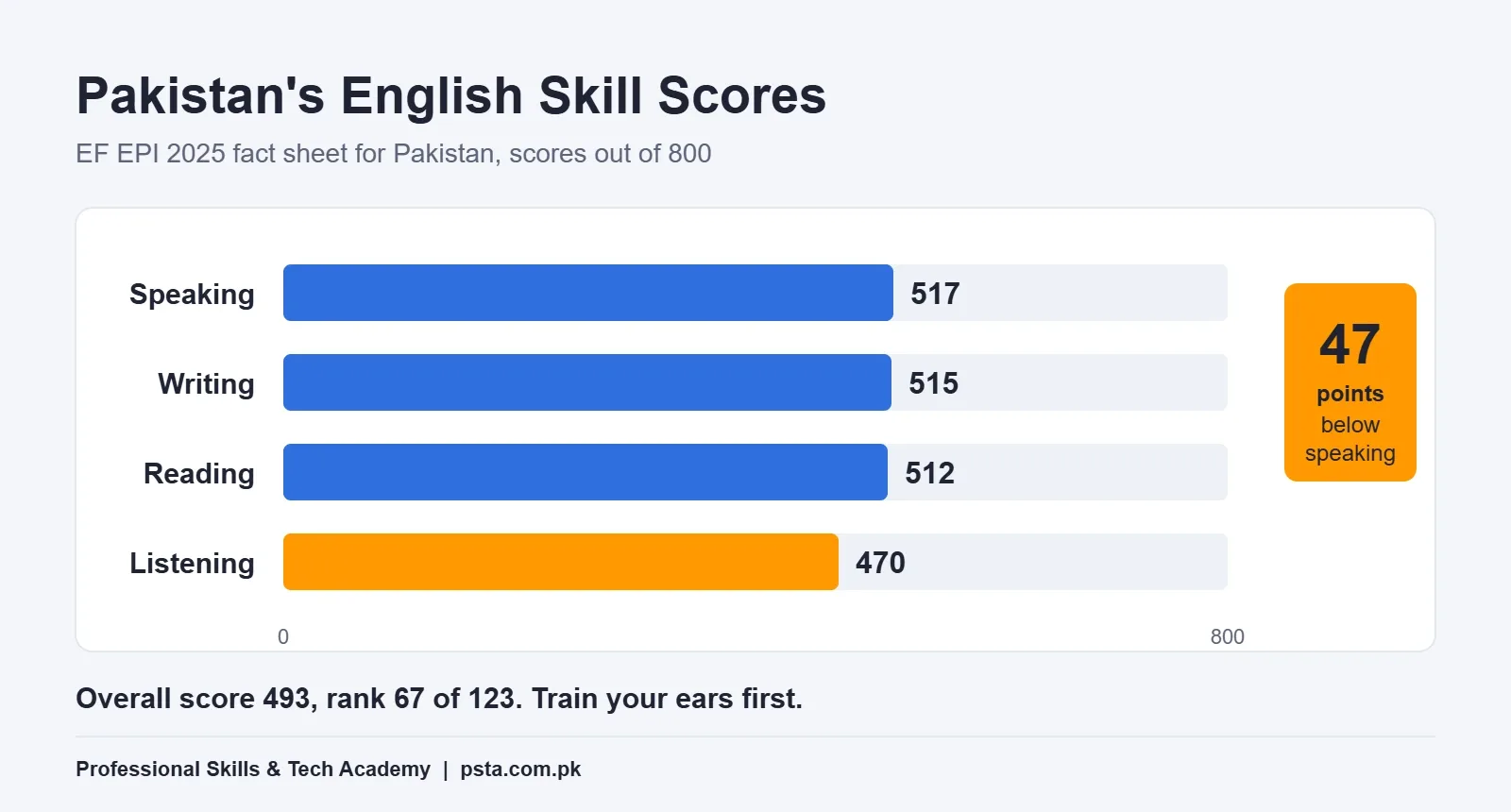
This is why the plan below starts with listening, not grammar drills. Better listening gives you the rhythm and stock phrases you'll reuse when you speak.
How Long Does It Take to Improve English Speaking?
Cambridge English publishes rough figures for guided learning hours on the CEFR scale. The totals are counted from a complete beginner, so each number includes the levels below it.
| CEFR Level | What It Looks Like in Speech | Total Guided Hours (Approx.) |
|---|---|---|
| A1 | Simple greetings and personal details | 90–100 |
| A2 | Short everyday exchanges, shopping, directions | 180–200 |
| B1 | Handles familiar topics, explains plans and opinions | 350–400 |
| B2 | Talks with fair fluency at work and in interviews | 500–600 |
| C1 | Speaks flexibly on complex topics | 700–800 |
| C2 | Near-native precision | 1,000–1,200 |
Cambridge adds a rule of thumb of about 200 hours to move from one level to the next, and calls all of these figures a guideline only. Your background, your age and how much English you hear outside class change the number.
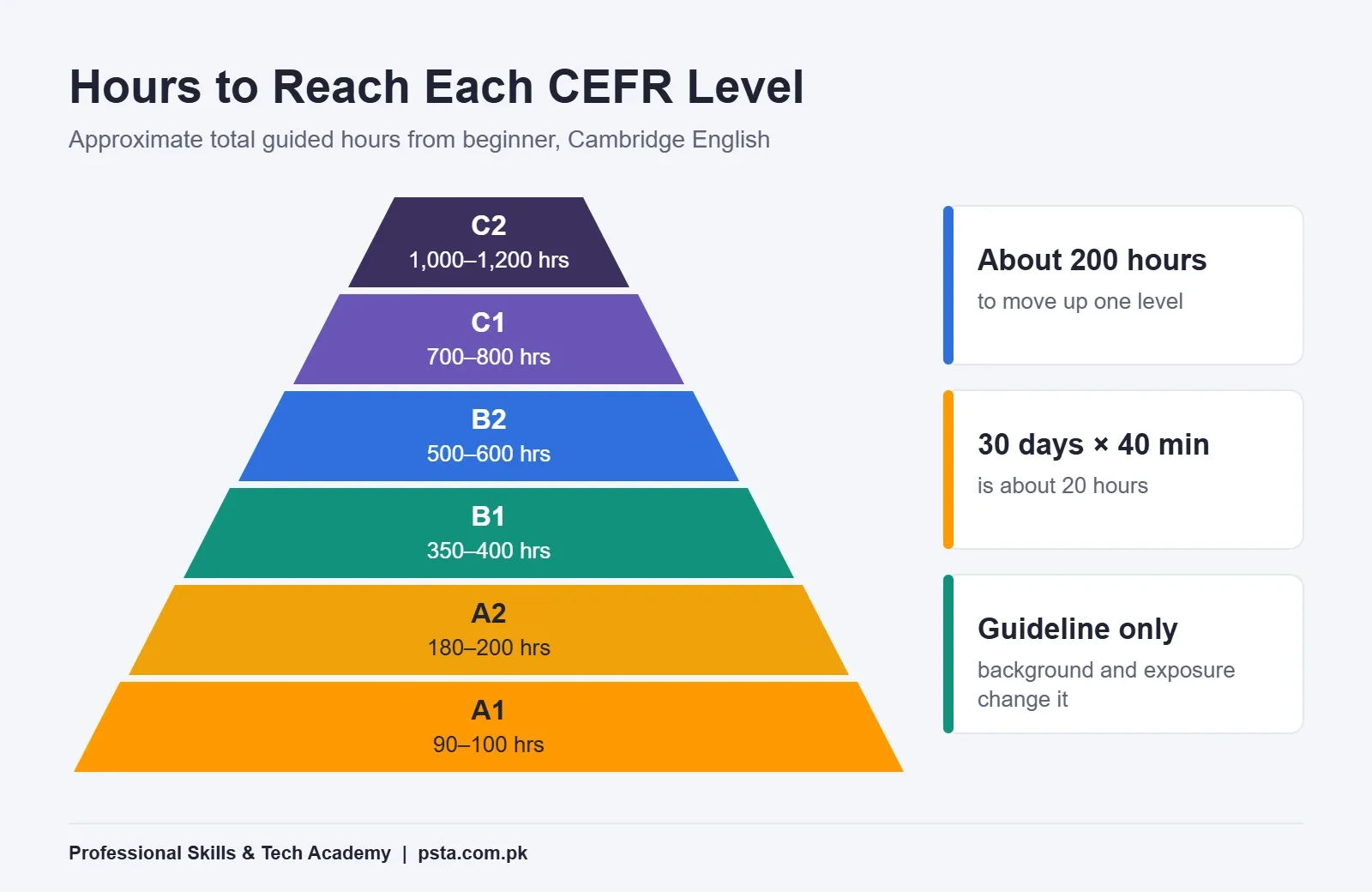
Now do the honest math. Forty minutes a day for 30 days is about 20 hours. That won't lift you a full level, and anyone who promises fluency in a month is selling something. What 30 focused days can do for your English fluency is build a daily habit, cut your long pauses, fix a few sounds that confuse listeners and give you ready phrases for interviews and calls. Those are the changes people notice first.
Set Up Your Home Practice Kit Before Day 1
You don't need a paid app for English speaking practice at home. Spend one evening putting these in place so that each practice day starts without friction.
| Tool | What You Use It For | Cost |
|---|---|---|
| Phone voice recorder | Recording your answers and comparing them over time | Free, built in |
| British Council LearnEnglish podcasts | Everyday English for A2 and B1 learners, with transcripts and exercises | Free to use |
| A dictionary with audio | Hearing how a word sounds before you say it | Free online |
| PowerPoint Speaker Coach | Feedback on pace, filler words and reading from slides | Free preview, if offered on your account |
| A small notebook | Your phrase bank and daily progress notes | Any cheap notebook works |
| One practice partner | A friend, cousin or classmate for short calls in Week 3 | Free |
A quick note on Speaker Coach. Microsoft's Speaker Coach support page says it is in free preview without an Office subscription, works only in English and needs the Microsoft 365 interface set to English. It also says the tool is offered in English-speaking markets, so check whether the Rehearse with Coach option appears in PowerPoint for the web when you sign in. If it doesn't, your phone recorder does most of the same job.
The 30-Day Plan at a Glance
Every day follows the same four blocks. The content changes each week, but the routine stays fixed so you don't waste time deciding what to do.
- Listen (10 minutes): one short audio clip with a transcript.
- Copy (10 minutes): repeat lines from that clip out loud.
- Speak (10 to 15 minutes): answer one prompt and record it.
- Review (5 minutes): play it back and write one fix in your notebook.
Consistency is what helps you improve English speaking, so pick a fixed time. After Fajr, during a commute with earphones, or after dinner all work. The time matters less than doing it daily. Two missed days in a row is your signal to shorten the session, not to quit.
Week 1 (Days 1–7): Listen Closely and Copy the Sounds
This week trains your ear, because you can't improve English speaking much while fast replies still lose you. You'll talk less than you expect, and that's fine.
- Day 1, record a baseline. Speak for two minutes on "Introduce yourself and describe the place you live." Don't stop or restart. Save the file as day-01.
- Days 2–7, one clip a day. Choose a LearnEnglish podcast episode or any short clip with a transcript. Listen once without reading, then once while reading.
- Mark the stress. Underline the stressed syllable in five new words, such as de-VE-lop, PHO-to-graph and pho-TO-gra-phy.
- Collect phrases, not single words. Write down five chunks a day, for example "I'm not sure, but I think" or "Could you say that again?"
By Day 7 you should have about 30 phrases in your notebook. These become your raw material for the next three weeks.
Week 2 (Days 8–14): Shadowing and Clear Pronunciation
The shadowing technique means playing a short recording and speaking along with it, a fraction of a second behind the speaker. You copy the speed, pauses and rise and fall of the voice, not only the words.
It's more than a classroom trick. A quasi-experimental study of 60 tenth-grade students at a vocational school found that the group taught with shadowing made larger gains in speaking fluency than a group taught with traditional speaking lessons. It's one small study, but it matches what teachers see in practice.
How to Shadow in Four Steps
- Pick 30 to 60 seconds of audio with a transcript.
- Read the transcript aloud slowly, twice.
- Play the audio and speak along while reading.
- Repeat without the transcript until you can keep pace.
Sounds Worth Extra Attention
Speakers of Urdu, Pashto and Hindko often swap a few sounds that confuse listeners. These pairs affect English pronunciation more than accent does, so spend five minutes a day on them:
- V and W: "vest" and "west", "vine" and "wine"
- Th sounds: "three" and "tree", "they" and "day"
- Extra vowels before S clusters: say "school", not "is-school"
Record one shadowing clip on Day 14 and listen to it next to your Day 1 file. Most learners hear a smoother rhythm already.
Week 3 (Days 15–21): Talk to Yourself, Then to a Partner
Now you move from copying to producing your own sentences. Start alone, where there's no pressure.
- Narrate a routine task. While making tea, describe each step out loud: "First I'm boiling the water, then I'll add the milk."
- Think in English for 10 minutes. On a walk, describe what you see in your head without translating from Urdu.
- Answer one prompt a day for two minutes. Use topics you actually talk about: your studies, cricket, a recent trip, your plans after graduation.
From Day 18, add a partner. Agree on a 15-minute phone call with one rule: English only until the timer ends. When you get stuck, describe the word instead of switching languages. "The thing you use to open a bottle" works fine when you forget "opener".
Keep this spoken English practice light. Your partner's English level matters less than the fact that you both keep talking.
Week 4 (Days 22–30): Practise Real Situations
The last stretch prepares you for the moments where spoken English counts in Pakistan: interviews, phone calls and presentations.
| Days | Situation | What to Practise |
|---|---|---|
| 22–24 | Job interview | Answer "Tell me about yourself" and two common questions in under 90 seconds each |
| 25–26 | Phone call | Call a friend playing a customer, a receptionist or an HR officer |
| 27–28 | Short presentation | Speak for three minutes about a project or your hometown, ideally with Speaker Coach |
| 29 | Free talk | A 20-minute partner call on any topic |
| 30 | Final recording | Repeat the exact Day 1 prompt and save it as day-30 |
Need questions to rehearse? Pick three from our English interview questions and answers post and time each reply. If the job needs you to follow up in writing, the job application email guide covers that side.
How Can You Measure Progress Without a Teacher?
Feelings are a poor guide to whether you improve English speaking from week to week. Some days you'll feel worse even when you're improving. Use your Day 1 and Day 30 recordings instead, and count a few things on paper.
| What to Count | How to Check It | Good Sign by Day 30 |
|---|---|---|
| Long pauses | Count silences of three seconds or more | Fewer than on Day 1 |
| Filler words | Tally "umm", "matlab" and "you know" | Noticeably lower |
| Urdu words | Count words you switched to Urdu for | Close to zero |
| Speaking time | Note how long you talked before running out of ideas | Closer to the full two minutes |
| Repeated errors | List the same mistake heard twice or more | One or two fixed for good |
If the numbers barely moved, look at your notebook. Usually the cause is skipped Speak blocks, because listening feels productive but asks nothing of your mouth.
Five Habits That Slow Home Practice Down
- Translating every sentence from Urdu first. It makes you slow. Use the phrase chunks from Week 1 instead.
- Studying rules without saying them. Grammar helps, but a rule you've never spoken won't come out under pressure.
- Watching without speaking. English dramas with subtitles build vocabulary, yet they don't train your mouth. Pause and repeat lines out loud.
- Chasing a foreign accent. Clear and understandable beats British or American. In the mock interviews I run, clarity and calm delivery make the strongest impression.
- Practising in bursts. Three hours on Sunday and nothing all week does less than 30 minutes daily.
For the grammar slips that show up most in speech, read our list of common English mistakes Pakistanis make and pick two to fix this month.
When Home Practice Needs a Teacher: PSTA's Spoken English Classes
A self-study plan works best when someone corrects you. If you want to improve English speaking faster with live feedback, a class helps. If you've finished 30 days and want a structured spoken English course, PSTA runs an English Spoken & Grammar course that lasts 12 weeks and starts from beginner level. At the time of writing, its course page lists the fee as Rs. 12,000, down from Rs. 14,000.
The syllabus moves through accent and pronunciation work, listen-and-repeat fluency drills, role plays, group discussions and speaking in front of others. It also covers email, CV and message writing, and ends with a final presentation and certification assessment. In short, it's the same listen, copy and speak cycle from this plan, with a trainer and classmates giving you live correction.
You can join on campus in Abbottabad (Mandian, Old College Road, opposite FIMS College), live online from anywhere in Pakistan, or in a mix of both. Fresh batches open monthly, and timings run Monday through Saturday, from morning slots until 9:30 at night. See how to apply on the admission page, compare options on all courses, or message the team on WhatsApp at +92 314 5424399. If presentations are part of your job, our Office Automation course covers PowerPoint alongside Word and Excel.
Record Your Day 1 Baseline Tonight
Don't wait for a free week. Open your phone recorder tonight, speak for two minutes about yourself and where you live, and save it as day-01. Don't listen to it yet. In 30 days you'll play it next to your final recording, and that comparison will tell you more than any test score.
Frequently asked questions
Can I improve my spoken English without a partner?
Yes, for the first few weeks. Listening, shadowing, narrating daily tasks and recording two-minute answers all work alone. Your phone recordings act as a mirror, showing pauses and repeated mistakes. A partner becomes useful once you can talk for a minute or two without stopping, because real conversation adds unpredictable replies you can't rehearse.
How many minutes a day should I practise speaking English?
Thirty to 40 minutes a day is a realistic target for students and working people. Split it into listening, repeating, speaking and a short review. Daily practice matters more than long sessions. If you're busy, 15 minutes every day will do more for you than two hours once a week.
Should I learn grammar first or start speaking?
Start speaking now and learn grammar alongside it. Grammar helps you correct sentences, but a rule you've never said aloud rarely comes out under pressure. Use your recordings to spot the grammar slips you actually make, then study those specific rules. That targeted approach saves time compared with working through a full book first.
Which accent should I learn for jobs in Pakistan?
Aim for clear, understandable English rather than a British or American accent. Work on word stress, the V and W difference and the th sounds, because these affect meaning. A local accent is fine if listeners can follow you easily. Trying to copy a foreign accent often makes beginners slower and more nervous.
Do English dramas and movies help with speaking?
They help your listening and vocabulary, which supports speaking. On their own, they won't train your mouth. Turn them into practice by pausing after a line, repeating it aloud with the same rhythm and writing down useful phrases. Five minutes of active repeating is worth more than an hour of passive watching.
How long does it take to speak English fluently?
It depends on your starting level and practice time. Cambridge English estimates roughly 500 to 600 total guided hours to reach B2, a level where you can talk with fair fluency at work. Daily practice at home adds to those hours, so a consistent routine over several months brings steady, visible progress.
What should I say in my Day 1 recording?
Use a simple, repeatable prompt such as introducing yourself and describing where you live. Speak for two minutes without stopping or restarting, even if you make mistakes. Keep the file unchanged. On Day 30, answer the exact same prompt so the comparison is fair and you can count the difference.
Sources & references
- EF EPI 2025 Fact Sheet: Pakistan ef.com
- EF English Proficiency Index (2025 rankings overview) en.wikipedia.org
- Cambridge English: Guided Learning Hours support.cambridgeenglish.org
- British Council LearnEnglish Podcasts learnenglish.britishcouncil.org
- Microsoft Support: Rehearse Your Slide Show With Speaker Coach support.microsoft.com
- The Impact of Shadowing Activity on EFL Students' Speaking Fluency e-journal.stkipsiliwangi.ac.id
Last reviewed & updated on by Umar Qureshi. Written by the PSTA team in Abbottabad, Pakistan.

Umar Qureshi

English Spoken & Grammar Course in Pakistan – Build Confidence, Speak Fluently (Online & Campus)
Turn this guide into a career: hands-on training with real projects, online across Pakistan or on-campus in Abbottabad · 12 Weeks.


Comments
No comments yet — ask a question or share your experience.