Quick answer
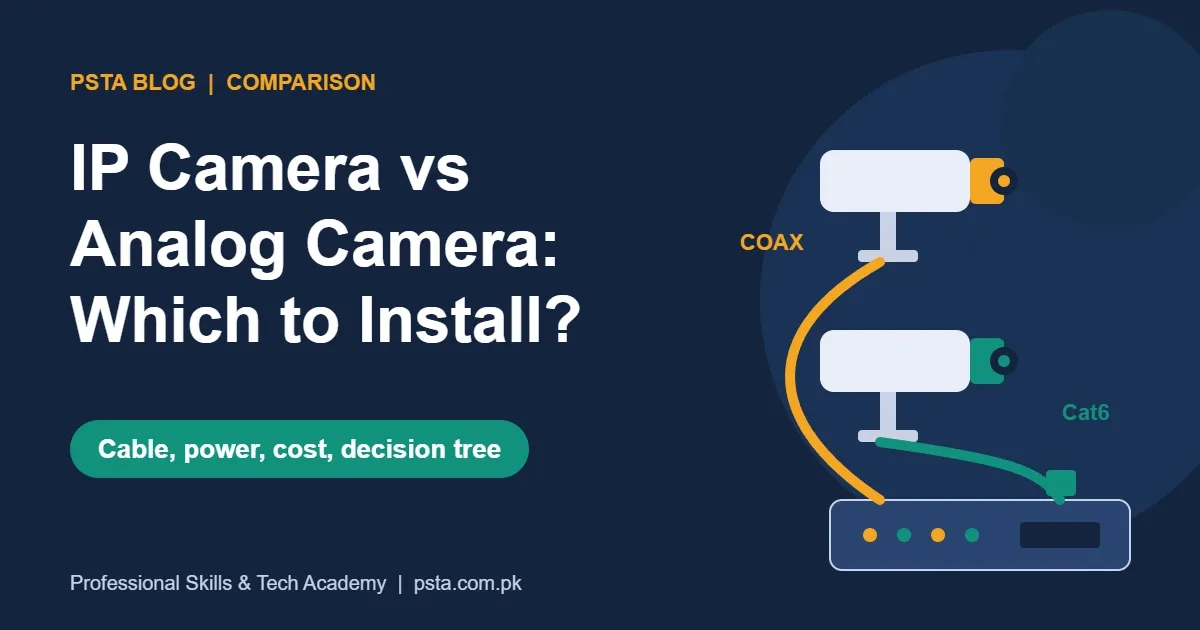
Analog HD cameras cost far less per camera and reuse existing coax, which suits small homes and tight budgets. IP cameras cost more but carry power over one Ethernet cable, offer smart alerts and encryption, and suit new or growing sites. Ethernet runs stop at 100 m; coax reaches 300 to 500 m.
Key takeaways
- • The key difference is where video becomes digital: at the DVR for analog, inside the camera for IP.
- • Ethernet runs are limited to 100 m; RG59 coax reaches 300 m for AHD and HD-CVI and 500 m for HD-TVI.
- • A 2MP IP bullet cost Rs. 8,640 and a 2MP analog bullet Rs. 2,390 at one Pakistani retailer in October 2026.
- • PoE lets one UPS keep the NVR and every IP camera running during load-shedding.
- • A hybrid XVR mixes coax and IP cameras, but IP channel counts vary by model.
Table of contents 14 sections
- How Do IP and Analog CCTV Cameras Actually Differ?
- IP Camera vs Analog Camera: Side-by-Side Table
- Cabling: Coax, Cat6 and the 100-Meter Rule
- Power: Separate Supply or PoE?
- What Does Each System Cost in Pakistan?
- Picture Quality, Storage and Smart Alerts
- Picture Quality
- Storage
- Smart Alerts and Security
- Is a Hybrid XVR a Good Middle Path?
- Which Should You Choose for Your Site?
- Mistakes That Make Either System Fail
- Where the CPCST Course Fits
- Walk Your Site With a Tape Measure
Before you settle the IP camera vs analog camera question, take a quick self-test about the site you're working on. Three questions, yes or no:
- Is there already coaxial cable running through the walls from an older system?
- Do you want your phone to warn you when a person, not a stray cat, crosses the gate at night?
- Will any camera sit more than 100 meters of cable away from the spot where the recorder goes?
A yes to the first question leans toward analog HD, because reusing cable saves money and labor. A yes to the second leans toward IP. A yes to the third means you need to plan the cable route carefully, whichever system you pick. Most homes and shops in Pakistan answer these three questions in about a minute, and the answers settle the IP camera vs analog camera choice better than any brochure.
This comparison covers what you need to make that call:
- how the two systems carry video, and why that changes cable, power and recorder choices
- real cable distance limits for IP, AHD, HD-CVI and HD-TVI
- prices we checked at a Pakistani retailer in October 2026
- when a hybrid recorder makes sense
- a pre-quote checklist that installers can use on site
How Do IP and Analog CCTV Cameras Actually Differ?
The real difference is where the video becomes digital. An analog camera sends a video signal down a coaxial cable. The recorder at the other end, a DVR, converts that signal to digital, compresses it and writes it to the hard drive. The FS comparison of NVRs and DVRs describes it the same way: a DVR processes video at the recorder, while an IP system processes it at the camera. That is the whole NVR vs DVR split in one sentence.
An IP camera is a small computer with a lens. It compresses its own video and sends it as network data over Ethernet cable, or over Wi-Fi in wireless models. The recorder, an NVR, mostly stores and manages streams that arrive already encoded.
Everything else follows from that one design choice. Analog cameras are simpler and cheaper at the camera end. IP cameras do more work inside the camera, so they can offer features such as smart alerts and encrypted streams, but each camera costs more.
One note on terms. When installers in Pakistan say "analog" today, they rarely mean the old 700-line cameras. They mean analog HD formats such as AHD, HD-CVI and HD-TVI, which push 1080p and higher over coax. That's the IP camera vs analog camera comparison that matters for anyone buying now.
IP Camera vs Analog Camera: Side-by-Side Table
Use this table as a summary. Each row is explained in the sections below, with the source for every number.
| Point | Analog HD (DVR) | IP (NVR) |
|---|---|---|
| Where video is encoded | At the DVR | Inside the camera |
| Usual cable | RG59 coax plus a power pair | Cat5e or Cat6 |
| Single run without extra gear | 300 m (AHD, HD-CVI) to 500 m (HD-TVI) on RG59 | 100 m per Ethernet run |
| Camera power | Usually a separate 12 V supply | PoE over the same cable |
| 2MP bullet price we checked | Rs. 2,390 | Rs. 8,640 |
| Smart alerts and encryption | Depends on the DVR model | Built into many models |
| Best fit | Tight budgets, existing coax, long single runs | New builds, analytics, larger or growing sites |
Cabling: Coax, Cat6 and the 100-Meter Rule
Cable is where most installation mistakes happen, so start here. Ethernet has a hard limit. The eufy guide to PoE distance puts the standard maximum at 100 meters (328 feet) per run, as defined by IEEE standards. Go past that and you risk dropped video or a camera that keeps rebooting.
Coax goes further on a single run. The CCTV Camera Pros cable length guide lists these limits on RG59 without amplifiers. Notice that HD-TVI cable distance is the longest of the three:
- AHD: 300 m (1,000 ft)
- HD-CVI: 300 m (1,000 ft)
- HD-TVI: 500 m (1,640 ft)
The same guide notes that amplifiers stretch these numbers further, and that analog HD can also run over Cat5 with baluns (250 m for HD-TVI, 300 m for AHD and HD-CVI).
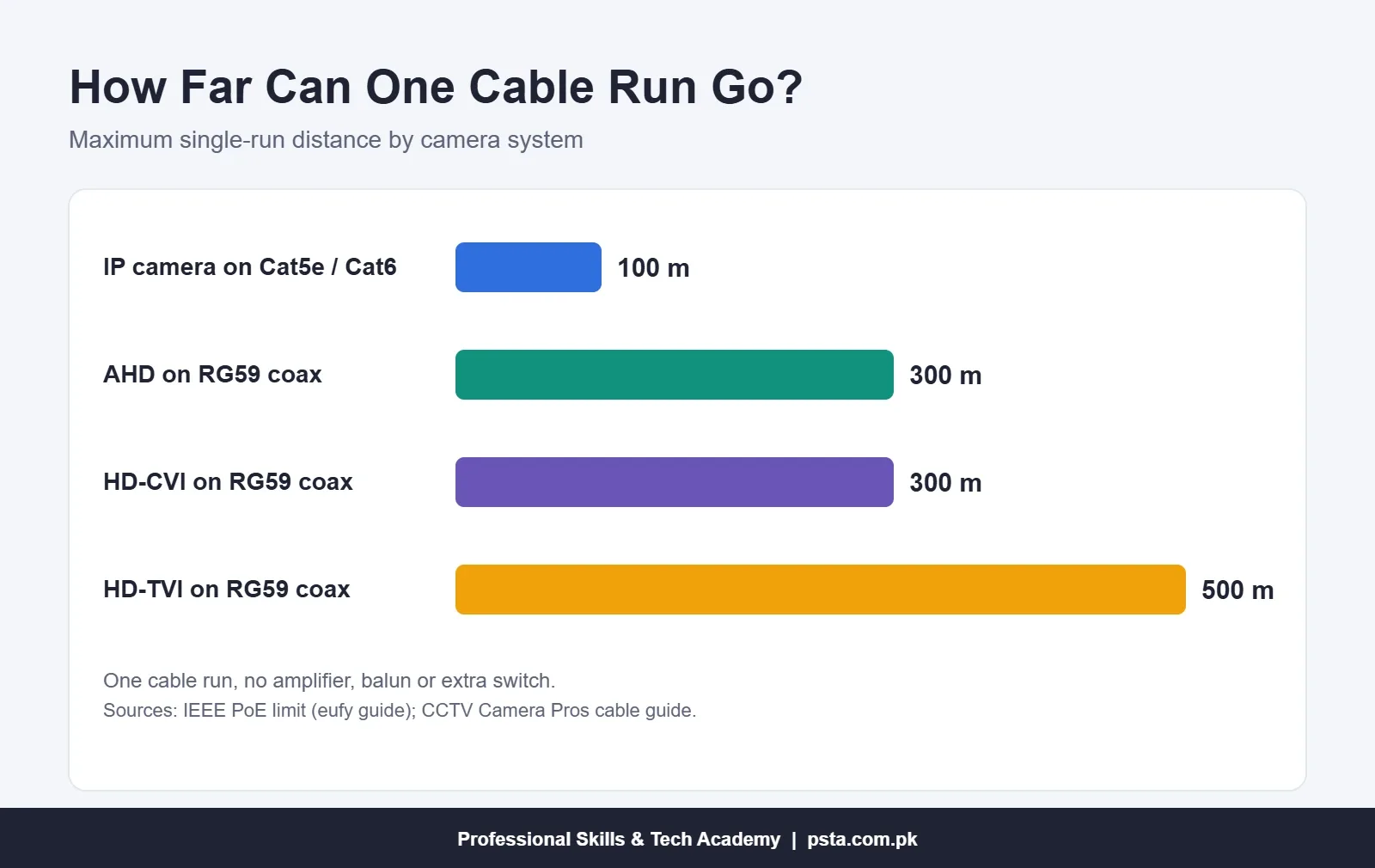
So does coax win the IP camera vs analog camera contest on distance? Only on a single unbroken run. An IP system isn't stuck at 100 meters overall. You place a PoE switch closer to the far cameras, or link two buildings with a fiber media converter, and each Ethernet run starts its own 100 meters. The FS article on IP and analog cameras makes the same point: once video is on a network, distance depends on the network, not one cable.
In most houses and shops, every cable run stays well under 100 meters. Distance becomes a real factor on factories, farmhouses, petrol stations and school campuses. On those sites, measure every route before you choose.
Power: Separate Supply or PoE?
Most analog cameras need two things at the camera: the coax for video and a separate 12 V DC feed. Installers often use Siamese cable, which bundles coax and a power pair, and run everything back to one boxed power supply. It works well, but it's one more thing that can fail, and a loose DC jack is a common reason for a camera going dark.
IP cameras usually take power over the Ethernet cable itself, known as PoE. According to the IONOS explainer on IEEE 802.3af, the original PoE standard, adopted in 2003, supplies about 15 watts at the source and up to 12.95 watts at the device. PoE+ (802.3at) raises that to 30 watts per port, according to eufy's guide.
For a normal fixed PoE camera, standard PoE is plenty. The Hikvision DS-2CD1023G0E-I 2MP bullet listed on W11Stop draws a maximum of 6.5 W under 802.3af. Four of them need 26 W in total, so a small PoE switch with a power budget above that, plus some headroom, covers them. Save PoE+ ports for PTZ cameras and anything with heaters or strong IR.
There's a practical bonus for Pakistani homes. With PoE, one UPS behind the switch keeps both the NVR and every camera running through load-shedding. With analog, you need to back up the DVR and the camera power supply separately.
What Does Each System Cost in Pakistan?
CCTV camera price in Pakistan moves with the dollar, so treat these IP camera vs analog camera figures as a snapshot. When we checked W11Stop in October 2026, the analog Hikvision DS-2CE16D0T-IRP 1080p bullet was listed at Rs. 2,390, and the 2MP IP bullet mentioned above was Rs. 8,640. Both are 2MP-class bullets from the same brand, so the comparison is fair at the camera level.
That gap is Rs. 6,250 per camera. On a four-camera home system, the IP cameras alone cost Rs. 25,000 more than the analog ones. That is before the recorder, hard drive, cable and labor, which you need for either system.
Some of the gap comes back in other places:
- You don't buy separate camera power supplies or DC splitters for PoE models.
- One UPS can cover the whole IP system, as explained above.
- Smart alerts can cut the hours someone spends scrolling through footage.
Still, be honest with clients. For a small home where the owner only wants to review footage after something happens, analog HD is usually the cheaper and perfectly sensible choice. Don't sell IP as a status symbol.
Picture Quality, Storage and Smart Alerts
Picture Quality
A 2MP analog HD camera and a 2MP IP camera both record 1920 x 1080. At short cable lengths, the difference you see comes mostly from the sensor, lens and lighting, not the system type. Over long coax runs, analog signals can lose quality, as the FS article notes. IP video arrives as data, so it either arrives intact or not at all.
At the top end of the IP camera vs analog camera range, IP has more room. FS points out that IP cameras are now available above 4K. If a client needs to read number plates at a gate or count items on a counter, IP gives you more model choices.
Storage
Many IP cameras support newer compression. The DS-2CD1023G0E-I listing shows H.265+ on its main stream. Lower bitrates mean more days of footage on the same drive. Our CCTV storage calculation guide shows how to turn bitrate into drive size, and it works for both systems.
Smart Alerts and Security
FS lists analytics such as object recognition and perimeter breach alerts among IP camera features, along with encrypted streams. It also notes that analog signals aren't encrypted. Some DVRs add their own detection features, so check the exact model's datasheet rather than assuming.
Network cameras do bring a duty. Every IP camera is a device on the network, so you must change default passwords, update firmware and keep cameras off the open internet. If that side interests you, our Cyber Security & Ethical Hacking course covers it in depth.
Is a Hybrid XVR a Good Middle Path?
Often, yes. A hybrid XVR accepts both coax cameras and IP cameras. Dahua calls its version "penta-brid", and its announcement of penta-brid XVRs describes support for five standards: IP, HDCVI, CVBS, AHD and TVI.
Here's where a hybrid fits well:
- A shop already has eight working coax cameras and wants two new IP cameras at the entrance and cash counter.
- A school wants to replace cameras block by block over two budget years.
- A client wants analog prices now but a path to IP later without buying another recorder.
The catch is channel count. A hybrid recorder supports only a limited number of IP channels on top of its coax inputs, and that number varies by model. Read the datasheet before you promise a client any upgrade path.
Which Should You Choose for Your Site?
Go back to the self-test at the top. If the site already has good coax, start by pricing analog HD or a hybrid XVR. Otherwise, two questions decide most jobs: how much the owner needs smart alerts, and how big the site is. The matrix below turns those answers into an IP camera vs analog camera recommendation. It isn't a rule book, but it matches how experienced installers think through a site survey.
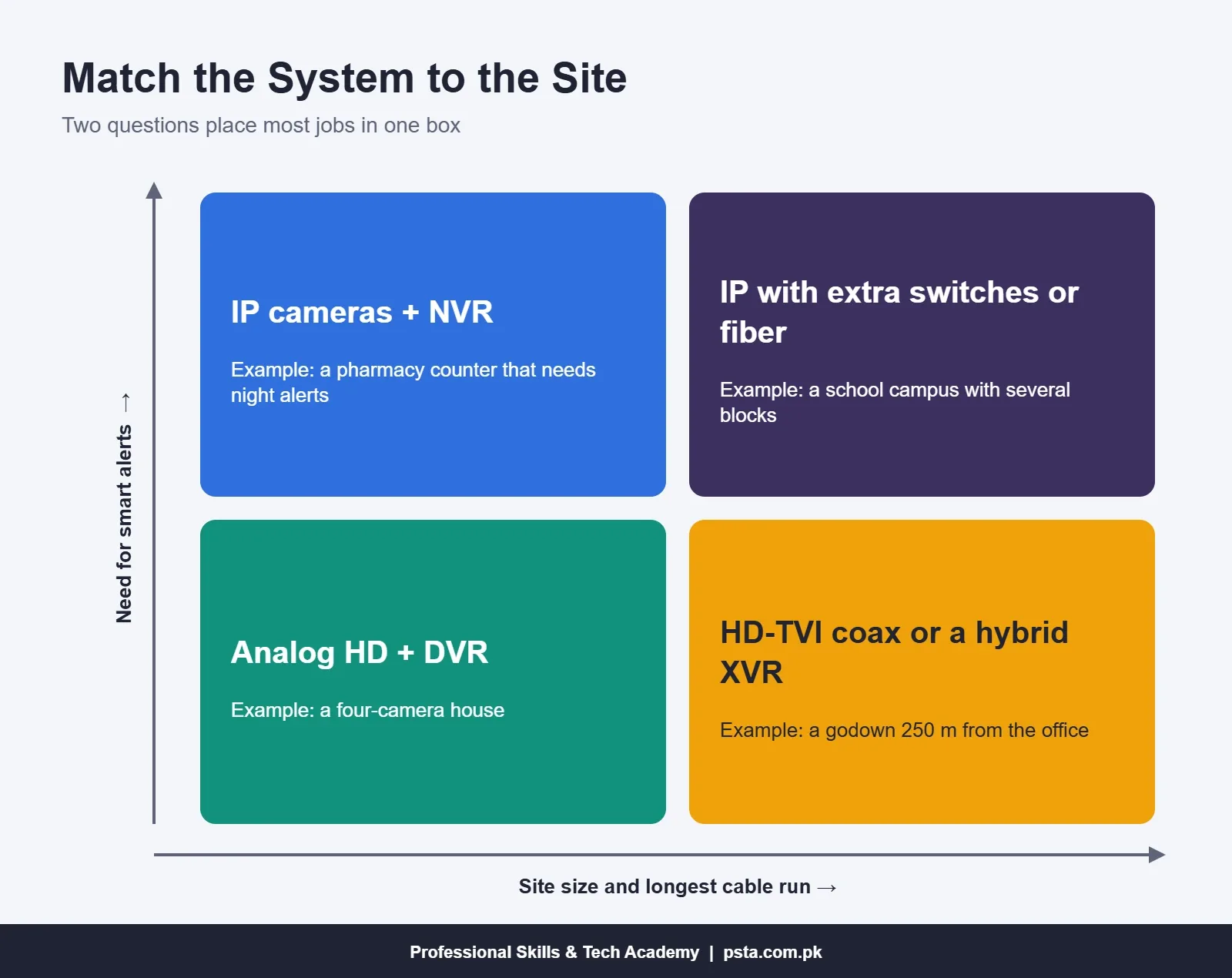
Here's how it plays out for three common jobs (these are examples, not client cases):
- A four-camera house in Abbottabad. Short cable runs, an owner who reviews footage only after an incident and a tight budget. Analog HD with a 4-channel DVR is the sensible pick.
- A pharmacy that wants alerts after closing time. The owner wants a phone notification if someone walks behind the counter at night. IP cameras with line-crossing or intrusion detection fit that need.
- A small factory with a godown 250 m from the office. Either works. Coax can reach on one HD-TVI run, while IP needs a switch or fiber link near the godown. Price both routes before deciding.
Mistakes That Make Either System Fail
The system type matters less than the quality of the CCTV installation. Watch for these common faults on any job:
- Stretching Ethernet past 100 m. The camera may work at first, then drop out or keep rebooting.
- Undersized power supplies on analog systems. IR LEDs draw more at night, so a supply that's fine in daylight can fail after dark.
- Mixing analog formats without checking the DVR. Many DVRs detect the format on their own, but confirm in the datasheet that yours accepts every format on site.
- Leaving default passwords on IP cameras. This is the easiest way to expose a client's cameras online.
- Skipping the storage calculation. A drive that holds four days of footage when the client expects 30 will bring an angry phone call.
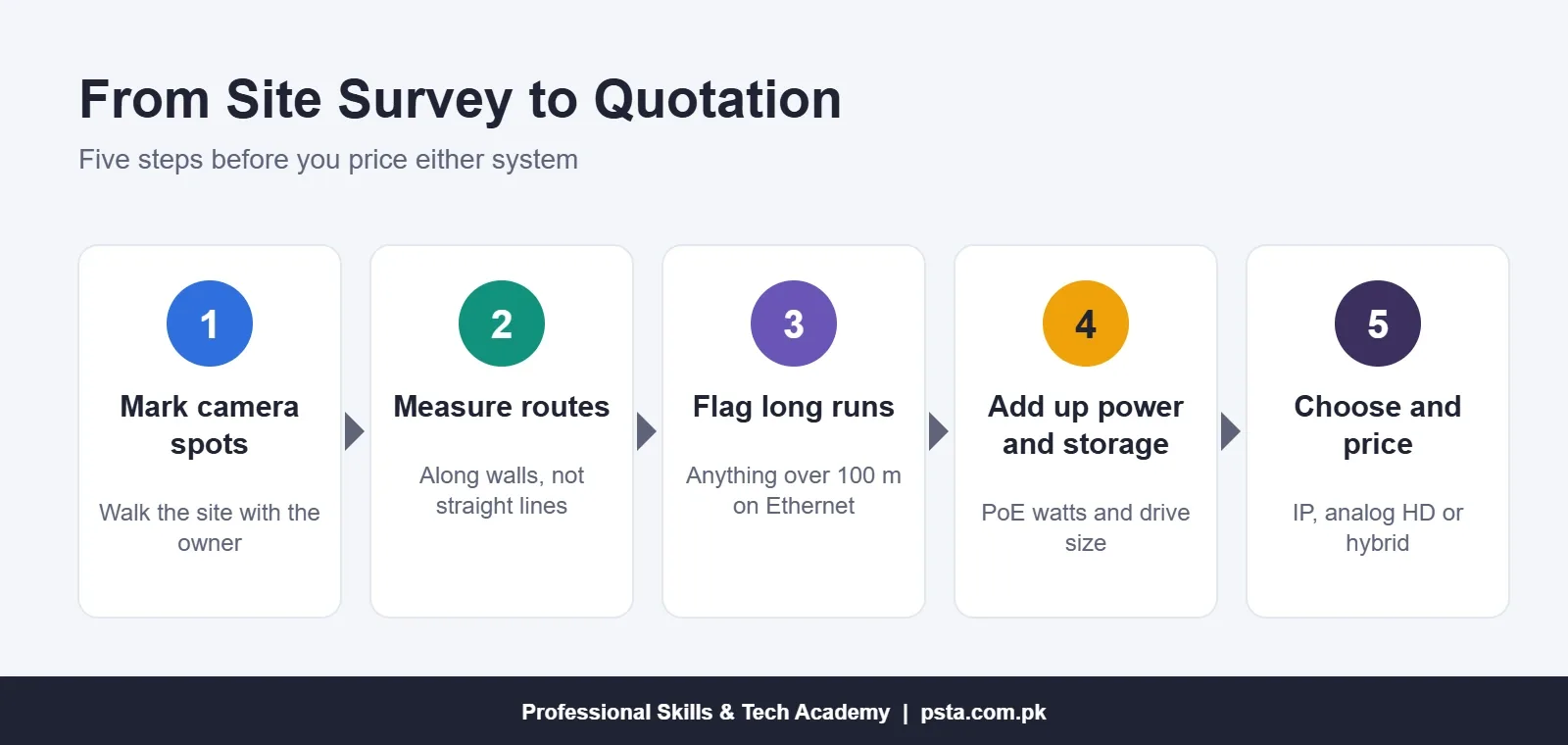
Follow the five steps below on every site visit before you write a quotation.
Where the CPCST Course Fits
If you want to install and design both kinds of system, PSTA's CPCST course for CCTV and AI security technicians covers the IP camera vs analog camera comparison in the lab, with both systems on the bench. It runs for 12 weeks at beginner level, and the course page lists the fee as Rs. 22,000.
The modules move from analog DVR setup and power management to IP networking, PoE switching, VLANs, NVR deployment, ONVIF and smart analytics. Later modules cover site surveys, system design with AutoCAD basics, quotations and freelancing. Classes run at the Abbottabad campus and as live online sessions, and you can switch between the two if your schedule changes.
If you plan to draw site layouts professionally, the AutoCAD Mastery course pairs well with it. You can compare every option on the courses page, and the admission page explains how to join the next monthly batch. If you'd rather ask first, our WhatsApp line (+92 314 5424399) answers questions about batches and timings.
Walk Your Site With a Tape Measure
Before you buy a single camera, walk the site with a notepad and a measuring tape. Mark each camera position, measure the cable route to the recorder (along walls, not in a straight line) and note where power and the UPS will sit. With those three things on paper, the IP camera vs analog camera choice usually makes itself, and your quotation will hold up when the work starts.
Frequently asked questions
Can I connect an IP camera to my old DVR?
Only if the recorder is a hybrid model, often sold as an XVR, with IP channels. A standard analog DVR has only BNC coax inputs, so it cannot read a network camera. Check the recorder datasheet for the number of IP channels before you buy. If it has none, you will need an NVR or a hybrid recorder.
Do IP cameras need internet to record?
No. IP cameras record over your local network to the NVR, even if the internet connection is down. Internet is only needed when you want to watch live video or playback on your phone away from the site. Keep the cameras on a local network and avoid exposing them directly to the internet.
Can I use Cat6 cable with analog cameras?
Yes. With video baluns at each end, analog HD signals can travel over twisted-pair cable. The CCTV Camera Pros guide lists about 250 m for HD-TVI and 300 m for AHD and HD-CVI over Cat5 with baluns. You still need to supply power to each camera separately or through spare pairs.
Is a 2MP IP camera clearer than a 2MP analog HD camera?
Both record at 1920 x 1080, so on short cable runs the picture depends mostly on the sensor, lens and lighting. The difference grows over long coax runs, where analog signals can lose quality, and at higher resolutions, where IP offers more models, including cameras above 4K.
How big a PoE switch do I need for four cameras?
Add up the maximum power of every camera and leave headroom. For example, a 2MP IP bullet rated at 6.5 W needs 26 W for four units. Choose a switch whose total PoE budget is comfortably above that figure, and use PoE+ ports for PTZ cameras or models with heaters.
Which system is easier to keep running during load-shedding?
IP with PoE is usually simpler. One UPS behind the PoE switch and the NVR powers every camera and the recorder together. An analog system needs backup for the DVR and for the separate camera power supply, which means two units to size and maintain.
Should I replace a working analog system with IP?
Not always. If the cameras still give a usable picture and the client only reviews footage after incidents, keep them. Add IP cameras through a hybrid recorder where you need smart alerts, such as gates or cash counters, and replace the rest gradually as cameras fail or budgets allow.
Sources & references
- NVR vs DVR, What Are Their Differences? (FS) community.fs.com
- IP Cameras vs Analog Cameras, What Are the Differences? (FS) fs.com
- CCTV Camera Video Max Cable Length Guide (CCTV Camera Pros) videos.cctvcamerapros.com
- PoE Max Distance (eufy) eufy.com
- How Powering Over Ethernet Works With 802.3af (IONOS) ionos.com
- Next-Generation XVRs Feature Penta-brid Support (Dahua) us.dahuasecurity.com
- Hikvision DS-2CD1023G0E-I 2MP Network Camera (W11Stop) w11stop.com
- Hikvision DS-2CE16D0T-IRP 1080p Bullet Camera (W11Stop) w11stop.com
Last reviewed & updated on by Umar Qureshi. Written by the PSTA team in Abbottabad, Pakistan.

Umar Qureshi

Certified Professional CCTV Surveillance & AI Security Technician (CPCST)
Turn this guide into a career: hands-on training with real projects, online across Pakistan or on-campus in Abbottabad · 12 Weeks.


Comments
No comments yet — ask a question or share your experience.