Quick answer
Most Python interview questions for freshers test understanding, not memory. Expect basics such as == vs is and PEP 8, data structures and mutability, functions and OOP traps like mutable default arguments, and a short live coding task. Answer in one line first, add an example, and mention one trade-off.
Key takeaways
- • Group your revision into four levels: basics, data structures, functions and OOP, and live coding.
- • is tests identity while == compares values; use is mainly for None.
- • Default argument values are evaluated once, so never use a list as a default.
- • PEP 8 asks for 4-space indents, 79-character lines and snake_case function names.
- • In a live task, talk while you code and test at least one edge case.
Table of contents 27 sections
- How Are These Questions Grouped?
- Level 1: Python Basics
- 1. What Is Python, and Is It Really Interpreted?
- 2. Which Python Version Should You Use?
- 3. What Does PEP 8 Say About Code Style?
- 4. What Is the Difference Between == and is?
- Level 2: Data Structures
- 5. What Is the Difference Between Mutable and Immutable Objects?
- 6. When Would You Use a Tuple Instead of a List?
- 7. When Should You Use a Dictionary or a Set?
- 8. What Is a List Comprehension?
- Level 3: Functions and OOP
- 9. What Do *args and **kwargs Mean?
- 10. Why Is a List a Bad Default Argument?
- 11. What Is a Decorator?
- 12. What Is self, and How Do Class and Instance Attributes Differ?
- Level 4: Practical Python and Live Coding
- 13. What Is a Generator?
- 14. How Do You Handle Errors in Python?
- 15. What Is the GIL?
- 16. Live Task: Find the Most Common Word in a Sentence
- Python Interview Questions Cheat Sheet
- How Should You Answer Out Loud?
- Mistakes That Cost Freshers the Interview
- A One-Week Revision Plan
- Preparing for Python Roles at PSTA
- Answer Three Questions Out Loud Tonight
Which Python interview questions does a fresh graduate actually face, and what does a good answer sound like? Most first-round questions test whether you understand how Python behaves, not whether you memorized definitions. Can you explain why a list changes and a tuple doesn't? Or why a default argument "remembers" old values? Then you are ahead of many candidates.
Python is worth the preparation. In the 2025 Stack Overflow Developer Survey, 57.9% of all respondents said they had used Python, including 54.8% of professional developers. This guide covers:
- 16 questions in four levels, from basics to live coding
- Short answers in plain English, with code where it helps
- The traps interviewers like, such as mutable defaults and
isversus== - How to answer out loud so you sound clear, not rehearsed
- A one-week plan to revise before the interview
How Are These Questions Grouped?
Many interviewers for junior roles move from easy to hard. They often start with basics to settle you, then probe data structures, then functions and classes, and finish with a small coding task. This guide follows the same order, so you can practice in the sequence you'll meet.
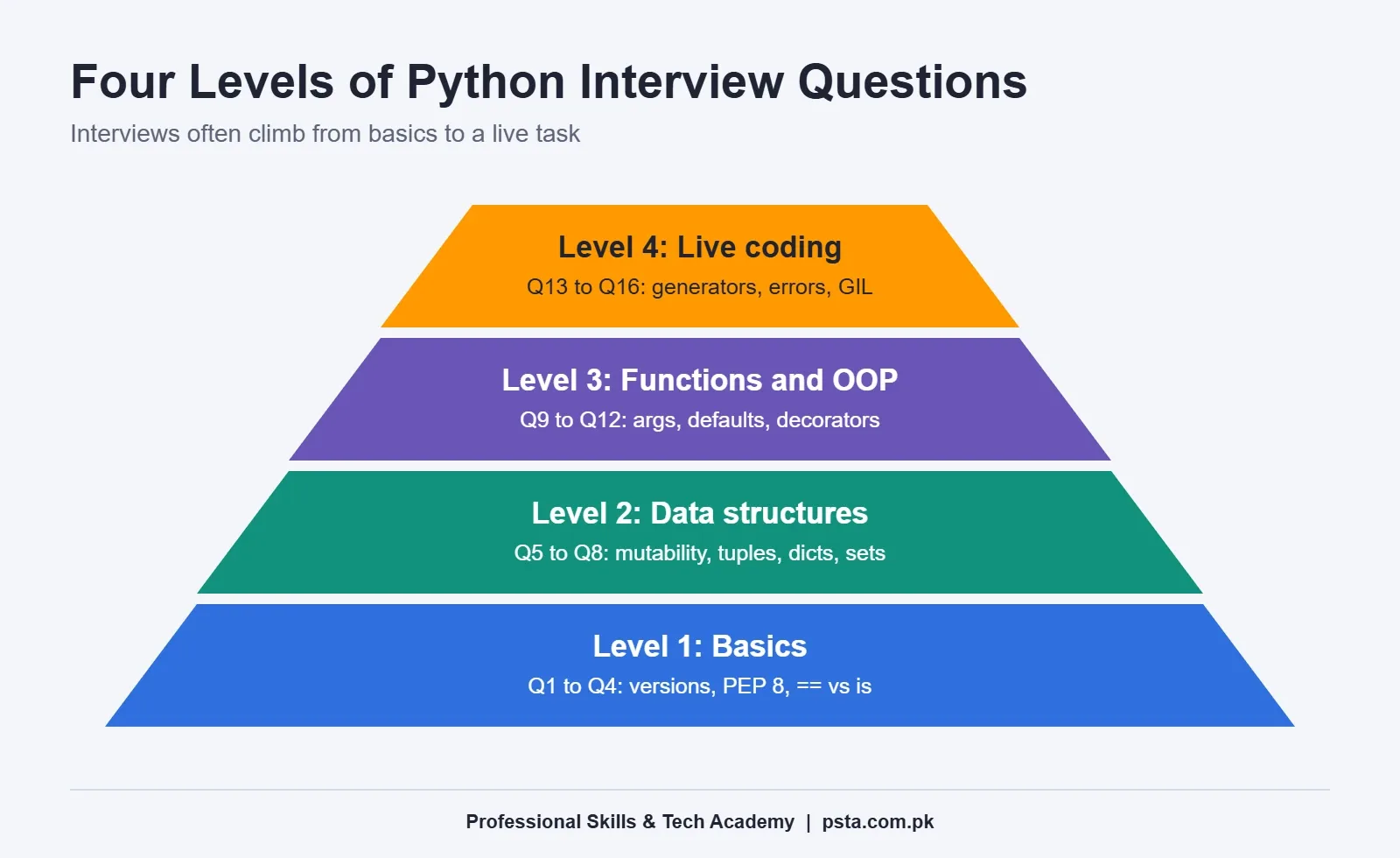
Each of these Python interview questions can be answered in under a minute once you have practiced it out loud a few times. Aim for that length, because long answers leave less time for the questions that decide the result.
Don't skip the first level because it looks easy. A shaky answer to a basic question makes the interviewer doubt everything after it.
Level 1: Python Basics
1. What Is Python, and Is It Really Interpreted?
Python is a high-level, general-purpose language known for readable syntax. People call it interpreted, but a more complete answer earns marks. The standard implementation, CPython, first compiles your source code into bytecode, and then its virtual machine runs that bytecode. You never run a separate compile step yourself, which is why it feels interpreted.
2. Which Python Version Should You Use?
Use a current, supported version. The Python developer guide's version status page lists 3.15 as first released on 9 October 2026 and 3.14 as another bugfix branch. Versions 3.11 to 3.13 receive security fixes only. For an interview, saying "I work on 3.14 or newer" shows you keep up.
3. What Does PEP 8 Say About Code Style?
PEP 8 is Python's official style guide. Mention three rules. Use 4 spaces per indentation level. Keep lines to 79 characters. Name functions in lowercase with underscores (calculate_fee), and name classes in CapWords (StudentRecord).
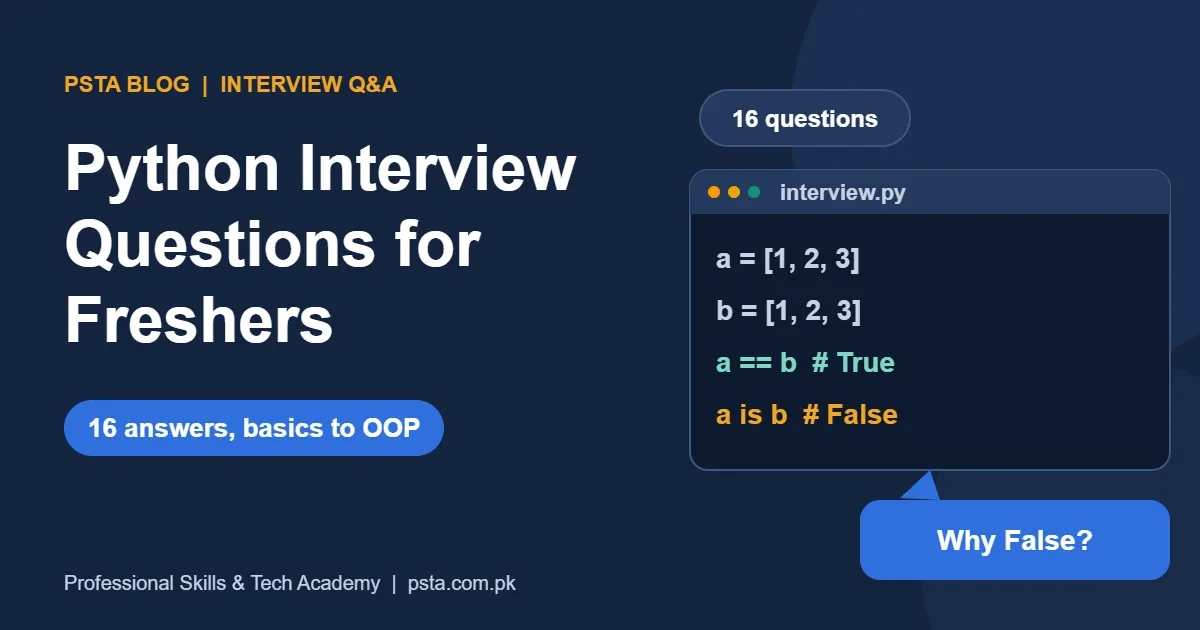
4. What Is the Difference Between == and is?
According to the Python language reference, is tests identity: x is y is true only if both names point to the same object. == compares values.
a = [1, 2, 3]
b = [1, 2, 3]
print(a == b)   # True: same values
print(a is b)   # False: two different list objects
Use is mainly to compare with None, as in if result is None:.
Level 2: Data Structures
5. What Is the Difference Between Mutable and Immutable Objects?
The Python glossary defines a mutable object as one whose state can change while the program runs. Immutable objects, such as numbers, strings and tuples, can't be changed. To store a different value, Python creates a new object. Lists, dictionaries and sets are mutable.
6. When Would You Use a Tuple Instead of a List?
Use a tuple for a fixed group of values that shouldn't change, such as a coordinate (33.15, 73.22) or a database row. Because tuples are immutable, they can serve as dictionary keys, while lists can't. Use a list when items will be added, removed or sorted.
7. When Should You Use a Dictionary or a Set?
Use a dictionary when you look things up by a key, such as a student's roll number. Use a set when you only care whether an item exists, or you need unique values. Both are built on hashing, so membership checks stay quick even when they hold many items, unlike searching through a long list.
cities = ["Abbottabad", "Lahore", "Abbottabad", "Karachi"]
unique_cities = set(cities)   # {'Abbottabad', 'Lahore', 'Karachi'}
8. What Is a List Comprehension?
The glossary calls it a compact way to process all or part of a sequence and return a list. It replaces a short loop:
fees = [3000, 22000, 30000]
discounted = [f * 0.9 for f in fees if f > 5000]
Say that you use comprehensions for simple transformations, and a normal loop when the logic grows past one line.
Level 3: Functions and OOP
9. What Do *args and **kwargs Mean?
*args collects extra positional arguments into a tuple. **kwargs collects extra keyword arguments into a dictionary. They let one function accept a flexible number of inputs, which is common in wrappers and decorators.
10. Why Is a List a Bad Default Argument?
This is a favorite trap. The official Python tutorial warns that a default value is evaluated only once, so a mutable default is shared between calls:
def add_mark(mark, marks=[]):
    marks.append(mark)
    return marks

add_mark(50)   # [50]
add_mark(70)   # [50, 70], not [70]
The fix is to default to None and create a new list inside the function when the argument is None.
11. What Is a Decorator?
The glossary describes a decorator as a function that returns another function, usually applied with the @ syntax. It adds behavior, such as logging or timing, without changing the original function's code. If you have used Flask, @app.route("/") is a decorator you already know.
12. What Is self, and How Do Class and Instance Attributes Differ?
self is the conventional name for the instance a method is working on. Instance attributes, set as self.name inside __init__, belong to one object. Class attributes are defined in the class body and shared by every instance. A school name stored as a class attribute is the same for every Student, while each student's roll number is an instance attribute.
Level 4: Practical Python and Live Coding
The last level checks whether you can use Python, not just describe it. Expect fewer definitions here and more "show me" moments.
13. What Is a Generator?
A generator function uses yield to produce values one at a time instead of building a full list in memory. It is useful for large files or long sequences. Reading a 2 GB log file line by line with a generator keeps memory use small.
14. How Do You Handle Errors in Python?
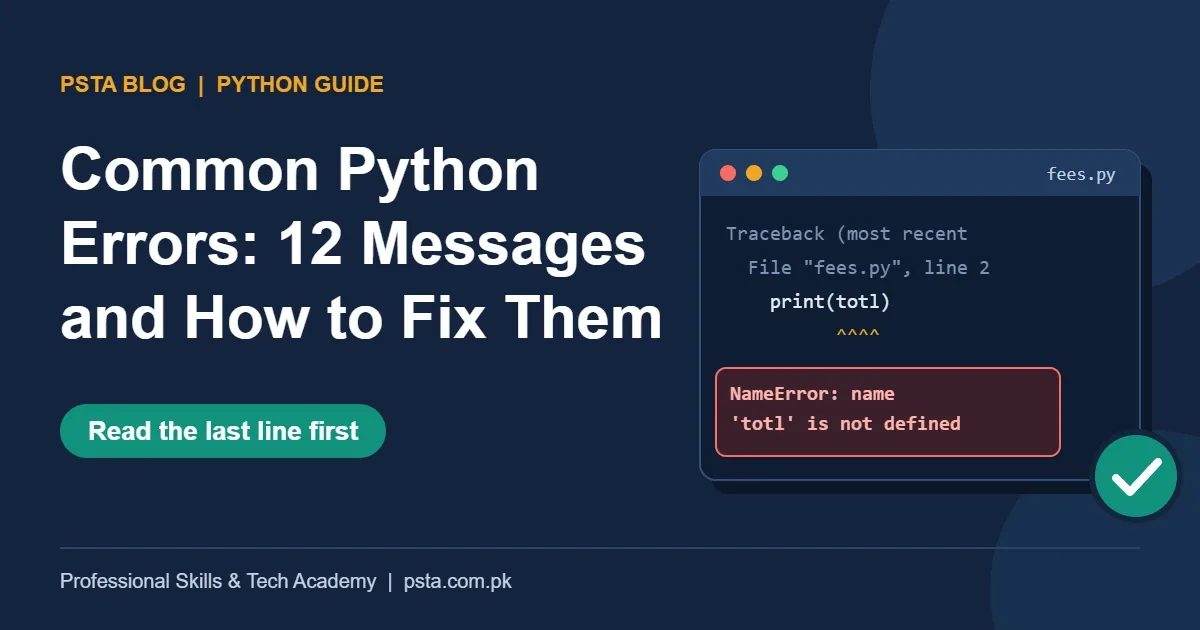
Use try and except, and catch the specific exception you expect, such as ValueError, not a bare except:. Mention EAFP, which the glossary explains as "easier to ask for forgiveness than permission": try the operation, and handle the exception if it fails. Our guide to common Python errors shows the messages you will meet most.
15. What Is the GIL?
The glossary defines the global interpreter lock as the mechanism CPython uses so that only one thread executes Python bytecode at a time. For a fresher, the useful takeaway is this: threads help with waiting tasks, such as downloading files, while CPU-heavy work often uses multiple processes instead.
16. Live Task: Find the Most Common Word in a Sentence
Short tasks like this often appear in a first round. Talk while you code, and start with the simplest working version:
from collections import Counter

text = "fee paid fee due fee waived"
counts = Counter(text.split())
print(counts.most_common(1))   # [('fee', 3)]
Then mention what you would improve: lowercase the text, strip punctuation, and handle an empty string.
Python Interview Questions Cheat Sheet
Revise these pairs the night before. They come up often in Python interview questions for juniors.
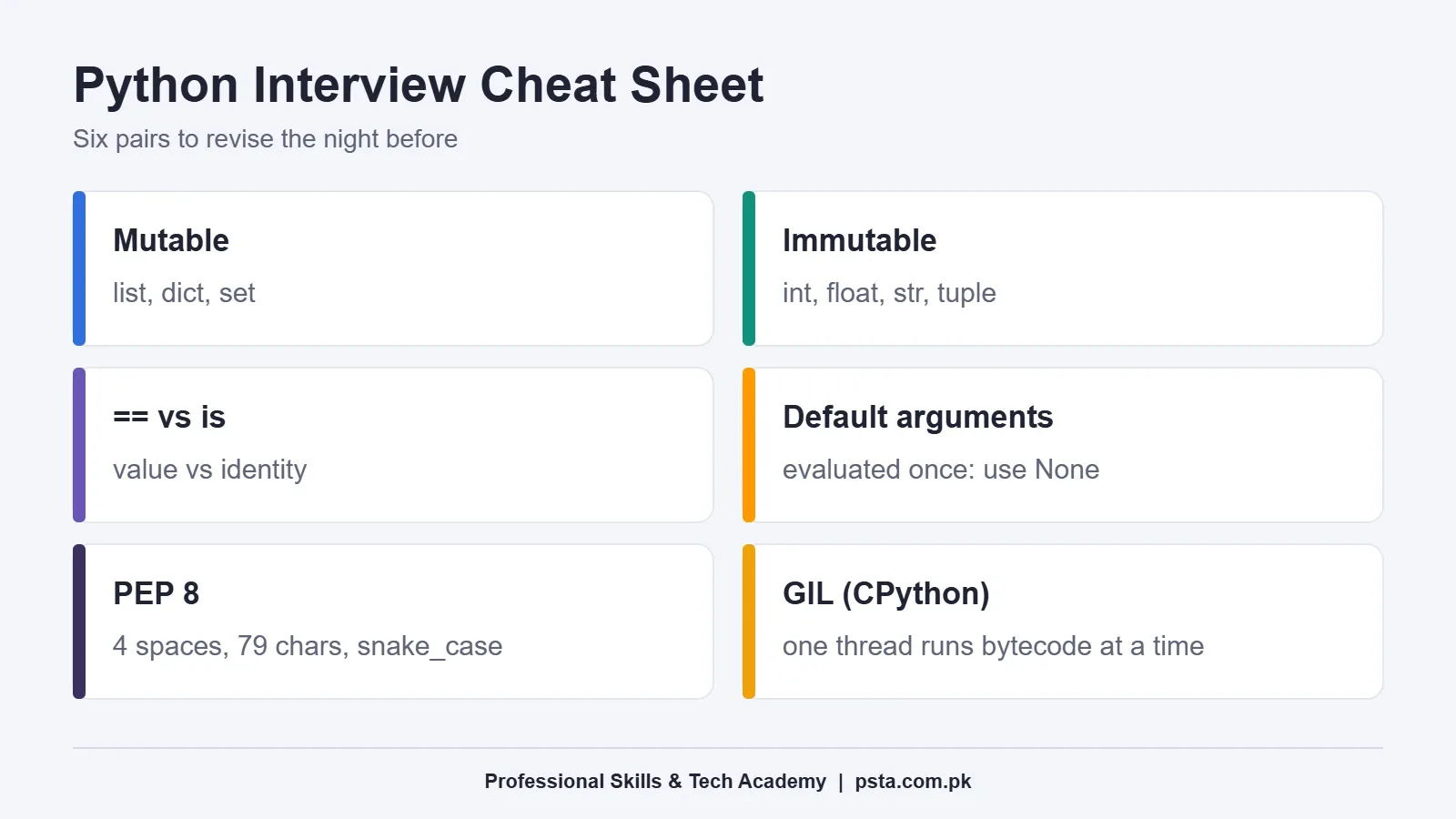
| Topic | Remember |
|---|---|
| Mutable types | list, dict, set |
| Immutable types | int, float, str, tuple |
| == vs is | Value vs identity |
| Default arguments | Evaluated once; use None for lists |
| PEP 8 basics | 4 spaces, 79 characters, snake_case |
| GIL | One thread runs bytecode at a time in CPython |
How Should You Answer Out Loud?
Knowing the answer is half the job. The other half is saying it clearly in under a minute. A simple pattern works for most questions:
- Give the one-line answer first.
- Add a short example, ideally from a project you built.
- Mention one trade-off or common mistake.
- Stop, and let the interviewer ask more.
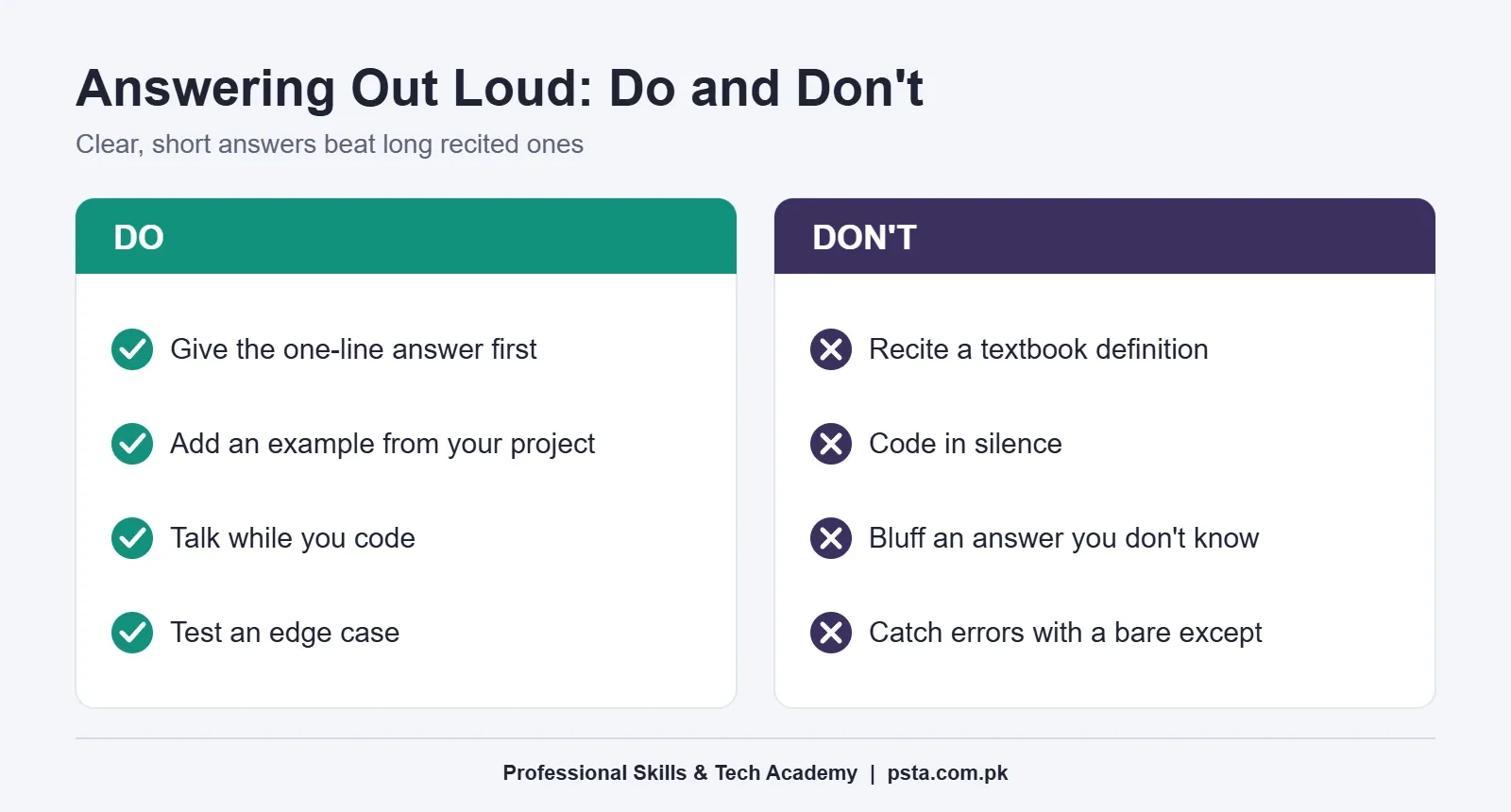
If you don't know something, say what you do know and how you would find out. "I haven't used asyncio, but I know it handles many waiting tasks in one thread, and I would start with the official docs" is a far better answer than guessing.
Mistakes That Cost Freshers the Interview
Many weak answers aren't wrong. They are unclear, too long or impossible to check. Watch for these habits when you practice:
- Reciting textbook definitions. A memorized line about "high-level, dynamically typed" means little without an example you can explain.
- Listing projects you can't explain. If your CV mentions a Django app, expect questions about how its models, views and URLs fit together.
- Coding in silence. In a live task, the interviewer wants to hear your thinking, including the parts you aren't sure about.
- Ignoring edge cases. Empty input, a missing key or a zero in a division are the first things a reviewer will try.
- Bluffing. An invented answer is easy to spot and hard to recover from. Say what you know and stop there.
A junior Python developer isn't expected to know everything. The interviewer is checking whether you understand the basics deeply, write readable code and can learn the rest on the job.
A One-Week Revision Plan
Spend about an hour a day for the week before your interview:
- Days 1 and 2: Levels 1 and 2. Type every code example yourself and change it.
- Days 3 and 4: Level 3. Write a small class and one decorator from memory.
- Day 5: Level 4. Solve three short string and list tasks while speaking out loud.
- Day 6: Explain one of your own projects in two minutes. Our list of Python projects for beginners has ideas if you need one.
- Day 7: Rest, then do one mock interview with a friend.
If the role involves web work, also read our Django vs Flask comparison. Data roles often add SQL, so our SQL interview questions for freshers are worth a look too.
Preparing for Python Roles at PSTA
The Advanced Python Programming course at PSTA covers every topic in this guide and the projects that give you something to talk about. Its modules run from installation, data types, loops and functions to OOP, file handling and exceptions. Later modules cover automation scripts, web development with Flask and Django, Pandas, NumPy and Matplotlib, and machine learning with Scikit-learn, ending with a final project.
The course page lists a 12-week duration and a fee of Rs. 30,000, against a regular price of Rs. 40,000, payable in two installments. It starts from beginner level, with a new batch every month and morning, afternoon, evening and weekend slots.
Classes run on campus in Abbottabad (Mandian, Old College Road, opposite FIMS College), live online, or as a mix of the two. If you want to pair Python with front-end skills, see the Full-Stack Web Development course. Compare fees on the courses page and apply on the admission page. You can also send a WhatsApp message to +92 314 5424399 to ask about the next batch.
Answer Three Questions Out Loud Tonight
Pick questions 4, 5 and 10. Answer each one out loud in under a minute, then type the code and run it. If any answer took longer or felt unclear, that is the topic to revise first.
Frequently asked questions
Which Python topics should freshers prepare first?
Prepare data types and mutability, lists versus tuples, dictionaries and sets, functions with *args and **kwargs, default arguments, classes and self, exceptions, and a short coding task. Interviewers also like the difference between == and is. Prepare a two-minute explanation of one project you built, because many questions grow out of it.
How should I prepare for a Python interview in one week?
Spend about an hour a day. Revise basics and data structures on days one and two, functions and OOP on days three and four, and short coding tasks on day five. Practice explaining a project on day six, then do one mock interview. Type every example yourself instead of only reading it.
Do I need to know Django or Flask for a junior Python job?
It depends on the role. Web developer posts often expect one framework, so be ready to explain how routes, views and templates fit together. Data and automation roles focus more on Pandas, scripting and SQL. Read the job advert closely and prepare for the stack it names.
Which Python version should I mention in an interview?
Mention a current one. The Python developer guide lists 3.15, first released on 9 October 2026, and 3.14 as bugfix branches, while 3.11 to 3.13 get security fixes only. Saying you work on 3.14 or newer shows you keep your tools up to date.
What is the most common Python trap in interviews?
The mutable default argument is a strong candidate. The official tutorial warns that a default value is evaluated only once, so a list used as a default keeps growing across calls. The fix is to default to None and create a new list inside the function.
What should I do if I don't know an answer?
Say so calmly, then share what you do know and how you would find the answer, such as the official documentation. Interviewers prefer an honest partial answer to a confident guess. Follow up after the interview by learning the topic, because it may come up again in the next round.
Sources & references
- Stack Overflow Developer Survey 2025: Technology survey.stackoverflow.co
- Python Developer's Guide: Status of Python versions devguide.python.org
- PEP 8: Style Guide for Python Code peps.python.org
- Python Language Reference: Expressions docs.python.org
- Python Glossary docs.python.org
- Python Tutorial: More Control Flow Tools docs.python.org
Last reviewed & updated on by Umar Qureshi. Written by the PSTA team in Abbottabad, Pakistan.
Umar Qureshi

Advanced Python Programming Course in Pakistan – Online Classes and On-Campus in Abbottabad
Turn this guide into a career: hands-on training with real projects, online across Pakistan or on-campus in Abbottabad · 12 weeks.
Comments
No comments yet — ask a question or share your experience.