Quick answer
Pick Django if your project needs logins, a database and an admin panel quickly. Pick Flask if you want a small app or want to see how web requests work. Many learners start with Flask for two weeks, then move to Django, and add FastAPI later for APIs and AI work.
Key takeaways
- • Django includes an ORM, migrations, an admin panel and user login out of the box.
- • Flask keeps a small core; you add databases, logins and forms through extensions.
- • Stack Overflow's 2025 survey puts FastAPI, Flask and Django within about 2 points of each other.
- • Django 6.1 needs Python 3.12 or newer, so check tutorial dates before following them.
- • A sensible order is two weeks of Flask, then Django, then FastAPI if you want API or AI work.
Table of contents 16 sections
- Django vs Flask at a Glance
- What Does "Batteries Included" Mean in Django?
- How Long Is Each Django Version Supported?
- How Flask Stays Small, and What You Add Yourself
- Same Project, Two Builds: The Tuition Center App
- Building It in Django
- Building It in Flask
- Which Is Easier for a Complete Beginner?
- What Do Developers and Employers Actually Use?
- What Pakistani Job Ads Show
- Where Does FastAPI Fit In?
- Picking a Framework by Project Type
- A Six-Week Learning Order That Uses Both
- Common Mixups Between the Two Frameworks
- Where Both Frameworks Sit in PSTA's Python Course
- Build a Two-Route App This Weekend
Example scenario: Hira, a BSCS student in Rawalpindi, has finished Python basics. Her final-year group wants a web app for a local tuition center, with student records, fee entries and a login for staff. One friend says Flask is easier. Another says Django is what software houses hire for. She has six weeks before the proposal is due.
If you're in a similar spot, the Django vs Flask choice really hinges on a single point. Do you want the framework to hand you the parts, or do you want to pick them yourself? Django ships with a database layer, an admin panel and user accounts. Flask gives you routing and templates, then lets you add the rest. Here's what this guide covers:
- A side-by-side table of what each framework includes on day one
- How the same tuition-center app looks when built in each one
- What current surveys and Pakistani job ads say about demand
- Where FastAPI fits, since it now shows up in many backend listings
- A six-week learning order that uses both frameworks without wasting time
Django vs Flask at a Glance
Both are free, open-source options, and each is a mature Python web framework with active maintainers. The differences are in scope and in how many decisions they make for you.
| Point | Django | Flask |
|---|---|---|
| Latest release (checked October 2026) | 6.1.2, released October 6, 2026 | 3.1.3, released February 19, 2026 |
| Minimum Python version | Python 3.12 | Python 3.9 |
| Database layer | Built-in ORM and migrations | Added through an extension such as Flask-SQLAlchemy |
| Admin panel | Generated automatically from your models | None by default |
| User login | Built-in authentication system | Added through Flask-Login or similar |
| Forms and CSRF protection | Built in | Added through Flask-WTF |
| Project structure | Fixed layout of apps, models, views and templates | You decide, from one file to many packages |
| Best first use | Data-heavy sites with staff users | Small apps, APIs and learning how the web works |
Version numbers come from the Django page on PyPI and the Flask page on PyPI. Check them again before you install, because both projects release patch updates often.
What Does "Batteries Included" Mean in Django?
Django's own overview page walks through the pieces it gives you. You describe your data as Python classes called models. Django turns those into database tables through migrations, and you query them with Python instead of raw SQL.
Register a model with the Django admin, and you get a working back office where logged-in staff can add, edit and delete records. For a tuition center, a clinic or a small school, that admin alone can save a week of work. The same overview also covers URL routing, a template language with inheritance, and more.
The trade-off is structure. Django expects a certain folder layout and a certain way of doing things. When you follow it, projects stay tidy and another developer can join without a long handover. When you fight it, you spend time reading documentation to find the "Django way."
How Long Is Each Django Version Supported?
This matters if you build something a client will use for years. The official download page lists Django 5.2 as the current long-term support (LTS) release, with security fixes until April 2028. Django 6.2 LTS is planned for April 2027. The same page says that from Django 2028 onward, every feature release will get three years of support. For client work, pick the LTS line unless you need a newer feature.
How Flask Stays Small, and What You Add Yourself
Flask's foreword explains that "micro" doesn't mean weak. It means the core stays simple and makes few choices for you. The foreword says plainly that Flask leaves out a database layer and form validation, because good libraries for those already exist.
So a real Flask project grows through Flask extensions. Three common ones, all listed on PyPI:
- Flask-SQLAlchemy connects Flask to SQLAlchemy for database work.
- Flask-Login handles user sessions and login state.
- Flask-WTF adds form rendering, validation and CSRF protection.
This is Flask's strength for learners. Each piece you add teaches you what a web app needs and why. You see the request come in, the route match and the response go out, with very little hidden. The cost is that you make more decisions, and a messy beginner can end up with a project that only they understand.
Same Project, Two Builds: The Tuition Center App
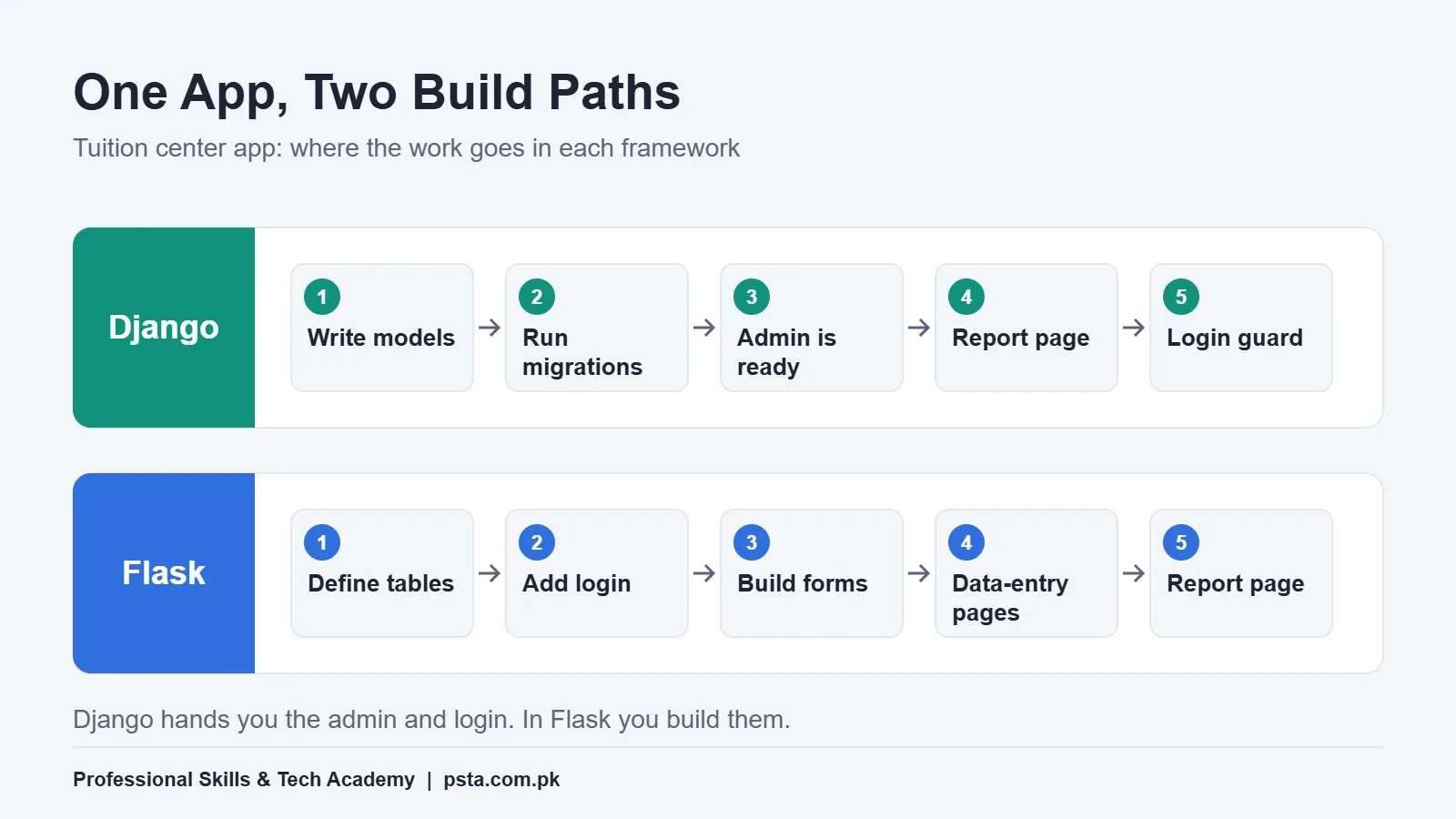
Let's return to the example. Hira's app needs four things: a student list, fee records, a staff login and a simple report page. Here's how the work splits in each framework.
Building It in Django
- Create a project and one app called
students. - Write two models,
StudentandFeePayment, then run migrations. - Register both models in the admin. Staff can now log in and enter data.
- Build one public view for the monthly fee report, using a template.
- Restrict the report to logged-in staff with Django's built-in login tools.
Most of the effort goes into steps 2 and 4. The login and data-entry screens come almost free.
Building It in Flask
- Create the app file and set up a virtual environment.
- Install Flask-SQLAlchemy and define the same two tables.
- Install Flask-Login and write the user model, login route and logout route.
- Install Flask-WTF and build forms for adding students and payments.
- Write list, add and edit pages for both tables, then the report page.
The Flask version takes longer because you build the data-entry screens yourself. But by the end, you know exactly how sessions, forms and queries connect. Neither result is wrong. For a deadline with staff users, Django gets there faster. For understanding the plumbing, Flask teaches more.
Which Is Easier for a Complete Beginner?
For a true beginner, the Django vs Flask answer depends on the week you ask. Flask is easier on the first day. A working page needs about five lines, and you can read every one of them. Django asks you to learn projects, apps, settings and the admin before you see much on screen.
By week three, the picture changes. Once your app needs logins, forms and a database, the Flask learner is reading three sets of extension docs. The Django learner already has those features and is building the actual product.
A practical rule: if you have never built a web page with Python, start with Flask for one or two weeks. Once routes, templates and form posts make sense, move to Django. You'll understand what Django is doing for you instead of treating it as magic.
What Do Developers and Employers Actually Use?
Popularity shouldn't decide the Django vs Flask question alone, but it helps to know the numbers. Two recent surveys give a useful picture, and they disagree a little.
In the Stack Overflow Developer Survey 2025, about 23,678 people answered the web framework question. Of all respondents, 14.8% had used FastAPI, 14.4% Flask and 12.6% Django. Among professional developers, the figures were 15.1%, 13.2% and 11.7%. This survey covers all developers, including people who never write Python.
JetBrains looked only at Python developers. Its summary of the State of Python 2025 survey reports FastAPI at 38%, Django at 35% and Flask at 34%, using 2024 figures. FastAPI gained 9 points from the year before, Django 2 points and Flask 1 point.
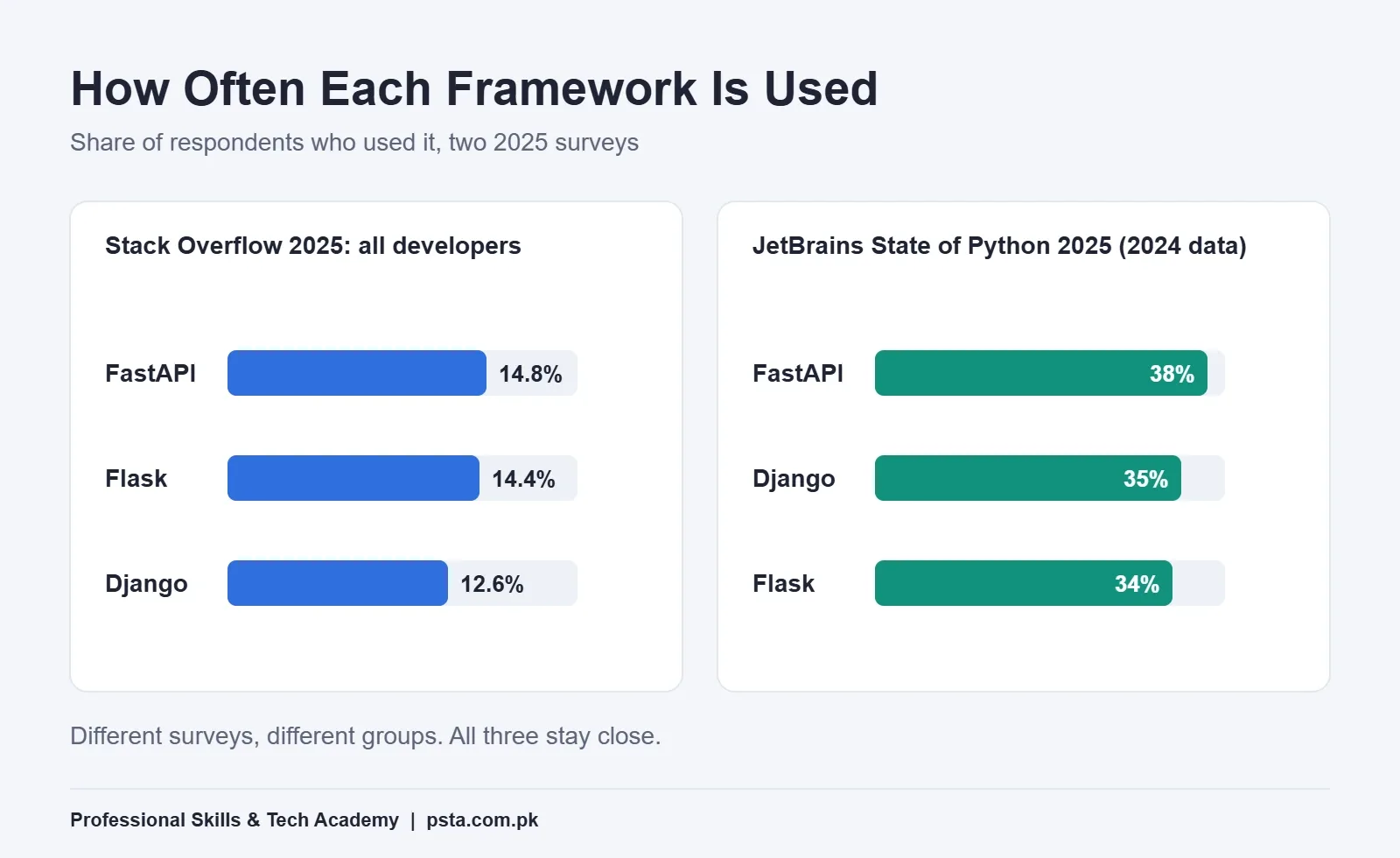
The takeaway is that the three are close. None of them is fading, and the skills move between them because they share Python, HTTP and SQL.
What Pakistani Job Ads Show
Global surveys don't tell you much about Python jobs in Pakistan, or what a software house in Lahore wants. So we looked at the first results page for backend Python developer jobs on Indeed Pakistan in October 2026. An Islamabad listing asked for a strong backend developer in Python with Django. A Lahore backend role listed Django and FastAPI among its stack and showed Rs. 200,000 to Rs. 300,000 a month. Flask wasn't named in any listing on that page, and several ads focused on AI and data pipeline work instead.
That's one snapshot, not a market study. Even so, it suggests Django is the safer name to have on your CV if you plan to apply to local software houses. Search the job sites yourself before you decide, because listings change every week.
Where Does FastAPI Fit In?
FastAPI is a third option built mainly for APIs, the back ends that mobile apps and JavaScript front ends talk to. Its PyPI page lists version 0.143.3, released October 16, 2026, and it needs Python 3.10 or later. It uses Python type hints to check incoming data and produce API documentation automatically.
FastAPI is not a replacement for Django's admin or templates. It's closer to Flask in spirit: small core, add what you need. Many AI-focused roles use it to serve machine learning models. If your goal is AI engineering, learn it after you're comfortable with either Flask or Django, not instead of them.
Picking a Framework by Project Type
The most useful way to settle Django vs Flask is to match the framework to the project in front of you, rather than asking which one is better overall.
| Project | Good fit | Why |
|---|---|---|
| School, clinic or shop management system | Django | Admin panel and logins save the most time |
| Final-year project with many tables | Django | Migrations and the ORM keep data changes manageable |
| Small dashboard or internal tool | Flask | Few pages, quick to set up and deploy |
| Learning how web requests work | Flask | Nothing hidden, every step visible |
| JSON API for a mobile app | FastAPI or Flask | Light core, fast to build endpoints |
| Serving a trained ML model | FastAPI | Type-checked input and automatic API docs |
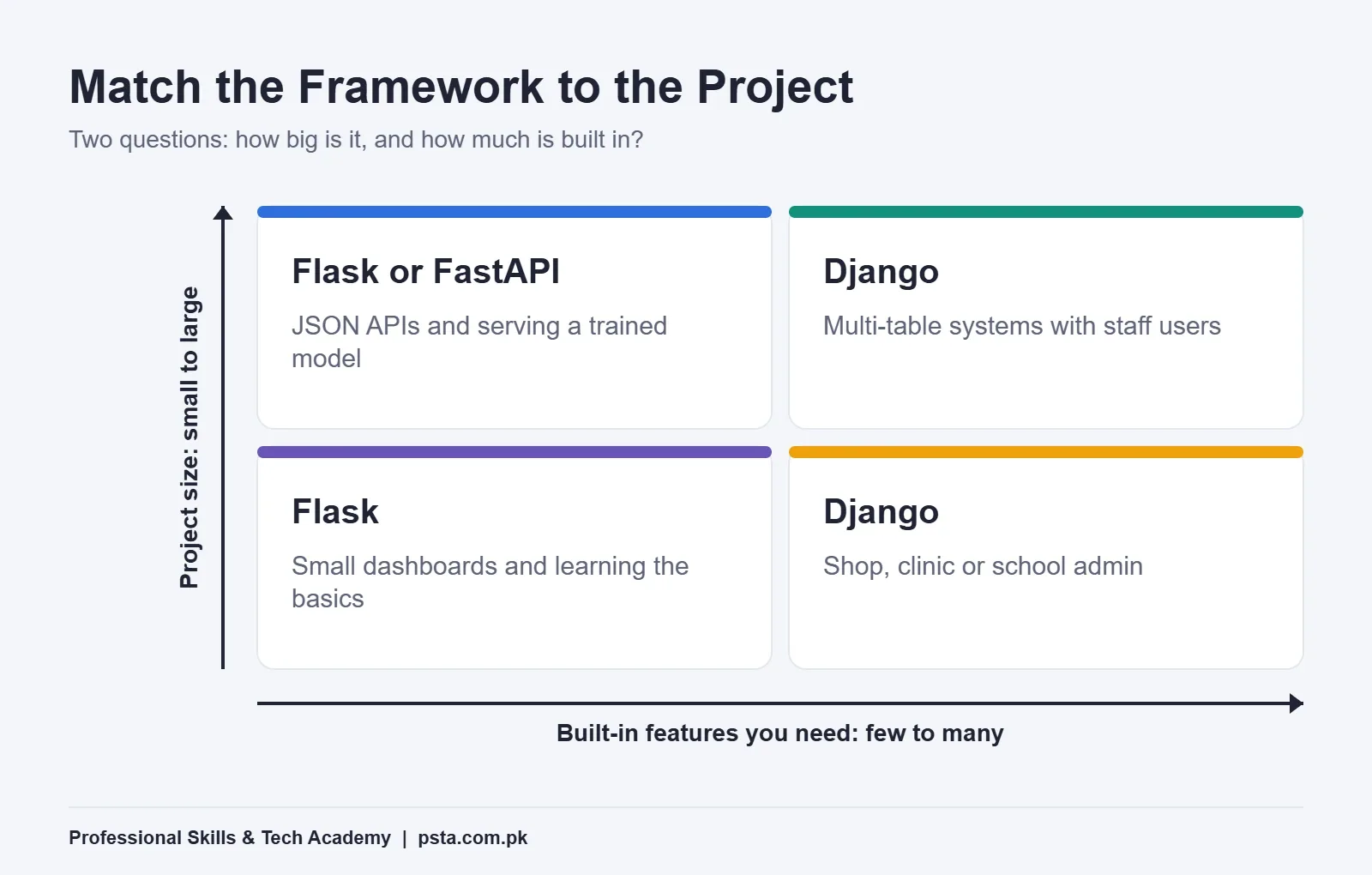
For Hira's tuition-center app, Django is the sensible pick. It has staff users, several related tables and a deadline. If her project were a single page that predicts exam scores from a trained model, Flask or FastAPI would be lighter.
A Six-Week Learning Order That Uses Both
You don't have to choose forever. This order builds understanding first and job-ready backend development skills second. Plan on roughly two focused hours each day.
- Week 1: Build a Flask app with three routes, one template and one HTML form. Print the form data to the terminal so you see what the browser sends.
- Week 2: Add Flask-SQLAlchemy and save the form data in SQLite. Write list and delete pages.
- Week 3: Start the same idea in Django. Create models, run migrations and open the admin.
- Week 4: Add public pages with class-based or function views, templates and template inheritance.
- Week 5: Add login, permissions and form validation. Write a few tests for your views.
- Week 6: Deploy the Django app online and put both projects on GitHub with clear README files.
Two finished projects, one in each framework, give you something real to show an interviewer. If you need hosting ideas for week 6, see our comparison of free web hosting options for students. For more project ideas at the beginner level, the list of Python projects for beginners pairs well with weeks 1 and 2.
Common Mixups Between the Two Frameworks
A few misunderstandings slow learners down. Watch for these:
- Thinking Flask can't handle big projects. It can, with careful structure and blueprints. It just leaves that structure to you.
- Thinking Django is only for big projects. A small Django app with one model and the admin is quick to build.
- Copying tutorials written for old versions. Django 6.1 needs Python 3.12 or newer, so old guides may fail on install. Check the date on any tutorial.
- Skipping SQL. Both ORMs write queries for you, but interviews still test joins and grouping. Our guide to SQL interview questions for freshers shows the level employers expect.
Where Both Frameworks Sit in PSTA's Python Course
PSTA's Advanced Python Programming course is a 12-week program, and no earlier coding background is needed. Core Python, object-oriented programming, file handling and automation come first. Then a dedicated module covers web development with Flask and Django, followed by data work in Pandas, NumPy and Matplotlib and a first look at Scikit-learn.
One of the listed projects is a small Flask or Django web app with user forms and a database, such as a student record system. That's very close to the tuition-center example above. The course ends with a final project you can put in your portfolio.
Fees for this course stand at Rs. 30,000 against a regular Rs. 40,000, and you can split the amount into two parts. Study in person in Abbottabad (Mandian, Old College Road, across from FIMS College) or follow the same classes live online from another city. Hybrid attendance is allowed, and a fresh batch begins each month.
If APIs and interfaces interest you as well, the Full-Stack Web Development course covers JavaScript, React and Node.js. To see other options, browse the courses page, read how enrollment works on the admission page, or reach the PSTA team through WhatsApp (+92 314 5424399) if you want the current timings for morning or evening slots.
Build a Two-Route App This Weekend
Before you commit to either framework, spend two short evenings on a test. On the first, make a Flask app with a home page and a form page. On the second, build the same two pages in Django and open its admin. Notice which one felt clearer and which one did more of the work. That small comparison will settle the Django vs Flask question for you better than any list.
Frequently asked questions
Is Django harder than Flask for beginners?
Django has more to learn at the start, because you meet projects, apps, settings and the admin before you build much. Flask lets you make a working page in a few lines. Once your app needs logins, forms and a database, Django often feels simpler, because those parts already exist and follow one documented pattern.
Can I get a job in Pakistan knowing only Flask?
It's possible, especially for freelance work, small internal tools and API roles. Still, many local backend listings name Django, and AI-focused roles often mention FastAPI. Knowing Flask well makes both easier to pick up. A sensible plan is to finish one Flask project, then build a Django project before you apply widely.
Should I learn Django or FastAPI for AI jobs?
Learn the basics of one general framework first, then add FastAPI. FastAPI is popular for serving machine learning models as APIs, and it checks incoming data using Python type hints. Without a grounding in routes, requests and databases from Flask or Django, FastAPI tutorials can feel confusing to a beginner.
Do I need to know SQL before Django or Flask?
You can start without it, because both Django's ORM and Flask-SQLAlchemy write queries for you. However, you should learn basic SQL within your first month. Interviewers often test joins, grouping and filtering, and understanding SQL helps you spot slow queries the ORM produces when your tables grow.
Which Python version should I install for Django in 2026?
Check the Django page on PyPI before you install. When we checked in October 2026, Django 6.1.2 required Python 3.12 or later, while Flask 3.1.3 needed Python 3.9 or later. Installing a recent Python release keeps you compatible with both frameworks and with current tutorials.
How long does it take to learn Django after Python basics?
If you practice for around two hours daily, a realistic target is a small Django app with models, the admin, templates and login within three to four weeks. Deploying it and writing tests takes longer. The six-week plan in this guide spends two weeks on Flask first, which makes the Django weeks faster.
Sources & references
- Django on PyPI pypi.org
- Flask on PyPI pypi.org
- Django download and supported versions djangoproject.com
- Django at a glance (Django documentation) docs.djangoproject.com
- Flask foreword (Flask documentation) flask.palletsprojects.com
- Stack Overflow Developer Survey 2025: Technology survey.stackoverflow.co
- The Most Popular Python Frameworks and Libraries in 2025 (JetBrains PyCharm Blog) blog.jetbrains.com
- FastAPI on PyPI pypi.org
Last reviewed & updated on by Umar Qureshi. Written by the PSTA team in Abbottabad, Pakistan.

Umar Qureshi

Advanced Python Programming Course in Pakistan – Online Classes and On-Campus in Abbottabad
Turn this guide into a career: hands-on training with real projects, online across Pakistan or on-campus in Abbottabad · 12 weeks.
Comments
No comments yet — ask a question or share your experience.