Quick answer
Build small Python projects that solve real problems, in three levels: core Python first, such as an expense tracker, then APIs and files, such as a prayer time notifier, then apps and data, such as a Flask shop app. Publish each on GitHub with a README and demo, and you'll have a portfolio in about three months.
Key takeaways
- • A good beginner project solves a problem you can name and has a clear finish line.
- • Learn in three levels: core Python, then APIs, files and the web, then apps and data.
- • Free tools are enough: AlAdhan and Open-Meteo worked without an API key, and PythonAnywhere hosts one free web app.
- • Always check what an API sends back. Our Abbottabad test showed why coordinates beat city names.
- • A project only counts once it's on GitHub with a README, sample data and a demo.
- • Treat older datasets as practice data, and say so in your README.
Table of contents 22 sections
- What Makes a Good Python Project for Beginners?
- 10 Python Projects for Beginners at a Glance
- Level 1: Core Python Projects
- 1. Rupee Expense Tracker
- 2. Electricity Bill Slab Calculator
- 3. Flashcard Quiz From a CSV File
- Level 2: Projects That Use APIs, Files and the Web
- 4. Prayer Time Notifier
- 5. City Weather Alert
- 6. Excel Report Merger
- 7. Book Price Scraper
- Level 3: Apps and Data Projects
- 8. Telegram FAQ Bot for a Local Business
- 9. Shop Inventory Web App With Flask
- 10. Property Price Explorer
- Which Python Project Should You Build First?
- A 12-Week Plan to Build Your Python Portfolio
- How Do You Turn Projects Into a Portfolio People Trust?
- Five Habits That Make Beginner Projects Look Weak
- How Soon Can You Have a Python Portfolio?
- Learn Python With PSTA
- Pick One Project Today
The best Python projects for beginners are small programs you can finish in a week or two and explain in one sentence. Think of a rupee expense tracker, or a script that merges a shop's Excel sheets. Python is a safe place to put that effort. In Stack Overflow's 2025 Developer Survey, 57.9% of developers said they had used it in the past year. It also ranks first on the TIOBE Index for September 2026.
What most beginners lack isn't another tutorial. It's proof. A folder of half-done exercises tells an employer or client very little. A handful of finished projects, each with a clear README and a short demo, tells them a lot.
In this guide you'll find:
- A quick test for whether a project idea is worth your time
- 10 project ideas in three levels, each with a Pakistani twist
- A simple way to choose your first project
- A 12-week build plan and a checklist for a portfolio people trust
What Makes a Good Python Project for Beginners?
A good beginner project is small enough to finish but real enough that someone else could use it. Before you start any idea, run it through four checks:
- It solves a problem you can name. "Track where my monthly allowance goes" is a problem. "Practice loops" is not.
- It has a clear finish line. Write down what "done" means before you write any code.
- It adds one new skill at a time. If an idea needs an API, a database and a website all at once, split it into smaller projects.
- It produces something you can show. A CSV file, a chart, a message on your phone or a live web page all count.
Ideas that pass these checks are easier to finish. They're also easier to talk about. Interviewers and clients often ask you to walk them through something you built, and a project with a clear purpose gives you a clear story.
10 Python Projects for Beginners at a Glance
These Python projects for beginners are grouped into three levels. Each level adds one new kind of skill, so you never have to learn everything at once.
| # | Project | Level | Main skills | Rough build time |
|---|---|---|---|---|
| 1 | Rupee expense tracker | 1 | Lists, dictionaries, CSV files | 3–5 days |
| 2 | Electricity bill slab calculator | 1 | Functions, conditions, input checks | 2–3 days |
| 3 | Flashcard quiz from a CSV file | 1 | Files, random order, scoring | 3–4 days |
| 4 | Prayer time notifier | 2 | APIs, JSON, dates and times | 4–6 days |
| 5 | City weather alert | 2 | APIs, conditions, scheduling | 4–6 days |
| 6 | Excel report merger | 2 | pandas, openpyxl | 5–7 days |
| 7 | Book price scraper | 2 | requests, BeautifulSoup, CSV | 5–7 days |
| 8 | Telegram FAQ bot | 3 | Libraries, commands, JSON | 5–7 days |
| 9 | Shop inventory web app | 3 | Flask, SQLite, deployment | 1–2 weeks |
| 10 | Property price explorer | 3 | pandas, charts, scikit-learn | 1–2 weeks |
Build times assume 6 to 8 hours of practice a week. Yours may be faster or slower, and that's fine.
Level 1: Core Python Projects
These three projects use only Python's built-in features and standard library. Install the current version from python.org (Python 3.14.4 at the time of writing), open VS Code or IDLE and start.
1. Rupee Expense Tracker
Write a command-line program that records each expense with a date, an amount in rupees, a category and a payment method, such as cash, JazzCash or Easypaisa. Save every entry to a CSV file so nothing is lost when the program closes. Then add a monthly summary that totals spending by category.
You'll practice: lists, dictionaries, loops, and reading and writing CSV files.
Make it portfolio-ready: add a "biggest category this month" line now, and a bar chart with Matplotlib once you reach Level 3.
2. Electricity Bill Slab Calculator
Household electricity in Pakistan is billed in slabs, so a few extra units can push the whole bill into a costlier bracket. Build a calculator that takes the units used and works out the cost. Tariffs change often, so don't hard-code them. Read the slab rates from a small settings file that you copy from your latest bill.
Real bills also add taxes and adjustments, so label your answer as an estimate.
You'll practice: functions, if/elif conditions, input validation and handling wrong input without crashing.
Make it portfolio-ready: write three test cases with known answers and show them in your README.
3. Flashcard Quiz From a CSV File
Store questions and answers in a CSV file: English vocabulary, entry test practice or Python terms. Your program asks them in random order, keeps score and saves the best score to a file. Anyone can add new questions without touching your code, and that separation of data from logic is the real lesson.
You'll practice: the random module, file handling and functions.
Make it portfolio-ready: add a review round that repeats only the questions the user got wrong.
Level 2: Projects That Use APIs, Files and the Web
Level 2 is where your programs start working with live data. You'll install packages with pip, such as requests, pandas and BeautifulSoup. You'll also learn to read JSON, the text format most web services use to send data. Projects 4 to 7 are your first Python automation projects, because each one saves someone a repetitive task.
4. Prayer Time Notifier
The free AlAdhan Prayer Times API returns daily timings for any location. It also lets you pick a calculation method, including the University of Islamic Sciences, Karachi. Write a script that fetches today's timings, prints them neatly and shows how long remains until the next prayer.
Here's something we found while testing this project in October 2026. When we asked the API for Abbottabad by city name, the response came back with placeholder coordinates instead of Abbottabad's real location. Asking by latitude and longitude returned the right place. So read the "meta" section of every response, and use coordinates for smaller cities.
You'll practice: HTTP requests, JSON, the datetime module and checking what an API actually sent back.
Make it portfolio-ready: let the user pick from a list of saved cities, and show a friendly message when the internet is down.
5. City Weather Alert
Open-Meteo offers a weather forecast API that's free for non-commercial use and needs no API key. Ask it for the daily maximum temperature and the chance of rain for your city. Then print a plain warning, for example when tomorrow will cross 40°C or the chance of rain passes 60%. Forecasts cover 7 days by default and up to 16 days if you ask.
You'll practice: query parameters, conditions on real data, and running a script on a schedule with Windows Task Scheduler or cron.
Make it portfolio-ready: compare three cities side by side, such as Abbottabad, Lahore and Karachi.
6. Excel Report Merger
Plenty of shops and offices keep one Excel file per month or per branch, and someone combines them by hand. Write a script with pandas and openpyxl that reads every file in a folder, joins them, totals sales by product and writes a clean summary workbook.
You'll practice: pandas DataFrames, grouping and totals, and reading and writing .xlsx files.
Make it portfolio-ready: include sample files with made-up data and a before-and-after screenshot. If you enjoy this kind of work, our Power BI vs Excel guide shows where reporting skills can take you next.
7. Book Price Scraper
Web scraping means collecting data from web pages with code. Practice on Books to Scrape, a demo store built for scraping practice that lists 1,000 books across 50 pages. Collect each book's title, price, rating and stock status. Follow the "next" links through every page and save everything to a CSV file.
You'll practice: requests, BeautifulSoup, reading HTML structure, looping over pages and adding polite delays between requests.
Make it portfolio-ready: add a short note in your README on scraping responsibly. Real sites have terms of use, and some don't allow scraping at all.
Level 3: Apps and Data Projects
Level 3 combines everything so far. Each project gives you something other people can use: a bot, a website or an interactive data report.
8. Telegram FAQ Bot for a Local Business
Pick a real business you know, such as a tuition center, pharmacy or tailor. Build a Telegram bot that answers its five most common questions, like timings, location, prices and how to order. You create the bot for free through Telegram's BotFather, and the python-telegram-bot library handles most of the plumbing. Keep every answer in a JSON file so the owner can update it without editing code.
You'll practice: reading a library's documentation, handling commands and keeping data separate from code.
Make it portfolio-ready: record a 60-second screen video of the bot answering real questions.
9. Shop Inventory Web App With Flask
Build a small web app for a kiryana store or mobile shop. It should let the owner add products, record sales and see which items are running low. Use Flask for the pages and SQLite for the database. Then put it online. PythonAnywhere's free Beginner account includes one web app at your-username.pythonanywhere.com, which is enough for a portfolio demo.
You'll practice: routes, HTML templates, forms, a database and deployment.
Make it portfolio-ready: add an owner login and a demo account so visitors can try it safely. If web apps become your favorite part, our Full-Stack Web Development course builds on this project.
10. Property Price Explorer
Open Data Pakistan hosts a free property dataset built from Zameen.com listings. It covers prices, area and coordinates for Islamabad, Rawalpindi, Lahore, Faisalabad and Karachi. Clean it with pandas, chart how prices change by city and size, and try a simple price prediction with scikit-learn.
One honest warning: the dataset was last updated in April 2021, so treat it as practice data, not today's market prices. Saying that clearly in your README shows good judgment.
You'll practice: data cleaning, charts with Matplotlib, a first machine learning model and explaining results in plain words.
Make it portfolio-ready: turn your analysis into a small interactive page with Streamlit.
Which Python Project Should You Build First?
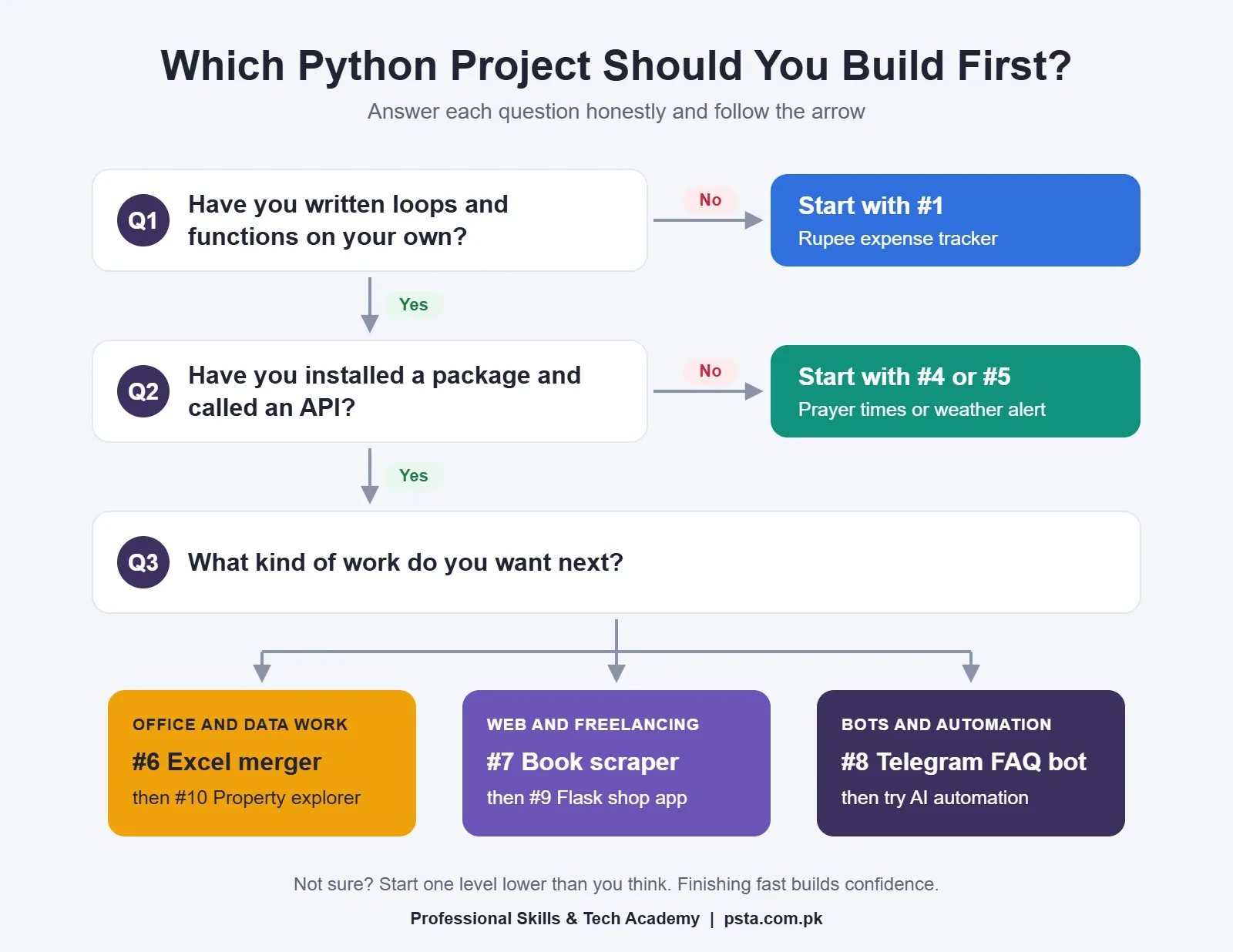
You don't have to build these Python projects for beginners in order. Start where your skills are today.
- Never written a loop or a function? Start with the expense tracker.
- Comfortable with the basics but never installed a package? Start with the prayer time notifier or the weather alert.
- Interested in office or data jobs? Build the Excel report merger, then the property explorer.
- Interested in web development or freelancing? Build the scraper, then the Flask app.
- Interested in bots and automation? Build the Telegram bot, then read our guide on learning AI automation.
If you're unsure, start one level lower than you think. Finishing fast builds confidence.
A 12-Week Plan to Build Your Python Portfolio
If you like structure, follow this plan at 6 to 8 hours a week. It gives one week to each of the first eight projects, two weeks to the Flask app and leaves the last weeks for the data project and polishing.
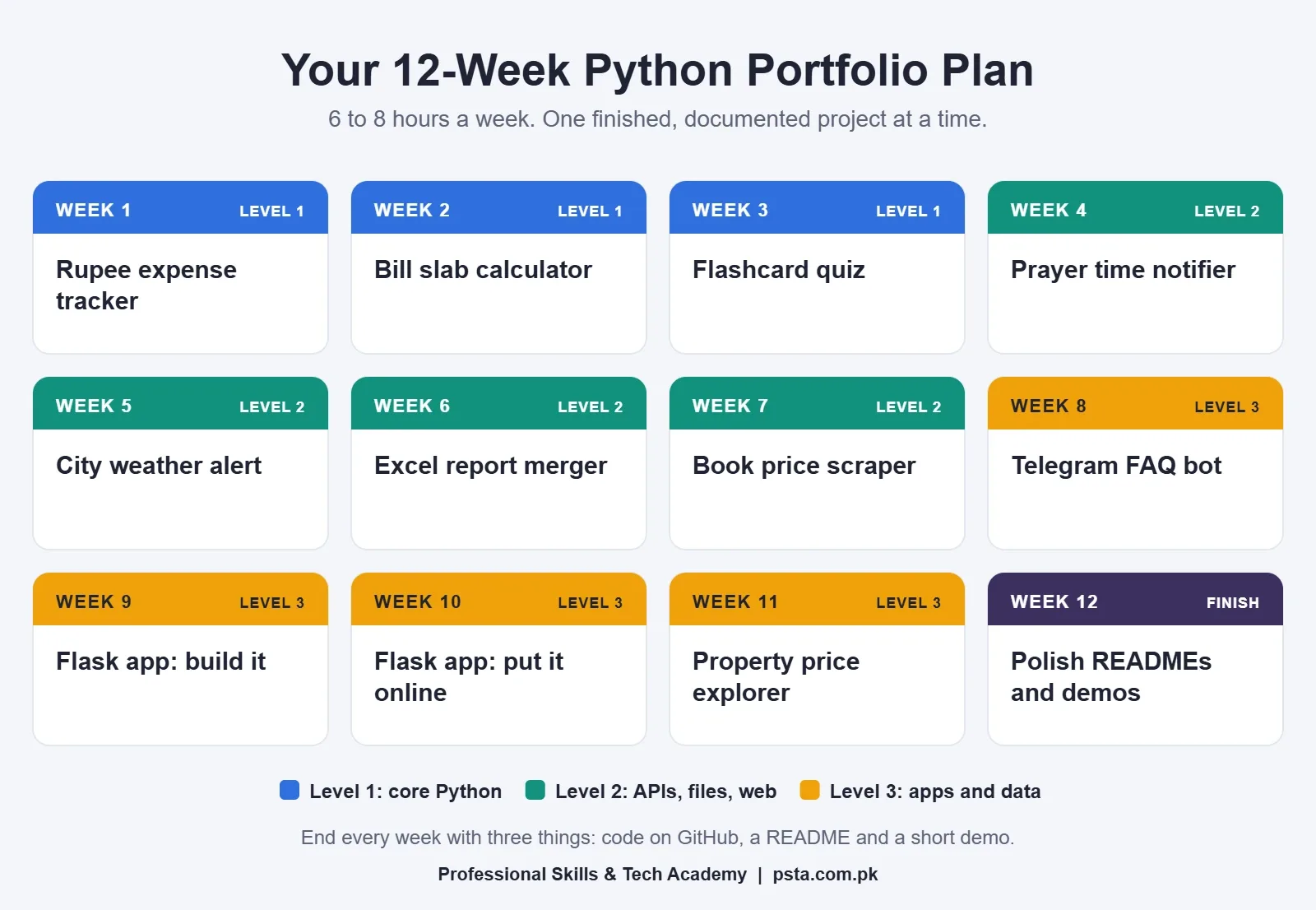
End every week the same way: push your code to GitHub, write the README and record a short demo. Don't move on until that's done. Python projects for beginners only become a portfolio when they're finished and documented.
How Do You Turn Projects Into a Portfolio People Trust?
Recruiters and clients skim, so make each project easy to understand in under a minute. This matters even more for Python projects for students, because a clear GitHub profile helps make up for a CV with little work history.
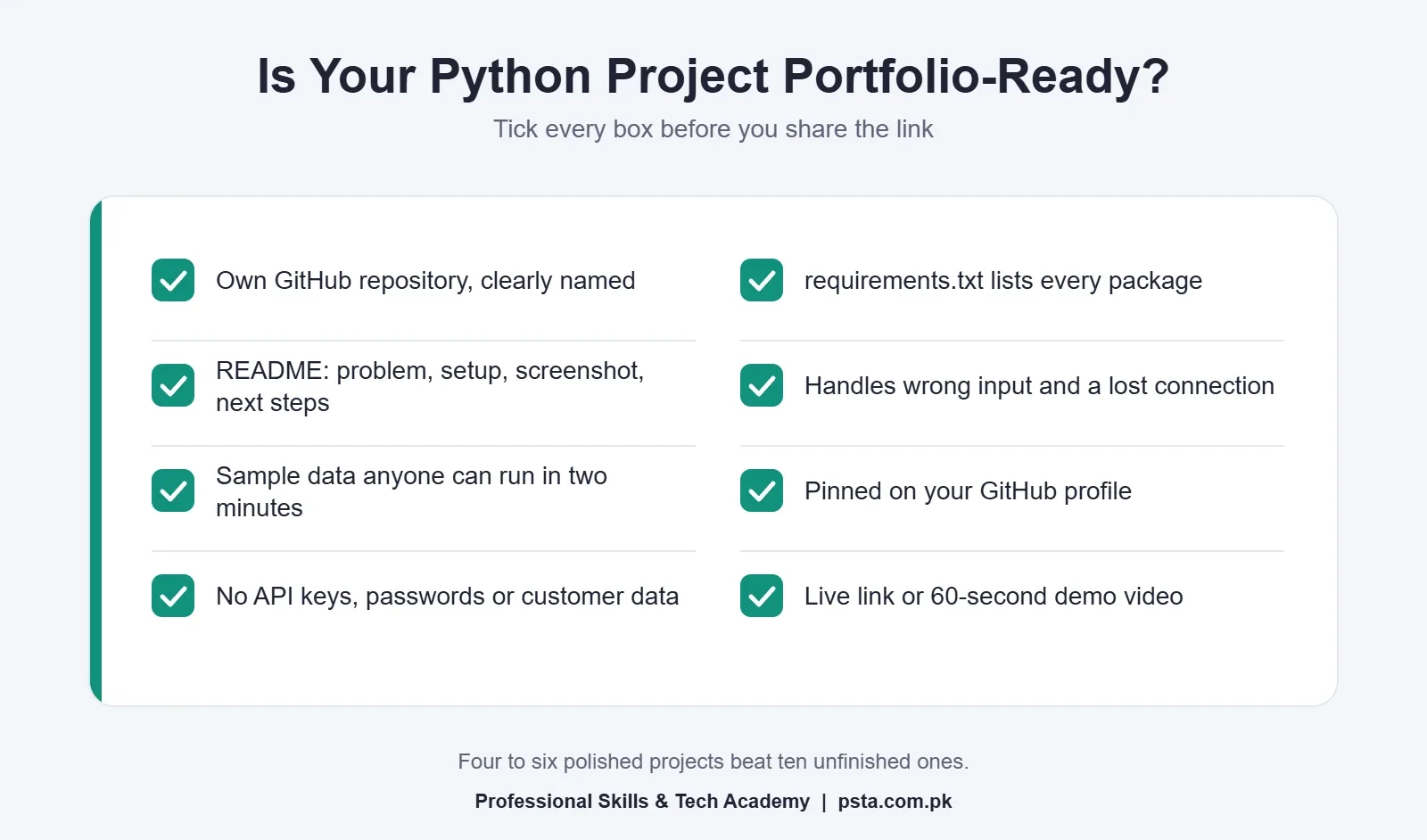
- Give each project its own GitHub repository with a clear name, such as rupee-expense-tracker.
- Write a README that answers four questions: what problem it solves, how to run it, what it looks like and what you'd improve next.
- Include sample data so anyone can run it in two minutes. Never upload real customer data.
- Keep API keys and passwords out of your code. Store them in environment variables or a settings file that isn't uploaded.
- Add a requirements.txt file listing the packages your project needs.
- Pin your best four to six projects on your GitHub profile, with a live link or demo video for the Level 3 ones.
Then link your GitHub on your CV, LinkedIn and any Fiverr or Upwork profile. A short case study for your best project helps too. Our portfolio guide is written for marketers, but its case study format works just as well for code.
Five Habits That Make Beginner Projects Look Weak
- Copying a tutorial line by line. Change at least one feature so the project is yours, and be ready to explain every line.
- Hard-coding things that change. Tariffs, prices and file paths belong in settings, not buried in your code.
- Committing secrets. If an API key reaches a public repository, treat it as leaked and replace it straight away.
- Ignoring errors. A program that crashes on wrong input or a slow connection looks unfinished, even if the logic is right.
- Jumping to machine learning first. A model is only as good as the data cleaning before it. Get there through Levels 1 and 2.
How Soon Can You Have a Python Portfolio?
At 6 to 8 hours a week, most beginners can finish the Level 1 projects in about a month. A small, honest portfolio takes about three months. If you already know another programming language, you'll move faster. That holds whether you learn Python in Pakistan on your own or in a class.
Treat these as rough estimates, not promises. The real measure is simple: does each project work, and can you explain how?
Learn Python With PSTA
If you'd like an instructor reviewing your code and keeping you on schedule, PSTA's Python course in Pakistan covers the same ground as these Python project ideas. It runs from core Python to Flask, data science and a final project.
- Duration: 12 weeks
- Mode: classes at our Abbottabad campus, or live online classes across Pakistan
- Fee: Rs. 30,000 (regular fee Rs. 40,000)
- Modules include: OOP, file handling, scripting and automation projects, Flask or Django, Pandas, NumPy and Matplotlib, and machine learning with scikit-learn
- Ends with: a final project, such as a web app, a data tool or an ML model
Our campus is on Old College Road in Mandian, Abbottabad, opposite FIMS College. For batch dates and timings, send a message on WhatsApp (+92 314 5424399) or fill in the online admission form. You can also compare all PSTA courses.
Pick One Project Today
Choose the project on this list that fixes a problem in your own life or your family's business. Write one sentence that describes "done," create the GitHub repository and write your first 20 lines of code tonight. A small, finished project beats a big, abandoned one every time.
Frequently asked questions
What is the easiest Python project for a complete beginner?
A rupee expense tracker is a strong first choice. It only needs core Python, saves data to a CSV file and solves a problem you already have. You'll practice lists, dictionaries, loops and file handling. Once it works, add a monthly summary by category, then a chart when you reach the data projects.
Do I need a powerful laptop to build these Python projects?
No. An ordinary laptop or desktop can run every project on this list, because they work with small files and simple web requests. You'll need a stable internet connection for the API projects and for GitHub. Only heavier machine learning work, beyond the property explorer, would call for a faster computer.
How many Python projects do I need before applying for jobs or freelance work?
There's no fixed number, but four to six finished, well-documented projects usually tell a clearer story than ten half-done ones. Include at least one project that uses an API, one that works with data and one that other people can use, such as a bot or web app. Each needs a README and a demo.
Are these Python projects free to build?
Yes. Python, VS Code, GitHub and the libraries used here are free. The AlAdhan prayer times API worked without a key in our tests, and Open-Meteo is free for non-commercial use with no key. PythonAnywhere's free Beginner account hosts one web app, and the Open Data Pakistan property dataset is free to download.
Should I learn Flask or Django first?
For a first web project, Flask is usually easier because it's small and you add pieces as you need them. Django includes more out of the box, such as an admin panel and user accounts, which helps on bigger projects. Build the inventory app in Flask, then try Django once routes, templates and databases feel comfortable.
Can Python projects help me earn on Fiverr or Upwork?
They can help, because clients want proof before they hire. Scrapers, automation scripts, bots and small web apps are all services freelancers offer, and your projects show you can deliver that kind of work. Earnings depend on your portfolio, communication and reliability, so no one can promise a fixed income.
Is Python still worth learning in 2026?
Yes. Python ranks first on the TIOBE Index for September 2026, and 57.9% of developers in Stack Overflow's 2025 survey said they had used it in the past year. It's used for automation, web apps, data analysis and AI, so the skills from these projects carry over to many kinds of work.
Does PSTA's Python course include projects?
Yes. PSTA's 12-week Python course includes scripting and automation projects, Flask or Django web development, data science with Pandas, NumPy and Matplotlib, machine learning with scikit-learn and a final project. You can join at the Abbottabad campus or attend live online classes from any city in Pakistan. The fee is Rs. 30,000. Message +92 314 5424399 on WhatsApp about the next batch.
Sources & references
- Stack Overflow 2025 Developer Survey: Technology survey.stackoverflow.co
- TIOBE Index (September 2026) tiobe.com
- Python downloads, python.org python.org
- AlAdhan Prayer Times API aladhan.com
- Open-Meteo Weather Forecast API documentation open-meteo.com
- Books to Scrape, a web scraping sandbox books.toscrape.com
- PythonAnywhere plans and pricing pythonanywhere.com
- Open Data Pakistan: Property Data for Pakistan opendata.com.pk
Last reviewed & updated on by Umar Qureshi. Written by the PSTA team in Abbottabad, Pakistan.
Umar Qureshi

Advanced Python Programming Course in Pakistan – Online Classes and On-Campus in Abbottabad
Turn this guide into a career: hands-on training with real projects, online across Pakistan or on-campus in Abbottabad · 12 weeks.
Comments
No comments yet — ask a question or share your experience.