Quick answer
Start with C++ if your university's first programming course uses it, or if games, robotics or electronics interest you. Start with Python if you want quick results in office automation or data work. For websites, begin with JavaScript instead. Spend about 12 weeks on one language before adding the second.
Key takeaways
- • C++ is compiled and statically typed; Python is interpreted and dynamically typed.
- • The TIOBE Index for September 2026 ranks Python first (17.76%) and C++ third (8.67%).
- • In the 2025 Stack Overflow survey, 71.8% of learners reported Python and 44.6% reported C++.
- • BSCS students should check their Programming Fundamentals outline before choosing.
- • Learn one language for about 12 weeks, then rewrite the same project in the other.
Table of contents 14 sections
- How Do C++ and Python Differ at the Core?
- C++ vs Python Side by Side
- What Do the Popularity Rankings Actually Show?
- Why Python Feels Easier in Week One
- Why C++ Still Earns Its Place
- Where C++ Will Slow You Down
- Which Should BSCS Students Learn First?
- Choosing by Goal: Five Common Situations
- Strengths and Trade-Offs Worth Weighing
- What You Gain and Give Up With C++
- What You Gain and Give Up With Python
- A Sensible Order if You Want Both
- Studying C++ or Python at PSTA
- Write Ten Lines in Each Language This Weekend
Take this short self-test before you settle the C++ vs Python question for yourself. Answer each line with a plain yes or no.
- Will you start a BSCS, BSSE or computer engineering degree within the next year?
- Do games, robots or electronics interest you more than websites and spreadsheets?
- Would you rather build something useful in your first month than understand how memory works?
- Do you want to automate office work or move toward data analysis?
Two yes answers on the first pair point toward C++. Two yes answers on the second pair point toward Python. A mix means either language is a fair start, and the sections below will help you break the tie.
Here is what this C++ vs Python comparison covers:
- How the two languages run your code, and why that changes your first few weeks
- A side-by-side table on syntax, speed, typing and typical uses
- What two well-known popularity rankings say, and what they leave out
- Five common student situations, each with a clear first pick
- A practical order to follow if you plan to learn both
How Do C++ and Python Differ at the Core?
The biggest difference is how each language turns your code into a running program. C++ is compiled. A compiler reads your whole file, checks it, and produces a separate program your computer runs directly. Python is interpreted. You run your script, and Python reads and executes it as it goes.
That one difference shapes almost everything else. Compiled C++ programs usually run fast and give you close control over memory. The price is more setup and stricter rules. In C++ you declare that a variable holds an integer, and the compiler holds you to it.
Python takes the opposite approach. The official Python Tutorial describes it as easy to learn, with elegant syntax, dynamic typing and an interpreted nature. Dynamic typing means you do not declare types up front. Python works them out while the program runs.
In the C++ vs Python debate, neither approach is better in general. Each fits different work, and each teaches you different habits.
C++ vs Python Side by Side
Here are the practical differences gathered into one grid. Read it with your own goal in mind rather than looking for a winner.
| Point | C++ | Python |
|---|---|---|
| How code runs | Compiled to a program before it runs | Interpreted while it runs |
| Typing | Static: you declare types | Dynamic: types are worked out at run time |
| Code length for small tasks | Longer, with headers, semicolons and braces | Shorter, with indentation instead of braces |
| Memory control | Close control, more room for mistakes | Handled for you |
| Typical uses | Games, embedded systems, real-time and high-performance software | Web back ends, automation, data work, education |
| Current standard or release line | C++23 published, C++26 in progress | Python 3 series |
| First-month feel | Slower start, deep understanding | Quick wins, less detail on what happens underneath |
To see the difference in length, here is the same small task in both languages: read two numbers and print their sum.
// C++
#include <iostream>
int main() {
    int a, b;
    std::cin >> a >> b;
    std::cout << a + b << std::endl;
    return 0;
}
# Python
a = int(input())
b = int(input())
print(a + b)The C++ version asks you to think about a header, a main function, types and a return value. The Python version lets you think only about the task. For a complete beginner, that gap feels large in week one and much smaller by week eight.
What Do the Popularity Rankings Actually Show?
Students often ask which language is "more in demand." Two public rankings give a partial answer. For C++ vs Python, neither ranking is a job count for Pakistan, so treat both as signals, not verdicts.
The TIOBE Index for September 2026 places Python first with a rating of 17.76%. C is second at 10.28%, and C++ is third at 8.67%. TIOBE builds these ratings from search engine data, so they reflect how much a language is discussed and taught online.
The 2025 Stack Overflow Developer Survey asked developers which languages they used. Among all respondents, 57.9% reported Python and 23.5% reported C++. Among people learning to code, the figures rise to 71.8% for Python and 44.6% for C++.
That last pair is worth a second look. Close to half of the learners in that survey group reported using C++. Python leads, but C++ is far from a niche choice for beginners.
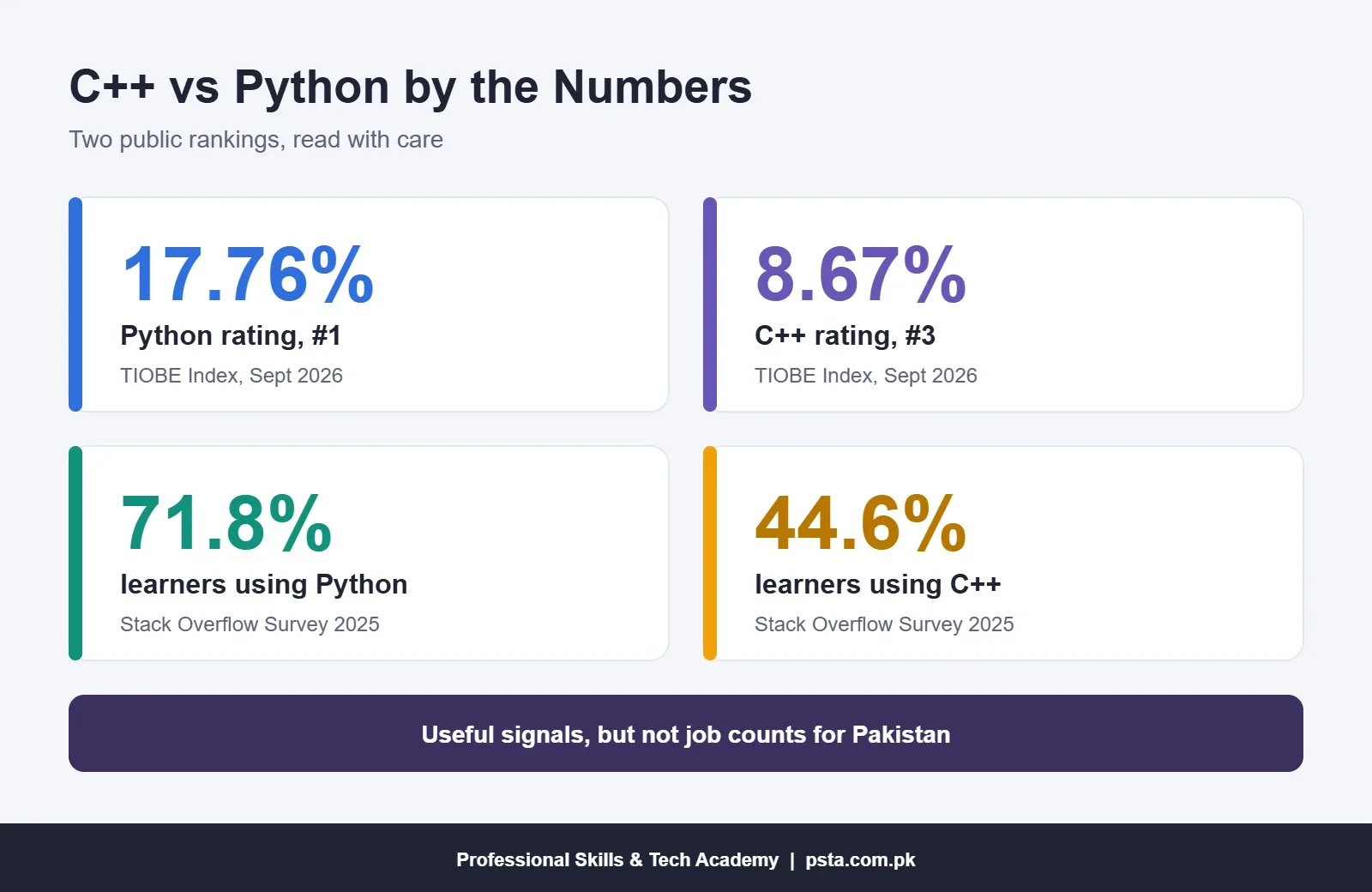
What these numbers cannot tell you is which language suits your degree, your city or your next job ad. For that, look at your goal, which the next sections cover.
Why Python Feels Easier in Week One
Python removes most of the ceremony around a program. There is no main function to write, no semicolons to forget and no types to declare. Indentation shows the structure, so neat code and working code look the same.
Errors are also gentler. Python stops at the line that failed and prints a message that usually names the problem. C++ compiler messages can run to many lines, especially once templates are involved, and new students often find them hard to read.
Python also reaches useful results quickly. According to Python.org's applications page, the language is used for web and internet development, scientific and numeric computing, education, desktop GUIs, software development and business applications. In practice, Python for beginners can mean renaming 200 files, cleaning a CSV sheet or pulling numbers into a chart within your first few weeks.
The trade-off is that Python hides details. You can write working code for months without knowing how a list sits in memory. That is fine for many careers, but it can leave gaps if you later study data structures or systems programming.
Why C++ Still Earns Its Place
C++ has been around for a long time, and that history matters. According to LearnCpp.com, Bjarne Stroustrup began building it at Bell Labs in 1979 as an extension of C, and ISO standardized it in 1998. The same tutorial lists uses such as video games, real-time systems, financial software, embedded software, audio and video processing, and neural networks.
The language is still moving forward. The Standard C++ Foundation's status page says C++23 has been published and work on C++26 is underway. You will not need the newest features as a beginner, but it is useful to know the language is actively maintained.
Games are one clear example. Epic Games' Unreal Engine documentation has a full section on programming gameplay classes in C++. If you dream of working on game engines, C++ for beginners is the direct route rather than a detour.
C++ also trains your thinking. You learn what a type really is, how arrays sit in memory and why a loop that runs a million times needs care. Those ideas carry into every language you learn afterward.
Where C++ Will Slow You Down
Be honest with yourself about the early friction. You will spend time installing a compiler and setting up an editor. You will fight missing semicolons and type mismatches. Small tools that take ten lines in Python may take thirty in C++. If you need visible progress to stay motivated, plan small wins so the slow start does not discourage you.
Which Should BSCS Students Learn First?
For many BSCS students, the C++ vs Python choice is settled by the first semester. If you are starting a computer science degree, look at your university's own course outline before anything else. Many departments publish their scheme of studies online.
As one example, the BSCS curriculum published by Sindh Agriculture University, Tando Jam says Programming Fundamentals may be taught as language independent. Its reference list for that course still includes books on C and C++, and its Object Oriented Programming list includes C++ and Java titles.
In that outline, the course leaves room for choice, but the reference books lean toward C-family languages. For BSCS students, a head start in C++ often makes the first two programming courses less stressful. You already know loops, functions and arrays, so you can focus on problem solving in class.
If your department teaches Programming Fundamentals in Python, flip that advice. Learn what your first semester uses, then add the other language in your first summer break.
Choosing by Goal: Five Common Situations
Most students who ask whether to learn C++ or Python are really asking a narrower question about one goal. Find the situation closest to yours.
- Starting a university CS or SE program soon. Check the course outline. If it uses C++ or does not say, start with C++.
- Interested in games, robotics or electronics. Start with C++. Unreal Engine uses it for gameplay code, and embedded software is one of its listed uses.
- Working in an office and wanting to automate reports. Start with Python. You will see time savings within weeks.
- Aiming for data analysis or machine learning. Start with Python, then add SQL and a dashboard tool.
- Wanting to build websites. Neither is the usual first step. JavaScript is the language of the browser, so begin there.
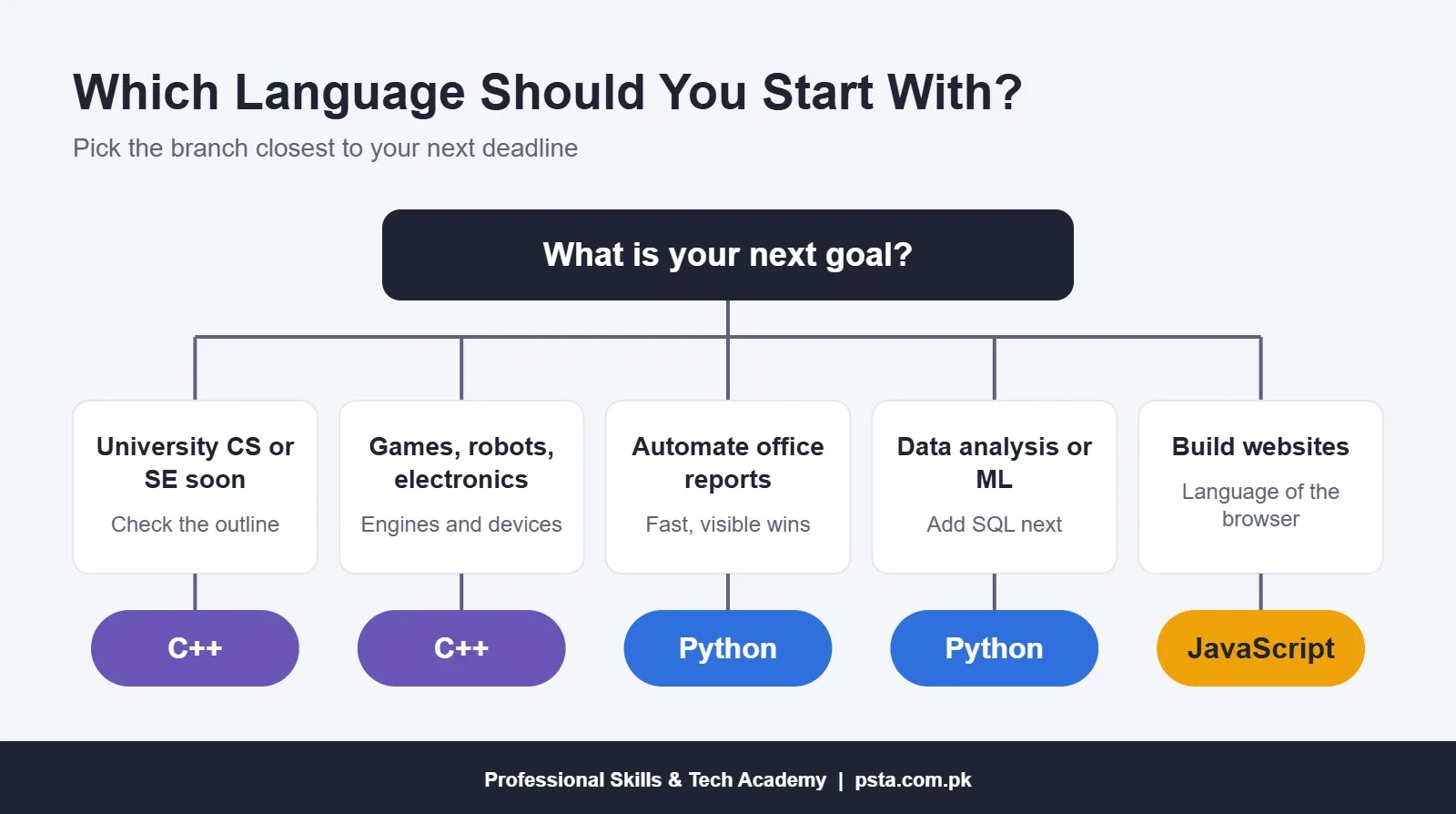
If two situations fit you equally, choose the one with a deadline. A semester that starts in four months is a stronger reason than a career idea that is still forming.
Strengths and Trade-Offs Worth Weighing
Every first programming language involves a trade. When you weigh C++ vs Python, the useful question is which trade you can live with for the next three months.
What You Gain and Give Up With C++
- You gain a solid grasp of types, memory and how programs really run.
- You gain a direct path into game engines, embedded work and university coursework.
- You give up speed of early progress, since setup and syntax take longer.
- You give up some forgiveness, because small mistakes can produce confusing errors.
What You Gain and Give Up With Python
- You gain short, readable code and quick, visible results.
- You gain a wide set of uses, from automation to data work and web back ends.
- You give up some insight into memory and performance in the early months.
- You give up strict checks before running, so some type mistakes only appear at run time.
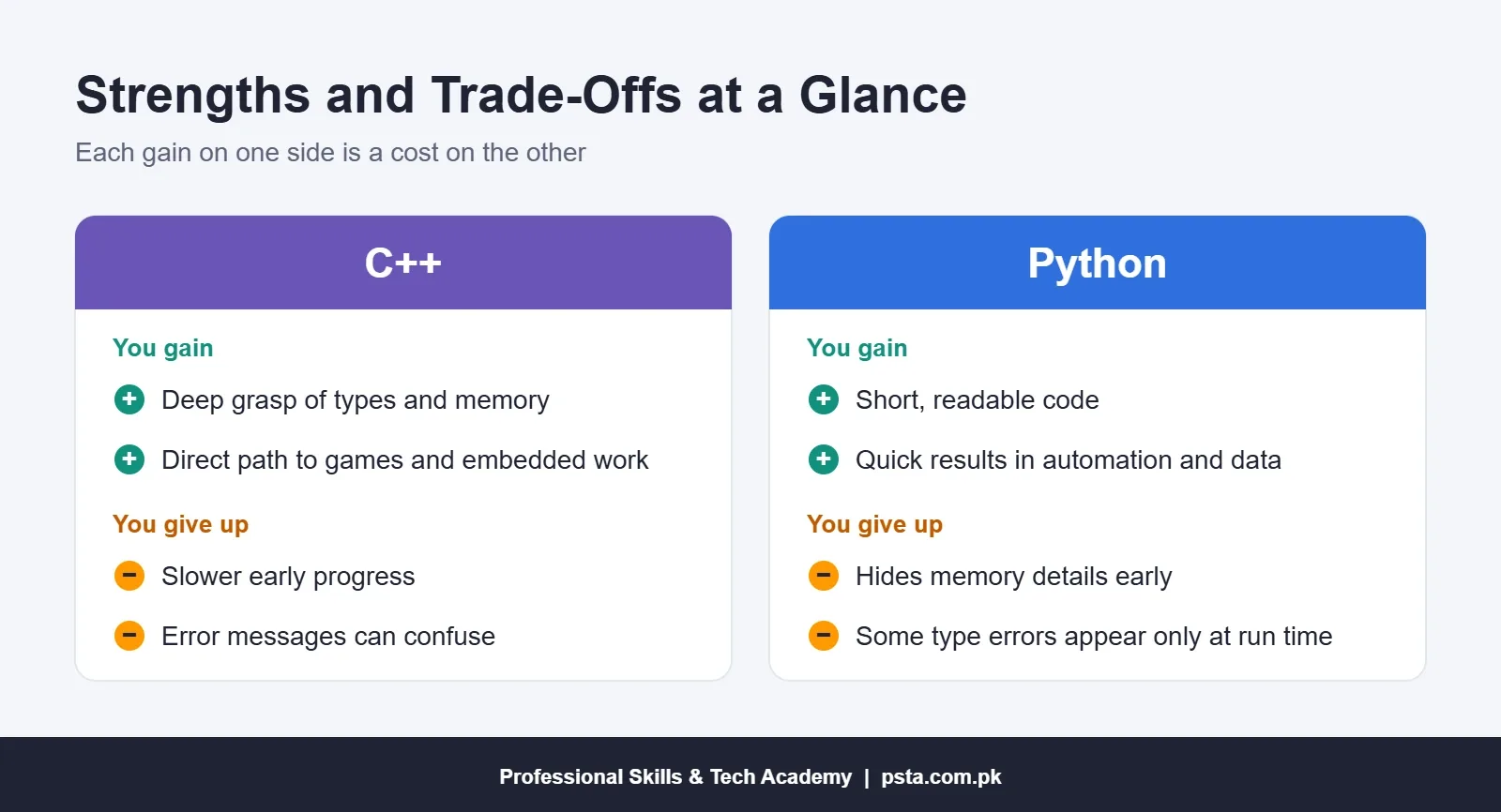
Notice that the gains of one language match the trade-offs of the other. That is why many programmers end up learning both.
A Sensible Order if You Want Both
Learning two languages at once usually slows beginners down. A sequence works better. Here is a plan that suits most students who expect to need both.
- Pick the language your next deadline needs. A university semester, a job task or a project brief decides the first one.
- Spend about 12 weeks on fundamentals. Cover variables, conditions, loops, functions, arrays or lists, and basic classes.
- Finish one small, complete project. A grade calculator, a quiz game or a file organizer is enough. Finishing matters more than size.
- Switch to the second language. Rewrite the same project. You will learn the new syntax fast because the logic is already familiar.
- Compare the two versions. Note what each language made easy or hard. That reflection is where real understanding forms.
The concepts transfer, so the second language usually takes less time than the first.
If Python is your second language, our list of Python projects for beginners gives you ready-made practice ideas. If you lean toward web work after both, the frontend developer roadmap for Pakistan shows the next steps.
Studying C++ or Python at PSTA
PSTA offers both languages as separate courses at our campus in Abbottabad, so you can follow whichever order fits your goal.
The C++ programming course for beginners is a 12-week, beginner-level program. It is listed at Rs. 12,000 against a regular price of Rs. 16,000. Its eight modules start with setting up your tools and writing your first program. They then cover if/else decisions, loops, functions, arrays and strings, and a first look at classes and objects. The course ends with a final project built from scratch. It suits matric and FSc students heading for BSCS or BSSE, and anyone curious to test whether coding fits them.
The Python programming course also lasts 12 weeks. The fee is Rs. 30,000, down from a regular Rs. 40,000, payable in two installments. It starts from zero and moves through object-oriented programming, automation, Flask and Django, and data work with Pandas and NumPy. You can join on campus, live online or in a hybrid format.
If web development is your longer-term aim, the JavaScript course is the better first step. You can compare every option on our courses page.
In-person classes take place at our Mandian building, facing FIMS College on Old College Road in Abbottabad. For batch timings, the simplest route is a WhatsApp message to +92 314 5424399, and the admission page explains how to enroll.
Write Ten Lines in Each Language This Weekend
You do not need to commit to a course to run your own C++ vs Python test. Install a free C++ compiler and Python this weekend. Write the sum program from this article in both, then extend each to print the larger of the two numbers.
Notice which one you kept tinkering with after it worked. That small signal, plus your answers to the self-test at the top, is usually enough to make a confident first choice. When you are ready for structured practice, we are happy to help you pick a batch.
Frequently asked questions
Is C++ harder than Python for a complete beginner?
Usually, yes, at the start. C++ asks you to declare types, manage a compile step and handle stricter syntax, so early progress is slower. Python lets you write useful scripts within days. The gap narrows after a few months, because the core ideas such as loops, conditions and functions work the same way in both languages.
Can I learn C++ and Python at the same time?
You can, but most beginners progress faster by learning one first. Two sets of syntax at once tend to blur together, and small mistakes multiply. A better plan is to spend about 12 weeks on one language, finish a small project, then rewrite that project in the second language. The logic carries over, so the second language comes faster.
Which language is better for university entry tests and first semester?
Check your department's Programming Fundamentals outline first. Many BSCS outlines leave the language open but list C and C++ textbooks, so a head start in C++ often helps in the first two programming courses. If your university teaches the course in Python, start with Python instead and add C++ during your first summer break.
Is Python enough to get a programming job in Pakistan?
Python can lead to roles such as junior Python developer, data analyst or automation specialist, but the language alone is rarely enough. Employers also look for projects, version control with Git, basic SQL and the ability to explain your code. Build two or three complete projects and put them on GitHub before you start applying.
Do I need a powerful computer to learn C++ or Python?
No. Both run comfortably on an ordinary laptop or desktop. You need a free compiler for C++, the official Python installer, and a code editor. Beginner programs are small, so processing power rarely matters at this stage. A stable power backup and a reliable internet connection for documentation will help you more than extra RAM.
Should I learn C before C++?
It is not necessary. C++ began as an extension of C, so it includes most C ideas, and beginner C++ courses cover variables, loops, functions and arrays directly. Learning C first makes sense mainly if your university course or a specific embedded systems job asks for plain C. Otherwise, starting straight with C++ saves time.
How long does it take to learn the basics of C++ or Python?
With regular practice, most beginners can cover the fundamentals of either language in about three months. That means variables, conditions, loops, functions, lists or arrays, and a first look at classes. Daily practice matters more than total hours, so short sessions of 45 to 60 minutes on most days usually beat one long weekend session.
Sources & references
- TIOBE Index tiobe.com
- Stack Overflow Developer Survey 2025: Technology survey.stackoverflow.co
- The Python Tutorial docs.python.org
- Applications for Python python.org
- Introduction to C/C++ (LearnCpp.com) learncpp.com
- Current Status of Standard C++ (isocpp.org) isocpp.org
- Programming with C++ in Unreal Engine dev.epicgames.com
- BSCS Curriculum, Sindh Agriculture University sau.edu.pk
Last reviewed & updated on by Umar Qureshi. Written by the PSTA team in Abbottabad, Pakistan.

Umar Qureshi
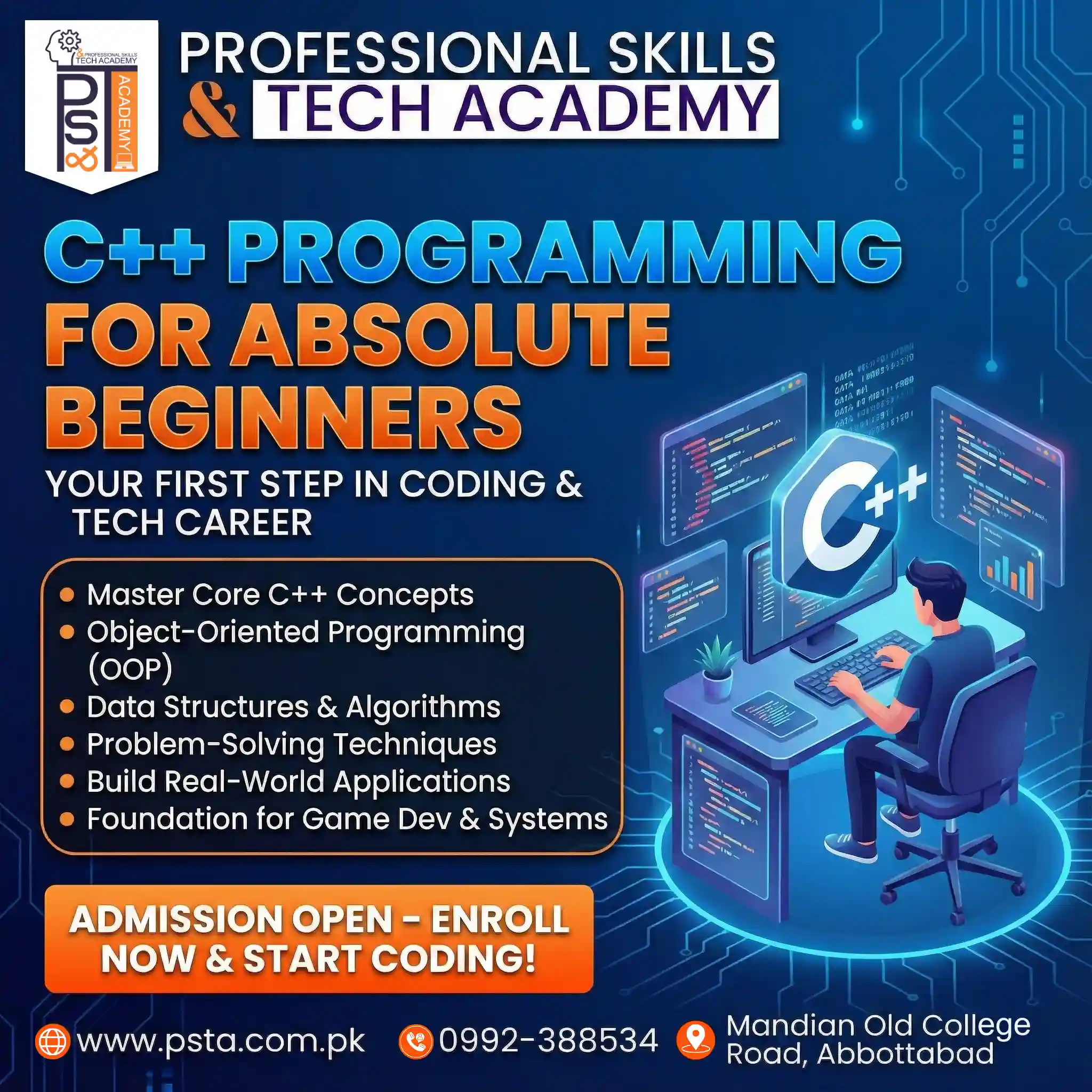
Best C++ Programming Course for Beginners in Pakistan
Turn this guide into a career: hands-on training with real projects, online across Pakistan or on-campus in Abbottabad · 12 Weeks.
Comments
No comments yet — ask a question or share your experience.