Quick answer
Choose a soft starter when a motor runs at fixed speed and you only need a gentler start and stop. Choose a VFD when flow or speed must change while the motor runs, or the load needs full torque from zero speed. Drives save energy only when they actually slow the motor down.
Key takeaways
- • A soft starter controls only start and stop; a VFD controls speed the whole time the motor runs.
- • ABB lists typical starting current as 6 to 8 times rated for DOL, 3 to 5 times for a soft starter and close to rated for a VFD.
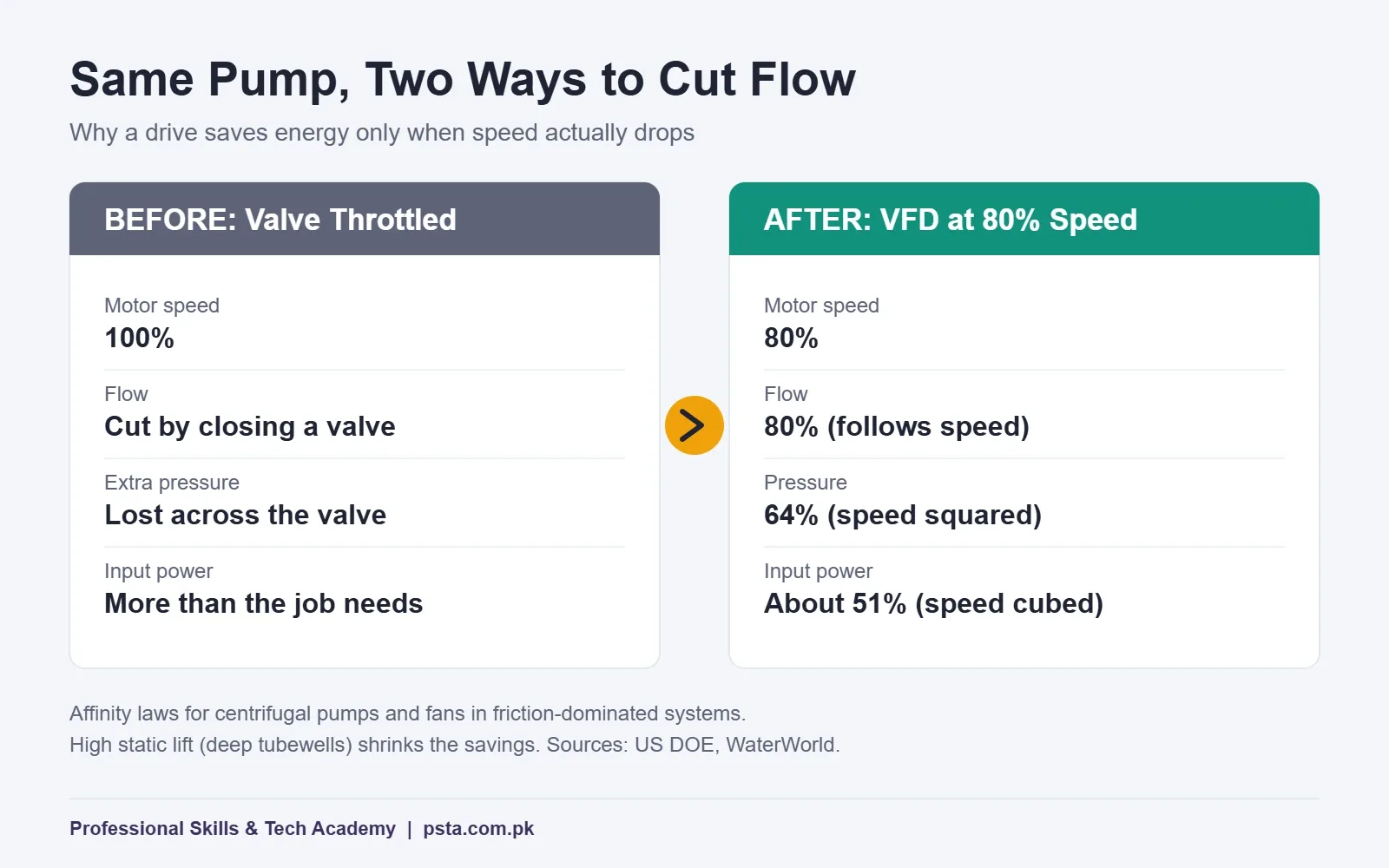
- • On pumps and fans, a 20% speed cut can reduce input power by about 50%, but high static lift shrinks the savings.
- • Eaton puts a VFD at two to three times the upfront cost of a soft starter.
- • Drives bring harmonics, cable length limits and bearing current risks that need proper installation.
Table of contents 17 sections
- VFD vs Soft Starter: The Side-by-Side Table
- What Does a Soft Starter Actually Do?
- The Limit You Must Respect
- How Is a VFD Different Inside?
- What You Configure on a Drive
- How Much Starting Current Does Each Method Draw?
- Which Saves More Electricity, and When?
- The Affinity Laws in One Paragraph
- Where the Savings Shrink
- Drive Efficiency at Light Load
- Cost, Size and Heat in the Panel
- What Problems Can a VFD Create?
- Matching the Starter to the Load: Two Questions
- Can a Soft Starter and a VFD Work Together?
- Five Selection Mistakes Technicians See
- Practising Drives and Soft Starters in PSTA's Panel Wiring Lab
- Before You Order, Read the Nameplate and Watch the Load
VFD vs soft starter: which one should a 30 kW tubewell motor get? That is one of the most common questions in our panel wiring lab, usually because an owner and a shopkeeper have given two different answers. The honest answer is that both can be right, and the deciding factor is not the motor. It is the load, and whether that load ever needs to run slower than full speed.
A soft starter only manages the start and the stop. A variable frequency drive (VFD) controls speed the whole time the motor runs. That one difference drives everything else: price, panel space, heat, harmonics and the electricity bill.
In this comparison you will find:
- What each device does to the motor's voltage and frequency, in plain terms
- Published starting current and torque figures for DOL, star delta, soft starter and VFD
- When a drive cuts electricity use, and when it barely saves a rupee
- The side effects a VFD brings into a panel, such as harmonics and long cable problems
- A simple two-question method for picking the right device for a pump, fan, conveyor or crusher
VFD vs Soft Starter: The Side-by-Side Table
Start with the full picture of the VFD vs soft starter choice. The table below summarizes what the manufacturers' own guides say. The figures come from ABB's Softstarter Handbook and Eaton's selection guide.
| Point of comparison | Soft starter | VFD (variable frequency drive) |
|---|---|---|
| What it controls | Voltage during start and stop only | Frequency and voltage at all times |
| Speed control while running | No, motor runs at full speed | Yes, continuously adjustable |
| Typical starting current | About 3 to 5 times rated current | Close to rated current; usually trips near 1.5 times |
| Starting torque | Reduced; falls with the square of voltage | Rated motor torque available from zero speed |
| Upfront cost | Lower | Two to three times a soft starter (Eaton) |
| Size and heat in the panel | Smaller; runs cool once bypassed | Larger and heavier; needs ventilation |
| Energy savings | Little during normal running | Large on pumps and fans that run at reduced flow |
| Harmonics | Generally not a concern | Generated; filters reduce but do not remove them |
| Best fit | Fixed-speed pumps, fans, compressors, conveyors | Variable flow, speed control, high starting torque |
If you only remember one row, make it the second one. Everything else follows from whether you need speed control after the motor is up and running.
What Does a Soft Starter Actually Do?
A soft starter sits between the supply and the motor. Inside it are pairs of thyristors (SCRs) on two or three phases. At switch-on, they let through only part of each voltage wave. Over a few seconds, they open up further until the motor sees full line voltage.
Lower voltage means lower current and gentler torque. That protects belts, couplings and gearboxes from the jolt of a direct-on-line (DOL) start. On pumps, a slow stop also prevents water hammer, the bang you hear in pipes when a pump stops suddenly.
Once the motor reaches full speed, most modern soft starters close an internal bypass contactor. The thyristors drop out of the circuit and the motor runs straight from the mains. Schneider Electric's conveyor comparison points out that this bypass is why a soft starter runs cooler, and slightly more efficiently, than a drive at full speed.
The Limit You Must Respect
Torque drops with the square of the voltage. ABB's handbook gives a clear example: at 50% voltage, the motor produces only about 25% of its maximum torque. On a light load such as a centrifugal pump, that is fine. On a loaded crusher or a long incline conveyor, the motor may not break away at all.
How Is a VFD Different Inside?
A VFD works in three stages. A rectifier turns incoming AC into DC. A DC bus with capacitors smooths it. Then an inverter section, built from IGBT transistors, switches that DC rapidly to create a new AC output at whatever frequency the drive is asked for.
Motor speed follows frequency. A four-pole motor that runs near 1,500 rpm on Pakistan's 50 Hz supply will run near 750 rpm at 25 Hz. ABB notes that drives can output anywhere from 0 to 250 Hz, which is why they can also run some machines above their nameplate speed.
Because the drive keeps the ratio of voltage to frequency under control, the motor can produce its rated torque even at very low speed. That is something no soft starter can do, and it is why cranes, extruders and loaded conveyors are classic drive jobs.
What You Configure on a Drive
A soft starter usually needs three or four settings: initial voltage, ramp-up time, ramp-down time and current limit. A drive asks for much more. You will enter the motor nameplate data, acceleration and deceleration times, minimum and maximum frequency, the control source (keypad, terminals or a PLC), and protection settings. The menus differ by brand, so the drive manual is the document you keep open while commissioning.
How Much Starting Current Does Each Method Draw?
Starting current is where most VFD vs soft starter comparisons begin, because high inrush current dips the voltage for every other machine on the same transformer. It also matters when you start a motor from a generator, since a large inrush can stall the genset.
ABB's Softstarter Handbook lists these typical figures for motor starting current, each as a multiple of the motor's rated current:
- Direct-on-line: typically 6 to 8 times, and ABB notes cases of up to 14 times.
- Star delta: about one-third of the DOL value in the star stage, but the changeover to delta can create a peak that is higher than a DOL start.
- Soft starter: about 3 to 5 times, and around 3 to 4 times for compressors and conveyor belts.
- VFD: close to rated current, because the drive raises frequency and voltage together. Drives usually trip if current reaches about 1.5 times rated.
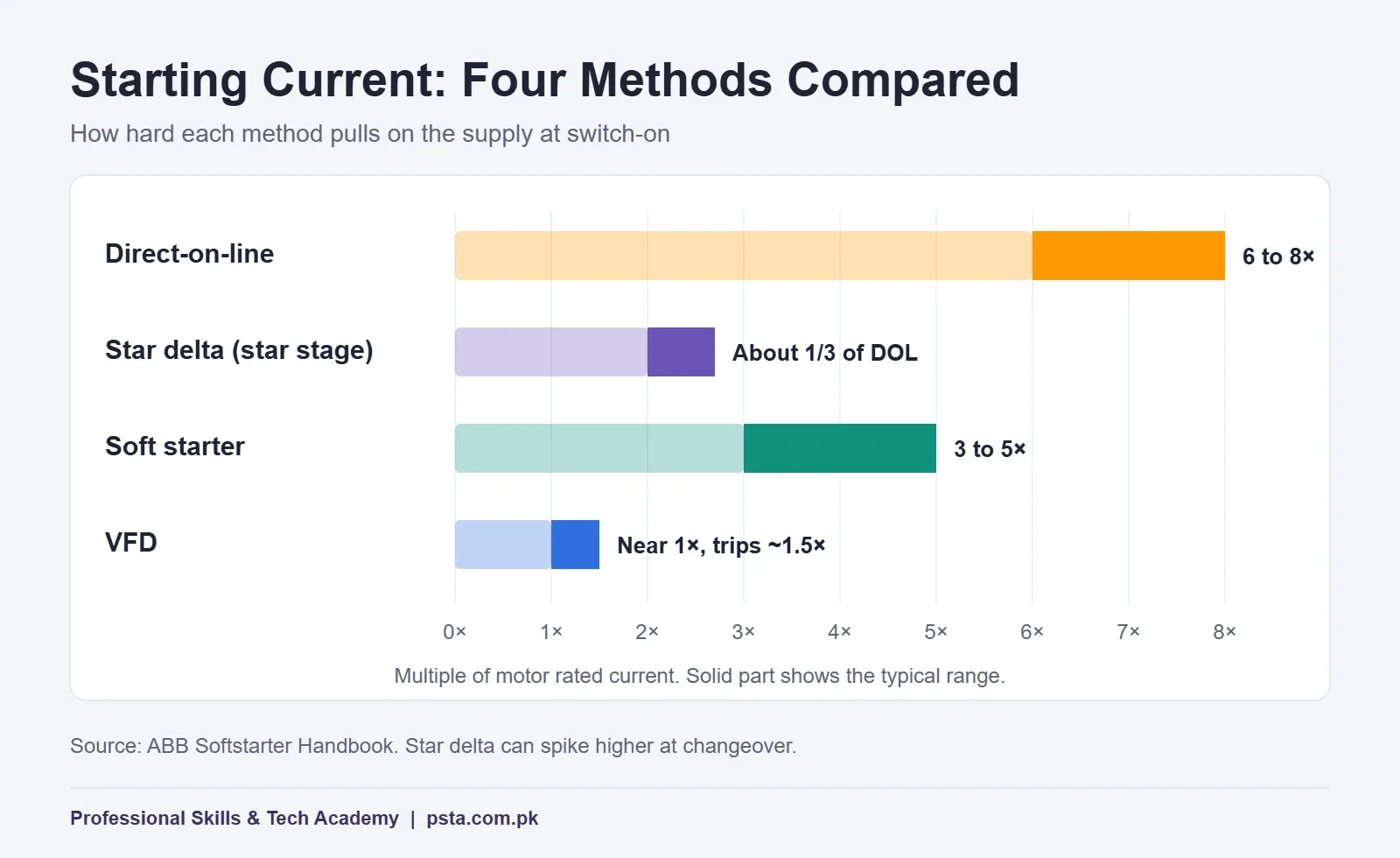
Notice where star delta sits. It looks attractive on paper, but its starting torque is only about 25% of the delta value in practice, according to ABB. If you want the wiring details and timer settings, our star delta starter guide covers them. For a 6-lead motor on a light load, star delta is still a cheap option. For anything heavier, the choice moves to a soft starter or a VFD.
Which Saves More Electricity, and When?
Here is the part of the VFD vs soft starter question that sellers often oversimplify. A VFD saves energy only when the motor would otherwise run faster than the job needs. Real VFD energy savings come from running the motor slower. If your pump or fan must run at full speed all day, the drive saves almost nothing. It even adds a few percent of its own losses.
The Affinity Laws in One Paragraph
For centrifugal pumps and fans, flow changes in step with speed, pressure changes with the square of speed, and power changes with the cube of speed. The U.S. Department of Energy's motor tip sheet on drive part-load efficiency puts it simply: cutting speed by 20% can reduce input power by roughly 50%. The same sheet works through a 20 hp exhaust fan that drops from 16.4 kW at full speed to about 2.8 kW at half speed.
Where the Savings Shrink
The cube law holds best when the system's resistance is mostly pipe friction. Many tubewells and overhead-tank systems in Pakistan are the opposite: most of the work is lifting water a fixed height. WaterWorld's pump column explains that with a large static head, you can't slow the pump much before flow collapses, and the pump drifts away from its best efficiency point.
The same article reports a plant audit where only 2 of 110 large pumps justified a variable speed drive. Pumps that run only a few hours a day rarely pay one back. For steady flow, trimming the impeller is often the better investment.
Constant-torque loads behave differently again. The DOE sheet notes that for conveyors, mixers, positive displacement pumps and compressors, power falls only in proportion to speed, so savings are smaller.
Drive Efficiency at Light Load
Drives are efficient near full load, but less so when lightly loaded. In the DOE's table of typical drives, a 20 hp unit runs at 97% efficiency at full load and about 86% at 12.5% load. A 5 hp unit drops from 95% to about 80% over the same range. Size the drive to the motor, not two sizes bigger "for safety."
Cost, Size and Heat in the Panel
Price is the other big factor in VFD vs soft starter decisions. Eaton's guide says a VFD can cost two to three times more up front than a soft starter. ABB's handbook gives an older but useful index of average installation cost: if DOL is 1, star delta is about 3, a soft starter about 6, and a drive more than 12. That index includes cabling and panel work, not just the device.
Local prices vary widely by brand, rating and stock. As one reference point, a Pakistani online store, W11 Stop, lists a 4 kW SAJ solar pump inverter at Rs. 48,000 (shown as coming soon when we checked in October 2026). Always get a written quote with the exact model before you budget.
Space and heat also matter. A drive is larger and heavier for the same power, according to ABB, and its electronics shed heat the whole time the motor runs. In a sealed panel during a Pakistani summer, that heat needs a fan, filter and sometimes a panel air conditioner. A bypassed soft starter, by contrast, makes most of its heat only during the ramp.
What Problems Can a VFD Create?
A drive is not a plug-in upgrade. It changes the electrical environment around the motor, and installers who ignore that end up with nuisance trips and early failures.
- Harmonics: ABB notes that drives generate harmonic currents. Filters and shielded cables reduce them, but do not remove them completely. Soft starters generally do not raise this concern.
- Long motor cables: WaterWorld mentions that long leads, anywhere from 30 to 100 feet depending on the case, may need reactors or special cable. Submersible pumps deep in a borehole are a common example.
- Bearing currents: The same source warns that stray currents can damage motor bearings, especially on motors above 150 hp.
- Older motors: A retrofit on an old rewound motor may need motor replacement, because insulation that was fine on mains power can fail on drive output.
None of these is a reason to avoid drives. They are reasons to install them properly: correct earthing, shielded cable glanded at both ends, separate routing from control wiring, and the cable length limits in the drive manual.
Matching the Starter to the Load: Two Questions
You can settle most VFD vs soft starter decisions with two questions. First, does the flow or speed need to change while the machine runs? Second, how many hours a day does it run? The matrix below shows where common jobs land.
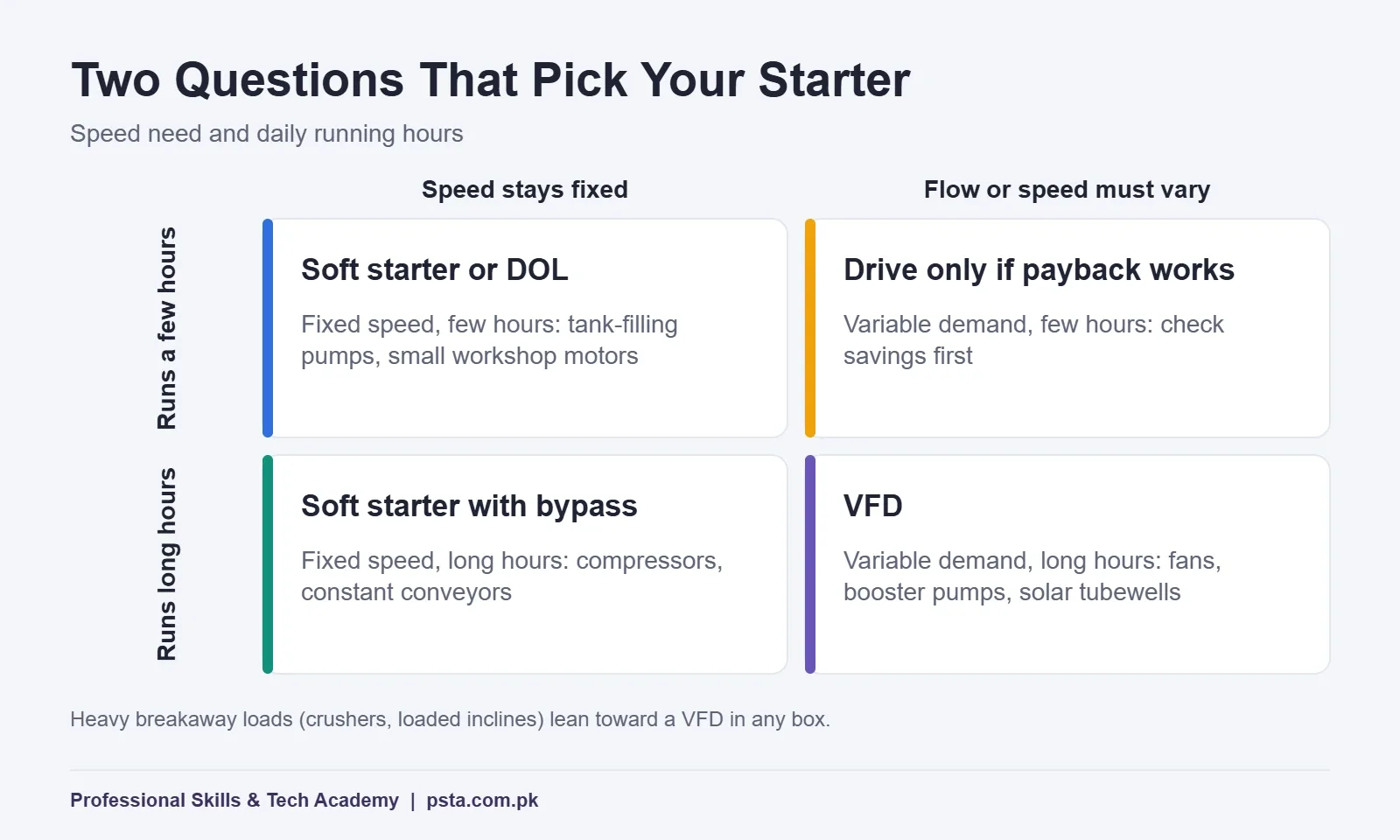
Here is how that plays out on typical jobs, presented as examples rather than fixed rules:
- Domestic or building water pump filling a tank: fixed speed, short runs. A soft starter, or simply DOL on small ratings, makes sense.
- Air compressor in a workshop: fixed speed with frequent starts. A soft starter reduces inrush and mechanical stress.
- Ventilation or humidification fans in a textile mill: long hours and airflow that changes with weather and shift. This is where drives usually earn their price.
- Booster pumps holding constant pressure in a building: demand rises and falls all day, so a drive with a pressure sensor is a strong fit.
- Loaded stone crusher or inclined conveyor: high breakaway torque. A drive, or a heavy-duty soft starter checked carefully against the load curve.
- Solar tubewell: the panel output changes through the day, so a solar pump inverter (a VFD designed for this job) is the standard choice.
Schneider adds one more useful line: a soft starter suits lightly loaded conveyors with ten or fewer starts per hour. More frequent starting points toward a drive.
Can a Soft Starter and a VFD Work Together?
Not on the same motor at the same time. A drive already starts the motor softly, so adding a soft starter in front of it gains nothing. ABB's handbook describes a drive used only for starting and stopping as an unnecessarily expensive choice, so choose one device to match the job.
What you will see in larger plants is a drive with a bypass contactor. If the drive faults, a maintenance team can switch the motor to mains power and keep production going at full speed. Some pump stations also use one drive to control a lead pump while soft starters handle the standby pumps. These are design decisions for the panel builder, and they appear in the schematic.
Five Selection Mistakes Technicians See
- Buying a drive "to save electricity" on a full-speed load. No speed reduction means no meaningful savings.
- Oversizing the drive. Efficiency falls at light load, and you pay more for nothing.
- Using a soft starter on a heavy breakaway load. If the motor stalls at reduced voltage, the starter trips or overheats.
- Ignoring the cable run. A long run to a submersible pump without the right cable or output filter is a common cause of motor failures.
- Skipping protection coordination. Both devices still need correctly rated upstream protection. Our MCB vs MCCB vs RCCB comparison explains how to choose it.
Practising Drives and Soft Starters in PSTA's Panel Wiring Lab
Reading a VFD vs soft starter guide only gets you so far. You learn this properly by wiring a starter, setting a ramp time, and watching the clamp meter as the motor accelerates.
The Industrial Automation course at PSTA covers this in a dedicated module, Motor Drives & Soft Starters, after you have wired DOL, forward-reverse and star delta circuits by hand. Later modules add PLC and HMI integration, so you also learn to run a drive from ladder logic. Details from the course page:
- Duration: 3 months (12 weeks), beginner level
- Fee: Rs. 28,000 (listed down from Rs. 35,000 on the course page at the time of writing)
- Modes: on campus in Abbottabad, online or hybrid, with a new batch every month
- Who joins: DAE and B-Tech graduates, electricians moving into industry, engineering students and factory maintenance staff
If you are preparing for maintenance jobs, our PLC interview questions and industrial automation explainer are good next reads. You can also compare every program on the courses page, or check batch dates and seats on the admission page. If you would rather ask about a specific motor job first, send a message to the academy on WhatsApp at +92 314 5424399.
Before You Order, Read the Nameplate and Watch the Load
The quickest way to settle VFD vs soft starter on a real job is to pick one motor you work on and note three things: its kW rating, how many hours it runs each day, and whether anyone ever throttles a valve or damper to reduce its output. If a valve is being throttled on a long-running pump or fan, you have found a likely VFD job. If the motor simply runs flat out and only the start is rough, a soft starter will usually do the work for far less money.
Frequently asked questions
Can I use a VFD instead of a soft starter?
Yes. A VFD also starts a motor gently, with current close to its rated value, so it can do every job a soft starter does. The drawback is cost, size and heat. If the motor will always run at full speed, a soft starter usually does the same starting job for much less money and with fewer installation concerns such as harmonics.
Does a soft starter save electricity?
Not much during normal running. A soft starter cuts the current surge at switch-on and can lower peak demand, but once the motor reaches full speed its bypass contactor closes and the motor runs straight from the mains. Real energy savings come from running a pump or fan slower, which needs a VFD.
Is a VFD better than a star delta starter?
For most loads, yes, but it costs far more. ABB notes that star delta gives only about 25% of normal starting torque in practice and can create a current peak at changeover. A VFD keeps current near rated and gives full torque. For a light pump on a tight budget, star delta can still be acceptable.
Which is cheaper, a VFD or a soft starter?
A soft starter is cheaper. Eaton estimates a VFD costs two to three times more up front, and ABB's installation cost index rates a drive at more than double a soft starter once cabling and panel work are included. A VFD can win over its life only if it regularly runs the motor below full speed.
Can a soft starter control motor speed?
No. A soft starter only ramps the voltage up at start and down at stop. Once the motor is running, it turns at the speed set by the supply frequency and the number of poles. If you need to change speed during operation, for a fan, booster pump or conveyor, you need a VFD.
Do I need a VFD for a solar tubewell?
In practice, yes. Solar panels give a varying DC output through the day, so a solar pump inverter, which is a VFD designed for this job, converts it into AC at a frequency that matches the available power. Many units also include dry-run and overload protection. A soft starter cannot work from a solar array.
Does a VFD shorten motor life?
Not when it is installed correctly. Problems usually come from long motor cables without filters, poor earthing, or old motors with weak insulation. Stray currents can also damage bearings, especially on large motors. Following the cable length limits in the drive manual and using shielded cable prevents most of these failures.
Sources & references
- ABB Softstarter Handbook library.e.abb.com
- Eaton: How to choose between a soft starter and a VFD eaton.com
- Schneider Electric: Soft starters vs. VFDs for conveyor motors blog.se.com
- U.S. DOE: Adjustable Speed Drive Part-Load Efficiency (Motor Tip Sheet 11) energy.gov
- WaterWorld: When should variable speed drives be used to save energy? waterworld.com
- Lakeland Engineering: Choosing between a drive, soft starter or across-the-line starter lakelandengineering.com
- W11 Stop: SAJ 4 kW VFD solar pump inverter listing w11stop.com
Last reviewed & updated on by Umar Qureshi. Written by the PSTA team in Abbottabad, Pakistan.

Umar Qureshi

Master Industrial Automation: Single & Three-Phase Panel Wiring, PLC & VFD Certification
Turn this guide into a career: hands-on training with real projects, online across Pakistan or on-campus in Abbottabad · 3 Months (12 Weeks).


Comments
No comments yet — ask a question or share your experience.