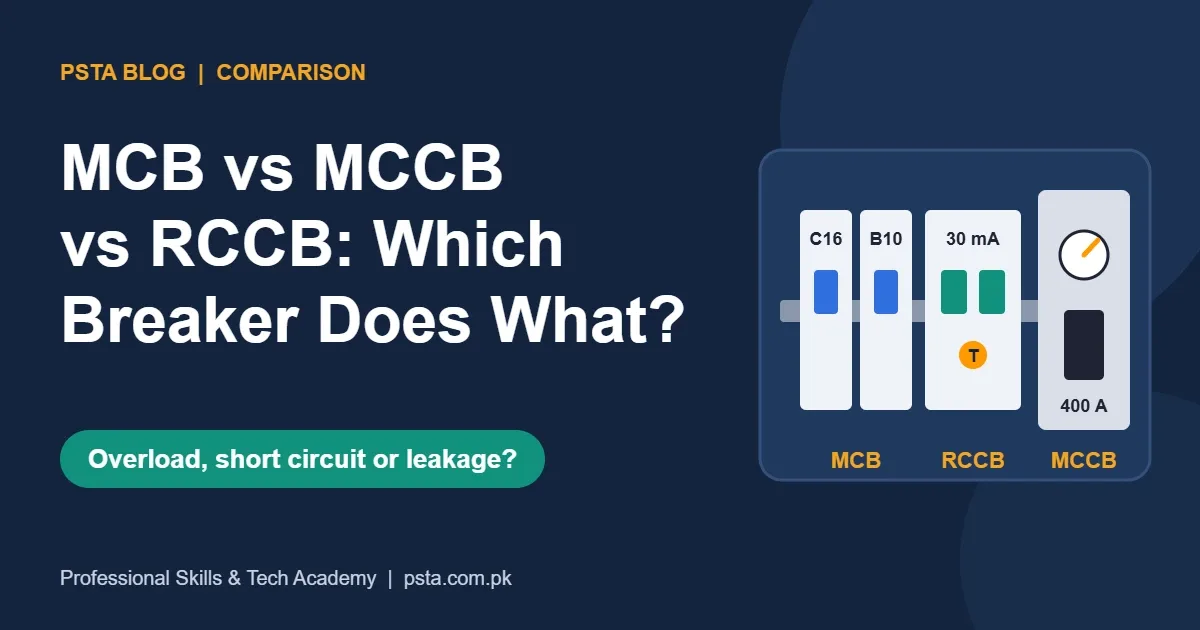
Quick answer
An MCB protects small circuits, below about 125 A, from overload and short circuit. An MCCB does the same for larger currents and often has adjustable settings. An RCCB trips only on earth leakage, usually at 30 mA, to protect people. Homes normally need MCBs and an RCCB together, or RCBOs.
Key takeaways
- • MCBs and MCCBs trip on overload and short circuit; an RCCB trips only on earth leakage.
- • Use a B curve for lights, C for sockets and ACs, and D for heavy motor starts.
- • A 30 mA RCCB protects people; a 300 mA device is meant for fire risk.
- • Size the cable first, then choose a breaker rated below the cable.
- • Inverter loads may need a Type A, F or B RCCB, so follow the maker's manual.
Table of contents 16 sections
- What Does Each Breaker Actually Protect Against?
- MCB vs MCCB vs RCCB: The Side-by-Side Table
- MCB: The Workhorse of Home and Shop Boards
- B, C and D Trip Curves
- MCCB: When the Current Gets Too Big for an MCB
- RCCB: The Device That Protects People
- RCCB Types: AC, A, F and B
- Where Do RCBO and ELCB Fit In?
- RCBO
- ELCB
- How to Choose the Right Device: A Five-Step Method
- Six Myths Electricians Still Repeat
- A Typical House Board, Explained as an Example
- Testing and Maintenance Habits That Prevent Fires
- Practising Protection Wiring at PSTA
- Check Your Own Board This Weekend
Before you read this MCB vs MCCB vs RCCB comparison, try a quick self-test. A breaker in a house board trips every time the 1.5-ton AC starts. Another one trips when a wet kettle leaks to its metal body. A third sits on a 400 A factory feeder. Can you name the right device for each? If you hesitated on any of them, keep reading.
Here is the short version. An MCB guards small circuits against overload and short circuit. An MCCB does the same job for big currents and lets you adjust its settings. An RCCB watches for current leaking to earth, which is the fault that kills people, and it does nothing about overload. Most homes need an MCB and an RCCB working together.
After reading, you will be able to:
- Explain what each of the five common breaker names actually protects against
- Read a side-by-side table of ratings, standards and typical uses
- Pick the right MCB trip curve for lights, sockets and motors
- Follow a five-step method to choose protection for any circuit
- Spot the myths that cause nuisance trips and unsafe boards
What Does Each Breaker Actually Protect Against?
Every protective device in a distribution board answers one question: what kind of fault am I waiting for? There are three main faults in low-voltage wiring, and each one needs a different sensor.
- Overload. A circuit carries more current than its cable is meant to carry, for minutes or hours. Think of three heaters on one socket circuit in January. The cable heats slowly until its insulation fails.
- Short circuit. Live touches neutral or another phase through almost no resistance. Current jumps to many times the normal value in a fraction of a second.
- Earth leakage. Some current escapes to earth through a damaged cable, a wet appliance or a human body. The amount can be tiny, far too small for an overcurrent breaker to notice, yet it is enough to stop a heart or start a fire.
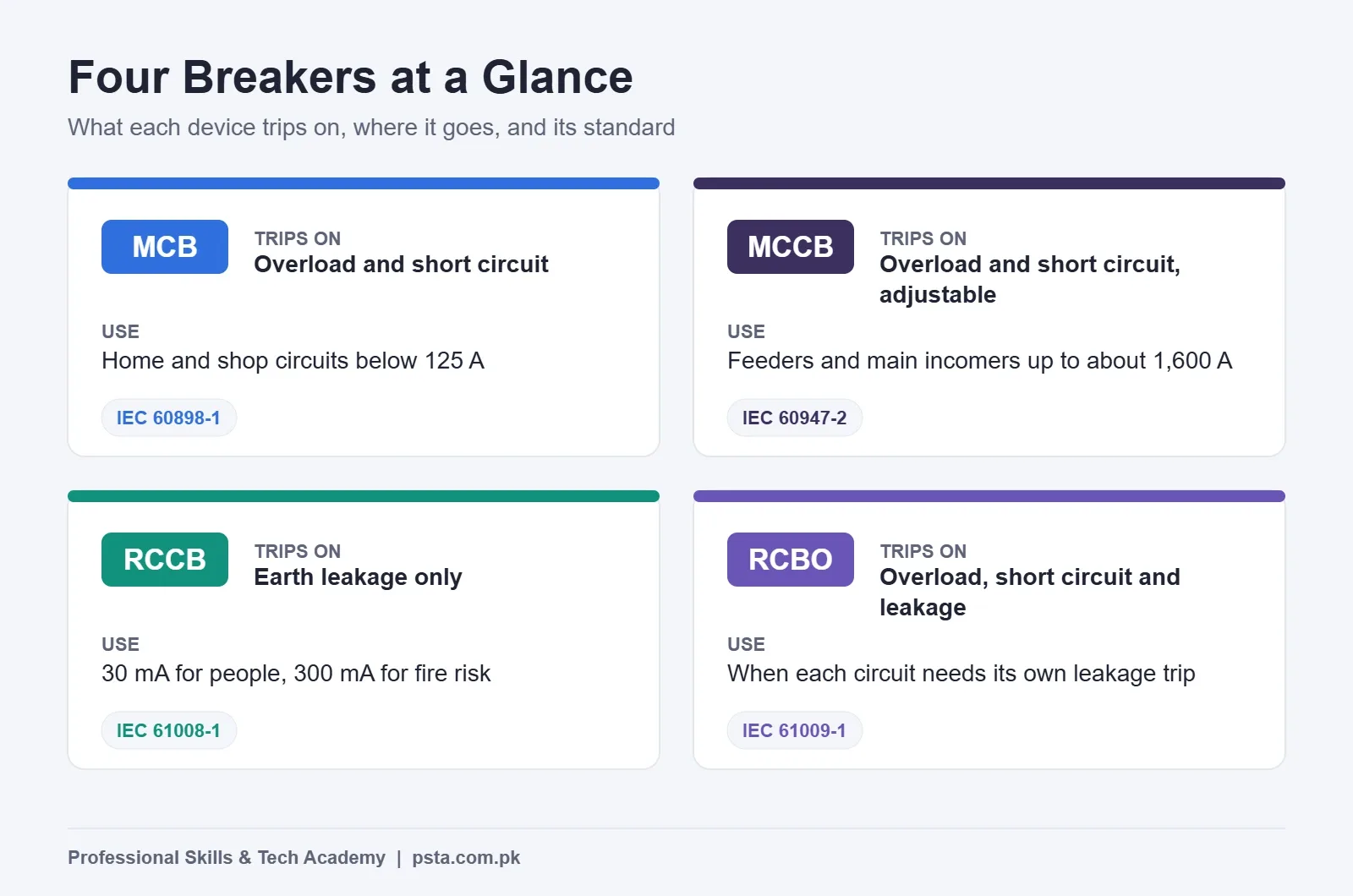
MCBs and MCCBs handle the first two. RCCBs handle the third. RCBOs handle all three in one unit. Once you see protection this way, the alphabet soup on breaker labels starts to make sense.
MCB vs MCCB vs RCCB: The Side-by-Side Table
The table below puts the MCB vs MCCB vs RCCB differences in one place. Ratings come from manufacturer guides by Himel and ABB. Always check the label on the actual device you're fitting, because exact ranges vary by model.
| Feature | MCB | MCCB | RCCB |
|---|---|---|---|
| Full name | Miniature Circuit Breaker | Moulded Case Circuit Breaker | Residual Current Circuit Breaker |
| Trips on | Overload and short circuit | Overload and short circuit (some add earth fault) | Earth leakage only |
| Typical current range | Below 125 A | Up to about 1,600 A | Sized to the circuit it guards |
| Breaking capacity | Under 10 kA | 10 kA to 85 kA | Not designed to break short circuits |
| Settings | Fixed | Fixed or adjustable | Fixed sensitivity, usually 30 mA |
| Product standard | IEC 60898-1 | IEC 60947-2 | IEC 61008-1 |
| Where you'll find it | Homes, shops, final circuits | Factory feeders, main incomers, big motors | Home and office boards, wet areas |
The row that matters most is "Trips on." An MCB and an RCCB are not competitors. They watch for different faults, so a safe board usually has both.
MCB: The Workhorse of Home and Shop Boards
An MCB has two tripping parts inside. A bimetal strip bends slowly as it heats, which handles overload. A magnetic coil pulls the contacts open almost instantly when current spikes, which handles short circuits. Because its settings are fixed, you choose an MCB by three things: its rated current, its number of poles, and its trip curve.
The rated current should never be higher than what the cable can carry. A 32 A breaker on a cable rated for 20 A protects nothing; the cable will cook before the breaker reacts.
B, C and D Trip Curves
The letter printed before the amp rating (for example C16) tells you how much surge the breaker tolerates before its magnetic part trips. According to ABB's guide to MCB trip curves:
- B curve trips at 3 to 5 times its rated current. It suits lighting and resistive loads, but it can trip when a motor starts.
- C curve trips at 5 to 10 times rated current. It handles moderate inrush, which is why it is the common choice for sockets and AC circuits.
- D curve trips at 10 to 20 times rated current. It is meant for heavy starting currents, such as large motors and transformers.
If a B16 keeps tripping each time a water pump starts, don't jump to a bigger amp rating. Check whether a C16 is the right fit instead, because that keeps the cable protected while tolerating the start-up surge.
MCCB: When the Current Gets Too Big for an MCB
Once a circuit needs more than about 125 A, or the fault current at that point is higher than an MCB can safely break, you move to an MCCB. You'll see them as main incomers in plazas, on generator change-over panels and on feeders to large motors in textile and steel units around Hattar and Gadoon.
The big advantage is adjustment. Many MCCBs let you set the overload pickup and the magnetic trip level on the front dial. That lets an engineer match the breaker to the exact cable and load, and coordinate it with the smaller breakers downstream so only the faulty branch trips.
The trade-off is size and cost. An MCCB is bulkier, needs proper busbar or lug connections, and is overkill for a 16 A bedroom circuit. In a normal house, you won't need one.
RCCB: The Device That Protects People
An RCCB compares the current going out on live with the current coming back on neutral. In a healthy circuit they match. If some current goes missing, it must be leaking to earth, possibly through a person, and the RCCB trips.
The ABB RCD technical guide gives two key sensitivities. A 30 mA device gives extra protection against direct contact with live parts, and it is the preferred value for homes. A 300 mA device is used for fire protection, because leakage too small for an overcurrent breaker can still start a fire in damp or dusty places.
RCCB Types: AC, A, F and B
The type letter tells you what shape of leakage current the RCCB can detect. ABB describes them this way:
- Type AC detects only plain sinusoidal AC leakage.
- Type A also detects pulsating DC leakage.
- Type F extends Type A for loads with single-phase inverters, such as modern washing machines.
- Type B also detects smooth DC and high-frequency leakage, for drives, UPS systems and some solar installations.
Inverter ACs, VFDs and solar inverters are now common in Pakistani homes and workshops. That makes the type letter more important than it was a decade ago. When a manufacturer's manual names a required RCD type, follow it.
One rule never changes: an RCCB cannot detect overload or short circuit. It must always sit with an MCB or fuse on the same circuit.
Where Do RCBO and ELCB Fit In?
These two names cause most of the confusion at electrical shops on Hall Road or in Saddar, so let's sort them out.
RCBO
An RCBO is an RCCB and an MCB built into one unit. It trips on overload, short circuit and earth leakage. Its product standard is IEC 61009-1. The main benefit is that each circuit gets its own leakage protection, so one leaky appliance only switches off its own circuit instead of the whole house. The cost per circuit is higher than a shared RCCB.
ELCB
"ELCB" is an older name that covers two different devices. The early voltage-operated type sensed a voltage rise on the earth wire and could only catch faults that reached connected metalwork. According to the EPFL Graph Search summary, these have now been replaced by current-sensing RCDs and RCCBs. When a shopkeeper in Pakistan says "ELCB" today, he usually means a current-operated RCCB. Read the label to be sure: look for IEC 61008 (RCCB) or IEC 61009 (RCBO) and a mA rating.
How to Choose the Right Device: A Five-Step Method
Use this sequence for any circuit, from a single bedroom to a small workshop.
- Find the load current. Add up the watts on the circuit and divide by the voltage. A rough estimate is fine at this stage.
- Size the cable first. Choose a cable whose current rating comfortably exceeds the load, using the cable maker's chart for your installation method.
- Pick the overcurrent device. Choose an MCB whose rating sits between the load current and the cable rating. If you need more than about 125 A, or the fault level is high, choose an MCCB.
- Pick the trip curve. Use B for lights and heaters, C for sockets and ACs, and D only for heavy motor or transformer starts.
- Add leakage protection. Put sockets, bathrooms, kitchens and outdoor points behind a 30 mA RCCB or on RCBOs. Choose the RCD type your appliances need.
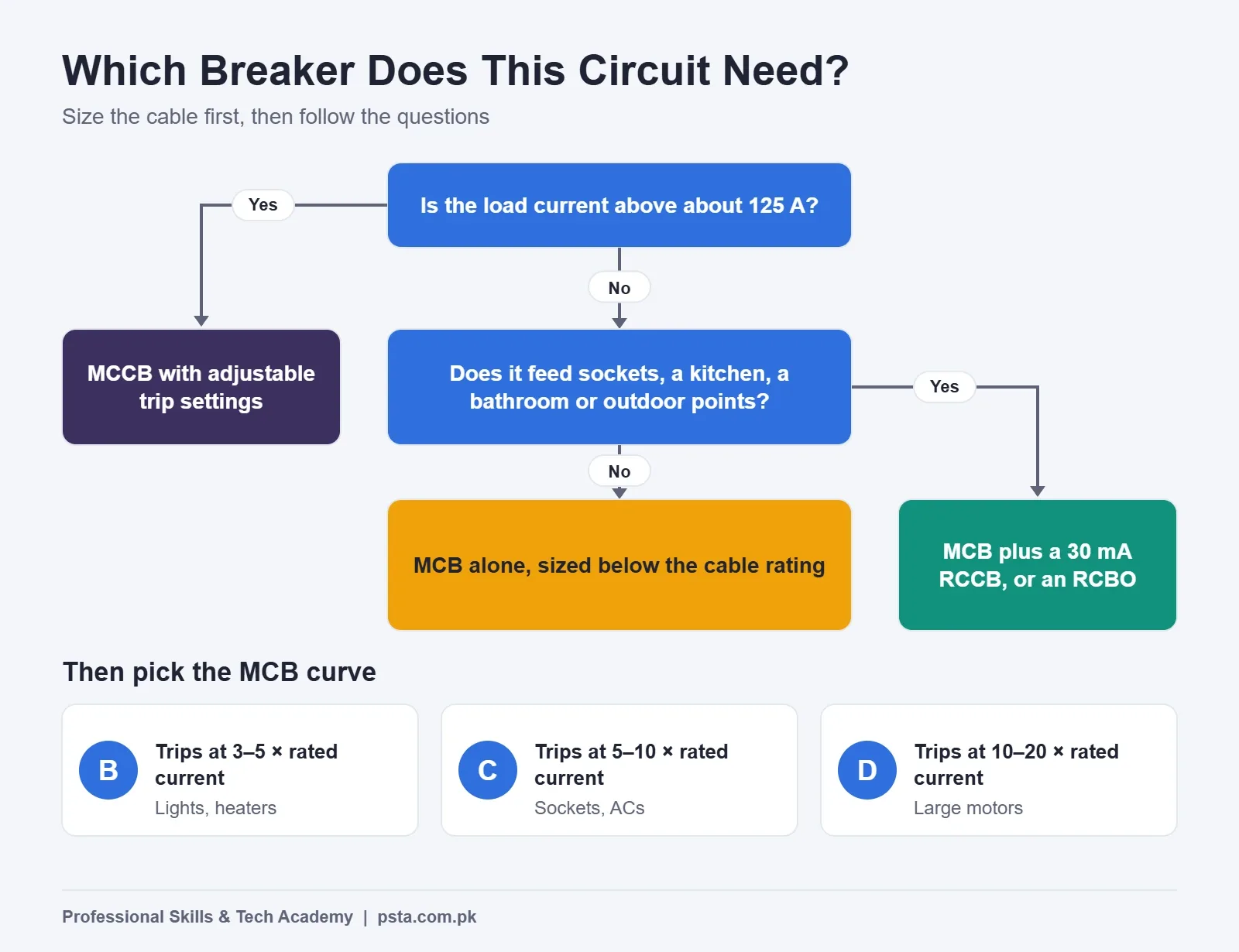
Notice that the cable comes before the breaker. The breaker exists to protect the cable, so you can't pick one correctly without knowing the other.
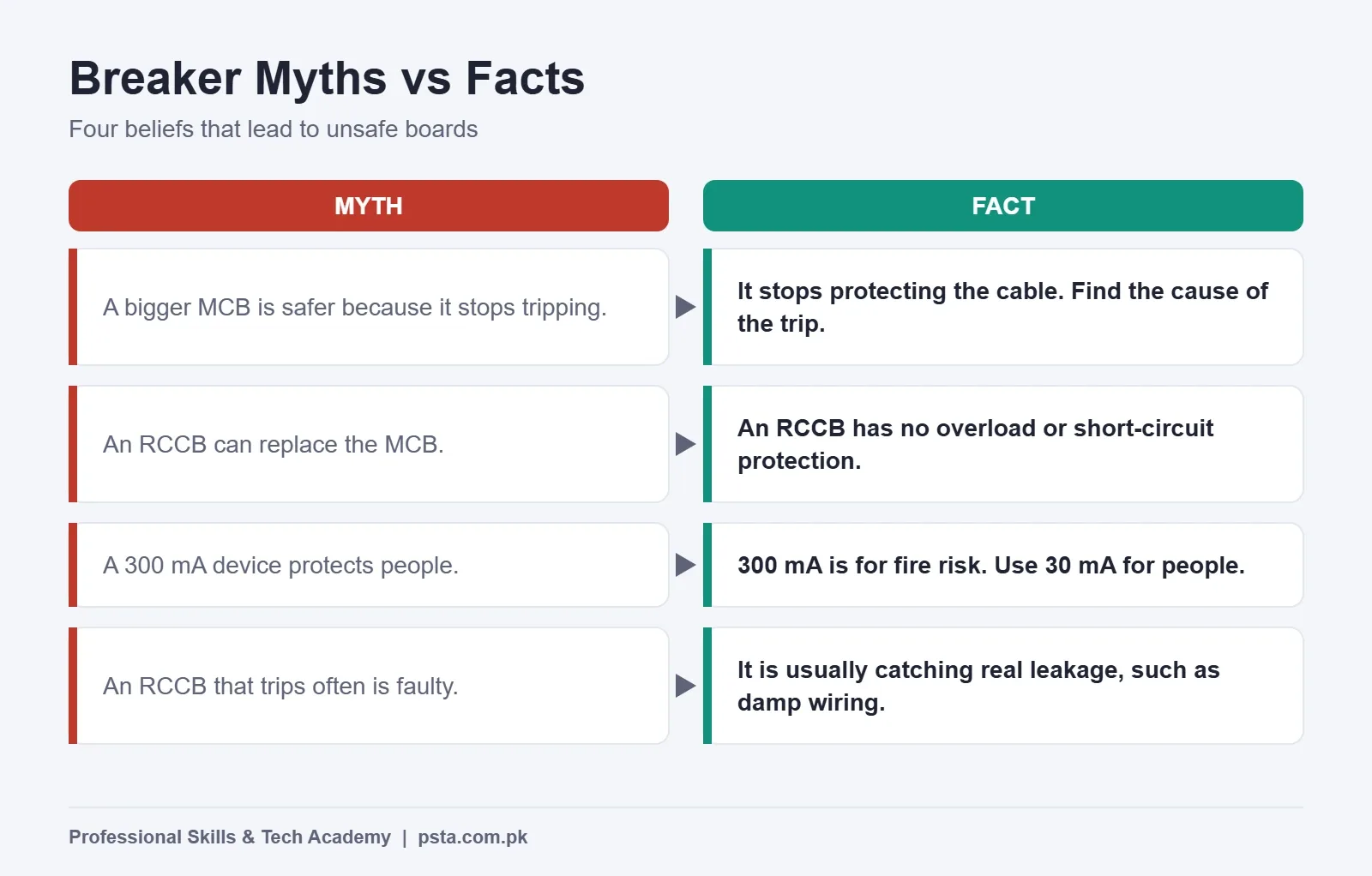
Six Myths Electricians Still Repeat
Most board problems we see in practical classes come from habits, not from missing knowledge. These six come up again and again.
- "A bigger MCB stops tripping, so it's better." It stops tripping because it no longer protects the cable. Find out why the smaller one trips.
- "An RCCB replaces the MCB." It doesn't. An RCCB has no overload or short-circuit protection of its own.
- "No earth wire means the RCCB can't work." An RCCB measures the live and neutral imbalance, so it still trips on leakage through a person. Earthing is still essential, because it gives fault current a safe path and lets the RCCB trip before anyone touches the metal.
- "Frequent RCCB trips mean it's faulty." Usually it is doing its job. Damp walls, a leaky geyser element or a damaged extension lead are common culprits.
- "300 mA protects people." A 300 mA device is for fire protection. For people, use 30 mA.
- "Any breaker from the market will do." Unbranded breakers may not trip when they should. Pakistan Cables advises homeowners never to buy unbranded breakers and to look for IEC 60898-1 on MCBs.
A Typical House Board, Explained as an Example
Example: picture a five-marla house in Abbottabad on a single-phase supply. This is an illustration of a common layout, not a design for your home. A licensed electrician must size any real installation.
- A double-pole main switch or MCB isolates the whole house.
- A 30 mA double-pole RCCB covers the socket, kitchen and bathroom circuits.
- Lighting circuits run on B-curve MCBs. Lighting is sometimes kept outside the RCCB so a leakage trip doesn't leave the house in the dark at night.
- Each AC gets its own C-curve MCB on a dedicated cable.
- The geyser and any outdoor pump get their own MCBs, behind the RCCB or on RCBOs.
Now picture the same family adding a rooftop solar system with a hybrid inverter. The inverter's manual might call for a specific RCD type on its AC output. That detail is easy to miss, and it is exactly the kind of thing a trained technician checks first.
Testing and Maintenance Habits That Prevent Fires
Protection only works if the devices still trip. Build these habits into every job and every home visit.
- Press the RCCB test button. ABB's guide says to press it periodically and confirm the power switches off. Pakistan Cables suggests doing it monthly. If it doesn't trip, replace it.
- Check terminals for heat. Loose screws cause discolored plastic and burning smells. Tighten to the maker's torque with the supply isolated.
- Label every circuit. A board with handwritten or missing labels slows down fault finding and tempts people to switch off the wrong breaker.
- Keep earthing in good shape. NEPRA's public safety campaign advises installing earthing for homes, shops and factories through an authorized electrician, and having internal wiring inspected regularly.
- Don't overload sockets. Heaters, irons and ACs need their own suitably rated outlets and circuits.
Practising Protection Wiring at PSTA
Reading about breakers helps, but the skill sticks when you wire a board yourself and watch each device trip on a real fault. In PSTA's Industrial Automation and Panel Wiring course, Module 2 covers industrial control components and protection. Later modules move on to DOL, forward-reverse and star-delta motor starters, VFDs, soft starters and basic PLC logic, plus fault finding with multimeters, clamp meters and meggers.
The course runs for 12 weeks at beginner level. The current fee listed on the course page is Rs. 28,000, down from Rs. 35,000. You can study at the Abbottabad campus in Mandian, live online from anywhere in Pakistan, or mix both. A new batch starts every month.
If you're more interested in security systems, the CCTV Surveillance and AI Security Technician course is the closer fit. You can also read our guides on the star delta starter, industrial automation careers in Pakistan and PLC interview questions. To compare every program, see all PSTA courses, and when you're ready, the admission page explains how to join. If you work shifts and need a batch that fits around them, send a WhatsApp message to +92 314 5424399.
Check Your Own Board This Weekend
Open the front flap of your home distribution board. Only the flap: never unscrew the inner cover, because live parts sit behind it. Write down each device's type, rating and curve letter. Is there an RCCB? Does it say 30 mA? Is every socket circuit behind it? Press its test button and note what switches off. If anything is missing or doesn't trip, call a licensed electrician. That ten-minute check teaches you more about MCB vs MCCB vs RCCB than any chart, and it might prevent a real accident.
Frequently asked questions
Can an RCCB be used without an MCB?
No. An RCCB only senses current leaking to earth. It does not trip on overload or short circuit, so the circuit still needs an MCB or fuse in series. If you want one device that does both jobs on a single circuit, fit an RCBO instead, which combines overcurrent and leakage protection in one unit.
Which mA rating should I choose for a home RCCB?
For protecting people, choose 30 mA. ABB's RCD guide describes 30 mA as the preferred sensitivity for extra protection against direct contact with live parts. Devices rated at 100 mA or 300 mA are used for fire protection or selectivity, and they should not be relied on to protect someone who touches a live part.
Which MCB curve is right for an air conditioner?
A C-curve MCB is the usual choice for AC circuits because it tolerates moderate starting surges, tripping magnetically at 5 to 10 times its rating. Give each AC its own circuit and cable, and pick an amp rating below the cable rating. Always check the manufacturer's installation sheet, which often states the recommended breaker size.
Is an ELCB the same thing as an RCCB?
Not exactly. The name ELCB once covered two devices. The old voltage-operated type watched for voltage on the earth wire and has been replaced by current-sensing devices. Today, when shops in Pakistan sell an "ELCB", it is usually a current-operated RCCB. Check the label for IEC 61008 and a mA rating to confirm.
Why does my RCCB trip when it rains?
Rain often exposes real leakage. Water can get into outdoor sockets, light fittings, junction boxes or damp walls, letting current escape to earth. Switch off all MCBs, reset the RCCB, then switch circuits on one at a time to find the faulty one. If you cannot locate the fault safely, call a licensed electrician.
Do I need an MCCB in a house?
Usually not. Typical houses use MCBs, because their circuits run well below 125 A. MCCBs are meant for larger currents and higher fault levels, such as plaza main incomers, generator change-over panels and factory feeders. If an electrician suggests an MCCB for a normal home, ask what load or fault level calls for it.
Does a solar or inverter system need a special RCCB?
It might. Inverters and drives can produce leakage currents that a basic Type AC RCCB cannot detect properly. ABB lists Type F for single-phase inverter loads and Type B for drives, UPS systems and some solar setups. Follow the inverter manufacturer's manual, which normally states the RCD type it needs.
Sources & references
- ABB: What You Need to Know About MCB Trip Curves library.e.abb.com
- ABB: RCD Technical Guide library.e.abb.com
- Himel: MCB, MCCB, RCCB, ELCB and How They Differ himel.com
- EPFL Graph Search: Earth-Leakage Circuit Breaker graphsearch.epfl.ch
- Pakistan Cables: A Homeowner's Guide to Electrical Safety in Pakistan pakistancables.com
- NEPRA: General Public Safety Awareness Campaign nepra.org.pk
Last reviewed & updated on by Umar Qureshi. Written by the PSTA team in Abbottabad, Pakistan.

Umar Qureshi

Master Industrial Automation: Single & Three-Phase Panel Wiring, PLC & VFD Certification
Turn this guide into a career: hands-on training with real projects, online across Pakistan or on-campus in Abbottabad · 3 Months (12 Weeks).



Comments
No comments yet — ask a question or share your experience.