Quick answer
Google Ads ranks search ads with Ad Rank, which combines your bid with ad and landing page quality, search context and other factors. Quality Score is only a diagnostic. Start with tightly themed ad groups, phrase and exact match keywords, negative keywords, and a daily budget set from your monthly limit divided by 30.4.
Key takeaways
- • Ad Rank uses six factors, so the highest bid does not automatically win the top spot.
- • Quality Score (1 to 10) is a diagnostic tool, not an input in the ad auction.
- • Broad match is the default; phrase and exact match give new accounts more control.
- • A campaign can spend up to 2x its daily budget in a day, but no more than 30.4x in a month.
- • Prepay is not available in Pakistan, so your payment method must be ready before ads run.
- • For walk-in local businesses, the Presence location option usually wastes less money.
Table of contents 13 sections
- How a Google Ads Account Is Structured
- How Does the Google Ads Auction Decide Who Shows First?
- Quality Score Explained Without the Jargon
- Keyword Match Types: Broad, Phrase and Exact
- Negative Keywords Are Half the Job
- How Do Daily Budgets and Billing Work?
- Writing Your First Responsive Search Ad
- Location Settings That Matter for Local Businesses
- Google Ads for Beginners: Four Beliefs That Cost Money
- A Glossary of 12 Terms for Your First Week
- Is Google Ads Certification Worth It for Beginners?
- Practicing Google Ads in PSTA's Digital Marketing Course
- Before You Spend a Rupee, Plan One Ad Group on Paper
A common belief among shop owners in Pakistan is that Google sells the top spot to whoever pays the most. That isn't how it works, and it's the first thing to unlearn if you're looking for Google Ads for beginners. Google ranks ads with a score that mixes your bid with the quality of your ad and page, so a smaller business with a sharper ad can sit above a bigger spender.
I teach this every month to students and local business owners in Abbottabad, and most of the money beginners lose comes from a handful of misunderstood settings, not from bad luck. This guide explains those settings in plain English, using Google's own help pages as the reference.
Here is what you'll be able to explain after reading:
- How a Google Ads account is built, from billing at the top down to single keywords
- What Ad Rank and Quality Score really measure, and why they are not the same thing
- How broad, phrase and exact match change who sees your ad
- Why your daily budget can be crossed on some days, and the monthly limit that protects you
- Which terms, settings and free certification to focus on in your first month
How a Google Ads Account Is Structured
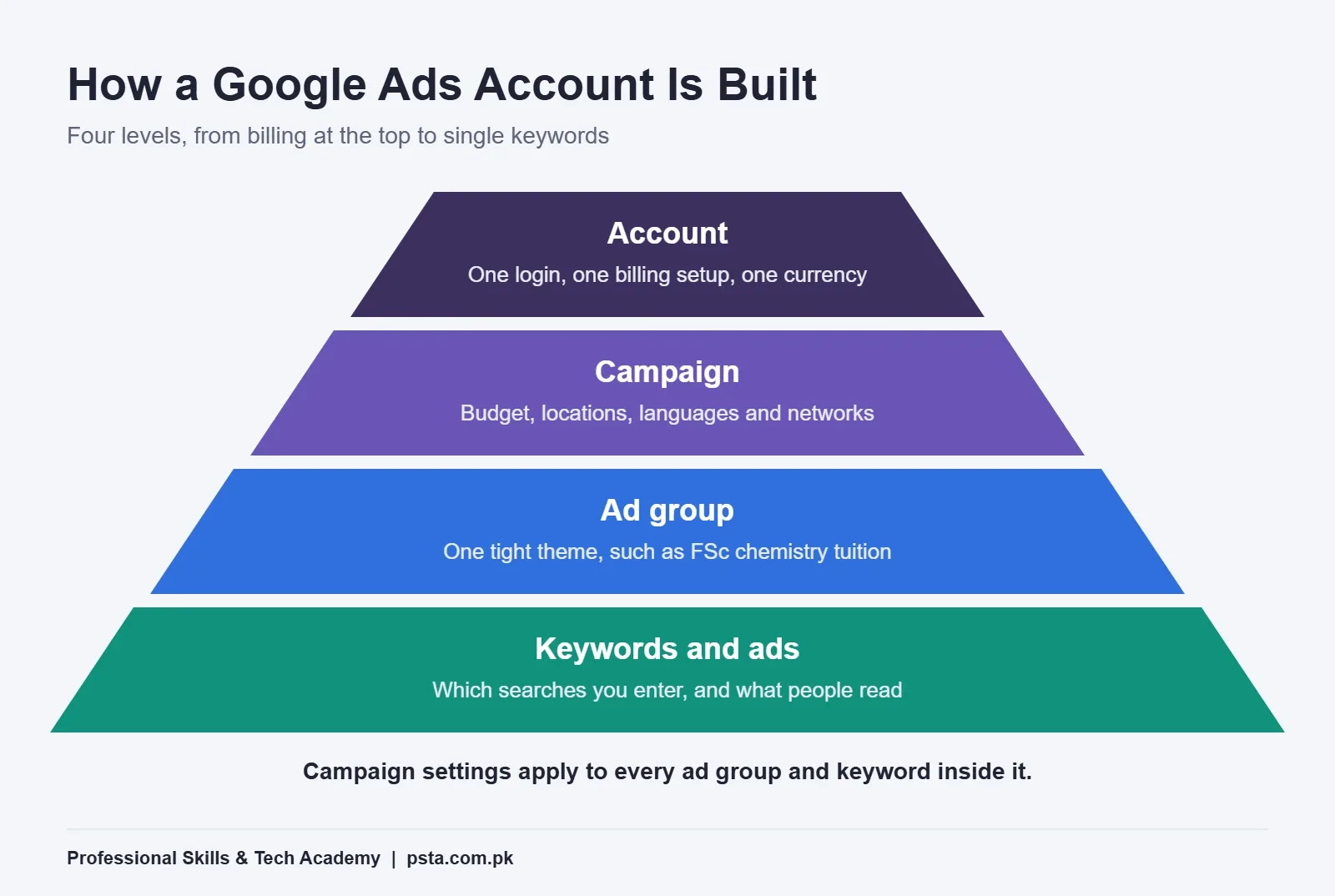
Before you touch keywords, understand the boxes they live in. Every lesson on Google Ads for beginners should start here. Google describes three layers in its help page on account organization: the account, campaigns and ad groups. Ads and keywords sit inside ad groups.
- Account: one login and one billing setup. This is where payment details and your account currency live.
- Campaign: each campaign has its own budget and settings, such as locations, languages and networks. A tuition academy might run one campaign for Abbottabad and another for online students across Pakistan.
- Ad group: a tight theme inside a campaign. "Matric physics tuition" and "FSc chemistry tuition" should be two ad groups, not one.
- Keywords and ads: the keywords decide which searches you can appear for, and the ads are what people read.
The structure matters because settings flow downward. If you put every product into one ad group, your ad text has to be generic, and generic ads tend to earn weaker quality ratings. Small, focused ad groups let you write an ad that matches the search almost word for word.
How Does the Google Ads Auction Decide Who Shows First?
Every time someone searches, Google runs a quick auction among the advertisers whose keywords match. According to Google's help page on Ad Rank, the score that sets your position is calculated for every search and recalculated for each position on the page. It uses six factors:
- Your bid, the most you're willing to pay for a click (you often pay less than this)
- The quality of your ad and landing page
- Ad Rank thresholds, the minimum an ad must reach to show at all
- How competitive the auction is, meaning how close rival scores are
- The context of the search: words used, location, device and time
- The expected impact of your assets, such as extra links, call buttons and other formats
Google's page also states that higher-quality ads can often lead to lower costs per click. In practice, this is why a well-built ad for a small laptop repair shop on Mansehra Road can win clicks at a fair price, even next to a national electronics chain.
Quality Score Explained Without the Jargon
Quality Score is a rating from 1 to 10 that Google reports for each keyword. The Quality Score help page lists three parts behind it:
- Expected clickthrough rate: how likely people are to click your ad for that keyword
- Ad relevance: how closely the ad text matches what the person searched
- Landing page experience: how useful and relevant the page is after the click
Each part is marked Above average, Average or Below average, compared with other advertisers whose ads showed for exactly the same search over the last 90 days. You'll find the score in the Keywords table once you add its columns.
Here's the detail beginners miss. Google says in plain words that the score itself is not fed into the auction. It is a diagnostic tool, like the warning lights on a car's dashboard. The real auction uses live quality signals for each search. So don't chase a "10" for its own sake. Use a "Below average" label as a pointer to the one thing you should fix: the ad text, the page, or the keyword itself.
Keyword Match Types: Broad, Phrase and Exact
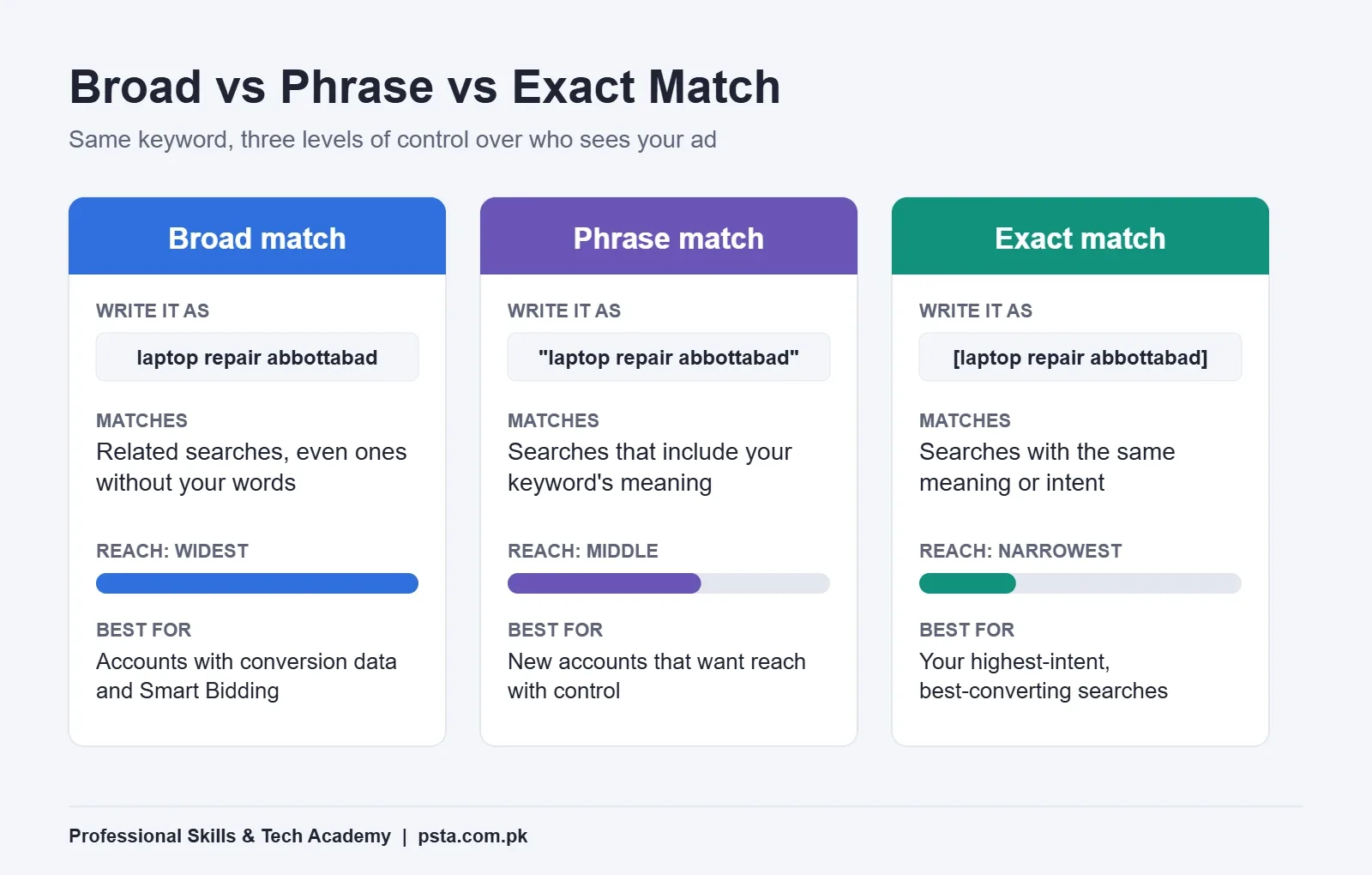
Match types control how loosely Google connects your keyword to real searches. The keyword matching help page describes three options, each written differently in your account.
| Match type | How you write it | What it can match | Reach |
|---|---|---|---|
| Broad match | laptop repair abbottabad | Searches related to the keyword, even ones that don't contain its words | Widest |
| Phrase match | "laptop repair abbottabad" | Searches that include the meaning of the keyword, sometimes more specific | Middle |
| Exact match | [laptop repair abbottabad] | Searches with the same meaning or intent as the keyword | Narrowest |
Broad match is the default, so if you type a keyword with no symbols, that's what you get. Google says Smart Bidding works best with broad match, because the wider set of searches gives it more data to learn from. That advice makes sense once your account records sales or leads. On day one, with no conversion data and a small budget, a mix of phrase and exact match keeps your spending closer to what you meant.
Negative Keywords Are Half the Job
A negative keyword stops your ad from showing for searches that contain it. A repair shop that doesn't sell parts online might add "price list" or "OLX" as negatives. A paid academy might add "free" and "PDF." During your first month, open the search terms report two or three times a week and add negatives as you spot wasted clicks.
How Do Daily Budgets and Billing Work?
Your Google Ads daily budget is set per campaign, and it's an average, not a wall. Google's page on average daily budgets explains that for most campaigns you won't pay more than two times your daily budget on any single day, and no more than 30.4 times the daily budget in a month.
A quick example with simple numbers. Say your daily budget works out to Rs. 1,000. On a busy Saturday, Google may spend up to Rs. 2,000. Across the month, the most you'd be charged is Rs. 30,400. If you can only afford Rs. 25,000 a month, set the daily budget from that monthly figure, not from what feels comfortable today.
On payments, Google's payment settings help page lists Pakistan among the countries where prepay isn't available. That means you'll normally be charged after your ads run, so your card or payment method has to be ready before you launch. The payment methods on offer depend on your country and the currency you select, so check the options shown in your own account. If you plan to use a debit or credit card, ask your bank whether it allows international online charges.
Writing Your First Responsive Search Ad
Search ads today are responsive search ads. You give Google several headlines and descriptions, and it tests combinations. The responsive search ads help page sets these limits:
- Headlines: at least 3, up to 15, each up to 30 characters
- Descriptions: at least 2, up to 4, each up to 90 characters
- Two display path fields of up to 15 characters each
Thirty characters is short. "Laptop Repair in Abbottabad" fits with three to spare. Write headlines that each say something different: the service, the area, a time promise you can actually keep, and a reason to call. If every headline repeats the same idea, Google has nothing useful to test.
Google also lets you pin a headline to a fixed position, and its help page says pinning isn't recommended for most advertisers because it can lower Ad Strength. Pin only what must appear every time, such as a legal line or your brand name.
Location Settings That Matter for Local Businesses
Google's help page on advanced location options describes two choices. "Presence or interest," the default, can reach people who are in your area or regularly there, plus people who have shown interest in it. "Presence" reaches only people likely to be physically in, or regularly in, the place you chose.
For a clinic in Abbottabad that only serves walk-in patients, interest alone isn't enough. Someone in Dubai reading about Abbottabad is unlikely to book a check-up. In that case Presence is usually the safer choice. For a hotel, tour company or online course, interest can bring the right people, so the default may be fine.
Running Google Ads in Pakistan gives you a large potential audience. According to DataReportal's Digital 2026 Pakistan report, the country had 117 million internet users in October 2025, about 45.6% of the population. Your job isn't to reach all of them. It's to reach the few hundred in your area searching for what you sell.
Google Ads for Beginners: Four Beliefs That Cost Money
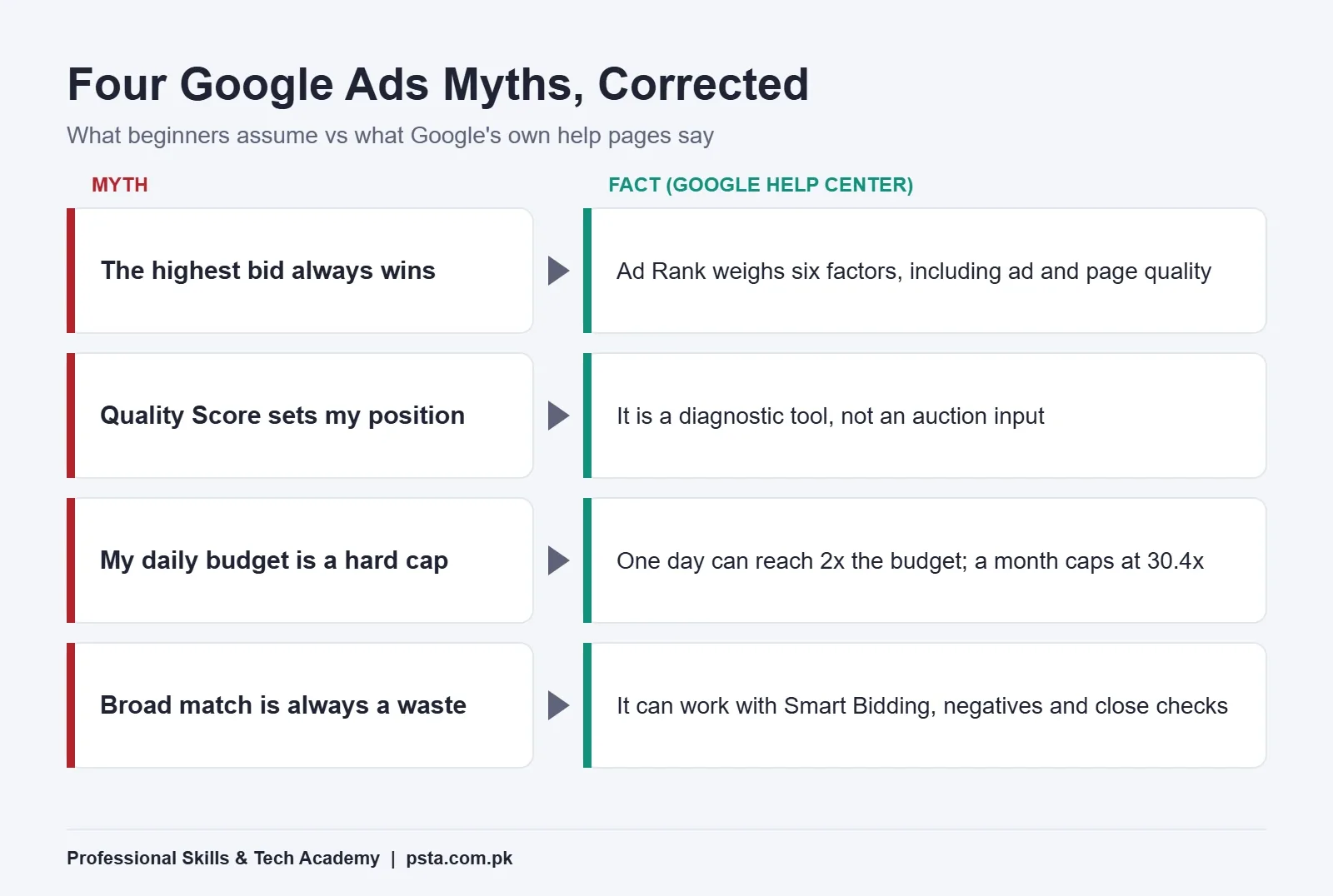
Most early losses trace back to one of four ideas. Each sounds reasonable, and each is contradicted by Google's own documentation.
- "The highest bid always wins." Ad Rank uses six factors, and quality is one of them.
- "Quality Score sets my position." It's a diagnostic, not an auction input.
- "My daily budget is a hard limit." A single day can reach twice the budget; the month is capped at 30.4 times.
- "Broad match is always a waste." It can work well with Smart Bidding and conversion data, but it needs negatives and close watching.
A Glossary of 12 Terms for Your First Week
Most guides on Google Ads for beginners skip the vocabulary, yet the interface is full of short labels. These are the ones you'll meet first, explained in one line each.
| Term | What it means for you |
|---|---|
| Impression | Your ad was shown once on a results page. |
| Click | Someone tapped your ad and visited your page or called. |
| CTR | Clickthrough rate: clicks divided by impressions. |
| CPC | Cost per click: what you paid for one click. |
| Max CPC bid | The most you're willing to pay for a click. |
| Conversion | An action you count as a result, such as a form, call or sale. |
| Conversion rate | Conversions divided by clicks. |
| Ad Rank | The score that decides whether and where your ad shows. |
| Quality Score | A 1 to 10 diagnostic rating for each keyword. |
| Search terms report | The real searches that triggered your ads. |
| Negative keyword | A word that blocks your ad from certain searches. |
| Smart Bidding | Automatic bidding that aims at conversions or conversion value. |
If you learn only three, pick CTR, conversion rate and search terms report. Together they tell you whether people want your ad, whether your page turns visits into leads, and whether you're paying for the right searches.
Is Google Ads Certification Worth It for Beginners?
Google offers free Google Ads certifications through its Skillshop platform. According to Loves Data's guide to the certification, the Search exam has 50 questions, a time limit of 75 minutes, a pass mark of 80% and validity of one year. Check Skillshop itself before you book, because Google updates exam details.
Is it worth your time? For a fresh graduate applying to agencies in Lahore, Karachi or Islamabad, it's a cheap signal that you know the vocabulary. It won't replace practical proof, though. A short case study showing a campaign you set up, the searches it caught and what you changed carries more weight with an employer or a Fiverr buyer than the badge alone. Pair the certificate with a small portfolio, like the approach in our digital marketing portfolio roadmap.
Practicing Google Ads in PSTA's Digital Marketing Course
Reading about Google Ads for beginners only gets you so far. You learn match types the first time you open a search terms report and see what your broad keyword actually caught. That's why we teach it hands-on.
The Advanced Digital Marketing course lasts 12 weeks. Its syllabus covers Google Search ads with Quality Score, match types, ad copy and A/B tests, then moves on to Display ads, remarketing and Google Analytics basics. The fee is currently Rs. 30,000 against a regular Rs. 35,000, you can split it into 2 installments, and a new batch starts every month. Classes run in three modes: in person near FIMS College in Mandian, live online for students elsewhere in Pakistan, or a hybrid of both.
Before you run ads, it helps to know how people search, so our keyword research guide is a good companion read. If your business gets most enquiries through Facebook and Instagram, compare this with our Meta Ads and social media course. Need a landing page first? The WordPress course covers building one. Browse other options on all PSTA courses, then apply online from the admission page once a batch suits your schedule. Ask about morning, evening or weekend slots by WhatsApp on +92 314 5424399.
Before You Spend a Rupee, Plan One Ad Group on Paper
Pick one service you sell. On a sheet of paper, write one campaign name, one ad group, five phrase or exact keywords, five negatives, eight headlines under 30 characters and two descriptions under 90. Then write the monthly amount you can afford and divide it by 30.4 to get your daily budget.
If you can fill that page without guessing, you're ready to build the same plan inside a real account. If you get stuck on a line, that's the exact topic to study next.
Frequently asked questions
Is Google Ads good for small businesses in Pakistan?
It can be, especially for services people search for when they are ready to buy, such as repairs, tuition, clinics and home services. Start with one campaign, a small daily budget and tightly themed ad groups. Track calls or form fills from day one so you can judge results by enquiries, not just clicks.
How much money do I need to start Google Ads?
Work backwards from your limit. Decide the most you can afford per month, then divide it by 30.4 to get your average daily budget. Google may spend up to twice that on a busy day, but your monthly charge stays within 30.4 times the daily budget for most campaigns.
Can I pay for Google Ads in advance from Pakistan?
According to Google's payment settings help page, prepay is not available in Pakistan. Advertisers there are normally charged after their ads run, so your payment method must be added and working before launch. Ask your bank whether your card allows international online charges.
What is a good Quality Score in Google Ads?
Quality Score runs from 1 to 10 for each keyword. Rather than chasing a perfect number, look at its three parts: expected clickthrough rate, ad relevance and landing page experience. A Below average label tells you which part to fix. Google notes the score is a diagnostic tool, not an auction input.
Which keyword match type should a beginner use?
Many beginners start with phrase and exact match because they keep spending closer to the intended searches. Broad match reaches the most searches and works best with Smart Bidding once your account records conversions. Whichever you use, check the search terms report often and add negative keywords.
Is the Google Ads certification free?
Yes. Google offers its Google Ads certifications free through Skillshop. A guide from Loves Data says the Search exam has 50 questions, a 75-minute limit and an 80% pass mark, and stays valid for one year. Confirm current details on Skillshop before you sit the exam.
Should I learn Google Ads or Meta Ads first?
Learn the platform your target customers use when they are ready to act. People searching for a service on Google already have intent, while Meta Ads create demand in feeds. Plenty of local businesses use both. A digital marketing course that covers Search ads and Meta Ads lets you compare them on real campaigns.
Sources & references
- About Ad Rank (Google Ads Help) support.google.com
- About Quality Score for Search campaigns (Google Ads Help) support.google.com
- About keyword matching options (Google Ads Help) support.google.com
- About average daily budgets (Google Ads Help) support.google.com
- About responsive search ads (Google Ads Help) support.google.com
- About payment settings (Google Ads Help) support.google.com
- Digital 2026: Pakistan (DataReportal) datareportal.com
- Google Ads Certification Guide (Loves Data) lovesdata.com
Last reviewed & updated on by Umar Qureshi. Written by the PSTA team in Abbottabad, Pakistan.

Umar Qureshi

Advanced Digital Marketing Course in Pakistan and Abbottabad
Turn this guide into a career: hands-on training with real projects, online across Pakistan or on-campus in Abbottabad · 12 Weeks.
Comments
No comments yet — ask a question or share your experience.