Quick answer
Follow this order: HTML and CSS in months one and two, JavaScript and the DOM in month three, APIs and Git in month four, React in month five, then TypeScript, testing and deployment in month six. Build one project per stage and move on only after you pass its self-test.
Key takeaways
- • Learn in order: HTML and CSS, JavaScript, APIs and Git, React, then TypeScript.
- • Give each stage one project and a clear "done when" test before moving on.
- • React was used by 44.7% of respondents in the Stack Overflow 2025 survey, so it's a sensible first framework.
- • Three live, well-explained projects make a stronger portfolio than ten tutorial clones.
- • Read 10 real job ads in your city to see which skills employers repeat.
Table of contents 13 sections
- What Does a Frontend Developer Actually Do?
- Why Is JavaScript Still the Safest First Bet?
- The Frontend Developer Roadmap at a Glance
- Months 1–2: HTML, CSS and Layouts That Work on Phones
- What to Practice
- Month 3: JavaScript Fundamentals and the DOM
- Month 4: APIs, Async Code and Working in Git
- Month 5: React, Built on What You Already Know
- Month 6: TypeScript, Testing and Going Live
- How Should You Build a Portfolio That Gets Replies?
- Where Do Frontend Developer Jobs Come From in Pakistan?
- Learning This Roadmap With PSTA
- One Thing to Do This Week
Try this quick self-test before you read on. Can you build a page that looks right on a phone without a CSS framework? Can you fetch data from an API and show it in a list? Have you pushed a project to GitHub that someone else could run? If you said no to all three, this frontend developer roadmap starts at month one. If you said yes to two, skip ahead to the React stage.
I teach JavaScript to beginners in Abbottabad, and the students who get stuck are rarely short of talent. They are short of order. They jump into React in week two, copy tutorials they can't explain, and stop when the first error appears. The plan below fixes the order. It assumes about two hours of practice a day, six days a week. With less time, stretch each stage; don't skip one.
In this roadmap, you'll see:
- What a frontend developer does on a normal workday
- Why JavaScript and React are still sensible first choices, with survey numbers
- A month-by-month plan with one project and one "done when" test per stage
- How to set up a portfolio that a hiring manager in Lahore or a client abroad can check in two minutes
- Where PSTA's JavaScript and React courses fit, if you prefer a guided route
What Does a Frontend Developer Actually Do?
A frontend developer builds the part of a website or web app that people see and touch. That means turning a design into HTML and CSS, adding behavior with JavaScript, and connecting screens to data that comes from a server. In a Pakistani software house, a typical ticket might read "Add a filter to the orders page" or "Fix the checkout form on small Android phones."
The job sits between two other people. A designer hands you screens, often in Figma. A backend developer hands you an API. Your work is to make the two meet without bugs, slow pages or broken layouts. Good frontend developers also care about accessibility, so that a person using a screen reader or a keyboard can still complete the form.
This is different from building WordPress sites, which is a valid career of its own. If you're still choosing, our breakdown of what a WordPress website costs in Pakistan shows what that work looks like from the client's side.
Why Is JavaScript Still the Safest First Bet?
JavaScript runs in every browser, so every frontend job uses it. In the Stack Overflow 2025 Developer Survey, 66% of respondents said they used JavaScript and 61.9% used HTML/CSS. Among web frameworks, React was used by 44.7% of respondents, well ahead of Angular at 18.2% and Vue.js at 17.6%.
TypeScript is the other number worth knowing. GitHub's Octoverse report says TypeScript passed both Python and JavaScript in August 2025 to become the most used language on the platform by monthly contributors. TypeScript is JavaScript with types added, so learning JavaScript first is not wasted time. It's the foundation.
The local picture is also encouraging. Pakistan's IT exports reached a record $4.6 billion in FY26, up 20.7% from the year before, according to State Bank data reported by Nukta. Much of that work is web and app development for foreign clients. Export growth doesn't guarantee you a job, but it does mean the companies hiring frontend developers are not disappearing.
The Frontend Developer Roadmap at a Glance
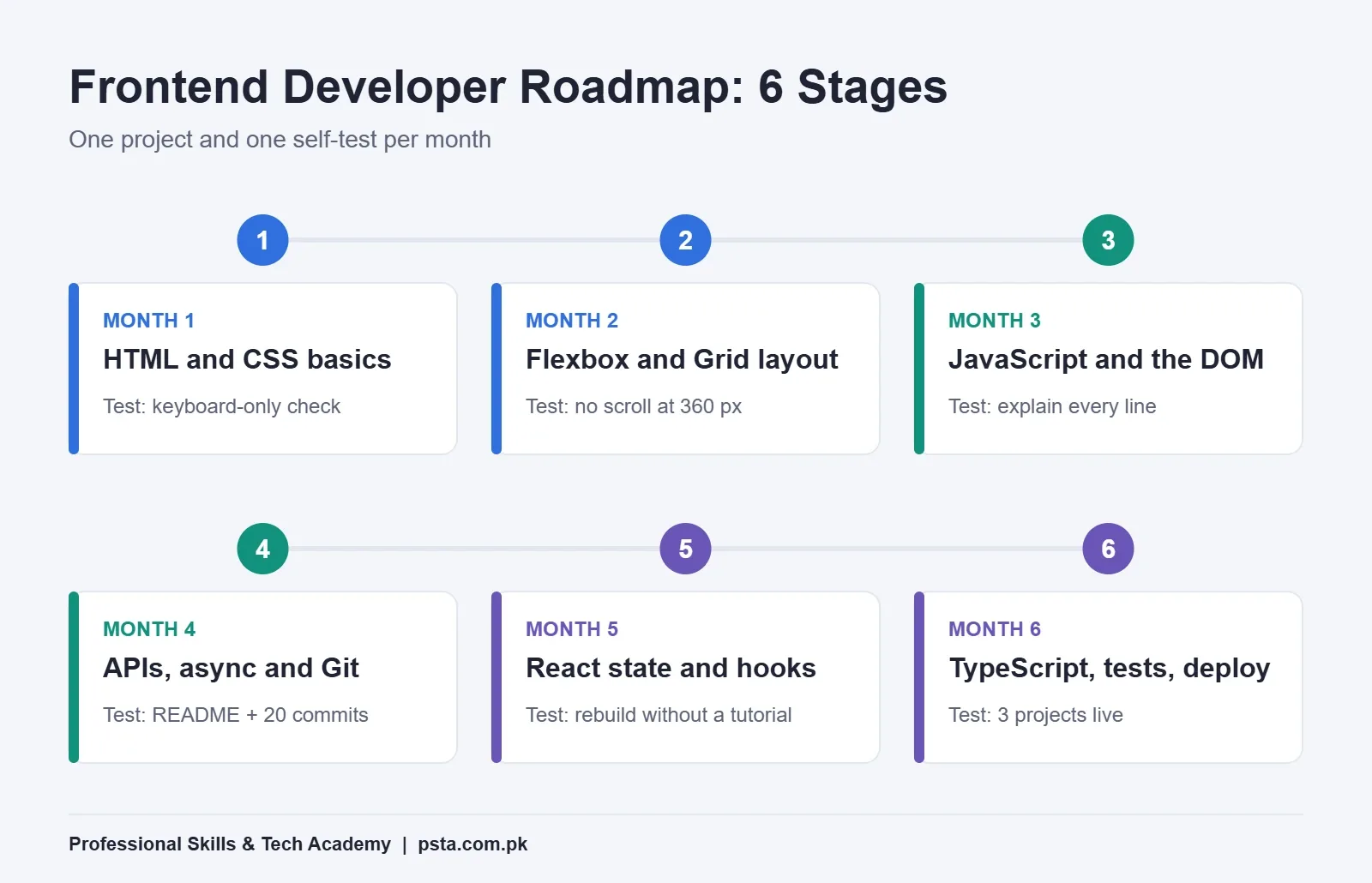
Here is the whole plan in one table. Each stage ends with a test you can check yourself. Don't move on until you pass it, even if that takes an extra two weeks.
| Stage | Focus | Project to Build | Done When |
|---|---|---|---|
| Month 1 | Semantic HTML and CSS basics | A one-page profile for a local business | The page passes a keyboard-only test |
| Month 2 | CSS layout with Flexbox and Grid | A three-page responsive site | No sideways scrolling at 360 px width |
| Month 3 | JavaScript fundamentals and the DOM | A fee calculator or quiz app | You can explain every line to a friend |
| Month 4 | Async JavaScript, APIs, Git and GitHub | A weather or prayer-times app using a public API | The repo has a README and 20+ commits |
| Month 5 | React components, state and hooks | A product catalog with search and a cart | You rebuild one component without a tutorial |
| Month 6 | TypeScript basics, testing and deployment | Your portfolio site, live on a real URL | Three projects are live and linked |
Months 1–2: HTML, CSS and Layouts That Work on Phones
Many of the people who visit your sites will be on phones, so start every layout at phone width and widen it later. That habit is the heart of responsive design. Mozilla's free MDN Curriculum lists semantic HTML, CSS fundamentals, text styling, CSS layout and accessibility among its core modules. Use it as your checklist for these two months.
What to Practice
- Write HTML that uses the right tags:
header,nav,main,buttonandlabel, not a page full ofdivelements. - Learn the box model until margin and padding stop surprising you.
- Build the same layout twice, once with Flexbox and once with Grid.
- Add a
@mediabreakpoint only when the layout breaks, not at random widths. - Test each page with the Tab key alone. If you can't reach the button, fix it.
A good month-two project is a three-page site for a real shop near you, such as a bakery or tuition center. You don't need their permission to practice, but don't publish their name or photos without asking.
Month 3: JavaScript Fundamentals and the DOM
Many beginners hurry through this stage, and it's the one that decides whether React later feels easy or confusing. Learn variables, conditions, loops, functions, arrays and objects. Then learn how JavaScript finds elements on the page, changes them and reacts to clicks and form input.
Build something small and complete. A fee calculator works well: the user picks a course, enters a discount code and sees the total update instantly. It forces you to read input, validate it, do arithmetic and update the page. When it works, delete the code and write it again from memory. The second version is often shorter and cleaner.
Month 4: APIs, Async Code and Working in Git
Real apps load data from somewhere. Learn fetch, promises and async/await, then build an app that calls a free public API and handles three states: loading, success and error. Most beginner projects forget the error state, and reviewers notice.
This is also the month to treat Git as a daily habit. The MDN Curriculum includes version control with GitHub as a core module, not an extra. Commit small changes with clear messages, such as "Add error message when API fails," rather than one giant "final" commit. A history of 20 or more meaningful commits shows an employer how you think.
Month 5: React, Built on What You Already Know
React's latest release at the time of writing is version 19.3, listed on the official React versions page with a September 2026 date. The React team now recommends starting real apps with a framework such as Next.js or React Router. For learning, though, the same page notes that building from scratch with a tool like Vite is a reasonable way to understand the basics.
A practical setup for this month:
- Install a Node.js LTS release. The Node.js releases page currently lists v24 and v22 as LTS lines.
- Create a project with
npm create vite@latestand pick the React template. The Vite guide lists Node.js 20.19+ or 22.12+ as the minimum. - Learn components and props, then state with
useState, then effects withuseEffect. - Rebuild your month-four API app in React. Comparing the two versions teaches more than any new tutorial.
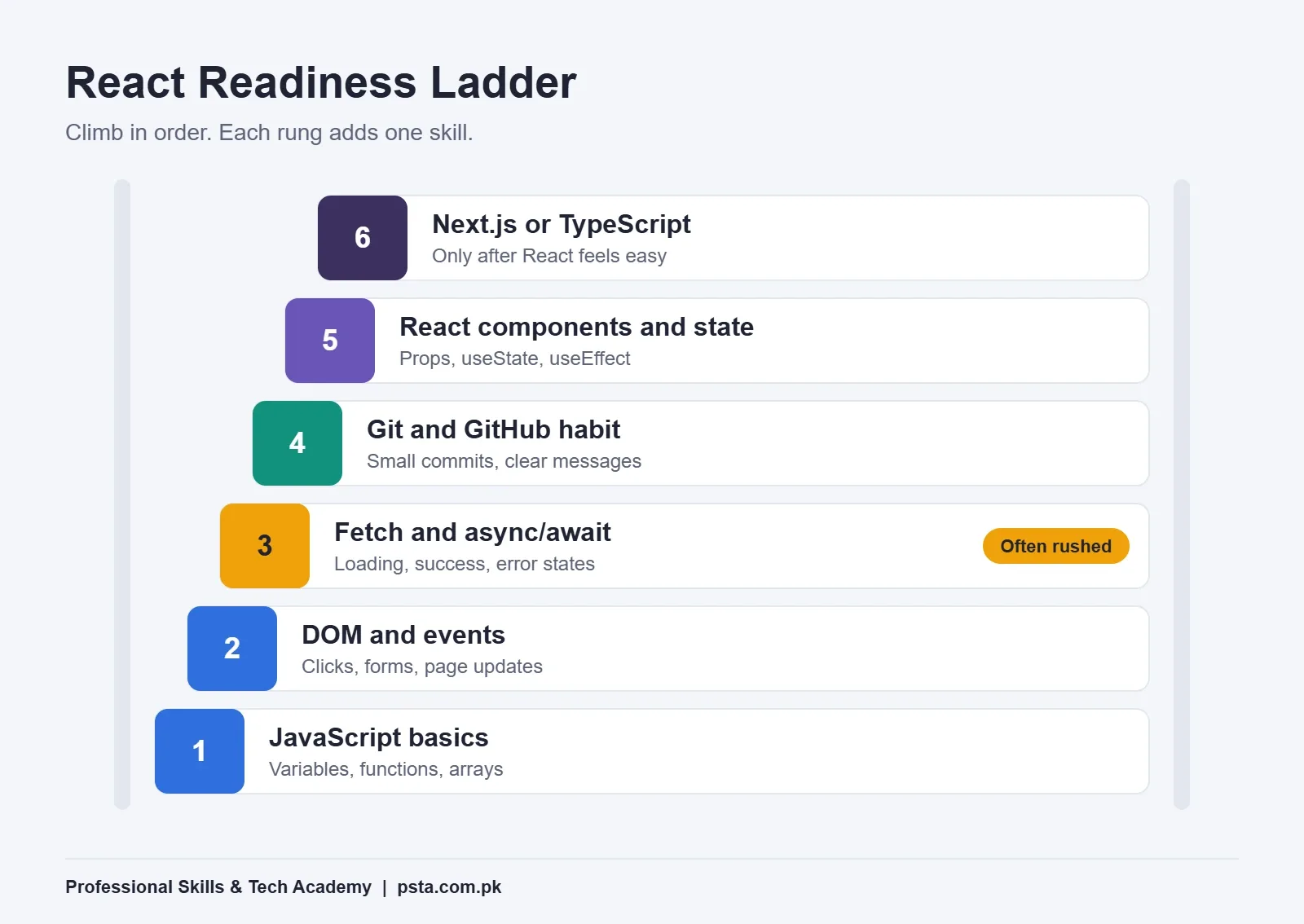
The best time to learn React is right after your API project, not before it. Move to Next.js only after plain React feels comfortable. Next.js adds routing, server rendering and its own rules, and it's much easier to learn when components and state are already second nature.
Month 6: TypeScript, Testing and Going Live
This is the last stage of the frontend developer roadmap. Spend it on the skills that separate a hobby project from work someone would pay for. Convert one React project to TypeScript and fix the errors it shows you. Write a few simple tests for your most important function, such as the cart total. Then deploy every project to a free hosting service so each one has a public link.
Finish with your portfolio site. Keep it plain: your name, one line about what you build, three projects with live links and code links, and a way to contact you. A fast, readable portfolio beats an animated one that takes eight seconds to load on mobile data.
How Should You Build a Portfolio That Gets Replies?
Hiring managers and clients spend very little time on each web developer portfolio, so make the important things obvious. Each project should explain the problem in one sentence, list the tools you used and show a screenshot. If a project uses an API key, keep the key out of your public repo.
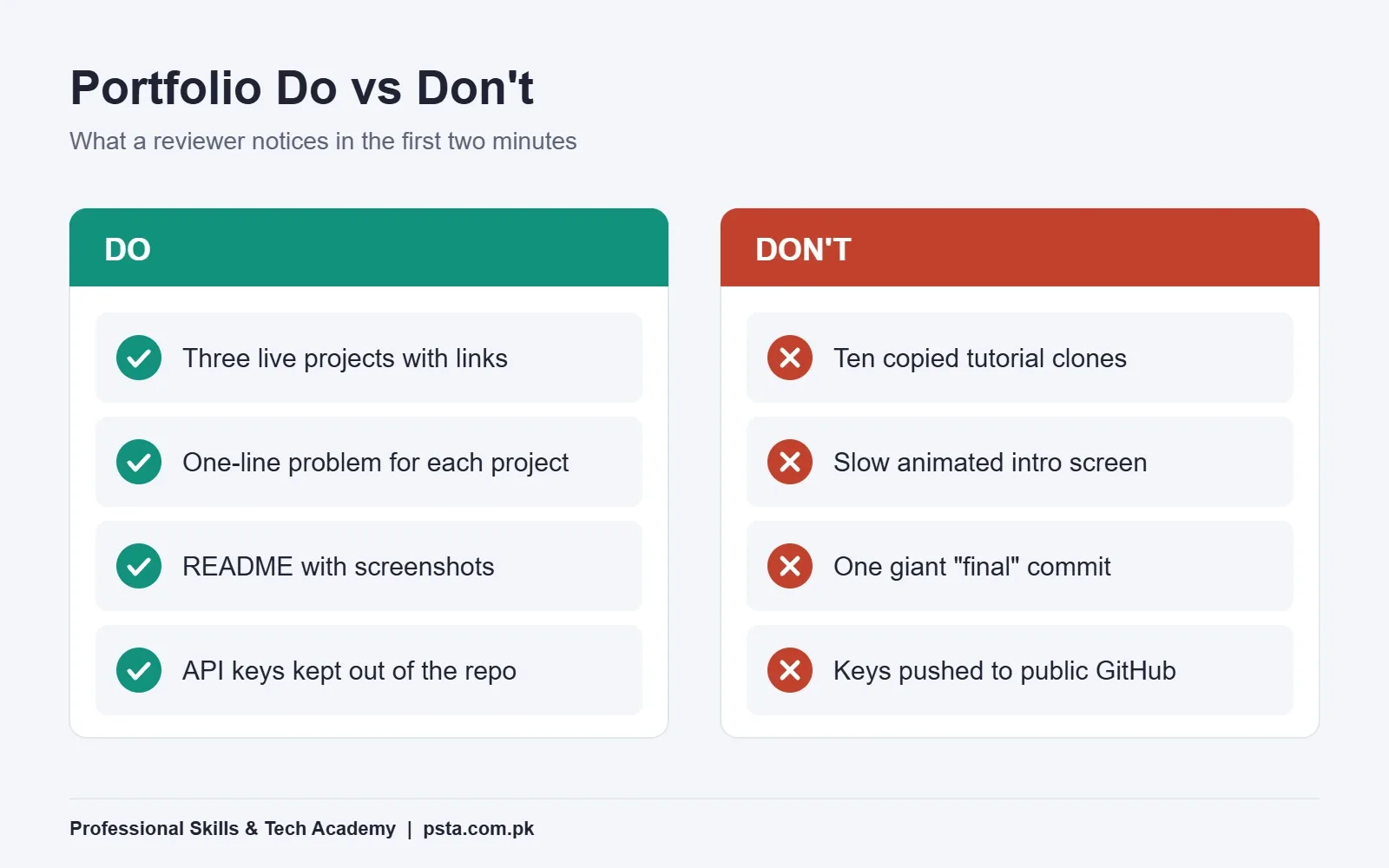
Three solid projects are enough. Good choices for a Pakistani audience include a school timetable viewer, a shop catalog with WhatsApp ordering, and a dashboard that reads data from a public API. They show real use cases that local employers and clients recognize.
Where Do Frontend Developer Jobs Come From in Pakistan?
There are three common routes, and many developers move between them:
- Software houses: Large cities such as Lahore, Karachi and Islamabad host many of them, and some also hire remotely. Expect a short technical test, often a small React task.
- Remote roles with foreign companies: These usually ask for stronger English, TypeScript and a GitHub history you can talk through.
- Freelancing: Small businesses abroad and at home need landing pages, dashboards and fixes. Your portfolio does most of the selling here.
Salaries vary widely by city, company and English level, so treat any single number you see online with caution. Read 10 real job ads in your target city and list the skills they repeat. That list is more useful than any average.
If you'd rather work on the server side later, the same JavaScript you learn here carries over to Node.js. Python is another route; our list of Python projects for beginners shows what that path looks like.
Learning This Roadmap With PSTA
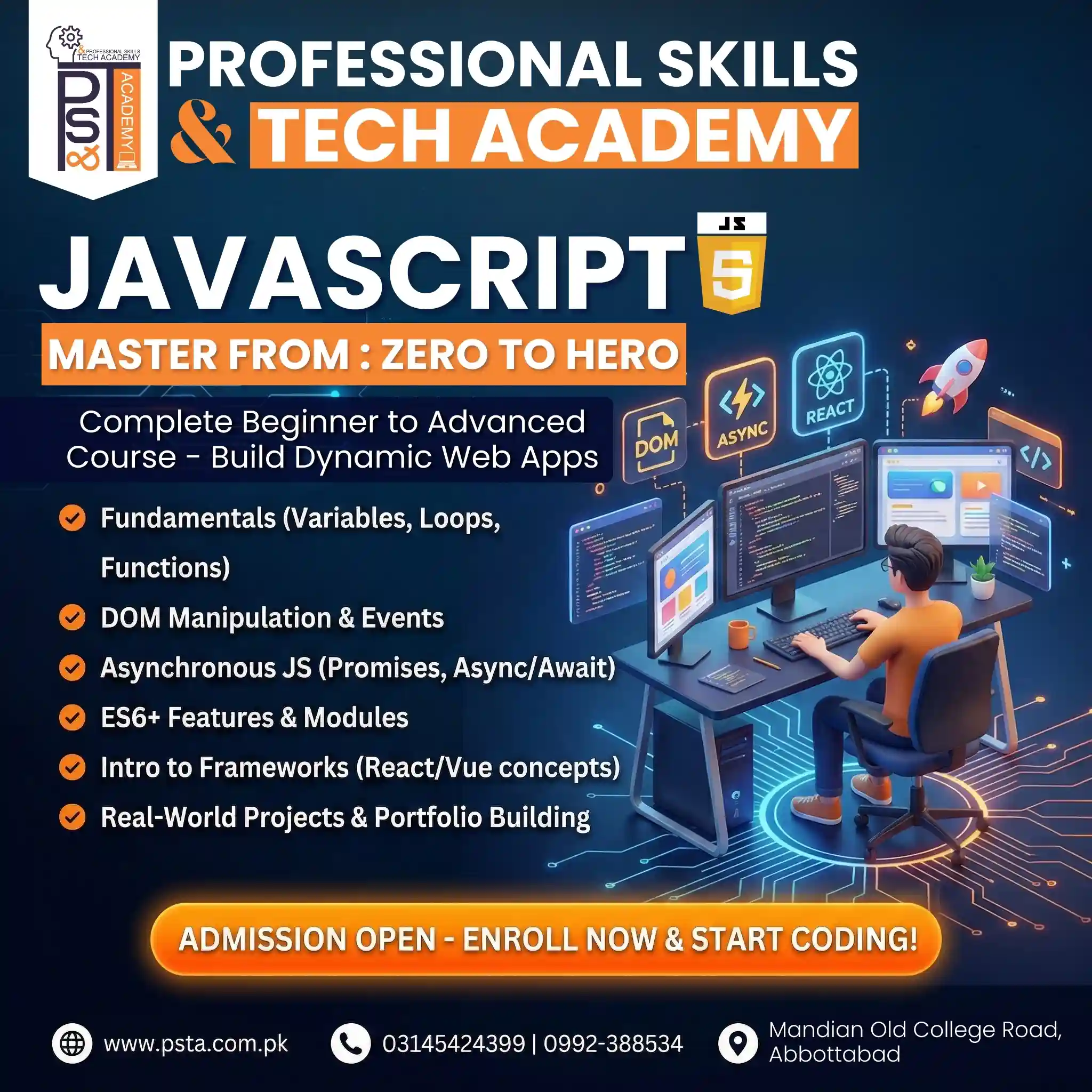
PSTA's JavaScript Programming Course: Beginner to React covers months three to five of this plan in a guided format. It's a sensible JavaScript course to start with if you prefer a teacher to self-study. It runs for 12 weeks at beginner level. You can attend in person at the Abbottabad campus, join live classes online from anywhere in Pakistan, or mix the two. The modules move from variables and functions to DOM work, events, promises, the Fetch API, ES6+ features, and React components, props, state, hooks and routing. The final weeks focus on portfolio projects and deploying them on GitHub.
At the time of writing, the course page lists the fee as Rs. 24,000 (down from Rs. 28,000), with a new batch every month. Fees can change, so confirm on the course page before you apply.
If you already know JavaScript, the Advanced React.js course goes deeper into larger React apps. If you want both frontend and backend, see the Full-Stack Web Development course. You can compare everything on the courses page and apply through online admission.
One Thing to Do This Week
Open a blank HTML file and build the top section of a shop's homepage: a logo, a three-link menu and a heading. Make it work at 360 px width with no sideways scroll. Then press Tab and check that you can reach every link. That one exercise tells you whether to start this frontend developer roadmap at month one or month two. Not sure which batch suits you? Our team answers questions on WhatsApp (+92 314 5424399) during office hours.
Frequently asked questions
How long does it take to become a frontend developer in Pakistan?
With about two hours of practice a day, six days a week, many beginners can work through the six stages in around six months. Treat that as a guide, not a deadline. If a stage's self-test fails, spend another week or two on it. Skipping ahead usually costs more time later, especially once you reach React.
Do I need a computer science degree to become a frontend developer?
You don't need a degree to learn the skills, and many employers judge frontend candidates mainly by their portfolio and a short technical test. Some companies, especially larger ones and public-sector organizations, still list a degree in their ads. Check the requirements in the specific job ads you plan to apply for.
Should I learn React or Angular first?
For most beginners, React is the safer first framework. In the Stack Overflow 2025 Developer Survey, 44.7% of respondents used React, compared with 18.2% for Angular. Once you understand components and state in one framework, picking up another becomes much easier, so your first choice is not permanent.
Is TypeScript necessary for a frontend job?
Not on day one, but more employers expect it each year. GitHub's Octoverse report says TypeScript became the most used language on GitHub by monthly contributors in August 2025. Learn plain JavaScript first, then convert one of your React projects to TypeScript so you have something to show.
What laptop do I need to learn frontend development?
Any laptop that runs a modern browser, a code editor such as VS Code and a current Node.js LTS release will do. You don't need a gaming machine. More RAM makes running a browser, editor and development server together smoother, but you can start on modest hardware and upgrade later.
Can I start freelancing after learning only HTML and CSS?
You can take small jobs such as fixing layouts or building simple landing pages, but your options widen once you add JavaScript. Much paid frontend work involves forms, data from an API or interactive features. Use small HTML and CSS jobs for practice and reviews, and keep following the roadmap.
Does PSTA's JavaScript course include React?
Yes. PSTA's JavaScript Programming Course: Beginner to React runs for 12 weeks and ends with React components, props, state, hooks, routing and API integration, followed by portfolio projects deployed on GitHub. You can attend at the Abbottabad campus, join live online classes, or combine both.
Sources & references
- Stack Overflow 2025 Developer Survey: Technology survey.stackoverflow.co
- GitHub Octoverse: TypeScript Becomes the Top Language github.blog
- MDN Curriculum for Front-End Developers developer.mozilla.org
- React Versions react.dev
- React Docs: Creating a React App react.dev
- Vite: Getting Started vite.dev
- Node.js Releases nodejs.org
- Nukta: Pakistan's Record IT Exports in FY26 nukta.com
Last reviewed & updated on by Umar Qureshi. Written by the PSTA team in Abbottabad, Pakistan.

Umar Qureshi
JavaScript Programming Course in Abbottabad: Beginner to React
Turn this guide into a career: hands-on training with real projects, online across Pakistan or on-campus in Abbottabad · 12 Weeks.


Comments
No comments yet — ask a question or share your experience.