Quick answer
Recent Pakistani government ads ask for 30 WPM for Lower Division Clerk posts and 40 WPM for Data Entry Operator and Stenotypist posts, with stenotypists also needing 80 WPM shorthand. Tests count five characters as one word and subtract uncorrected errors, so accuracy matters as much as raw speed.
Key takeaways
- • LDC ads reviewed ask for 30 WPM; Data Entry Operator and Stenotypist ads ask for 40 WPM.
- • Stenotypist posts add a separate 80 WPM shorthand test.
- • One typing word equals five characters, including spaces and punctuation.
- • Net WPM is gross WPM minus uncorrected errors per minute, so mistakes cost real marks.
- • A steady four-week plan of 20 to 30 minutes a day builds speed without bad habits.
- • Prepare Urdu typing separately if the ad asks for it, and confirm which layout the test uses.
Table of contents 16 sections
- What Typing Speed Do Pakistani Job Ads Actually Ask For?
- How Is Typing Speed for Jobs Measured?
- A "Word" Is Five Characters
- Gross WPM vs Net WPM
- Accuracy
- Which Speed Band Fits Which Post?
- Step 1: Measure Where You Stand
- Step 2: Fix Your Posture and Home Row
- Step 3: Build Speed With a Four-Week Plan
- Step 4: Add Urdu Typing If the Post Needs It
- Step 5: Practice Under Real Test Conditions
- Typing Test Myths That Cost You Marks
- Where Should You Look for Typing-Based Jobs?
- Learn English and Urdu Typing With PSTA
- Which Other Skills Do These Posts Expect?
- Your Action for Today: Record Your Starting Speed
A common belief among job seekers is that you need 60 or 70 words per minute before you can apply anywhere. That's a myth. The typing speed for jobs advertised by Pakistani government offices in 2026 is usually 30 to 40 words per minute (WPM), and the test counts your errors, so a steady, accurate 40 beats a sloppy 55.
This guide is built from the actual wording of recent job ads, not guesses about typing speed for jobs. By the end, you will know:
- What WPM figures real ads list for LDC, Data Entry Operator and Stenotypist posts
- How a typing test turns your keystrokes into a gross and a net score
- Which speed band fits which kind of post
- A four-week practice plan, including Urdu typing
- The test-day habits that protect your marks
What Typing Speed Do Pakistani Job Ads Actually Ask For?
Advertisements state the requirement in a fixed format, so it pays to read them closely. Here is what four recent ads for typing-based posts say.
| Post | Office and Scale | Qualification | Typing Requirement |
|---|---|---|---|
| Lower Division Clerk (LDC) | Directorate of Internal Audit (Customs), Lahore, BS-7 | Matriculation | 30 WPM |
| Data Entry Operator | Border Health Services Pakistan, PPS-5 (May 2026) | Bachelor's in CS/IT plus one year of experience | 40 WPM |
| Stenotypist | Federal Criminal Prosecution Service, BPS-14 (February 2026) | Intermediate, computer literate | 40 WPM typing and 80 WPM shorthand |
| Stenotypist | Directorate of Internal Audit (Customs), Lahore, BS-14 | Intermediate | 40 WPM typing and 80 WPM shorthand |
You can read the originals yourself: the customs audit advertisement on the FBR site, the Border Health Services listing on the National Job Portal and the Federal Criminal Prosecution Service stenotypist listing.
Two patterns stand out in the typing speed for jobs listed above. First, 30 WPM is the entry point for clerical posts, and 40 WPM is the common bar for data entry and stenography. Second, stenotypist ads write the rule as "80/40", which means shorthand and typing are two separate tests. Passing one doesn't cover the other.
Requirements change from ad to ad. Treat the table as a guide to what departments usually ask, then check the exact advertisement before you apply.
How Is Typing Speed for Jobs Measured?
Most candidates lose marks because they don't understand the scoring, not because their fingers are slow. Three terms matter.
A "Word" Is Five Characters
Typing tests don't count real words. The standard definition of words per minute treats every five characters, including spaces and punctuation, as one word. So "Islamabad " (nine letters plus a space) counts as two words. Long official terms don't slow your score down unfairly, and short words don't inflate it.
Gross WPM vs Net WPM
Gross WPM is your raw speed with no penalty. Net WPM is what most tests care about. According to SpeedTypingOnline's typing equations, you get net WPM by taking gross WPM and subtracting the errors you left uncorrected per minute.
Here's a quick example. You type 250 characters in a one-minute test and leave six mistakes.
- Gross WPM = 250 ÷ 5 = 50
- Errors per minute = 6
- Net WPM = 50 − 6 = 44
Leave 12 mistakes in the same test, and your net score drops to 38. That's below the bar for a 40 WPM post, even though your fingers moved at 50.
Accuracy
Accuracy is the share of correct characters out of everything you typed. None of the ads above publish a minimum accuracy figure, so ask the recruiting office or read the test instructions on the day. Either way, every uncorrected error costs you a full word per minute.
Which Speed Band Fits Which Post?
Think of your typing speed for jobs as a ladder. Each rung opens a different group of advertisements.
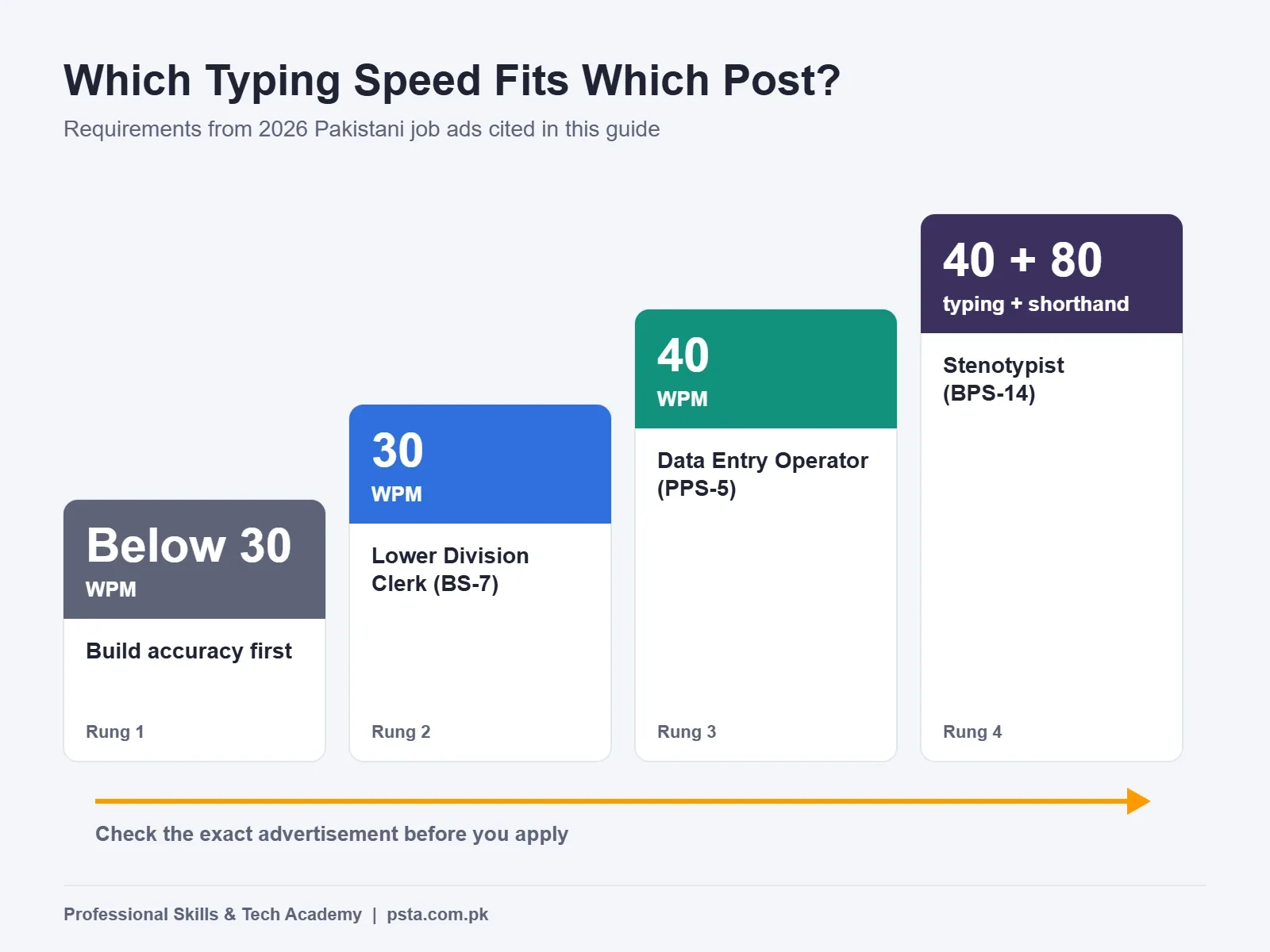
For context, a well-known 1999 study cited in the same Wikipedia article found that average computer users transcribed text at 32.5 WPM. So the 30 WPM clerk requirement sits near ordinary office speed, while 40 WPM asks for a bit more than average. Professional typists usually work between 43 and 80 WPM, which shows how much room there is to grow after you qualify.
If you already sit around 25 WPM with frequent errors, aim for a clean 30 first. Then push toward 40. Chasing 40 before your accuracy settles usually slows progress.
Step 1: Measure Where You Stand
Before practicing, find out your real starting point. Use any free online typing test and run it three times on three different passages. Write down gross WPM, net WPM and accuracy for each attempt, then take the middle result as your baseline.
Use a desktop or laptop keyboard for this. Phone typing is a different skill. A 2019 study cited on Wikipedia put average mobile typing speed at 36.2 WPM, but that number tells you nothing about how you'll perform on the keyboard in an exam hall.
Step 2: Fix Your Posture and Home Row
Speed comes from not looking at the keys. In touch typing, your left fingers rest on A, S, D and F and your right fingers on J, K, L and the semicolon. The small raised bumps on F and J let you find that position without looking down.
Set up your chair so your elbows bend at roughly a right angle and your wrists float just above the keyboard. Keep the screen at eye level. These details sound minor, but a cramped wrist in minute three of a test is where most errors begin.
If you've typed with two fingers for years, expect your speed to fall for a week or two after switching. That dip is normal. It recovers as the new finger paths become automatic.
Step 3: Build Speed With a Four-Week Plan
Short daily practice works better than one long weekend session. It is also the most reliable way to raise your typing speed for jobs without picking up bad habits. Give it 20 to 30 minutes a day, six days a week, and follow one focus per week.
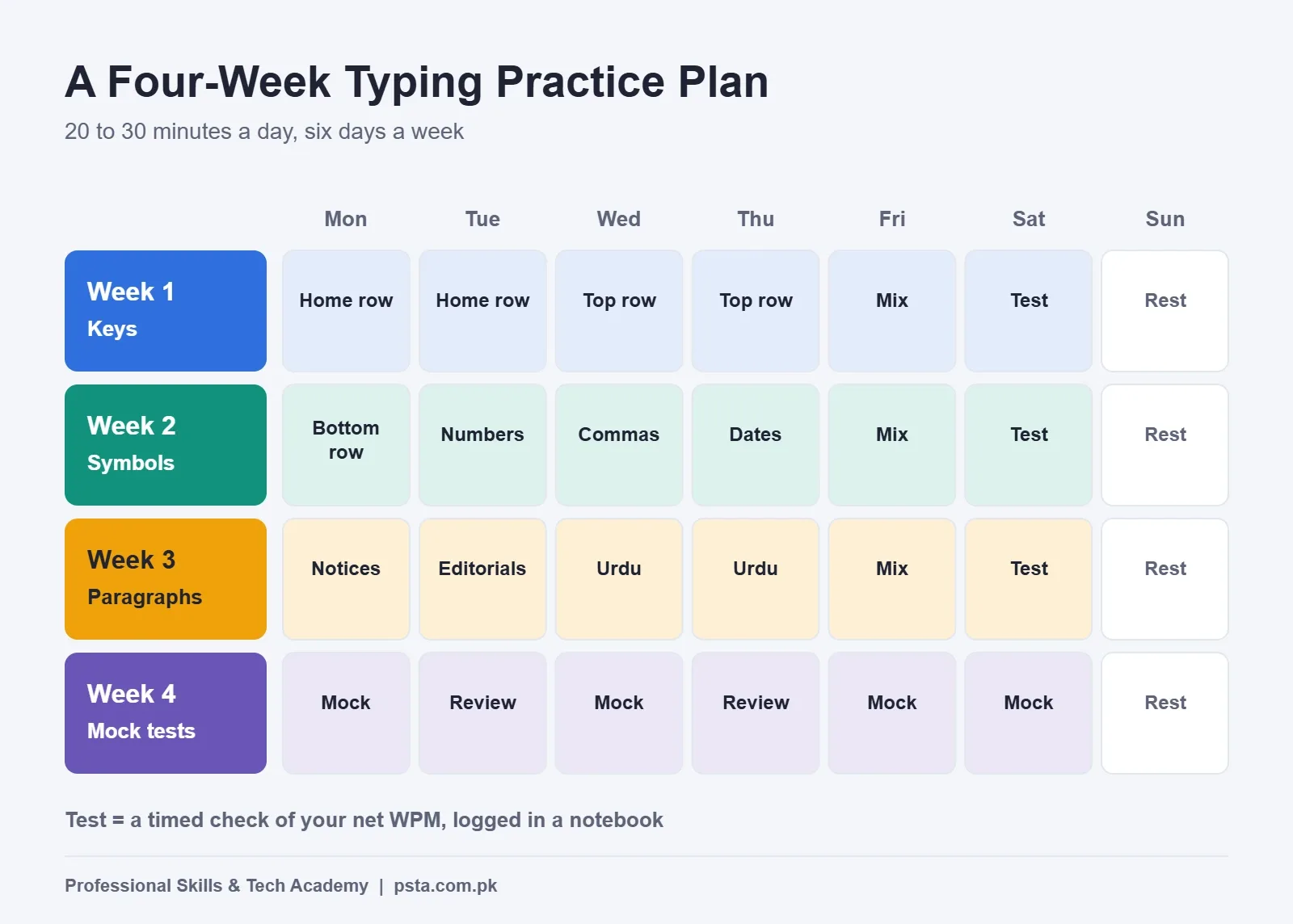
Here's how each week works in practice:
- Week 1: Drill the home row, then add the top row. Type slowly enough to stay above 95% accuracy, even if that feels painfully slow.
- Week 2: Add the bottom row, numbers and punctuation. Government test passages often include dates, file numbers and commas, so practice those on purpose.
- Week 3: Switch to full paragraphs. Copy from newspaper editorials or official notices, since their vocabulary resembles real test passages. Start Urdu layout practice if your target post needs it.
- Week 4: Run timed mock tests of the same length your target test uses. Track net WPM, not gross.
Keep a simple log in a notebook or spreadsheet. Seeing your net score rise by a few words every week keeps you going when practice feels repetitive.
Step 4: Add Urdu Typing If the Post Needs It
Some offices still prepare letters and records in Urdu. If an ad mentions Urdu typing or Urdu stenography, prepare for it separately, because the layout is completely different.
Two tools come up most often:
- InPage: InPage is a word processor and page layout program first developed in 1994 for Pakistan's Urdu newspaper industry. It produces Nastaliq text and is still common in offices and print shops.
- Unicode phonetic keyboards: The Center for Language Engineering (KICS, UET Lahore) offers a free Urdu phonetic keyboard for Windows, extended from the InPage layout to support Unicode. It lets you type Urdu in Word, email and browsers.
Phonetic layouts map Urdu letters to English keys that sound similar, so if you already touch-type in English, the learning curve is shorter. Ask the recruiting office which software the test uses, because switching layouts on test day is a real risk.
Step 5: Practice Under Real Test Conditions
Many candidates practice on colorful websites, then freeze on a plain test screen. Close that gap in the final week.
- Practice on a desktop keyboard similar to an office one, not only your laptop.
- Type from a printed page as well as from the screen, because some tests give you paper copy.
- Turn off autocorrect and spell check in Word so your mistakes stay visible.
- Time yourself with a phone stopwatch for the full test length.
- Do at least two mock tests at the same hour of day as your real test.
Typing Test Myths That Cost You Marks
A few wrong ideas come up again and again in class. Clearing them early saves weeks of misdirected practice.
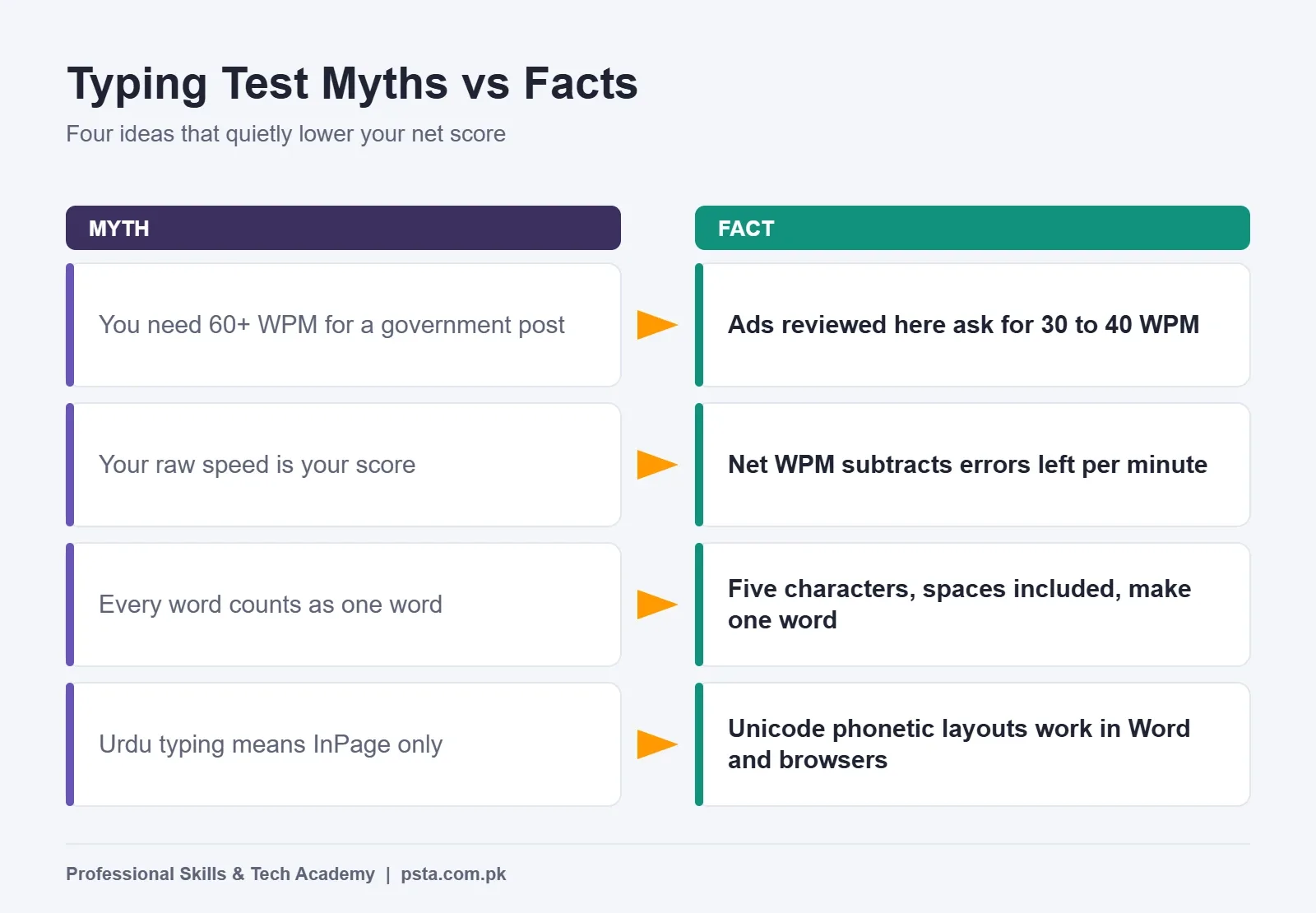
The biggest one is speed over accuracy. A candidate who types fast and leaves mistakes behind can end up with a lower net score than a slower, careful typist. Fix errors as you go only if your test allows backspace. If it doesn't, slow down by a few words and stay clean.
Where Should You Look for Typing-Based Jobs?
Typing-based posts appear in many places, but two official sources are worth checking every week. The National Job Portal lists federal vacancies with the full eligibility text, including the WPM figure. Department websites, such as the FBR jobs pages, publish the original advertisement as a PDF.
When you find an ad, copy four details into your log: the post title, the scale, the WPM figure and the last date to apply. Note whether it says English, Urdu or both. Over a month, this list shows you which speed band most of your target posts need, so you're practicing toward a real number rather than a vague goal.
Be careful with copied listings on unofficial sites. They sometimes drop the typing requirement or the qualification line. Always open the original advertisement before you pay any test fee or submit documents.
Learn English and Urdu Typing With PSTA
If you prefer guided practice with feedback while you build your typing speed for jobs, our Professional English and Urdu Typing course is built around the requirements in this guide. Here are the details from the course page:
- Duration: 4 weeks, beginner level
- Fee: Rs. 3,000 (discounted from Rs. 4,500)
- Mode: Join from anywhere in Pakistan online, or attend classes at our Abbottabad campus
- Modules: 10, from touch typing and ergonomics through all three key rows, numbers and punctuation, speed and accuracy drills, Urdu typing (phonetic and InPage layouts) and typing test simulations
- Target: 30 to 40+ WPM, the range asked for Junior Clerk, LDC, UDC and Data Entry Operator posts
Which Other Skills Do These Posts Expect?
Meeting the typing speed for jobs gets you through the skill test, but it rarely stands alone. The stenotypist ad above asks candidates to be computer literate, and data entry roles run on spreadsheets and forms all day. Basic MS Word formatting, Excel data entry and file management are worth learning alongside typing. Our Office Automation course covers those everyday office tools.
If you want a broader qualification for IT and office roles, the one-year DIT program adds more depth. Many of these posts also include an interview, so read our English interview questions guide before that stage.
You can visit us in Mandian on Old College Road, across from FIMS College, Abbottabad. To compare options, see the full list of PSTA courses. When you are ready, the admission page explains how to apply, or you can send a WhatsApp message to +92 314 5424399.
Your Action for Today: Record Your Starting Speed
Open any free typing test, run it three times, and write down your middle net WPM and accuracy. Then find one current ad for the post you want and note its exact requirement. The gap between those two numbers is your practice target for the next four weeks.
Frequently asked questions
Is 30 WPM enough for a government job in Pakistan?
It can be. The Lower Division Clerk ad reviewed in this guide asked for 30 WPM with matriculation. Data Entry Operator and Stenotypist ads usually asked for 40 WPM. Treat 30 as the minimum for clerical posts, and aim for 40 if you want more options. Always confirm the figure in the exact advertisement for your post.
Does a typing test count my mistakes?
Usually, yes. Most tests report net WPM, which is your gross speed minus the errors you left uncorrected per minute. Six errors in a one-minute test can turn a gross 50 into a net 44. If the test allows backspace, fix errors as you go. If it doesn't, slow down slightly and type cleanly.
How is a word counted in a typing test?
Typing tests don't count real words. They treat every five characters as one word, including spaces and punctuation. This keeps scores fair whether the passage has long official terms or short everyday words. So a 250-character passage typed in one minute equals a gross speed of 50 WPM.
Do I need Urdu typing for government jobs?
Only if the advertisement asks for it. Some offices still prepare letters and records in Urdu, so certain posts mention Urdu typing or Urdu stenography. If yours does, ask which software the test uses, such as InPage or a Unicode phonetic keyboard, and practice on that exact layout before test day.
What is the shorthand requirement for a stenotypist?
The 2026 stenotypist ads reviewed here, for BPS-14 posts, asked for 80 WPM in shorthand and 40 WPM in typing, written as 80/40. These are two separate tests, so passing the typing test does not cover the shorthand one. Both ads also required an intermediate qualification.
Can I practice typing on my phone instead of a keyboard?
Phone practice won't prepare you well for a keyboard test. The finger movements are different, and a typing test uses a computer keyboard. Use a laptop or, better, a full desktop keyboard similar to the one in an office. Keep phone typing for messages, not for test preparation.
Should I look at the keyboard while I type?
Try not to. Touch typing keeps your eyes on the passage and your fingers on the home row, using the raised bumps on F and J to find your place. Looking down breaks your rhythm and leads to skipped lines. Expect a short dip in speed when you switch, then steady gains.
Sources & references
- Stenotypist (BPS-14), Federal Criminal Prosecution Service njp.gov.pk
- Data Entry Operator, Border Health Services Pakistan njp.gov.pk
- Directorate of Internal Audit (Customs) Lahore job advertisement download1.fbr.gov.pk
- Words per minute en.wikipedia.org
- Typing Equations, SpeedTypingOnline speedtypingonline.com
- Touch typing en.wikipedia.org
- CLE Urdu Phonetic Keyboard v1.2 cle.org.pk
- InPage en.wikipedia.org
Last reviewed & updated on by Umar Qureshi. Written by the PSTA team in Abbottabad, Pakistan.

Umar Qureshi

Professional English & Urdu Typing Course in Abbottabad
Turn this guide into a career: hands-on training with real projects, online across Pakistan or on-campus in Abbottabad · 4 Weeks.

Comments
No comments yet — ask a question or share your experience.