
Quick answer
In August 2018, attackers set up a fake card-approval switch at India's Cosmos Bank and took about Rs. 94 crore (roughly $13.5 million) through ATMs in 28 countries and SWIFT transfers to Hong Kong. Securonix linked it to North Korea's Lazarus Group. A Pune court convicted 11 people in 2023.
Key takeaways
- • The attackers never touched core banking; a fake proxy switch approved the withdrawals instead.
- • About Rs. 78 crore left through Visa ATM withdrawals abroad and Rs. 13.92 crore through SWIFT.
- • The Lazarus Group link is an analyst attribution; US FASTCash alerts do not name Cosmos.
- • A Pune court convicted 11 people in April 2023, and Rs. 5.72 crore was recovered.
- • US agencies list Pakistan among likely FASTCash targets, so local banks should harden payment switches.
Table of contents 12 sections
- What Happened in the Cosmos Bank Cyber Attack?
- Cosmos Bank Hack Timeline in Indian and Pakistan Time
- How Did a Fake Switch Approve Money It Should Have Refused?
- Following the Money: Three Streams Out of One Bank
- Why the Totals Do Not Match Exactly
- Who Was Behind It, and How Sure Is Anyone?
- What Happened After the Attack?
- Why Should Banks and Fintechs in Pakistan Care?
- Seven Defensive Lessons From the Cosmos Bank Hack
- If You Hold a Debit Card
- Studying Payment Attacks in PSTA's Cyber Security Course
- Turn On Card Alerts Before You Sleep Tonight
Quick self-test on the Cosmos Bank cyber attack: if hackers never touch a bank's core banking system, can they still pull Rs. 94 crore out of it in two days? In August 2018, at a century-old cooperative bank in Pune, India, the answer turned out to be yes. Hold on to your guess while you read the timeline below.
All rupee amounts in this case study are Indian rupees. Here is what you will find:
- A timeline of both attack waves, with Pakistan time next to Indian time
- How a fake card-approval system said "yes" to withdrawals it should have refused
- Where the money went, and why reports give slightly different totals
- Who was blamed, and how strong that attribution really is
- Numbered lessons for banks, fintechs and cardholders in Pakistan
What Happened in the Cosmos Bank Cyber Attack?
The bank at the center of the Cosmos Bank cyber attack, Cosmos Co-operative Bank, was founded in 1906. Indian news agency IANS described it as the country's second-oldest and second-biggest cooperative bank, in its Business Standard report of 14 August 2018. The same report, based on the police complaint, said attackers moved Rs. 94.42 crore to foreign and domestic accounts.
The theft came in two waves. On Saturday, 11 August, thousands of ATM withdrawals hit the bank from many countries. On Monday, 13 August, the attackers sent money abroad through the SWIFT banking network. SecurityWeek, citing research by security firm Securonix, put the total at about $13.5 million.
Ordinary account holders were not the ones who paid for the Cosmos Bank cyber attack. Chairman Milind Kale said none of the bank's 20 lakh customer accounts across 140 branches were affected, according to a second IANS report. The bank carried the loss itself.
Cosmos Bank Hack Timeline in Indian and Pakistan Time
Pakistan Standard Time is 30 minutes behind India Standard Time, so a 3:00 PM start in Pune was 2:30 PM in Lahore. Each row of this Cosmos Bank cyber attack timeline comes from the sources linked in this article.
| Date | What happened | Time (IST / PKT) |
|---|---|---|
| Late 2016 | US agencies later said North Korean actors had targeted banks in Africa and Asia with the "FASTCash" ATM scheme since at least this point | Not applicable |
| Fri 10 Aug 2018 | The FBI privately warned banks of a coming global ATM cash-out, according to Krebs on Security | Not reported |
| 10 to 11 Aug 2018 | Attackers took over internal and ATM systems, per the Securonix analysis | Not reported |
| Sat 11 Aug 2018 | First wave: about 12,000 Visa withdrawals abroad and 2,849 RuPay withdrawals in India | 3:00 to 10:00 PM IST / 2:30 to 9:30 PM PKT |
| Mon 13 Aug 2018 | Second wave: SWIFT transfers of Rs. 13.92 crore to an account in Hong Kong | About 11:30 AM IST / 11:00 AM PKT |
| 14 to 15 Aug 2018 | Bank goes public; ATMs shut for two days; NPCI says the problem was inside the bank's own IT setup | Daytime |
| 27 Aug 2018 | Securonix research linking the attack to the Lazarus Group is reported | Not applicable |
| 2 Oct 2018 | US agencies publish the FASTCash technical alert | Not applicable |
| 12 Dec 2018 | Pune police file a 1,750-page chargesheet against nine accused | Not applicable |
| Apr 2023 | A Pune court convicts 11 people in the case | Not applicable |
How Did a Fake Switch Approve Money It Should Have Refused?
To follow the Cosmos Bank cyber attack, you need one idea: the payment switch. When you use a debit card at an ATM, the request travels through a card network such as Visa or RuPay to your bank's switch. The switch asks the core banking system whether your card is valid and your balance is enough. Then it sends back "approve" or "decline."
At Cosmos, the attackers built a second, fake switch that sat beside the real one. Chairman Kale said "a proxy switch was created" and fake approvals passed through it, as quoted in the IANS report on NPCI's response. Because requests never reached the core banking system, nothing checked the card or the balance.
Securonix gave a fuller picture, as summarized by SecurityWeek. Its researchers said the first break-in likely came through spear phishing or a remote or third-party connection. They added that the attackers probably misused ATM test software or altered the switch software. Cash was then drawn with 450 cloned debit cards that used the older magnetic stripe rather than a chip.
This proxy switch approach matches what US agencies described in their FASTCash alert. The CISA alert TA18-275A said malware on bank switch servers sent back fake but valid-looking approvals. It noted that every compromised switch it studied ran an old, unsupported version of IBM's AIX operating system. The alert does not name Cosmos Bank, so treat the match as a strong similarity, not proof.

Two days later came the second wave. The attackers used the bank's SWIFT access to make SWIFT transfers to ALM Trading Ltd at Hang Seng Bank, Hong Kong, according to the first IANS report. That money was withdrawn soon after it arrived.
Following the Money: Three Streams Out of One Bank
The police complaint, as reported by IANS, split the Cosmos Bank hack into three money streams:
- Visa withdrawals abroad: about Rs. 78 crore through roughly 12,000 transactions, moved outside India, including to Hong Kong.
- SWIFT transfers: Rs. 13.92 crore sent to the Hong Kong account on 13 August.
- RuPay withdrawals in India: about Rs. 2.50 crore from 2,849 transactions.
Chairman Kale said cash gangs in 28 countries were alerted at the same moment. In many cases they took out around $100 at a time to avoid drawing attention, according to the IANS report. Small, spread-out withdrawals like these are the signature of an ATM cash-out.

Why the Totals Do Not Match Exactly
You will see a few different figures in reports, and none of them is a mistake on your part. Most outlets use Rs. 94.42 crore. The IANS story on NPCI's response printed Rs. 94.24 crore in its text, which looks like swapped digits. The Bridge Chronicle used Rs. 94.45 crore when reporting the chargesheet.
The first-day amount also varies. Some reports say Rs. 78 crore and others say Rs. 80.50 crore. The second figure appears to add the Rs. 2.50 crore of domestic RuPay withdrawals to the Rs. 78 crore taken abroad. The difference is in counting, not in what happened.
Who Was Behind It, and How Sure Is Anyone?
This is where you need to separate court findings from analyst opinion. They are not the same thing.
| Claim | Who made it | How strong it is |
|---|---|---|
| 11 people are guilty of offences in the case | A Pune magistrate's court, April 2023 | Confirmed by a court |
| The Lazarus Group carried out the attack | Securonix researchers, August 2018 | Analyst attribution based on tactics |
| North Korea runs the FASTCash ATM scheme | US DHS, Treasury and FBI, October 2018 | Official, but Cosmos is not named |
| The bank's own IT setup was the weak point | NPCI's head of risk management | Statement by an interested party |
The court case is the firmest fact. ThePrint, carrying a PTI report, said a magistrate convicted 11 people. Nine got four years in prison and two got three years. Police had arrested at least 18 people across India. Back in December 2018, The Bridge Chronicle reported that the masterminds had not been caught.
The Lazarus Group link in the Cosmos Bank cyber attack comes from Securonix. According to SecurityWeek, its researchers pointed to methods tied to the group. Examples include disguising control traffic as normal encrypted traffic and faking file timestamps. That is a judgment based on how the attack was done, not an arrest or an indictment.
The US government's view adds weight. In August 2020, the FASTCash 2.0 advisory AA20-239A said a North Korean unit it called the BeagleBoyz ran the FASTCash cash-outs. It said the group overlaps with what private firms call the Lazarus Group or APT38. The advisory listed both India and Pakistan among countries probably targeted. It still did not name Cosmos. As far as the sources read for this article show, Indian authorities have not publicly blamed North Korea.
What Happened After the Attack?
The bank's first moves after the Cosmos Bank cyber attack were defensive. It shut all its ATMs across India for two days, according to IANS. Chairman Kale said the bank had annual RBI and system audits and that its security was "fully operational."
The National Payments Corporation of India, which runs RuPay, pushed responsibility back to the bank. Its risk head, Bharat Panchal, said the problem "occurred within the (Cosmos Bank's) own IT environment," as quoted in the IANS report. That is a reminder that, in a shared payment system, each party will defend its own piece.
The police side moved slowly but steadily:
- A special investigation team (SIT) of the Pune police took the case.
- In December 2018, the SIT filed a 1,750-page chargesheet against nine people, The Bridge Chronicle reported. Police had written to other countries through Interpol about the overseas withdrawals.
- Of the Rs. 13.92 crore sent to Hong Kong, Rs. 5.72 crore was recovered, according to ThePrint.
- In April 2023, 11 accused were convicted.
Most of the Rs. 78 crore drawn from foreign ATMs does not appear in any recovery report. Cash taken from machines in dozens of countries is very hard to trace back.
Why Should Banks and Fintechs in Pakistan Care?
The CISA advisory names Pakistan as a probable target of the same type of scheme. That alone makes the Cosmos Bank cyber attack required reading for anyone who works near card payments here.
The pattern also connects to cases you may already know. The Bangladesh Bank heist of 2016 abused SWIFT, just like the second Cosmos wave. The same US advisory blames it on the same North Korean unit. In the same year as Cosmos, Pakistan dealt with its own bank card data breach, where stolen card details ended up for sale online. Cloned cards are the raw material an ATM cash-out needs.
Smaller banks, microfinance banks and fintech wallets should pay special attention. Cosmos was a well-established bank with yearly audits, and it still had a switch the attackers could shadow. Weekend timing mattered too: the first wave ran on a Saturday afternoon and evening, when fewer staff were watching.
For you as a cardholder, the direct risk from the Cosmos Bank hack itself was low, since the bank carried the loss. The wider lesson is that magnetic stripe data can be copied. If your bank offers chip-only use or app controls, use them.
Seven Defensive Lessons From the Cosmos Bank Hack
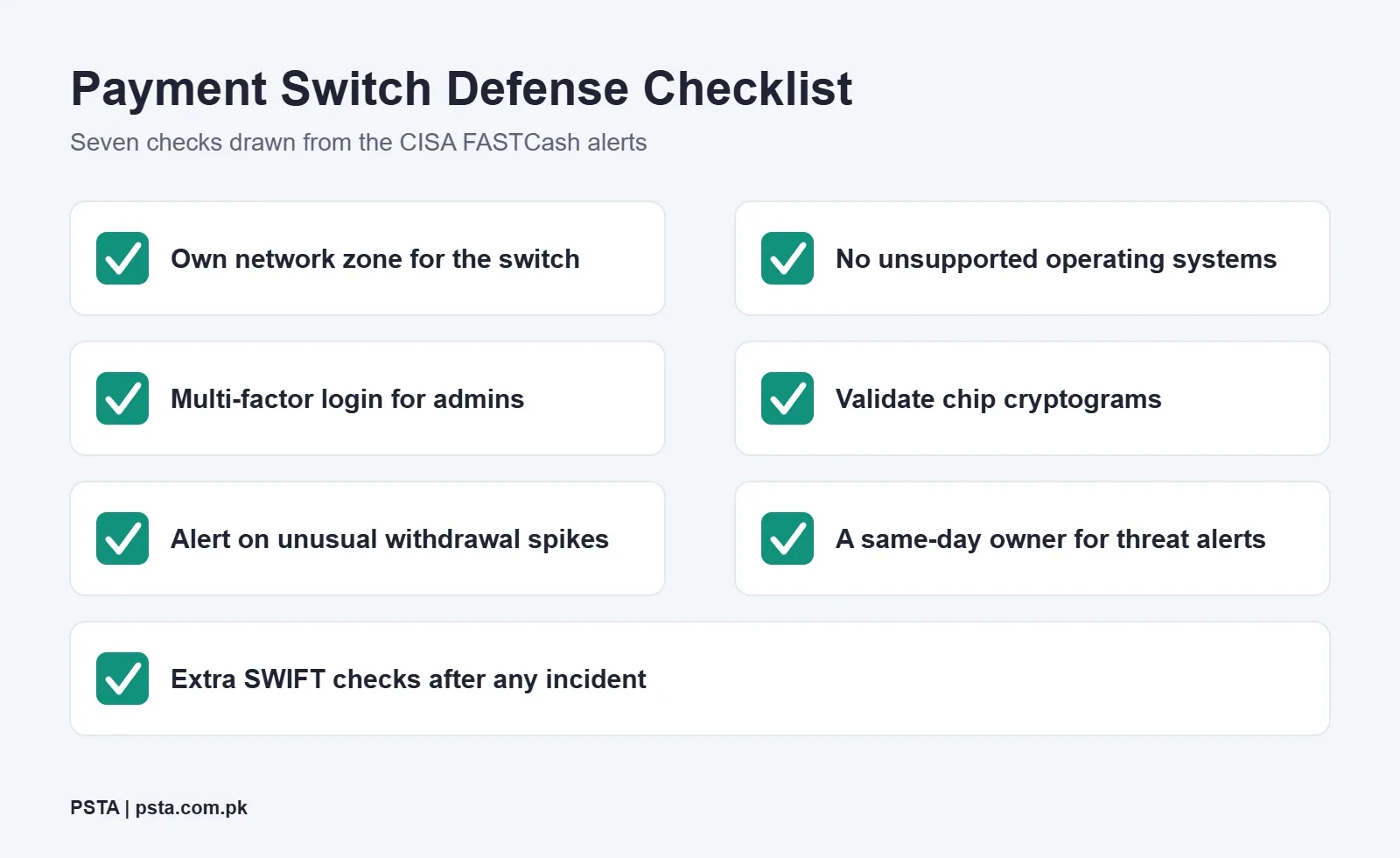
These lessons draw on the mitigations in the 2018 and 2020 CISA alerts, applied to what happened in the Cosmos Bank cyber attack.
- Treat the payment switch as a crown jewel. Put it in its own network zone with strict firewall rules, so a phished office laptop cannot reach it.
- Retire unsupported systems. CISA found the hacked switches ran AIX versions past their support. Old platforms on money paths should get an upgrade date.
- Require multi-factor login for switch administrators. Stolen passwords alone should never open the system that approves cash.
- Check chip cryptograms and limit magstripe use. CISA recommends chip and PIN plus checking the codes cards and issuers generate. The Cosmos gangs relied on cloned magstripe cards.
- Learn your normal and alert on the abnormal. Thousands of cross-border withdrawals on one weekend afternoon should set off alarms fast. Baseline users, software and transaction patterns.
- Act on warnings the same day. The FBI warned banks on 10 August, a day before the first wave, as Krebs on Security reported. Threat alerts need an owner and a response plan.
- Guard SWIFT separately after any card incident. The attackers came back two days later through a different door. Once one system is hit, assume others are exposed and add extra checks on large transfers.
If You Hold a Debit Card
Turn on SMS or app alerts for every card transaction. Disable international ATM use in your banking app if you do not travel. If you see a withdrawal you did not make, call your bank's helpline at once and ask them to block the card. These habits also help with the scams covered in our guide to a hacked WhatsApp account, where speed matters just as much.
Studying Payment Attacks in PSTA's Cyber Security Course
Cases like this one are why our Cyber Security and Ethical Hacking course leans on real incidents. It is a 12-week, beginner-level program. Pakistani learners can take it through live online classes, or come to the PSTA campus in Abbottabad. You cover common attacks, network security, malware and threat detection, cyber law and digital forensics, with hands-on labs and a final case-study project.
In class, you would map the Cosmos Bank cyber attack onto a simple network diagram and mark where segmentation or monitoring could have stopped it. Then you write a short incident timeline, the same skill this article uses. If you already have the basics and want to test defenses in depth, the Advanced Ethical Hacking and Penetration Testing course is the next level.
Not sure which certificate to aim for after that? Our guide to cyber security certifications for beginners compares the common first exams. You can also read our Binance hack case study to see how a crypto theft differs from a bank cash-out.
Turn On Card Alerts Before You Sleep Tonight
Go back to the self-test at the top. The Cosmos Bank cyber attack showed that a bank can lose crores without anyone touching its core system. The part that says "approve" was simply faked. Your one action today is small: open your banking app and switch on instant alerts for every card transaction. If you want to learn how defenders catch attacks like this, send PSTA a message and ask about the next cyber security batch.
Frequently asked questions
Did Cosmos Bank customers lose money in the 2018 attack?
No customer balances were hit, according to the bank. Chairman Milind Kale said none of its 20 lakh accounts across 140 branches were affected, and the bank absorbed the loss itself. The cash came out through cloned cards and fake approvals, not by draining real savings accounts. Customers did face a two-day shutdown of the bank's ATMs while it investigated.
What is a proxy switch attack in banking?
A payment switch is the system that passes card requests between card networks and a bank's core banking system. In a proxy switch attack, intruders set up a fake switch beside the real one. The fake switch answers card requests itself and approves them without asking core banking to check the card or the balance. At Cosmos, this let cloned cards withdraw cash freely.
Was North Korea officially blamed for the Cosmos Bank hack?
Not by name. Security firm Securonix attributed the attack to the Lazarus Group based on its methods. Separately, US agencies said North Korea runs the FASTCash ATM cash-out scheme, which works in a very similar way, but their alerts do not mention Cosmos. Indian authorities have not publicly blamed North Korea in the sources reviewed for this article.
How much of the stolen money was recovered?
Only a small share. ThePrint, carrying a PTI report, said Rs. 5.72 crore was recovered from the Rs. 13.92 crore sent to Hong Kong through SWIFT. The Rs. 78 crore drawn from ATMs abroad does not appear in any recovery report. Cash taken from machines in many countries at once is extremely hard for police to trace.
How is the Cosmos attack different from the Bangladesh Bank heist?
The Bangladesh Bank heist of 2016 relied mainly on fraudulent SWIFT payment orders. Cosmos combined two methods: a fake card switch that approved ATM withdrawals in 28 countries, followed two days later by SWIFT transfers. US agencies blame the Bangladesh theft on a North Korean unit, while the Cosmos link to North Korea comes from a security firm's analysis.
Could a similar ATM cash-out happen in Pakistan?
It is possible, and US agencies list Pakistan among countries probably targeted by FASTCash-style schemes. The risk is highest where payment switches share a network with office computers, run unsupported software or accept magnetic stripe cards without chip checks. Banks and fintechs reduce it with network separation, multi-factor admin access, cryptogram validation and fast alerts on unusual withdrawal patterns.
Why did the attackers use magstripe cards instead of chip cards?
Magnetic stripe data is easy to copy onto blank cards, and it carries no one-time code for the bank to verify. Chip cards create a cryptogram for each transaction, which a properly configured bank checks. Securonix said the Cosmos gangs used 450 cloned non-chip cards, and CISA's FASTCash advice tells banks to validate chip cryptograms to block this route.
Sources & references
- Hackers transfer Rs 94 crore from Pune's Cosmos Bank (IANS, Business Standard) business-standard.com
- NPCI blames Cosmos Bank for malware attacks (IANS, Business Standard) business-standard.com
- North Korea-linked Hackers Stole $13.5 Million From Cosmos Bank (SecurityWeek) securityweek.com
- HIDDEN COBRA – FASTCash Campaign, Alert TA18-275A (CISA) us-cert.cisa.gov
- FASTCash 2.0: North Korea's BeagleBoyz Robbing Banks, AA20-239A (CISA) us-cert.cisa.gov
- FBI Warns of 'Unlimited' ATM Cashout Blitz (Krebs on Security) krebsonsecurity.com
- Charge sheet filed in server hacking case of Cosmos Bank (The Bridge Chronicle) thebridgechronicle.com
- Pune court convicts 11 accused in Cosmos Bank cyber fraud case (PTI, ThePrint) theprint.in
Last reviewed & updated on by Umar Qureshi. Written by the PSTA team in Abbottabad, Pakistan.

Umar Qureshi
Cyber Security & Ethical Hacking Course in Abbottabad - PSTA
Turn this guide into a career: hands-on training with real projects, online across Pakistan or on-campus in Abbottabad · 12 Weeks.
Comments
No comments yet — ask a question or share your experience.