Quick answer
On October 29, 2026, attackers moved about $6.3 billion out of Binance in roughly 20 minutes after compromising an engineer's laptop and bypassing approval controls. About $3 billion was frozen, analysts blame North Korea's TraderTraitor unit, and Binance says it will cover all losses from company funds.
Key takeaways
- • The Binance hack is the largest crypto theft on record, at about $6.3 billion.
- • The entry point was a compromised DevOps engineer's laptop, followed by bypassed approval controls.
- • Tether, Circle and others froze about $3 billion within hours.
- • TRM Labs and Chainalysis link the theft to North Korea's TraderTraitor unit.
- • Binance set aside more than $6.34 billion and promised a proof-of-reserves report.
- • Keep only trading funds on exchanges and ignore anyone offering "hack compensation."
Table of contents 16 sections
- What Happened at Binance on October 29?
- Binance Hack Timeline: The First 48 Hours
- How Did the Attackers Get In?
- The Five Stages, as Reported So Far
- Where Did the $6.3 Billion Go?
- Who Is TraderTraitor, and Why Is North Korea Blamed?
- How Does This Compare With Earlier Crypto Thefts?
- Are Binance Users' Funds Safe?
- What the Binance Hack Means for Crypto Users in Pakistan
- Seven Habits to Protect Your Crypto This Week
- Lessons for Security Teams and Students
- The Endpoint Is the Perimeter
- Approval Controls Must Cover Every Path
- Speed of Response Changes the Outcome
- Studying Real Breaches in PSTA's Cyber Security Course
- Check Your Exchange Account Tonight
The Binance hack of October 29, 2026 is the largest crypto theft on record: Binance estimates that about $6.3 billion left its wallets, and TRM Labs found that most of it moved out in roughly 20 minutes. The attacker did not steal anyone's password. They got inside Binance's own systems and told its wallets to pay them.
This guide pulls together what has been confirmed so far, what is still unclear, and what the incident means for anyone in Pakistan who holds crypto. Here is what you will find below:
- A timeline of the first 48 hours, with times in both UTC and Pakistan time
- How investigators think the attackers got in, in plain language
- Where the money went, and how about $3 billion was frozen
- Why analysts link the theft to North Korea's TraderTraitor unit
- Practical steps to protect your own exchange account this week
A note before you read: this is the biggest crypto hack 2026 has produced, and the story is still moving fast. Every number here comes from a named source, and Binance has promised a full post-mortem. Some figures will change as that report arrives.
What Happened at Binance on October 29?
Late on Thursday, October 29, Binance confirmed it was investigating a possible multibillion-dollar breach. According to Bitcoin.com News, the exchange placed the loss at about $6.3 billion at roughly 8:05 PM UTC. In Pakistan, that was 1:05 AM on Friday, so most local users woke up to the news.
Binance paused withdrawals the same day. Co-founder Changpeng Zhao posted on X, "It does look like a hack on Binance," as reported by Forbes Africa. The company's message to customers was short: user funds are safe, and Binance will cover the losses.
Estimates of the size differ slightly because each firm measures at a different moment:
- Binance: about $6.3 billion, and it warned the figure "may continue to increase"
- TRM Labs: about $6.36 billion across 10 blockchains, per Al Jazeera
- Chainalysis: about $5.9 billion, valued at the time of the theft
Even the lowest estimate is roughly four times the previous record, the $1.5 billion taken from the exchange Bybit in February 2025.
Binance Hack Timeline: The First 48 Hours
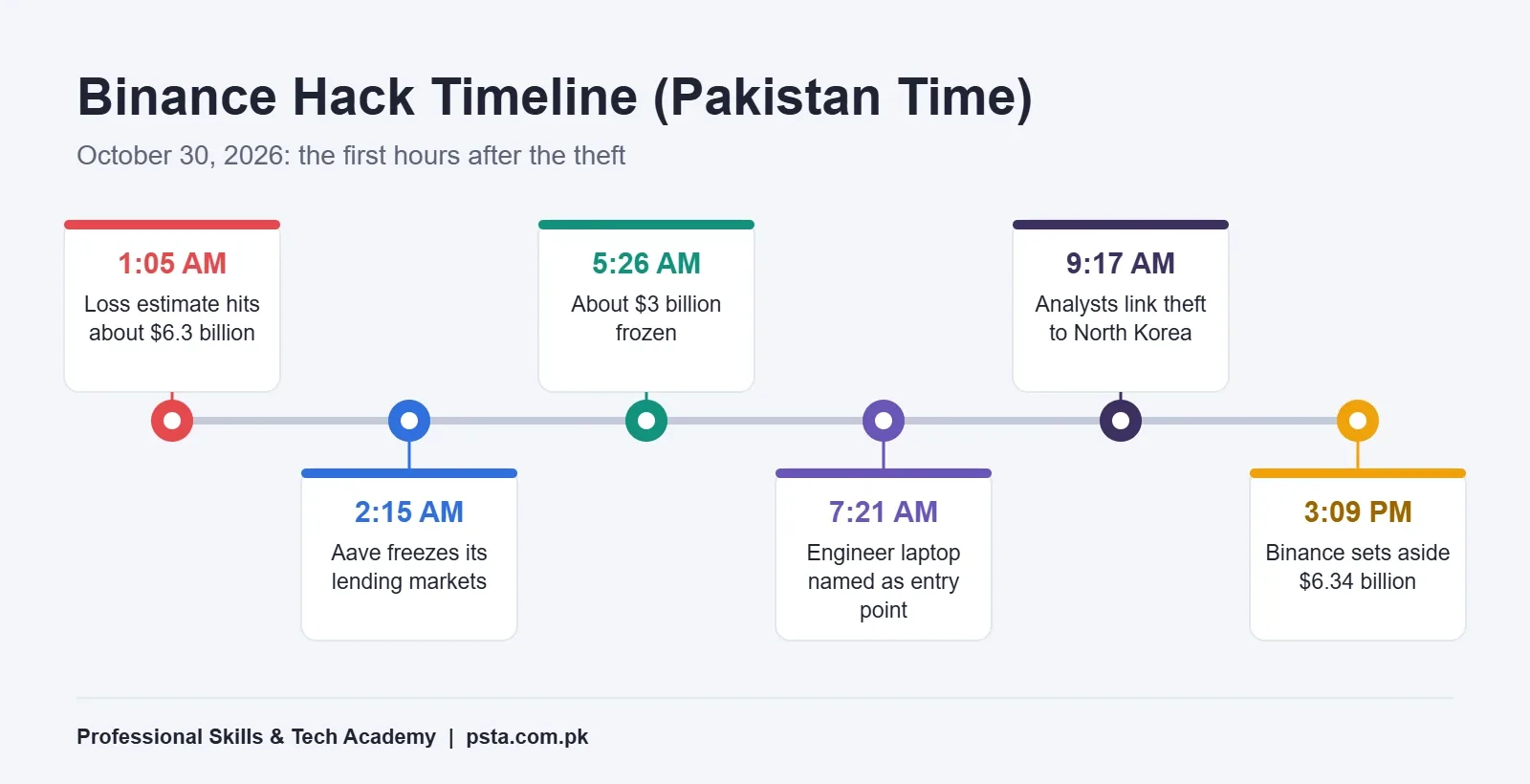
The sequence below is built from the live coverage by Cointelegraph and Binance's own updates. Pakistan time (PKT) is UTC plus five hours.
| Time (UTC) | Time (PKT) | What happened |
|---|---|---|
| Oct 29, about 8:05 PM | Oct 30, 1:05 AM | Binance's estimate of the loss reaches about $6.3 billion |
| Oct 29, 8:58 to 9:01 PM | Oct 30, 1:58 to 2:01 AM | The attacker borrows about $44.6 million in WETH on the lending app Aave |
| Oct 29, 9:15 PM | Oct 30, 2:15 AM | Aave freezes its V3 and V4 markets |
| Oct 29, 10:36 PM | Oct 30, 3:36 AM | Binance reports $2.54 billion in verified frozen assets |
| Oct 30, 12:26 AM | Oct 30, 5:26 AM | Frozen assets reach $3 billion |
| Oct 30, 2:21 AM | Oct 30, 7:21 AM | First finding: a DevOps engineer's laptop was compromised |
| Oct 30, 4:17 AM | Oct 30, 9:17 AM | Chainalysis, TRM Labs and ZachXBT link the theft to North Korea |
| Oct 30, 7:37 AM | Oct 30, 12:37 PM | Binance reports "additional points of breach" |
| Oct 30, 10:09 AM | Oct 30, 3:09 PM | Binance sets aside more than $6.34 billion of company funds |
The target date for reopening withdrawals moved several times. Binance first said 48 hours, then 45, then 40. Its second formal update promised a phased restart about 34 hours later, subject to security checks. Forbes Africa reported on October 31 that Binance planned to reopen withdrawals over the weekend.
How Did the Attackers Get In?
Binance's first explanation was simple. According to CoinDesk, the attacker compromised a DevOps engineer's laptop, used it to reach a service container, and submitted withdrawal requests that Binance never approved. A service container is a small, isolated piece of software that runs one job inside a larger system. In this case, that job was close to the wallets.
The picture grew more complex within hours. Co-CEO Richard Teng said the attack "was not a single 'one-click' action," as Forbes reported. He described several extra breach points and approval controls that were bypassed. He also said the attacker used a "self-destruct mechanism" that deleted its tools and traces once the money moved.
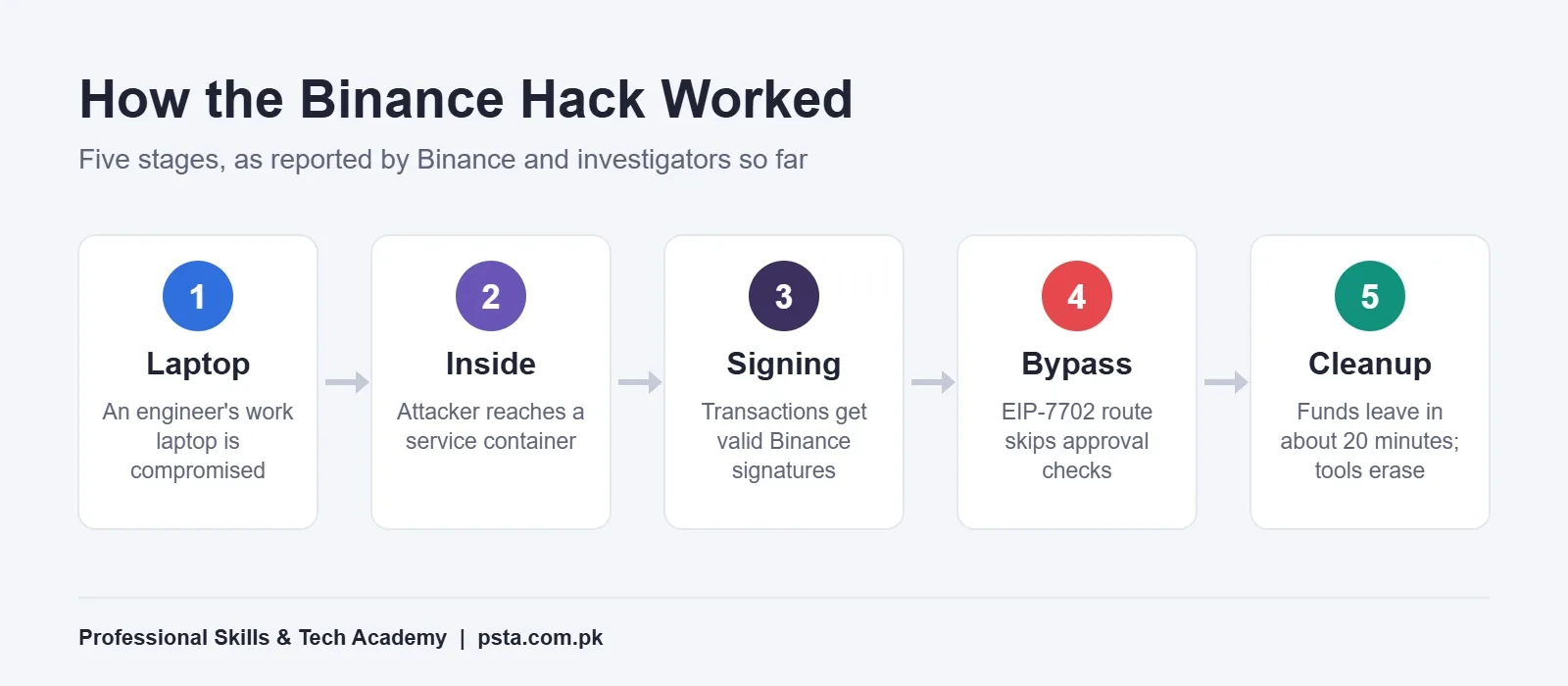
The Five Stages, as Reported So Far
- Initial access. One engineer's work computer is compromised. Binance has not yet said how.
- Movement inside. From that laptop, the attacker reaches internal infrastructure, including a service container.
- Signing. Security firm Hypernative reports that the transactions carried valid signatures from keys Binance controls.
- Bypass. Teng said an EIP-7702 delegation over a hot wallet "did not pass through our normal approval controls." EIP-7702 is an Ethereum feature that lets a regular wallet run smart contract code.
- Cleanup. Funds leave in about 20 minutes, and the attacker's tools erase themselves.
Here is the key point for learners studying the Binance hack. Binance says it has found no evidence that any wallet's private key leaked. That sounds reassuring, but it also shows the real weakness. If an attacker can make your own system sign a transaction, they don't need your key. Modern attacks on large platforms often look like normal work from a trusted account, which is why they are hard to spot in time.
Not everyone accepts the no-leak claim. Mark Karpeles, the former head of the collapsed exchange Mt. Gox, told Reuters that the attackers probably reached keys for at least two Binance wallets, according to Al Jazeera. The full post-mortem should settle this.
Where Did the $6.3 Billion Go?
At its peak, the attacker's wallets held more than $5.7 billion, according to Arkham data quoted by CoinDesk. That included about $1.5 billion in bitcoin, $900 million in ether, about $1.5 billion in USDT and more than $800 million in USDC.
Stablecoins turned out to be the weak spot in the Binance hack. USDT and USDC are issued by companies that can freeze tokens at a specific address. Within hours, both did:
| Who froze funds | Amount reported |
|---|---|
| Tether (USDT) | More than 1.567 billion USDT, per CEO Paolo Ardoino |
| Circle (USDC) | More than 800 million USDC, per CEO Jeremy Allaire |
| Arbitrum Security Council | $30.5 million (74.6 million ARB and 8,425 ETH) |
| World Liberty Financial | $27 million in USD1 and $2 million in WLFI |
| Ripple and First Digital | RLUSD and FDUSD frozen, amounts not disclosed |
| Total verified by Binance | About $3 billion |
The independent firm Elliptic counted $2.84 billion frozen as of 8 AM UTC on October 30, most of it USDT and USDC. Bitcoin and ether can't be frozen in the same way, so those parts of the haul are now the focus of tracing.
Laundering began fast. Chainalysis said it saw "never-seen-before laundering patterns," with thousands of automated transactions bouncing funds between addresses. Investigator ZachXBT reported that some Binance funds moved through the THORChain cross-chain service and were mixed in one address with money from September's Bitget theft. A contract call funded through the Tornado Cash mixer also created a new attacker address.
Who Is TraderTraitor, and Why Is North Korea Blamed?
TraderTraitor is the name used for a North Korean hacking unit linked to the wider Lazarus Group. TRM Labs said with "high confidence" that this unit carried out the Binance hack, and Chainalysis agreed. Analysts see the marks of a North Korea crypto hack: the same methods used in the Bybit theft and to funds mixing with the Bitget proceeds.
The FBI has named this group before. In public service announcement I-022625-PSA, it said North Korea was responsible for the roughly $1.5 billion Bybit theft of February 21, 2025, and described the pattern: convert stolen assets quickly, spread them across thousands of addresses on several blockchains, and later cash out to regular money.
The motive is money for a sanctioned state. TRM's Ari Redbord told Al Jazeera that these funds support weapons programs, which makes the theft a security issue beyond crypto. North Korea routinely denies involvement in hacking. Binance itself has been careful: Teng said its investigation "has not attributed responsibility to any individual."
How Does This Compare With Earlier Crypto Thefts?
The size is what makes this the largest crypto hack on record. TRM's 2026 Crypto Crime Report, quoted by Al Jazeera, found that hackers stole $2.87 billion in nearly 150 attacks across all of 2025. The Binance hack alone more than doubled that.
| Incident | Reported loss | Note |
|---|---|---|
| Binance, October 2026 | About $6.3 billion | Largest on record; about $3 billion frozen |
| All hacks in 2025 (TRM) | $2.87 billion | Nearly 150 separate attacks |
| Bybit, February 2025 | About $1.5 billion | FBI attributed it to TraderTraitor |
| Binance BNB exploit, 2022 | About $570 million minted | Reduced to about $115 million after Binance intervened |
| Bitget, September 2026 | More than $350 million | Funds later mixed with Binance proceeds |
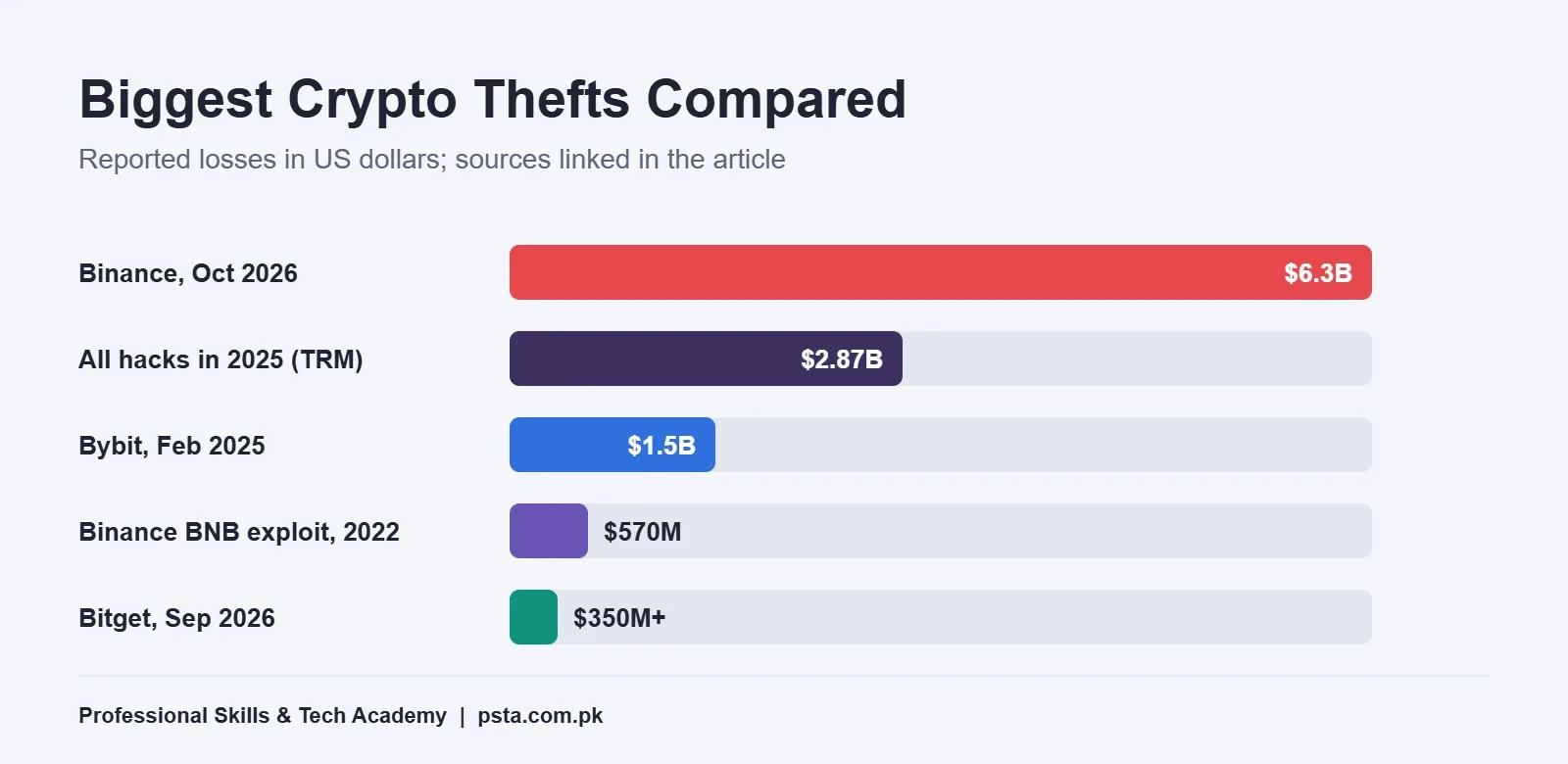
Size alone is not the only lesson. The Bitget theft in September froze only $1.1 million, according to Forbes Africa. At Binance, the stablecoin share and fast action by issuers meant almost half the loss was locked within a day.
Are Binance Users' Funds Safe?
After the Binance hack, the exchange says yes, and it has put money behind the promise. Its statement reads: "Binance will absorb the financial impact of these stolen funds, not our users." The plan has three parts:
- Reserves: more than $6.34 billion in company funds set aside, including $5 billion already held in the affected tokens, which covers about 80% of the loss
- Buying the rest: Yi He said Binance is buying the remaining tokens through exchanges and over-the-counter deals
- Proof of reserves: a snapshot comparing holdings with customer balances, with results promised by Monday, November 2
For scale, Binance held about $144 billion in assets before the hack, according to DefiLlama data cited by CoinDesk. The theft equals about 4% of that. Its emergency fund, the Secure Asset Fund for Users (SAFU), holds about $1 billion in bitcoin, so the SAFU fund alone could not cover this loss. The company's balance sheet carries most of the burden.
Two honest caveats. First, a promise is not a payout; watch whether phased withdrawals actually work for every coin. Second, Al Jazeera notes that most crime and cyber insurance policies don't cover stolen crypto. Your protection rests on the exchange's own strength.
What the Binance Hack Means for Crypto Users in Pakistan
Binance is one of the platforms Pakistanis use most for crypto. If you hold coins there, nothing in the reports so far suggests individual accounts were broken into. The attack hit Binance's own wallets. Your balance should still show in your account, but you couldn't withdraw while the pause lasted.
The Binance hack also arrives at a turning point for local rules. According to Sumsub, Pakistan's Virtual Assets Act, 2026 created a licensing system run by the Pakistan Virtual Assets Regulatory Authority (PVARA). Firms already serving users had to apply for a No Objection Certificate by September 5. Operating without one can bring fines of up to Rs. 50 million or up to five years in prison. PVARA has issued preliminary NOCs to Binance and HTX, which is a first step and not a full licence.
Two licence conditions matter after this week. Licensed firms must keep customer holdings separate from company assets, and they must run a documented cybersecurity framework. Large incidents like this one tend to shape how regulators write the detailed rules, so expect cybersecurity to get closer attention.
Seven Habits to Protect Your Crypto This Week
You can't fix the internal controls behind the Binance hack, but you can shrink your own risk. These crypto security tips work best in order:
- Keep only trading money on an exchange. Move long-term savings to a wallet where you control the keys, and write the recovery phrase on paper, never in your phone's gallery.
- Ignore anyone who offers "hack compensation." Binance does not need your seed phrase, password or a "verification fee" to pay you. Fake support accounts on WhatsApp, Telegram and X are the next wave after every big breach.
- Use an authenticator app or a passkey. SMS codes can be stolen through SIM swaps. If you've had a scare before, our WhatsApp hacked recovery checklist walks through the same account-locking ideas.
- Turn on an anti-phishing code and a withdrawal address allowlist. Both are in your exchange's security settings, and both block common tricks.
- Check where you are logged in. Remove old devices and API keys you no longer use.
- Clean your own devices. This attack began with one laptop. Avoid cracked software and keep your phone updated. If your phone acts strangely, read our guide to checking whether your phone is hacked.
- Report fraud attempts. In Pakistan, cybercrime complaints now go to the National Cyber Crime Investigation Agency (NCCIA), which took over from the FIA's Cyber Crime Wing.
Lessons for Security Teams and Students
If you are learning cyber security, the Binance hack belongs in your notes. Three lessons stand out.
The Endpoint Is the Perimeter
One engineer's laptop opened the door. Companies need strict device management, hardware security keys for staff with production access, and fast alerts when a work device behaves oddly.
Approval Controls Must Cover Every Path
Binance had approval rules, yet one route skipped them. Good design asks a simple question for every wallet: is there any way to move funds that does not pass the same checks? New features such as EIP-7702 add paths that older rules may not cover.
Speed of Response Changes the Outcome
About $3 billion was frozen because issuers, investigators and other platforms acted within hours. Incident response, log keeping and relationships with outside partners are skills, and they can be practiced.
Studying Real Breaches in PSTA's Cyber Security Course
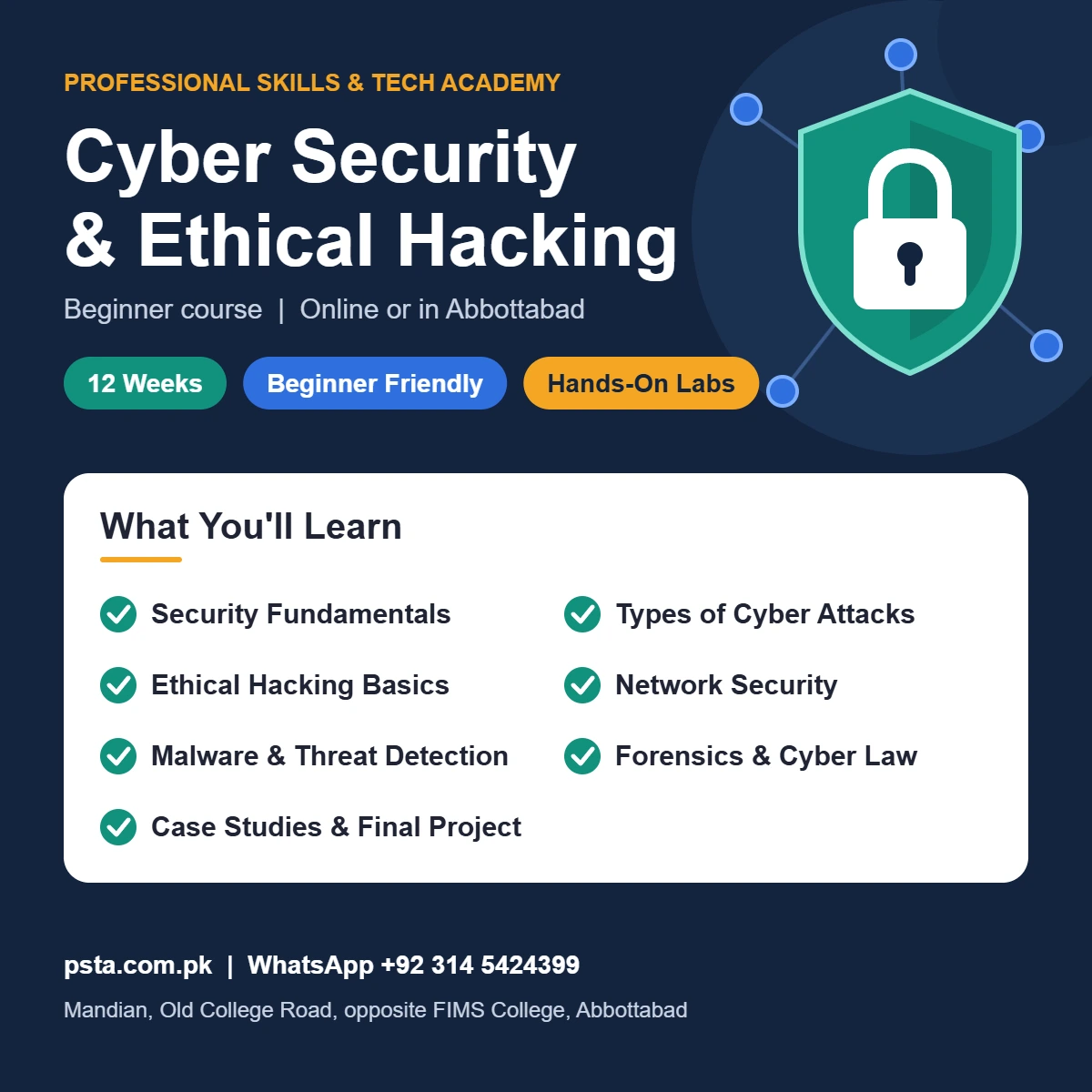
Cases like the Binance hack are the reason PSTA's Cyber Security and Ethical Hacking Course ends with case studies. The course runs 12 weeks at beginner level, and you can join online from any city or attend classes in Abbottabad. Its seven modules move from security fundamentals and common attacks such as phishing and social engineering to network defense, malware analysis, incident response, digital forensics and Pakistan's PECA law, finishing with a final security project.
That last part fits the Binance hack well. You learn to rebuild an incident timeline, preserve evidence and explain findings to a manager, which is what investigators did for Binance this week. Once you have the basics, the Advanced Ethical Hacking and Penetration Testing Course goes deeper into offensive testing. To plan which exam to take afterwards, see our cyber security certifications guide.
You can compare all programs on the courses page, apply through online admission, or ask about the next batch on WhatsApp at +92 314 5424399.
Check Your Exchange Account Tonight
Open your exchange app, go to security settings and spend ten minutes on three items: switch to an authenticator app, set an anti-phishing code and remove any device you don't recognize. Then decide how much crypto truly needs to sit on an exchange. The Binance hack shows that even the largest platform can be hit, and the best protection you control is how much you leave there.
Frequently asked questions
How much was stolen in the Binance hack?
Binance estimates about $6.3 billion. TRM Labs counted about $6.36 billion leaving its wallets across 10 blockchains, while Chainalysis valued the theft at about $5.9 billion at the time it happened. The small differences come from measuring prices at different moments. Every estimate makes it the largest crypto theft on record, about four times the Bybit loss of 2025.
Will Binance customers get their money back?
Binance says customers will not bear the loss. It has set aside more than $6.34 billion in company funds, including $5 billion already held in the affected tokens, and is buying the remaining coins. It also promised a proof-of-reserves report by November 2. Until withdrawals work normally for every coin, treat the promise as a plan, not a completed payout.
Who is behind the Binance hack?
Blockchain analysts TRM Labs and Chainalysis attribute it to TraderTraitor, a North Korean hacking unit tied to the Lazarus Group. The FBI blamed the same unit for the Bybit theft in February 2025. Binance itself has not named anyone and says its investigation has not attributed responsibility to any individual. North Korea usually denies involvement in such attacks.
Were individual Binance user accounts hacked?
Reports so far describe an attack on Binance's own wallets and internal systems, not on customer logins. The attacker reached the exchange through a compromised engineer's laptop and pushed unapproved withdrawals from company-controlled wallets. Your balance should still appear in your account. Even so, it is a good moment to review your own security settings and active devices.
When will Binance withdrawals resume?
Binance changed its estimate several times, from 48 hours to 45, then 40. Its second formal update targeted a phased reopening about 34 hours later, subject to security checks, and Forbes Africa reported a plan to reopen over the weekend of October 31. Check Binance's official announcements page rather than social media posts for the current status.
How can I spot a fake Binance compensation message?
Real exchange support never asks for your seed phrase, password, two-factor code or a fee to release funds. Be wary of WhatsApp, Telegram or X accounts that contact you first, links that look like Binance but use a different domain, and urgent deadlines. Open the official app yourself instead of clicking a link, and report scam attempts to the NCCIA.
Is it safe to keep crypto on an exchange in Pakistan?
Any exchange can be hacked, so keep only what you need for trading there. Move long-term holdings to a wallet where you control the keys, and protect the recovery phrase offline. Under Pakistan's Virtual Assets Act, 2026, licensed firms must separate customer holdings from company assets and run a cybersecurity framework, which adds protection over time.
Sources & references
- Binance loses over $6 billion in the largest crypto hack to date (CoinDesk) coindesk.com
- Binance says $6.3bn stolen in biggest crypto heist in history (Al Jazeera) aljazeera.com
- Binance $6.3 billion hack started with one engineer's laptop (Forbes) forbes.com
- Binance prepares to resume withdrawals, unveils recovery plan (Bitcoin.com News) news.bitcoin.com
- Binance record $6.3B hack as it happened (Cointelegraph) cointelegraph.com
- Binance plans to resume withdrawals this weekend (Forbes Africa) forbesafrica.com
- FBI PSA I-022625-PSA on North Korea and the Bybit theft (IC3) ic3.gov
- Pakistan opens crypto licensing regime (Sumsub) sumsub.com
Last reviewed & updated on by Umar Qureshi. Written by the PSTA team in Abbottabad, Pakistan.

Umar Qureshi
Cyber Security & Ethical Hacking Course in Abbottabad - PSTA
Turn this guide into a career: hands-on training with real projects, online across Pakistan or on-campus in Abbottabad · 12 Weeks.

Comments
No comments yet — ask a question or share your experience.