Quick answer
Most fraud calls in Pakistan don't hack your account. They persuade you to share an OTP, PIN or card number, tap a link or send money. Never share codes on a call, verify through the number on your card or the official app, and report scams to the NCCIA on 1799 or through the PTA complaint portal.
Key takeaways
- • Caller ID can be spoofed, so your bank's number on the screen proves nothing.
- • No genuine caller needs your OTP, PIN, password or card number.
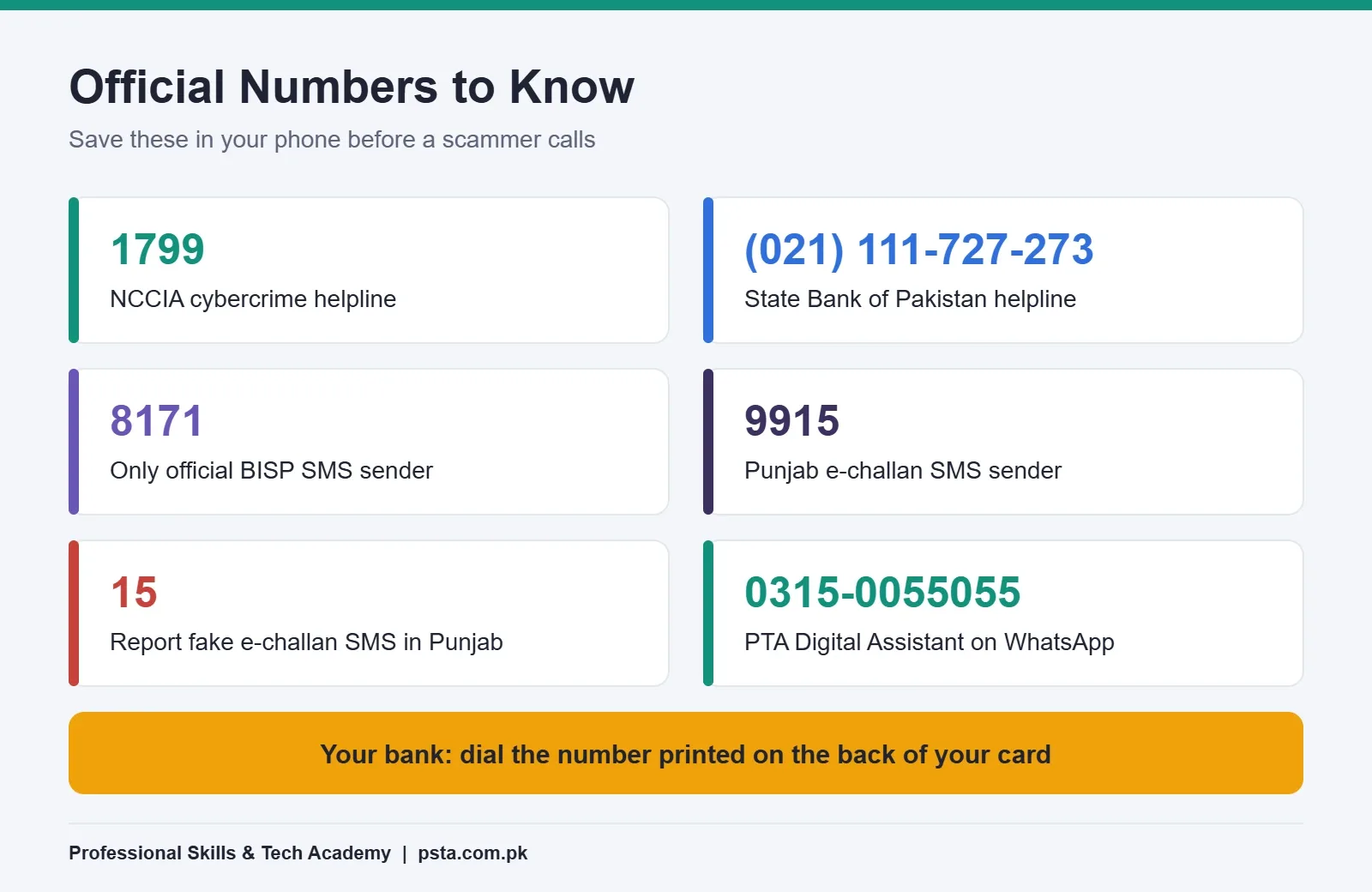
- • BISP messages come only from 8171, and Punjab e-challan SMS only from 9915.
- • Check any "mistaken transfer" claim in your own banking app before returning money.
- • If you shared a code, call your bank first, then report to the NCCIA on 1799.
Table of contents 20 sections
- Why Do Fraud Calls in Pakistan Still Work?
- The Scams Doing the Rounds in 2026
- Myths About Caller ID and Official Numbers
- Myth 1: If the Screen Shows My Bank's Number, the Call Is Real
- Myth 2: A Short Code Means the SMS Is Official
- Myths About OTPs, PINs and "Verification"
- Myth 3: It's Fine to Share a One-Time Code With Bank Staff
- Myth 4: They Know My CNIC and Address, So They Must Be Official
- Myths About Prizes, Refunds and Mistaken Transfers
- Myth 5: Sending Back a "Mistaken" Transfer Is Just Being Honest
- Myth 6: Paying a Small Fee to Release a Prize Is Normal
- Myths About Reporting Fraud
- Myth 7: Reporting Is Pointless, Nobody Acts on It
- Myth 8: I Should Wait Until I'm Sure I Lost Money
- How Can You Check a Suspicious Call in Under Five Minutes?
- What Should You Do in the First Hour After Sharing a Code?
- Where to Report: Official Channels at a Glance
- Protecting Parents and Shop Staff
- Studying the Defender's Side With PSTA
- Save These Numbers in Your Phone Today
Before you read about fraud calls in Pakistan, try this quick self-test. Answer each question with yes or no.
- If a caller knows your full name and bank, is the call probably genuine?
- Is it safe to read out a one-time code to someone who says they're from your bank's fraud team?
- If a stranger says they sent money to your JazzCash or bank account by mistake, should you send it back right away?
The safe answer to all three is no. Fraud calls in Pakistan rarely break into banking systems. They rely on you doing the work for them: sharing a code, clicking a link or sending money. If you hesitated on even one question, the myths below are worth ten minutes of your time.
This guide covers:
- The call and SMS scams that Pakistani regulators warned about in 2026
- Eight common beliefs that make people easy targets, and what is actually true
- A five-minute method to check any suspicious call or message
- What to do in the first hour if you already shared a code or paid
- Which official number or portal handles which kind of fraud
Why Do Fraud Calls in Pakistan Still Work?
The SBP has introduced fraud-mitigation rules, and banks have added their own safeguards, so attackers have changed targets. At the 2026 Future Banking Summit in Karachi, a State Bank of Pakistan official said scammers now exploit trust and social engineering more than they breach banking systems. He described customers as the first line of defence, as reported by Digital Pakistan.
Social engineering means persuading a person to break their own security. The caller doesn't need your password if you will read it out. That's why the same tricks keep working on educated, careful people. They're built around pressure, fear of loss and the hope of a reward, and those feelings switch off the part of your brain that would normally ask questions.
The Pakistan Telecommunication Authority has issued several public alerts this year. In February, ProPakistani reported a PTA warning about rising scam calls that claim prize winnings and ask for bank details. In August, another PTA alert covered fake emails, texts and calls that push people to act immediately.
The Scams Doing the Rounds in 2026
The script behind fraud calls in Pakistan changes every few months, but the pattern underneath stays the same. Here are the versions that official bodies have named in 2026 public warnings.
| Scam | What you hear or see | What the real organization does |
|---|---|---|
| Fake bank officer | "Your card is blocked. Share the code we just sent to verify." | Banks don't ask for PINs, passwords or card details on unsolicited calls (SBP). |
| Spoofed helpline | The caller ID shows your bank's UAN or helpline number. | Helpline numbers are generally for incoming calls; banks don't normally call out from them (SBP). |
| Fake debit alert | An SMS says money was debited, with a number to call. | Check the balance in your banking app or call the number printed on your card. |
| "Sent by mistake" | A stranger asks you to return money they say they sent you. | Verify the credit with your bank before doing anything (SBP). |
| Prize or lottery | "You've won a cash prize. Pay a small fee or share details to claim it." | PTA says to ignore these and report them. |
| Fake BISP payment | An SMS or call about Benazir payments from an unknown number. | BISP says its official messages come from 8171 only. |
| Fake e-challan | A traffic fine SMS with a payment link. | Punjab Safe Cities says genuine e-challan SMS come from 9915 and include time, place and offence. |
The fake e-challan wave is a useful example. In March 2026, the Punjab Safe Cities Authority warned in The News that fake challan messages were coming from the number 8070. Genuine ones come only from 9915. For BISP, the programme's chairperson told beneficiaries to trust only messages from 8171.
Myths About Caller ID and Official Numbers
Myth 1: If the Screen Shows My Bank's Number, the Call Is Real
Caller ID can be faked. The SBP specifically warned that scammers spoof banks' Universal Access Numbers so a call looks genuine. It also noted that helpline numbers are generally for incoming calls, and banks don't normally call customers from them.
Fact: The number on your screen proves nothing. If a call worries you, hang up and dial the number printed on the back of your card yourself. Don't call back the number that rang you, and don't use one the caller reads out.
Myth 2: A Short Code Means the SMS Is Official
The SBP advises checking that bank SMS come from the bank's designated short code, which is generally four digits, rather than an ordinary mobile number. That's good advice, but it isn't the whole check. The fake e-challan messages in Punjab also came from a four-digit number, 8070.
Fact: Learn the exact sender for each service you use. A message that comes from a long mobile number is a red flag. A short code is only reassuring when it's the correct one.
Myths About OTPs, PINs and "Verification"
Myth 3: It's Fine to Share a One-Time Code With Bank Staff
A one-time password (OTP) is the last lock on your account. When someone asks you to read it out, they're usually sitting on a login or payment screen, waiting for that exact code. The PTA's August advisory, covered by ProPakistani, tells people never to share OTPs, passwords, PINs or financial information with anyone.
Fact: Read the full SMS before you do anything. It often says what the code is for, such as a new device login or a transfer. If you didn't start that action, someone else did.
Myth 4: They Know My CNIC and Address, So They Must Be Official
Personal details leak through many routes: forms, courier slips, old data breaches and social media. A caller who reads your CNIC number back to you is using it to build trust. It isn't proof of anything.
Fact: Real verification runs the other way. Your bank checks you when you call its helpline. A caller who wants you to prove your identity on a call they started is a warning sign.
Myths About Prizes, Refunds and Mistaken Transfers
Myth 5: Sending Back a "Mistaken" Transfer Is Just Being Honest
Here's how this one usually plays out. You receive an SMS that looks like a credit alert. Minutes later, a polite or tearful caller says the money was meant for someone else. In many cases no money arrived at all; the "alert" was just a text. In others, the money came from a stolen account and could later be reversed.
Fact: The SBP advises independently verifying mistaken-transfer claims. Open your banking or wallet app and check the actual balance. If money really did arrive, ask your bank to handle the reversal. Don't send it yourself.
Myth 6: Paying a Small Fee to Release a Prize Is Normal
Prize scams are among the oldest tricks, and PTA advisories still name them. The February 2026 warning described callers who claim you've won a prize, then use that excitement to get you to click a link or share banking details.
Fact: If you didn't enter a draw, you didn't win it. A genuine prize doesn't require a "tax", "processing fee" or your card details first.
Myths About Reporting Fraud
Myth 7: Reporting Is Pointless, Nobody Acts on It
The National Cyber Crime Investigation Agency (NCCIA) replaced the FIA's Cybercrime Wing in April 2025, and the 1799 cybercrime helpline was launched that June, according to Arab News. In May 2026, for example, Aaj News reported that the agency detained 41 people in a raid on a Karachi call centre.
Fact: A report creates a record that can link your case to others. The PTA says early reporting helps limit financial damage. Your report also gives your bank a reference if you dispute a transaction.
Myth 8: I Should Wait Until I'm Sure I Lost Money
Waiting usually helps the scammer, because it gives them time to move the money on.
Fact: Call your bank as soon as you suspect something, even if you're not sure. Blocking a card and then unblocking it costs you a few minutes. Losing your savings costs much more.
How Can You Check a Suspicious Call in Under Five Minutes?
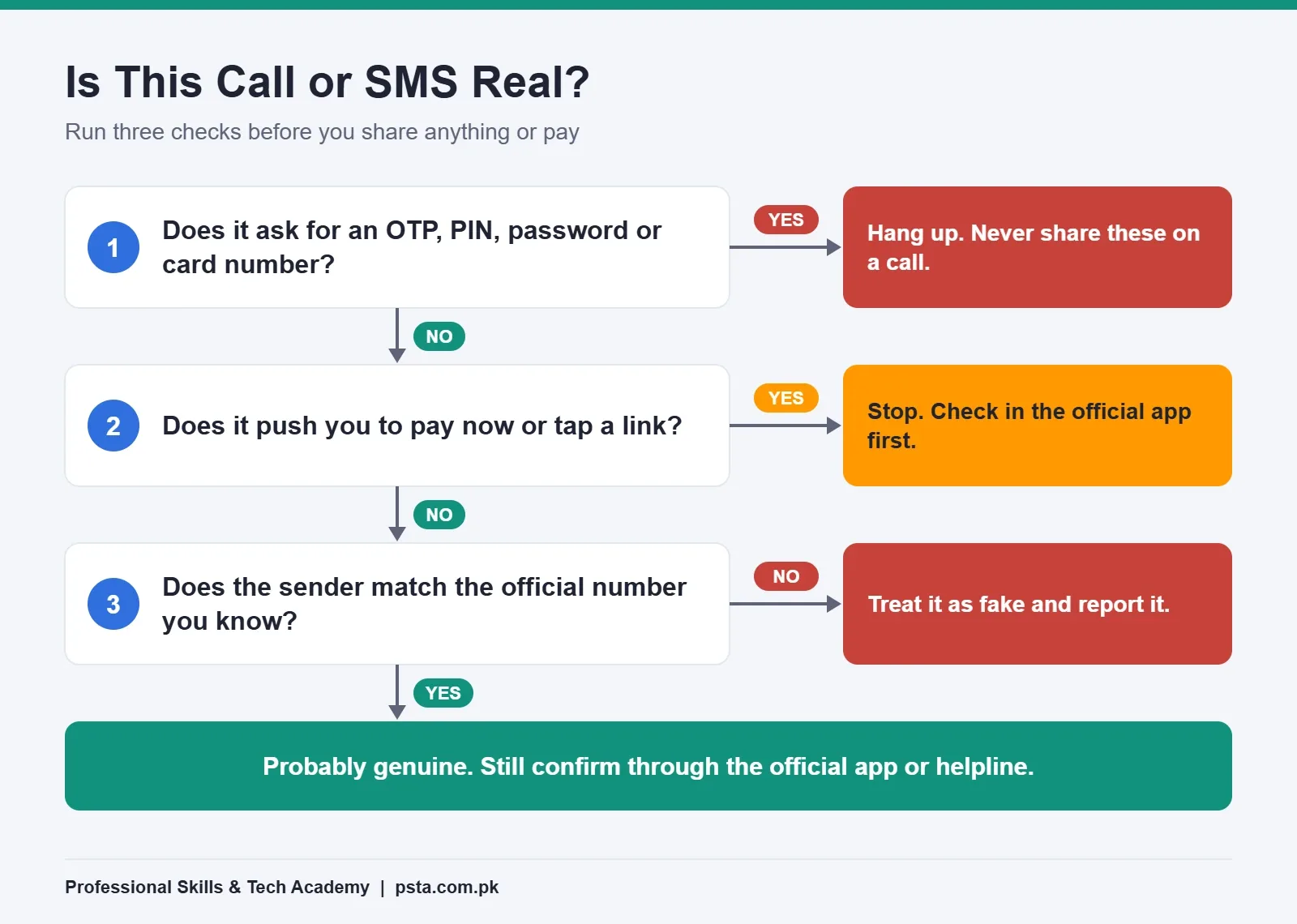
You don't need technical skills for this. You need a habit. Use these steps whenever a call or message involves money, codes or urgency.
- Pause. Tell the caller you'll call back. A real bank or office won't object.
- Look for the three demands. Does it ask for a code or PIN, push you to pay, or send a link? Any one of these is reason for caution.
- Check the sender. Compare it with the official number you already know, such as 8171 for BISP or 9915 for Punjab e-challans.
- Verify on your own. Open the official app, or dial the number printed on your card or on the organization's official website.
- Report and delete. If it's fake, report it through the PTA complaint portal or the PTA CMS app, then delete the message without tapping any link.
What Should You Do in the First Hour After Sharing a Code?
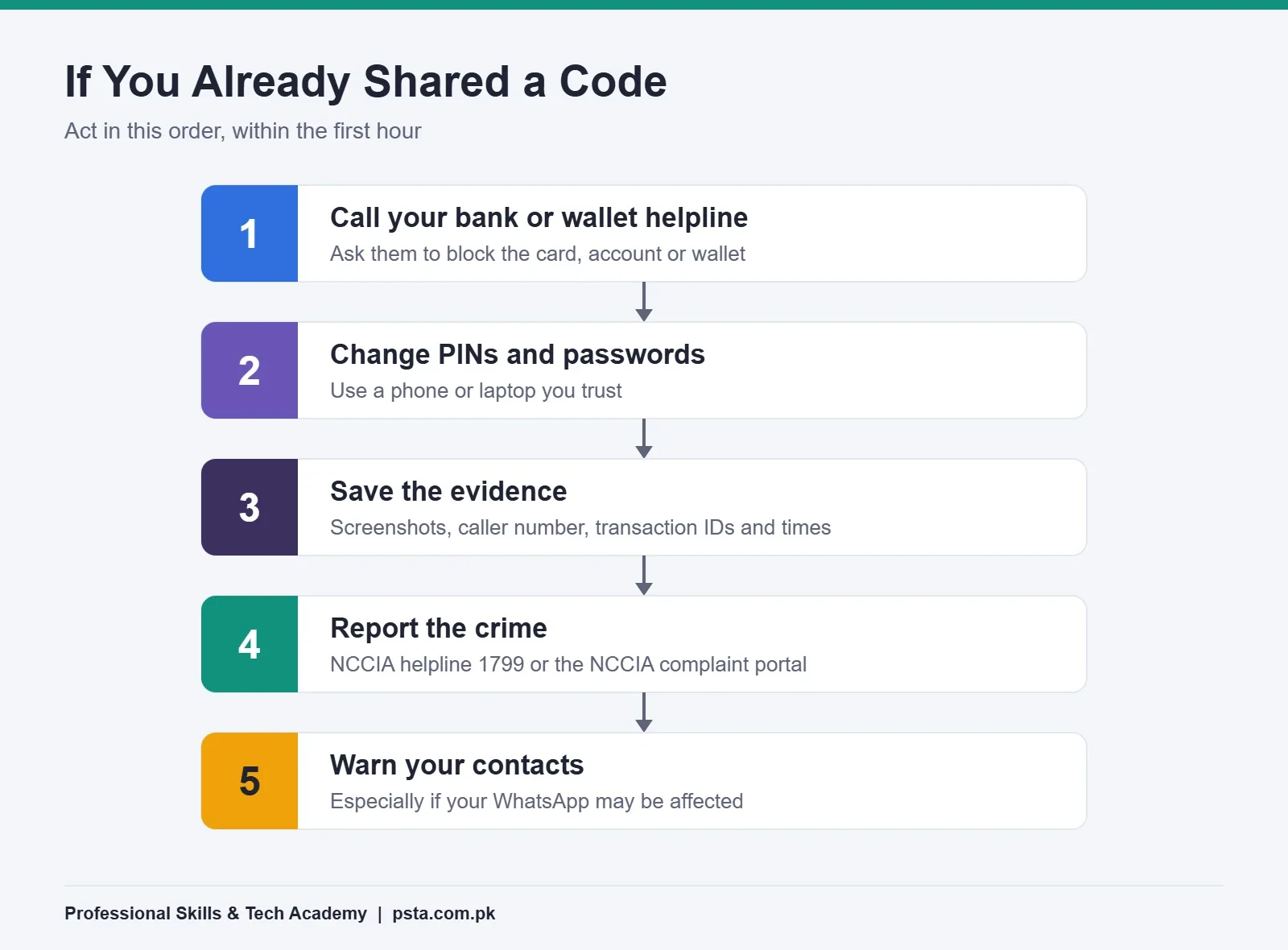
Mistakes happen, even to careful people. If you've already shared an OTP, a PIN or card details, act quickly and in this order.
- Call your bank or wallet helpline using the number on your card or in the official app. Ask them to block the card, account or wallet and to flag recent transactions.
- Change your passwords and PINs from a device you trust. Start with banking apps and your email.
- Save the evidence. Take screenshots of messages, note the caller's number, and record transaction IDs, times and amounts.
- Report the crime. Call the NCCIA helpline on 1799 or file a complaint through the NCCIA portal. In September 2026, the NCCIA advised citizens to attach screenshots, contact numbers and transaction details, ARY News reported.
- Warn your contacts if the scammer may have reached your WhatsApp or social accounts. Our guide to a hacked WhatsApp account covers that recovery in detail.
For mobile banking fraud or unauthorized transactions, the PTA's advisories also list the State Bank of Pakistan helpline, (021) 111-727-273.
Where to Report: Official Channels at a Glance
Each channel handles a different part of the problem. Using the right one first saves time.
| Situation | Where to go | What to have ready |
|---|---|---|
| Money taken or card misused | Your bank or wallet helpline, right away | Account number, time and amount of each transaction |
| Cybercrime such as fraud, impersonation or hacking | NCCIA helpline 1799 or the NCCIA complaint portal | Screenshots, caller numbers, transaction details |
| Mobile banking or unauthorized transaction issues | State Bank of Pakistan helpline (021) 111-727-273 | Bank reference number, if you have one |
| Scam calls or SMS from a number | PTA complaint portal or PTA CMS app | The number, date and message text |
| Fake e-challan SMS in Punjab | Emergency helpline 15 | The sender number and link |
| Questions about a PTA advisory | PTA Digital Assistant on WhatsApp, 0315-0055055 | Your question |
Protecting Parents and Shop Staff
Older relatives and busy shopkeepers are frequent targets. They may be less familiar with app alerts, or they may be handling several customers at once when the call comes. A short family rule works better than a long lecture.
- Agree on one sentence: "We never share codes on the phone, with anyone."
- Save the genuine bank helpline in their contacts under a clear name.
- Ask them to call you before they send money to anyone who rang them first.
- In a shop, confirm payments in the wallet or bank app, not from a screenshot or SMS the customer shows you.
If a family member falls for a scam, keep the conversation calm. People who feel embarrassed often delay reporting, and delay is what the fraudster wants.
Studying the Defender's Side With PSTA
If this topic interests you beyond your own safety, social engineering is a real part of cyber security work. Banks, telecom companies and software houses need people who can spot these attacks, train staff and respond when something goes wrong.
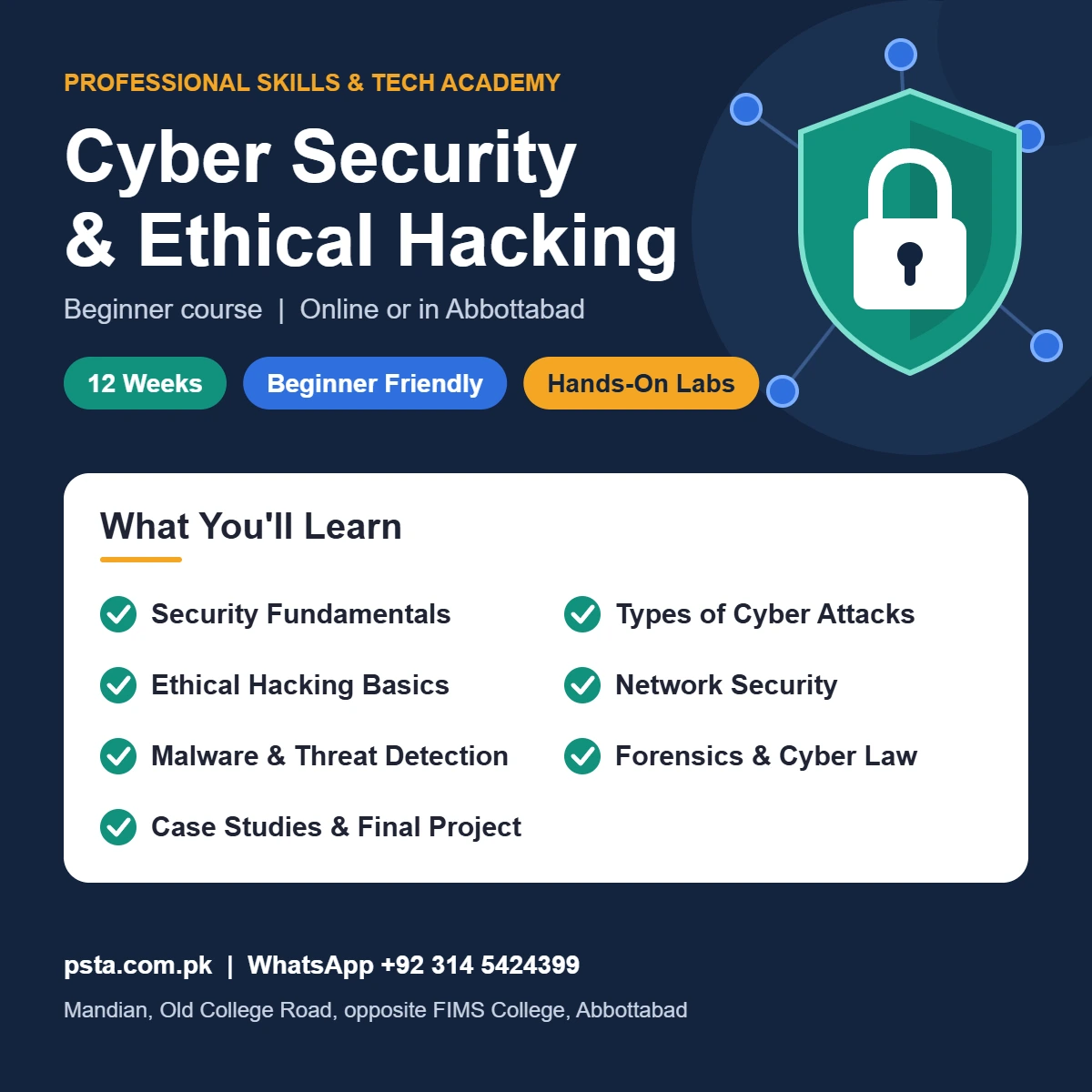
PSTA's Cyber Security and Ethical Hacking course takes 12 weeks and is open to beginners with basic computer skills. Module 2 covers common attacks, including phishing and social engineering. Later modules cover incident response, digital forensics and Pakistan's cyber law, PECA. Its fee on the course page is currently Rs. 45,000.
Classes run live online for students anywhere in Pakistan, and in person at our Mandian campus in Abbottabad, opposite FIMS College. Once you have the foundations, our advanced penetration testing track goes deeper into offensive testing.
If you're still deciding on a path, compare beginner-level cyber security certifications or browse all PSTA courses. When you're ready, the online admission form takes a few minutes, and the team answers batch questions on WhatsApp at +92 314 5424399.
Save These Numbers in Your Phone Today
Take two minutes now. Open your contacts and save your bank's helpline from the back of your card, the NCCIA helpline 1799 and the SBP helpline. Then send the same three numbers to one parent or older relative. The next time a caller pushes you to act fast, you won't need to search for anything. You'll hang up and call the right number yourself.
Frequently asked questions
How do I report a fraud call in Pakistan?
If money or a card is involved, call your bank or wallet helpline first so it can block the account. Then report the crime to the NCCIA on its 1799 helpline or through its online complaint portal. You can also report the scam number through the PTA complaint portal or the PTA CMS app. Keep screenshots, the caller's number and any transaction details ready.
Can scammers show my bank's real number on caller ID?
Yes. The State Bank of Pakistan has warned that scammers spoof banks' Universal Access Numbers so a call looks genuine. It also says helpline numbers are generally meant for incoming calls, and banks don't normally call customers from them. If a call worries you, hang up and dial the number printed on the back of your card yourself.
What is the official BISP number for SMS messages?
BISP has told beneficiaries to trust only messages that come from 8171. Treat any message about Benazir payments from another number as suspicious, even if it uses the programme's name or logo. Don't share your CNIC details or send money in reply. Check your status through official BISP channels instead.
How can I tell if an e-challan SMS is real?
In Punjab, the Safe Cities Authority says genuine e-challan messages come only from 9915 and include the time, location and nature of the offence. Fake messages have been sent from other numbers, including 8070, with payment links. Safe City officials don't ask for card or bank details by SMS. You can report fake challan messages on the emergency helpline 15.
Someone says they sent money to my account by mistake. What should I do?
Don't send anything back yourself. Open your banking or wallet app and check whether money actually arrived, because the "credit alert" may be a fake SMS. If funds did arrive, contact your bank and let it handle any reversal. The State Bank of Pakistan advises verifying mistaken-transfer claims independently before you act.
Is it safe to share an OTP if the caller already knows my CNIC?
No. Personal details such as your name, CNIC number and address can leak from many places, so a caller who knows them hasn't proved anything. An OTP is meant only for you, and the PTA advises never sharing OTPs, PINs or passwords with anyone. Read the full SMS, because it often says exactly what the code would approve.
What is the NCCIA?
The National Cyber Crime Investigation Agency is Pakistan's agency for cybercrime cases. It replaced the FIA's Cybercrime Wing in April 2025, and its 1799 helpline was launched in June 2025 for cybercrime complaints. When you file a complaint, the agency asks for evidence such as screenshots, contact numbers and transaction details.
Sources & references
- SBP calls for greater vigilance against evolving digital banking scams (Digital Pakistan) digitalpakistan.pk
- PTA Warns Public Against Rising Scam Calls and Online Fraud (ProPakistani) propakistani.pk
- Your Money and Data Are at Risk as Phishing Attacks Rise (ProPakistani) propakistani.pk
- PSCA issues public alert against fake e-ticket SMS (The News) thenews.pk
- BISP cautions beneficiaries against fake messages (Geo News) geo.tv
- Pakistan launches cybercrime helpline seeking swift action on complaints (Arab News) arabnews.com
- NCCIA busts illegal call centre in Karachi, detains 41 suspects (Aaj News) english.aaj.tv
- NCCIA issues guidelines for citizens on registering cybercrime complaints (ARY News) arynews.tv
Last reviewed & updated on by Umar Qureshi. Written by the PSTA team in Abbottabad, Pakistan.

Umar Qureshi
Cyber Security & Ethical Hacking Course in Abbottabad - PSTA
Turn this guide into a career: hands-on training with real projects, online across Pakistan or on-campus in Abbottabad · 12 Weeks.
Comments
No comments yet — ask a question or share your experience.