Quick answer
Start by learning HTTP and sessions, then practice free PortSwigger labs on access control, injection and authentication. Read program scopes before testing anything live, hunt one target deeply and write reproducible reports. HackerOne needs ID verification, a payout method and a tax form, and bank transfers start at $50 local or $100 SWIFT.
Key takeaways
- • A bug bounty policy is your written permission. Testing outside scope can fall under PECA 2016.
- • Spend the first 10 weeks on HTTP basics and free legal labs before touching a live target.
- • Start with access control bugs, which sit at A01 in the OWASP Top 10:2025.
- • Hunt one program deeply for a month instead of skimming ten.
- • HackerOne pays only after ID verification, a payout method and an approved tax form.
- • Not Applicable reports cost 5 reputation points and spam costs 10, so submit only proven bugs.
Table of contents 14 sections
- What Is Bug Bounty Hunting, in Plain Terms?
- Is Bug Bounty Legal in Pakistan?
- The Bug Bounty for Beginners Roadmap at a Glance
- Stage 1: Learn How Websites Talk (Weeks 1–4)
- Stage 2: Practice on Legal Labs (Weeks 5–10)
- A Sensible Lab Order
- Stage 3: Read Scope Like a Contract (Weeks 11–12)
- Stage 4: Hunt One Target Slowly (Months 4–5)
- Stage 5: Write a Report a Triager Can Reproduce
- What a Strong Report Contains
- How Do Payouts Reach a Pakistani Bank Account?
- Mistakes That Quietly Damage Your Reputation
- Building These Skills in PSTA's Penetration Testing Course
- Your First Assignment: Read One Policy Line by Line
Here's a myth worth clearing up first: bug bounty for beginners is not about firing Kali Linux tools at big websites and waiting for dollars to arrive. Paid platforms reward one thing, a real security flaw that you found inside the rules and explained clearly enough for a company to fix. Learning that difference early saves you months of frustration.
The good news is that the path for bug bounty for beginners is free, legal and well mapped. You need a laptop, steady internet, patience with English documentation and about six months of regular practice before your first valid report is a realistic goal.
This roadmap covers five things:
- What bug bounty hunting is and where the law in Pakistan draws the line
- A stage-by-stage plan from web basics to your first submitted report
- Which free labs to use and which vulnerability classes to learn first
- How to write a report that a triager can reproduce in minutes
- How payouts from HackerOne and Bugcrowd reach a bank account in Pakistan
What Is Bug Bounty Hunting, in Plain Terms?
A bug bounty program is a public invitation from a company. It says, in effect, "test these parts of our product, follow these rules, and we may pay you for valid security bugs." The company lists what you may test (the scope), what you must not do, and how much each severity level pays.
Most programs run on platforms such as HackerOne and Bugcrowd. The platform hosts the program, a triage team checks your report, and the company pays through the platform. You never invoice the company yourself.
Some programs pay nothing at all. Each one is called a vulnerability disclosure program (VDP). They accept reports and may thank you publicly, but there's no money. In bug bounty for beginners, a VDP is still worth your time, because a resolved report builds your track record on the platform.
Bug bounty in Pakistan has a small local history too. Back in 2018, Rozee.pk and Finja announced what Profit called Pakistan's first formal bug bounty program, offering Rs. 1,000 to Rs. 30,000 per bug and a response within five working days. Most paid programs you'll join today are still run by foreign companies on global platforms.
Is Bug Bounty Legal in Pakistan?
Testing a system is legal only when the owner has given you permission, and a bug bounty policy is that written permission. Step outside the listed scope, and you're simply accessing someone else's system without authorization.
The Prevention of Electronic Crimes Act 2016 covers this directly. Under Section 3 of the original 2016 text, dishonestly getting into an information system or its data without authorization can bring three months of jail time, a Rs. 50,000 penalty, or both. Section 4, on copying or sending data without permission, doubles those limits to six months and Rs. 100,000.
In practice, three habits keep you on the right side of the line:
- Test only the domains and apps named in scope, and re-read the policy before each session.
- Never download, keep or share real user data. Stop at the minimum proof the policy allows.
- Never test a Pakistani website "to help them" without a published policy or written permission.
I'm a trainer, not a lawyer. If a situation feels unclear, stop testing and ask the program team through the platform.
The Bug Bounty for Beginners Roadmap at a Glance
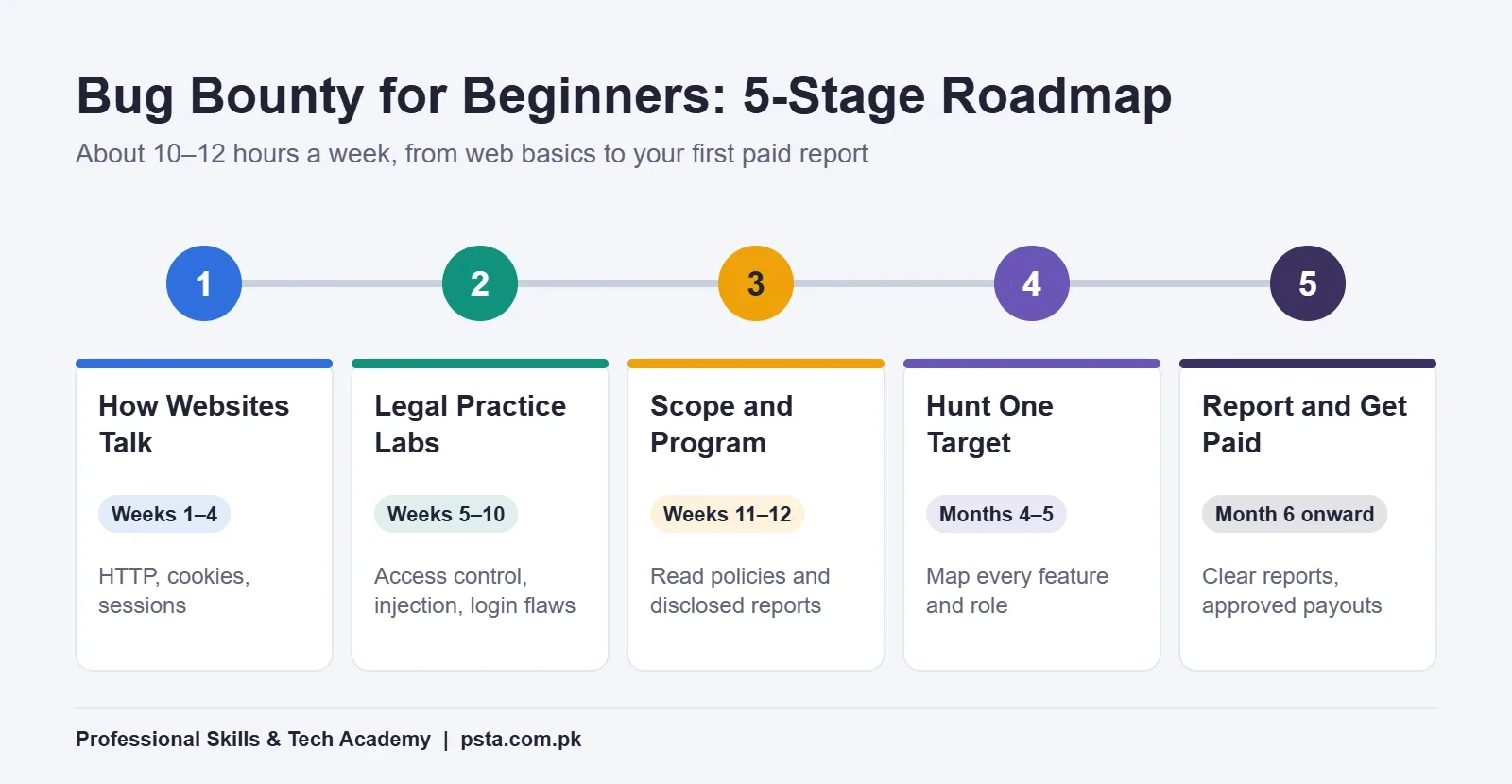
This bug bounty for beginners plan assumes about 10 to 12 hours a week, for example two hours on weekdays and a longer session on Sunday. If you already know HTTP and basic JavaScript, you can compress the first stage.
| Stage | Timeframe | Main Goal | Proof You're Ready to Move On |
|---|---|---|---|
| 1. How websites talk | Weeks 1–4 | HTTP, cookies, sessions, basic HTML and JavaScript | You can read a raw request and explain each header |
| 2. Legal practice labs | Weeks 5–10 | Solve labs on access control, injection and authentication | You've solved 40+ labs without copying the solution |
| 3. Scope and program choice | Weeks 11–12 | Read policies and disclosed reports | You've shortlisted two programs with wide scope |
| 4. Hunt one target | Months 4–5 | Map one app deeply and test its features | You have notes on every feature and user role |
| 5. Report and get paid | Month 6 onward | Write clear reports and set up payouts | Identity, tax form and payout method are approved |
Stage 1: Learn How Websites Talk (Weeks 1–4)
Every web bug lives inside a request and a response. If you can't read those comfortably, tools won't save you. Spend your first month on fundamentals that most YouTube "hacking in 10 minutes" videos skip.
- Learn HTTP methods, status codes, headers and how cookies keep a user logged in.
- Build one tiny login page in HTML, JavaScript and a simple backend, so you see how sessions work from the developer's side.
- Install Burp Suite Community Edition and watch your own browser traffic for a week.
- Get comfortable on the Linux command line: files, permissions, curl and grep.
Python helps later for small scripts, but it isn't the first priority. Reading traffic is. If you'd like a guided start, our ethical hacking lab setup checklist explains how to build a safe practice machine at home.
Stage 2: Practice on Legal Labs (Weeks 5–10)
PortSwigger's Web Security Academy is free with an account, and its labs are built for exactly this stage. Each lab gives you a deliberately broken app and a clear goal, so you learn the bug without touching anyone's real system.
For bug bounty for beginners, use the OWASP Top 10:2025 to decide what to study first. Broken Access Control sits at A01 in the 2025 list, Injection is A05 and Authentication Failures is A07. For beginners, access control is the most rewarding place to start, because it needs logic and patience more than advanced exploit skills.
A Sensible Lab Order
- Access control and IDOR: can user A see or change user B's data by editing an ID?
- Authentication: password reset flaws, weak login limits, broken 2FA logic.
- Cross-site scripting (XSS): reflected and stored first, DOM-based later.
- SQL injection: learn to recognize it, then learn why modern apps rarely have the easy versions.
Keep a notebook for every lab. Write the bug, the request that proved it and one sentence on how a developer would fix it. That notebook becomes your personal cheat sheet when you start hunting for real.
Stage 3: Read Scope Like a Contract (Weeks 11–12)
Before you test anything live, spend two weeks reading. Open ten program policies and five disclosed reports for each vulnerability class you learned. Under HackerOne's disclosure guidelines, a resolved report becomes public within 30 days by default if neither side objects, so there's a large library of real reports to learn from.
When you choose your first program, look for these signs:
- A wide scope, such as a wildcard domain, rather than one login page
- A product you can actually use, like a shop, booking site or SaaS tool with a free plan
- Clear rules on test accounts, rate limits and what counts as out of scope
- Recent activity, meaning the team still resolves and responds to reports
Skip programs that list only one heavily tested page. Experienced hunters have usually tested it many times already.
Stage 4: Hunt One Target Slowly (Months 4–5)
A frequent bug bounty for beginners mistake is jumping between ten programs in a week. That spreads your attention so thin that you only ever find the obvious issues, which someone else reported years ago. Instead, pick one target and stay with it for a month.
- Create two test accounts, and a third with a different role if the app allows it.
- Use every feature as a normal user while Burp records the traffic.
- List every request that contains an ID, a role, a price or an email address.
- Replay those requests from the other account and compare the responses.
- Write down what you tested, even when nothing breaks, so you don't repeat work.
Expect weeks without a valid finding. That's normal. Each feature you map makes the next bug easier to spot, because you start to understand how this particular team builds things.
Stage 5: Write a Report a Triager Can Reproduce
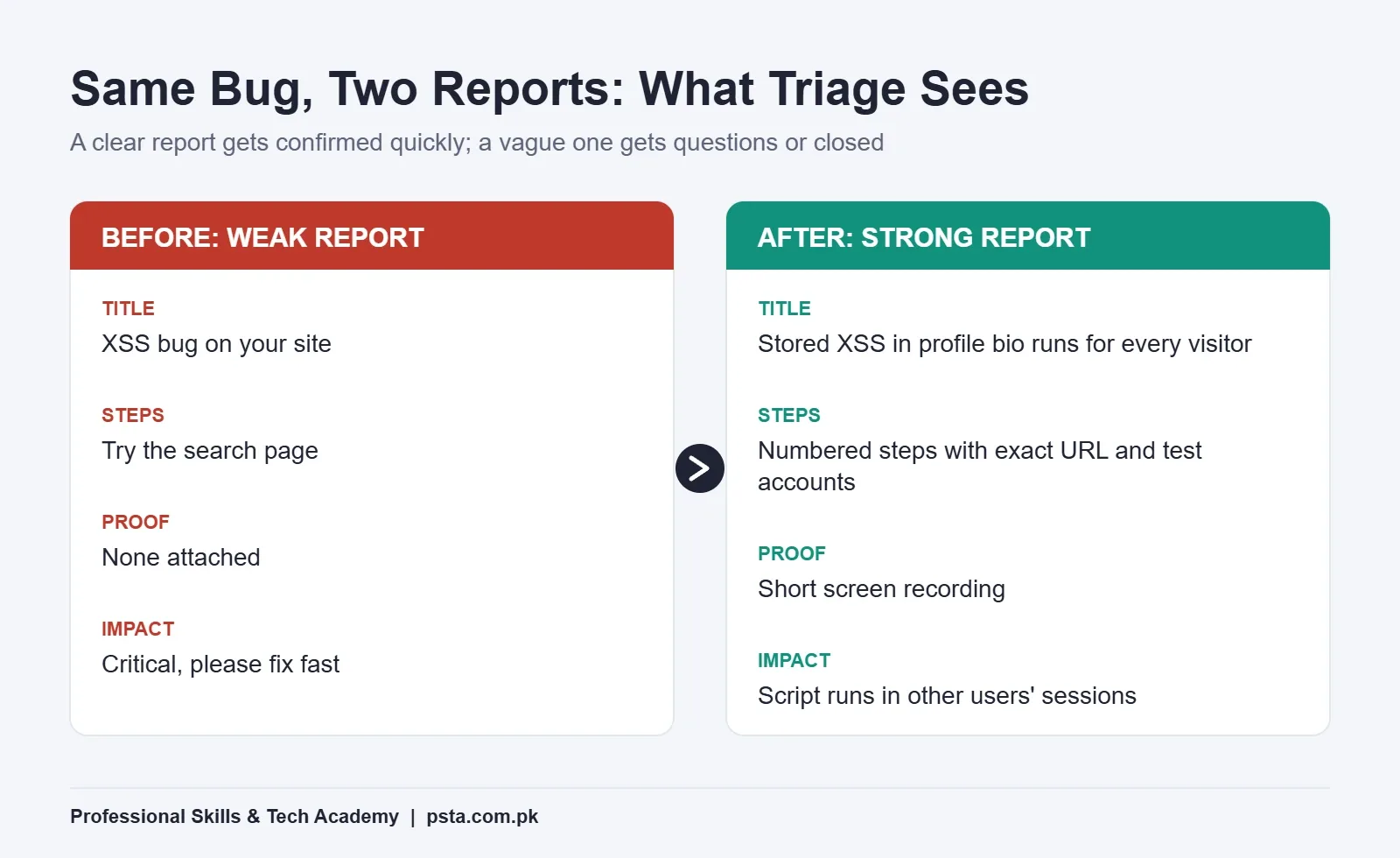
Triagers handle a steady queue of reports. If yours is vague, it gets closed or sent back with questions, and you lose time. A good report lets a stranger confirm the bug in a few minutes.
What a Strong Report Contains
- A title that names the bug, the place and the impact in one line
- Numbered steps with the exact URLs, accounts and requests used
- Proof, such as a short screen recording or a redacted screenshot
- The real-world impact in plain words, without exaggeration
- No personal data from anyone except your own test accounts
On severity, let the platform guide you. Bugcrowd's Vulnerability Rating Taxonomy rates issues from P1 (Critical) down to P5 (Informational). Claiming "critical" for a P4-style issue doesn't raise your payout. It only damages your credibility with that team.
How Do Payouts Reach a Pakistani Bank Account?
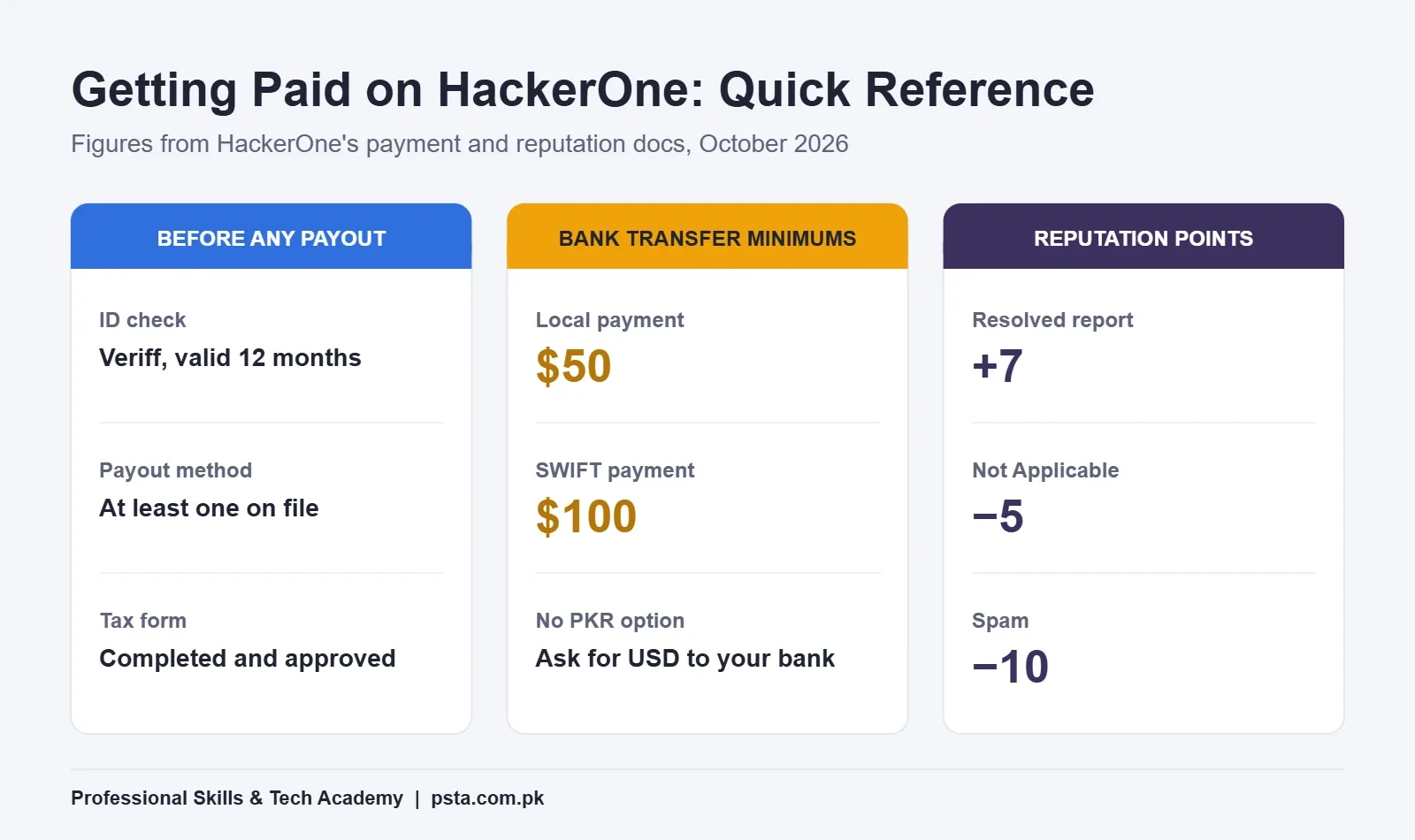
Payouts are the part of bug bounty for beginners that most Pakistani students ask about first, so plan it early. On HackerOne, the receiving payments guide lists three steps before any reward can be paid: identity verification through Veriff (valid for 12 months), at least one payout method, and an approved tax form.
HackerOne's bank transfer minimum is $50 for regular local payments and $100 for priority SWIFT payments. Pending rewards are grouped until they reach the minimum. PKR isn't in the platform's bank transfer currency table at the time of writing, but the same page says you can request USD delivery to your bank. Your bank's conversion rate will usually be less favorable than the platform's.
A few practical points to sort out before your first reward:
- The account holder name must match your own name and your tax form. Third-party accounts are not allowed, so don't use a relative's account.
- Ask your bank which documents it needs for an incoming dollar transfer before your first reward arrives.
- If you also freelance, our PSEB registration guide explains how registration affects the tax rate on IT export income.
- Treat crypto wallet payouts with extra caution, since the rules for crypto in Pakistan are still changing.
Bugcrowd works in a similar way. Its payment setup documentation lists bank transfer and PayPal, and asks you to submit a tax form after adding a payout method.
Mistakes That Quietly Damage Your Reputation
Platforms track how useful your reports are. On HackerOne, the reputation system adds 7 points for a resolved report but takes away 5 for a report closed as Not Applicable and 10 for spam. Low reputation can keep you out of private invitations, which are often where beginners find less crowded targets.
These are the habits that cost points most often:
- Submitting scanner output. An automated tool's warning is not a bug until you prove real impact.
- Ignoring the out-of-scope list. Many policies exclude issues like missing headers or self-XSS.
- Reporting known public issues. A duplicate filed after the original was disclosed loses 5 points.
- Arguing with triage. Ask one polite question, add evidence if you have it, then move on.
- Hunting while tired. Sloppy notes lead to sloppy reports. Short, focused sessions work better.
Building These Skills in PSTA's Penetration Testing Course
If you'd rather follow this path with a trainer and a fixed timetable, our Advanced Ethical Hacking and Penetration Testing course runs for 12 weeks at an intermediate level. Its modules include cyber crime law under PECA 2016, reconnaissance, Burp Suite web testing against the OWASP Top 10, and a dedicated module on setting up HackerOne and Bugcrowd profiles and writing professional reports.
The fee listed on the course page today is Rs. 30,000. You can join on our Mandian campus in Abbottabad, attend live online from anywhere in Pakistan, or mix both. If you're completely new to IT security, the Cyber Security and Ethical Hacking course covers the defensive side first, and the Advanced Python course helps when you want to script your own tools. Our guide to cyber security certifications for beginners is useful if you're also weighing an exam.
Fees for every program sit side by side on our courses page. Batch dates are on the admission page, or you can message us on WhatsApp at +92 314 5424399 with any question about the syllabus.
Your First Assignment: Read One Policy Line by Line
Before you install another tool, open one public bug bounty program and read its policy from top to bottom. Write down the in-scope assets, the banned test types and the reward table in your own words. If you can explain that policy to a friend in two minutes, you're ready to start stage one with the right mindset.
Frequently asked questions
How long does it take to earn a first bug bounty?
There is no fixed timeline and no guarantee of income. With about 10 to 12 hours of practice a week, many learners need around six months of fundamentals, lab work and careful hunting before a first valid report is realistic. Your first accepted findings may also come from disclosure programs that pay nothing but still build your platform reputation.
Do I need to know coding to start bug bounty hunting?
You don't need to be a developer, but you must read HTML, JavaScript and HTTP traffic comfortably. Building one small login page teaches you how sessions and cookies work. Python becomes useful later for automating repetitive checks, though manual testing and clear thinking matter more than scripts in the first months.
Is Kali Linux necessary for bug bounty hunting?
No. Most beginner web bugs are found with a browser, Burp Suite and patience. Kali Linux bundles many tools and is handy for a practice lab, but it doesn't find bugs for you. A normal Windows or Linux laptop with Burp Suite Community Edition is enough to complete the free PortSwigger labs.
Should a beginner join HackerOne or Bugcrowd?
Both platforms host public programs that anyone can apply to. Many beginners create accounts on each, then pick one program with a wide scope to focus on. Read each platform's payment setup before your first report, because HackerOne and Bugcrowd both require a tax form and a working payout method before rewards are released.
Can I legally test Pakistani websites for security bugs?
Only if the owner has given permission, usually through a published bug bounty or disclosure policy. Without it, testing can count as unauthorized access under the Prevention of Electronic Crimes Act 2016. Never probe a local business site to help them, however good your intentions. Ask for written permission first.
How do bug bounty payments reach a bank account in Pakistan?
HackerOne offers bank transfer, PayPal and crypto wallets. PKR isn't in its bank currency table, but you can request USD delivery to your own bank account, with a $50 local or $100 SWIFT minimum. The account name must match your own name and tax form. Check with your bank about incoming dollar transfers first.
What is a vulnerability disclosure program, and is it worth joining?
A vulnerability disclosure program, or VDP, accepts security reports but pays no cash reward. For a beginner it is still useful. Resolved reports add reputation points, show you how triage teams think and give you real examples for your portfolio, which helps when you apply for penetration testing jobs or private program invitations.
Sources & references
- HackerOne: Receiving Payments docs.hackerone.com
- HackerOne: Reputation docs.hackerone.com
- HackerOne: Vulnerability Disclosure Guidelines hackerone.com
- Bugcrowd: Vulnerability Rating Taxonomy github.com
- OWASP Top 10:2025 top10.owasp.org
- PortSwigger Web Security Academy portswigger.net
- Prevention of Electronic Crimes Act 2016 (National Assembly of Pakistan) na.gov.pk
- Profit: Rozee, Finja launch Pakistan's first bug bounty program (2018) profit.pakistantoday.com.pk
Last reviewed & updated on by Umar Qureshi. Written by the PSTA team in Abbottabad, Pakistan.

Umar Qureshi

Advanced Ethical Hacking & Penetration Testing Course in Abbottabad
Turn this guide into a career: hands-on training with real projects, online across Pakistan or on-campus in Abbottabad · 12 Weeks.
Comments
No comments yet — ask a question or share your experience.