Quick answer
The future of AI points toward agents that complete tasks, AI built into everyday software, faster science, heavy electricity demand and stricter rules. Agents still trail humans on computer tasks, and many projects will fail. For Pakistan, the biggest opportunity is applying AI in businesses and exporting AI services, not building giant models.
Key takeaways
- • Generative AI reached 53% adoption within three years, according to Stanford's 2026 AI Index.
- • AI agents scored 66.3% on the OSWorld test in 2025, still below the 72.35% human baseline.
- • Gartner expects 33% of enterprise apps to include agentic AI by 2028, but over 40% of agent projects to be scrapped by 2027.
- • The IEA expects data centre electricity use to roughly double by 2030.
- • EU high-risk AI rules now start on December 2, 2027.
- • Pakistan's AI policy sets a target of 1 million trained AI professionals by 2030.
Table of contents 18 sections
- Where AI Stands in 2026
- What Will AI Do in the Future? Eight Changes to Expect
- 1. From Chatbots to Agents
- 2. AI Built Into Everyday Software
- 3. Faster Science and Medicine
- 4. AI That Sees, Hears and Speaks
- 5. A Heavy Demand for Electricity
- 6. Rules Catching Up
- 7. Competition Between Countries
- 8. Trust, Safety and Mistakes
- Will AI Become Smarter Than Humans?
- How Will AI Agents Change Office Work?
- Known Dates and Forecasts to 2030
- Myths About the Future of AI
- What Does the Future of AI Mean for Pakistan?
- How Can You Prepare for What Comes Next?
- Preparing for What Comes Next at PSTA
- Follow One Reliable AI Source for a Month
"What will AI be able to do in five years? Should I be worried or getting ready?" Some version of that question comes up in almost every AI class. The future of AI is easier to discuss once you separate measured trends from guesses. The measured part is already striking: generative AI reached 53% population adoption within three years, according to Stanford's 2026 AI Index.
The guesses are where people get confused. Headlines swing between "AI will do everything" and "it's all hype." The evidence sits in between. It points to changes you can plan for today.
This explainer covers:
- Where AI stands in 2026, in verified numbers
- Eight changes to expect between now and 2030
- How AI agents may change office work, and where they still fail
- Common myths about what comes next
- What these trends mean for students and workers in Pakistan
Where AI Stands in 2026
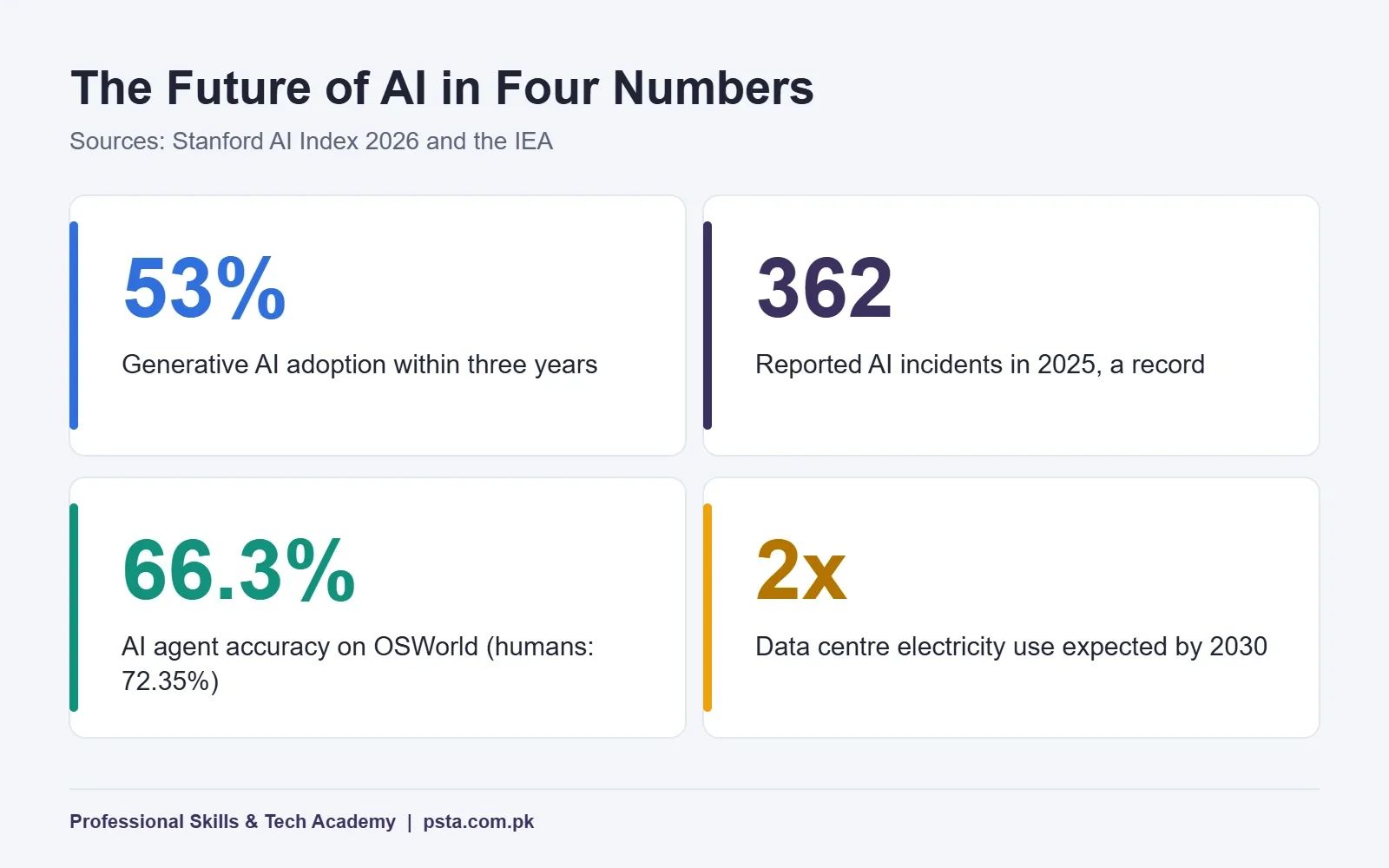
Every forecast about the future of AI needs a starting point. Stanford's 2026 AI Index Report gives one of the most careful snapshots available. It records 53% adoption of generative AI within three years, along with a record 362 reported AI incidents in 2025.
The same report tracks AI agents, which are systems that carry out tasks on a computer rather than only answering questions. On the OSWorld test, agent accuracy rose to 66.3% in 2025. That is close to, but still below, the human baseline of 72.35%. In short, agents are getting useful but are not yet as reliable as a careful person.
Money is flowing in fast. The report puts US AI investment at $285.88 billion in 2025, compared with $20.92 billion for Europe and $12.41 billion for China. On a popular comparison leaderboard, the top US model scored 1,503 and the top Chinese model scored 1,464. The gap between the two countries' best systems is narrow.
What Will AI Do in the Future? Eight Changes to Expect
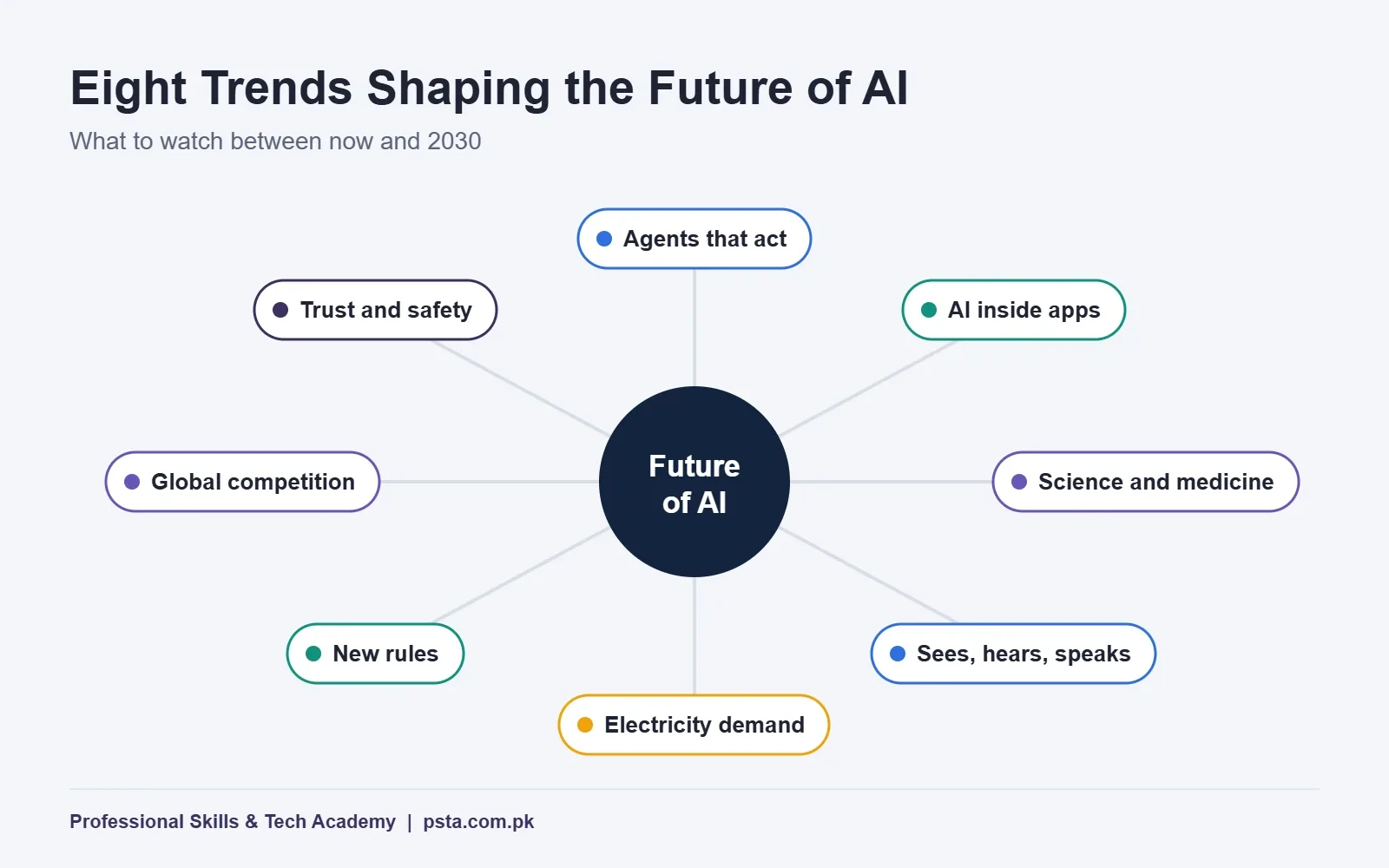
No one can predict exact dates for new breakthroughs, so any honest view of the future of AI starts with trends. The useful ones already have data, money and rules behind them. These eight AI trends are the clearest.
1. From Chatbots to Agents
Today's assistants mostly answer. The next wave acts: it books, files, fills forms and moves data between apps. Research firm Gartner predicts that by 2028, 33% of enterprise software applications will include agentic AI, up from under 1% in 2024. It also expects at least 15% of routine work decisions to be made by agents by then.
2. AI Built Into Everyday Software
You will visit AI websites less often. Instead, AI will sit inside the tools you already use, such as spreadsheets, email, design apps and accounting software. The skill that matters shifts from finding a tool to using the AI features inside your normal work.
3. Faster Science and Medicine
AI already changed one field of science in a measurable way. The 2024 Nobel Prize in Chemistry went partly to Demis Hassabis and John Jumper for AlphaFold2, which predicts protein structures. According to the Nobel committee, it has predicted the structure of nearly all of the roughly 200 million known proteins. More than two million people in 190 countries had used it by October 2024. Expect similar tools in drug discovery, materials and climate research.
4. AI That Sees, Hears and Speaks
Newer models handle text, images, audio and video together. For users, that means pointing a phone camera at a machine fault, a document or a math problem and talking through it. Stanford's report notes that models now match or beat human-level scores on some multimodal reasoning tests. Yet they still stumble on simple tasks, like reading an analog clock.
5. A Heavy Demand for Electricity
AI runs in data centres, and they use a lot of power. The International Energy Agency reports that data centre electricity demand rose 17% in 2025. It expects data centre power use to roughly double by 2030, and AI-focused data centre use to roughly triple. Energy supply may limit how fast AI spreads, especially in countries with grid problems.
6. Rules Catching Up
AI regulation is arriving, led by Europe. In the European Union, the AI Act's bans on certain practices and its AI literacy duty have applied since February 2, 2025. Rules for general-purpose models followed on August 2, 2025, according to Gibson Dunn. A follow-up law entered into force on July 27, 2026, as reported by The National Law Review. It moved the high-risk rules for areas such as hiring, education and credit to December 2, 2027.
These rules matter in Pakistan too. Freelancers and software houses that build AI products for European clients will need to meet them.
7. Competition Between Countries
The US and China lead in models, chips and spending, while other countries try to adopt AI without falling behind. Pakistan's approach, set out in the National AI Policy 2025, focuses on training and adoption, which we cover below.
8. Trust, Safety and Mistakes
More use means more failures. The rise in reported incidents to 362 in 2025 is a reminder that AI errors reach real people. Expect more demand for testing, audits, security and human review, which also creates new kinds of work.
Will AI Become Smarter Than Humans?
This is one of the most common questions about the future of AI, and nobody can answer it with certainty. Researchers and company leaders disagree openly about whether, and when, AI will match people across most tasks.
The current evidence shows an uneven picture. Stanford's 2026 report describes models that reach human-level scores on PhD-level science questions and competition mathematics. The same models can fail at reading an analog clock, and agents still fall short of people on everyday computer tasks. Analysts call this a "jagged frontier."
For planning your career, that unevenness is the useful part. AI will be very strong at some tasks in your job and weak at others. Your value comes from knowing which is which, and from handling the parts it gets wrong.
How Will AI Agents Change Office Work?
Agents are the change most likely to reach your desk first. Today you ask an assistant to draft an email. Soon you could ask an agent to read a supplier's message, check stock in a sheet, draft a reply and log the order. Each step still needs clear rules and a person to approve anything risky.
Expect a bumpy start. Gartner also predicts that over 40% of agentic AI projects will be scrapped by the end of 2027. The main reasons are rising costs, unclear business value and weak risk controls. It estimates that only about 130 of the thousands of vendors selling "agentic" products offer the real thing.
For workers, the practical lesson is to learn how workflows are designed. People who can map a process, set the rules and check the results will be needed whether a given agent project succeeds or not. Our guide to AI skills for jobs sets out a 90-day plan for building exactly that.
Known Dates and Forecasts to 2030
Some items below are fixed legal dates. Others are forecasts and may change. The table labels each one.
| When | What | Type |
|---|---|---|
| Feb 2025 | EU AI Act bans and AI literacy duty apply | Law in force |
| Aug 2025 | EU rules for general-purpose AI models apply | Law in force |
| Dec 2027 | EU high-risk rules for hiring, education and credit | Legal deadline |
| End of 2027 | Over 40% of agentic AI projects scrapped | Gartner forecast |
| 2028 | 33% of enterprise apps include agentic AI | Gartner forecast |
| 2030 | Data centre electricity use roughly doubles | IEA projection |
| 2030 | Pakistan's target of 1 million trained AI professionals | Government target |
Myths About the Future of AI
Big claims spread quickly on social media. Here is how four popular ones compare with the evidence.
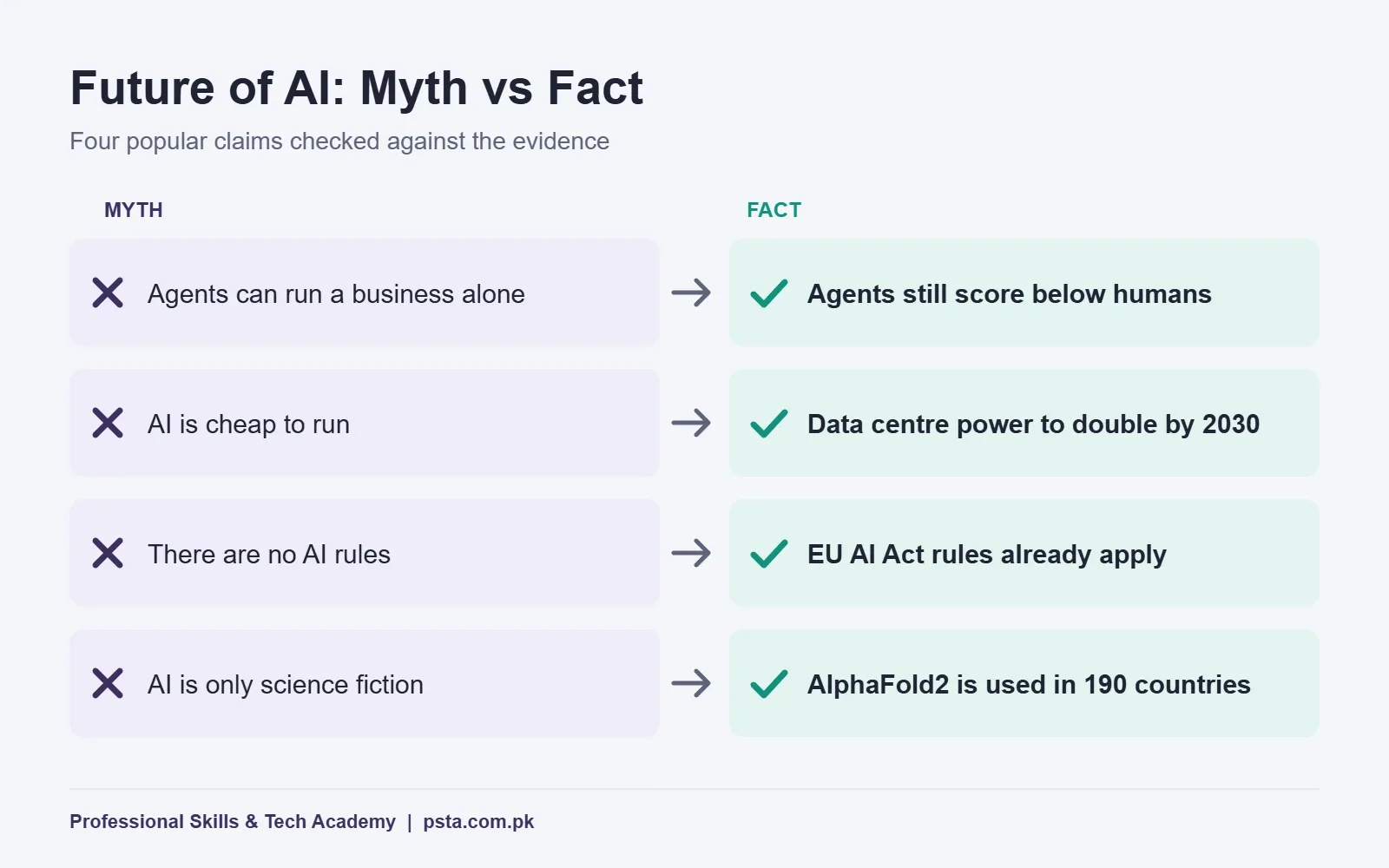
- Myth: AI agents can already run a business alone. Fact: on OSWorld, agents still score below the human baseline, and Gartner expects many agent projects to be cancelled.
- Myth: AI is cheap to run. Fact: the IEA expects data centre electricity use to roughly double by 2030.
- Myth: there are no rules for AI. Fact: parts of the EU AI Act already apply, with more deadlines set for 2027 and 2028.
- Myth: AI only matters in science fiction. Fact: AlphaFold2 earned a share of a Nobel Prize and is used in 190 countries.
What Does the Future of AI Mean for Pakistan?
When it comes to AI in Pakistan, the country is mostly a user rather than a builder of the largest models, and that shapes the opportunities. Islamabad set its direction when the federal cabinet signed off on the National AI Policy 2025. The Express Tribune reported its goals for 2030: 1 million trained AI professionals, 3,000 scholarships every year and 50,000 AI-related projects.
Three practical points stand out for students and workers here:
- Applying AI is the main opportunity. Most local jobs will come from using AI inside businesses, such as automating customer replies, reports and document handling, rather than training giant models.
- Power and internet reliability matter. Since AI depends on data centres and connectivity, offline backups and cloud-based tools will shape how businesses adopt it.
- Exporting AI services is realistic. Freelancers who set up automations, chatbots and secure AI workflows for foreign clients can compete on skill. They will also need to understand rules like the EU AI Act.
For a data-led view of which local jobs feel pressure first, read our report Will AI Replace Jobs in Pakistan?
How Can You Prepare for What Comes Next?
You can't control the pace of AI research, but you can control how ready you are. Five steps cover most of it:
- Use AI weekly on real tasks. Familiarity beats theory. Our review of free AI tools shows where to start at no cost.
- Learn how workflows connect. Agents are workflows with a model inside. Understanding triggers, steps and approvals prepares you for them.
- Get comfortable with data. Clean sheets and clear reports make every AI tool more useful.
- Take security seriously. As AI handles more data, people who understand access, privacy and attacks become more valuable. PSTA's Cyber Security course covers that ground.
- Follow evidence, not hype. Read one solid annual report, such as the AI Index, instead of ten viral threads.
Preparing for What Comes Next at PSTA
Agents and automation are where AI is heading. So the most useful training now is the kind that teaches you to build them. The AI Automation course at PSTA lasts 8 weeks and is pitched at beginners. Its fee is Rs. 22,000, reduced from a regular Rs. 28,000, and it can be paid in 2 installments.
The modules start with core AI and machine learning ideas. They then cover no-code platforms like n8n, Make and Zapier, document reading with OCR, LLM chatbots, AI API integrations and agentic AI design. It ends with a multi-step agent project and a module on ethical deployment. You can join in person in Abbottabad, live online or in hybrid mode, and batches start every month.
If you want to write your own AI scripts later, the Advanced Python course is the next step. Compare options on the courses page, or go straight to admission when you're ready. Batch questions are answered on WhatsApp (+92 314 5424399), and in-person visitors can find the academy opposite FIMS College, Old College Road, Mandian.
Follow One Reliable AI Source for a Month
Pick one trusted source, such as the Stanford AI Index or a research lab's official blog. Read one update from it each week for the next month. Write one line after each: what changed, and how it could affect your field. By the fourth week, you will have your own grounded view of the future of AI, one that no viral headline can shake.
Frequently asked questions
What is the future of AI in simple words?
AI is moving from tools that answer questions to systems that complete tasks, called agents. It will be built into the apps you already use, speed up research in science and medicine, and need far more electricity. Governments are also adding rules. Expect gradual change in most jobs rather than overnight replacement.
Will AI agents replace office staff by 2030?
Not completely. Stanford's 2026 AI Index shows agents scoring 66.3% on the OSWorld computer-task test, below the 72.35% human baseline. Gartner expects over 40% of agent projects to be scrapped by 2027. Agents will take over routine steps, while people set the rules, check results and handle exceptions.
Does the EU AI Act affect people in Pakistan?
It can. The law applies to AI systems used in the European Union, so Pakistani software houses and freelancers serving EU clients need to follow it. Some parts already apply, and high-risk rules for areas such as hiring, education and credit start on December 2, 2027, after a 2026 amendment.
What is Pakistan doing about AI?
Pakistan's main plan is the National AI Policy 2025, cleared by the federal cabinet in July 2025. Its 2030 goals include 1 million trained professionals, 3,000 yearly scholarships and 50,000 AI-related projects. Real progress will depend on funding, training quality, and steady power and internet across the country.
Which AI skills will matter most in the future?
Skills that sit around AI tools will matter most: giving clear instructions, checking output, working with data, designing simple workflows and keeping systems secure. These transfer from one tool to the next, so they stay useful even as specific apps change. Start with the tools you already use at work or university.
Is AI bad for the environment?
AI has a real energy cost. The IEA reports that data centre electricity demand rose 17% in 2025 and expects it to roughly double by 2030. Companies are signing renewable power deals, but energy supply may limit how fast AI spreads. Using AI for useful work, not idle experiments, is a reasonable habit.
Sources & references
- Stanford HAI: The 2026 AI Index Report hai.stanford.edu
- IEA: Data centre electricity use surged in 2025 iea.org
- Gartner: Over 40% of agentic AI projects will be canceled by end of 2027 gartner.com
- NobelPrize.org: The Nobel Prize in Chemistry 2024, popular information nobelprize.org
- Gibson Dunn: EU AI Act Omnibus Agreement gibsondunn.com
- The National Law Review: EU Digital Omnibus on AI enters into force natlawreview.com
- The Express Tribune: Cabinet approves national AI policy tribune.com.pk
Last reviewed & updated on by Umar Qureshi. Written by the PSTA team in Abbottabad, Pakistan.

Umar Qureshi

AI Automation Course: Beginner to Pro (Dominate Workflows)
Turn this guide into a career: hands-on training with real projects, online across Pakistan or on-campus in Abbottabad · 8 Weeks.
Comments
No comments yet — ask a question or share your experience.