Quick answer
AI mostly changes jobs before it replaces them. The ILO finds one in four workers has some generative AI exposure, but only 3.3% sit in the highest group. For Pakistan, the World Bank warns that educated youth face the most risk, and entry-level hiring is already slowing. Learning to use and check AI tools is your best protection.
Key takeaways
- • One in four workers worldwide has some generative AI exposure, but the ILO expects most jobs to be transformed rather than erased.
- • The World Bank's 2026 report says educated young people in countries like Pakistan face the greatest risk.
- • AI takes tasks first, so hiring slows and entry-level roles shrink before layoffs appear.
- • Clerical work, data entry, basic writing and template design face the most pressure.
- • Data, AI, software and security roles are among the fastest growing to 2030.
- • Audit your weekly tasks, automate one yourself and keep proof of the results.
Table of contents 12 sections
- Will AI Replace Jobs, or Mostly Change Them?
- What the World Bank's 2026 Report Says About Pakistan
- How AI Actually Replaces Work: Tasks First, Then Roles
- Which Jobs in Pakistan Face the Most Pressure?
- Early Signs From Pakistan's Tech Sector
- Where New Work Is Growing
- How Can You Protect Your Career From AI?
- If You Are a Student or Fresh Graduate
- If You Run a Small Business
- Five Myths That Make People Panic
- Building AI Skills at PSTA
- Spend 20 Minutes Auditing Your Own Job
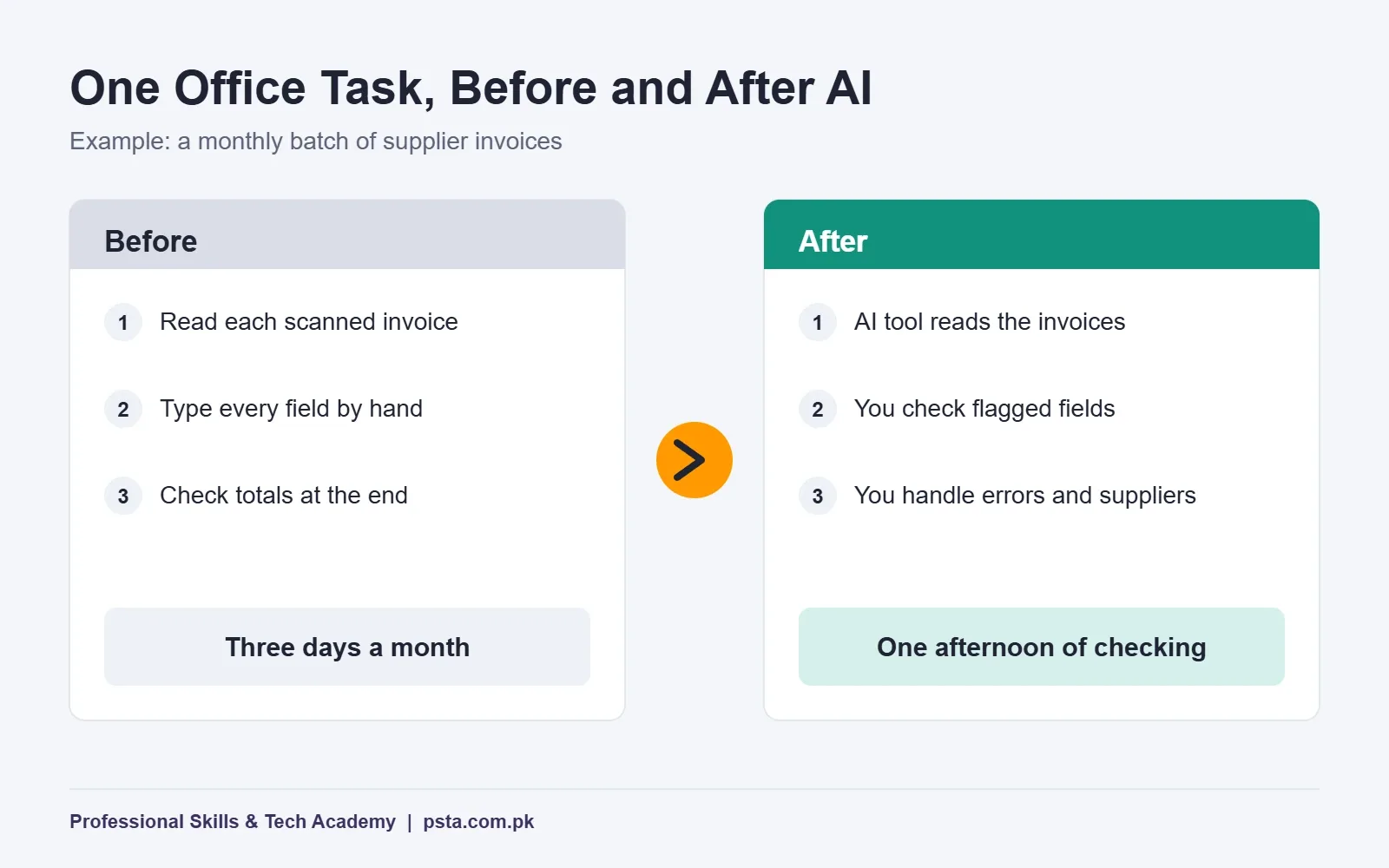
Here is a realistic example to test the question "will AI replace jobs" against. Sana, a data entry assistant at a Rawalpindi distributor, spends three days each month typing supplier invoices into Excel. Her manager tries an AI tool that reads scanned invoices, and the same batch now takes her one afternoon of checking. Sana keeps her job. The second assistant her manager planned to hire is never hired.
That small story matches what the research shows so far. AI rarely deletes a whole job overnight. It takes over tasks, so companies need fewer new people for the same output, and entry-level openings shrink first. The good news is that the people who learn to direct and check these tools are the ones employers keep.
This report covers:
- What the ILO, the World Bank and the World Economic Forum found about the AI impact on jobs
- How replacement actually happens, task by task
- Which kinds of work in Pakistan face the most pressure, and which are growing
- Early warning signs from Pakistan's own software industry
- Six practical moves to protect your income over the next year
Will AI Replace Jobs, or Mostly Change Them?
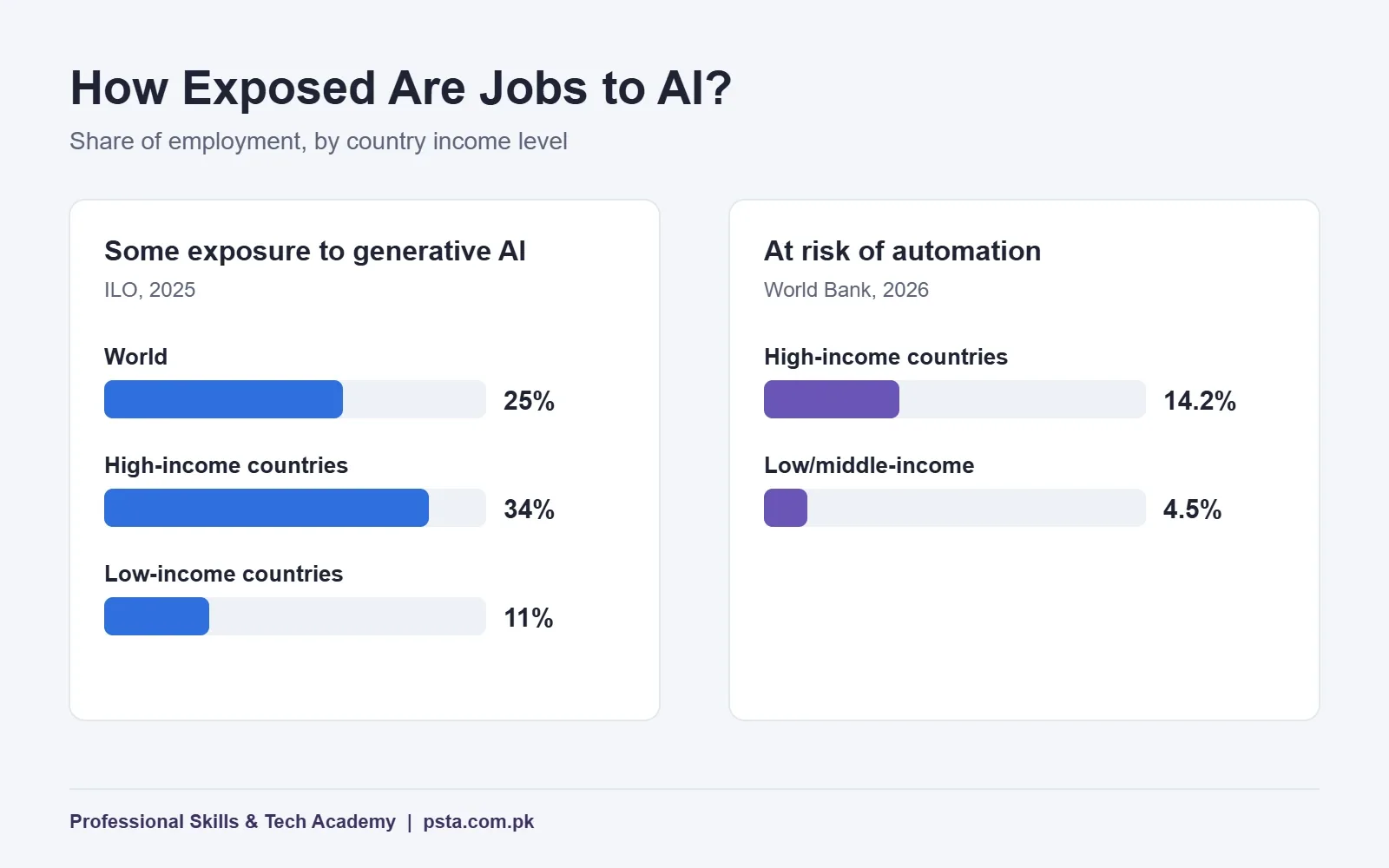
For most people, the honest answer is change first and replace later, if at all. The ILO published a 2025 update on generative AI and jobs. It says one in four workers worldwide is in an occupation with some exposure to generative AI. Exposure means AI can do part of the work. It does not mean the job disappears.
The same ILO team scored nearly 30,000 tasks. Their working paper puts only 3.3% of global employment in the highest exposure group. Clerical occupations remain the most exposed. The paper concludes that transformation of jobs is the most likely result, because most roles still contain tasks that need a person.
Exposure also depends on where you live. The ILO measures it at 34% of employment in high-income countries and 11% in low-income countries. Women are more exposed than men. Globally, 4.7% of women's jobs sit in the top exposure group, compared with 2.4% of men's.
What the World Bank's 2026 Report Says About Pakistan
The World Bank published its World Development Report 2026: The Promise of Artificial Intelligence in August 2026. As reported by Business Recorder, it estimates that 14.2% of jobs in high-income countries are at risk of automation by generative AI. In low- and middle-income countries, the figure is 4.5%.
So will AI replace jobs here more slowly than in rich countries? The numbers suggest yes, but the report adds two warnings that matter for Pakistan. First, it groups Pakistan with countries that are especially vulnerable because youth unemployment is already high and the private sector creates few quality jobs. Second, it says educated young people face the greatest risk, since AI now handles more knowledge-based tasks.
There is an upside too. The report estimates that AI could raise productivity in 16.2% of jobs in developing economies, close to the 18.7% figure for rich countries. Its advice to governments is to adopt existing tools first, adapt them to local needs, and only then try to build new AI.
How AI Actually Replaces Work: Tasks First, Then Roles
Replacement usually follows a pattern. You can spot each stage before it reaches your desk.
- A tool takes one task. Drafting an email, reading an invoice or writing a first version of code now takes minutes.
- The person becomes a checker. Staff spend less time producing and more time reviewing what the tool produced.
- Hiring slows. The team handles more work with the same headcount, so the next vacancy is delayed or dropped.
- Junior roles shrink. The simple tasks that used to train new staff are the first to be automated.
- The role is redesigned. Remaining jobs ask for tool skills, judgment and client contact.
Stage four is already visible in data from the United States. Researchers at the Stanford Digital Economy Lab found a 13% relative fall in employment for workers aged 22 to 25 in the most AI-exposed occupations. Older workers in the same fields held steady or grew. The losses clustered where AI automates work, not where it assists people.
Which Jobs in Pakistan Face the Most Pressure?
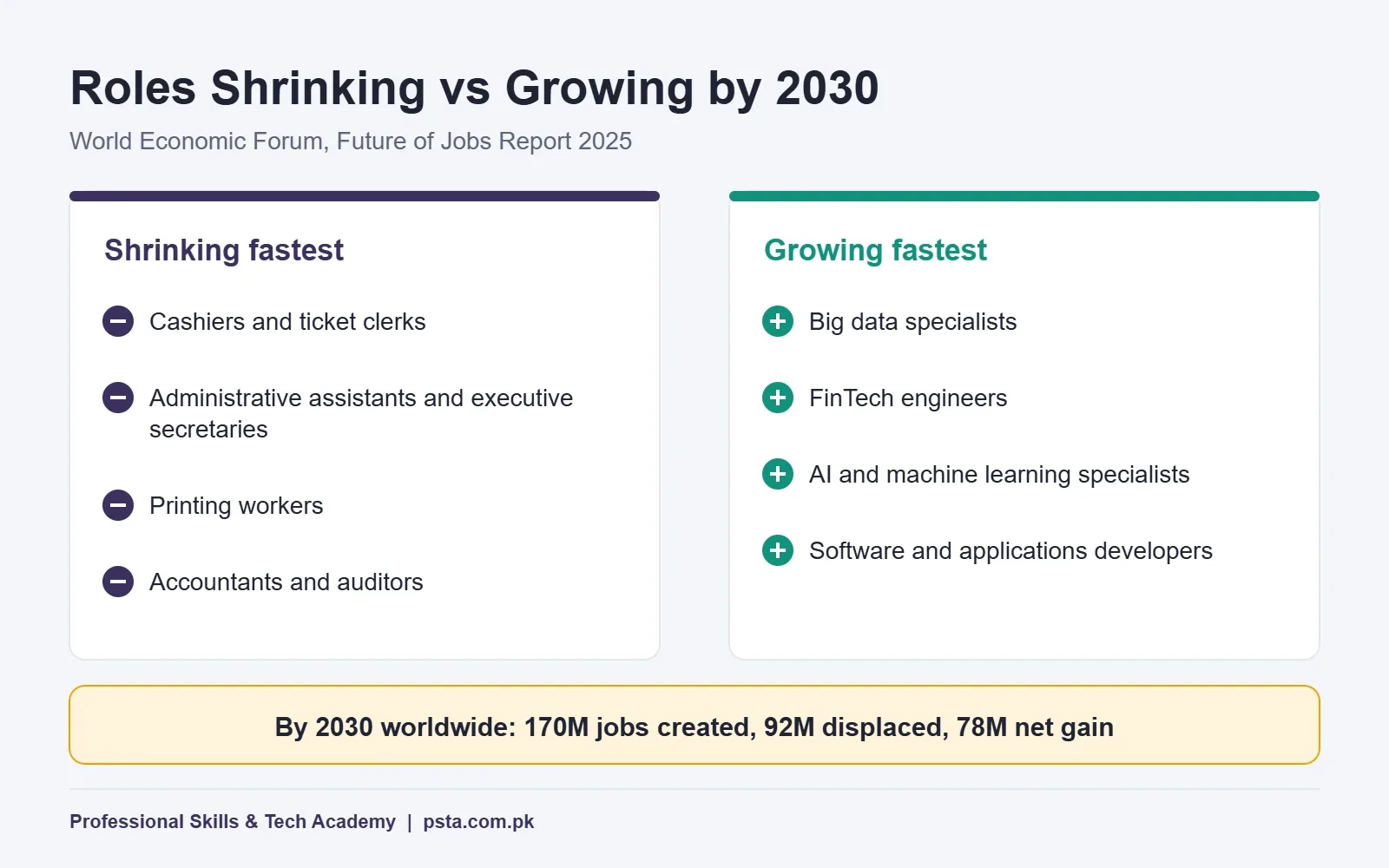
The World Economic Forum's Future of Jobs Report 2025 lists the roles employers expect to shrink fastest by 2030. Cashiers and ticket clerks, administrative assistants and executive secretaries, printing workers, and accountants and auditors are all on it. Graphic designers and legal secretaries sit just outside the top 10, the first time the report has flagged creative work this way.
So where will AI replace jobs first in Pakistan? Look for roles built on routine text and data, which are the jobs at risk from AI soonest. The table below applies that thinking to common Pakistani roles. It is a practical guide based on the tasks involved, not a forecast or a statistic.
| Role | Tasks AI already handles | Work that stays with people | Best next skill |
|---|---|---|---|
| Data entry operator | Reading forms, typing fields, basic checks | Handling errors, missing data, vendor follow-up | Excel automation, OCR workflows |
| Call center agent | Common questions, order status, scripted replies | Complaints, refunds, upset customers | Chatbot setup and escalation design |
| Content writer | First drafts, rewrites, basic translation | Research, interviews, brand voice, fact checks | SEO strategy, editing, original reporting |
| Junior developer | Boilerplate code, simple pages, test cases | System design, debugging, security reviews | Code review, cloud, testing with AI tools |
| Graphic designer | Social posts from templates, resizing, mockups | Brand systems, client briefs, print production | Art direction, motion, UI design |
| Accounts assistant | Invoice matching, simple reconciliations | Tax judgment, audits, client advice | Power BI reporting, ERP skills |
Notice the pattern in the third column. The work that remains involves exceptions, responsibility and other people. A tool can draft a reply to an angry customer, but someone still has to decide on the refund.
Early Signs From Pakistan's Tech Sector
An August 2026 ProPakistani report cites figures from the Pakistan Software Houses Association (P@SHA). Entry-level hiring at major tech companies fell about 25%. Employment of software developers aged 22 to 25 fell nearly 20% since 2024. Entry-level projects dropped from about 15% of freelance listings to below 9%, and basic writing and translation work fell 32% in a year.
Treat these numbers with care. The article does not publish P@SHA's method or sample, and part of the slowdown may come from cost cutting rather than AI alone. Still, the direction matches the Stanford findings: fewer doors open for beginners.
The same report shows the other side. IT and telecom export earnings reached a record Rs. 1.2 trillion in FY2025-26, up 20.6%. Companies are still growing. They want people who already work well with AI tools.
Where New Work Is Growing
Now look at the future of jobs 2030 as a whole. The WEF expects 170 million jobs to be created and 92 million displaced worldwide by 2030. That leaves a net gain of 78 million. AI and information processing alone are expected to create 11 million jobs and displace 9 million.
The fastest-growing roles in that report include big data specialists, fintech engineers, AI and machine learning specialists, and software and applications developers. Security management specialists and information security analysts also rank high.
At home, Federal IT Minister Shaza Fatima Khawaja has spoken about the National AI Policy 2025. According to ProPakistani, it aims to create 3 million AI-related jobs by 2030. A target is not a result, but it signals where training money and hiring attention will go.
How Can You Protect Your Career From AI?
You don't need to become an AI engineer. You need to be the person on your team who gets more done with these tools and can be trusted to check them. Here are six moves, in order.
- Audit your own week. List every task you did last week. Mark the ones that follow fixed rules or produce text from a template. Those are the tasks AI will reach first.
- Automate one of them yourself. Use a free assistant to draft, summarize or sort that task. When you automate your own work, you become the expert on the new process.
- Get good at checking output. AI tools make confident mistakes. Being the reliable reviewer of numbers, facts and code is a skill employers pay for.
- Add one technical layer. Pick one: workflow automation with tools like n8n or Make, data reporting with Power BI, or cyber security basics. Each one connects directly to growing roles.
- Move toward people work. Ask for tasks that involve clients, training juniors or handling exceptions. Responsibility is hard to automate.
- Keep proof of your results. Write each improvement as a short before-and-after note. For example: "monthly report cut from two days to three hours." A note like that is stronger than any certificate on your CV.
If You Are a Student or Fresh Graduate
Entry-level jobs feel the pressure first. Your plan needs to be sharper than your seniors' was, and the AI skills to learn are practical ones. Build two or three small projects that solve a real problem with AI, then explain what you checked and fixed. Our earlier guide on IT skills in demand in Pakistan shows which skills local companies list in their job ads. For automation starters, see these n8n project ideas.
If You Run a Small Business
Start with tasks that eat staff time but add little value. Copying leads into sheets is one. Answering the same WhatsApp question 50 times a day is another. Automate those, then move the freed hours into sales and service. Done this way, AI helps you grow without cutting the team you trained.
Five Myths That Make People Panic
A lot of the fear comes from claims that don't match the evidence. Keep these in mind when the next viral post appears.
- "AI will take every job within a few years." The ILO places 3.3% of global jobs in its highest exposure group. Most work will change, not vanish.
- "Only factory jobs are at risk." Generative AI affects office and knowledge work most. Clerical roles top the ILO's list.
- "Skilled people are safe." The World Bank flags educated young people as the group at greatest risk.
- "Learning AI means learning to code." Many useful AI skills, such as prompting, checking and no-code automation, need no programming.
- "There is nothing you can do." Start testing tools on your own tasks this week. That puts you in charge of how your role changes.
Building AI Skills at PSTA
If you want structured practice, PSTA's AI Automation course is built for people without a coding background. Here are the details from the course page:
- Length and level: 8 weeks, beginner level
- Fee: Rs. 22,000 (regular Rs. 28,000), payable in 2 installments
- Tools covered: n8n, Make and Zapier, plus the OpenAI API, OCR for documents and LLM chatbots for WhatsApp and websites
- Projects: a lead follow-up workflow, an invoice reader, a WhatsApp support bot and a multi-step AI agent
- Study mode: campus classes in Abbottabad, live online, or hybrid
- Start dates: a new batch each month
Learners who want to write their own scripts often continue with the Advanced Python course. Marketers can pair automation with the Advanced Digital Marketing course. For a week-by-week plan, read our AI automation roadmap. You can compare fees on the courses page or apply through admission. Send timing questions to WhatsApp at +92 314 5424399. You can also drop in at our Mandian campus, which sits opposite FIMS College on Old College Road.
Spend 20 Minutes Auditing Your Own Job
Tonight, open a blank page and write down ten tasks from your normal week. Label each one "AI drafts it," "AI helps" or "needs me." Pick one task from the first group and try a free AI tool on it tomorrow. Will AI replace jobs like yours? That single test will tell you more than any headline.
Frequently asked questions
Will AI replace jobs in Pakistan within the next five years?
Some tasks will move to AI quickly, especially data entry, basic writing and template design. Whole jobs disappearing is less common. The World Bank estimates 4.5% of jobs in low- and middle-income countries are at risk of automation by generative AI. The bigger near-term effect is slower hiring for beginners, so freshers should build AI-ready skills now.
Which jobs are hardest for AI to take over?
Work that mixes judgment, responsibility and dealing with people is hardest to automate. Examples include technicians who install and repair equipment, teachers and trainers, nurses, sales staff who manage client relationships, and managers who make final decisions. Even in these roles, people who use AI for paperwork and planning will work faster than those who don't.
Is computer science still worth studying if AI can write code?
Yes, but the target has moved. AI can produce simple code, so employers now value people who can design systems, review AI output, find bugs and keep software secure. The WEF still lists software and applications developers among the fastest-growing roles. Pair your degree with real projects and learn to use coding assistants critically.
Can AI replace freelancers on Fiverr and Upwork?
It is replacing some low-cost gigs. A P@SHA report cited by ProPakistani says basic writing and translation work fell 32% in a year. Freelancers who offer outcomes, such as automation setups, data dashboards or full marketing campaigns, face less pressure than those who sell single, simple deliverables.
Do I need to learn coding to build AI skills?
No. Many valuable AI skills need no programming. You can learn to write clear prompts, check AI answers, and build automations with no-code tools such as n8n, Make and Zapier. Coding helps later, for example Python for custom scripts, but it is not the entry ticket.
Are women's jobs more exposed to AI than men's?
Globally, yes. The ILO's 2025 analysis places 4.7% of women's employment in the highest exposure group, compared with 2.4% of men's. The gap is wider in rich countries. Women in clerical and admin roles should give priority to upskilling, especially in automation, data and customer-facing skills.
How long does it take to learn useful AI automation skills?
A focused beginner can learn the basics of workflow automation in about two months. PSTA's AI Automation course runs for 8 weeks and covers n8n, Make, Zapier, OCR and chatbots through real projects. After that, regular practice on your own work tasks matters more than any extra certificate.
Sources & references
- ILO: Generative AI and Jobs, 2025 Update ilo.org
- ILO Working Paper 140: A Refined Global Index of Occupational Exposure ilo.org
- World Bank: World Development Report 2026, The Promise of Artificial Intelligence ppp.worldbank.org
- Business Recorder: AI adoption may hit Pakistan's job market, World Bank warns brecorder.com
- World Economic Forum: Future of Jobs Report 2025, Jobs Outlook weforum.org
- Stanford Digital Economy Lab: Canaries in the Coal Mine digitaleconomy.stanford.edu
- ProPakistani: AI is ending junior tech jobs in Pakistan propakistani.pk
Last reviewed & updated on by Umar Qureshi. Written by the PSTA team in Abbottabad, Pakistan.

Umar Qureshi

AI Automation Course: Beginner to Pro (Dominate Workflows)
Turn this guide into a career: hands-on training with real projects, online across Pakistan or on-campus in Abbottabad · 8 Weeks.
Comments
No comments yet — ask a question or share your experience.