Quick answer
Modal verbs in English (can, could, may, might, must, shall, should, will, would) add meanings like ability, permission, advice, obligation or certainty to a main verb. They never take -s, -ing or -ed, and the next verb stays in base form without to. For past guesses, use must have, might have or can't have.
Key takeaways
- • Modals never change form: no -s, -ing or -ed, and the next verb is always the base form.
- • Should gives advice, have to is the everyday word for duties, and must sounds stronger and more formal.
- • Mustn't means forbidden; don't have to means optional.
- • For guesses, use must (sure), might or may (possible) and can't (impossible).
- • Modal + have + past participle talks about the past: must have, should have, could have.
Table of contents 14 sections
- Modal Verbs in English: The Rules That Never Change
- What Are the Main Modal Verbs and Their Jobs?
- Ability and Permission: Can, Could and May
- Talking About Ability
- Asking For and Giving Permission
- Advice and Obligation: Should, Must and Have To
- Mustn't or Don't Have To: What's the Difference?
- How Sure Are You? Modals for Guessing About the Present
- Talking About the Past: Must Have, Should Have and Could Have
- Polite Requests and Offers With Would, Could and Shall
- Seven Modal Mistakes Pakistani Learners Make
- Practice: Fix These 8 Sentences
- Building Modal Habits in PSTA's English Course
- Say Three Sentences Before Bed
Quick test before you read on. Which sentence is correct: "She can speaks three languages" or "She can speak three languages"? If you chose the second one, you already know the most important rule of modal verbs in English: the verb after a modal stays in its plain base form. Everything else in this guide builds on that one habit.
Here is what you will be able to do by the end:
- Name the main modal verbs and the job each one does in a sentence.
- Pick between must, have to and should without guessing.
- Tell the difference between mustn't and don't have to, which many learners mix up.
- Make guesses about the present and the past with must, might and can't.
- Spot and fix the seven modal mistakes that show up most in emails, exams and interviews.
Modal Verbs in English: The Rules That Never Change
Modal verbs are helping verbs. They sit in front of a main verb and add a shade of meaning, such as ability, permission, advice, obligation or how sure you are. The verb that carries the action comes after them.
The Cambridge Dictionary blog's guide to modal basics lists the main ones as can, could, may, might, must, ought, shall, will and would, and it points out that modals "do not inflect". In practice, that gives you four fixed rules:
- No -s for he, she or it. Say "He can drive", never "He cans drive".
- Base verb after the modal, with no "to". Say "We could leave early", not "We could to leave". The one exception is ought: "You ought to rest."
- No "do" in questions and negatives. Move the modal to the front for a question ("Can you hear me?") and add not or n't for a negative ("I can't hear you").
- No -ing or -ed forms. You can't say "musting" or "shoulded". For other tenses, you borrow a phrase such as had to or was able to.
Once these four rules are automatic, most of your modal errors disappear. The rest of the work is choosing the right modal for the meaning you want.
What Are the Main Modal Verbs and Their Jobs?
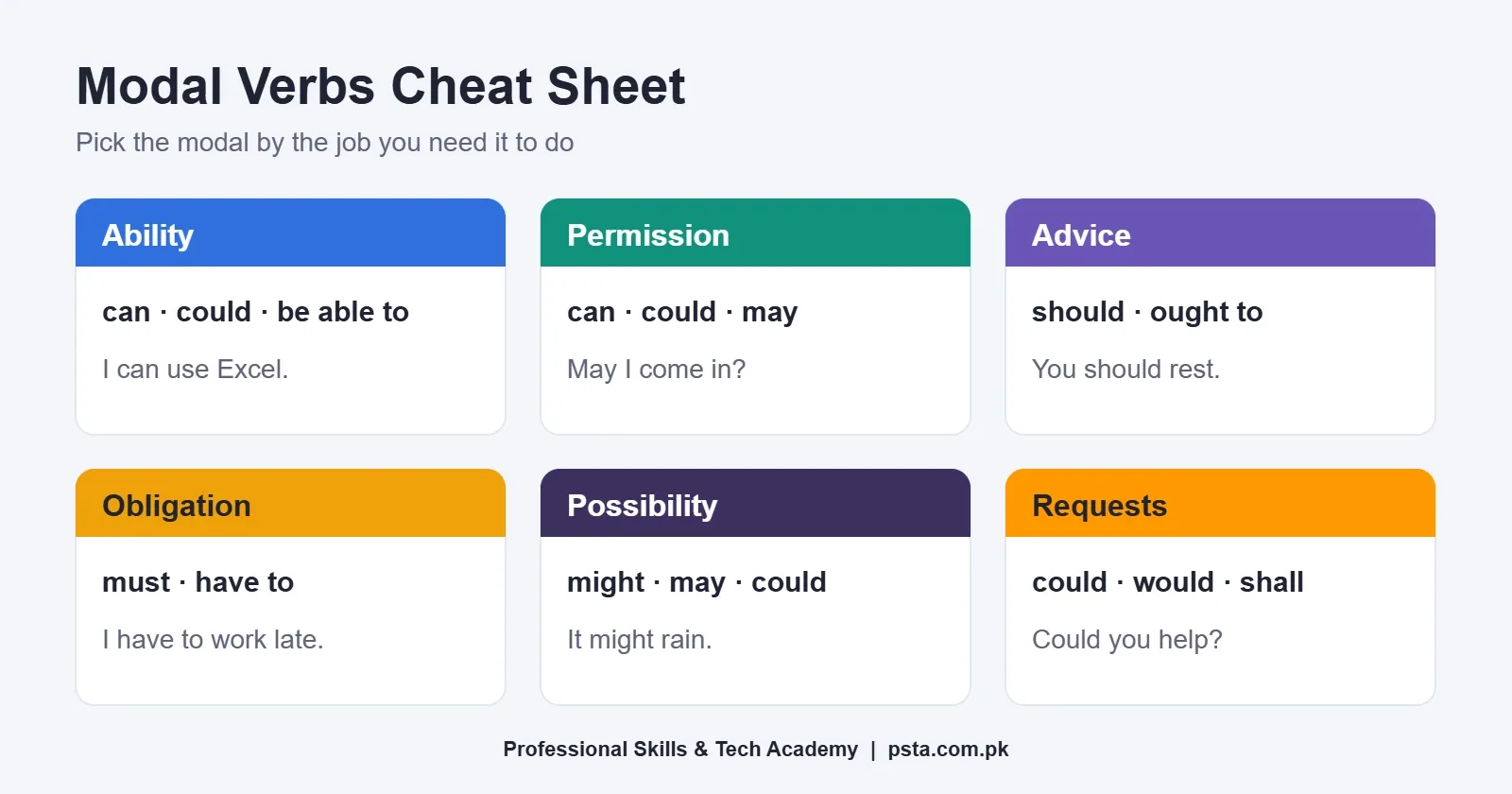
Most modal verbs in English can do more than one job, and the job changes with context. This table of modal verbs with examples groups the common ones by what they usually mean in everyday English.
| Modal | Main jobs | Example |
|---|---|---|
| can | Ability, permission, possibility | I can type 40 words a minute. |
| could | Past ability, polite request, possibility | Could you send the file again? |
| may | Formal permission, possibility | You may submit the form online. |
| might | Weaker possibility | The meeting might start late. |
| must | Strong obligation, strong certainty | Applicants must bring a copy of their CNIC. |
| should / ought to | Advice, expectation | You should check the deadline today. |
| will / would | Future, willingness, polite requests, conditions | Would you like some tea? |
| shall | Offers and suggestions with I or we | Shall we start the meeting? |
Notice that have to and need to are not true modals. They behave like normal verbs (he has to, she doesn't need to), but you will use them alongside modals all the time, so this guide covers them too.
Ability and Permission: Can, Could and May
Talking About Ability
For ability, use can and could: can for ability now and could for general ability in the past: "I can use Excel formulas" and "I could read Urdu before I started school". For one specific success in the past, English prefers was able to or managed to: "The server crashed, but we were able to recover the data."
Because modals have no future form, you also need be able to for the future: "After this course, you will be able to write a formal email." A Yale Poorvu Center handout on modal verbs gives the same substitutes: wasn't able to for the past and will be able to for the future.
Asking For and Giving Permission
Can is normal in daily speech: "Can I sit here?" Could sounds a little softer. May is the most formal choice, and you will see it on notices and in official letters: "Candidates may leave after 30 minutes." In a job interview, "May I ask a question about the role?" sounds polite and confident.
Advice and Obligation: Should, Must and Have To
These three are where most learners hesitate, because all of them push someone toward an action. The difference is how strong the push is and where it comes from.
- Should gives advice. The choice still belongs to the listener: "You should save a backup of your thesis."
- Must sounds strong and often personal or official. Kate Woodford, writing on the Cambridge Dictionary blog, notes that must is common in rules and eligibility requirements, and that it can sound more urgent than have to.
- Have to is the everyday choice for duties that come from outside: "I have to be at the office by 9." The same Cambridge post explains that must only works in the present, so for the past you say "I had to", and for the future "I will have to".
Britannica Dictionary adds that must is more formal than have to in every use it describes. That is the must vs have to question in short: same idea, different tone. So in a WhatsApp message to a colleague, "I have to leave early today" sounds more natural than "I must leave early today".
Mustn't or Don't Have To: What's the Difference?
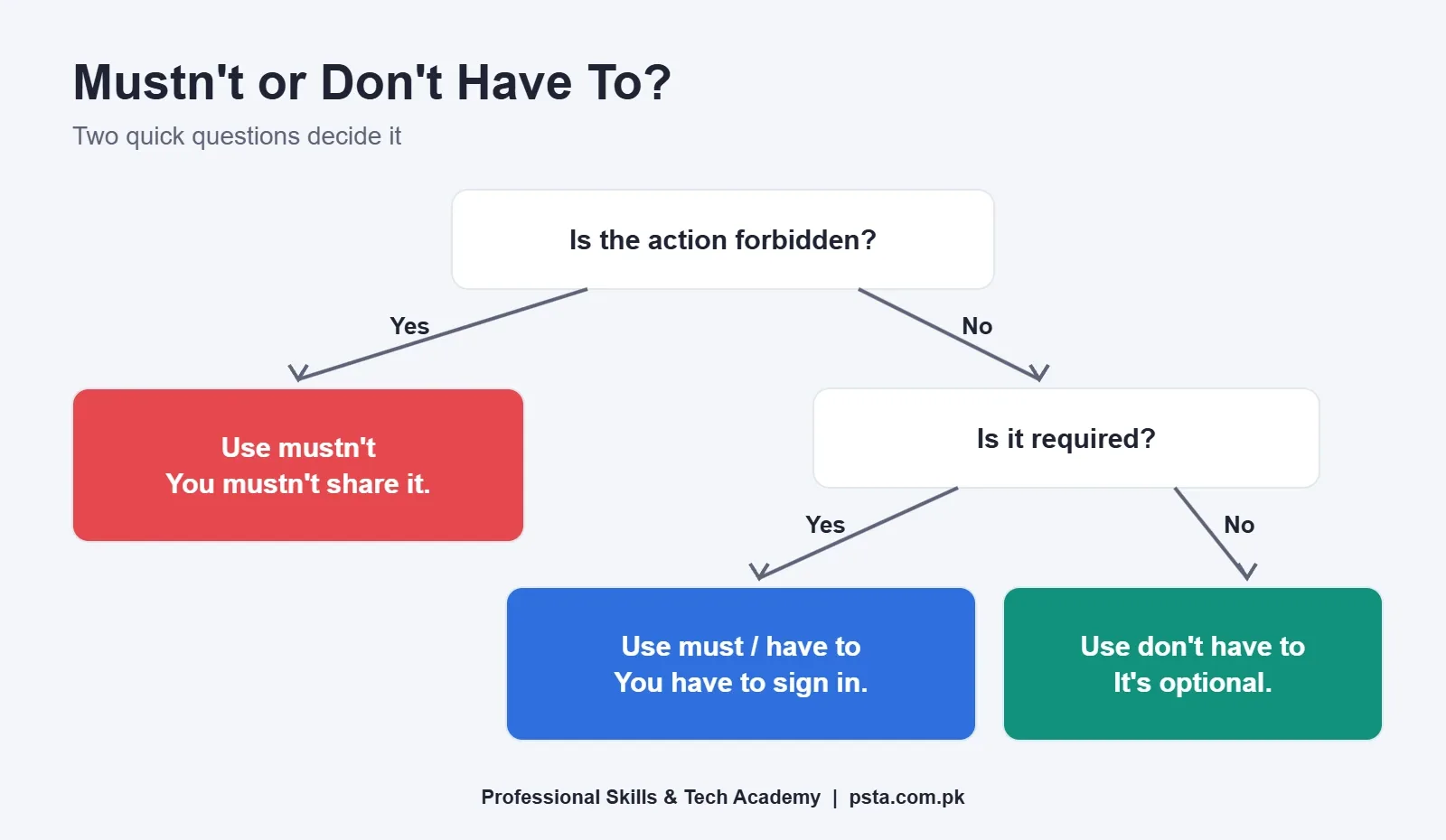
Mustn't means something is not allowed, while don't have to means something is optional. They look similar, but their meanings are almost opposite. Mix them up and you can confuse a colleague or lose easy marks in a grammar test.
Compare these two office sentences:
- "You mustn't share your password with anyone." (Sharing it is forbidden.)
- "You don't have to come in on Saturday." (You can come if you want, but nobody requires it.)
The Cambridge blog post linked above draws exactly this line: mustn't tells you it is necessary not to do something, while don't have to and don't need to remove the obligation. A simple check helps. If you can add "but you can if you like" to the end of the sentence, you need don't have to.
How Sure Are You? Modals for Guessing About the Present
Modal verbs in English also show how certain you are about something you can't see directly. Grammar books call these modals of deduction. The British Council's LearnEnglish page on deductions about the present sets out three levels:
| How sure you feel | Modal | Example |
|---|---|---|
| Almost certain it is true | must | The lights are off. They must be at the wedding. |
| Possible, not sure | might / may / could | Ali isn't answering. He might be in class. |
| Almost certain it is not true | can't | That can't be the right invoice. The total is zero. |
The same page notes that might, may and could share this meaning, with may being more formal. Here is a detail that catches many learners: the opposite of must for a guess is can't, not mustn't. "He mustn't be at home" is an order, not a guess.
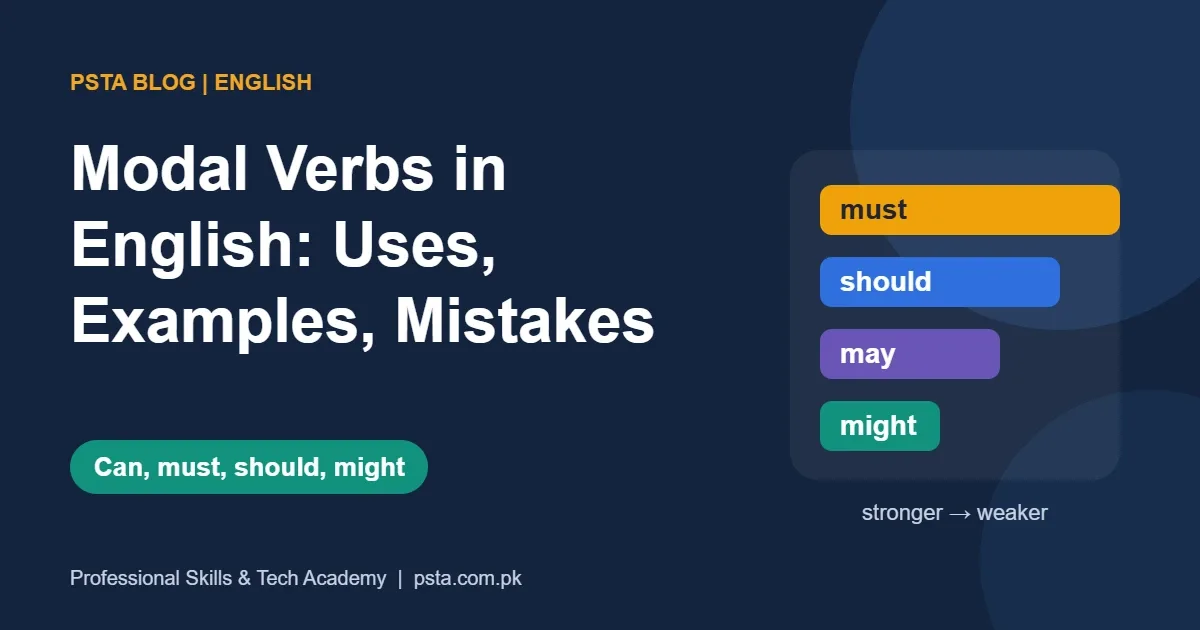
The Yale handout goes a step further and ranks modals for possibility from strongest to weakest: must, then will and would, then should, then may, and finally can, could and might. You don't need to memorize the full scale. Just remember that must sits at the top and might sits near the bottom.
Talking About the Past: Must Have, Should Have and Could Have
To talk about the past with a modal, use modal + have + past participle. The British Council's page on deductions about the past uses the same three levels of certainty:
- must have + past participle when the evidence makes you feel sure: "The floor is wet. It must have rained."
- might have / may have + past participle when it is possible but uncertain: "She might have missed the bus."
- can't have / couldn't have + past participle when you think it was not possible: "He can't have finished the report already. He only started an hour ago."
Two more past forms carry feelings rather than guesses. Should have shows regret or criticism: "I should have checked the spelling before I sent it." Could have shows a chance that was missed: "We could have taken the motorway, but we chose the old road."
When people speak quickly, should have sounds like "should've". That is why so many learners write "should of". The Cambridge modal basics post lists this as a common error, so always write have.
Polite Requests and Offers With Would, Could and Shall
In emails, calls and customer service chats, modals do a lot of the polite work for you. Compare "Send me the report" with "Could you send me the report by Friday?" The second asks for the same thing without sounding like an order.
Some useful patterns:
- Requests: "Could you share the meeting link?" or "Would you mind checking this table?"
- Offers: "Shall I book the room?" or "Would you like me to call the client?"
- Suggestions: "Shall we move the call to 3 pm?" or "We could split the work between us."
Would you mind is followed by an -ing verb ("Would you mind waiting?"), because mind is a normal verb, not a modal. For more ready-made lines, see the PSTA post on office English for meetings, calls, chat and email.
Seven Modal Mistakes Pakistani Learners Make
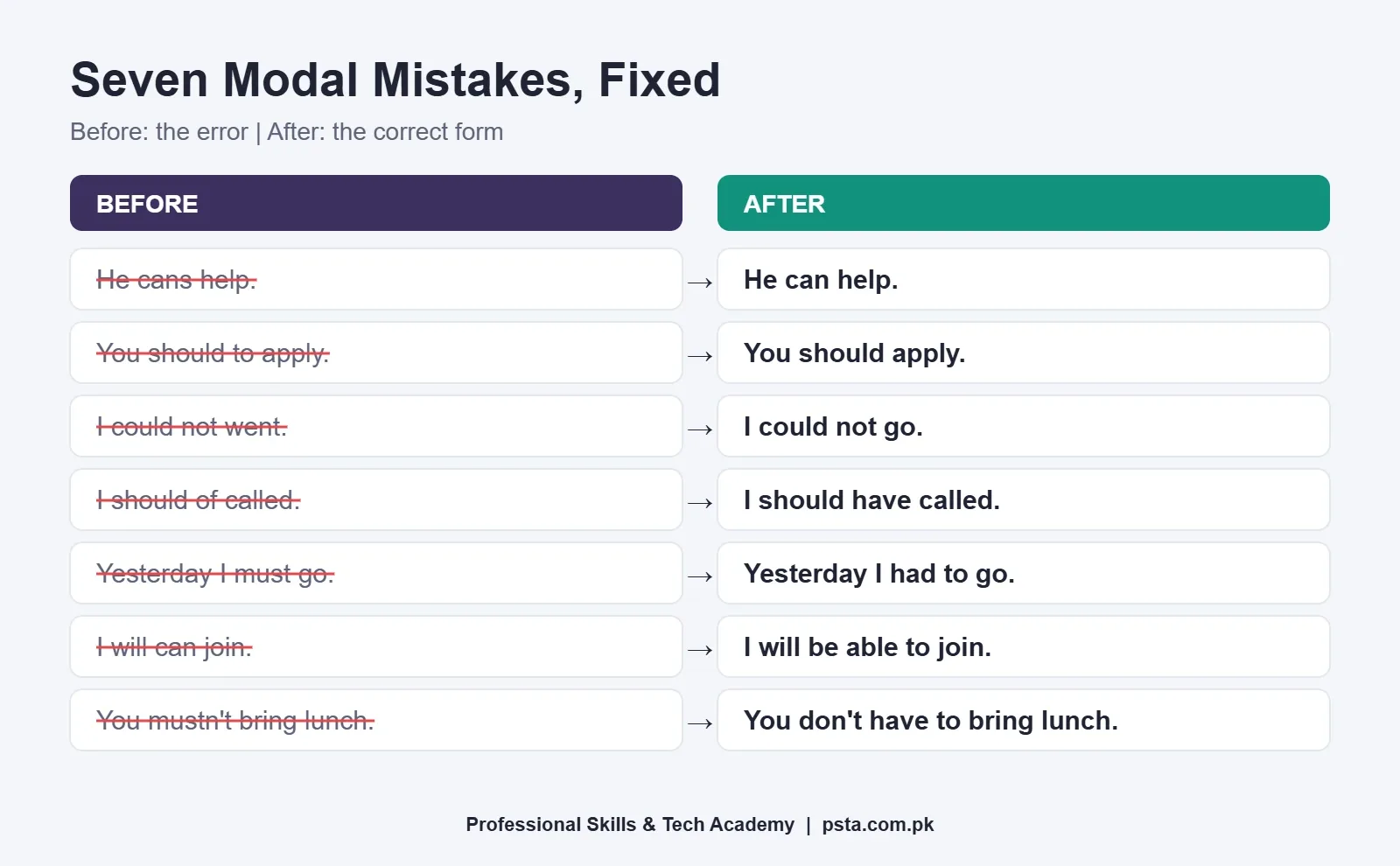
These errors with modal verbs in English come up again and again in classroom writing, job emails and spoken practice. Many of them start when an Urdu sentence is turned into English one word at a time.
- Adding -s after he or she. Wrong: "He cans help." Right: "He can help."
- Putting "to" after the modal. Wrong: "You should to apply." Right: "You should apply."
- Using a past verb after the modal. Wrong: "I could not went." Right: "I could not go."
- Writing "should of". Wrong: "I should of called." Right: "I should have called."
- Using mustn't for optional things. Wrong: "You mustn't bring lunch, we'll order food." Right: "You don't have to bring lunch."
- Using must for the past. Wrong: "Yesterday I must go to the bank." Right: "Yesterday I had to go to the bank."
- Stacking two modals. Wrong: "I will can join." Right: "I will be able to join."
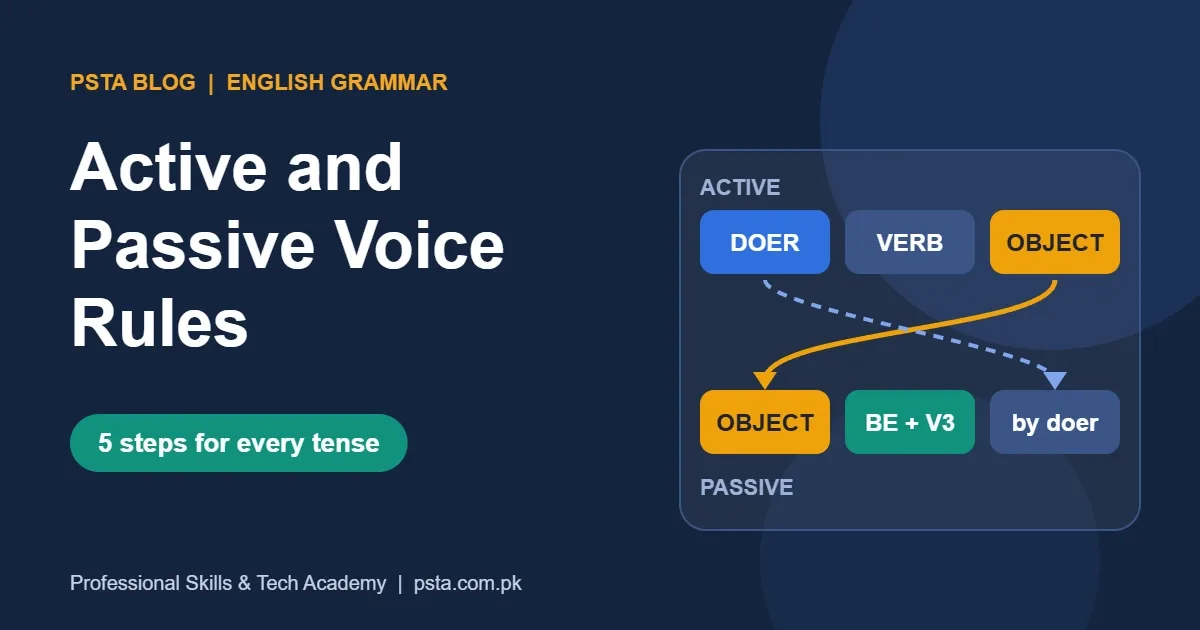
If you also struggle with verb forms after modals in the passive, such as "The form must be submitted", our active and passive voice guide covers modal passives in detail.
Practice: Fix These 8 Sentences
Cover the answers, correct each sentence, then check. Say each corrected sentence out loud once, because speaking it fixes the pattern faster than reading it.
- She can sings very well.
- You must to wear your ID card.
- I should of told you earlier.
- He mustn't be at home; his car is outside.
- Last week we must work on Sunday.
- Could you sending me the address?
- You mustn't pay now; you can pay next month.
- I will can finish the slides tonight.
Answers: (1) She can sing very well. (2) You must wear your ID card. (3) I should have told you earlier. (4) He must be at home; his car is outside. (5) Last week we had to work on Sunday. (6) Could you send me the address? (7) You don't have to pay now; you can pay next month. (8) I will be able to finish the slides tonight.
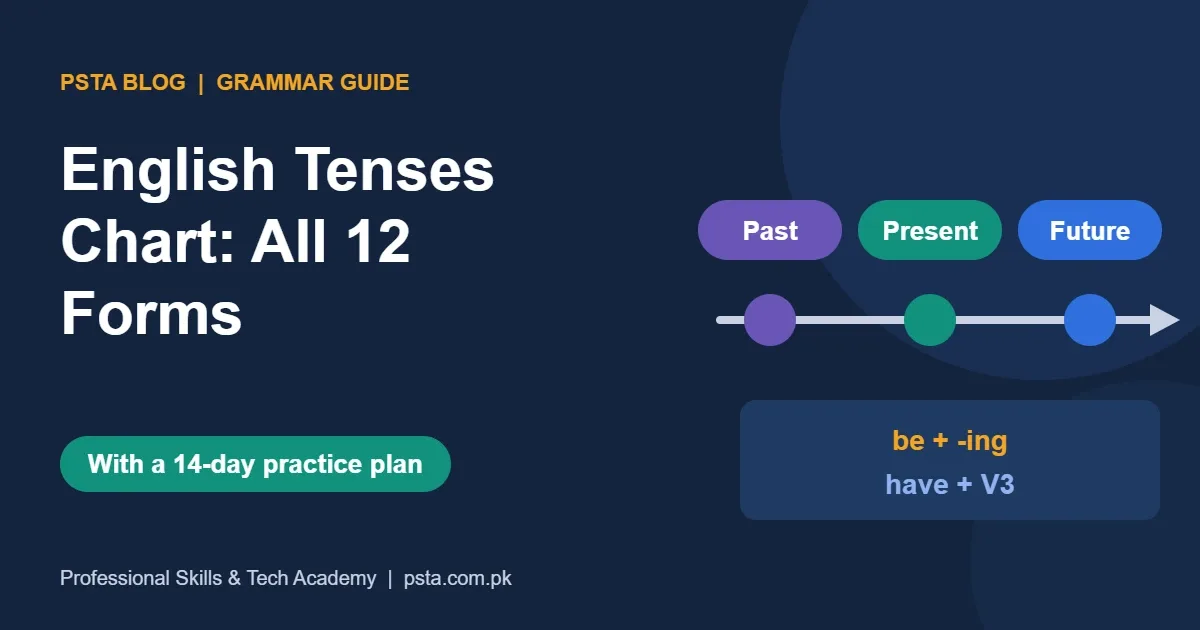
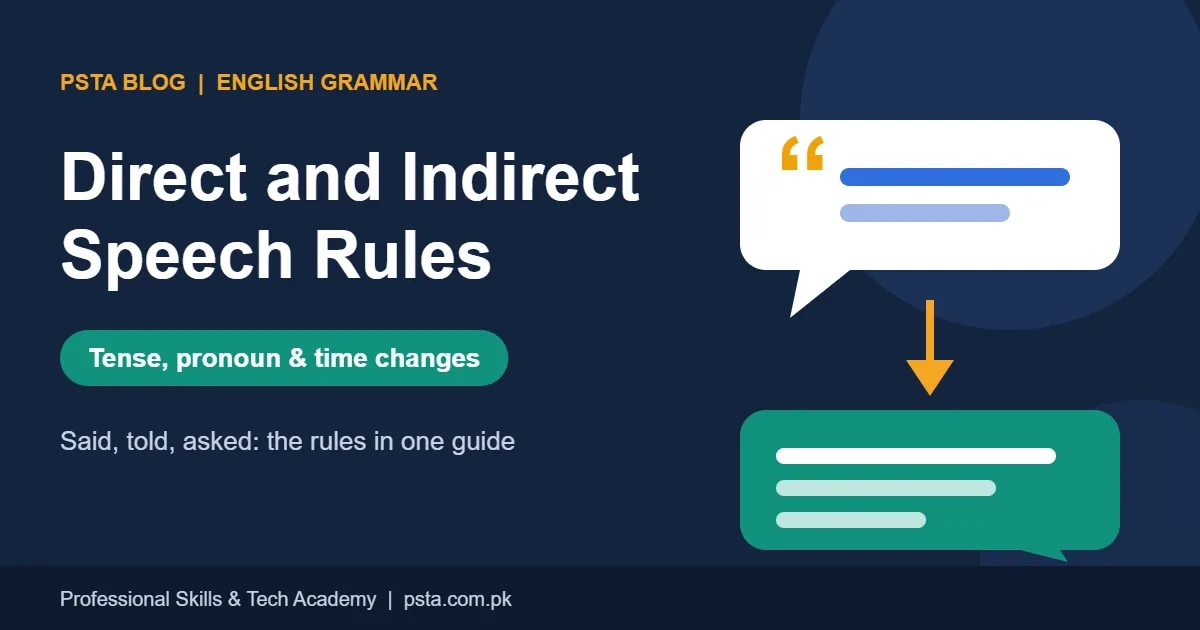
Got six or more right? Move on to mixing modals with tenses. Our English tenses chart and the direct and indirect speech rules show how can becomes could and will becomes would in reported speech.
Building Modal Habits in PSTA's English Course
Reading rules is the first step. Using modal verbs in English naturally in a meeting or interview takes guided speaking practice, and that practice sits at the center of PSTA's spoken English and grammar course. According to its course page, it is a 3-month program designed for beginners, offered on campus in Abbottabad and online across Pakistan.
The course page lists modules that fit this topic closely:
- Speaking Confidence: Interviews, Meetings, Social Talks
- Tenses & Grammar Usage in Speaking
- Email, CV & Message Writing
- Formal vs Informal English in Daily Communication
- Parts of Speech & Sentence Formation
The fee shown on the course page today is Rs. 12,000, with Rs. 14,000 listed alongside it, so check the page for the current offer before you apply. Its last module pairs a presentation with the assessment for your certificate. You can compare it with other options on the full course list, and when you are ready, the admission form is short and online.
Say Three Sentences Before Bed
Tonight, say three true sentences about your own day out loud: one with must or have to, one with should have, and one with might. For example: "I have to finish my assignment tomorrow. I should have started it on Monday. My friend might help me with the last part." Repeat this every evening for a fortnight, and your modal verbs in English will improve more than a full chapter of rules could manage.
If you'd like a trainer to correct your sentences as you speak, message PSTA on WhatsApp at +92 314 5424399 and ask about the next English batch.
Frequently asked questions
What are the 9 main modal verbs in English?
The nine core modal verbs are can, could, may, might, must, shall, should, will and would. Ought to is often listed with them because it behaves like a modal. Have to and need to carry similar meanings but act like normal verbs, so they change form: he has to, she doesn't need to.
Is must stronger than have to?
Must often sounds stronger and more formal, and you will see it in rules, notices and requirements. Have to is the everyday choice for duties that come from outside, like office hours or exam rules. In daily speech and messages, have to usually sounds more natural, and only have to works for the past (had to).
What is the difference between mustn't and don't have to?
Mustn't means something is not allowed: "You mustn't share your password." Don't have to means there is no obligation, so it is your choice: "You don't have to come on Saturday." If you can add "but you can if you like" to the sentence, the correct form is don't have to.
Can I use to after a modal verb?
No. After can, could, may, might, must, shall, should, will and would, use the base verb without to: "You should apply," not "You should to apply." Ought is the exception, because it always takes to: "You ought to apply." Have to and need to are not true modals, so they keep their to.
How do I use modal verbs for the past?
Use modal + have + past participle. Must have shows you are sure something happened, might have or may have shows it was possible, and can't have shows it was not possible. Should have expresses regret, and could have shows a missed chance. For past obligation, use had to instead of must.
Why is should of wrong?
In fast speech, should have sounds like should've, which many learners hear as should of. The correct written form is always should have, could have, would have or must have. Writing of after a modal is a spelling mistake that examiners and employers notice quickly, so check for it in every email.
Which modal verbs are most polite for requests?
Could you and would you are softer than can you, so they suit emails to managers, teachers and clients. Would you mind is also polite, but it is followed by an -ing verb: "Would you mind checking this?" For offers, use shall I or would you like me to.
Sources & references
- Modal verbs – the basics (Cambridge Dictionary blog) dictionaryblog.cambridge.org
- You must read this! (Have to or must?) (Cambridge Dictionary blog) dictionaryblog.cambridge.org
- Modals: deductions about the present (British Council LearnEnglish) learnenglish.britishcouncil.org
- Modals: deductions about the past (British Council LearnEnglish) learnenglish.britishcouncil.org
- Modal Verbs handout (Yale Poorvu Center) poorvucenter.yale.edu
- Must, have to and need (Britannica Dictionary) britannica.com
Last reviewed & updated on by Umar Qureshi. Written by the PSTA team in Abbottabad, Pakistan.

Umar Qureshi

English Spoken & Grammar Course in Pakistan – Build Confidence, Speak Fluently (Online & Campus)
Turn this guide into a career: hands-on training with real projects, online across Pakistan or on-campus in Abbottabad · 12 Weeks.
Comments
No comments yet — ask a question or share your experience.