Quick answer
Turn orders into requests with "could you" or "would you", soften them with words like "just" or "would you mind if", and give a reason and a time. Learn one reliable line each for meetings, phone calls, email, chat and leave, then practice them aloud for 10 days until they feel natural.
Key takeaways
- • "Could you" and "would you" sound more polite than "can" and "will" in office requests.
- • Pakistan scored 493 in the EF English Proficiency Index 2025, ranking 67th.
- • Every good request names what you need, why, and by when.
- • Local phrases like "do the needful" confuse foreign clients; say exactly what you need.
- • Fifteen minutes of spoken practice a day for 10 days builds lasting habits.
Table of contents 27 sections
- Why Does Office English Feel Harder Than Classroom English?
- Three Habits Behind Polite Office English
- 1. Ask, Don't Order
- 2. Add a Softener
- 3. Give a Reason and a Time
- English Phrases for Office Meetings
- Opening and Setting the Agenda
- Giving Your View
- Disagreeing Without Starting a Fight
- Interrupting and Asking for Clarity
- Closing With Clear Actions
- Phone Call English: Answering, Transferring and Taking Messages
- Email Phrases for Openings, Requests and Follow-Ups
- Opening Lines
- Making a Request
- Following Up
- Closing
- WhatsApp and Teams Messages: How Formal Should You Be?
- Asking for Leave, Help or More Time
- Leave
- Help
- More Time
- Saying No or Owning a Mistake Without Sounding Rude
- Local Phrases to Swap for Clearer International English
- A 10-Day Practice Plan for Office English
- How the PSTA English Course Builds These Habits
- Choose Five Phrases for Tomorrow
Try a quick self-test before you read on. Your manager has asked for a sales report by 4 PM. Which message would you send: "Report not ready, send tomorrow," "Sir, kindly do the needful and give me one more day," or "I'm sorry, the report needs one more check. Could I send it to you by 10 AM tomorrow?" If you picked the third, you already sense how English phrases for office work should sound: short, polite and clear about the next step.
Most people in Pakistani offices know enough grammar. What they lack is a ready set of lines for the moments that happen every day: opening a meeting, taking a phone message, asking for leave, saying no. This guide gives you those lines and explains why they work. Think of it as a set of business English phrases tuned for Pakistani workplaces.
Here's what this guide covers:
- The three habits that make any request sound polite in English
- Ready-to-use phrases for meetings, phone calls, email and WhatsApp
- How to ask for leave, more time or help without sounding weak
- Local expressions that confuse foreign clients, with clearer swaps
- A 10-day plan to make these phrases automatic
Why Does Office English Feel Harder Than Classroom English?
School English is mostly reading and writing. Office English is spoken, fast and social. You have a few seconds to answer a call, and nobody waits while you build a perfect sentence.
The numbers back this up. In the EF English Proficiency Index 2025, which covers 123 countries and regions and 2.2 million test takers, speaking was the weakest skill in more than half of the countries measured. Pakistan ranked 67th with a score of 493, slightly above the global average of 488, according to EF's Pakistan fact sheet. The same report shows big gaps inside the country: Islamabad scored 529, Peshawar 506 and Karachi 496.
So if you freeze on a call, you're not unusual. The fix isn't more grammar rules. It's a small bank of workplace English you have practiced aloud so many times that it comes out without thinking.
Three Habits Behind Polite Office English
Nearly all the English phrases for office use in this guide follow one of three habits. Learn the habits and you can build your own lines for situations this guide doesn't list.
1. Ask, Don't Order
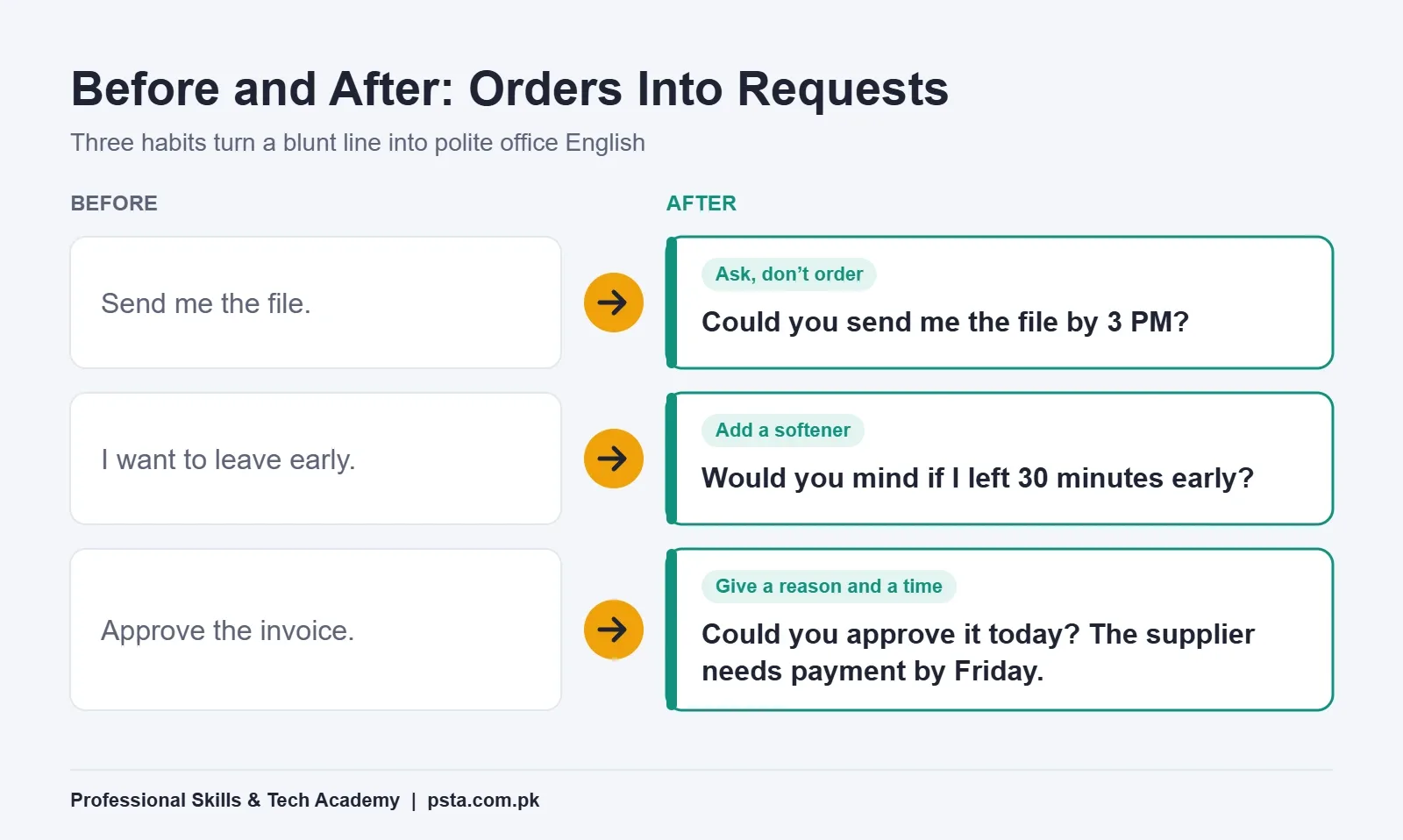
"Send me the file" is an order. "Could you send me the file?" is a request. The British Council's grammar guide recommends "could you" and "would you" for polite requests and describes "can" and "will" as less polite. Use "could" with seniors, clients and anyone you don't know well.
2. Add a Softener
Small words make a request feel lighter. A Cambridge Dictionary blog post on softeners explains that "would you mind if" followed by a past-tense verb sounds more polite than "could," and that "just" makes a request seem like a small favor. Compare "Would you mind if I left 30 minutes early?" with "I want to leave early."
3. Give a Reason and a Time
Polite isn't the same as vague. A good office request says what you need, why, and by when: "Could you approve the invoice today? The supplier needs payment by Friday." The reason makes people want to help, and the time stops the request from sliding to next week.
English Phrases for Office Meetings
Meetings are where many people stay silent, even with a good idea, because English for meetings feels risky. These English phrases for office meetings give you a safe way in at each stage.
Opening and Setting the Agenda
- "Thanks for joining. Shall we start?"
- "We have three points to cover today, and we'll finish by 11."
- "Let's begin with last week's sales figures."
Giving Your View
- "In my view, we should test the ad for one more week."
- "From what I've seen with our customers, delivery time matters more than price."
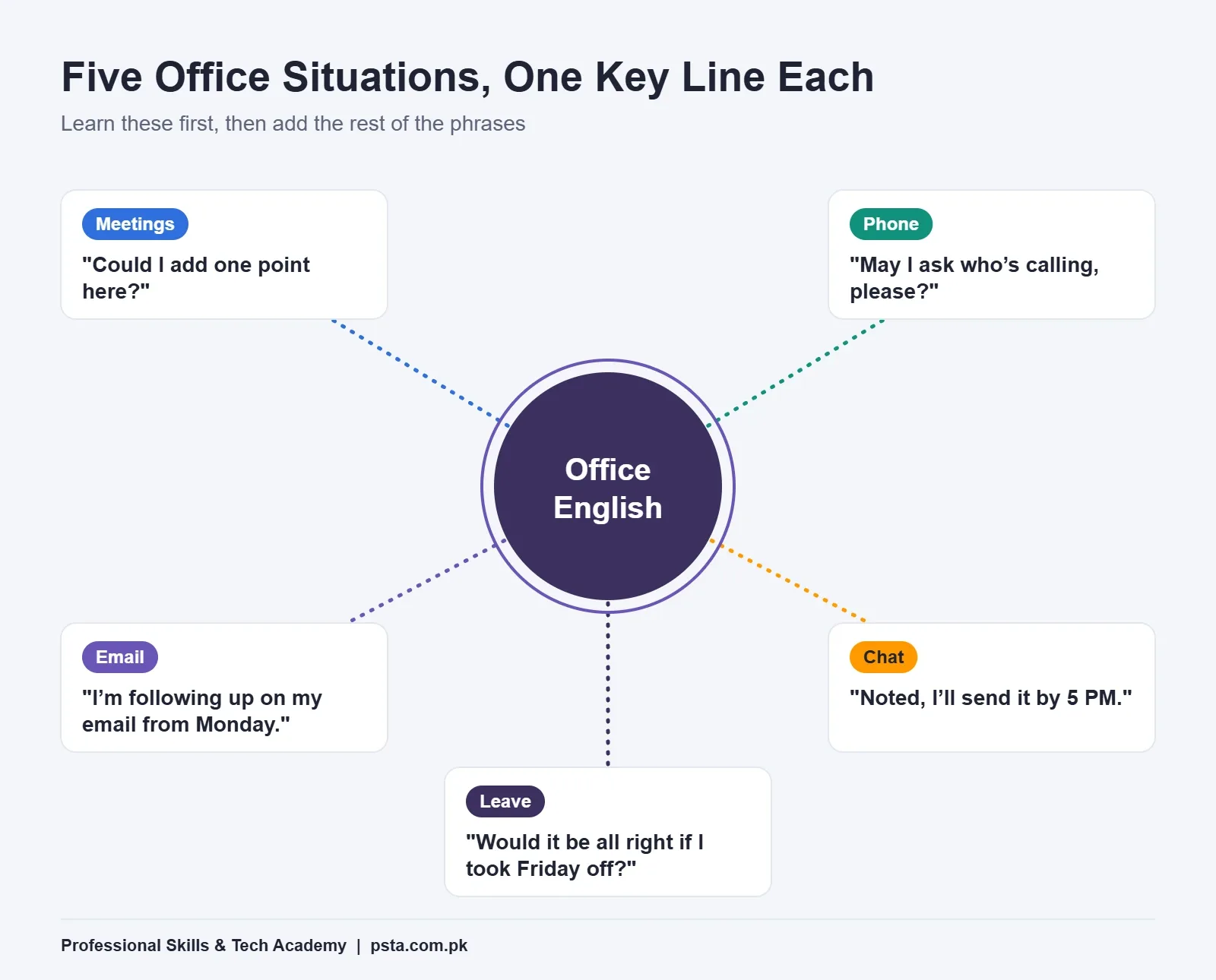
- "Could I add one point here?"
Disagreeing Without Starting a Fight
- "I see your point, but I'm worried about the cost."
- "That could work. Have we checked whether the warehouse can handle it?"
- "I'd suggest a different approach, if that's all right."
Interrupting and Asking for Clarity
- "Sorry to cut in. Can I check one thing?"
- "Just to be sure I've understood, you want the report weekly, not monthly?"
- "Could you repeat the last figure, please?"
In online meetings, use the platform's tools as well as your words. In Microsoft Teams, you can select Raise in the meeting controls, and Microsoft's support page notes that raised hands are numbered in the People list in the order people raised them. Raise your hand, wait for your name, then say, "Thanks. I'd like to add something about the budget."
Closing With Clear Actions
- "So, to sum up, Ali will update the price list and Sana will call the supplier."
- "Who will take this forward?"
- "I'll share the notes by email this afternoon."
Phone Call English: Answering, Transferring and Taking Messages
Phone calls scare people more than meetings because there's no body language and no time to think. The good news is that office calls follow a pattern, so a handful of lines covers most of them.
| Situation | Say This | Avoid |
|---|---|---|
| Answering | "Good morning, Hazara Traders, Ayesha speaking. How can I help?" | "Hello? Who is this?" |
| Asking who is calling | "May I ask who's calling, please?" | "Who are you?" |
| Transferring | "One moment, please. I'll put you through to Accounts." | "Wait." (then silence) |
| Person unavailable | "I'm afraid he's in a meeting. Can I take a message?" | "He is not here. Call later." |
| Bad line | "Sorry, the line isn't clear. Could you say that again?" | "What? What?" |
| Checking details | "Let me read that back: 0300 1234567, is that right?" | Writing it down without checking |
| Ending | "Thanks for calling. Have a good day." | Hanging up without a closing line |
The example company name and number above are made up. Swap in your own. When you take a message, always note five things: the caller's name, company, number, the reason for the call and the best time to call back.
Email Phrases for Openings, Requests and Follow-Ups
Office email in Pakistan often swings between too stiff ("I am writing this email to inform your good self") and too casual ("Plz chk file"). Aim for the middle. If you're writing to apply for a job, our guide on writing a job application email covers that case in detail. The phrases below are for everyday internal and client email.
Opening Lines
- "I hope your week is going well." (use once, not in every email)
- "Thanks for your quick reply."
- "Following our call this morning, here are the revised rates."
Making a Request
- "Could you confirm the delivery date by Thursday?"
- "Would it be possible to move the meeting to 3 PM?"
- "I've attached the draft. Please let me know if anything needs changing."
Following Up
- "Just checking whether you had a chance to look at the quotation."
- "I'm following up on my email from Monday about the March invoice."
Closing
- "Let me know if you have any questions."
- "Best regards," or "Kind regards," then your name, role and phone number.
Write the subject line last, and make it specific: "Revised quotation for 200 school bags" tells the reader far more than "Quotation."
WhatsApp and Teams Messages: How Formal Should You Be?
A lot of office talk in Pakistan now happens on WhatsApp groups and chat apps. The tone can be lighter than email, but it's still work. Follow three simple rules.
- Put the whole message in one go. "Assalam o Alaikum, Sir. The client has approved the design. Shall I send it to the printer today?" is better than four separate pings.
- Skip shortcuts with seniors and clients. "Plz," "u" and "k" are fine with friends, not with your manager.
- Confirm with words, not only emojis. A thumbs-up can mean "seen" or "agreed." Write "Noted, I'll send it by 5 PM" when a deadline is involved.
Useful chat lines include "Noted, thanks," "On it," "Quick question about the payroll sheet," and "Is now a good time for a two-minute call?"
Asking for Leave, Help or More Time
These are the requests people put off because they feel awkward. A clear, polite line removes most of that discomfort.
Leave
- "Would it be all right if I took Friday off? My cousin's wedding is in Mansehra."
- "I'm not feeling well today and won't be able to come in. I'll check email in the afternoon."
Help
- "Do you have five minutes? I'm stuck on this Excel formula."
- "Could you show me how you set up the stock sheet? I'd like to learn it properly."
More Time
- "I won't be able to finish this by noon. Could I send it by 4 PM instead?"
- "The data from the branch arrived late. Would Tuesday morning work for you?"
Ask for extra time before the deadline, not after it. Offer a new time yourself so the other person only has to say yes.
Saying No or Owning a Mistake Without Sounding Rude
A refusal doesn't have to sound harsh. The Cambridge blog mentioned earlier lists "I'm sorry," "I'm afraid" and "Actually" as common ways to soften a refusal. Pair one of them with a reason or an alternative.
- "I'm afraid I can't take this on today. I'm finishing the payroll. Could it wait until tomorrow?"
- "Actually, that price is below our cost. The best we can offer is Rs. 950 per piece."
- "I'd like to help, but I'll need my manager's approval first."
When you get something wrong, say so plainly and move to the fix:
- "That was my mistake. I sent the old file. Here's the correct version."
- "Sorry for the delay. I've now updated the sheet and checked the totals twice."
Avoid long apologies. One clear sentence of ownership, then the solution, earns more respect than three paragraphs of "extremely sorry."
Local Phrases to Swap for Clearer International English
Some expressions are normal in Pakistani offices but confuse clients in the UK, the Gulf or the US. They aren't wrong at home. Swap them when you write to people outside Pakistan or apply for remote work. For grammar slips like missing articles, see our list of common English mistakes.
| Common in Pakistan | Clearer Option |
|---|---|
| "Kindly do the needful." | "Could you please approve the leave form?" (say what you need) |
| "He is out of station." | "He's traveling this week and back on Monday." |
| "Please do one thing." | "Could you please..." |
| "I will send it today itself." | "I'll send it today." |
| "Today morning I called him." | "I called him this morning." |
| "Myself Ahmed from Accounts." | "This is Ahmed from Accounts." |
A 10-Day Practice Plan for Office English
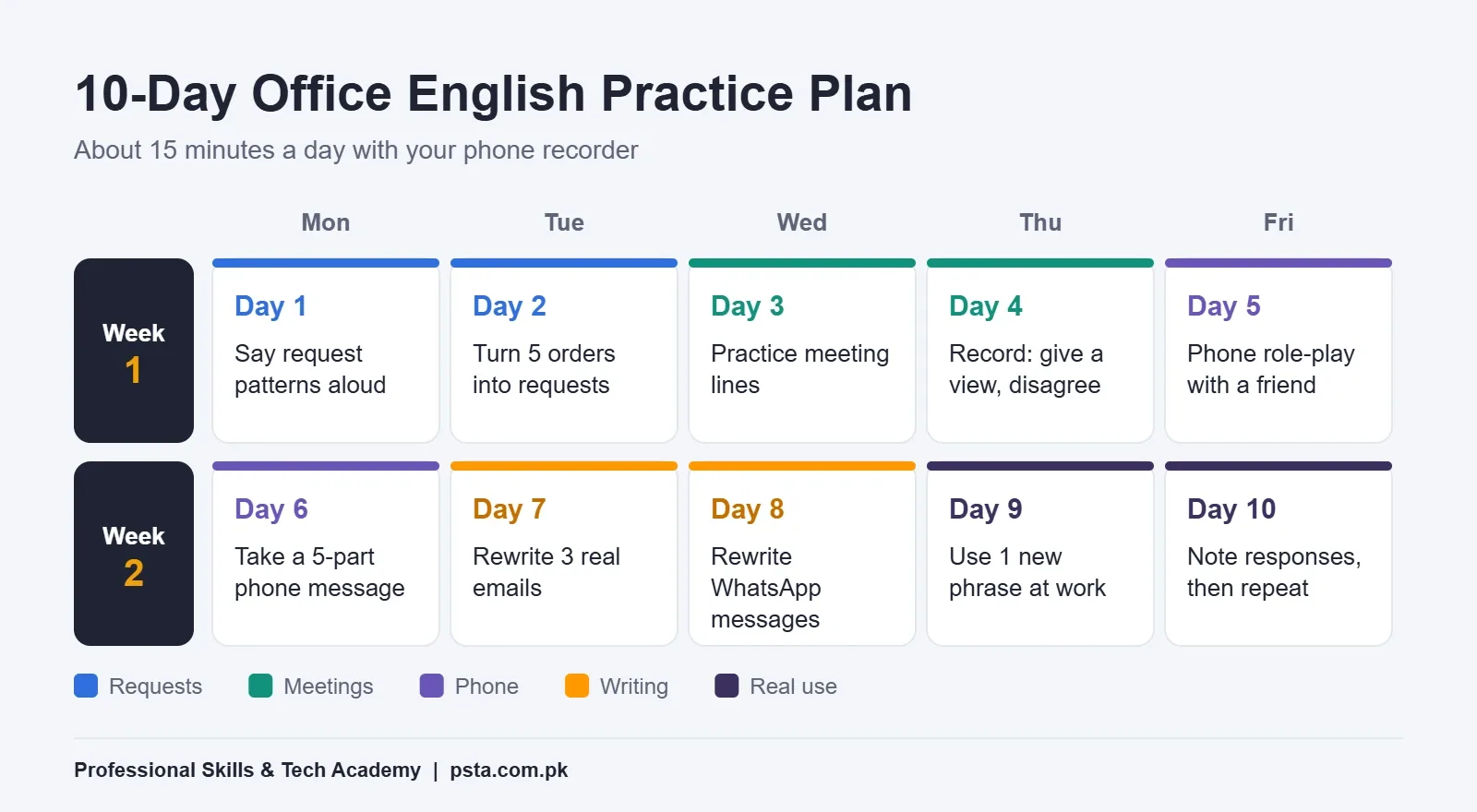
Reading phrases won't make them automatic. Saying them aloud will. This plan takes about 15 minutes a day for two working weeks, and you only need your phone's voice recorder.
- Days 1 and 2: Read the polite request patterns aloud. Turn five orders from your own job into requests.
- Days 3 and 4: Practice the meeting lines. Record yourself giving a view and disagreeing politely.
- Days 5 and 6: Role-play phone calls with a friend. Take a full five-part message each time.
- Days 7 and 8: Rewrite three real emails or WhatsApp messages using the phrases above.
- Days 9 and 10: Use one new phrase at work each day, then note how people responded.
If you want a structured speaking routine beyond office situations, the home routine in our guide on how to improve English speaking fits neatly alongside this one.
How the PSTA English Course Builds These Habits
Lists of English phrases for office work help, but most people also need someone to listen and correct them, because spoken English for office work improves fastest with feedback. PSTA's English Spoken and Grammar course takes 12 weeks, and nobody needs prior fluency to start it. Its modules include formal vs informal English, speaking for interviews and meetings, role plays and group discussions, and email, CV and message writing. At the time of writing, you pay Rs. 12,000 for the whole program instead of the usual Rs. 14,000.
Lessons take place at the PSTA campus in Mandian, Abbottabad, on Old College Road facing FIMS College. Students in other cities join the same lessons live online. If your office role also involves documents and spreadsheets, the Office Automation course is where you get comfortable with Word, Excel and PowerPoint, and the English and Urdu typing course helps you reply faster. You can see every option on the courses page, and once you've chosen, the admission page explains how to register. Questions about batch timings can go to WhatsApp at +92 314 5424399.
Interviews coming up too? Practice these English interview questions and answers next.
Choose Five Phrases for Tomorrow
Don't try to learn everything on this page at once. Pick five English phrases for office situations you'll face tomorrow, perhaps one for a meeting, one for the phone, one request, one follow-up and one polite no. Write those office English sentences on a sticky note beside your screen, say each one aloud three times, and use at least one before lunch. Next week, swap in five more.
Frequently asked questions
How can I improve my office English quickly?
Pick a small set of lines for the situations you face most, such as meetings, calls and emails, and say them aloud every day. Record yourself, listen back and fix what sounds unclear. Use one new phrase at work daily. Fifteen focused minutes of speaking practice usually helps more than an hour of silent grammar reading.
Is it wrong to write "kindly" in office emails?
No, "kindly" is polite and common in Pakistan. The problem is overuse and pairing it with vague phrases like "do the needful." Foreign clients may find "kindly" in every line stiff. Use "please" or "could you" for most requests, and keep "kindly" for formal letters or when you need extra courtesy.
What should I say if I don't understand something in a meeting?
Ask for clarity early instead of nodding along. Say "Sorry, could you repeat the last point?" or "Just to be sure I've understood, you mean the report is due Friday?" Repeating what you heard in your own words shows attention and prevents mistakes later. Nobody thinks less of someone who checks.
How should I answer an office phone call in English?
Use a three-part greeting: the time of day, the company name and your name, then an offer to help. For example, "Good afternoon, Hazara Traders, Bilal speaking. How can I help?" Keep a pen ready, read numbers back to the caller, and end with a closing line such as "Thanks for calling."
How do I ask my manager for leave in English?
Ask early, give a reason and offer a plan for your work. Say "Would it be all right if I took Thursday off? I have a family function in Haripur. I'll finish the stock report on Wednesday." For sick leave, inform your manager before office hours and mention when you'll be reachable.
Should I use "Sir" and "Madam" in office English?
In most Pakistani offices, "Sir" and "Madam" are normal and respectful, so use them where your workplace expects it. With foreign clients, first names or "Mr." and "Ms." with a surname are more common. When unsure, copy how the other person signs their email and address them the same way.
Can I learn office English at PSTA if I live outside Abbottabad?
Yes. PSTA's English Spoken and Grammar course runs live online for students across Pakistan, as well as on campus in Abbottabad. The 12-week course includes role plays, meetings practice and email writing. Message +92 314 5424399 on WhatsApp to ask about batch timings before you register.
Sources & references
- EF English Proficiency Index 2025 launch ef.edu
- EF EPI 2025 Fact Sheet: Pakistan ef.com
- EF EPI 2025: Pakistan ef.com
- British Council LearnEnglish: Requests, offers and invitations learnenglish.britishcouncil.org
- Cambridge Dictionary blog: Would you mind reading this, please? dictionaryblog.cambridge.org
- Microsoft Support: Raise your hand in Microsoft Teams meetings support.microsoft.com
Last reviewed & updated on by Umar Qureshi. Written by the PSTA team in Abbottabad, Pakistan.

Umar Qureshi

English Spoken & Grammar Course in Pakistan – Build Confidence, Speak Fluently (Online & Campus)
Turn this guide into a career: hands-on training with real projects, online across Pakistan or on-campus in Abbottabad · 12 Weeks.

Comments
No comments yet — ask a question or share your experience.