Quick answer
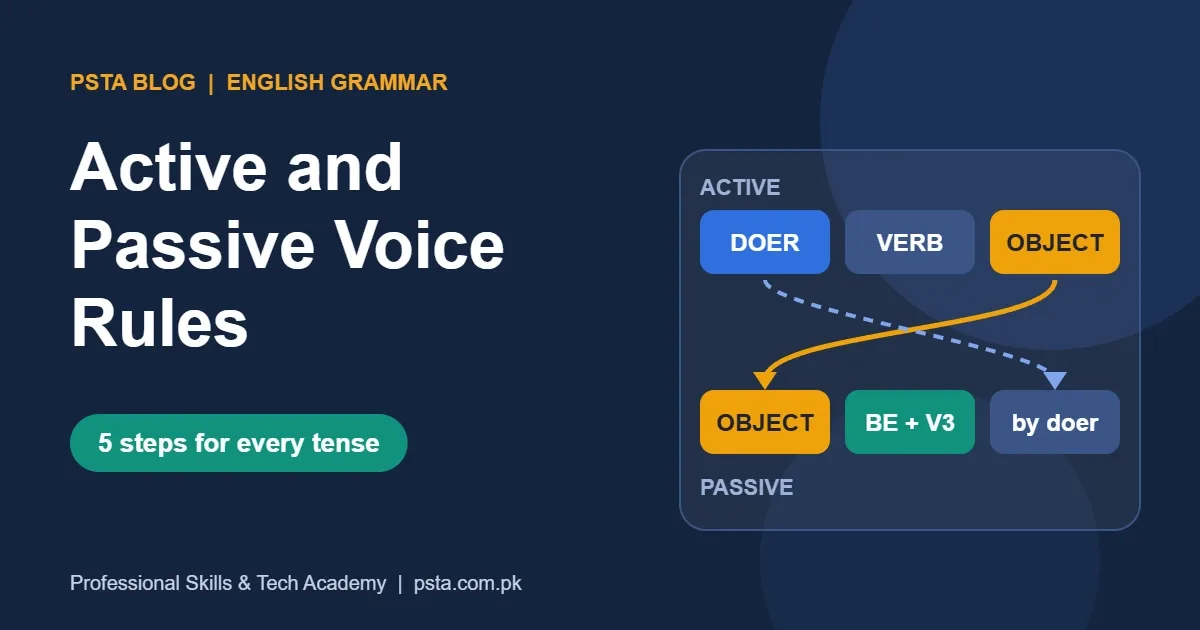
To change active to passive voice, move the object to the front, add the form of be that matches the original tense, then the past participle, and keep "by + doer" only if it helps. Verbs without an object, such as happen or arrive, have no passive. Use active when the doer matters.
Key takeaways
- • Every passive verb is a form of be plus a past participle; only be changes with the tense.
- • Work in five steps: find the object, move it, match be to the tense, add V3, then decide on the doer.
- • Verbs with no object, such as happen, arrive and die, can't be made passive.
- • Modals take modal + be + V3, and verbs like give and send allow two passive versions.
- • Choose passive when the result matters more than the doer; use active to show who is responsible.
Table of contents 17 sections
- What Is the Difference Between Active and Passive Voice?
- Active and Passive Voice: The 5-Step Conversion Method
- Passive Voice Rules for Every Tense
- What About the Perfect Continuous Tenses?
- Modals, Two-Object Verbs and Phrasal Verbs
- Modals: Modal + Be + V3
- Verbs With Two Objects
- Phrasal Verbs
- Reporting Verbs and the Informal Get Passive
- Which Sentences Can't Be Made Passive?
- When Should You Choose the Passive Voice?
- Active vs Passive in Office Emails and Reports
- Six Conversion Mistakes to Watch For
- How to Make Microsoft Word Flag Passive Sentences
- Practice: Convert These 8 Sentences
- Practising Voice Out Loud in PSTA's English Course
- Rewrite Three Sentences From Your Last Email
Test yourself first, without scrolling down. Which of these three sentences is in the passive voice? (a) The clerk has stamped your form. (b) Your form has been stamped. (c) Your form looks fine.
Only (b) is passive. Active and passive voice differ in one thing: whether the subject does the action or receives it. A passive verb is always a form of be plus a past participle, which is why "has been stamped" qualifies and "looks fine" doesn't. If you got that right, this guide will make you faster. If you didn't, it will give you a method you can trust.
When you finish, you'll be able to:
- Spot a passive sentence in a few seconds, even in a long email
- Convert any active sentence with a simple five-step routine
- Use the right form of be in every tense, including modals
- Avoid the classic errors such as "The accident was happened"
- Decide when the passive helps your writing and when it hides meaning
What Is the Difference Between Active and Passive Voice?
In an active sentence, the subject is the doer. In a passive sentence, the subject is the thing that receives the action, and the doer either moves to the end after by or disappears.
Compare these two:
- Active: The accountant prepared the salary sheet.
- Passive: The salary sheet was prepared by the accountant.
The meaning is the same. What changes is the focus. The first sentence is about the accountant. The second is about the salary sheet.
The British Council's grammar reference on active and passive voice sums up the structure neatly: transitive verbs have both forms, and the passive is built from be plus a past participle. Only the be part changes for tense. The past participle (the third form of the verb, often called V3) never changes.
So the whole topic rests on one formula: object + form of be + V3 (+ by + doer). Everything else in this guide is that formula applied carefully.
Active and Passive Voice: The 5-Step Conversion Method
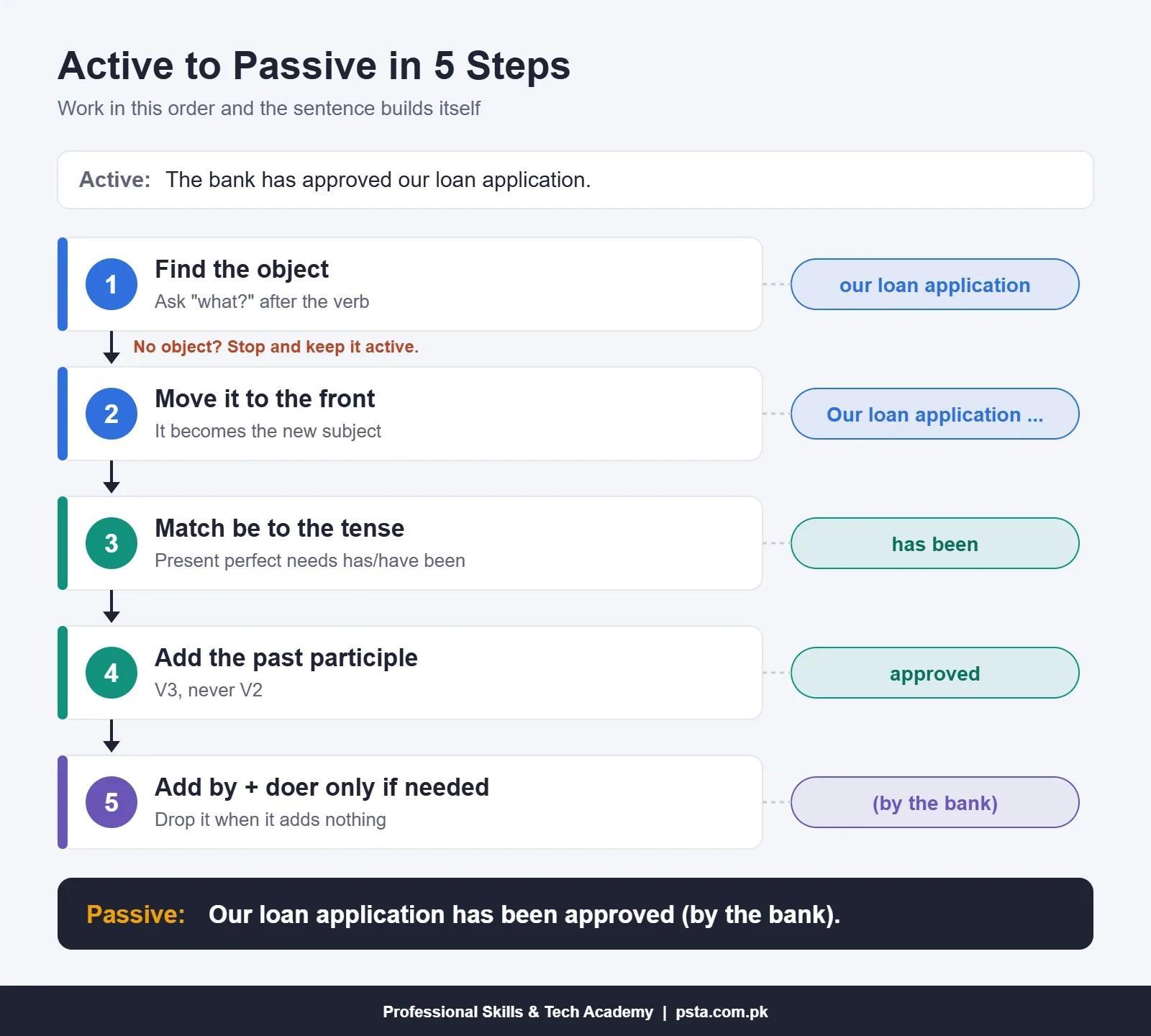
Most students who struggle with voice try to change the whole sentence at once. When you change active to passive, it's easier to work in a fixed order. I teach these five steps, and I ask students to say them out loud for the first week.
- Find the object. Ask "what?" or "whom?" after the verb. In "The bank has approved our loan application," the answer is "our loan application." If there's no answer, stop. The sentence can't become passive.
- Move the object to the front. It becomes the new subject. If it's a pronoun, switch it to subject form: me becomes I, him becomes he, them becomes they.
- Name the tense of the active verb. "Has approved" is present perfect. Write down the matching form of be: has been or have been, depending on the new subject.
- Add the past participle of the main verb. Approve becomes approved. Write becomes written, not wrote.
- Decide on the doer. Add "by + doer" only if the reader needs it. If you keep it, use the object form of pronouns: by him, by her, by us, by them.
Result: "Our loan application has been approved by the bank." If everyone knows which bank you mean, "Our loan application has been approved" is cleaner.
The flowchart below puts the same routine on one page. Print it and keep it next to your grammar notebook for the first few days.
Passive Voice Rules for Every Tense
Use this table as your reference. Every row uses the same base sentence, "Sana prepares the salary sheet," so the passive voice examples line up and you can see that only the be part moves.
| Tense | Active | Passive form | Passive example |
|---|---|---|---|
| Present simple | Sana prepares | is/are + V3 | The salary sheet is prepared by Sana. |
| Present continuous | Sana is preparing | is/are being + V3 | The salary sheet is being prepared. |
| Present perfect | Sana has prepared | has/have been + V3 | The salary sheet has been prepared. |
| Past simple | Sana prepared | was/were + V3 | The salary sheet was prepared. |
| Past continuous | Sana was preparing | was/were being + V3 | The salary sheet was being prepared. |
| Past perfect | Sana had prepared | had been + V3 | The salary sheet had been prepared. |
| Future simple | Sana will prepare | will be + V3 | The salary sheet will be prepared. |
| Future perfect | Sana will have prepared | will have been + V3 | The salary sheet will have been prepared. |
| Going to | Sana is going to prepare | is/are going to be + V3 | The salary sheet is going to be prepared. |
These forms match the tense list in the British Council's quick grammar page on passives, which also stresses that the past participle stays the same while be carries the tense.
What About the Perfect Continuous Tenses?
Many school charts in Pakistan list 12 tenses and expect a passive for each one. In practice, forms like "has been being prepared" or "will be being prepared" sound clumsy, and you'll rarely see them in real writing. If an exam asks for them, follow your teacher's chart. In an email or report, switch to the simple or perfect passive, or keep the sentence active. Our English tenses chart covers the active forms of all 12 tenses if you need a refresher first.
Modals, Two-Object Verbs and Phrasal Verbs
These three patterns cause most of the confusion after the basic tenses. Each one still follows the same formula.
Modals: Modal + Be + V3
After can, could, should, must, may and might, the passive is always modal + be + V3. "You must submit the form by Friday" becomes "The form must be submitted by Friday." Notice that "by Friday" here is a deadline, not a doer. Don't let the word by fool you.
For past possibility, use modal + have been + V3: "Someone might have deleted the file" becomes "The file might have been deleted."
Verbs With Two Objects
Verbs like give, send, offer and show can take two objects, so you get two possible passives. "The HR officer gave Ahmed the offer letter" can become:
- Ahmed was given the offer letter. (focus on the person)
- The offer letter was given to Ahmed. (focus on the thing)
The British Council reference shows the person-first version, "He was given a book," as a standard pattern. Both are correct. In job emails, the person-first version usually sounds more natural.
Phrasal Verbs
Keep the particle with the verb. "Management called off the meeting" becomes "The meeting was called off." Dropping "off" changes the meaning completely.
Reporting Verbs and the Informal Get Passive
The British Council's advanced passives review covers two patterns you'll see in news and reports. One starts with it: "It is estimated that..." The other moves the topic to the front: "Prices are expected to rise." The same page notes that informal English sometimes uses get instead of be, as in "My phone got stolen." That's fine when you're chatting, but use be in a formal letter or report.
Which Sentences Can't Be Made Passive?
Only verbs with an object can go into the passive. Verbs such as happen, arrive, sleep, die, go and come don't take an object, so they have no passive form.
That's why "The accident was happened" is wrong. Nothing "happened the accident." The correct sentence is simply "The accident happened." The same goes for "He was died" (correct: "He died") and "The train was arrived" (correct: "The train arrived").
A few verbs that do take an object still sound odd in the passive, especially verbs of state like have, resemble and fit. "Ali has a car" doesn't become "A car is had by Ali." When the passive sounds unnatural to you, trust that instinct and keep the active.
When Should You Choose the Passive Voice?
Here's the good news: the passive isn't a mistake. The Writing Center at Habib University makes this point clearly in its handout Using the Active and Passive Voice. Voice is a matter of clarity and style, not correctness. The handout says active is usually the stronger choice, but the passive has a place when the doer is unknown or unimportant, or when the receiver of the action matters more.
Purdue's Online Writing Lab, in Active Versus Passive Voice, adds a practical reason to prefer active most of the time: active sentences need fewer words, so they're easier to follow.
I give students two questions to ask before they choose:
- Do I know who did it?
- Does my reader care more about the doer or about the result?
Put those together and you get four situations, shown in the grid below.
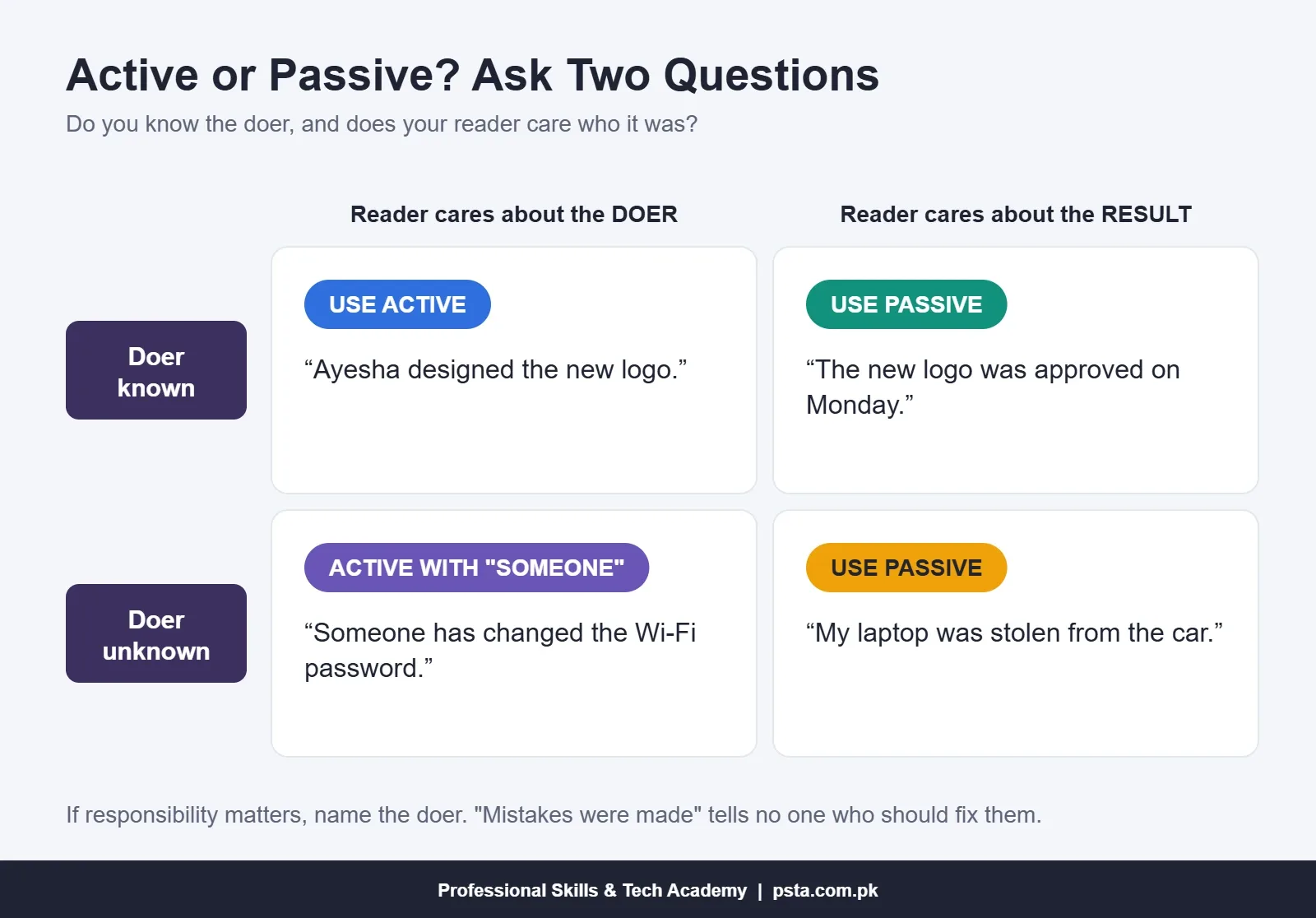
One warning from the Habib handout is worth repeating: a passive can hide weak thinking. "Mistakes were made" tells the reader nothing about who should fix them. If responsibility matters, name the doer.
Active vs Passive in Office Emails and Reports
In a Pakistani office, business English uses both voices every day. A notice from admin, a fee reminder from a school, or a bank's SMS often uses the passive because the result matters more than who did the work: "Your cheque has been cleared," "The office will remain closed on Friday," "Fee challans have been issued."
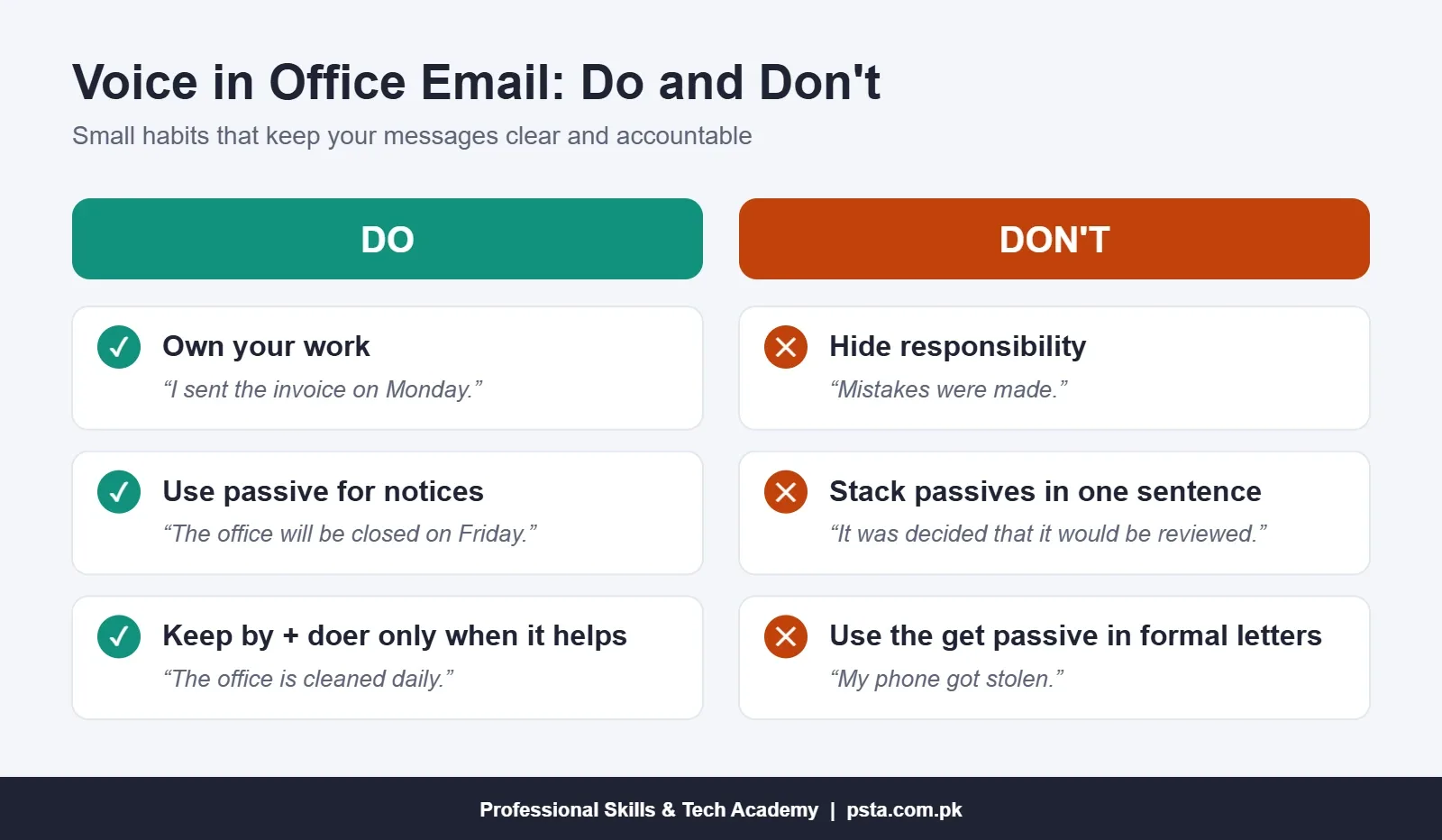
Personal emails are different. When you're reporting your own work, the active voice shows ownership. "I sent the invoice on Monday" is clearer than "The invoice was sent on Monday," especially if your manager later asks who sent it.
Watch out for stacked passives too. "It was decided that the policy would be reviewed" makes the reader work hard. "The board decided to review the policy" says the same thing in fewer words and names who acted.
Here's a quick set of habits that keeps both voices working for you.
If you write a lot of office email, our guide to English phrases for office meetings, calls and email pairs well with this section.
Six Conversion Mistakes to Watch For
These come up again and again when I check students' exercise books and practice emails. Each one breaks a specific step of the method above.
| Wrong | Right | What went wrong |
|---|---|---|
| The accident was happened. | The accident happened. | Happen has no object, so no passive (Step 1) |
| The letter was wrote by him. | The letter was written by him. | Past tense (V2) used instead of past participle (Step 4) |
| The files was sent yesterday. | The files were sent yesterday. | Be must agree with the new subject (Step 3) |
| Dinner was being cooked by her. (from "She is cooking dinner") | Dinner is being cooked by her. | Tense changed during conversion (Step 3) |
| The report was checked by he. | The report was checked by him. | Subject pronoun after by (Step 5) |
| The office is cleaned by someone daily. | The office is cleaned daily. | A by-phrase that adds nothing (Step 5) |
For more errors of this kind, see 15 common English mistakes Pakistanis make.
How to Make Microsoft Word Flag Passive Sentences
Word can highlight passive sentences while you type, which is a useful check before you send a CV or report. Microsoft's grammar settings help page explains that you choose which issues Editor checks from the Editor pane on the Home tab.
A TechRepublic walkthrough for Microsoft 365 on Windows gives this route:
- Go to File, then Options, then Proofing.
- Next to the writing style list, choose Grammar, then click Settings.
- Under Clarity, tick the two passive voice options.
- Click OK twice, then press F7 to open Editor.
Editor then lists passive sentences under Clarity and often suggests an active version. Menu names can shift a little between Word versions, so look for the same words if your screen differs. Treat each suggestion as a prompt to think, not an order. Sometimes the passive is the right choice, as the grid above shows.
If you want to get comfortable with Word's proofing tools, settings and shortcuts, the Office Automation course covers MS Word in depth.
Practice: Convert These 8 Sentences
Cover the answers and try each one with the five steps. Say the tense out loud before you write.
- The guard opens the gate at 8 am.
- Our team is testing the new website.
- Someone has stolen my bike.
- The principal announced the results yesterday.
- Workers were repairing the road all week.
- The clerk had verified the documents before the interview.
- We will send you the invoice tomorrow.
- You should save the file every 10 minutes.
Answers:
- The gate is opened at 8 am (by the guard).
- The new website is being tested by our team.
- My bike has been stolen.
- The results were announced by the principal yesterday.
- The road was being repaired all week.
- The documents had been verified by the clerk before the interview.
- You will be sent the invoice tomorrow, or: The invoice will be sent to you tomorrow.
- The file should be saved every 10 minutes.
Check answer 3: the doer is "someone," so the by-phrase is dropped. Check answer 7: it's a two-object verb, so both versions are correct.
Practising Voice Out Loud in PSTA's English Course
English grammar rules stick when you use them in speech, not only on paper. The English Spoken & Grammar course at PSTA is a 3-month program for beginners. Its modules include Parts of Speech & Sentence Formation, Tenses & Grammar Usage in Speaking, Formal vs Informal English, and Email, CV & Message Writing, which is where voice choices matter most.
Right now the fee is Rs. 12,000, according to the course page, which shows Rs. 14,000 as the regular price. Classes run at our Abbottabad campus, and you can also join online from other cities. You can compare it with other programs on the all courses page, or read how to apply on the admission page. Want to check batch timings before you visit? Send a WhatsApp to +92 314 5424399 to ask about the next batch.
Rewrite Three Sentences From Your Last Email
Open the last email you sent at work or university. Find three sentences that use is, are, was, were, been or being followed by a past participle. For each one, ask the two questions: do I know the doer, and does my reader care? Rewrite the ones where the answer to both is yes. That 10-minute habit will improve your writing faster than another page of drills.
If you're also preparing applications, our guide on how to write a job application email shows where active sentences make the strongest impression.
Frequently asked questions
What is the basic rule for changing active to passive voice?
Take the object of the active sentence and make it the subject. Then add the form of be that matches the original tense, followed by the past participle of the main verb. Add "by" and the doer at the end only if the reader needs that information. For example, "Sara wrote the report" becomes "The report was written by Sara."
Can every sentence be changed into passive voice?
No. Only sentences with a transitive verb, meaning a verb that has an object, can become passive. Verbs like happen, arrive, die, sleep and come have no object, so they have no passive form. That is why "The accident was happened" is wrong. Some state verbs such as have and resemble also sound unnatural in the passive.
Is it wrong to use passive voice in English?
No, the passive is grammatically correct. It is a style choice. Writing guides such as Purdue OWL recommend active voice for most writing because it is shorter and clearer. The passive works well when the doer is unknown or unimportant, or when the result matters more, as in "Your cheque has been cleared" or "The office will be closed on Friday."
How do you change a question into passive voice?
Keep it a question and apply the same steps. Move the object into subject position and put the form of be before it. "Did the manager sign the letter?" becomes "Was the letter signed by the manager?" For wh-questions about the doer, use "by whom": "Who wrote this email?" becomes "By whom was this email written?" In everyday English, "Who was this email written by?" also works.
How do you change an imperative sentence into passive voice?
Many school grammar books use "let" for this. "Close the door" becomes "Let the door be closed," and "Send the file today" becomes "Let the file be sent today." These forms sound formal and are rare in modern speech. For polite requests at work, writers often use "You are requested to" instead, as in "You are requested to submit the form by Friday."
Does the tense change when you convert active to passive?
No. The tense stays exactly the same. Only the form of be shows the tense. If the active sentence is present continuous, "She is cooking dinner," the passive must also be present continuous: "Dinner is being cooked." Changing it to "was being cooked" is a common exam mistake because it changes the time of the action.
Do I always need to write "by" in a passive sentence?
No. Most passive sentences in real writing leave out the doer. Keep the by-phrase only when the doer is new or useful information, such as "The bridge was designed by a local engineer." Drop it when the doer is obvious, unknown or unimportant: "My bike has been stolen" is better than "My bike has been stolen by someone."
Sources & references
- Active and passive voice - LearnEnglish, British Council learnenglish.britishcouncil.org
- Passives - LearnEnglish Quick Grammar, British Council learnenglish.britishcouncil.org
- Advanced passives review - LearnEnglish, British Council learnenglish.britishcouncil.org
- Active Versus Passive Voice - Purdue OWL owl.purdue.edu
- Using the Active and Passive Voice - Habib University Writing Center habib.edu.pk
- Grammar settings - Microsoft Support support.microsoft.com
- How to find and rewrite passive voice in Microsoft Word - TechRepublic techrepublic.com
Last reviewed & updated on by Umar Qureshi. Written by the PSTA team in Abbottabad, Pakistan.

Umar Qureshi

English Spoken & Grammar Course in Pakistan – Build Confidence, Speak Fluently (Online & Campus)
Turn this guide into a career: hands-on training with real projects, online across Pakistan or on-campus in Abbottabad · 12 Weeks.

Comments
No comments yet — ask a question or share your experience.