Quick answer
In direct and indirect speech, you drop the quotation marks, add a linker (that, if, a wh-word or to), change pronouns to fit the new speaker and shift tenses one step back after a past reporting verb. Keep the original tense for general truths, facts that are still true, or when the reporting verb is says.
Key takeaways
- • After said, told or asked, move each verb one step back: is to was, has done to had done, will to would.
- • Past perfect, would, could, should and might never change.
- • Change pronouns, time words and place words only when they are no longer accurate.
- • Tell needs an object (told me); say does not (said that).
- • Reported questions use if, whether or the wh-word, statement word order and a full stop.
- • Commands use told, asked, warned or advised plus an object and a to-infinitive.
Table of contents 15 sections
- Direct and Indirect Speech: What Actually Changes?
- The Backshift Table: How Tenses Change
- Modal Verbs in Reported Speech
- When Should You Keep the Original Tense?
- Pronouns, Time Words and Place Words
- Say or Tell: Which Reporting Verb Fits?
- How Do You Report Questions?
- Yes/No Questions: Use If or Whether
- Wh- Questions: Keep the Question Word
- Commands, Requests and Advice
- Converting Direct and Indirect Speech in Six Steps
- Mistakes That Cost Marks in Exams and Interviews
- Practice: Convert These 8 Sentences
- How PSTA's Spoken English Course Handles Narration
- A Five-Minute Drill Before Your Next Class
Most questions about direct and indirect speech start the same way: "Do I always have to change the tense?" You don't. You shift the tense back when the reporting verb is in the past and the words are no longer current, and you leave it alone when the fact is still true or the reporting verb is in the present.
That single answer clears up a lot of confusion, but narration has a few more moving parts. This guide covers:
- the backshift table for tenses and modal verbs, plus the cases where you skip it
- how pronouns, time words and place words change, and why that depends on who is reporting
- when to use say and when to use tell
- how to turn questions, commands and requests into reported sentences
- a six-step conversion method and eight practice sentences with answers
Direct and Indirect Speech: What Actually Changes?
Direct speech repeats a speaker's exact words inside quotation marks. Indirect speech, also called reported speech, gives the meaning of those words without quotation marks, usually after a reporting verb such as said, told or asked.
Look at one pair:
- Direct: Ayesha said, "I am preparing for my interview."
- Indirect: Ayesha said that she was preparing for her interview.
Four things moved. The quotation marks disappeared. The word that joined the two parts (you can drop it in casual English). I and my became she and her. And am preparing became was preparing. Every rule in this guide is a version of one of those four changes.
| What changes | Direct speech | Indirect speech |
|---|---|---|
| Punctuation | Quotation marks, comma | No quotation marks |
| Linking word | None | that, if, whether, a wh-word or to |
| Pronouns | I, my, we | he, she, his, her, they |
| Tense | am preparing | was preparing |
| Time and place | today, here | that day, there |
For students in Pakistan, this isn't only a textbook topic. A 2026 Class 11 English pairing scheme shared for Federal Board and AJK students lists direct and indirect narration as a 6-mark grammar question. At work you use the same skill when you write meeting minutes, summarize a client call for your manager or start an email with "The customer told us that...". Once the narration rules click, sentences like these take seconds.
The Backshift Table: How Tenses Change
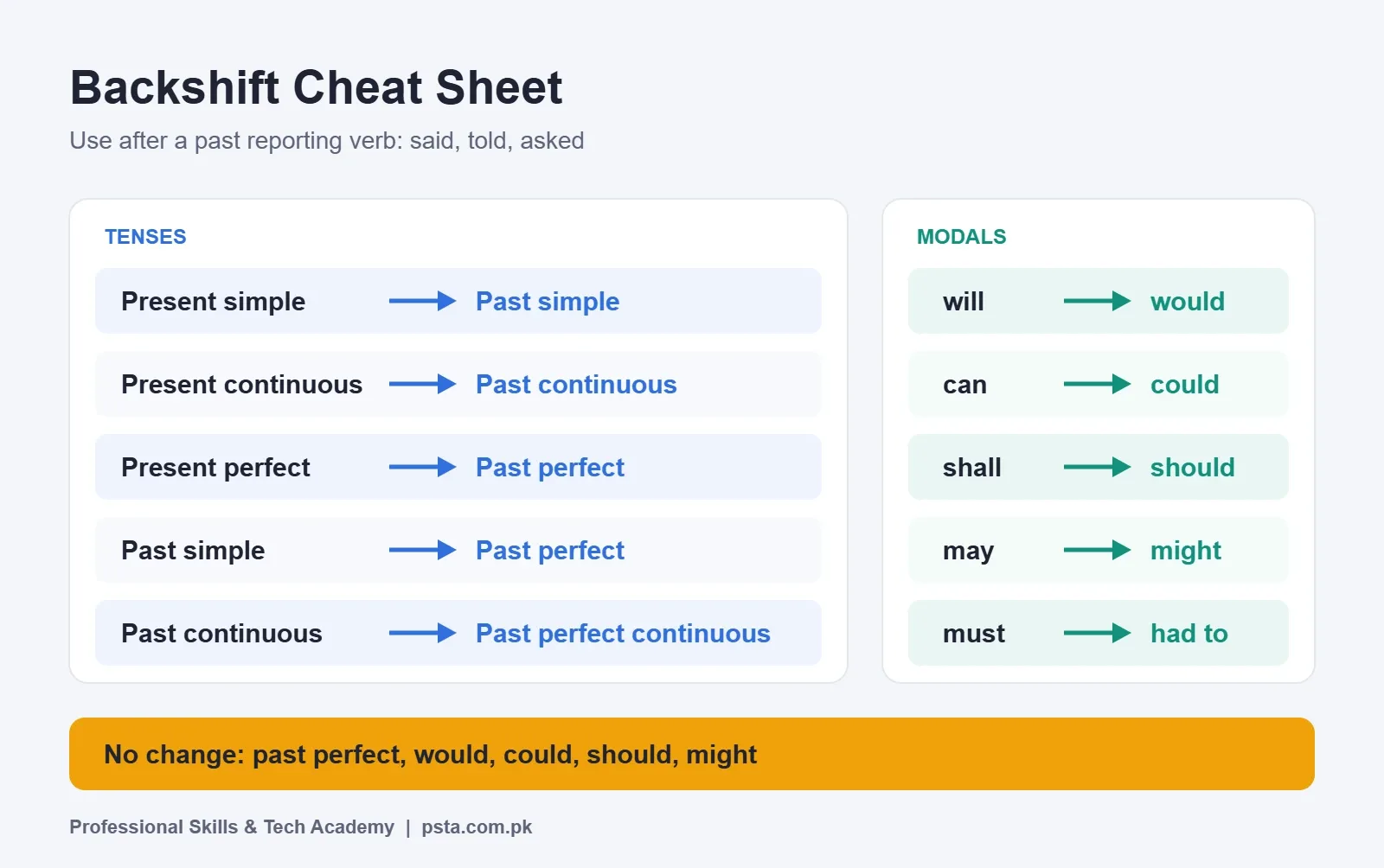
When the reporting verb is in the past, you normally move each verb in the reported part one step further into the past. Grammar books call this backshift. The British Council's LearnEnglish page on reported statements sets out the standard pattern, and the table below uses the same steps with local examples.
| Direct speech | Indirect speech | Example |
|---|---|---|
| Present simple | Past simple | "I live in Mansehra." → He said he lived in Mansehra. |
| Present continuous | Past continuous | "I'm waiting outside." → She said she was waiting outside. |
| Present perfect | Past perfect | "I have paid the fee." → He said he had paid the fee. |
| Past simple | Past perfect (usually) | "We visited Nathia Gali." → They said they had visited Nathia Gali. |
| Past continuous | Past perfect continuous (usually) | "I was revising." → She said she had been revising. |
| Past perfect | No change | "I had left." → He said he had left. |
Notice the word "usually" in two rows. If the order of events is already clear from the sentence, many writers keep the past simple. In an exam, the safer choice is the past perfect.
Modal Verbs in Reported Speech
Modals follow their own short list. EnglishClub's backshift guide gives these changes:
- will becomes would: "I will call you." → She said she would call me.
- can becomes could: "I can fix the printer." → He said he could fix the printer.
- shall becomes should, and may becomes might.
- must usually becomes had to, though it can stay as must when the deadline hasn't arrived yet.
Past perfect, would, could, should and might never change. If you see them in the quoted words, copy them across as they are.
When Should You Keep the Original Tense?
Of all the indirect speech rules, backshift is the one students overuse. It is a default, not a law. Students lose marks in both directions: some change every verb by reflex, others never change anything. There are three situations where the original tense can stay.
- The reporting verb is in the present. If you write says or tells, you're reporting something current, so the verb stays as it was. "My teacher says the test is on Monday."
- The statement is still true. The British Council's reported speech reference says you may keep the present tense when the situation hasn't changed, and that the past form is also correct. "I work at a bank in Abbottabad." → He told me he works (or worked) at a bank in Abbottabad.
- It's a general truth. Facts that everyone accepts normally stay in the present. "Water boils at 100 degrees Celsius." → The teacher said that water boils at 100 degrees Celsius.
A practical rule for school papers: backshift unless the sentence is a universal truth or the reporting verb is in the present. In everyday speech and emails, you have more freedom, and keeping the present tense often sounds more natural when the fact still holds.
Pronouns, Time Words and Place Words
Pronouns change to match the person who is now telling the story. If Bilal says, "I lost my wallet," and you report it, he becomes the subject: Bilal said that he had lost his wallet. If you were the original speaker, the pronouns stay the same: I said that I had lost my wallet.
Time and place words change for the same reason. They should still make sense at the moment of reporting. The usual changes are:
| Direct speech | Indirect speech |
|---|---|
| this / these | that / those |
| now | then |
| today | that day |
| tomorrow | the next day / the following day |
| yesterday | the day before |
| ago | before |
| here | there |
The key idea, which the British Council's statements page also stresses, is that you change these words only when they are no longer accurate. If your friend says, "I'll meet you here tomorrow," and you report it to someone else in the same café a minute later, "here" and "tomorrow" are still correct. Changing them would actually make your sentence wrong.
Say or Tell: Which Reporting Verb Fits?
Both verbs report statements, but their grammar is different. Perfect English Grammar puts it simply: tell needs an object, and say doesn't take one.
- Correct: He told me that the bus was late.
- Correct: He said that the bus was late.
- Wrong: He said me that the bus was late.
- Wrong: He told that the bus was late.
Many Pakistani textbooks write the direct sentence as He said to me, "...". When you convert it, said to me usually becomes told me. That one swap fixes a mistake we correct in almost every grammar class.
Tell also introduces orders: She told me to sit down. You'll use that pattern again in the section on commands.
How Do You Report Questions?
A reported question is no longer a question. It becomes a statement about what someone asked, so it uses statement word order and ends with a full stop. The British Council's guide to reported questions splits them into two groups.
Yes/No Questions: Use If or Whether
Add if or whether, remove do, does or did, and put the subject before the verb.
- The interviewer said to me, "Do you have a driving license?" → The interviewer asked me if I had a driving license.
- "Are you coming to the seminar?" she asked. → She asked whether I was coming to the seminar.
Wh- Questions: Keep the Question Word
Keep what, where, why, when, who or how, then switch to statement order.
- "Where do you live?" the clerk asked. → The clerk asked where I lived.
- "Why did you leave your last job?" he asked. → He asked why I had left my last job.
The most common slip here is keeping the question order: He asked where did I live. Read your sentence aloud. If it sounds like a question, the word order is still wrong.
Ask is the usual reporting verb. In formal writing you'll also see enquired, wanted to know and wondered.
Commands, Requests and Advice
Imperative sentences don't use that. Instead, you choose a verb that shows the function of the sentence and follow it with an object and a to-infinitive. For a negative command, put not before to. The British Council's reporting verbs page groups these patterns clearly.
| Function | Verb pattern | Example |
|---|---|---|
| Order | tell / order + object + to | "Send the invoice today." → The manager told Bilal to send the invoice that day. |
| Polite request | ask + object + to | "Please don't park here." → The guard asked us not to park there. |
| Warning | warn + object + not to | "Don't share your OTP." → The bank warned customers not to share their OTP. |
| Advice | advise + object + to | "You should revise tenses first." → The teacher advised me to revise tenses first. |
| Suggestion | suggest + -ing | "Let's take a break." → Sana suggested taking a break. |
| Offer | offer + to | "Shall I carry your bag?" → He offered to carry my bag. |
| Promise | promise + to | "I'll finish the report by Friday." → She promised to finish the report by Friday. |
Watch suggest. It never takes a to-infinitive, so "Sana suggested to take a break" is wrong. Use suggested taking or suggested that we take.
Choosing a precise verb also makes your writing sound more mature. Compare "He told me to be careful" with "He warned me to be careful". The second one tells the reader more.
Converting Direct and Indirect Speech in Six Steps
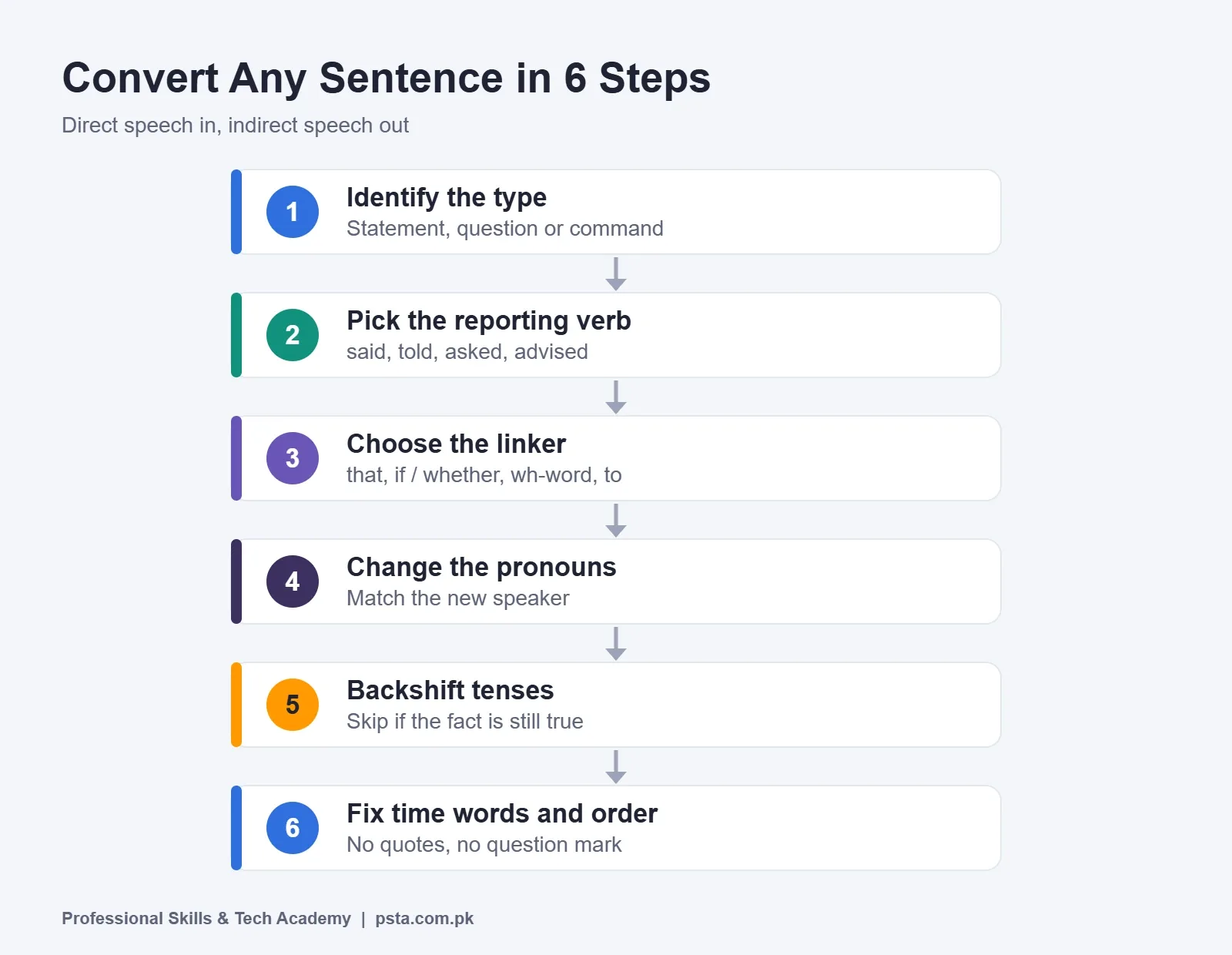
When a sentence looks complicated, slow down and work through it in order. These six steps handle almost every sentence you'll meet in a paper or an office email.
- Identify the sentence type. Is it a statement, a yes/no question, a wh- question, or a command or request?
- Choose the reporting verb. Use said or told for statements, asked for questions, and told, ordered, advised or similar for commands.
- Pick the linker. That for statements, if or whether for yes/no questions, the question word for wh- questions, and to for commands.
- Change the pronouns so they fit the person reporting.
- Backshift tenses and modals, unless the reporting verb is present or the fact is still true.
- Fix time words, place words, word order and punctuation. Remove the quotation marks and any question mark.
Try the method on one full sentence. Hamza said to me, "Can you help me with my CV tomorrow?" It's a yes/no question, so the verb is asked and the linker is if. You becomes I, me and my become him and his, can becomes could, and tomorrow becomes the next day. Result: Hamza asked me if I could help him with his CV the next day.
Mistakes That Cost Marks in Exams and Interviews
These direct and indirect speech errors come up again and again in written tests, and some of them carry into spoken English during job interviews.
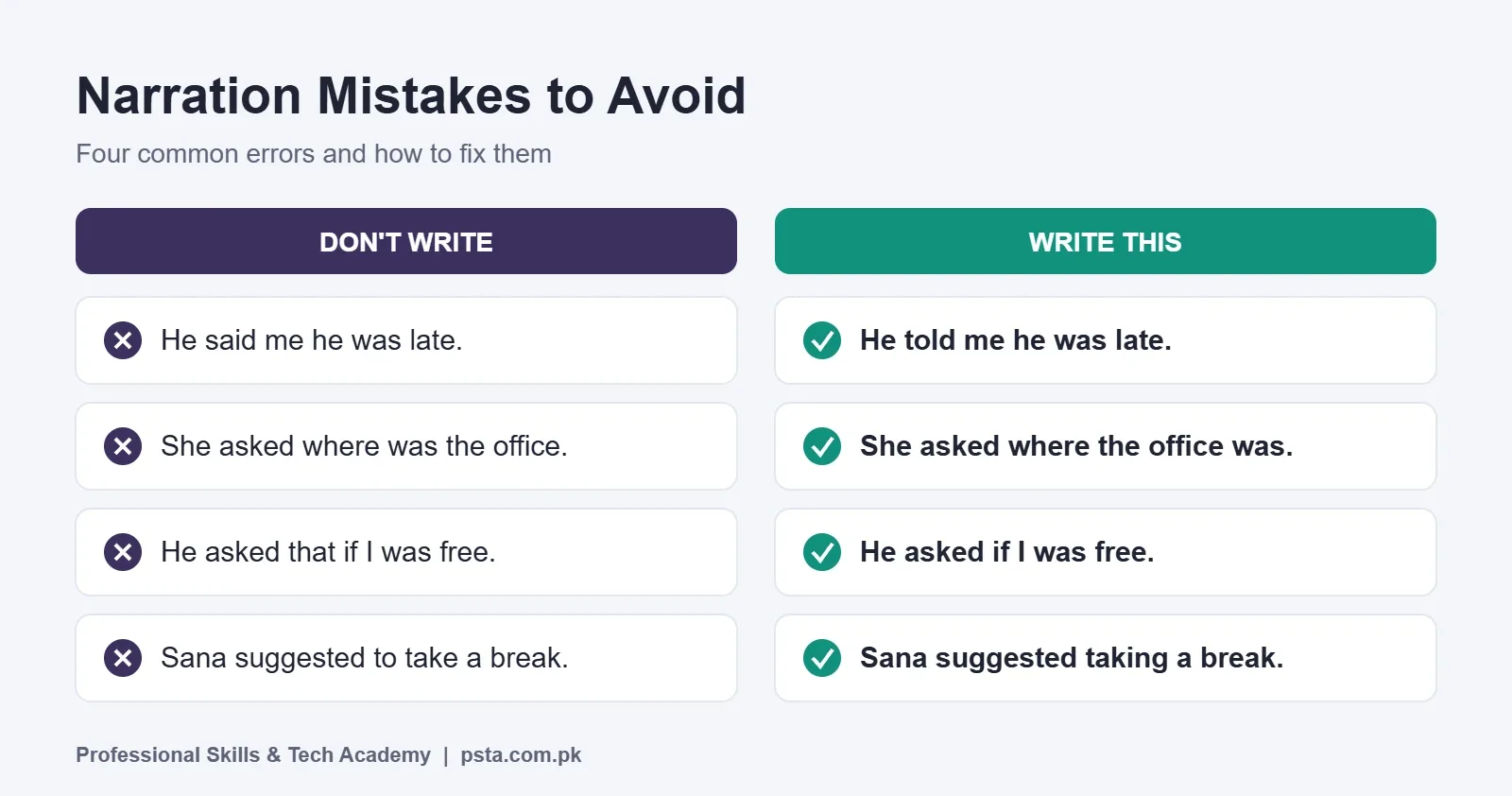
- Keeping question word order. "She asked where was the office" should be "She asked where the office was."
- Using say with an object. "He said me" should be "He told me" or "He said to me".
- Mixing that with if. "He asked that if I was free" needs only one linker: "He asked if I was free."
- Forgetting the pronoun. "Ali said that I was tired" changes the meaning completely when Ali meant himself.
- Backshifting words that don't move. Could, would, might, should and the past perfect stay as they are.
- Using suggest + to. Write "suggested taking", not "suggested to take".
- Leaving the question mark. A reported question ends with a full stop.
Urdu speakers often bring one more habit across. In Urdu, it's natural to repeat someone's words after keh without changing the tense, so learners write "He said that he is coming" for something that happened last week. If the event is over, shift the tense.
Practice: Convert These 8 Sentences
Here is a short direct and indirect speech exercise. Cover the answers, write your version, then check. Assume each sentence is being reported a few days later, so time words should change.
- Zainab said, "I am learning Excel this month."
- The principal said to the students, "Don't run in the corridor."
- Usman said to me, "Have you submitted your assignment?"
- My brother said, "I will book the tickets tomorrow."
- The trainer asked, "Why are you late?"
- Mariam said, "We went to Islamabad yesterday."
- Faisal said, "Let's practice speaking every evening."
- The doctor said to my father, "You must walk daily."
| # | Answer |
|---|---|
| 1 | Zainab said that she was learning Excel that month. |
| 2 | The principal told the students not to run in the corridor. |
| 3 | Usman asked me if I had submitted my assignment. |
| 4 | My brother said that he would book the tickets the next day. |
| 5 | The trainer asked why I was late. |
| 6 | Mariam said that they had gone to Islamabad the day before. |
| 7 | Faisal suggested practicing speaking every evening. |
| 8 | The doctor told my father that he had to walk daily. |
If you missed number 5, check the word order. If you missed number 7, review the suggest pattern. Most errors fall into one of those two groups.
For more grammar practice with the same step-by-step style, read our guides on active and passive voice and the English tenses chart. Backshift is much easier once all 12 tenses feel familiar. Our list of common English mistakes Pakistanis make covers related errors with prepositions and articles.
How PSTA's Spoken English Course Handles Narration
Direct and indirect speech sticks best when you use it out loud, not only on paper. In PSTA's English Spoken & Grammar Course, grammar is taught alongside speaking, so you practice telling a classmate what someone else said, summarizing a role-play meeting and writing short work messages.
- Length and level: 12 weeks, designed for beginners.
- Relevant modules: Tenses & Grammar Usage in Speaking; Role Plays, Group Discussions & Public Speaking Practice; and Email, CV & Message Writing.
- How you attend: join in person at our Abbottabad campus, take live classes online from anywhere in Pakistan, or mix the two.
- Timings: a new batch begins each month, and classes run from Monday to Saturday, from 9 AM until 9:30 PM.
- Fee: the course page currently lists Rs. 12,000. Check the page before you apply, since fees can change.
If you're preparing for interviews, our list of English interview questions and answers pairs well with the course. You can compare all programs on the courses page, and when you're ready, the admission form takes a few minutes. Questions about batch timings can go to our team on WhatsApp at +92 314 5424399, or you can visit us in Mandian, Old College Road, opposite FIMS College.
A Five-Minute Drill Before Your Next Class
Open any WhatsApp chat from yesterday and pick five messages: a statement, a question, a request and two more of your choice. Rewrite each one in indirect speech, starting with "She said", "He asked" or "They told me". Then run each sentence through the six steps above. Five sentences a day for two weeks will do more for your narration marks than reading the rules ten more times.
Frequently asked questions
What is the difference between direct and indirect speech?
Direct speech repeats a speaker's exact words inside quotation marks, as in: He said, "I am tired." Indirect speech reports the meaning without quotation marks and usually adjusts the tense and pronouns: He said that he was tired. Indirect speech is what you use when summarizing a call, writing minutes or telling a friend what someone said.
Is it always necessary to change the tense in indirect speech?
No. You normally backshift after a past reporting verb such as said or told. You can keep the original tense when the reporting verb is in the present (says), when the fact is still true, or when it is a general truth like "the sun rises in the east". In school exams, backshift unless one of those cases clearly applies.
When do I use said and when do I use told?
Use told when you mention the listener: She told me that the class was cancelled. Use said when you do not: She said that the class was cancelled. Never write "said me" or "told that". If the direct sentence uses said to me, it usually becomes told me in indirect speech.
How do I change a question into indirect speech?
Use asked, then add if or whether for yes/no questions, or keep the question word for wh- questions. Change the word order to subject plus verb, drop do, does or did, and end with a full stop. For example, "Where do you live?" becomes: She asked where I lived.
How do commands change in reported speech?
Report a command with a verb such as told, ordered, asked, warned or advised, followed by the person and a to-infinitive. Put not before to for negative commands. "Close the door" becomes: He told me to close the door. "Don't be late" becomes: She asked us not to be late.
What happens to words like today, tomorrow and here?
They change when they would no longer be accurate at the moment of reporting. Today becomes that day, tomorrow becomes the next day, yesterday becomes the day before, now becomes then and here becomes there. If you report the words on the same day and in the same place, you can keep them unchanged.
Which modal verbs change in indirect speech?
Will becomes would, can becomes could, shall becomes should, may becomes might, and must usually becomes had to. Would, could, should and might stay the same, and so does the past perfect. If the obligation is still in the future, must can stay as must.
Sources & references
- Reported speech: statements learnenglish.britishcouncil.org
- Reported speech: questions learnenglish.britishcouncil.org
- Reported speech: reporting verbs learnenglish.britishcouncil.org
- Reported speech (grammar reference) learnenglish.britishcouncil.org
- Backshift in Reported Speech englishclub.com
- Say and Tell perfect-english-grammar.com
- English Class 11 Pairing Scheme 2026 res.cloudinary.com
Last reviewed & updated on by Umar Qureshi. Written by the PSTA team in Abbottabad, Pakistan.

Umar Qureshi

English Spoken & Grammar Course in Pakistan – Build Confidence, Speak Fluently (Online & Campus)
Turn this guide into a career: hands-on training with real projects, online across Pakistan or on-campus in Abbottabad · 12 Weeks.
Comments
No comments yet — ask a question or share your experience.