Quick answer
Learn MySQL first if you want web development, freelancing or startup work; learn Oracle first if you are aiming for banks, telecoms or large institutions. Both have free editions, most core SQL transfers between them, and a sensible plan is MySQL basics first, then Oracle PL/SQL and administration if you want database roles.
Key takeaways
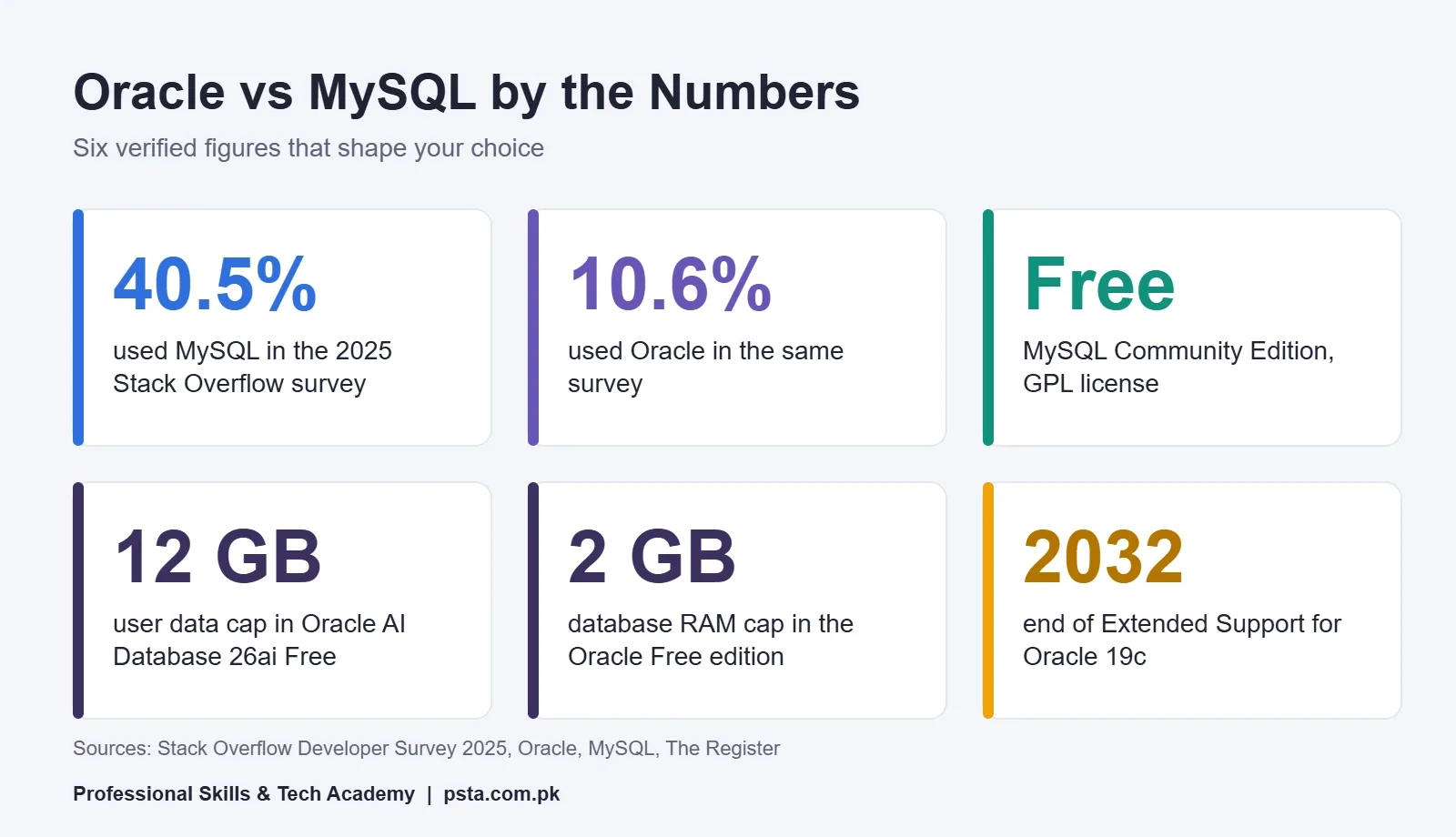
- • MySQL was used by 40.5% of 2025 Stack Overflow survey respondents, Oracle by 10.6%.
- • Both are free to learn: MySQL Community Edition (GPL) and Oracle AI Database 26ai Free, capped at 2 GB RAM and 12 GB of user data.
- • Oracle 19c keeps Premier Support until December 31, 2029, while MySQL 8.0 security support ended on April 30, 2026.
- • Oracle jobs cluster in banks and large institutions; MySQL usually appears inside web, PHP and WordPress roles.
- • Start with core SQL on MySQL, then add PL/SQL and admin skills if you want a DBA career.
Table of contents 13 sections
- Oracle vs MySQL at a Glance
- How Widely Is Each Database Used?
- What Does Each Cost You to Learn?
- Oracle's Free Edition
- MySQL Community Edition
- Where Does the SQL Look Different?
- Which Versions Should You Install in 2026?
- Which Jobs in Pakistan Ask for Oracle, and Which Ask for MySQL?
- Pick by Goal: Four Student Situations
- A Learning Order That Uses Both
- Can You Switch From One to the Other Later?
- Where PSTA's Oracle Course Fits
- Your First Hour: Run One Query on Both
Oracle vs MySQL comes down to where you want to work. MySQL is the better first database for web development, freelancing and startup jobs, while Oracle is the better bet if you are aiming for banks, telecom companies and large government systems. One number shows the gap in everyday use: in the 2025 Stack Overflow Developer Survey, 40.5% of respondents said they had used MySQL, compared with 10.6% for Oracle.
That figure measures how many developers touch each tool, not how many jobs pay well. Oracle roles are fewer, but they sit inside organizations that store money, phone records and citizen data, and those employers rarely switch databases. So the right choice depends on your goal, your laptop and the next two years of your plan.
In this comparison, you will find:
- A side-by-side table of cost, licensing, tools and typical employers
- The SQL differences you will actually notice in your first month
- Which versions to install in 2026, with official support dates
- Four common student situations and the database that suits each one
- A learning order that lets you use both without starting over
Oracle vs MySQL at a Glance
Both are relational databases. You store data in tables, link those tables with keys and query them with SQL. Oracle Corporation owns both products, which surprises many students. The difference is in who each one is built for and how it is sold.
| Point | Oracle Database | MySQL |
|---|---|---|
| Free option for learning | Oracle AI Database 26ai Free (with hardware limits) | MySQL Community Edition (GPL license) |
| Typical employers | Banks, telecoms, ERP users, large public bodies | Web agencies, startups, WordPress and PHP shops |
| Procedural language | PL/SQL (packages, triggers, functions) | Stored procedures with simpler syntax |
| Free desktop tool | SQL Developer | MySQL Workbench |
| Long-supported version to learn | 19c (Premier Support to December 31, 2029) | 8.4 LTS or 9.7 LTS |
| Learning curve | Steeper, more admin concepts | Gentler, faster first project |
| Common job titles | Oracle DBA, PL/SQL developer, Oracle APEX developer | Backend developer, PHP or WordPress developer |
Read this Oracle vs MySQL table as a map, not a scoreboard. Neither database is "better" in general. Each fits a different kind of employer, and the skills overlap more than the marketing suggests.
How Widely Is Each Database Used?
The Stack Overflow survey is a large yearly poll of developers, so it's a fair signal of daily use. Among professional developers in 2025, MySQL stood at 39.6% and Oracle at 10.4%. PostgreSQL led the whole list at 58.2%, and Microsoft SQL Server sat at 30.9%.
Two cautions before you read too much into this. First, survey takers lean toward web and app developers, which favors MySQL and PostgreSQL. Second, Oracle's users are concentrated in a smaller number of very large organizations. A single bank may run dozens of Oracle databases with a full team of DBAs, and none of that shows up as a high percentage in a developer poll.
What the numbers do tell you is practical. If you build websites or apps for clients, you will meet MySQL (or its close relative MariaDB) far more often. If you want a salaried database job at a large institution, Oracle remains a strong skill even though fewer developers use it.
What Does Each Cost You to Learn?
For a learner, the Oracle vs MySQL cost question has a short answer: both are free in software. The limits are about hardware and licensing for real business use.
Oracle's Free Edition
Oracle offers Oracle AI Database 26ai Free for developers, educators and startups. It installs on Windows x64 and Linux, and it also runs as a Docker container. The official licensing page sets three caps: it uses at most two CPU cores, 2 GB of database RAM and 12 GB of user data. Go past 12 GB and you get error ORA-12954.
Those limits are generous for practice. A student database with a few thousand rows of sales or attendance data takes a tiny fraction of 12 GB. The real constraint is your laptop. Oracle's install is heavier than MySQL's, so close your browser tabs during setup on a 4 GB machine.
MySQL Community Edition
MySQL Community Edition is free to download under the GPL license. It includes the InnoDB storage engine, replication, stored procedures, triggers, views and MySQL Workbench. Oracle also sells paid editions such as Enterprise and HeatWave, but you won't need them to learn or to build most client projects.
If you already practice WordPress on your laptop with XAMPP, you have a MySQL-compatible database running right now. Our guide to installing WordPress on localhost covers that setup.
Where Does the SQL Look Different?
Most of what you write in your first month looks the same in both: SELECT, WHERE, GROUP BY, JOIN and subqueries. The differences show up in small, annoying places. Knowing these Oracle vs MySQL syntax gaps in advance saves you from errors that look mysterious.
| Task | Oracle | MySQL |
|---|---|---|
| Return the first 5 rows | FETCH FIRST 5 ROWS ONLY |
LIMIT 5 |
| Auto-numbered ID column | GENERATED AS IDENTITY or a sequence |
AUTO_INCREMENT |
| Join two strings | first_name || ' ' || last_name |
CONCAT(first_name, ' ', last_name) |
| Current date and time | SYSDATE |
NOW() |
| Empty string | Treated as NULL | Stored as an empty value |
| Server-side logic | PL/SQL blocks, packages | Stored procedures, no packages |
The empty-string rule catches many beginners. In Oracle, a customer record saved with a blank phone number becomes NULL, so a query that checks phone = '' finds nothing. In MySQL the same check works. Neither behavior is wrong, but you need to know which database you are talking to.
PL/SQL is the larger gap. Oracle shops write serious business logic inside the database, using packages that group procedures and functions together. If that interests you, read our breakdown of SQL vs PL/SQL before you pick a course.
Which Versions Should You Install in 2026?
Versions matter in any Oracle vs MySQL decision because employers ask about them in interviews, and course material ages quickly.
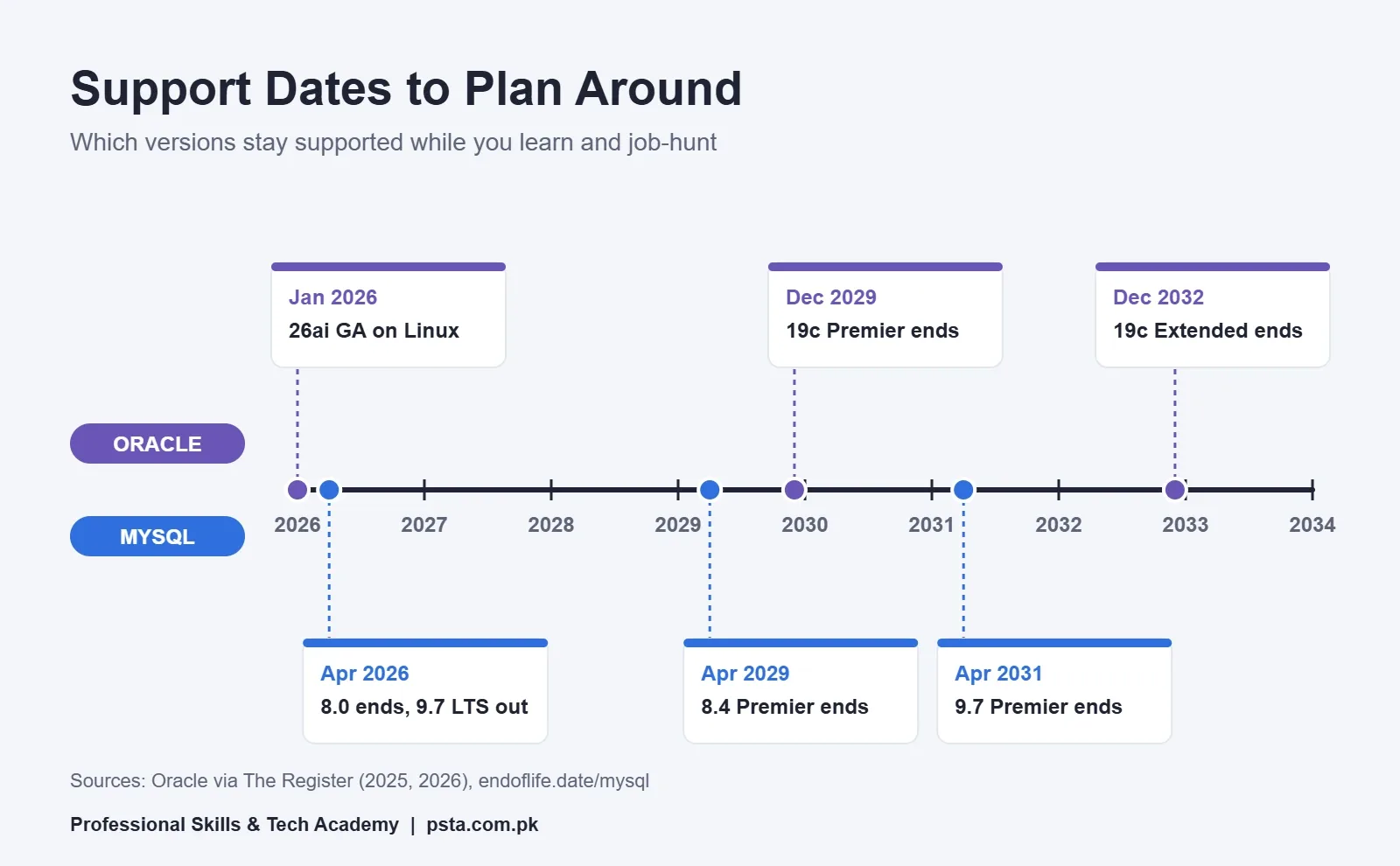
For Oracle, 19c is the long-term release you are most likely to meet at work. Oracle extended its support, and The Register reported Premier Support until December 31, 2029 and Extended Support until December 31, 2032. Oracle AI Database 26ai Enterprise Edition became generally available for on-premises Linux in late January 2026, according to a later Register report. In practice, you learn 19c concepts for the job market and use the free 26ai edition on your laptop. Core SQL, PL/SQL and architecture carry across.
For MySQL, the old favorite 8.0 has reached end of life. The endoflife.date tracker lists its security support ending on April 30, 2026. MySQL 8.4 LTS has Premier Support to April 30, 2029, and 9.7 LTS, released on April 21, 2026, runs to April 30, 2031. Short-lived "innovation" releases in between get only about three months each, so skip them for learning.
A simple rule: install MySQL 8.4 or 9.7 for web work, and if a hosting panel offers only 8.0, ask your host when it will upgrade, because 8.0 no longer receives security fixes.
Which Jobs in Pakistan Ask for Oracle, and Which Ask for MySQL?
Look at who posts the job, not only the title. That is where the Oracle vs MySQL split becomes clear. A good public example is a State Bank of Pakistan IT vacancy notice from late 2025. It listed a Senior Oracle Database Administrator, a Senior Oracle Applications Developer working with Oracle APEX, and a Database Administrator role covering "Oracle/DB2/SQL/My SQL Server" databases. Banking-sector roles like these tend to want Oracle depth plus comfort with at least one other system.
MySQL work in Pakistan usually looks different. It shows up inside job ads for PHP, Laravel, WordPress, Node.js and Django developers, where the database is one skill among five. You are rarely hired as a "MySQL specialist." You're hired to build an app, and MySQL is where it stores data.
Here is how that plays out:
- Oracle path: fewer openings, mostly at large head offices, with interviews that test architecture, backup and recovery, and PL/SQL.
- MySQL path: many more openings and freelance gigs, often remote, with interviews that test queries, indexes and how you connect a database to code.
For a wider view of database jobs in Pakistan and the skills listed next to them, see which IT skills Pakistani employers ask for.
Pick by Goal: Four Student Situations
The best answer to Oracle vs MySQL depends on your situation, so match it to the closest row. If two rows fit, follow the one tied to the job you'd accept first.
| Your situation | Start with | Why |
|---|---|---|
| BSCS student who wants a bank or telecom job after graduation | Oracle | These employers test PL/SQL and DBA basics in interviews. |
| Freelancer building WordPress or PHP sites for clients | MySQL | WordPress needs MySQL or MariaDB, so client sites already run one of them. |
| Python or JavaScript learner building portfolio apps | MySQL (or PostgreSQL) | Quick setup, free cloud tiers and plenty of framework tutorials. |
| Data analyst aiming for corporate reporting roles | SQL first, then Oracle | Reporting teams at banks and large firms may pull data from Oracle systems. |
Notice that none of these answers says "only one forever." The question is which one earns you your first job sooner.
A Learning Order That Uses Both
You don't need to choose a side for life. Standard SQL transfers between the two, so a sensible order lets you build on each step instead of starting over.
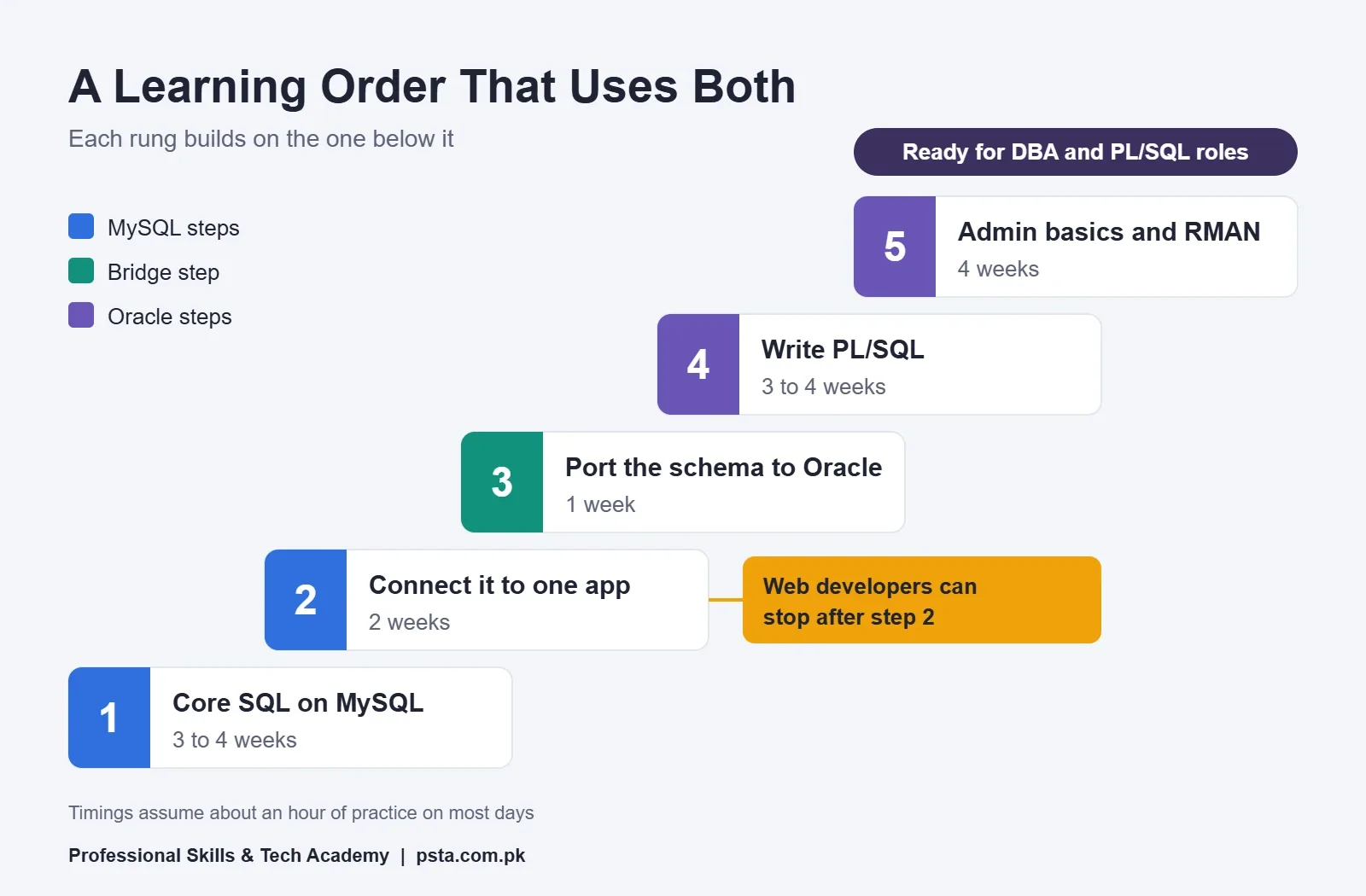
- Learn core SQL on MySQL (3 to 4 weeks). Create tables, insert data and practice joins and GROUP BY on a small shop or school database.
- Connect it to one app (2 weeks). Use Python, PHP or JavaScript to read and write rows. This is where most web jobs start testing you.
- Move the same schema to Oracle Free (1 week). Rewrite the queries that break. You will meet FETCH FIRST, identity columns and the empty-string rule naturally.
- Add PL/SQL (3 to 4 weeks). Write procedures, a package and a trigger that logs changes to an audit table.
- Learn admin basics (4 weeks). Users and roles, tablespaces, backups with RMAN and reading an execution plan.
Stop after step 2 if your goal is web development. Continue through step 5 if you want a DBA or PL/SQL role. The timings assume about an hour of practice on most days.
Can You Switch From One to the Other Later?
Yes. The Oracle vs MySQL choice is less permanent than it feels, and many professionals switch. Moving from MySQL to Oracle mostly means learning PL/SQL and administration on top of SQL you already know. Moving from Oracle to MySQL is easier still, because MySQL has fewer moving parts.
The habit that makes switching painless is writing standard SQL when you can. Use ANSI joins instead of old comma joins, and name your columns clearly. Keep database-specific tricks for when you need them. Our SQL interview questions for freshers lean on standard syntax for exactly this reason.
Where PSTA's Oracle Course Fits
If the Oracle path suits your goal, the Oracle Database 19c Masterclass at PSTA runs for 12 weeks and starts at beginner level. Today the listed fee is Rs. 33,000, reduced from the regular Rs. 45,000. The seven modules start with SQL and PL/SQL, then cover database architecture, user security, RMAN backups, tuning with optimizer statistics and indexes, and end with a capstone built on container and pluggable databases (CDB/PDB).
You can attend at our Mandian campus in Abbottabad, join live online from any city, or mix the two. New batches start every month, and class slots run Monday to Saturday.
If your goal leans toward websites, the WordPress development course or Advanced Python course will put MySQL to work inside real projects. The full list of programs sits on our courses page, while the admission page explains how to reserve a seat. Questions about which batch suits you can go to us on WhatsApp at +92 314 5424399.
Your First Hour: Run One Query on Both
Install MySQL Community Edition and Oracle AI Database 26ai Free, then create the same five-row "students" table in each. Write one query that lists the top three students by marks. You will need LIMIT in one and FETCH FIRST in the other, and that single difference will teach you more than another Oracle vs MySQL article. Note which one felt more natural, and let that, plus the job you want, decide your next 12 weeks.
Frequently asked questions
Is MySQL owned by Oracle?
Yes. Oracle Corporation owns MySQL as well as its own Oracle Database. MySQL Community Edition is still free to download under the GPL license, while Oracle sells paid MySQL editions such as Enterprise and HeatWave. For a learner, this changes nothing: you can install the community version, practice and build client projects without paying a license fee.
Is Oracle harder to learn than MySQL?
The SQL itself is similar, so your first few weeks feel much the same on both. Oracle gets harder once you move into PL/SQL packages, memory structures, tablespaces and RMAN backups. MySQL has fewer moving parts, so you reach a working web project sooner. Many beginners find Oracle easier after they already know basic SQL from MySQL.
Can I install Oracle Database on a normal student laptop?
Yes. Oracle AI Database 26ai Free runs on Windows x64, Linux and Docker, and it limits itself to two CPU cores and 2 GB of database RAM. That keeps it practical on an ordinary laptop. On a machine with only 4 GB of memory it still works, but close other programs during installation and while you run heavier queries.
Is MySQL enough to get a job in Pakistan?
On its own, rarely. Employers who use MySQL usually hire PHP, WordPress, Laravel, Node.js or Python developers and expect the database as one part of that stack. Pair MySQL with one backend language and two or three portfolio projects. If you want a pure database role, Oracle skills such as PL/SQL and RMAN are what banks tend to test.
Should I learn PostgreSQL instead of MySQL or Oracle?
PostgreSQL topped the 2025 Stack Overflow survey, used by 58.2% of professional developers, so it is a strong choice for modern web and startup work. Its SQL sits close to both Oracle and MySQL. Whichever open-source database you learn first, moving to Oracle later is mostly about PL/SQL and administration rather than new query syntax.
Which Oracle version should I learn in 2026?
Learn the concepts behind Oracle 19c, because Oracle has extended its Premier Support to December 31, 2029, and employers that run it have little reason to move quickly. For practice at home, install the free 26ai edition. Your SQL, PL/SQL, user and role management, and backup knowledge carry over between the two versions with only small changes.
Sources & references
- Stack Overflow Developer Survey 2025: Technology survey.stackoverflow.co
- Oracle AI Database Free oracle.com
- Oracle AI Database Free: Licensing Restrictions docs.oracle.com
- MySQL Community Edition mysql.com
- The Register: Oracle extends 19c database support to 2032 theregister.com
- The Register: Oracle on-prem AI Database 26ai release theregister.com
- endoflife.date: MySQL release cycles endoflife.date
- State Bank of Pakistan: IT Programs and Project Management vacancies sbp.org.pk
Last reviewed & updated on by Umar Qureshi. Written by the PSTA team in Abbottabad, Pakistan.

Umar Qureshi
Oracle Database 19c Masterclass: SQL, PL/SQL & Administration
Turn this guide into a career: hands-on training with real projects, online across Pakistan or on-campus in Abbottabad · 12 Weeks.
Comments
No comments yet — ask a question or share your experience.