Quick answer
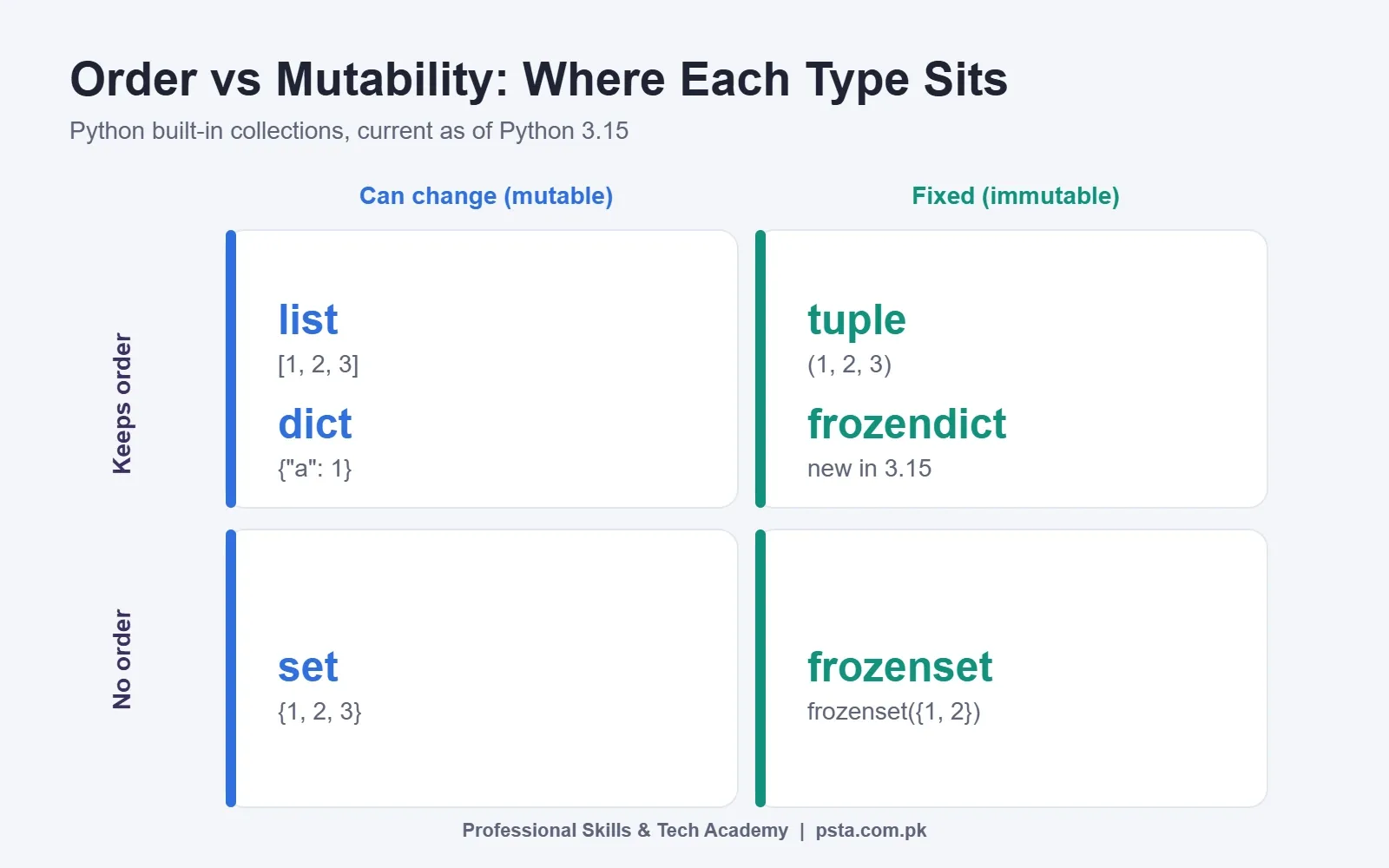
A list is ordered and editable. A tuple is ordered but fixed after creation. A set stores unique items without order and checks membership fast. A dictionary maps keys to values and keeps insertion order. Choose by how the data behaves, not by speed alone. Python 3.15 adds an immutable frozendict.
Key takeaways
- • Lists are ordered and mutable; tuples are ordered and immutable.
- • Sets remove duplicates and check membership in O(1) on average.
- • Dictionaries map keys to values and keep insertion order.
- • Only hashable objects, such as tuples of strings, can be dictionary keys.
- • Python 3.15 adds a built-in frozendict type through PEP 814.
Table of contents 19 sections
- What Do List, Tuple, Set and Dictionary Each Store?
- Python List vs Tuple: Mutability Is the Real Difference
- Syntax Traps Beginners Hit
- When a Tuple Is the Better Choice
- Where Do Sets and Dictionaries Fit In?
- Two Set Gotchas
- All Four Collections Side by Side
- Why Is Searching a Set Faster Than Searching a List?
- Four Beliefs About Tuples and Sets That Need Correcting
- "Tuples Are Always Faster, So Use Them Everywhere"
- "A Tuple Can Never Change at All"
- "Sets Keep Items in the Order You Typed Them"
- "Dictionaries Have No Order"
- How Do You Choose the Right Collection?
- Worked Example: A Tuition Center's Fee Records
- What Is New in Python 3.15: The frozendict Type
- Why Do Interviewers Keep Asking About This?
- Practicing Data Structures in PSTA's Python Course
- Rewrite One Old Program Tonight
Quick self-test before you read on. Look at these four lines and decide which will fail: marks = [72, 85, 90], point = (33.7, 73.1), cities = {"Abbottabad", "Lahore"}, fees = {"python": 30000}. Now imagine running marks[0] = 75, point[0] = 34.0, cities[0] and fees["python"] = 32000.
Two of those four commands raise a TypeError: changing the tuple and indexing the set. If you guessed both, you already understand the heart of the Python list vs tuple question. If you hesitated, this guide will settle it, along with sets and dictionaries.
- What each of the four built-in collections stores, with code you can paste into IDLE or VS Code
- One table that puts mutability, order, duplicates and lookup speed side by side
- Four common beliefs about tuples and sets that are only half true
- A five-question flow for picking the right type in assignments and real projects
- The new
frozendicttype that arrived with Python 3.15 in October 2026
What Do List, Tuple, Set and Dictionary Each Store?
All four are containers. They hold many values under one name. The difference lies in the rules each container follows about change, order and duplicates.
- List
[ ]: an ordered sequence you can change. Use it for a growing collection of similar items, such as the marks of one class. - Tuple
( ): an ordered sequence you cannot change after creation. Use it for a fixed record, such as a latitude and longitude pair. - Set
{ }: an unordered group with no duplicates. Use it to answer "is this value present?" quickly. - Dictionary
{key: value}: a collection of key and value pairs. Use it when you look things up by a name or ID instead of a position.
The official Python built-in types reference sums up the difference between list and tuple types neatly. It says lists are usually used for "homogeneous items," while tuples usually hold "heterogeneous data." In plain words, a list holds many things of the same kind, and a tuple holds a few fields that describe one thing.
Python List vs Tuple: Mutability Is the Real Difference
In any Python list vs tuple comparison, the central difference is mutability. That is the whole mutable vs immutable idea: a mutable object can be changed in place, and an immutable object cannot. Try it in a Python shell:
marks = [72, 85, 90]
marks.append(66)      # works: [72, 85, 90, 66]
marks[0] = 75         # works: [75, 85, 90, 66]

point = (33.7, 73.1)
point[0] = 34.0       # TypeError: 'tuple' object does not support item assignment
That error message comes straight from the Python tutorial chapter on data structures, which states that tuples are immutable. It also notes a subtle point. A tuple can contain mutable objects, such as a list, and that inner list can still change.
Syntax Traps Beginners Hit
- The one-item tuple.
("Python")is just a string in brackets. You need a trailing comma:("Python",). The tutorial says plain parentheses around one value are not enough. - Tuples without brackets.
t = 1, 2, 3also creates a tuple. The commas build it, not the parentheses. - Methods. Lists offer
append,insert,remove,pop,sortand more. Tuples offer onlycountandindex, because nothing else makes sense for an object that never changes.
When a Tuple Is the Better Choice
Pick a tuple when the values belong together and should stay fixed. Good examples are an RGB color such as (255, 153, 0), a date split into (2026, 11, 5), or a function that returns two results at once. A tuple also signals intent to anyone who reads your code later: "these values are not meant to be edited."
Where Do Sets and Dictionaries Fit In?
A Python set and a Python dictionary both rely on hashing. Python turns each set element or dictionary key into a number and uses it to find the item directly, without scanning everything.
The tutorial defines a set as an unordered collection with no duplicate elements. So set([3, 3, 5, 5, 7]) gives you {3, 5, 7}. That makes a set the shortest route to removing duplicates from a list of phone numbers or roll numbers.
A dictionary maps keys to values. Keys must be an immutable type, which is why a string, a number or a tuple of strings works as a key, but a list does not. The same tutorial page confirms that list(d) gives the keys in insertion order, so a dictionary remembers the order in which you added items.
Two Set Gotchas
{}creates an empty dictionary, not an empty set. Writeset()for an empty set. The Python tutorial calls this out directly.- Sets have no positions, so
cities[0]fails. If you need the first item, you probably need a list.
All Four Collections Side by Side
Keep this Python list vs tuple, set and dictionary table open while you practice. It covers the questions examiners and interviewers ask most often.
| Feature | List | Tuple | Set | Dictionary |
|---|---|---|---|---|
| Literal syntax | [1, 2] |
(1, 2) |
{1, 2} |
{"a": 1} |
| Can change after creation | Yes | No | Yes | Yes |
| Keeps order | Yes | Yes | No | Yes (insertion order) |
| Allows duplicates | Yes | Yes | No | Keys no, values yes |
| Access by | Index | Index | Membership only | Key |
Average x in ... cost |
O(n) | O(n) | O(1) | O(1) on keys |
| Usable as a dict key | No | Yes, if contents are hashable | No | No |
| Frozen version | Use a tuple | Already frozen | frozenset |
frozendict (3.15+) |
Why Is Searching a Set Faster Than Searching a List?
The official time complexity page for built-in types lists x in list as O(n), a linear scan. The same check on a set, or on dictionary keys, is O(1) on average. Reading an item by index from a list is also O(1), and append is O(1) amortized.
What does that mean for you? Suppose a shop in Saddar keeps 50,000 blocked customer numbers. Checking a new number against a list means Python may compare it with every entry. Checking against a set jumps almost straight to the answer. On small data you will not notice. On large data the gap is huge.
Two caveats from the same page keep this honest. First, the figures describe CPython, the standard interpreter, and other implementations can differ. Second, set and dictionary speed assumes a decent hash function. In the worst case, when every key hashes to the same value, those O(1) operations become O(n).
Also watch insert. Adding to the front of a list with insert(0, x) moves every other element, so it costs O(n). If you add and remove at both ends often, look at collections.deque instead.
Four Beliefs About Tuples and Sets That Need Correcting
These come up in viva exams, class discussions and code reviews. Each has a grain of truth, which is why they spread.
"Tuples Are Always Faster, So Use Them Everywhere"
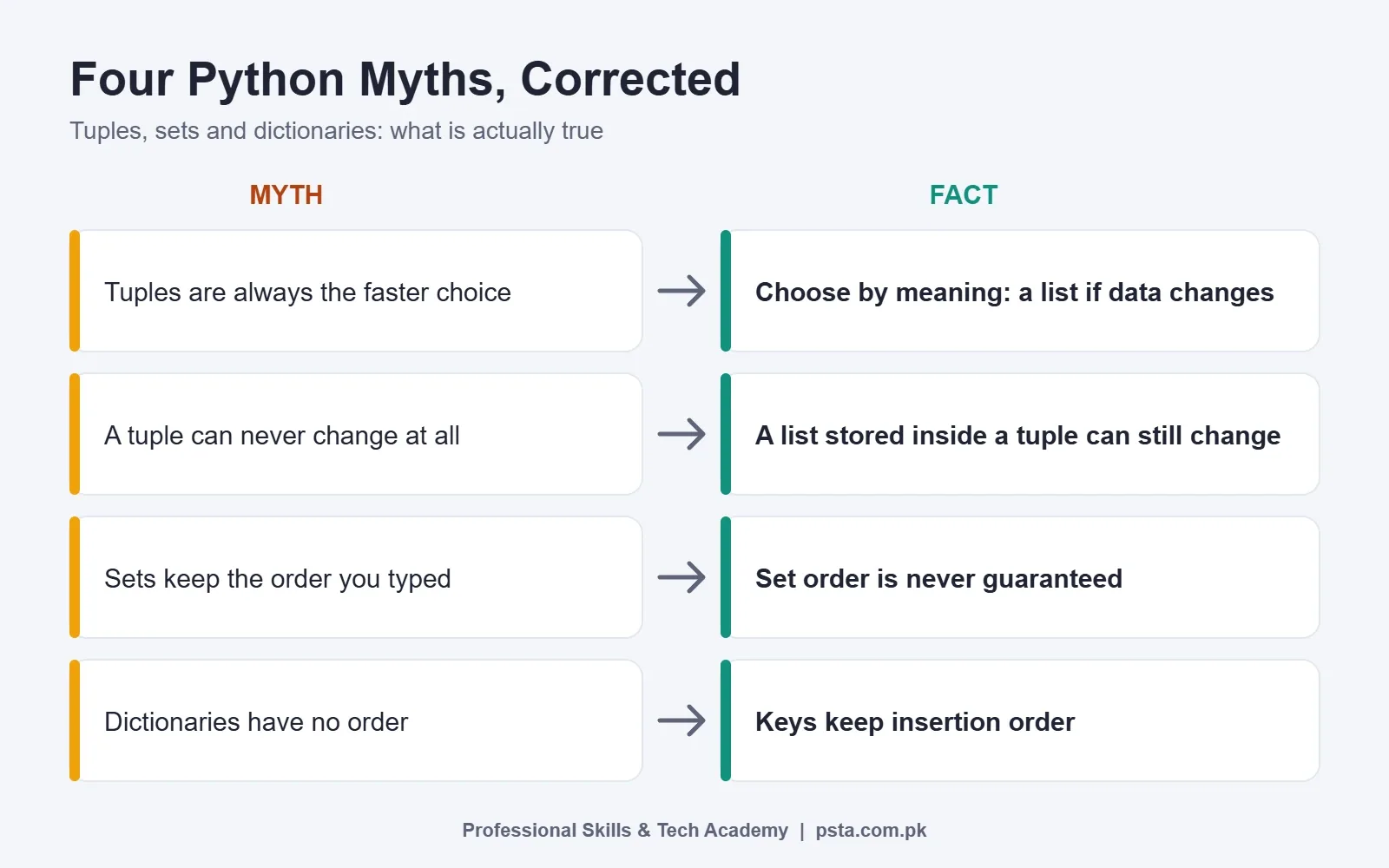
You will read this claim on many forums, but choosing by speed misses the point. Choose by meaning. If the data must grow or change, a list is correct, and converting back and forth costs more than any gain.
"A Tuple Can Never Change at All"
The tuple itself cannot be reassigned, yet a list stored inside it can still be edited. The Python tutorial shows exactly this case. It is also why a tuple holding a list cannot be a dictionary key.
"Sets Keep Items in the Order You Typed Them"
Sometimes a small set prints in a familiar order, which fools beginners. The tutorial warns that printing or iterating a set can produce an order you do not expect. Never rely on it.
"Dictionaries Have No Order"
Older notes and tutorials still repeat this line. Current Python keeps dictionary keys in insertion order, as the tutorial's list(d) example shows.
How Do You Choose the Right Collection?
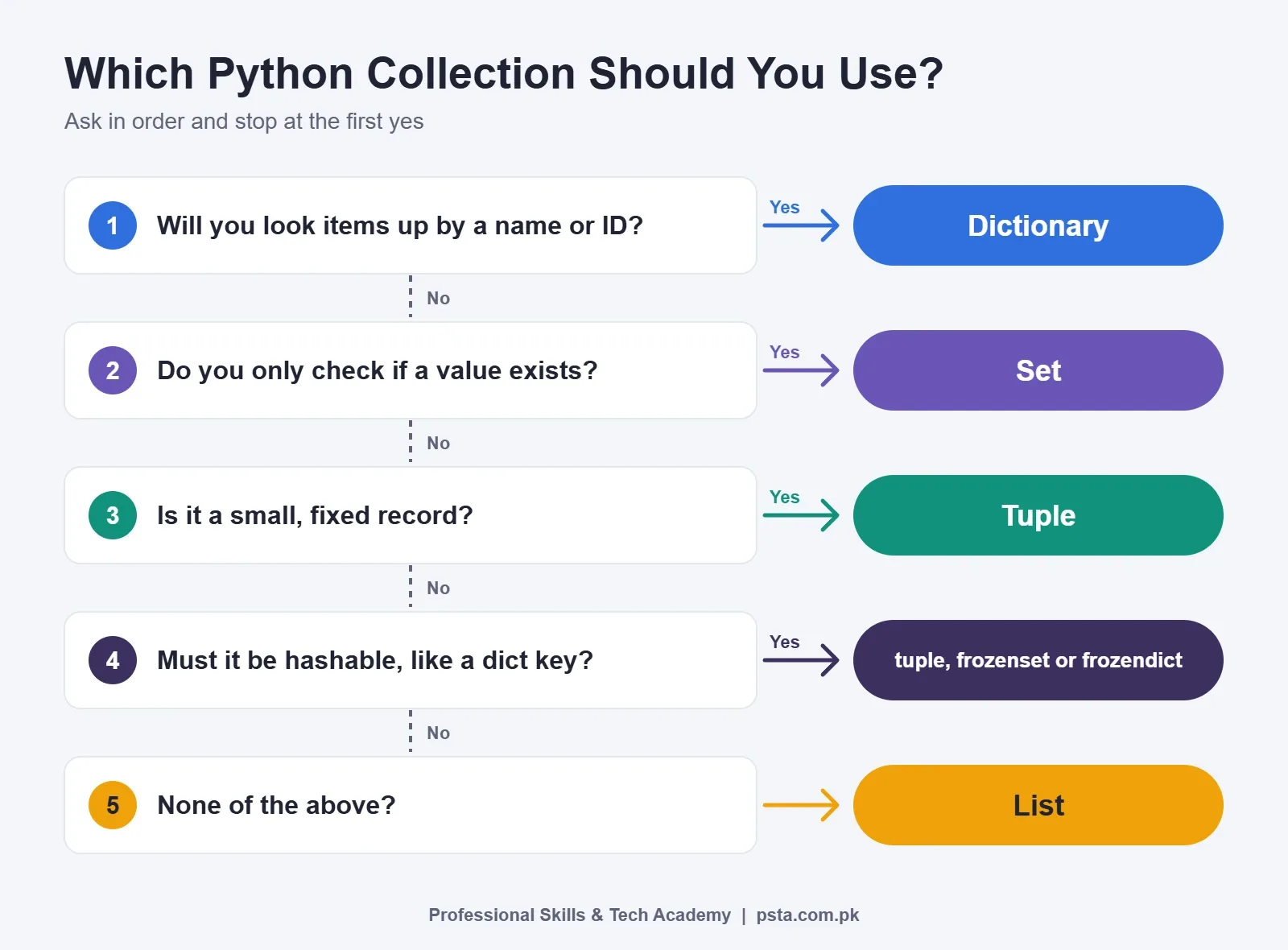
Run through these five questions in order. Stop at the first "yes."
- Will you look items up by a name, ID or code? Use a dictionary. Example: product code to price.
- Do you only care whether a value exists, and duplicates are unwanted? Use a set. Example: unique visitor emails.
- Is it a small, fixed record whose fields belong together? Use a tuple. Example:
("Ali", "BSCS", 3)for name, program and semester. - Must the result be hashable, for example a key inside another dictionary? Use a tuple, a
frozensetor, on Python 3.15 and later, afrozendict. - None of the above? Use a list. It is the general-purpose, ordered and editable default.
Worked Example: A Tuition Center's Fee Records
This is an illustrative example, not a real client. Picture a small tuition center in Mansehra that tracks fees in Python. Here is how the four types share the work:
students = ["Ayesha", "Bilal", "Hamza"]          # list: the class grows
batch = ("Python", "Evening", 2026)               # tuple: fixed batch details
paid = {"Ayesha", "Hamza"}                        # set: who has paid
fee_due = {"Ayesha": 0, "Bilal": 15000, "Hamza": 0}  # dict: name to balance

students.append("Sana")
fee_due["Sana"] = 15000

for name in students:
    if name not in paid:                          # fast set lookup
        print(name, "owes Rs.", fee_due[name])
Notice how each choice follows the five questions. The class list changes, so it is a list. The batch details never change, so they sit in a tuple. Payment status is a yes or no check, so a set handles it. Balances are looked up by name, so a dictionary stores them. Swap any of these and the code becomes longer or slower.
A common student version stores everything in parallel lists, such as names[i] and balances[i]. It works until someone deletes one entry and the two lists fall out of step. A dictionary removes that risk.
What Is New in Python 3.15: The frozendict Type
Python 3.15.0 was released on 9 October 2026, and the python.org downloads page lists 3.15.2 from 25 October 2026 as the latest release. According to the What's New in Python 3.15 page, one headline change is a built-in frozendict type from PEP 814.
A frozendict cannot be modified after creation. It keeps insertion order, but equality ignores order, so frozendict(x=1, y=2) equals frozendict(y=2, x=1). It is hashable as long as its keys and values are hashable. It is not a subclass of dict.
Why should a beginner care? Before 3.15, a fixed lookup table, such as province codes, had to live in a normal dictionary that anyone could edit by mistake. Now you can freeze it. If your university lab or laptop still runs an older version, the type will not exist, so check with python --version first.
Why Do Interviewers Keep Asking About This?
Python is now a mainstream skill. In the Stack Overflow Developer Survey 2025, 57.9% of all respondents said they used Python, a rise of seven percentage points from 2024. With that many people writing Python, interviewers need quick ways to separate memorized syntax from real understanding.
The Python list vs tuple question does that well. A weak answer stops at "lists use square brackets." A strong answer covers mutability, hashability, when to use each, and the speed of membership tests. Our Python interview questions guide covers more of these, and the common Python errors guide explains TypeError and KeyError messages you will meet while practicing.
For practical work, Python data structures sit under every Pandas dataframe, Django view and automation script. If you are building a portfolio, try one of the Python projects for beginners and refactor it with the five questions above.
Practicing Data Structures in PSTA's Python Course
PSTA's Advanced Python Programming course runs for 12 weeks and starts from zero, so no prior coding is required. Data types come early in the outline, followed by loops, functions, object-oriented programming, file handling, automation, Flask and Django, Pandas and NumPy, and a first look at Scikit-learn.
- Fee: Rs. 30,000 instead of the regular Rs. 40,000, split into 2 installments
- Format: attend in person at the Abbottabad campus, join live classes online, or combine the two
- Projects: a contact book, a file-sorting script, a small Flask or Django app and a data report
- Certificate: verifiable at psta.com.pk/certificate
The contact book project is a natural place to use a dictionary, and the file-sorting script is a good place to try sets. If you also want to work with data dashboards later, the Power BI course pairs well with Python. Browse all PSTA courses or check batch dates on the admission page. Questions about timings can go to WhatsApp at +92 314 5424399, and visitors are welcome at the campus in Mandian, Old College Road, opposite FIMS College.
Rewrite One Old Program Tonight
Open any Python file you wrote for a past assignment. Find one list that only checks membership and turn it into a set. Find one pair of parallel lists and merge them into a dictionary. Then run the program again and compare the output. Ten minutes of this teaches more than another page of definitions.
Frequently asked questions
What is the main difference between a list and a tuple in Python?
A list is mutable, so you can add, remove or replace items after creating it. A tuple is immutable, so its items cannot be reassigned once it exists. Both keep their order and allow duplicates. Use a list for data that grows or changes, and a tuple for a small fixed record such as coordinates or a date.
Can a tuple be used as a dictionary key in Python?
Yes, as long as everything inside it is hashable. A tuple of strings or numbers works as a key. A tuple that contains a list does not, because the inner list can change. The Python tutorial states this rule directly, so check the contents before you use a tuple as a key.
Why does my empty set print as a dictionary?
Writing a pair of empty curly braces creates an empty dictionary, not a set. To make an empty set, call set() with no arguments. Once a set has at least one item, curly braces with values and no colons do create a set, for example {1, 2, 3}.
Is checking membership faster in a set than a list?
On average, yes. The official time complexity page lists x in list as O(n), a linear scan, while the same check on a set or on dictionary keys is O(1) on average in CPython. For a few dozen items the difference is tiny, but for thousands of values a set is far quicker.
Do Python dictionaries keep the order of items?
Yes. Current Python keeps dictionary keys in the order you inserted them, and list(d) returns the keys in that order according to the official tutorial. Sets are different: they have no guaranteed order, so never rely on a set printing items in the sequence you typed them.
What is frozendict in Python 3.15?
frozendict is a new built-in type added in Python 3.15 through PEP 814. It works like a dictionary that cannot be changed after creation. It keeps insertion order, is hashable when its keys and values are hashable, and is not a subclass of dict. Older Python versions do not have it.
Sources & references
- Data Structures, Python Tutorial docs.python.org
- Built-in Types, Python Documentation docs.python.org
- Time Complexity of Built-in Types docs.python.org
- What's New in Python 3.15 docs.python.org
- Python Downloads, python.org python.org
- Stack Overflow Developer Survey 2025 survey.stackoverflow.co
Last reviewed & updated on by Umar Qureshi. Written by the PSTA team in Abbottabad, Pakistan.

Umar Qureshi

Advanced Python Programming Course in Pakistan – Online Classes and On-Campus in Abbottabad
Turn this guide into a career: hands-on training with real projects, online across Pakistan or on-campus in Abbottabad · 12 weeks.
Comments
No comments yet — ask a question or share your experience.