Quick answer
Answer salary expectations with a researched range, not a guess. Collect real figures for the role, set a private minimum, build a narrow range and check take-home pay under the 2026-27 tax slabs. Link your range to the role, stay open to the full package, and never accept a verbal offer on the spot.
Key takeaways
- • Work out a floor, a realistic target and an ideal figure before any interview.
- • Give a narrow range linked to the role instead of a single guess or "anything is fine."
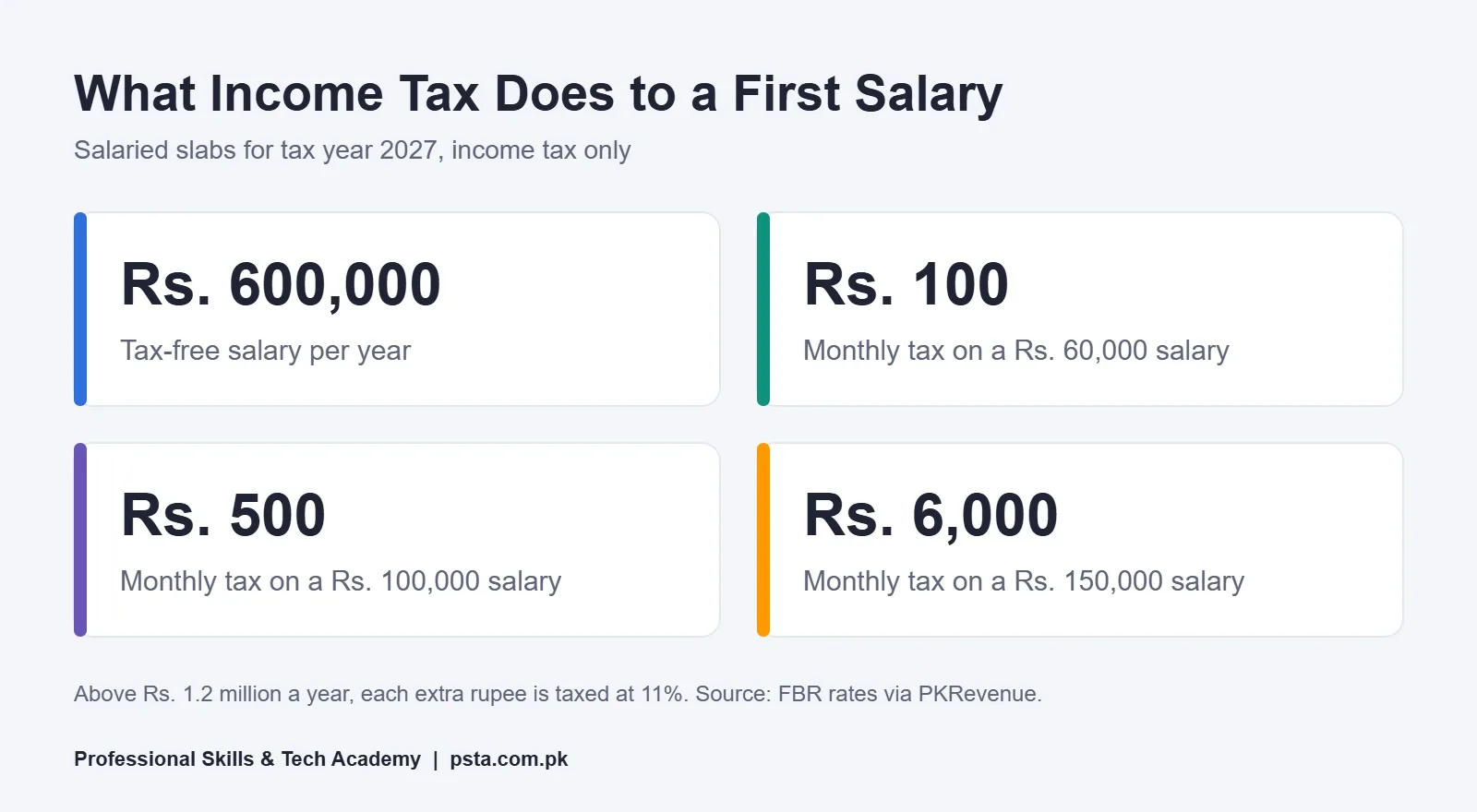
- • Salary up to Rs. 600,000 a year is tax-free; above Rs. 1.2 million a year, the slab rate rises to 11%.
- • Ask whether a figure is gross or net, and when probation and reviews happen.
- • One polite counter-offer is normal; ask for every offer in writing.
Table of contents 16 sections
- Why Do Employers Ask About Salary Expectations?
- Work Out Your Salary Expectations Before the Interview
- Gross vs Take-Home: What 2026-27 Tax Rates Mean for Your Offer
- Salary Interview Questions and Sample Answers
- 1. "What Are Your Salary Expectations?"
- 2. "What Is Your Expected Salary?" on an Application Form
- 3. "What Was Your Last Salary?"
- 4. "Why Should We Pay You More Than Other Freshers?"
- 5. "Our Budget Is Rs. 55,000. Can You Join at That?"
- 6. "Are You Flexible on Salary?"
- 7. "Do You Have Any Questions About the Package?"
- Range, Deflect or Exact Figure: Which Answer Style Fits?
- Is It Rude to Negotiate Your First Salary?
- Mistakes That Lower Your First Offer
- Rehearsing Salary Conversations at PSTA
- Before Your Next Interview: Write Three Numbers
Here's a typical example, with an invented name. Hira, a fresh BBA graduate in Abbottabad, reaches the last ten minutes of her first proper interview. The HR officer smiles and asks about her salary expectations. She hasn't thought about a number, so she says "whatever you think is right." The offer comes in lower than her classmate's for the same role, and she has no way to push it back up.
That question isn't a trap. It's a normal part of hiring, and you can prepare for it the same way you prepare for "tell me about yourself." This guide gives you the questions HR officers in Pakistan actually ask about pay, with sample answers you can adapt.
In this guide, you'll find:
- Why employers ask about salary expectations, and what they learn from your answer
- A four-step way to work out your number before you walk in
- What the 2026-27 tax rates do to a salary offer, with worked examples
- Seven salary questions with sample answers for freshers
- The mistakes that quietly lower a first offer
Why Do Employers Ask About Salary Expectations?
An interviewer who asks about your expected salary is usually checking two things. The first is budget. Hays, the recruitment firm, says employers use the question to get a baseline and see whether you're at the right level for the role. If your number is far above what they planned, they want to know before they spend another week on you.
The second is self-awareness. A Naukri careers article for freshers notes that interviewers also want to see whether you understand the value of your own work. A calm, researched answer tells them you've done your homework. A shrug tells them you'll accept anything.
So the goal isn't to win an argument. You want to show that your number is reasonable, based on facts, and open to discussion.
Work Out Your Salary Expectations Before the Interview
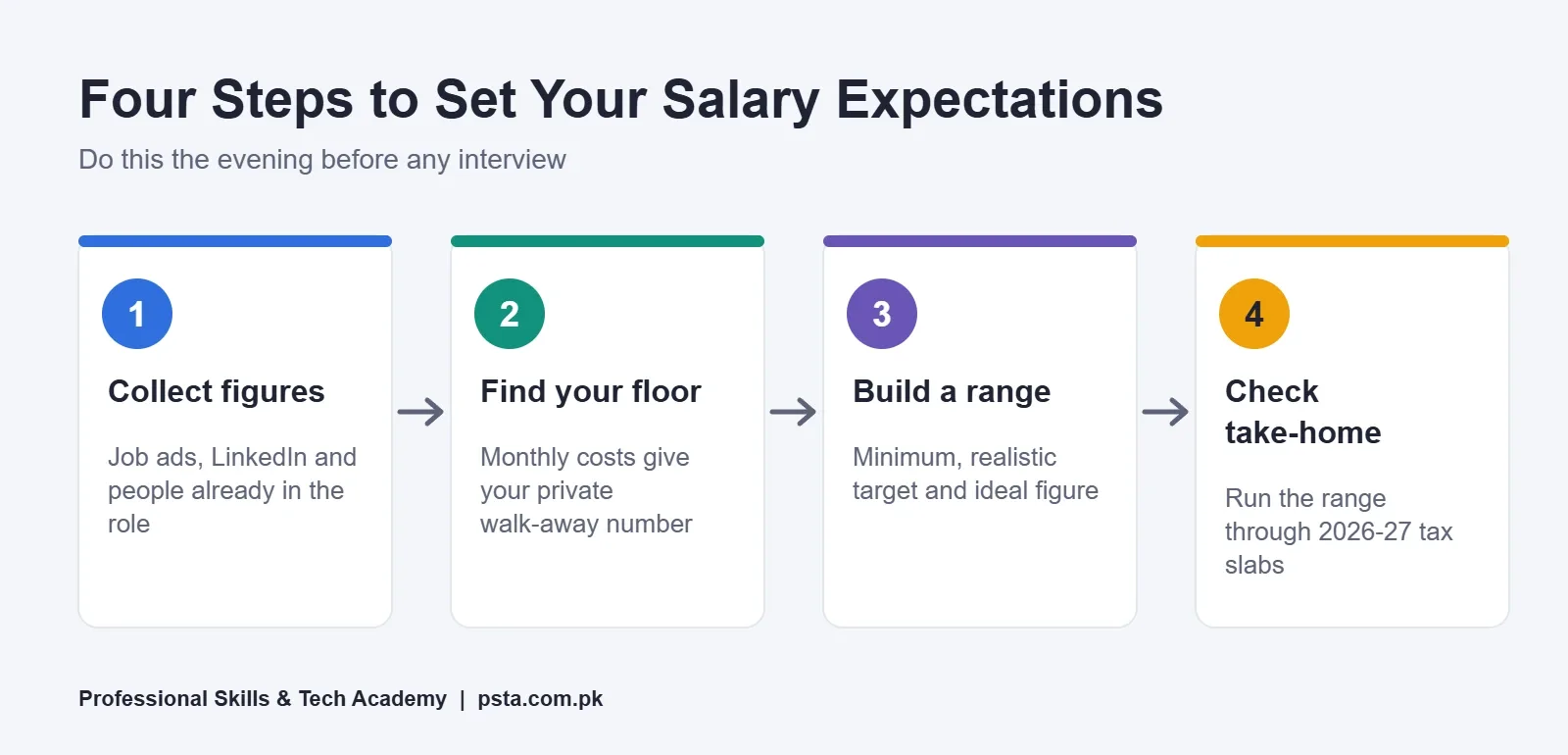
Most weak answers about salary expectations come from walking in without a figure. Spend one evening on these four steps before any interview.
- Collect real figures for the role. Look at salary ranges posted with similar jobs on Rozee.pk, LinkedIn and company career pages in your city. Ask two or three people already doing the job what new hires got last year. Write each figure down with its source.
- Find your floor. Add up what you need each month: travel, food, phone, rent if you're moving cities, and any family support you give. That total is your walk-away number. Don't share it in the interview.
- Build a range. Coursera's career team suggests thinking in three numbers: an ideal figure, a realistic target and a minimum. Keep the range narrow enough to look planned. A gap of about 15 to 20% between the bottom and top usually works for entry-level roles.
- Check the take-home amount. A gross figure isn't what lands in your account. Run your range through the current tax slabs, covered in the next section, so you aren't surprised by your first payslip.
If you can't find any figure for the role, don't guess. Say you'd like to hear the company's budget first. That's an honest answer, and recruiters hear it often.
Gross vs Take-Home: What 2026-27 Tax Rates Mean for Your Offer
Salaried income in Pakistan is taxed by slab. The rates for tax year 2027 took effect on 1 July 2026 under the Finance Act, 2026, as reported by PKRevenue from the FBR's notified rates. They apply when salary makes up more than 75% of your taxable income. Dawn's budget coverage reported that the tax-free threshold would stay at Rs. 600,000 a year.
| Annual taxable salary | Tax for tax year 2027 |
|---|---|
| Up to Rs. 600,000 | Nil |
| Rs. 600,001 to Rs. 1,200,000 | 1% of the amount above Rs. 600,000 |
| Rs. 1,200,001 to Rs. 2,200,000 | Rs. 6,000 + 11% of the amount above Rs. 1,200,000 |
| Rs. 2,200,001 to Rs. 3,200,000 | Rs. 116,000 + 20% of the amount above Rs. 2,200,000 |
| Rs. 3,200,001 to Rs. 4,100,000 | Rs. 316,000 + 25% of the amount above Rs. 3,200,000 |
| Above Rs. 4,100,000 | Higher slabs at 29%, 32% and 35% |
Most first jobs fall in the top three rows. Here's what that means for your monthly take-home salary, counting income tax only, so you can set salary expectations on take-home pay. Your employer may also deduct provident fund or social security contributions, so ask HR for a sample payslip.
| Monthly gross salary | Income tax per month | Take-home before other deductions |
|---|---|---|
| Rs. 45,000 | Rs. 0 | Rs. 45,000 |
| Rs. 60,000 | Rs. 100 | Rs. 59,900 |
| Rs. 100,000 | Rs. 500 | Rs. 99,500 |
| Rs. 150,000 | Rs. 6,000 | Rs. 144,000 |
Notice the jump between the last two rows. Once your yearly salary crosses Rs. 1.2 million, each extra rupee is taxed at 11%. That matters when you compare two offers that look close on paper, and the salary in a job offer in Pakistan can be written as gross or net, so always ask which.
The legal minimum is worth knowing too. In its June 2026 budget, the Khyber Pakhtunkhwa government proposed raising the minimum monthly wage from Rs. 40,000 to Rs. 45,000, subject to the provincial assembly's approval. A full-time offer below the minimum wage in your province is a warning sign, not a starting point.
Salary Interview Questions and Sample Answers
The wording changes from company to company, but these seven questions cover nearly every salary conversation a fresher faces. The rupee figures below are examples only. Replace them with the range from your own research.
1. "What Are Your Salary Expectations?"
This is the main one. Give your salary expectations as a researched range and link it to the role.
"Based on what I've seen for junior accounts roles in Islamabad, I'm looking at Rs. 70,000 to Rs. 80,000 a month. I'm open to discussing it once I understand the full package."
Why it works: you name a source, you give a range instead of a single figure, and you leave the door open without sounding unsure.
2. "What Is Your Expected Salary?" on an Application Form
Online forms often make this field compulsory. If it accepts text, write a range. If it only accepts a number, use the middle of your range. Don't type 0 or 1 to skip it. Some screening systems filter those out, and a human reader sees it as careless.
3. "What Was Your Last Salary?"
Freshers often panic here because they've only had an internship or a stipend. Be truthful and move the focus forward.
"My internship at a software house paid a stipend of Rs. 25,000. That was a learning role, though. For this full-time position, my expectation is based on the market rate for the job."
Never inflate a past salary. Many companies verify it with your previous employer or through a payslip.
4. "Why Should We Pay You More Than Other Freshers?"
Answer with evidence, not adjectives. Point to something the employer can check.
"I've already used Excel pivot tables and Power Query on a live project during my internship, so I can start on your reporting work without a long training period. I've brought the dashboard I built to show you."
5. "Our Budget Is Rs. 55,000. Can You Join at That?"
Don't say yes or no on the spot if the figure is below your range. Thank them, then ask about the rest of the package or a review date.
"Thank you, I appreciate the offer. It's a little below what I'd planned. Is there room to review the salary after probation, or are there allowances such as travel or a phone bill on top?"
Hays advises against accepting a verbal offer immediately. Asking for a day to think is normal and polite.
6. "Are You Flexible on Salary?"
Say yes only if you mean it, and say what would make you flexible.
"I'm flexible for the right role. A training budget or a clear six-month review would make a lower starting figure easier for me to accept."
7. "Do You Have Any Questions About the Package?"
Use this to learn what isn't in the headline number. Good questions include: Is the salary gross or net? When does probation end? Is there an annual increment, and how is it decided? Are overtime or weekend shifts paid?
Range, Deflect or Exact Figure: Which Answer Style Fits?
There are three common ways to handle salary expectations, and each suits a different situation. Coursera's guide notes that many experts advise against being the first to name a number, but in Pakistan's entry-level market, HR often insists on one. Choose your style based on how much you know.
| Style | When to use it | Risk |
|---|---|---|
| Give a range | You found real figures for the role | The employer may pick the bottom of it |
| Ask for their budget first | The role is new or you found no data | Some interviewers insist on your number anyway |
| Give one exact figure | The form only accepts a number, or you have a firm offer elsewhere | Less room to negotiate later |
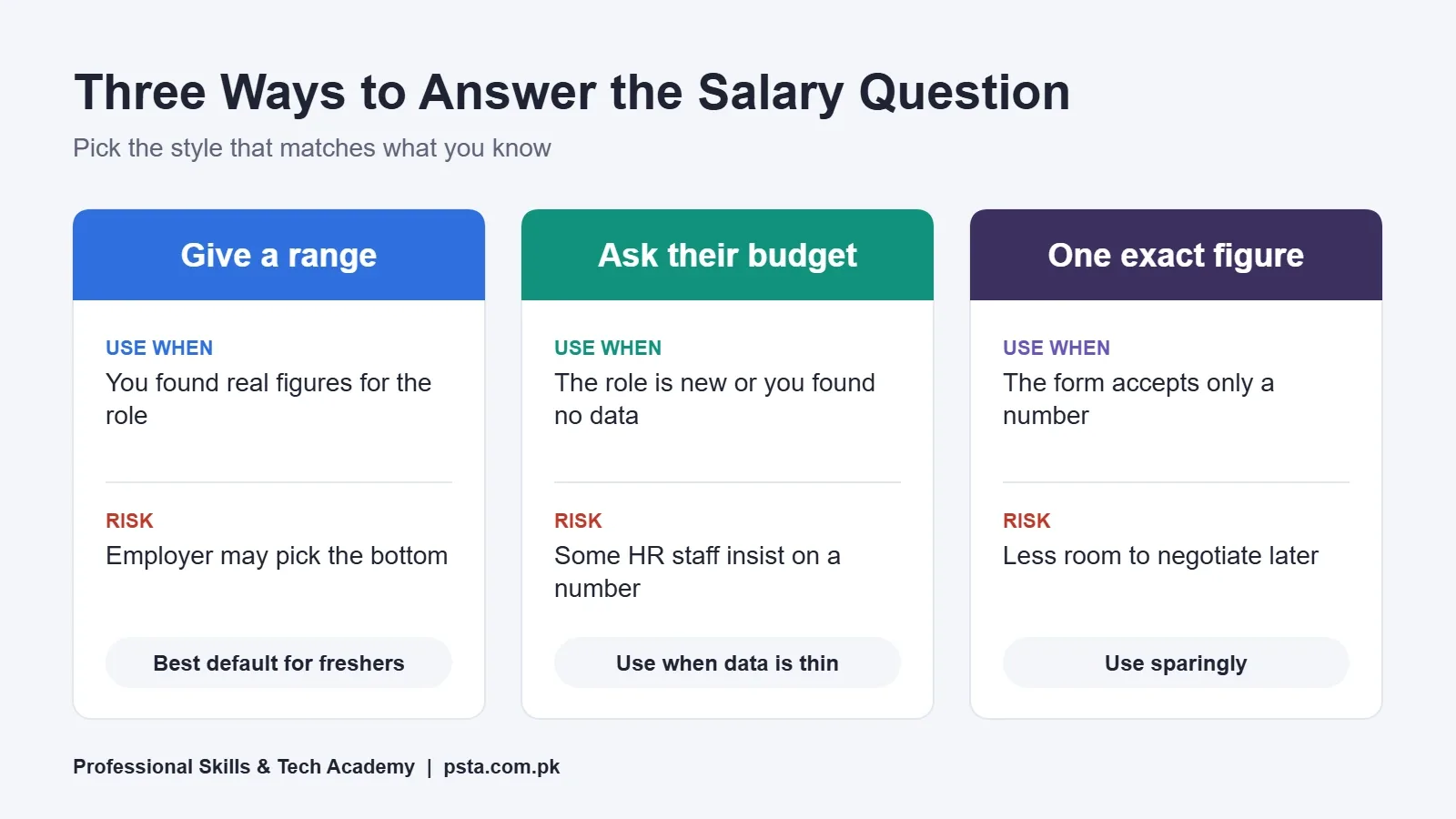
For most freshers, the range is the safest default. Set its bottom slightly above your true floor so there's space to meet in the middle.
Is It Rude to Negotiate Your First Salary?
No. Many students in Pakistan worry that asking for more will cancel the offer. A polite, specific request rarely does. Coursera cites a 2023 Glassdoor report finding that nearly half of employees negotiated the salary for their most recent job. Employers expect some discussion.
What makes negotiation feel rude is the tone, not the request. Compare these two lines. "Other companies pay more than this" sounds like a threat. "Based on my research and the Excel work I can take on from day one, would Rs. 65,000 be possible?" sounds like a professional talking to a future manager.
Salary negotiation for freshers works best when it stays short. Keep it to one counter-offer. If the company says its figure is final, decide within a day or two and reply in writing either way.
Mistakes That Lower Your First Offer
- Stating salary expectations you can't explain. If you can't say where a number came from, the interviewer won't defend it to their manager.
- Talking about your expenses. Your rent and fuel costs set your private floor. They don't belong in the answer.
- Using a very wide range. "Rs. 40,000 to Rs. 100,000" tells the employer you haven't researched anything.
- Forgetting tax. Comparing gross figures across offers can hide a real gap in take-home pay.
- Accepting on the call. Ask for the offer in writing, including salary, probation period and working hours.
- Answering in broken sentences. Salary talk is where nerves show most. Practice the exact lines aloud until they sound natural.
Salary talk usually comes at the end of a longer interview. If your earlier answers are weak, a good salary answer can't rescue them. Our guides on answering "tell me about yourself" and fixing common fresh graduate CV mistakes cover the steps before this one.
Rehearsing Salary Conversations at PSTA
A question about salary expectations is a short, high-pressure exchange in English, and practice helps more than reading. The English Spoken & Grammar Course at PSTA runs for 12 weeks at beginner level. Its modules include speaking confidence for interviews and meetings, role plays, and email and CV writing. The course page currently lists the fee as Rs. 12,000.
You can join at the Abbottabad campus on Mandian, Old College Road, opposite FIMS College, or attend live from another city, and a new batch starts every month. If the role you're targeting needs office skills to back up your number, the Office Automation course or the one-year DIT diploma may fit better. Compare options on the all courses page, see how to apply on the admission page, or message the team on WhatsApp at +92 314 5424399 with your questions.
Before Your Next Interview: Write Three Numbers
Take a sheet of paper tonight and write three figures for the role you're applying for: your floor, your realistic target and your ideal number. Next to each, note where it came from. Then say your answer to "what are your salary expectations?" out loud five times. When the question comes, you'll answer it in one calm sentence.
Frequently asked questions
Should a fresher negotiate salary in Pakistan?
Yes, as long as you do it politely and only once. Thank the interviewer, give one reason based on your skills or research, and suggest a specific figure. If the company says its offer is final, decide within a day or two. Most employers expect a short discussion and won't withdraw an offer because you asked respectfully.
What should I write in the expected salary field of a job form?
If the field accepts text, write your researched range, such as Rs. 60,000 to Rs. 70,000. If it only accepts a number, enter the middle of that range. Avoid typing 0 or 1 to skip the question, because screening software and HR staff may reject the application as incomplete or careless.
Should I quote gross or net salary in an interview?
Quote a gross monthly figure unless the interviewer asks otherwise, and say clearly that it's gross. Then ask HR whether their own figure is gross or net. Check the take-home amount yourself using the current salaried tax slabs, and ask about provident fund or social security deductions that may reduce it further.
What if HR says the salary is fixed for all freshers?
Accept that the base figure may not move, then ask about the parts that can. Useful questions include the length of probation, the date of the first salary review, travel or phone allowances, and paid training. A clear review date in writing can be worth more than a small increase today.
How do I answer salary expectations on a phone screening call?
Keep it short and calm. Say you're still learning about the role, then give your researched range in one sentence. If the caller presses for a single number, offer the middle of your range. Make a note of the figure you shared so your answer stays consistent in the final interview.
Can I ask for a salary review after probation?
Yes. Ask before you accept the offer, not months later. A simple line works: "If my work meets your expectations, can we review the salary after probation?" Ask HR to include the review timing in your offer letter, so the agreement doesn't depend on one manager's memory.
Does an internship stipend count when HR asks about my last salary?
Mention it honestly, but explain that it was a learning role. A stipend shows you've worked in a real office, yet it shouldn't anchor a full-time salary. Move the conversation to the market rate for the job you're applying for and the skills you can use from day one.
Sources & references
- FBR issues salary tax rates for Tax Year 2027 (PKRevenue) pkrevenue.com
- Budget offers tax break to salaried class, businesses (Dawn) dawn.com
- KP Govt Increases Minimum Wage to Rs. 45,000 per Month (ProPakistani) propakistani.pk
- How to Answer Salary Expectations Questions in an Interview (Coursera) coursera.org
- How to answer: What is your salary expectation? (Hays) hays.com.au
- How to Answer How Much Salary Do You Expect for Freshers (Naukri) naukri.com
Last reviewed & updated on by Umar Qureshi. Written by the PSTA team in Abbottabad, Pakistan.

Umar Qureshi

English Spoken & Grammar Course in Pakistan – Build Confidence, Speak Fluently (Online & Campus)
Turn this guide into a career: hands-on training with real projects, online across Pakistan or on-campus in Abbottabad · 12 Weeks.
Comments
No comments yet — ask a question or share your experience.