Quick answer
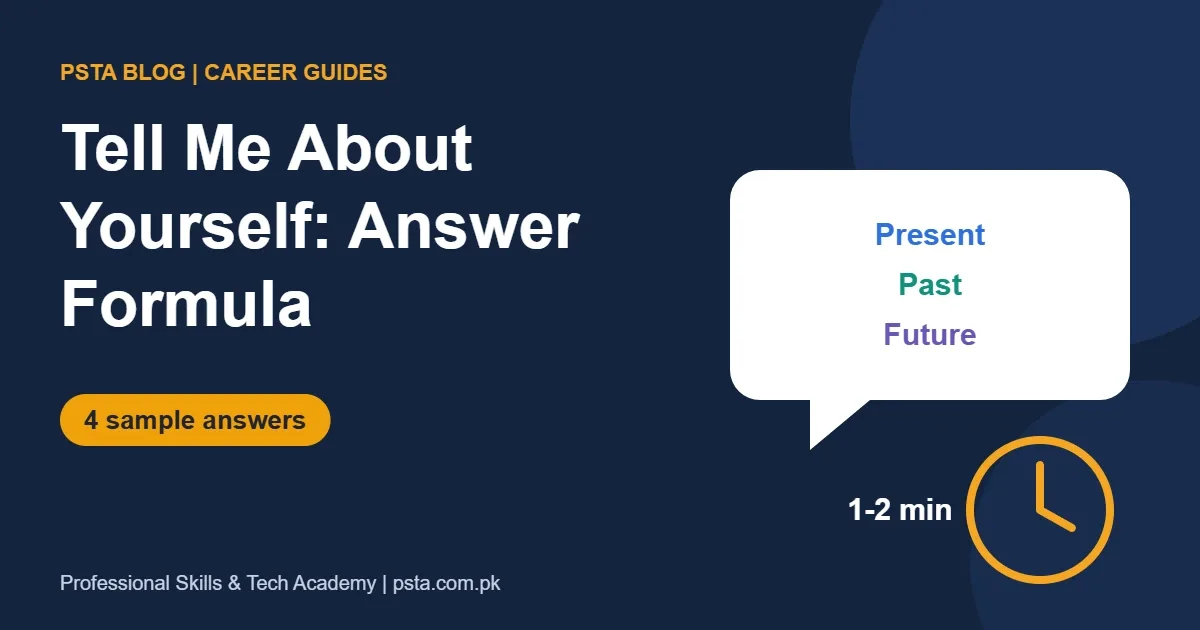
Answer tell me about yourself in one to two minutes using Present, Past, Future: say what you are doing now, mention only the past experience that fits the job, then explain why this role is your next step. Skip family history and your full CV. Practice out loud from an outline, not a memorized script.
Key takeaways
- • Use Present, Past, Future: now, relevant background, then why this job.
- • Keep it to one to two minutes, roughly 150 to 250 spoken words.
- • Drop family details, every certificate and a line-by-line CV recap.
- • Freshers can treat projects, internships and freelance work as their Past.
- • Practice from an outline over seven days instead of memorizing a script.
Table of contents 17 sections
- Why Interviewers Ask "Tell Me About Yourself"
- The Present, Past, Future Formula Explained
- Freshers Can Flip the Order
- How Long Should a Tell Me About Yourself Answer Be?
- What to Include and What to Leave Out
- Tell Me About Yourself for Freshers: Four Sample Answers
- Example 1: BS Computer Science Graduate, Junior Developer Role
- Example 2: DIT Holder, Computer Operator Post
- Example 3: Commerce Graduate, Office Administration Role
- Example 4: Freelancer Moving to a Full-Time Job
- Myths That Make Answers Weaker
- Is It Fine to Answer in Urdu?
- Useful Phrases for a Job Interview in English
- A Seven-Day Plan to Practice Your Self Introduction in Interview
- Which Interview Questions for Freshers Come Next?
- Building Interview Confidence at PSTA
- Write Your Three Sentences Tonight
"What should I say when the interviewer asks me to tell them about myself?" Students ask us this before almost every first interview, and it makes sense. It is usually the opening question, and a shaky first minute colors the rest of the conversation. The good news is that a strong tell me about yourself answer follows a simple pattern you can learn in one evening.
In this guide you will get:
- A three-part formula that career offices at several universities recommend
- How long your answer should run, and what to leave out
- Four sample answers for common Pakistani profiles, clearly marked as examples
- A seven-day practice plan you can start tonight
- How to handle the same question in an Urdu or mixed-language interview
Why Interviewers Ask "Tell Me About Yourself"
The question looks casual, but the interviewer is listening for three things at once. Can you speak clearly under mild pressure? Do you understand what the job needs? And do you have a reason for wanting it beyond "I need a job"?
A Naukri guide for freshers describes the question as an icebreaker that also shows your communication skills, gives a quick view of your education, and steers the rest of the interview. That last point matters most. Whatever you mention first is what the panel will ask about next, so you get to choose the ground.
Think of your answer as a trailer, not the full film. It should make them want to ask follow-up questions about the parts you're proudest of.
The Present, Past, Future Formula Explained
The structure most career centers teach for tell me about yourself is called Present, Past, Future. Brandeis University's career office describes it in three moves, and the University of Texas Moody College handout uses the same outline.
| Part | What you cover | Sentence starter |
|---|---|---|
| Present | Who you are now: degree, current role or training, one recent result | "I'm currently..." |
| Past | Only the experience and skills that match this job | "Before that, I..." |
| Future | Why this role at this company is your next step | "I'd love the chance to..." |
PennWest's career blog adds a useful detail: freelance projects count as experience in the Past section. That helps many Pakistani graduates who have done Fiverr or Upwork work but no formal job.
Freshers Can Flip the Order
If you have no work history, "Present" is your degree and "Past" is your projects, internship or training. The formula still holds. You simply lean harder on what you built and what you learned.
How Long Should a Tell Me About Yourself Answer Be?
Aim for one to two minutes. That is the range Jobscan recommends, and in practice it equals roughly 150 to 250 spoken words. Under a minute sounds unprepared. Over two minutes and the panel starts checking the time.
Time yourself with your phone's stopwatch. Most people speak faster when nervous, so if your practice run lands at 90 seconds, the real one will probably be shorter.
What to Include and What to Leave Out
Every sentence should earn its place by linking you to the job. A quick test for any tell me about yourself draft: if the interviewer couldn't use the sentence to judge your fit, cut it.
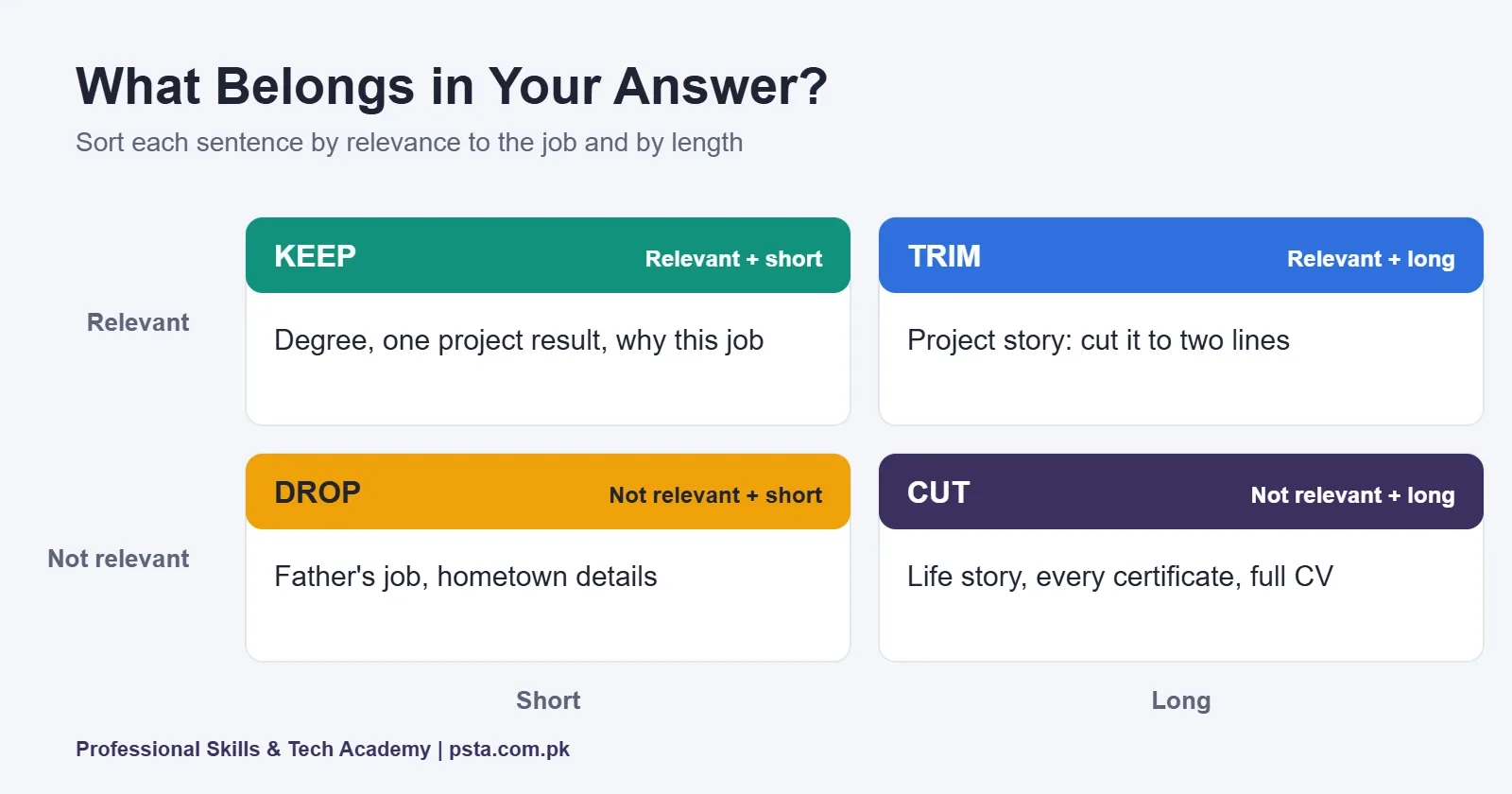
Brandeis puts it plainly: the question is not an invitation to recite your entire life story, and you shouldn't walk through your CV line by line either, because the panel already has it. Jobscan's list of common slip-ups adds rambling, oversharing personal details, vague claims without examples, and jargon the interviewer may not follow.
In Pakistani interviews, the usual oversharing is family background: father's job, number of siblings, hometown history. Unless the job is in your hometown and that matters, keep it to one short clause or skip it.
Tell Me About Yourself for Freshers: Four Sample Answers
These are examples written for this guide, not real candidates. Change every detail to match your own record. Copying a sample word for word is easy to spot.
Example 1: BS Computer Science Graduate, Junior Developer Role
"I recently completed my BS in Computer Science, where my final-year project was a web app that lets a small clinic book appointments online. I built the backend in Python with Flask and handled the database design. Before that, I spent two months on a short internship fixing bugs in a company's internal tools, which taught me how to read other people's code. I'm applying here because your team builds web products for local businesses, and that's exactly the kind of work I enjoyed most."
Example 2: DIT Holder, Computer Operator Post
"I hold a one-year Diploma in Information Technology and I type at a steady speed in both English and Urdu. During my diploma I prepared result sheets and letters for my college office, mostly in Excel and Word, and learned to check every figure twice. I'm interested in this post because it involves daily records and correspondence, and I'd like to grow into an office role where accuracy is valued."
Example 3: Commerce Graduate, Office Administration Role
"I've just finished my B.Com and I'm currently sharpening my Excel skills, especially pivot tables and lookups. In my last semester I helped my uncle's wholesale shop move its stock records from a register to a spreadsheet, which cut the time spent on month-end counts. I'd like to bring that habit of organizing messy information to your admin team."
Example 4: Freelancer Moving to a Full-Time Job
"For the past two years I've worked as a freelance graphic designer, mainly social media posts and logos for small brands abroad. Managing clients on my own taught me to meet deadlines and take feedback without getting defensive. I'm now looking for a full-time in-house role, because I want to work on one brand in depth and learn from a senior team."
Myths That Make Answers Weaker
Some advice that circulates among students sounds safe but hurts your answer. Here are the ones we correct most often.
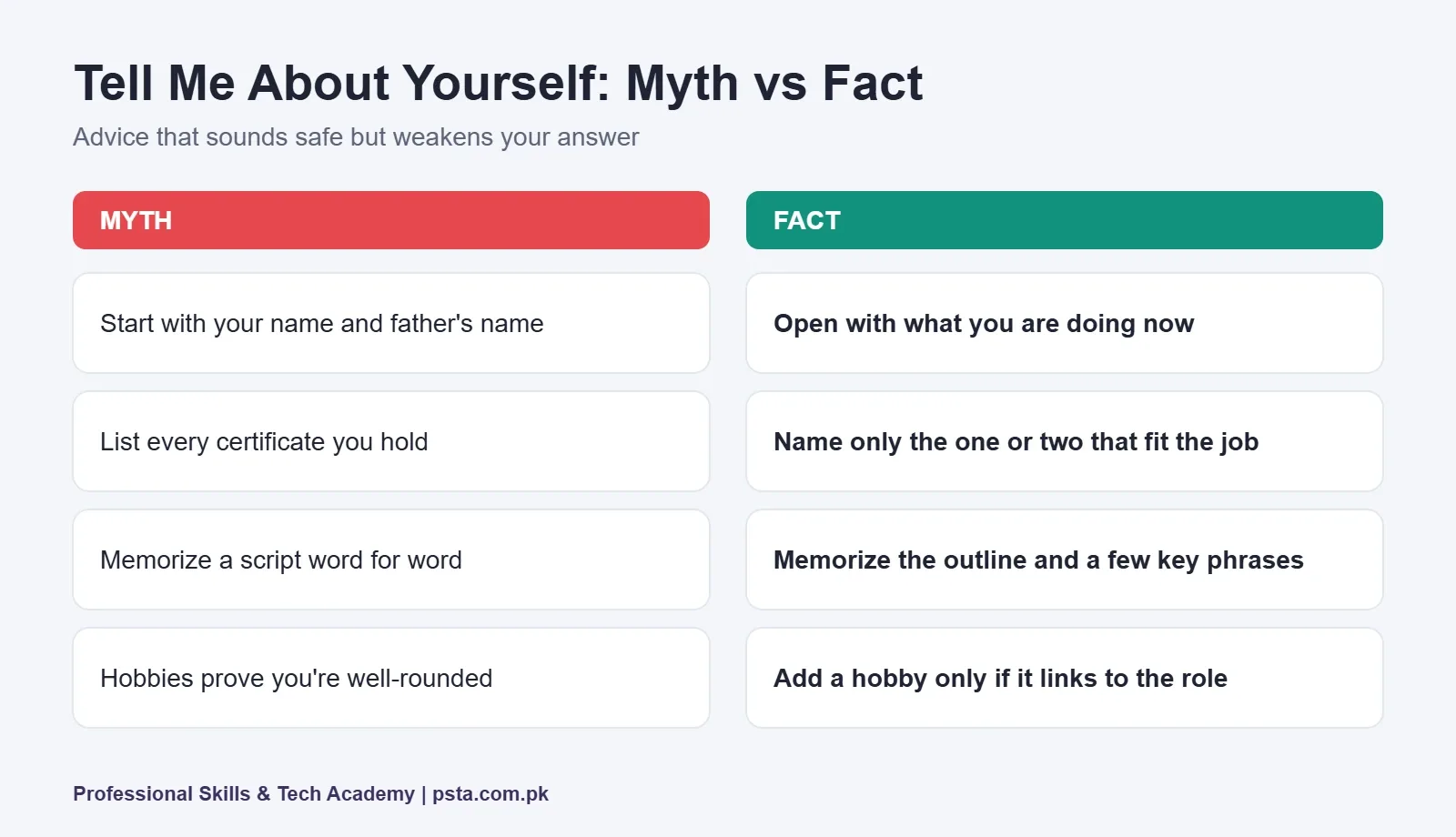
- Myth: start with your name and father's name. The panel has your CV. Open with your current status instead.
- Myth: list every certificate. Mention only the one or two that match the job.
- Myth: memorize a script word for word. Memorize the three-part outline and two or three key phrases. A recited answer sounds flat and breaks if you lose one word.
- Myth: hobbies prove you're well-rounded. Add a hobby only if it links to the role, such as running a cricket club's social media for a marketing job.
Is It Fine to Answer in Urdu?
Answer in the language the interviewer uses. If the panel opens in Urdu or mixes both, a clear Urdu answer is better than broken English. The Present, Past, Future structure works in any language, and what the panel judges is clarity and relevance.
That said, many private-sector and multinational interviews in Pakistan run in English, and the opening question is where nerves hit hardest. If you plan to answer in English, practice it in English out loud, not just in your head. Our tips on improving English speaking include drills that help with exactly this.
Useful Phrases for a Job Interview in English
If English isn't your first language, a small set of reliable phrases keeps your tell me about yourself answer smooth. Learn them as building blocks, then fill in your own details.
| Part of your answer | Phrases that sound natural |
|---|---|
| Opening (Present) | "I recently graduated in..." / "At the moment, I'm working as..." |
| Linking to experience (Past) | "Before that, I spent... on..." / "During my final year, I..." |
| Showing a result | "As a result, ..." / "That project taught me..." |
| Moving to the role (Future) | "That's why this role appeals to me..." / "I'd like to build on that by..." |
| Closing politely | "I'd be glad to tell you more about any of these." |
Avoid stock lines such as "I am a hardworking and dedicated person" unless you follow them with proof. Every candidate says it, so on its own it adds nothing. A single concrete example does more than three adjectives.
Watch your tenses too. Use the present tense for what you're doing now, the past simple for finished experiences, and "would like" or "hope to" for the future. Our English tenses chart is a handy refresher if you mix them up under pressure.
A Seven-Day Plan to Practice Your Self Introduction in Interview
Reading about tell me about yourself is not the same as answering it under pressure. Spread your practice over a week so it feels natural by interview day.
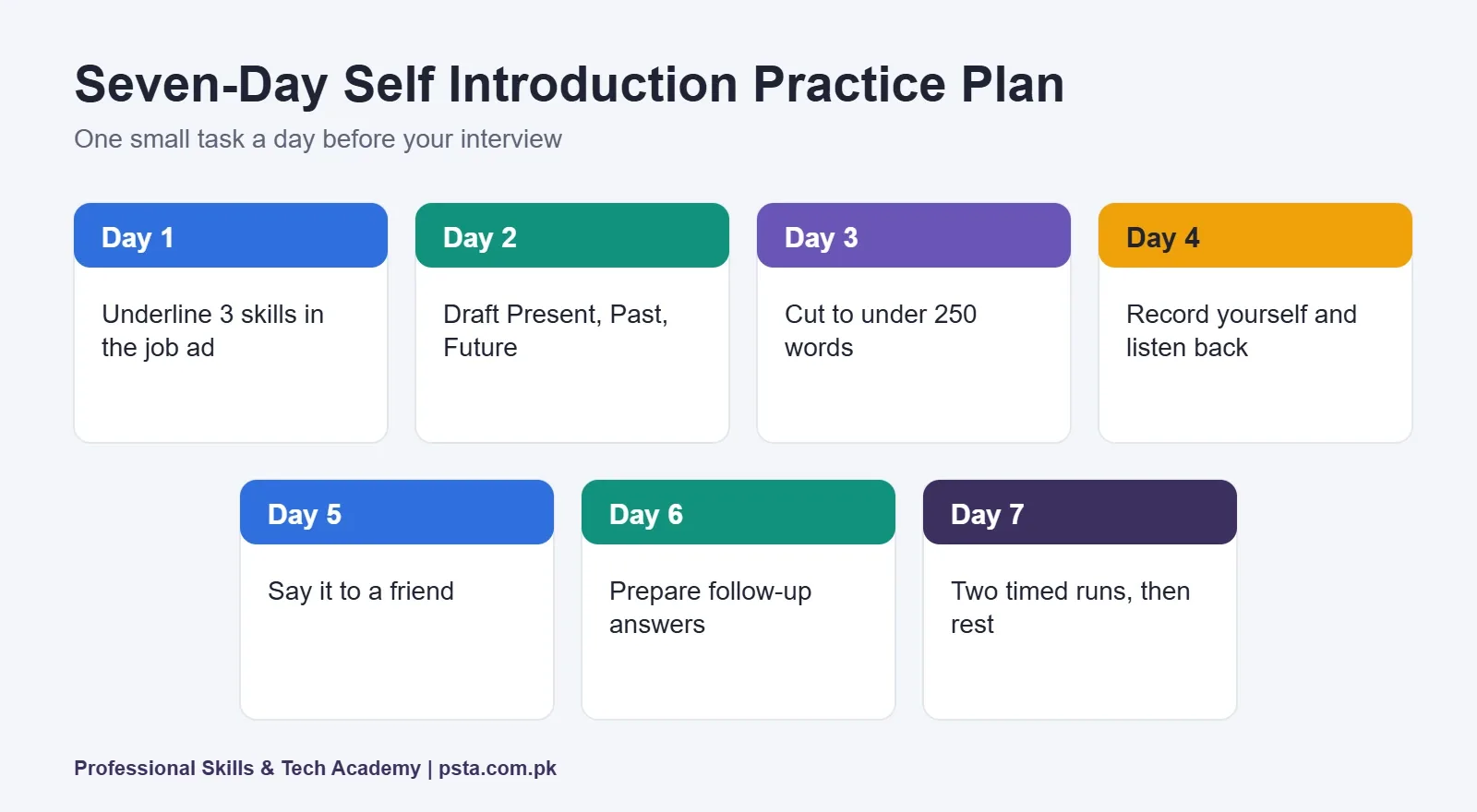
- Day 1: Read the job ad and underline the three skills it mentions most.
- Day 2: Write a draft using Present, Past, Future, linking each part to those skills.
- Day 3: Cut the draft to under 250 words and remove any sentence that fails the fit test.
- Day 4: Record yourself on your phone and listen back for filler words.
- Day 5: Say it to a friend or family member and ask what they remember.
- Day 6: Prepare answers to the follow-up questions your answer invites.
- Day 7: Do two timed runs, then stop. Rest matters too.
Which Interview Questions for Freshers Come Next?
Most interview questions for freshers that follow are built on whatever you mentioned. If you named a final-year project, be ready to explain your exact role in it. If you said you're good with Excel, you may be asked which functions you use. Plan two lines of detail for every claim in your answer.
Common follow-ups for freshers include "Why did you choose this field?", "What was the hardest part of your project?" and "Where do you see yourself in a few years?" The CV mistakes guide on our blog explains how to make sure your CV supports the same story you tell out loud.
Building Interview Confidence at PSTA
Practice for questions like tell me about yourself is built into PSTA's English Spoken & Grammar Course. The course page lists a 12-week, beginner-level program that includes a module called "Speaking Confidence: Interviews, Meetings, Social Talks," along with role plays, group discussions, pronunciation work, and email and CV writing. The listed fee is Rs. 12,000, and you can join on campus in Abbottabad, live online from anywhere in Pakistan, or hybrid.
If your target is office work, pair it with the Office Automation course, so the skills in your answer are real. Students aiming for computer operator or IT support posts often start with the one-year DIT program. You can compare every option on the courses page.
Write Your Three Sentences Tonight
Take one job ad you'd actually apply for. Write one sentence for Present, one for Past and one for Future, then read them aloud twice. That rough draft is the hardest step, and everything after it is polishing. When you'd like a trainer to listen and give feedback, you can apply for the next English batch or ask the PSTA team about batch timings on WhatsApp (+92 314 5424399).
Frequently asked questions
How do I start my answer to tell me about yourself?
Start with your present situation, not your birthplace or family. For example, open with your degree and current focus, such as a recent project or training. The interviewer already has your CV, so your first sentence should show where you stand today and hint at why you fit this particular job.
Can a fresher with no experience answer this question well?
Yes. Treat your degree as the Present and your projects, internship, freelance work or training as the Past. Career offices note that freelance projects count as experience. Pick one or two results you can explain in detail, then link them to what the job advertisement asks for.
Should I mention my family background?
Usually no, or only in one short clause. Family details rarely help the panel judge your fit, and they use up time you need for skills and results. Mention your hometown only if it matters for the job, for example a field role in your own district.
Is it bad to memorize my answer?
Memorizing every word is risky because a recited answer sounds flat and falls apart if you forget one line. Memorize the three-part outline and a few key phrases instead. Then practice out loud several times so the wording changes slightly each time but the structure stays steady.
How is tell me about yourself different from describe yourself?
Tell me about yourself asks for a short professional story: where you are, what led you here and where you want to go. Describe yourself asks for qualities. For the second, pick two or three traits and back each one with a quick example instead of a list of adjectives.
What if the interview is in Urdu?
Answer in the language the panel uses. The Present, Past, Future outline works just as well in Urdu, and a clear Urdu answer beats nervous English. If you expect English, rehearse it in English out loud so the words come easily when you are under pressure.
Sources & references
- Brandeis University: How to Answer Tell Me About Yourself brandeis.edu
- UT Austin Moody College: Tell Me About Yourself (PDF) moody.utexas.edu
- PennWest Career Services: Develop an Elevator Pitch career.pennwest.edu
- Jobscan: How to Answer Tell Me About Yourself jobscan.co
- Naukri: Tell Me About Yourself for Freshers naukri.com
Last reviewed & updated on by Umar Qureshi. Written by the PSTA team in Abbottabad, Pakistan.
Umar Qureshi
English Spoken & Grammar Course in Pakistan – Build Confidence, Speak Fluently (Online & Campus)
Turn this guide into a career: hands-on training with real projects, online across Pakistan or on-campus in Abbottabad · 12 Weeks.
Comments
No comments yet — ask a question or share your experience.