Quick answer
On November 23, 2022, ransomware hit AIIMS New Delhi. India's IT ministry said five e-Hospital servers were affected and about 1.3 TB was encrypted because of improper network segmentation. Data was restored from an unaffected backup, and most services returned after about two weeks. Officials alleged a China link, but no attacker was formally named.
Key takeaways
- • The attack began on November 23, 2022, and hit lab, billing and registration systems.
- • India's IT ministry blamed improper network segmentation and unknown threat actors.
- • About 1.3 TB on five servers was encrypted, and data came back from an unaffected backup.
- • Patient-exposure and ransom figures were estimates or denials, never confirmed facts.
- • The China link came from officials and police sources, not a formal finding.
Table of contents 17 sections
- The AIIMS Cyber Attack in Brief
- AIIMS Cyber Attack Timeline (India and Pakistan Time)
- How Did the AIIMS Cyber Attack Spread Through the Hospital?
- What Did the AIIMS Cyber Attack Cost Patients and Data?
- Who Was Blamed, and How Solid Is That Claim?
- Recovery: Clean Servers and Two Weeks on Paper
- Six Lessons the Hospital Learned the Hard Way
- 1. Segment the Network Before You Need To
- 2. Keep at Least One Backup Out of Reach
- 3. Know Every Device You Own
- 4. Rehearse Manual Operations
- 5. Restore Into a Clean, Isolated Network
- 6. Communicate Facts, Not Guesses
- What This Teaches a Security Learner
- What Does This Mean for Hospitals and Businesses in Pakistan?
- Practicing Incident Response at PSTA
- Ask Your IT Team One Question This Week
The AIIMS cyber attack began quietly at about 6:45 a.m. on November 23, 2022, when the emergency lab at India's best-known public hospital could not open patients' test reports, the hospital's director told Scroll. Billing and outpatient registration failed next. For roughly two weeks, a hospital that sees about 12,000 outpatients a day went back to paper registers and handwritten forms.
If you study defense in PSTA's Cyber Security and Ethical Hacking course, this case is worth your time. It shows how one weak design choice can turn a server problem into a full hospital outage. Here is what this lessons-learned report covers:
- A verified timeline, with India and Pakistan times side by side
- How the attack spread, explained without technical jargon
- What was confirmed, what was only estimated, and where reports disagree
- Six organizational lessons, plus practical skills for security learners
- What Pakistani hospitals, labs and small firms can check this month
The AIIMS Cyber Attack in Brief
AIIMS New Delhi is a large government teaching hospital. Its patient records, lab results, billing and appointments ran on e-Hospital, an application built and hosted by India's National Informatics Centre (NIC). When that system went down, almost every desk in the hospital felt it.
India's Minister of State for IT, Rajeev Chandrasekhar, later gave Parliament the official picture. In a written reply reported by The News Minute, he said five physical servers hosting e-Hospital were affected and about 1.3 TB of data was encrypted. He blamed "unknown threat actors" and said the servers were compromised because of improper network segmentation.
That last phrase is the core of the AIIMS cyber attack. Segmentation means dividing a network into zones, so a problem in one zone cannot easily reach the others. Without it, an intruder who lands on one machine can often see much more than they should.
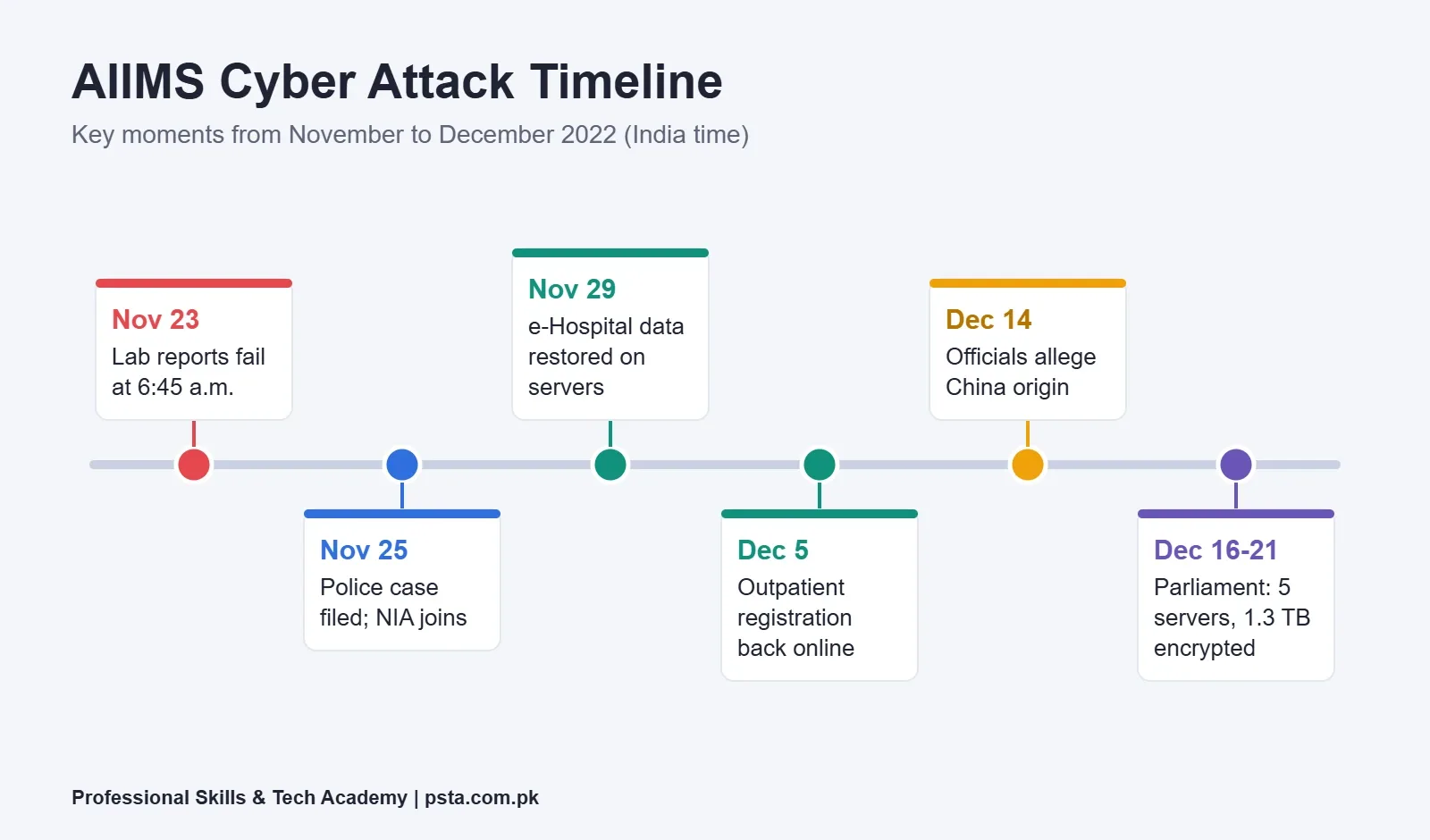
AIIMS Cyber Attack Timeline (India and Pakistan Time)
India Standard Time runs 30 minutes ahead of Pakistan Standard Time. The table lists the key moments of the AIIMS cyber attack as reported by officials and major outlets.
| Date (2022) | What happened | Source |
|---|---|---|
| Nov 23, 6:45 a.m. IST (6:15 a.m. PKT) | Emergency lab cannot view reports in the lab system; billing and outpatient services follow | Scroll, quoting the AIIMS director |
| Nov 25 | Delhi Police IFSO unit registers a case for extortion and cyber terrorism; NIA sends a team | Scroll; Lok Sabha reply |
| Nov 28 | Delhi Police say no ransom demand was brought to its notice by AIIMS | CSO Online (PTI) |
| Nov 29 | AIIMS says e-Hospital data is restored on servers, while the network is still being cleaned | CSO Online (PTI) |
| Dec 5 | Outpatient registration and admissions move back online; lab still manual | Daily Pioneer (PTI) |
| Dec 14 | Health ministry officials say the attack originated in China, citing the police case | Business Standard |
| Dec 16 to 21 | Ministers confirm five servers affected, 1.3 TB encrypted, and data recovered from a backup | Parliament replies |
How Did the AIIMS Cyber Attack Spread Through the Hospital?
Officials never published the exact way the attackers got in. You should be careful with any article that claims to know. What the record does show is how the damage spread once it started.
A detailed status note carried by the Daily Pioneer said the e-Hospital setup used 24 servers. Four were found infected early on: the main and backup e-Hospital databases, plus the application and database servers for the lab system. Ransomware was later also found on a separate virtual machine used for search.
Notice the pattern. The main database and its secondary copy were hit together. A backup that sits on the same reachable network as the original can be encrypted in the same attack. The hospital spokesperson also told Scroll that infected files had changed extensions, a common sign of ransomware.
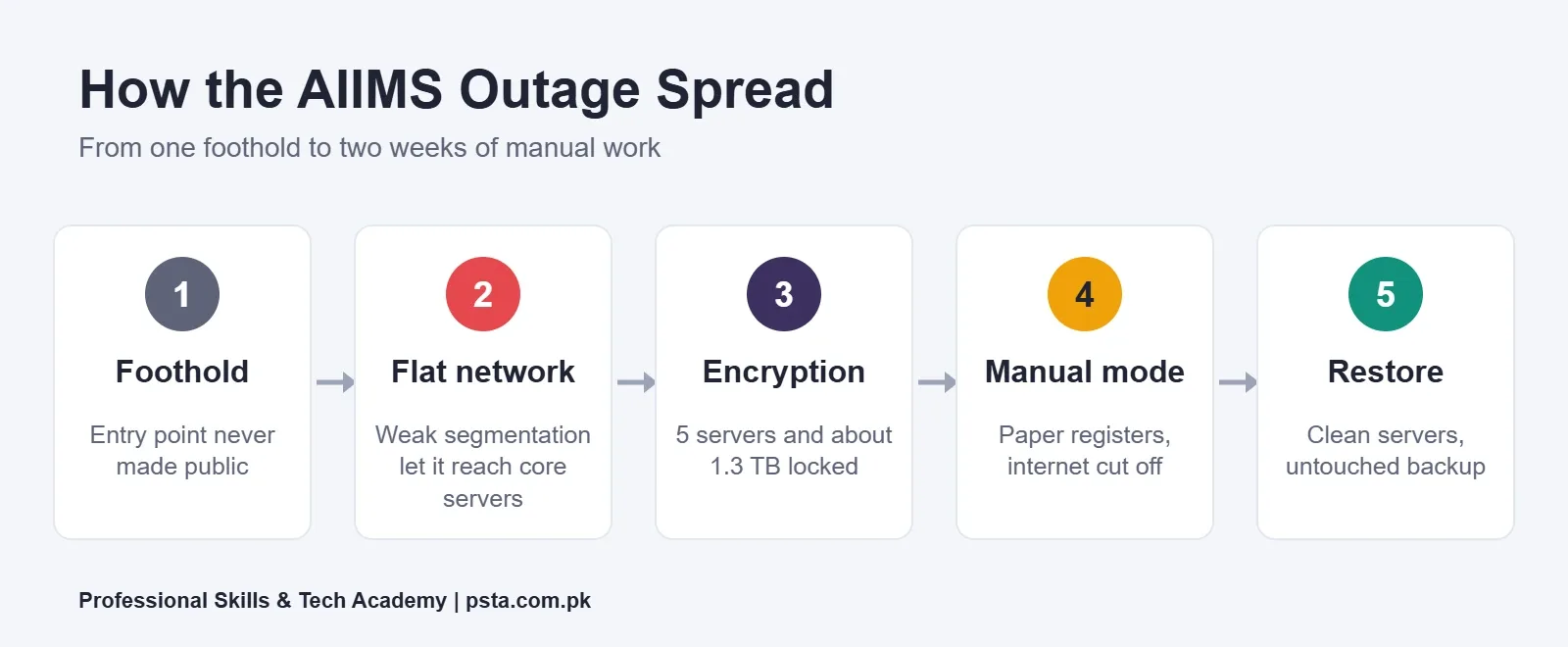
In plain terms, the chain looked like this:
- An unknown entry point gave attackers a foothold.
- A flat network let them reach several important servers.
- Core databases were encrypted, and the apps that relied on them stopped.
- Staff switched to manual work while investigators cut internet access.
- Teams rebuilt clean servers and restored data from a copy that had not been touched.
What Did the AIIMS Cyber Attack Cost Patients and Data?
The most visible cost was time. Patients queued for paper registration, birth and death certificates were issued manually, and only urgent lab samples were processed for a while, according to reports compiled by CSO Online from PTI.
The data impact is less clear, and you should keep that uncertainty in mind. Here is how the main figures compare:
| Claim | Status |
|---|---|
| About 1.3 TB of data encrypted on five servers | Confirmed by the IT minister in Parliament |
| Data recovered from a backup server that was not affected | Confirmed by the health ministry in Parliament |
| Records of 3 to 4 crore patients could be exposed | Estimate from unnamed sources (PTI); Scroll cited officials putting it at 2 to 4 crore |
| A ransom of Rs. 200 crore (Indian rupees) in crypto | Reported by PTI, then denied by Delhi Police |
On the ransom, the health ministry gave a careful answer. As reported by The News Minute, it said no specific amount was demanded, although a message pointing to a cyber attack was found on a server. Encryption was confirmed. Mass data theft was never confirmed in public.
Who Was Blamed, and How Solid Is That Claim?
Two weeks after the AIIMS cyber attack, Business Standard reported that senior health ministry officials said the attack originated in China, citing the police case. The same report said AIIMS ran about 100 servers, 40 physical and 60 virtual, of which five physical servers were infiltrated. NPR, in a report carried by KPBS, quoted police sources pointing to China and Hong Kong.
Now compare that with the formal record. The IT ministry's Lok Sabha reply of December 21, 2022, named no country and described the attackers as unknown. That gap matters. An IP address in one country shows where traffic came from, not who sat at the keyboard. Attackers routinely route traffic through rented or hijacked servers abroad.
So treat the China link as an allegation from officials, not a proven finding. No group was publicly named or charged in the records we reviewed.
Recovery: Clean Servers and Two Weeks on Paper
The response to the AIIMS cyber attack followed a sensible order, even if it was slow. Investigators asked AIIMS to block internet access. Infected servers were isolated and, on police direction, physically removed from the server room for forensics, the Daily Pioneer report said.
Ransomware recovery took time because the hospital had thousands of devices. By November 29, antivirus had been installed on about 1,200 of 5,000 computers, and 20 of 50 servers had been scanned, according to PTI figures in CSO Online. Backups were copied to external drives and scanned before use. New physical servers were set up on an isolated network behind a firewall.
According to the health ministry's Rajya Sabha reply, data was retrieved from an unaffected backup server, and most e-Hospital functions such as registration, appointments, admission and discharge returned after about two weeks. The IT minister listed the fixes as endpoint hardening, firewall policies and network segmentation.
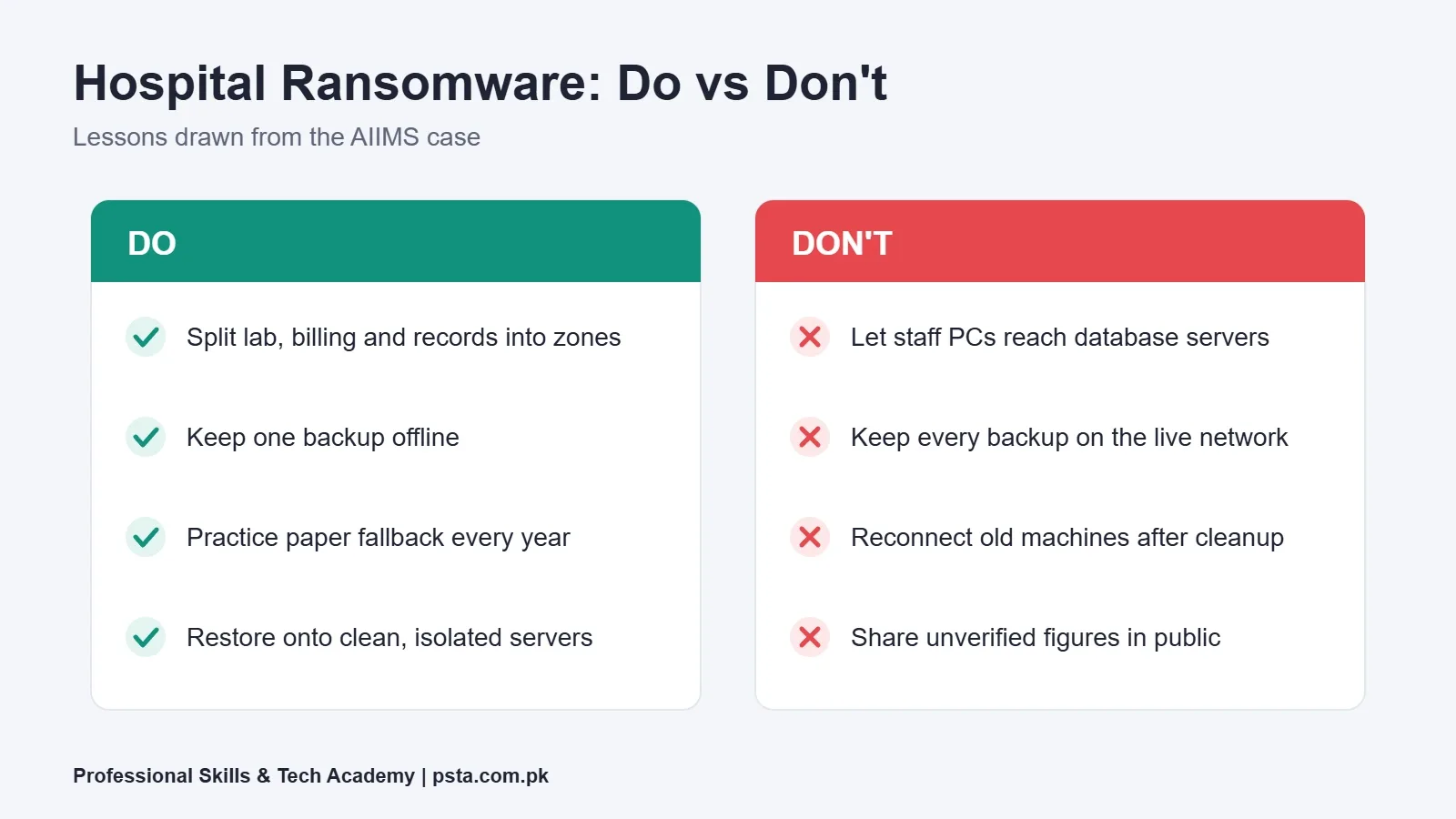
Six Lessons the Hospital Learned the Hard Way
These lessons come from the confirmed facts of the AIIMS cyber attack. They apply to any organization that depends on one central system, from a hospital to a bank branch network.
1. Segment the Network Before You Need To
The government's own explanation was improper segmentation. Lab, billing, records and staff computers should sit in separate zones, with only the traffic each one truly needs allowed between them.
2. Keep at Least One Backup Out of Reach
The primary and secondary databases were infected together. Recovery worked because one backup was unaffected. Plan for that on purpose: keep an offline or immutable copy that live systems cannot write to.
3. Know Every Device You Own
Scanning 5,000 computers and 50 servers took days. An up-to-date asset list, with owners and roles, shortens that work and shows which machines matter most.
4. Rehearse Manual Operations
AIIMS kept treating patients because staff could fall back to paper. Write that fallback down, print the forms and practice it once a year.
5. Restore Into a Clean, Isolated Network
The team scanned backups and rebuilt on new servers behind a firewall instead of reconnecting old machines. Restoring onto an infected network only invites a second outage.
6. Communicate Facts, Not Guesses
Conflicting reports about ransom amounts and patient numbers spread for weeks. Short, regular, verified updates protect trust and stop rumors from filling the silence.
What This Teaches a Security Learner
For a student, the AIIMS ransomware attack is a ready-made lab scenario. These are the skills it points to, and each one is something you can practice safely:
- Draw network zones. Sketch a small hospital network with lab, billing, records and staff zones. Then write the firewall rules that allow only needed traffic between them.
- Test a restore, not just a backup. In a lab, back up a virtual machine, wipe it, and time how long a full restore takes. A backup you have never restored is only a hope.
- Read early warning signs. Learn what mass file renaming, sudden extension changes and disabled security tools look like in logs. Those were the kinds of clues staff saw here.
- Write an incident timeline. Practice recording what happened, when, and who confirmed it. Investigators depend on clean notes, and so do managers.
- Separate evidence from claims. As this case shows, an IP address is not an identity. Train yourself to label each finding as confirmed, likely or unverified.
All five sit inside the network security, threat detection and digital forensics topics of the Cyber Security course at PSTA. If you want to understand how hospital ransomware hit the US on a larger scale, compare this case with our Change Healthcare hack breakdown.
What Does This Mean for Hospitals and Businesses in Pakistan?
Pakistan has already seen what a single attack can do to a public-facing organization. Our case studies on the K-Electric ransomware attack and the global WannaCry ransomware outbreak show the same pattern: shared networks, slow recovery and confused public updates.
Many private hospitals, diagnostic labs and clinics in Pakistan now run digital registration, lab and billing software. Healthcare cyber security often gets less budget than new equipment, yet the AIIMS cyber attack shows the system itself is a piece of medical equipment. When it fails, patients wait.
If you manage IT for a clinic, lab or small company, start with three questions. Can a staff laptop reach your database server directly? Is one backup copy disconnected right now? Does the front desk know how to work on paper for a day? If any answer is no, you have found your first project. Researchers quoted by NPR also pointed to low user awareness and legacy technology, so staff training belongs on that list too.
Practicing Incident Response at PSTA
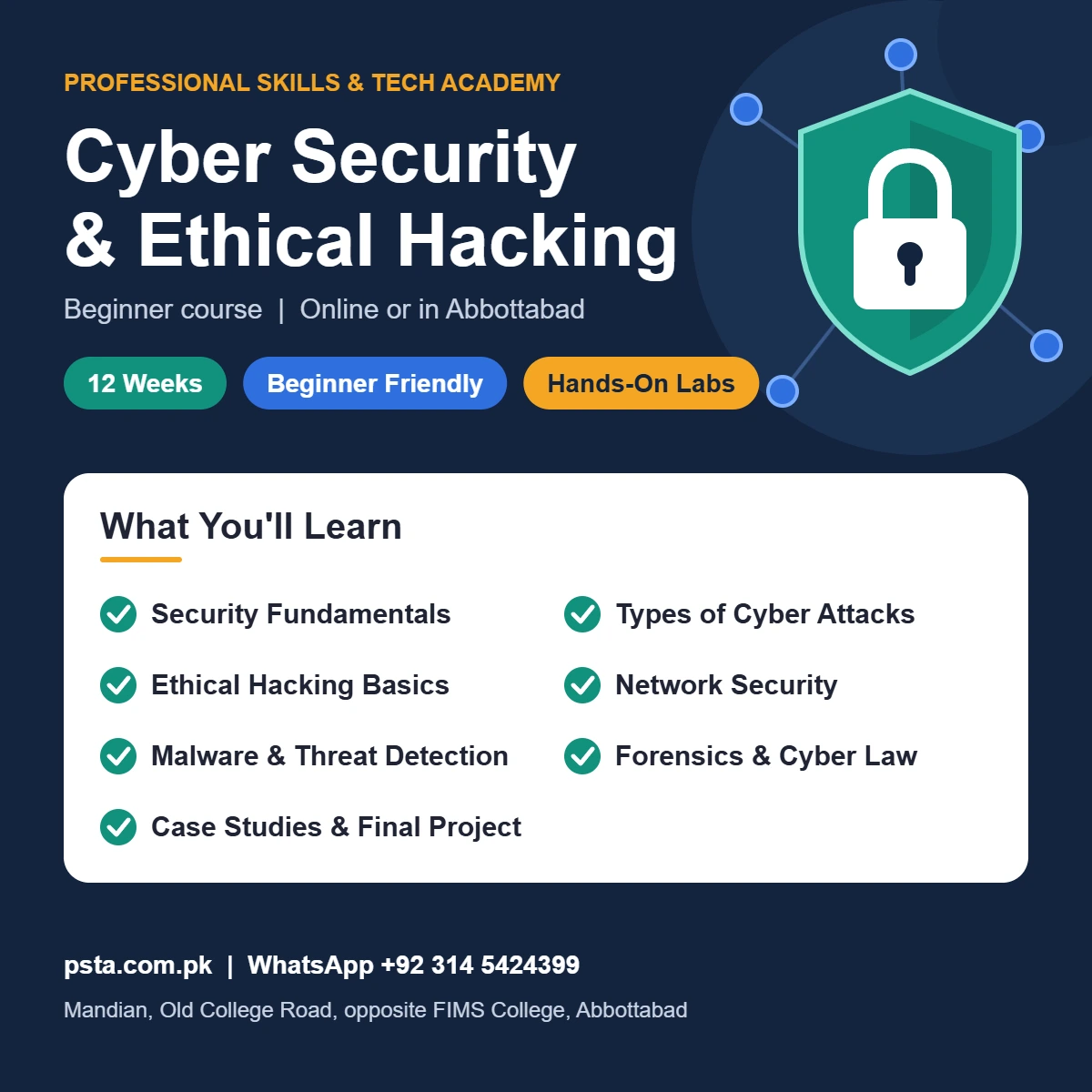
At PSTA, the beginner-level Cyber Security and Ethical Hacking program lasts 12 weeks. You can join on campus in Abbottabad or through live online classes from anywhere in Pakistan. According to the course page, it moves from core ideas such as the CIA triad and risk through common attacks, basic ethical hacking, network security, malware and threat detection, cyber law and digital forensics.
The labs include investigating an incident, preserving evidence and documenting a timeline, which is the exact work AIIMS investigators faced. Students finish with a case-study project and a written security report. Once you are comfortable on the defensive side and want to probe systems the way attackers do, the Advanced Ethical Hacking and Penetration Testing course is the next step. You can also read our SOC analyst roadmap to see where incident response fits in a career, or start the series from our first case study on the Binance hack.
Ask Your IT Team One Question This Week
You do not need a big budget to learn from the AIIMS cyber attack. Ask whoever runs your systems a single question: "If our main server were encrypted tonight, which backup would we restore from, and when did we last test it?" A clear answer means you are ahead of where AIIMS was in 2022. A pause tells you exactly what to fix first.
If you want guided practice with network zoning, restore drills and incident write-ups, take a look at the course page and message the PSTA team with your questions.
Frequently asked questions
When did the AIIMS cyber attack happen?
The attack began on November 23, 2022. The first sign came at about 6:45 a.m. India time, when the emergency lab could not open reports, according to the AIIMS director quoted by Scroll. Delhi Police registered a case on November 25, and the health ministry later told Parliament that most e-Hospital functions came back after about two weeks.
Was the AIIMS incident a ransomware attack?
Yes. India's IT minister told Parliament that about 1.3 TB of data on five servers was encrypted, and the minister later described a deliberate ransomware attack. Early on, hospital staff noticed that infected files had changed extensions, which is a typical sign. Officials did not publish the exact ransomware family or how the attackers first got in.
Did AIIMS pay a ransom?
There is no public evidence that any ransom was paid. PTI reported an alleged demand of Rs. 200 crore in Indian rupees, but Delhi Police said no such demand was brought to its notice. The health ministry told Parliament that no specific amount was demanded, although a message suggesting an attack was found on a server.
Was patient data stolen in the attack?
That was never confirmed in public. Media reports quoted unnamed sources estimating that records of 3 to 4 crore patients could have been exposed, and Scroll cited officials putting the figure at 2 to 4 crore. The official replies in Parliament confirmed encryption and recovery but did not confirm any theft of patient records.
Who was behind the AIIMS cyber attack?
No attacker has been publicly named or charged. In December 2022, health ministry officials told reporters the attack originated in China, and police sources mentioned China and Hong Kong. However, the IT ministry's formal reply to the Lok Sabha described the attackers only as unknown threat actors. Treat the China link as an allegation, not a proven finding.
What is network segmentation, and why did it matter here?
Network segmentation splits a network into separate zones, such as lab, billing and staff computers, and limits traffic between them. India's IT ministry said the AIIMS servers were compromised because of improper segmentation. With weak zoning, an attacker who reaches one machine can reach important servers too, which turns a small infection into a hospital-wide outage.
Could a similar attack hit a hospital in Pakistan?
Any hospital, lab or clinic that runs registration, lab and billing software on a shared network faces the same basic risk. The best defenses are not expensive: separate network zones, one backup kept offline and tested, an accurate device list, and a practiced paper fallback. Staff awareness training also matters, because many attacks start with a single careless click.
How can I learn to defend against attacks like this?
Start with networking basics, then practice firewall rules, backup restores and log reading in a safe lab. PSTA's 12-week Cyber Security and Ethical Hacking course covers network security, threat detection and digital forensics, including an incident investigation lab. You can study on campus in Abbottabad or join live online classes from anywhere in Pakistan.
Sources & references
- Five AIIMS servers were affected, 1.3 TB of data encrypted: MoS IT (The News Minute) thenewsminute.com
- Lok Sabha Unstarred Question 2310, MeitY reply (Dec 21, 2022) eparlib.sansad.in
- Rajya Sabha Unstarred Question 1478, MoHFW reply (Dec 20, 2022) rsdebate.nic.in
- How AIIMS is working to restore services after hackers crippled its systems (Scroll) scroll.in
- Online registration of OPD patients resumes at AIIMS-Delhi (Daily Pioneer) dailypioneer.com
- Ransomware attackers allegedly demand ransom from AIIMS, police deny report (CSO Online) csoonline.com
- AIIMS cyber attack originated in China, all servers retrieved now: MoHFW (Business Standard) business-standard.com
- Cyberattacks on hospitals thwart India's push to digitize health care (NPR via KPBS) kpbs.org
Last reviewed & updated on by Umar Qureshi. Written by the PSTA team in Abbottabad, Pakistan.

Umar Qureshi
Cyber Security & Ethical Hacking Course in Abbottabad - PSTA
Turn this guide into a career: hands-on training with real projects, online across Pakistan or on-campus in Abbottabad · 12 Weeks.
Comments
No comments yet — ask a question or share your experience.