Quick answer
In September 2020, Netwalker ransomware disrupted K-Electric's billing and online complaint services in Karachi, but the power supply continued. The gang demanded $3.85 million, rising to $7.7 million, and later leaked an 8.5 GB archive. No public evidence shows the company paid. US authorities later seized Netwalker funds and jailed a Canadian defendant for 20 years.
Key takeaways
- • The September 2020 attack hit K-Electric's billing and online services; reporters said power supply was not affected.
- • Netwalker demanded $3,850,000, set to double to $7.7 million, and later published an 8.5 GB archive.
- • K-Electric said customer data was secure; an independent firm said the leak held customer and financial records.
- • Attribution to the Netwalker gang is strong, but the individual intruder has never been publicly named.
- • Patched remote access, two-factor sign-in, tested offline backups and network separation are the core defenses.
Table of contents 19 sections
- Seven Myths About the K-Electric Ransomware Attack
- What Happened in Karachi in September 2020?
- Myth 1: Did the Hackers Switch Off Karachi's Power?
- How Did the Netwalker Ransomware Attack Work?
- A Criminal Business With Affiliates
- Getting a Foothold
- Stealing, Then Encrypting
- Money and Data: What Did the Attack Actually Cost?
- Myth 3: "No Data Left the Company"
- Myth 4: "K-Electric Paid the Ransom"
- Who Was Behind It, and How Sure Is Anyone?
- Myth 5: "A Foreign Government Did It"
- What Happened After the Attack?
- Myth 6: "He Was the One Who Hit K-Electric"
- Myth 7: "The Danger Ended With Netwalker"
- What a Ransomware Attack in Pakistan Means for You
- Eight Lessons in Ransomware Protection for Businesses
- Tracing a Ransomware Case in PSTA's Cyber Security Course
- Test One Backup Restore Before Friday
Ask people in Karachi about the K-Electric ransomware attack of September 2020 and many will tell you hackers "cut the city's power." That never happened. The attack froze billing and online complaint systems, while Dawn reported that the electricity supply itself kept running.
This case study takes seven popular beliefs about the attack and tests each one against the public record. In this post you will find:
- A day-by-day timeline in Pakistan time, from the first outage to the data leak
- How the Netwalker ransomware gang operated, explained for the people who defend networks
- What was at stake: a $3.85 million demand and an 8.5 GB leak
- Who was blamed, what was proven in court, and what is still unknown
- Eight lessons Pakistani firms can act on this month
Seven Myths About the K-Electric Ransomware Attack
Attack stories grow as they travel. A billing outage becomes a blackout. A ransom demand becomes a payment. The table below sets each common claim about the K-Electric ransomware incident beside what reporters, the company and US prosecutors actually said. The rest of this post works through them one by one.
| Myth | What the record shows |
|---|---|
| 1. Hackers switched off Karachi's power | Online services and billing were hit; Dawn and BleepingComputer both reported power supply was not affected |
| 2. Ransomware only locks files | Netwalker stole copies of files first, then encrypted systems, then threatened to publish |
| 3. No data left the company | K-Electric said customer data was secure; weeks later the gang posted an 8.5 GB archive |
| 4. K-Electric paid the ransom | No public evidence of payment; the company denied being directly approached |
| 5. A foreign government was behind it | No government named a state actor; the evidence points to a criminal gang after money |
| 6. The man jailed for Netwalker hit K-Electric | US charges cover other Netwalker victims; no public record ties him to Karachi |
| 7. The threat ended when Netwalker fell | Pakistan's tax authority faced a major cyber attack less than a year later |
What Happened in Karachi in September 2020?
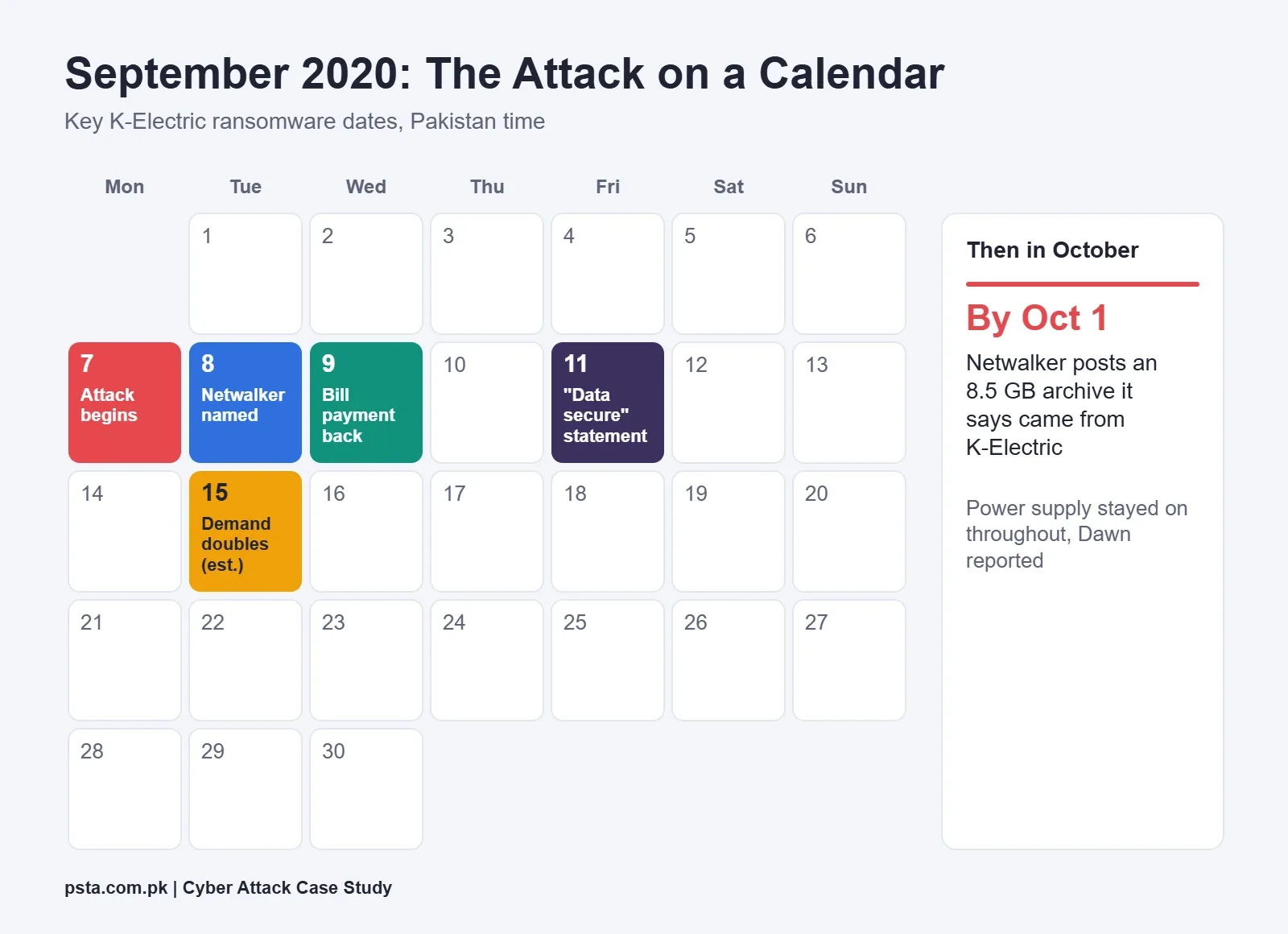
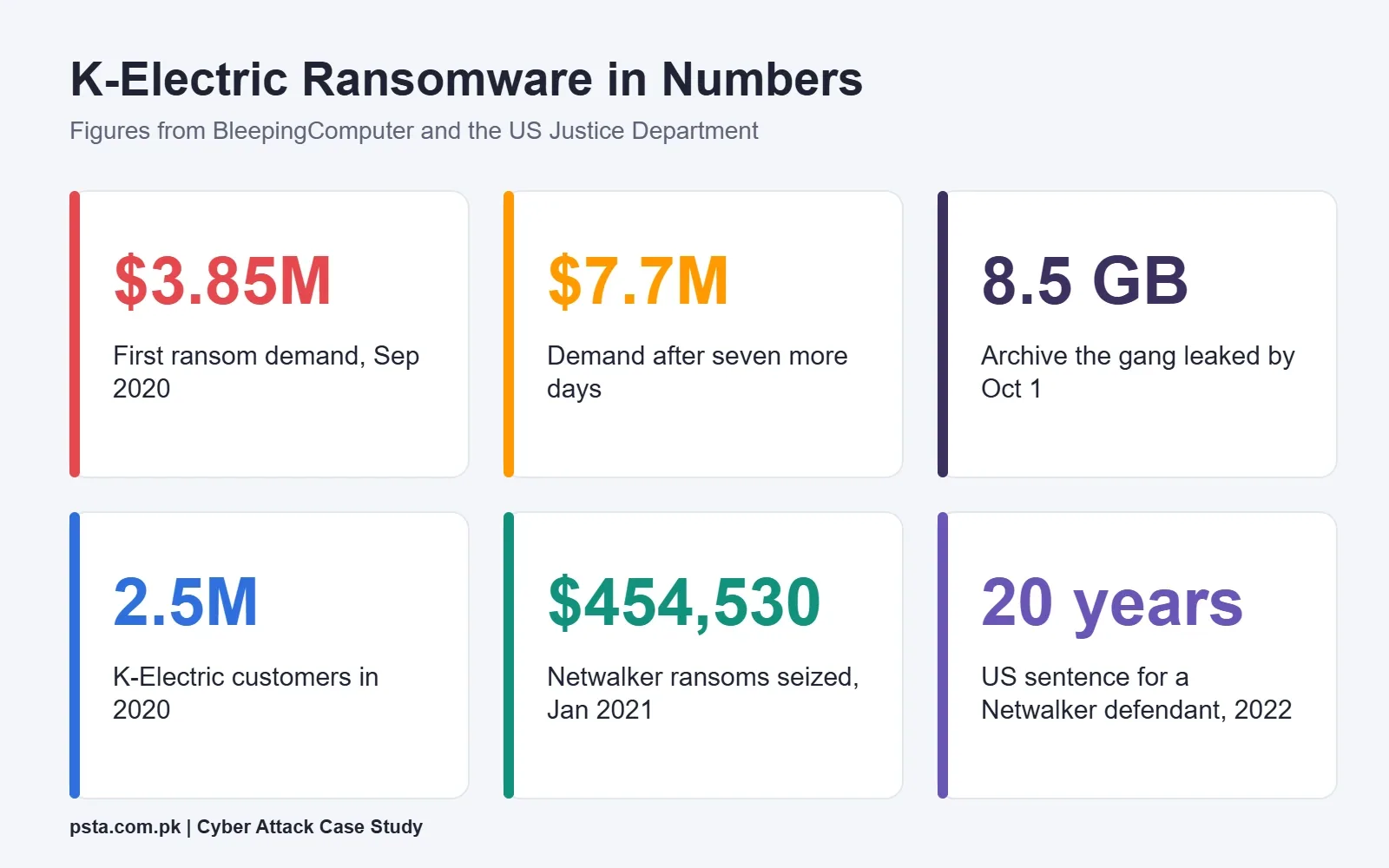
K-Electric is the private company that supplies electricity to Karachi. At the time, BleepingComputer described it as serving 2.5 million customers with more than 10,000 staff. That scale is what made the outage visible so quickly. Here is the K-Electric ransomware sequence, with dates in Pakistan Standard Time (PKT, UTC+5) where known.
| Date (PKT) | What happened | Source |
|---|---|---|
| Jul 28, 2020 | FBI issues a flash alert describing how Netwalker gangs break in | FBI alert via AHA |
| Mon, Sep 7, morning | Attack begins; customers lose access to online account services | BleepingComputer, citing Rewterz |
| Tue, Sep 8 | BleepingComputer names Netwalker and reports the ransom page; K-Electric warns of disruption to some online services | BleepingComputer, Dawn |
| Wed, Sep 9 | K-Electric calls it an "attempted cyber-incident" and says bill payment and the 118 call centre work | Dawn, ProPakistani |
| Fri, Sep 11 | K-Electric says customer data is "intact and secure" and denies receiving a ransom request directly | BleepingComputer |
| About Sep 15 | The demand was set to double to $7.7 million if unpaid after seven more days | BleepingComputer |
| By Oct 1 | Netwalker publishes an 8.5 GB archive it says came from K-Electric | BleepingComputer, Security Affairs |
| Jan 27, 2021 | US and Bulgarian action against Netwalker; a Canadian man is charged | US Justice Department |
| Oct 4, 2022 | That Canadian is sentenced to 20 years in a US prison | US Justice Department |
The "about Sep 15" row is an estimate. BleepingComputer's September 8 report said the price would rise after seven more days, without giving a calendar date.
Myth 1: Did the Hackers Switch Off Karachi's Power?
No. Every reliable report from that week separates the two. Dawn wrote that some services were frozen while supply was unaffected. BleepingComputer, quoting the Pakistani security firm Rewterz, said the same.
What customers did lose was the ability to reach the company online. According to Dawn, people could not log outage or fault complaints through the 118 helpline, the 8119 SMS service or the KE Live App. Duplicate bills were also hard to download from the website.
K-Electric said it had "isolated few non-critical services" as a precaution. By September 9, ProPakistani reported that bill payment and the 118 call centre were fully working again. Customers who needed a duplicate bill were told to visit a customer care centre.
Why did the grid keep running? The company never published a technical explanation. In many utilities, the systems that control generation and distribution sit on networks kept apart from office and billing IT. That is general industry context, not a confirmed fact about K-Electric's design, so treat it as a likely reason rather than a finding.
How Did the Netwalker Ransomware Attack Work?
K-Electric never disclosed how the attackers got in, and BleepingComputer's report did not say either. What we do know is how Netwalker crews generally worked in 2020, because the FBI described it in a public alert. Use it as a pattern for defense, not as a replay of this breach.
A Criminal Business With Affiliates
The US Justice Department explained that Netwalker ran on a ransomware-as-a-service model. Developers built and maintained the malware. Affiliates chose targets and carried out the intrusions. When a victim paid, the two sides split the money.
Getting a Foothold
The FBI flash alert of July 28, 2020 listed four common ways in. Crews sent phishing emails themed around COVID-19. They exploited unpatched VPN appliances, including a known Pulse Secure flaw. They abused vulnerable web application components. They also logged in through Remote Desktop accounts with weak passwords. Each of these is a gap that a patch, a setting or a short training class can close.
Stealing, Then Encrypting
Once inside, the FBI said, Netwalker crews collected administrator credentials and copied data out to file-sharing services. Only then did they launch the encryption step across connected Windows machines. This is the double extortion model. The victim faces two threats at once: locked systems and a public leak of stolen files.
That order matters for you as a defender. By the time a ransom note appears, the data may already be gone. Restoring from backup fixes the outage, but it does nothing about the leak.
Money and Data: What Did the Attack Actually Cost?
Start with the K-Electric ransomware demand. BleepingComputer saw the gang's payment page on the Tor network, which asked for $3,850,000 in Bitcoin. If unpaid after seven more days, the price would double to $7.7 million. Dawn rounded these to $3.8 million and $7 million. The difference is only rounding; the BleepingComputer figures come straight from the payment page, so they are the more precise pair.
Myth 3: "No Data Left the Company"
On September 11, K-Electric said its initial investigation showed that "all customer data has remained intact and secure." Three weeks later, the story changed. BleepingComputer reported on October 1 that Netwalker had published an 8.5 GB archive it said came from the attack.
Rewterz reviewed the archive and said it held financial data, customer information, engineering reports and maintenance logs. Security Affairs added that it included engineering diagrams for turbines. K-Electric did not reply to BleepingComputer's request for comment on the leak.
How do you weigh these two accounts? The company spoke within days, early in its own checks. The leak came weeks later and was described by an independent security firm. PSTA has not examined the files, and you should never download leaked data to check for yourself.
Myth 4: "K-Electric Paid the Ransom"
There is no public evidence of a payment. K-Electric's spokesperson, Mahreen Khan, told BleepingComputer the company had "not been directly approached" with a ransom request. Security Affairs reported that the company did not pay. Gangs usually publish stolen files when a victim refuses, which fits that reading. Still, K-Electric itself has not said, so this stays an analyst view.
No public figure exists for the cost of recovery, lost staff hours or outside experts. Be cautious with any number you see that does not name its source.
Who Was Behind It, and How Sure Is Anyone?
Confidence that the K-Electric ransomware attack was a Netwalker operation is high. BleepingComputer saw the gang's own Tor payment page naming the victim. Anonymous security sources confirmed it to the site. The gang later posted the stolen archive on its leak site. Crime groups rarely claim attacks they did not carry out. Their business depends on victims believing them.
Which person or affiliate ran the intrusion is unknown. No court record, police statement or company report names one.
Myth 5: "A Foreign Government Did It"
Nothing in the record backs this up. No government, in Pakistan or abroad, has attributed the K-Electric cyber attack to a state actor. The ransom demand and the leak threat point to a gang that wanted money. In the Bybit hack, by contrast, the FBI blamed North Korea openly.
What Happened After the Attack?
K-Electric said it was working with foreign security experts and local police on a forensic review. As far as we could find, no technical post-mortem was ever made public.
The bigger moves came from outside Pakistan. On January 10, 2021, US authorities seized about $454,530 in cryptocurrency from three Netwalker ransom payments. On January 27, 2021, the Justice Department announced a coordinated action. Bulgarian police took down a dark web site the affiliates used to talk to victims. A Canadian man, Sebastien Vachon-Desjardins, was charged in Florida; the indictment alleged he obtained at least $27.6 million.
Canadian police arrested him in Gatineau the same day and seized 719 Bitcoin. On October 4, 2022, a US court sentenced him to 20 years in prison and ordered $21.5 million forfeited.
Myth 6: "He Was the One Who Hit K-Electric"
The Justice Department never linked him to Karachi. Netwalker had many affiliates and, prosecutors said, hundreds of victims in numerous countries. Treat any claim that this case "solved" the K-Electric attack as unproven.
Myth 7: "The Danger Ended With Netwalker"
Brands die; methods survive. Less than a year later, Pakistan's tax authority faced its own crisis, covered in our FBR cyber attack case study. The tools change names, but phishing, unpatched remote access and stolen passwords keep showing up.
What a Ransomware Attack in Pakistan Means for You
For households, the main risk is what happens to personal data after a leak. Dawn pointed out that K-Electric bills carry names, addresses and CNIC and NTN numbers. Data like that helps scammers sound convincing on the phone. If someone calls about your electricity account and asks for an OTP or payment, hang up and call the official number yourself. The scripts these callers use are listed in our fraud calls in Pakistan guide.
For businesses, the lesson is wider. In 2020, experts quoted by Dawn said Pakistan had no clear redress mechanism for breach victims, and the data protection bill was still a draft. Card data was also at the center of the Pakistan bank data breach two years earlier. Any company that keeps customer records is a target, whether it sells power, phones or clothes.
It also helps to compare outcomes. In the Colonial Pipeline hack, an IT intrusion led a US company to pause physical operations. In Karachi, physical supply continued while customer-facing systems struggled. A good response plan covers both kinds of damage.
Eight Lessons in Ransomware Protection for Businesses
These lessons come from the FBI's Netwalker guidance and from the gaps the K-Electric ransomware case exposed. None needs a large budget to start.
- Patch remote access first. VPN gateways and web portals face the internet, so fix their known flaws before anything else.
- Close or lock down Remote Desktop. Never expose it directly to the internet, and require two-factor sign-in for every remote account.
- Train staff with real examples. Netwalker used topical phishing lures. Show your team what current local scams look like.
- Keep offline backups and test them. The FBI advises backups that cannot be changed or deleted from the main network. Until you have restored from it once, you cannot be sure it works.
- Separate business IT from operations. Billing, email and office systems should not share a flat network with equipment that keeps your service running.
- Watch outbound traffic. Large uploads to file-sharing sites can be the first sign of double extortion, before any file is encrypted.
- Prepare your public statements. K-Electric's message shifted over several days. Decide in advance who speaks, what you can confirm and how you will correct earlier statements.
- Collect less personal data. Every CNIC copy you store is something you may one day have to explain. Keep only what the law and the job require.
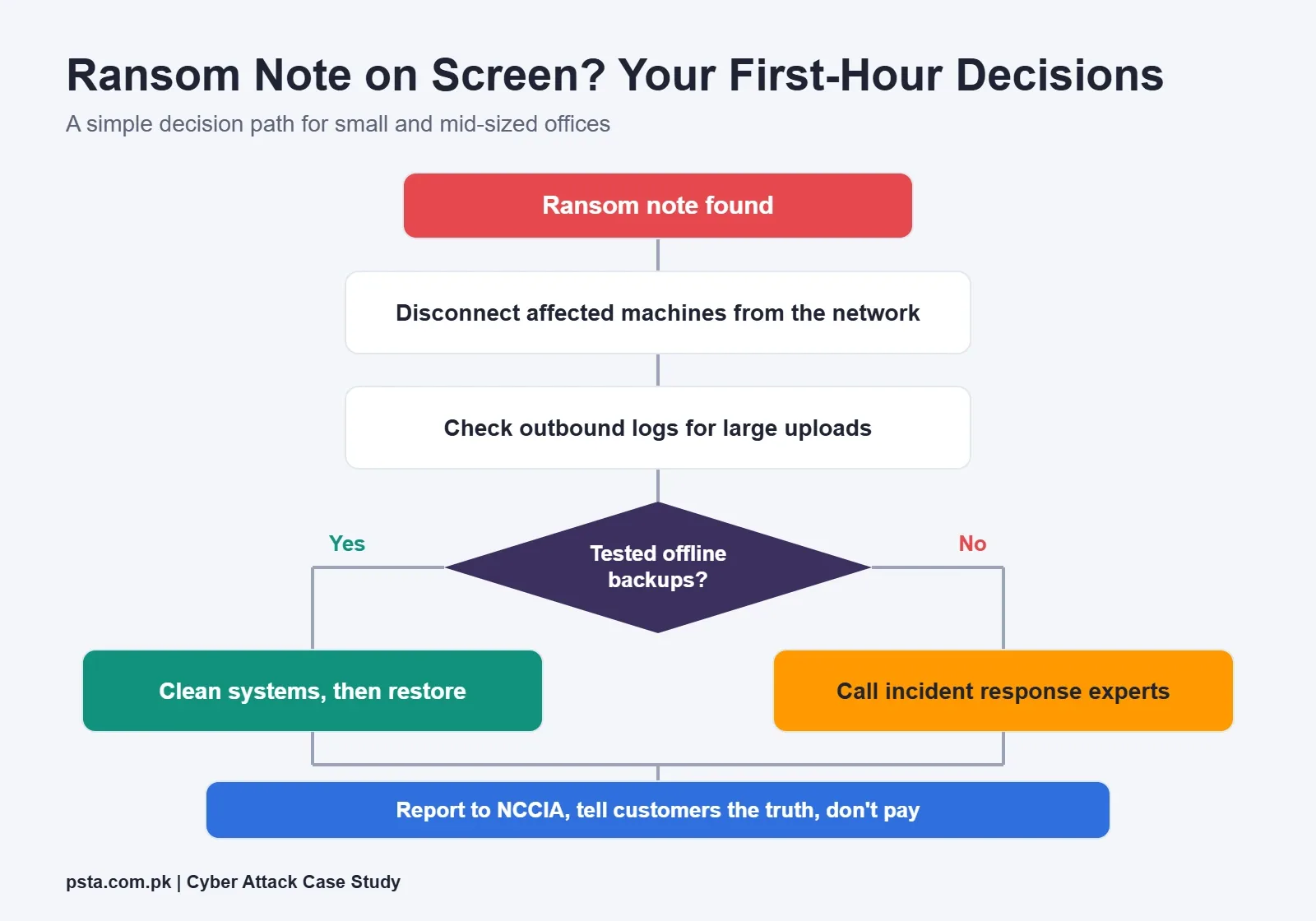
If a ransom note appears on a screen in your office, the first hour decides a lot. Work through these steps in order:
- Disconnect the affected machines from the network so the damage cannot spread.
- Check outbound logs for large uploads, since data may have left before the note appeared.
- Ask one question: do you have tested offline backups? If yes, clean the systems and restore. If no, call incident response experts.
- Report the attack. In Pakistan, cybercrime goes to the NCCIA, the National Cyber Crime Investigation Agency.
- Tell customers what you know and what you don't, and update them as facts change.
The FBI advises against paying, because payment does not guarantee recovery and funds more attacks.
Tracing a Ransomware Case in PSTA's Cyber Security Course
Reading about an incident is useful. Rebuilding its timeline from public evidence is where real understanding starts. That is the habit PSTA's Cyber Security and Ethical Hacking course tries to build.
It is a 12-week, beginner-level course, and no earlier security background is required. You can join live online from anywhere in Pakistan or attend on campus in Abbottabad. Lessons start with the CIA triad and risk, then cover common attacks and network defenses such as firewalls and intrusion detection. Later modules deal with malware, threat detection, digital forensics and Pakistani cyber law.
One lab asks you to look into an incident, keep the evidence safe and write up a timeline, much like the K-Electric ransomware table above. The course ends with a case-study project and a security report.
If you later want to test systems from the attacker's side, with permission, you can move on to the 12-week Advanced Ethical Hacking and Penetration Testing course. Earlier cases in this series, starting with the Binance hack explainer, make good practice material for the same exercise. For batch dates, PSTA answers questions on WhatsApp at +92 314 5424399.
Test One Backup Restore Before Friday
The K-Electric ransomware case shows that systems can be restored in days, while leaked data stays out of your hands for good. You can act on half of that right now. Choose one folder your office cannot work without. Restore it from backup onto a different computer and note the minutes it needs. If the restore fails or drags on all day, you have found your most urgent security task, and you found it before an attacker did.
Frequently asked questions
Did the K-Electric ransomware attack cause load-shedding in Karachi?
No. Dawn and BleepingComputer both reported that the September 2020 attack disrupted billing, the online account portal and complaint channels, while the electricity supply kept running. K-Electric described the event as an attempted cyber incident and isolated some non-critical services as a precaution.
What is Netwalker ransomware?
Netwalker was a criminal ransomware operation active from 2019 until a US-led action in January 2021. It ran as ransomware-as-a-service: developers built the malware and affiliates broke into victims, then shared the ransom. Its crews copied data before encrypting systems, then threatened to publish the files if the victim refused to pay.
Was my personal data part of the K-Electric leak?
Nobody can confirm that for an individual customer. K-Electric said in September 2020 that customer data was intact and secure. Later, the security firm Rewterz said the 8.5 GB archive held customer information. Do not search for or download the leaked files. Instead, be extra careful with unexpected calls or messages that quote your account or CNIC details.
Did K-Electric pay the Netwalker ransom?
There is no public evidence that it did. A company spokesperson said K-Electric had not been directly approached with a ransom request, and Security Affairs reported that it did not pay. The gang's decision to publish stolen files fits that view, because leaks usually follow a refusal. The company itself has not issued a detailed statement on the question.
Has anyone been arrested for the attack on K-Electric?
Not publicly. US prosecutors charged and later jailed a Canadian man for Netwalker attacks, and he received 20 years in October 2022. However, the Justice Department did not link him to K-Electric, and no Pakistani agency has named a suspect. Netwalker had many affiliates, so the person behind this intrusion remains unknown.
How can a small business in Pakistan reduce ransomware risk?
Start with the cheap steps. Patch your router, VPN and any web portal that faces the internet. Turn off Remote Desktop access from outside, or protect it with two-factor sign-in. Keep at least one backup offline and test a restore every month. Train staff to spot phishing, and keep only the customer data you really need.
Where should I report a ransomware attack in Pakistan?
Pakistan's National Cyber Crime Investigation Agency, known as NCCIA, takes cybercrime complaints. Keep evidence such as the ransom note, logs and affected machines untouched where possible, and write down when you first noticed the problem. If customer data may be involved, plan an honest notice to the people affected as well.
Sources & references
- BleepingComputer: Netwalker ransomware hits Pakistan's largest private power utility bleepingcomputer.com
- BleepingComputer: Hackers leak files stolen in Pakistan's K-Electric ransomware attack bleepingcomputer.com
- Dawn: K-Electric struck by 'ransomware' dawn.com
- ProPakistani: K-Electric restores customer and billing services after cyber attack propakistani.pk
- Security Affairs: Netwalker operators leaked files stolen from K-Electric securityaffairs.com
- FBI Flash MI-000130-MW: Indicators associated with Netwalker ransomware (via AHA) aha.org
- US Department of Justice: Global action against NetWalker ransomware justice.gov
- US Department of Justice: Canadian national sentenced in NetWalker ransomware case justice.gov
Last reviewed & updated on by Umar Qureshi. Written by the PSTA team in Abbottabad, Pakistan.

Umar Qureshi
Cyber Security & Ethical Hacking Course in Abbottabad - PSTA
Turn this guide into a career: hands-on training with real projects, online across Pakistan or on-campus in Abbottabad · 12 Weeks.
Comments
No comments yet — ask a question or share your experience.