Quick answer
In February 2024, criminals used a stolen password on a Change Healthcare remote-access portal that lacked multi-factor authentication. Nine days later, ALPHV ransomware struck, disrupting US pharmacy claims and payments. UnitedHealth Group paid a $22 million ransom, booked about $3.1 billion in 2024 costs, and roughly 192.7 million people were affected.
Key takeaways
- • Attackers entered on February 12, 2024 through a Citrix remote-access portal that accepted a password alone, with no second factor.
- • They spent about nine days moving inside and copying data before ransomware hit on February 21.
- • UnitedHealth Group paid a $22 million ransom, yet a second gang later claimed to hold the same data.
- • About 192.7 million people were affected, and 2024 costs reached roughly $3.1 billion.
- • MFA on every remote login, sign-in alerts and a vendor outage plan would have broken the chain at several points.
Table of contents 17 sections
- What Was the Change Healthcare Hack?
- Change Healthcare Hack Timeline: From One Login to 192.7 Million People
- How Did One Login Open the Door?
- What Went Wrong: Six Failures Behind the Breach
- 1. A Remote Door With Only One Lock
- 2. A Stolen Credential That Still Worked
- 3. Nine Quiet Days Inside the Network
- 4. One Company Holding Up a Whole Sector
- 5. A Ransom That Bought No Guarantee
- 6. A Count That Took 17 Months
- How Much Did the Healthcare Data Breach Cost, and Why Do the Numbers Keep Changing?
- Who Was Blamed, and How Sure Is Anyone?
- What Happened Afterwards?
- Why Should a Clinic or Billing Firm in Pakistan Care?
- Seven Defensive Lessons for Your Organization
- Taking Apart a Health Sector Breach in PSTA's Course
- Audit One Remote Login Before Monday
The Change Healthcare hack became public on February 21, 2024, when ransomware locked the systems of a US company that passes insurance claims and payments between doctors, pharmacies and insurers. The break-in itself started nine days earlier, with one stolen login on a remote-access portal that had no second factor. That single gap, confirmed by the parent company's own chief executive, led to a breach that US health regulators now put at about 192.7 million people.
This case study looks at the mistakes in order, so you can see where the chain could have been broken. Here is what you will get:
- A dated timeline, from the first login to the final count of 192.7 million people
- A plain-language picture of how the attack moved from one portal to a national outage
- Six specific failures, each paired with the control that would have helped
- The money: a $22 million ransom and about $3.1 billion in 2024 costs
- Seven defensive lessons you can apply in a Pakistani clinic, lab or billing office
What Was the Change Healthcare Hack?
Change Healthcare is part of UnitedHealth Group, one of the biggest names in US health insurance. It runs a clearinghouse, which is a middleman that checks and forwards medical claims, prescriptions and payments. According to Healthcare IT News, the company processes about 15 billion healthcare transactions a year.
When that middleman went dark, the effect spread far beyond one company. Pharmacies struggled to bill insurance for prescriptions. Hospitals and small practices waited for payments that normally arrived within days. In his written testimony to the US Senate Finance Committee, UnitedHealth Group CEO Andrew Witty said Change handles about 6% of all payments in the US health system.
The Change Healthcare cyberattack had two parts. First, criminals copied a huge amount of personal and medical data. Then they encrypted the systems and demanded money. Ransomware groups call this double extortion: pay to get your systems back, and pay again to keep the stolen files off the internet.
Change Healthcare Hack Timeline: From One Login to 192.7 Million People
The dates below come from the CEO's testimony, US government pages and reporting from the time. US Eastern time in February runs 10 hours behind Pakistan, so a US morning lands in the Pakistani evening.
| Date | What happened | Source |
|---|---|---|
| Dec 19, 2023 | The US Justice Department announces it disrupted the ALPHV/BlackCat group and offered a decryption tool to more than 500 victims | US DOJ |
| Feb 12, 2024 | Attackers sign in to a Change Healthcare Citrix remote-access portal with compromised credentials; the portal has no multi-factor authentication | Witty testimony |
| Feb 12 to 21, 2024 | About nine days inside the network, moving between systems and copying data | The Register |
| Feb 21, 2024 | Ransomware is deployed; UnitedHealth cuts connections to Change's data centers and contacts the FBI within hours | Witty testimony |
| Early March 2024 | ALPHV shuts down its sites; the affiliate who ran the attack says the group kept the whole ransom | Healthcare IT News |
| Mar 7, 2024 | 99% of pre-incident pharmacies can process claims again | Witty testimony |
| Apr 2024 | A second gang, RansomHub, lists Change Healthcare on its leak site; the listing is removed on April 20 | SentinelOne |
| May 1, 2024 | Witty testifies to Congress and confirms the $22 million ransom payment | The Register |
| Jul 19, 2024 | Change files its breach report with HHS using a placeholder figure of 500 people | HHS OCR |
| Oct 22, 2024 | About 100 million individual notices have been sent | HHS OCR |
| Dec 2024 | Nebraska's attorney general sues Change Healthcare | Becker's |
| Jan 16, 2025 | UnitedHealth reports about $3.1 billion in 2024 attack costs | Healthcare Dive |
| Jan 24, 2025 | About 190 million people are counted as affected | HHS OCR |
| Jul 31, 2025 | The count reaches about 192.7 million people | HHS OCR |
| Nov 2025 | A Nebraska judge rejects the companies' motion to dismiss the state's case | Becker's |
How Did One Login Open the Door?
Witty's testimony gives the starting point in plain terms. On February 12, criminals used compromised credentials to reach a Citrix portal, a tool staff use to open a remote desktop from outside the office. That portal, he said, did not have multi-factor authentication. A username and password were enough.
The testimony does not say how the password was stolen. Common routes in other cases include phishing pages, malware that harvests saved browser passwords, and passwords reused from older leaks. Treat any specific claim about this case as unconfirmed unless the company or investigators publish it.
Once inside, the intruders had time. The Register's account of the hearing reports that they moved laterally and took data for about nine days before launching the ransomware on February 21. Lateral movement simply means hopping from the first machine to other servers and accounts, collecting more access along the way.

Encryption was the noisy final step of the Change Healthcare hack, not the start. By the time screens locked, the data was already gone. That is why restoring from backups could bring systems back but could not undo the theft.
What Went Wrong: Six Failures Behind the Breach
None of the failures behind the Change Healthcare hack is exotic. Most of them appear on any basic security audit checklist, which is exactly what makes this case useful for students.
1. A Remote Door With Only One Lock
The portal accepted a password alone. Multi-factor authentication adds a second proof, such as a code from an app or a hardware key, so a stolen password stops being enough. Witty told lawmakers UnitedHealth has since turned it on. The control cost little compared with what followed.
2. A Stolen Credential That Still Worked
Someone's valid login was in criminal hands and nothing blocked it. Systems that flag sign-ins from new devices, unusual countries or odd hours can catch this early. So can regular reviews that remove remote access people no longer need.
3. Nine Quiet Days Inside the Network
Copying large volumes of data usually leaves traces: unusual traffic, new admin sessions, tools that do not belong on a server. Nine days passed between entry and encryption. Good monitoring shortens that window, and every hour matters during a ransomware attack.
4. One Company Holding Up a Whole Sector
When one clearinghouse touches 15 billion transactions a year, its outage becomes everyone's outage. Any provider without a backup route for claims felt it at once. That concentration risk was a business decision as much as a technical one.
5. A Ransom That Bought No Guarantee
UnitedHealth paid $22 million, Witty confirmed. Healthcare IT News reported that the affiliate then claimed ALPHV's leaders kept the money and vanished. Weeks later a second group, RansomHub, claimed to hold 4 terabytes of the same data, according to SentinelOne's analysis. The 4 TB figure is the criminals' claim, not a verified measurement.
6. A Count That Took 17 Months
The first breach report used a placeholder of 500 people. The final figure of about 192.7 million arrived on July 31, 2025. Some of the delay came from the sheer size of the data, but it left patients and providers guessing. Nebraska's lawsuit alleges the company was slow to notify residents; that is an allegation the court has not yet decided.
How Much Did the Healthcare Data Breach Cost, and Why Do the Numbers Keep Changing?
Two sets of numbers moved during the year after the Change Healthcare hack: the money and the people. Both grew as investigators learned more, so older articles often quote figures that are now out of date.
On cost, The Register reported in April 2024 that UnitedHealth had spent $870 million so far and expected the total for the year to reach up to $1.6 billion. By October, the company raised its estimate to about $2.87 billion. In January 2025, Healthcare Dive reported the final 2024 figure as $3.1 billion. Those totals include response work, lost business and support payments to providers.

Providers needed cash while claims were stuck. Witty's testimony says UnitedHealth Group had advanced more than $6.5 billion in accelerated payments and interest-free loans by April 26, 2024.
On people, the HHS Office for Civil Rights FAQ tracks how the count changed:
| Date | Reported figure | What it measured |
|---|---|---|
| Jul 19, 2024 | 500 | Placeholder, the minimum for posting on the HHS breach portal |
| Oct 22, 2024 | About 100 million | Individual notices sent so far |
| Jan 24, 2025 | About 190 million | People affected |
| Jul 31, 2025 | About 192.7 million | People affected |
Notice the change in what is measured. The October figure counted letters sent, while the later figures counted people affected. Mixing the two is a common reporting mistake.
Who Was Blamed, and How Sure Is Anyone?
Confirmed: in his testimony on the Change Healthcare hack, UnitedHealth's CEO named ALPHV/BlackCat as the ransomware, and the company confirmed paying the ransom. ALPHV BlackCat ransomware works as a service. A core group writes the malware and runs the payment sites, while affiliates break into victims and share the profits.
The group was not new to investigators. The US Justice Department said in December 2023 that ALPHV had targeted more than 1,000 victims and ranked as the second most prolific ransomware service. That disruption clearly did not end its operations.
Less certain: the identity of the individual affiliate. Public reporting relies on forum posts by criminals, and SentinelOne describes the link between the affiliate and the later RansomHub extortion as a belief rather than a confirmed fact. Healthcare IT News reported a US State Department bounty of as much as $10 million for tips that identify or locate ALPHV members. I found no arrest tied to this attack in any source used here.
What Happened Afterwards?
Recovery from the Change Healthcare hack came in stages. Pharmacy claims recovered first, with 99% of pharmacies back online by March 7, 2024, per the testimony. Medical claims were flowing at near-normal levels by the hearing, while payment processing stood at about 86% of earlier levels. The response team replaced thousands of laptops, rotated credentials and rebuilt the data center network, with help from firms including Mandiant and Palo Alto Networks.
Regulators and courts followed. HHS's Office for Civil Rights opened investigations in March 2024 and told hospitals and clinics they could let Change send the required notices on their behalf. Nebraska's attorney general filed suit in December 2024, and Becker's reported in November 2025 that a judge allowed the case to continue. Nebraska says nearly half the state's residents were affected.
The case also shaped policy debate. Witty told Congress he supports mandatory minimum cybersecurity standards for healthcare, developed by government and industry together.
Why Should a Clinic or Billing Firm in Pakistan Care?
You might think the Change Healthcare hack has little to do with a hospital in Peshawar or a lab in Multan. The pattern says otherwise. Pakistani organizations already face the same criminal business model, as the K-Electric ransomware attack and the FBR cyber attack showed.
Three points carry over directly. First, remote access is everywhere now: doctors check reports from home, vendors support hospital software over the internet, and billing staff work remotely. Second, if your firm handles US patient records for medical billing or coding clients, a US healthcare data breach could start on a laptop in your office. Third, patient records are permanent. You can change a card number, but you cannot change a diagnosis.
If you only manage your own accounts, the takeaway is smaller but real. Turn on two-step verification for email and WhatsApp, and read our WhatsApp account recovery checklist before you ever need it.
Seven Defensive Lessons for Your Organization
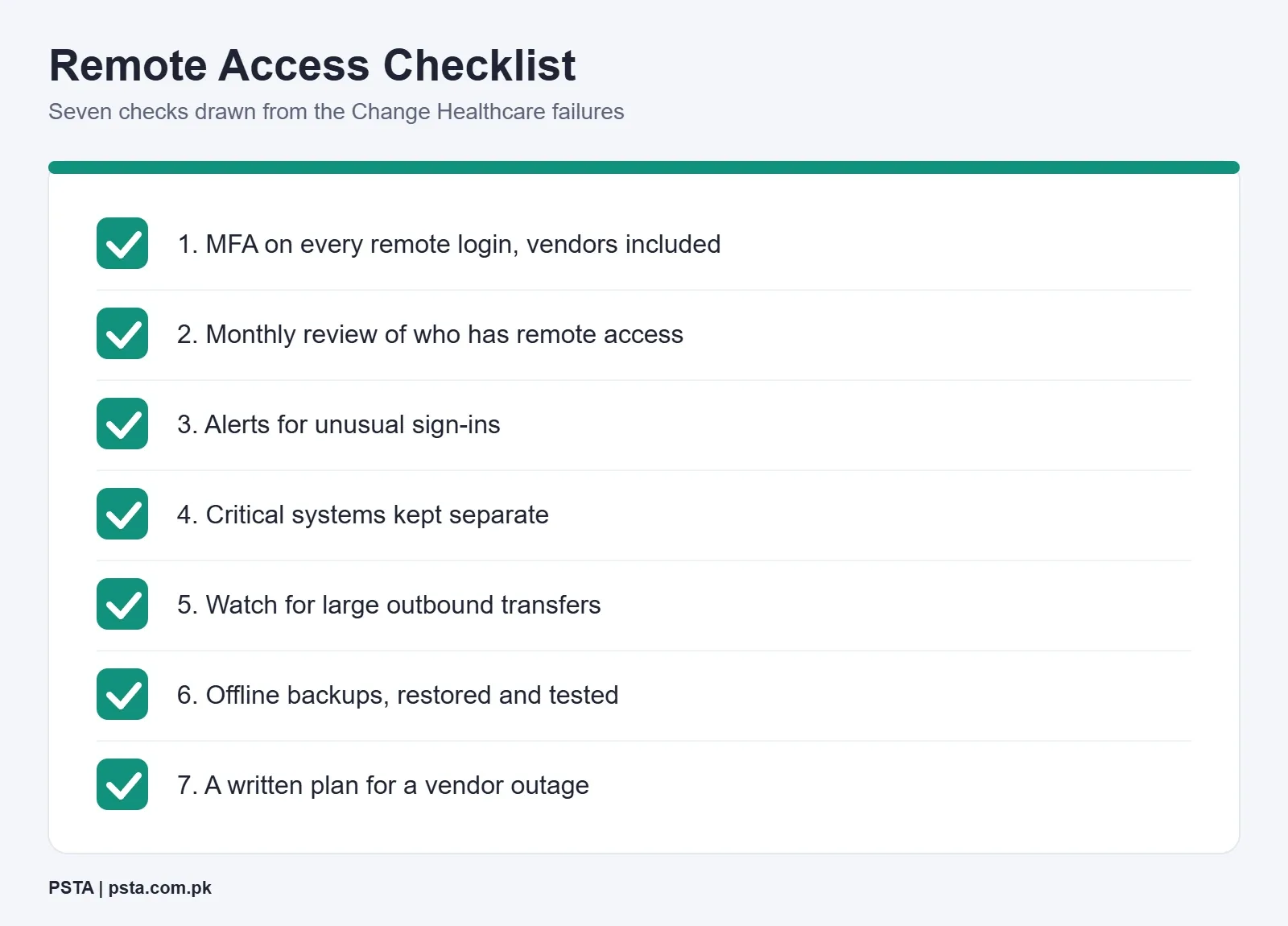
These lessons follow the failures behind the Change Healthcare hack. They suit a 20-bed hospital as well as a large billing company.
- Require multi-factor authentication on every remote login. That includes VPNs, remote desktop portals, email and vendor accounts. App-based codes or hardware keys are stronger than SMS.
- Keep a list of who has remote access. Review it every month and remove ex-staff, old vendors and unused accounts.
- Alert on unusual sign-ins. New country, new device or 3 AM access to an admin account should reach a person quickly.
- Separate critical systems. A single remote desktop should not lead straight to billing databases and backups.
- Watch for large outbound transfers. Data theft usually happens before encryption, so catching it early limits the damage.
- Keep offline, tested backups. Restore a sample regularly, and keep at least one copy that ransomware cannot reach.
- Plan for a vendor outage. Write down how you would bill, dispense or report if your main software provider went offline for a month.
The same habits appear in our earlier case studies. The Colonial Pipeline hack also traced back to one old VPN login, and the Binance hack showed how quickly stolen access turns into stolen value.
Taking Apart a Health Sector Breach in PSTA's Course
A news story tells you what broke. Piecing the timeline together from logs and notes teaches you how to spot it next time. PSTA runs its Cyber Security & Ethical Hacking course over 12 weeks at beginner level, live online across Pakistan or on campus in Abbottabad.
The course page lists modules on core principles such as the CIA triad and risk, common attacks including phishing and social engineering, network defenses like firewalls, VPNs and intrusion detection, malware and threat detection, and digital forensics with Pakistan's cyber laws. One lab asks you to investigate an incident, preserve evidence and write a timeline, which is the same skill the Change Healthcare hack calls for. The course ends with a case-study project.
Students who finish the foundations can move on to Advanced Ethical Hacking and Penetration Testing, a course on authorized testing that teaches you to find weak remote access before criminals do. Planning an exam? Our beginner certification guide lists the usual first steps. To ask about the next batch, message PSTA on WhatsApp at +92 314 5424399.
Audit One Remote Login Before Monday
Pick one system your office reaches from outside: email, a VPN, a hospital information system or a vendor portal. Sign in as a normal user and check whether it asks for a second factor. If it does not, ask your IT lead what it would take to switch it on this month. That one check is the lesson of the Change Healthcare hack in practical form.
Frequently asked questions
How did hackers get into Change Healthcare?
According to UnitedHealth Group CEO Andrew Witty's testimony to Congress, attackers used compromised credentials to sign in to a Citrix remote-access portal on February 12, 2024. The portal did not require multi-factor authentication, so the stolen username and password were enough. The testimony does not explain how the credentials were stolen in the first place.
Did UnitedHealth pay the ransom?
Yes. Andrew Witty confirmed to US senators on May 1, 2024 that the company paid a $22 million ransom and said the decision was his. Payment did not end the problem. The affiliate later said ALPHV kept the money, and a second group, RansomHub, claimed to hold the stolen data and listed the company on its leak site.
How many people were affected by the Change Healthcare breach?
The HHS Office for Civil Rights FAQ shows the count rising over time. Change filed with a placeholder of 500 in July 2024, reported about 190 million people in January 2025, and about 192.7 million on July 31, 2025. The October 2024 figure of 100 million counted notices sent, not total people affected.
Who was behind the Change Healthcare cyberattack?
The ransomware was ALPHV, also called BlackCat, a ransomware-as-a-service operation named in the CEO's testimony. An affiliate, not the core group, carried out the intrusion. That person's identity has not been publicly confirmed, and analysts treat links between the affiliate and the later RansomHub extortion as likely rather than proven.
How much did the attack cost UnitedHealth Group?
Healthcare Dive reported that UnitedHealth Group put its 2024 costs at $3.1 billion when it released fourth-quarter results in January 2025. Earlier estimates were lower: up to $1.6 billion in April 2024 and about $2.87 billion in October. The company also advanced more than $6.5 billion in payments and loans to providers by late April 2024.
Could multi-factor authentication have stopped the attack?
It would have removed the easiest path. With a second factor such as an authenticator app or hardware key, a stolen password alone would not have opened the Citrix portal. Attackers sometimes try other tricks, such as prompt flooding or phishing for codes, so MFA works best alongside sign-in alerts, access reviews and network separation.
Is a hospital in Pakistan likely to face a similar attack?
Any organization that allows remote access to patient systems faces the same basic risk. Pakistan has already seen ransomware hit K-Electric and an attack on FBR's data center. Clinics, labs and billing firms that serve foreign clients should check remote logins, backups and vendor access now rather than after an incident.
Sources & references
- UnitedHealth Group CEO Andrew Witty, written testimony to the Senate Finance Committee finance.senate.gov
- HHS OCR: Change Healthcare Cybersecurity Incident FAQs hhs.gov
- US DOJ: Justice Department Disrupts Prolific ALPHV/Blackcat Ransomware Variant justice.gov
- The Register: UnitedHealth CEO on the ransom and missing MFA theregister.com
- Healthcare Dive: UnitedHealth 2024 results and cyberattack costs healthcaredive.com
- Healthcare IT News: State Department offers $10M reward for info on BlackCat healthcareitnews.com
- SentinelOne: How cheated affiliates are recycling victim data sentinelone.com
- Becker's: Nebraska AG's lawsuit over Change Healthcare breach moves forward beckershospitalreview.com
Last reviewed & updated on by Umar Qureshi. Written by the PSTA team in Abbottabad, Pakistan.

Umar Qureshi
Cyber Security & Ethical Hacking Course in Abbottabad - PSTA
Turn this guide into a career: hands-on training with real projects, online across Pakistan or on-campus in Abbottabad · 12 Weeks.
Comments
No comments yet — ask a question or share your experience.