Quick answer
To become a SOC analyst, learn networking, Windows and Linux logs, common attacks, one SIEM and incident response, in that order. Build a home lab, write three investigation reports and take one entry certification such as Security+ SY0-801. Expect roughly 6 to 18 months, depending on your starting point.
Key takeaways
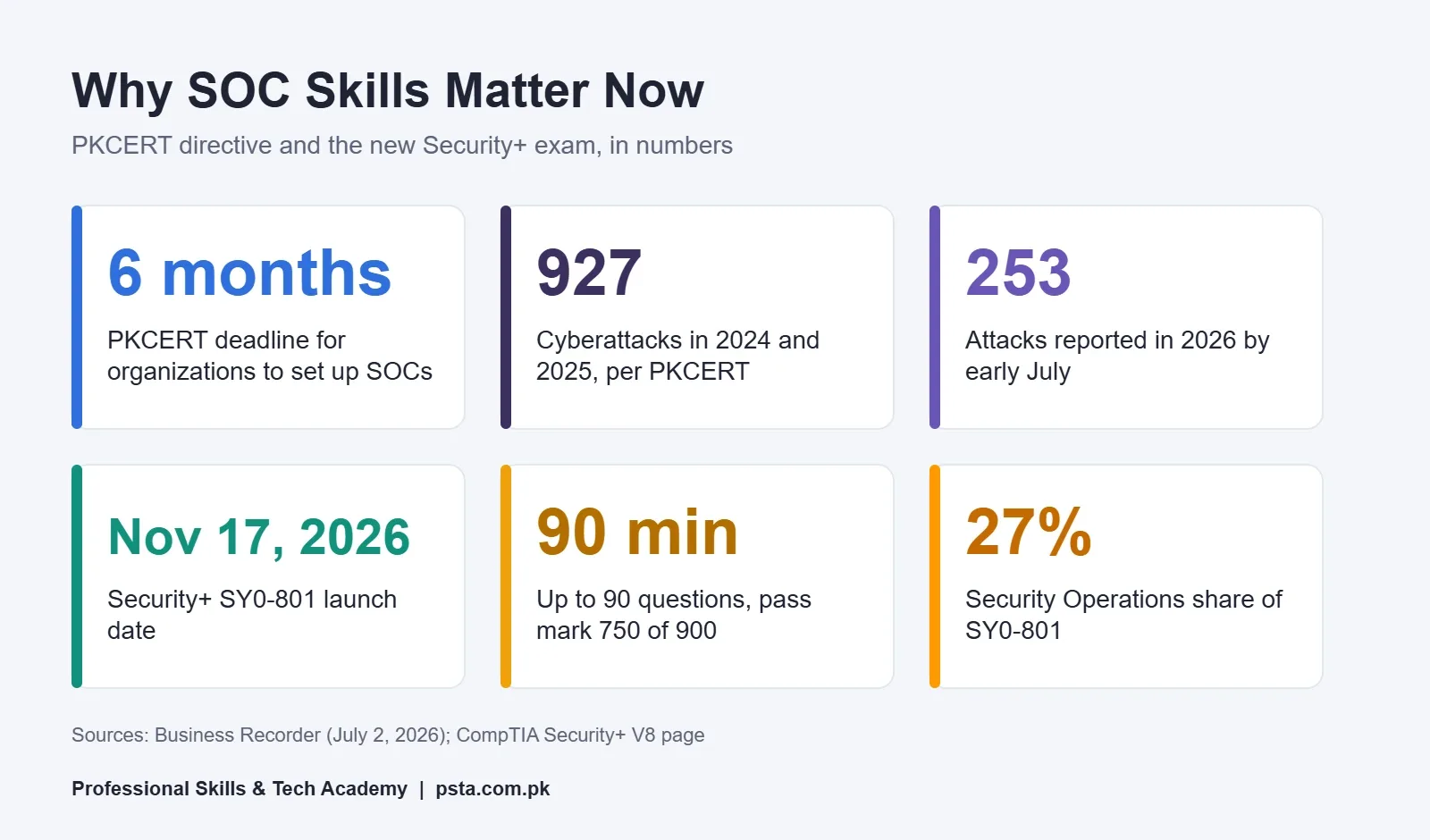
- • PKCERT told Pakistani organizations in July 2026 to set up SOCs within six months, so entry-level defensive skills are in demand.
- • Learn in order: networking, logs, attacks, one SIEM, incident response, then portfolio and certification.
- • Memorize Windows event IDs 4624, 4625, 4688, 4698 and 7045 and practice spotting suspicious patterns.
- • Security+ V8 (SY0-801) launched on November 17, 2026; check its new objectives before you book.
- • Three written lab investigations often say more to an employer than extra certificates.
Table of contents 18 sections
- What Does a SOC Analyst Actually Do All Day?
- Why Pakistan Needs More SOC Analysts in 2026
- SOC Analyst Roadmap: Six Stages From Beginner to Tier 1
- Stage 1: Networking Basics
- Stage 2: Windows and Linux Logs
- Stage 3: Attack Knowledge
- Stage 4: One SIEM, Learned Properly
- Stage 5: Incident Response Process
- Stage 6: Portfolio, Certification and Applications
- How Long Does It Take to Become a SOC Analyst?
- Which Logs and Event IDs Should You Learn First?
- How a Tier 1 Analyst Handles One Alert
- Which Certification Should a SOC Beginner Take First?
- A Home Lab and Portfolio That Gets Interviews
- Where Are SOC Analyst Jobs in Pakistan?
- Mistakes That Slow SOC Beginners Down
- Building SOC Skills at PSTA
- This Weekend: Find Your Own Failed Logins
Can you get a SOC analyst job in Pakistan without a computer science degree? In most cases, yes, if you follow a SOC analyst roadmap that produces proof of skill instead of a stack of certificates. A Tier 1 analyst is hired to read logs, judge whether an alert is real and write a short, clear note about it. You can practice all three at home, on a normal laptop, before anyone hires you.
This SOC analyst roadmap covers:
- What a security operations center analyst does on an ordinary shift
- Why demand for SOC staff in Pakistan is rising in 2026
- Six stages to learn, in order, with realistic time estimates
- Which first certification fits a SOC role now that Security+ has a new version
- A home lab and portfolio plan that gives you something real to show in interviews
What Does a SOC Analyst Actually Do All Day?
A security operations center (SOC) is the team that watches an organization's systems for signs of attack. Logs from laptops, servers, firewalls and cloud accounts flow into a SIEM (security information and event management) tool. The SIEM runs detection rules and raises alerts when something looks wrong.
A Tier 1 analyst sits at the front of that pipeline. On a typical shift you will:
- Open new alerts in the queue and decide which ones need attention first.
- Check the evidence behind each alert, such as the user, the device, the IP address and the time.
- Look up suspicious files, domains or IPs in threat intelligence sources.
- Close false alarms with a short reason, or escalate real incidents to Tier 2.
- Write ticket notes that the next shift can understand without calling you.
Tier 2 and Tier 3 staff handle deeper investigation, threat hunting and tuning of detection rules. Most people start at Tier 1, and that is the target of this roadmap.
Why Pakistan Needs More SOC Analysts in 2026
The clearest signal came in July 2026. Business Recorder reported that the National Cyber Emergency Response Team (PKCERT) had directed public and private sector organizations to set up fully operational SOCs within six months. The report quoted PKCERT's director general citing 927 cyberattacks across 2024 and 2025, and 253 more reported so far in 2026.
The same report said regulators including SBP, SECP, NEPRA, OGRA, HEC and CAA are deploying sector-level CERTs. Every one of those SOCs and CERTs needs people to watch the screens, triage alerts and keep records. Banks, telecom operators, power companies and large software houses are the obvious employers, and many smaller firms will rent a SOC from a managed security provider instead of building one.
A directive does not create jobs overnight, and some organizations will move slowly. Still, the direction is clear: entry-level defensive skills are becoming a requirement, not a nice extra.
SOC Analyst Roadmap: Six Stages From Beginner to Tier 1
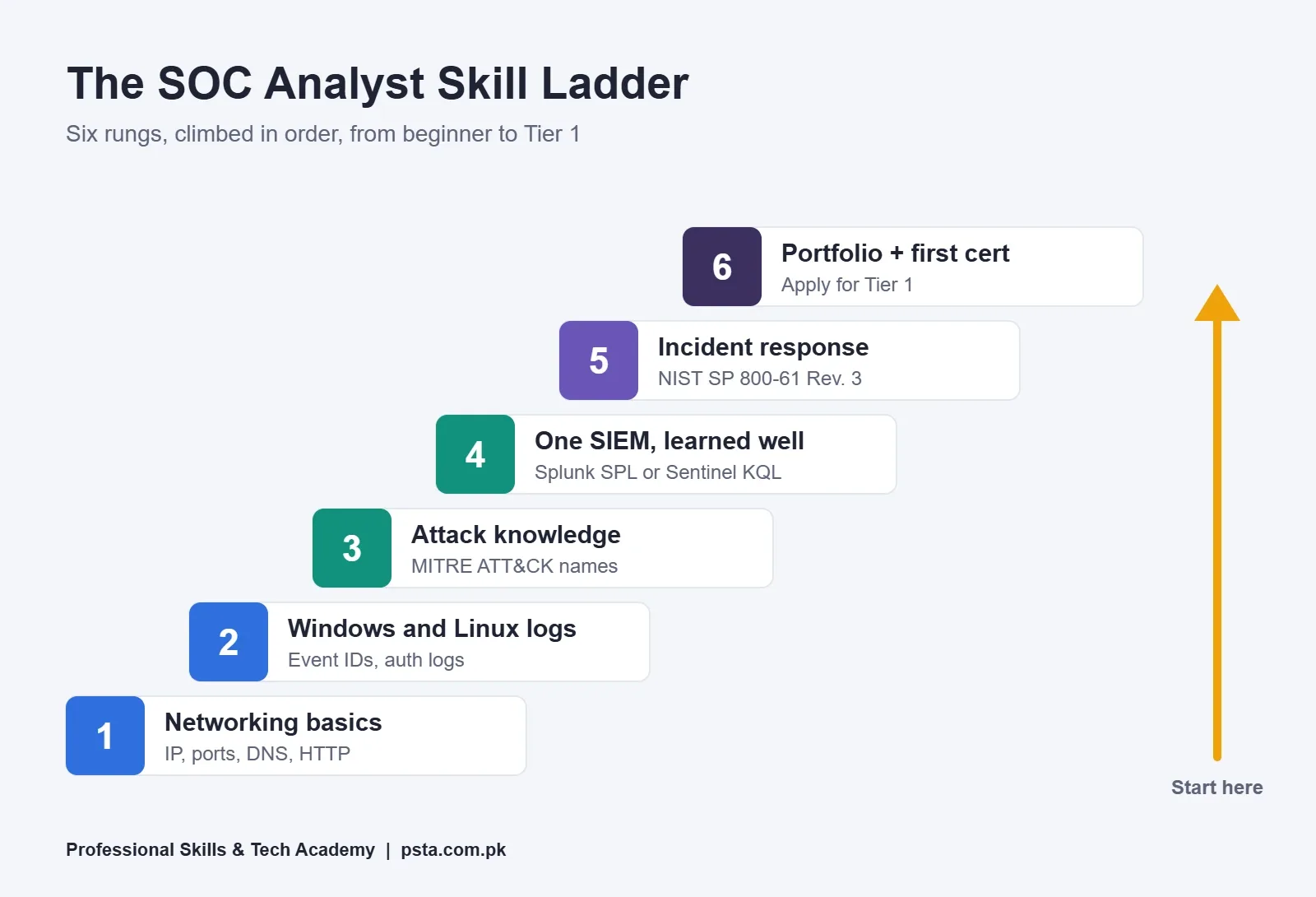
Learn the stages of this SOC analyst roadmap in order. Each one builds on the last, and skipping the early ones is the main reason beginners get stuck on SIEM queries they cannot interpret.
Stage 1: Networking Basics
Understand IP addresses, ports, DNS, HTTP and how a TCP connection starts. You should be able to look at a firewall log line and say which machine talked to which, on what port. Capturing your own traffic with Wireshark is the fastest way to make this stick; our Wireshark guide for beginners walks through a first capture.
Stage 2: Windows and Linux Logs
Most alerts you see will trace back to a Windows event log or a Linux auth log. Learn where these logs live, what a normal login looks like and what changes when someone guesses passwords. The table in the next section lists the Windows event IDs worth memorizing.
Stage 3: Attack Knowledge
You can't spot an attack you have never seen described. Study phishing, credential stuffing, malware delivery and privilege escalation. The MITRE ATT&CK framework gives each attacker technique a name and ID, which makes your notes precise and searchable.
Stage 4: One SIEM, Learned Properly
Pick one SIEM and learn to search it well. Splunk and Microsoft Sentinel are the two names you will see most often in job ads. A useful starting point for SIEM for beginners is Splunk's free training page, which lists "Intro to Splunk" and "Using Fields" as no-cost starting courses. Sentinel uses KQL, the query language Microsoft also uses across its security tools.
Stage 5: Incident Response Process
Learn the shape of a proper response: prepare, detect, analyze, contain, recover and learn. NIST published SP 800-61 Revision 3 in April 2025, replacing the 2012 version and tying incident response to the Cybersecurity Framework 2.0. You don't need to read all of it, but its vocabulary is what senior staff will use with you.
Stage 6: Portfolio, Certification and Applications
This is where the SOC analyst roadmap turns into a job search. Write up your lab investigations, take one entry-level certification and start applying. This stage overlaps with stages 4 and 5; you don't have to wait until everything feels finished.
How Long Does It Take to Become a SOC Analyst?
The time a SOC analyst roadmap takes depends heavily on where you start. A TryHackMe learning path published in May 2026 estimates 9 to 18 months to reach job-ready for someone with no IT background, and 6 to 12 months for someone who already works in IT. Those figures come from a training company that sells SOC courses, so treat them as a rough guide rather than a promise.
| Your Starting Point | Realistic Time to Tier 1 Readiness | Where to Spend Most of Your Time |
|---|---|---|
| No IT background (for example, after matric or FSc) | 9 to 18 months, per TryHackMe's estimate | Networking, operating systems and log basics |
| IT support, helpdesk or network admin | 6 to 12 months, per TryHackMe's estimate | Attack knowledge, SIEM searches and write-ups |
| CS or IT graduate with little hands-on work | Somewhere between the two, depending on lab practice | Home lab, one SIEM and a portfolio |
From what we see in class, consistency matters more than intensity on any SOC analyst roadmap. One focused hour a day for a year beats a two-week cram followed by nothing.
Which Logs and Event IDs Should You Learn First?
The TryHackMe path above names a short list of Windows event IDs for beginners. These five come up often in Tier 1 work, so learn what each one means and what a suspicious pattern looks like.
| Event ID | What It Records | A Pattern Worth Questioning |
|---|---|---|
| 4624 | A successful logon | A login at 3 AM from an account that only works office hours |
| 4625 | A failed logon | Dozens of failures for many usernames from one source |
| 4688 | A new process was created | Word or Excel starting PowerShell |
| 4698 | A scheduled task was created | A new task that runs an unknown script at every startup |
| 7045 | A new service was installed | A service with a random name pointing to a temp folder |
On Linux, start with authentication logs (failed SSH logins, sudo use) and web server access logs. Generate these events yourself in a lab so you know what normal looks like before you hunt for abnormal.
How a Tier 1 Analyst Handles One Alert
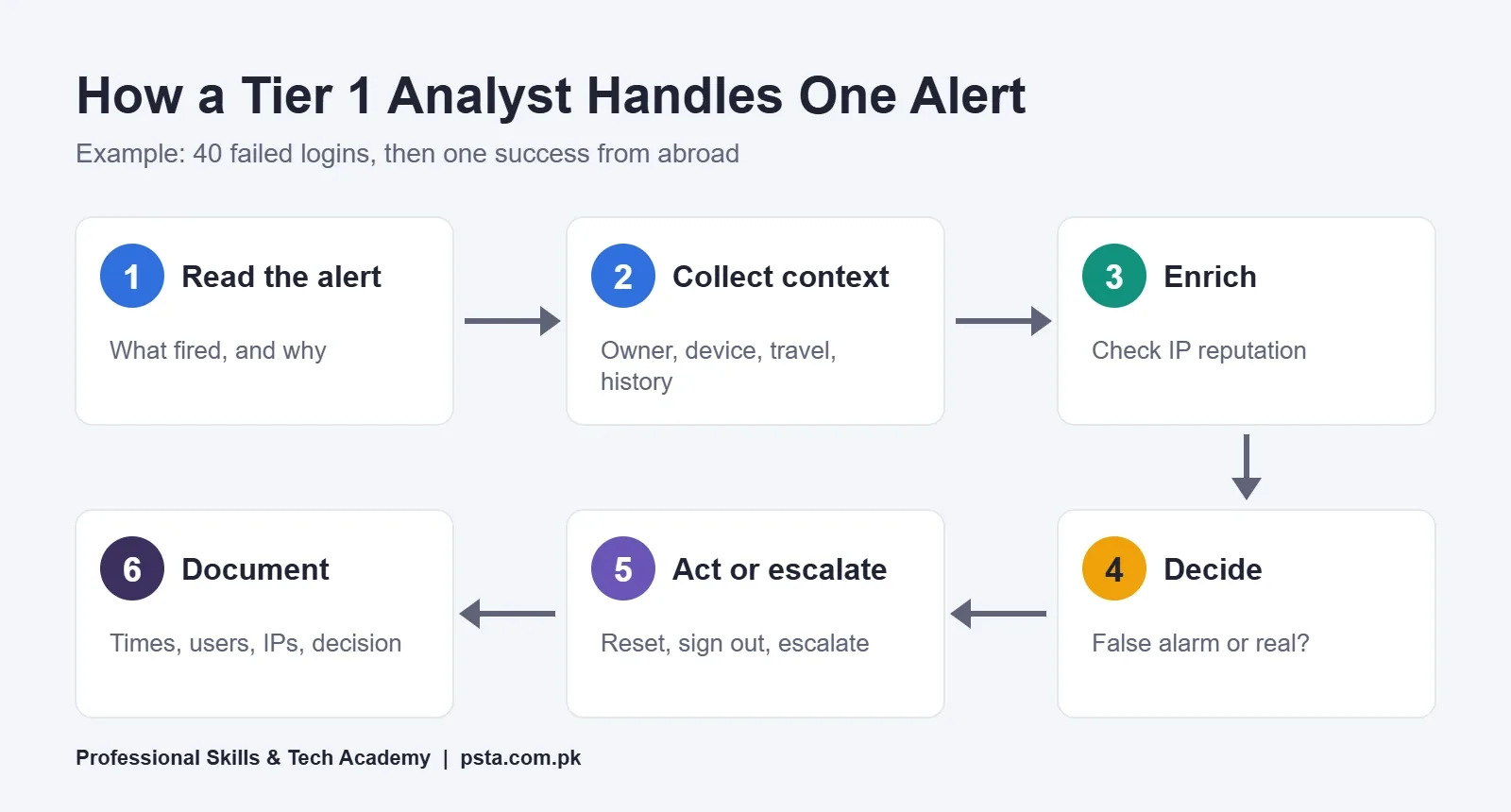
Here is a realistic example. Imagine you work night shift for a bank in Lahore, and the SIEM raises an alert: 40 failed logins for a branch manager's account, followed by one success, from an IP address outside Pakistan.
- Read the alert and its rule. Note exactly what fired and why. Don't trust the alert title alone.
- Collect context. Who owns the account? Is the manager on leave or travelling? Does this IP appear anywhere else in the logs?
- Enrich the indicators. Check the IP's reputation in a threat intelligence source and see whether other users were targeted from it.
- Decide. A travelling manager with a known VPN may be a false alarm. A first-time foreign IP after 40 failures is a likely account compromise.
- Act or escalate. Follow the playbook: in many SOCs, Tier 1 requests a password reset and session sign-out, then escalates to Tier 2.
- Document. Write what you saw, what you checked, what you decided and when. Times, usernames and IPs should be exact.
That last step separates analysts who get promoted from those who don't. A ticket that someone else can follow at 9 AM is worth more than a clever guess nobody can verify.
Which Certification Should a SOC Beginner Take First?
Of all the SOC analyst certifications on offer, one is enough to get past most HR filters for Tier 1. The timing matters in late 2026 because CompTIA has just refreshed its best-known entry exam.
| Certification | What It Covers | Best For |
|---|---|---|
| CompTIA Security+ V8 (SY0-801) | Broad security foundations; Security Operations is the largest domain at 27% | Your first recognized certificate for SOC and admin roles |
| Microsoft SC-200 | Microsoft Sentinel and Defender: operations, incident response, threat hunting | Analysts targeting employers that run Microsoft security tools |
| ISC2 Certified in Cybersecurity (CC) | Entry-level security principles | A low-pressure first step; check current pricing on ISC2's site |
According to CompTIA's Security+ V8 page, Security+ SY0-801 launched on November 17, 2026. It has a maximum of 90 questions, a 90-minute limit and a passing score of 750 on a 100 to 900 scale. If you started studying from older SY0-701 material, compare the new objectives before you book.
Microsoft's SC-200 study guide lists three skill areas: managing a security operations environment (40 to 45%), responding to incidents (35 to 40%) and threat hunting (20 to 25%). It is more hands-on with specific tools, so it fits better after you have some SIEM practice.
ISC2 has announced the conclusion of its One Million Certified in Cybersecurity program, which offered free CC training and exams. Don't plan around a free voucher unless ISC2's own page still shows one. For a wider comparison of beginner certificates, see our cyber security certifications guide.
A Home Lab and Portfolio That Gets Interviews
A certificate says you studied. A portfolio shows you can do the job, which is the real goal of any SOC analyst roadmap. Build a small lab with two or three virtual machines: one Windows machine generating logs, one Linux machine, and a free SIEM instance collecting both. Our lab setup guide covers the virtual machine side.
Then run small, safe scenarios against your own machines and investigate them:
- Brute-force a local account with wrong passwords and find the 4625 events.
- Create a scheduled task that runs a harmless script and trace it through 4698 and 4688.
- Scan your lab with Nmap and see what the firewall logs record; our Nmap commands guide helps here.
Write each one up in a page: what happened, which logs showed it, the query you used, and what you would recommend. Three clean write-ups on GitHub or a simple blog give an interviewer something concrete to ask about. More ideas are in our list of cyber security projects for beginners.
Where Are SOC Analyst Jobs in Pakistan?
Look in four places. Banks and microfinance institutions run their own SOCs or rent one. Telecom and internet providers monitor large networks around the clock. Managed security service providers in Islamabad, Lahore and Karachi run SOCs for many clients at once, and they hire more juniors than anyone else. Large software houses with foreign clients often need staff who understand compliance and monitoring.
Search job boards and LinkedIn for "SOC analyst", "security analyst L1", "NOC/SOC engineer" and "information security officer". Read ten ads and list the tools they repeat; that list tells you which SIEM to learn first.
On pay, public salary data for this role in Pakistan is thin. PayScale's entry-level page for cyber security analysts rests on about 20 profiles last updated in 2023, which is too small and too old to plan around. Before you commit to a SOC analyst roadmap for the money, look at real offers. Your best evidence is the salary range printed in current job ads and what people in the role tell you directly. Expect night and weekend shifts in your first role, because SOCs run 24/7.
Mistakes That Slow SOC Beginners Down
These are the detours we see most often when students follow a SOC analyst roadmap on their own.
- Collecting certificates instead of skills. Three certificates and no lab work is a weaker profile than one certificate and three investigations.
- Jumping straight into hacking tools. Offensive tools are fun, but a SOC job is mostly reading and judging evidence.
- Learning five SIEMs at a surface level. Learn one deeply. The concepts transfer.
- Weak written English. Your tickets are read by managers and auditors. Short, exact sentences matter.
- Testing on systems you don't own. Unauthorized access can be an offense under PECA. Keep all practice inside your own lab.
Building SOC Skills at PSTA
Our Cyber Security Course for Beginners follows the defender's side of this roadmap. The course lasts 12 weeks, needs no prior security background, and its page currently lists the fee as Rs. 45,000. You can study on campus in Abbottabad or join live classes online from any city.
The seven modules move from security fundamentals and common attacks through network defenses (firewalls, VPNs and intrusion detection), malware analysis and incident response, digital forensics and PECA, and a final case-study project. That maps closely onto stages 1 to 5 of the SOC analyst roadmap above. Students who later want the attacker's view can continue with the Advanced Ethical Hacking and Penetration Testing Course.
If your networking or computer basics are shaky, start with the DIT diploma first. You can compare options on the courses page, apply through online admission, or ask about the next batch on WhatsApp at +92 314 5424399.
This Weekend: Find Your Own Failed Logins
Before you buy a course or book an exam, do one small test. Open Event Viewer on your own Windows laptop, lock the screen, and type a wrong password five times. Then find those 4625 events in the Security log and write three sentences describing what you see. If that exercise feels interesting rather than tedious, SOC work will probably suit you, and the rest of this SOC analyst roadmap is a matter of steady practice.
Frequently asked questions
Can I become a SOC analyst in Pakistan without a degree?
Yes, many Tier 1 roles care more about practical skill than the degree title. Some banks and government bodies still list a degree as a requirement, so check each ad. Without one, a recognized certificate such as Security+ and two or three written lab investigations become even more important, because they are your evidence that you can do the work.
Do SOC analysts need to know programming?
Not at Tier 1. You will write search queries in a SIEM language such as Splunk's SPL or Microsoft's KQL, and read simple scripts during investigations. Basic Python or PowerShell helps later when you automate repetitive checks or move to Tier 2, so it is worth starting once your log and networking basics feel solid.
Should I study for Security+ SY0-701 or SY0-801?
SY0-801, the V8 exam, launched on November 17, 2026, so new learners should usually study its objectives. If you are already close to ready on SY0-701 material, check CompTIA's site for how long the older exam remains available before deciding. Either way, book only after comparing the official objectives with what you have studied.
What is the difference between a SOC analyst and an ethical hacker?
A SOC analyst defends: watching logs, judging alerts and responding to incidents as they happen. An ethical hacker or penetration tester attacks systems with permission to find weaknesses before criminals do. Both need networking and attack knowledge, but daily work differs. Many people start in the SOC and move to offensive roles later, or the other way around.
Is a SOC job a good choice for freshers in Pakistan?
It can be, especially with PKCERT pushing organizations to set up SOCs. The trade-offs are real: Tier 1 work involves shifts, including nights and weekends, and a lot of repetitive triage. Freshers who enjoy careful reading and clear writing tend to do well and can move toward incident response, threat hunting or engineering within a few years.
Can I prepare for a SOC role from a small city?
Yes. Everything in this roadmap, from networking basics to a home lab and SIEM practice, works on a decent laptop with an internet connection. Many SOC teams in Islamabad, Lahore and Karachi also hire for hybrid or remote shifts, and online classes let you learn with an instructor without moving cities before you have a job.
How much RAM do I need for a SOC home lab?
There is no fixed number, because it depends on how many virtual machines and which SIEM you run at once. A practical approach is to start with one Windows virtual machine and a lightweight log collector, then add machines as your laptop allows. Check each tool's official system requirements before installing so your lab stays stable.
Sources & references
- Cyber defence: Public, private entities told to set up SOCs in 6 months (Business Recorder) brecorder.com
- Security+ Certification V8 (CompTIA) comptia.org
- Study guide for Exam SC-200: Microsoft Security Operations Analyst (Microsoft Learn) learn.microsoft.com
- SP 800-61 Rev. 3, Incident Response Recommendations (NIST) csrc.nist.gov
- Complete SOC Analyst Learning Path 2026 (TryHackMe) tryhackme.com
- Splunk free training courses (Splunk) splunk.com
- One Million Certified in Cybersecurity conclusion (ISC2) isc2.org
Last reviewed & updated on by Umar Qureshi. Written by the PSTA team in Abbottabad, Pakistan.

Umar Qureshi
Cyber Security & Ethical Hacking Course in Abbottabad - PSTA
Turn this guide into a career: hands-on training with real projects, online across Pakistan or on-campus in Abbottabad · 12 Weeks.

Comments
No comments yet — ask a question or share your experience.