Quick answer
On February 21, 2025, attackers took about $1.5 billion in Ether from Bybit's cold wallet. They planted code on Safe{Wallet}'s website, so signers approved a transfer that looked routine but handed over control. The FBI blamed North Korea's TraderTraitor. Bybit kept withdrawals open and replaced the Ether within days.
Key takeaways
- • Attackers never cracked Bybit's keys; they changed what the signers saw on screen.
- • The entry point was one infected Safe{Wallet} developer laptop and its live cloud sessions.
- • The FBI publicly attributed the theft to North Korea's TraderTraitor activity on February 26, 2025.
- • By March 4, Bybit said 77% of funds were traceable and only 3% were frozen.
- • Verify transactions on a second device and cap how much any single transfer can move.
Table of contents 18 sections
- What Was the Bybit Hack?
- Bybit Hack Timeline in Pakistan Time
- How Did the Attackers Trick the Signers?
- Where Did It Start?
- Five Things That Went Wrong
- 1. One Developer Laptop Held Too Much Power
- 2. Active Sessions Outlived Their Welcome
- 3. Front-End Files Changed Without an Alarm
- 4. Signers Trusted the Screen
- 5. Too Much Sat in One Wallet
- Where Did $1.5 Billion Go After the Theft?
- Who Was Blamed, and How Sure Are Investigators?
- What Happened Next: Withdrawals, Loans and Bounties
- Bybit and Binance: The Same Pattern Twice
- What the Bybit Hack Means for Crypto Users in Pakistan
- Defensive Lessons for Exchanges and Security Teams
- Turning Case Studies Like Bybit Into Practical Skills at PSTA
- Before You Sign Anything Again
A popular myth says crypto kept in a cold wallet is out of a hacker's reach. The Bybit hack of February 21, 2025 shows why that belief is only half true. No one cracked Bybit's offline keys. Yet attackers still walked away with about $1.5 billion in Ethereum, according to the FBI. The weak point was the screen the signers trusted, not the vault itself.
This case study looks at the incident as a chain of mistakes. Each link could have broken the attack, and each one teaches something you can use. The sections below cover:
- Key dates in Pakistan time, from the first laptop infection to the FBI's statement
- A plain-language account of how signers approved a transfer they could not see
- Five things that went wrong, and which ones were Bybit's to control
- Who was blamed, and how much of that blame is confirmed
- Practical lessons for crypto users and security teams in Pakistan
What Was the Bybit Hack?
Bybit is a large crypto exchange based in Dubai. A Reuters report carried by Insurance Journal said it handled more than $36 billion in average daily trading volume. Citing CoinMarketCap data, it put Bybit's assets at about $16.2 billion before the theft. The stolen Ether equaled roughly 9% of those assets.
On February 21, 2025, Bybit was moving Ether from its multisig cold wallet to a hot wallet. A multisig wallet needs several authorized people, called signers, to approve each transaction. This was a routine job. During that transfer, control of the cold wallet passed to the attacker.
The Hacker News reported that Bybit spotted unauthorized activity around 12:30 PM UTC. More than 400,000 ETH and stETH, worth over $1.5 billion, went to an unknown address. Elliptic, quoted by Reuters, called it the largest crypto theft on record, well above the $611 million taken from Poly Network in 2021.
Bybit Hack Timeline in Pakistan Time
Pakistan Standard Time is five hours ahead of UTC. Where a source gave only a date, the table shows the date alone.
| Date (PKT) | What happened | Source |
|---|---|---|
| Feb 4, 2025 | A Safe{Wallet} developer's Mac is infected after the developer runs a Docker project, likely sent through social engineering | Safe{Wallet} and Mandiant, via The Hacker News |
| Feb 19, 2025 | Malicious JavaScript appears on the Safe{Wallet} website and stays for about two days | Safe{Wallet}, via The Hacker News |
| Feb 21, around 5:30 PM | Bybit detects unauthorized activity during a routine cold-to-hot wallet transfer | Bybit, via The Hacker News |
| Feb 21, minutes later | Clean JavaScript files are put back on Safe's server about two minutes after the theft | Sygnia, via The Block |
| Feb 21 to 22 | Elliptic, Arkham and TRM Labs link the theft to North Korea's Lazarus Group | The Hacker News |
| Feb 22 to 24 | Withdrawals top $5.3 billion within a day; Bybit CEO Ben Zhou says the ETH gap is closed | Decrypt |
| Feb 26, 2025 | The FBI names North Korea as responsible and lists 51 Ethereum addresses | FBI IC3 |
| Mar 4, 2025 | Zhou says 77% of funds remain traceable, 20% have gone dark and 3% are frozen | The Block |
How Did the Attackers Trick the Signers?
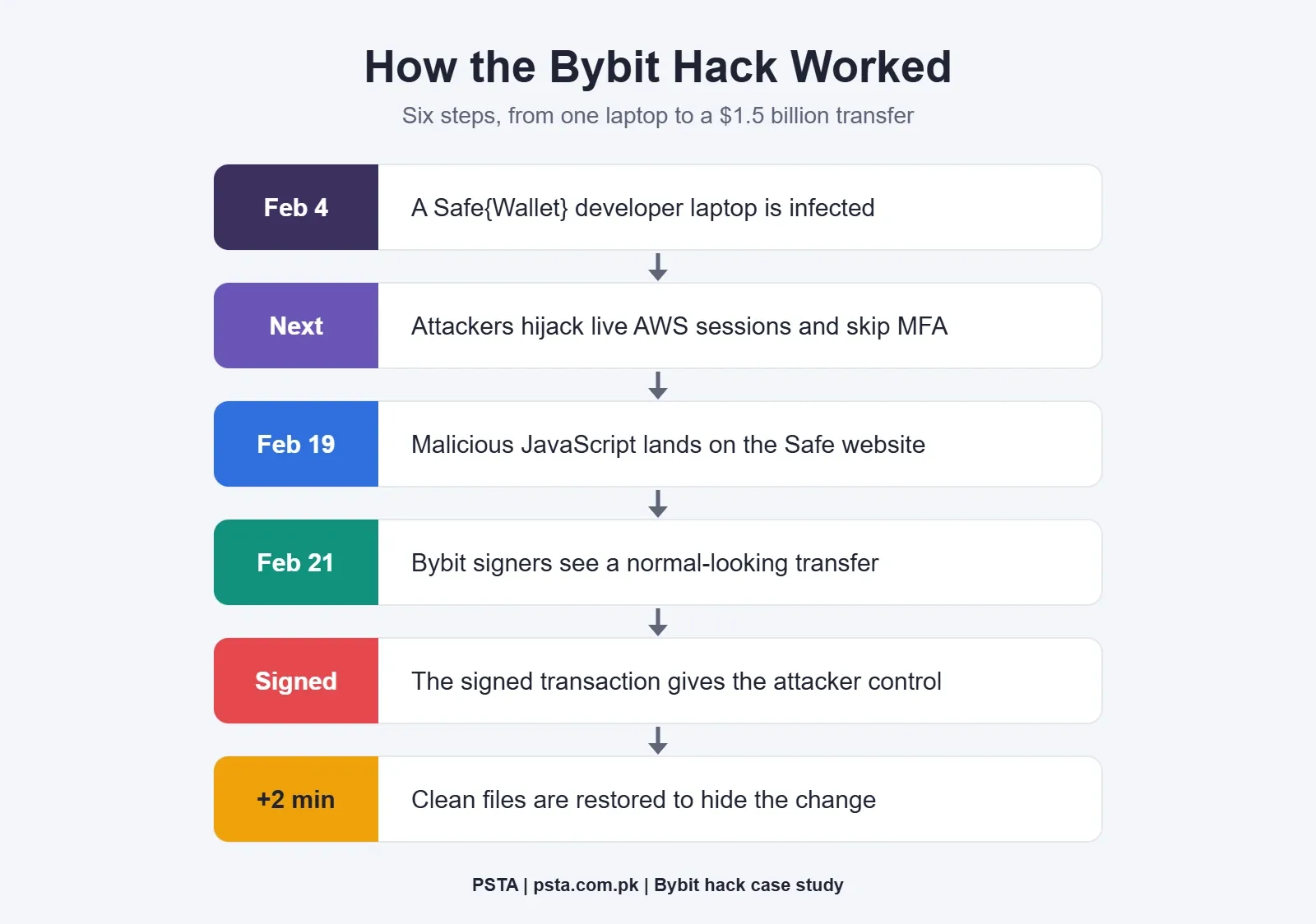
This is the heart of the Bybit hack explained in simple terms. Bybit used Safe{Wallet}, a popular service for running a multisig wallet. When signers approve a transfer, they open Safe's web interface, check the details on screen and sign with their devices.
According to Sygnia's initial findings, reported by The Block, the attackers placed malicious code in Safe's cloud storage, which served the website's JavaScript. The code stayed quiet for everyone else. It only switched on when the transaction came from Bybit's wallet address or one other address.
When Bybit's signers opened the page, their browsers loaded and cached that code. The screen showed what looked like a normal transfer. Underneath, the transaction they signed changed the wallet's logic and handed control to the attacker. Bybit described this as a masked signing interface that showed the correct address while the smart contract logic was altered.
Sygnia found the code on every machine used to start and sign the transfer. It also said its review so far had found no compromise of Bybit's own infrastructure. Two minutes after the theft, the attacker replaced the files with clean copies to hide the trail.
Where Did It Start?
Safe's own review, carried out with Google Cloud's Mandiant and reported by The Hacker News, traced the start to one developer's laptop. That developer was among the few staff with higher access. The attackers used the infected machine to take over the developer's active AWS sessions, which let them skip multi-factor authentication. They then cleared logs and removed their malware.
This is a classic supply chain attack. The target was Bybit, but the door was a trusted supplier. Bybit could have had perfect passwords and still been hit, because the tool its signers relied on had been changed behind their backs.
Five Things That Went Wrong
A "what went wrong" review is not about blaming one person. It looks for the controls that failed in sequence. Based on the sources above, five links in the Bybit hack chain stand out.
1. One Developer Laptop Held Too Much Power
A single infected machine gave access to the cloud storage that served a site used by large crypto holders. Access to production systems should not rest on one personal device.
2. Active Sessions Outlived Their Welcome
Multi-factor authentication only protects the login. Once the attackers held a live session token, MFA no longer stood in the way. Safe's post-mortem, as reported by The Hacker News, says the attackers hijacked those sessions and timed their actions to the developer's working hours.
3. Front-End Files Changed Without an Alarm
The malicious JavaScript sat on the live site for about two days. A simple file integrity check, comparing what is served with what was approved, might have flagged the change much sooner.
4. Signers Trusted the Screen
Every signer saw a normal-looking transfer. That is the danger of "blind signing": approving a transaction based on a summary instead of the raw data. Several signers checking the same faked screen add no real safety, because they all see the same lie.
5. Too Much Sat in One Wallet
One cold wallet held about 9% of the exchange's assets, by Reuters' estimate. Spreading funds across more wallets would have reduced the damage of one bad signature. So would a cap on how much any single transfer can move.
Where Did $1.5 Billion Go After the Theft?
The attacker moved fast. Elliptic told The Hacker News that the funds were split across about 50 wallets within two hours. More than $75 million then passed through the eXch service and was converted to Bitcoin. eXch denies laundering for Lazarus.
By March 4, Ben Zhou said 83% of the stolen Ether had been converted to Bitcoin across 6,954 wallets, according to The Block. The same report said 72% of the moved funds went through THORChain, a cross-chain swap protocol, and about 16% went through eXch.
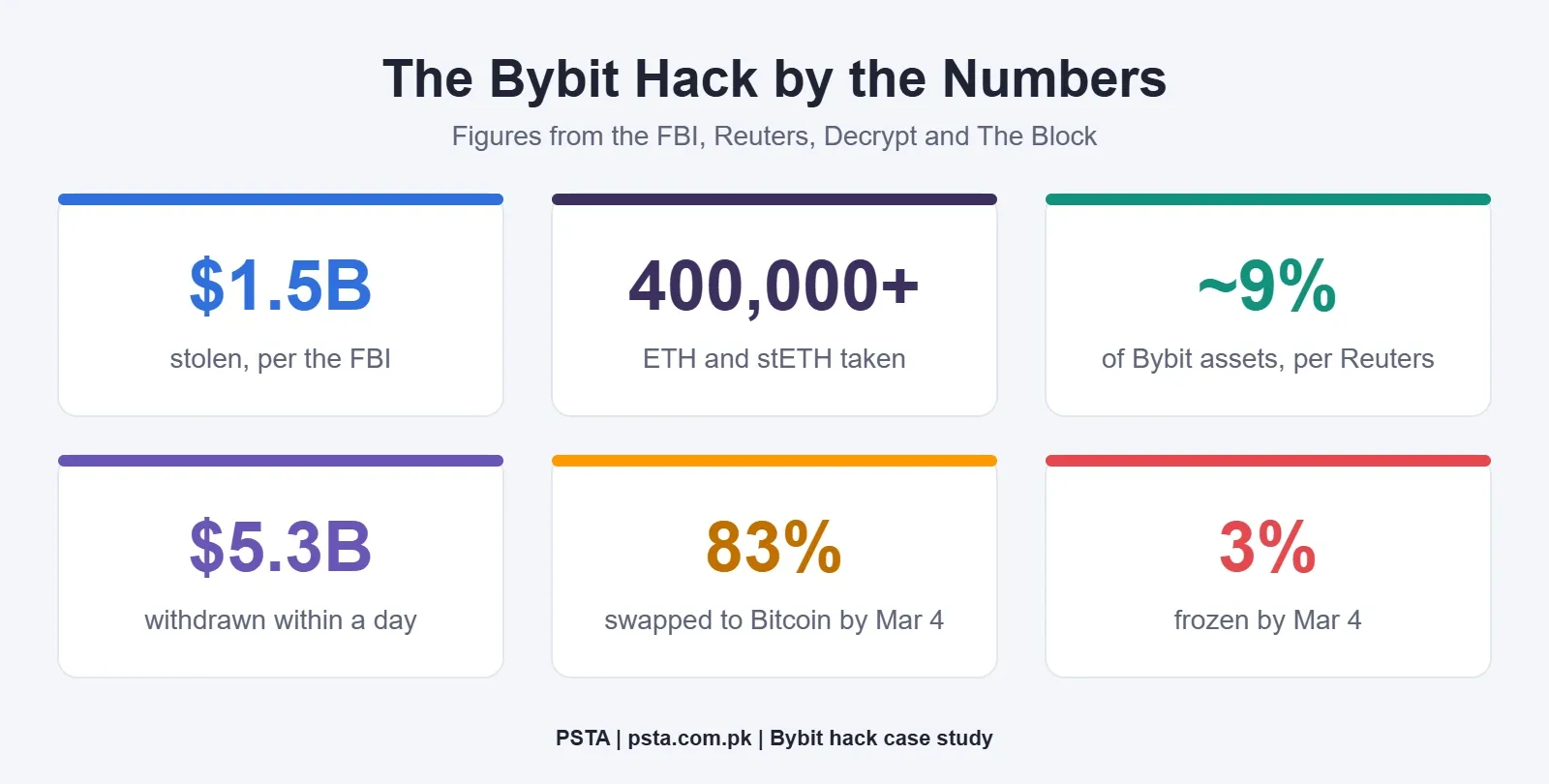
Note the small gap between figures. The FBI and Bybit used about $1.5 billion, while some trackers quoted around $1.4 billion. The difference most likely comes from Ether's price, which fell after the theft. It also depends on how staked tokens like stETH are valued.
Who Was Blamed, and How Sure Are Investigators?
Attribution in cyber security comes in levels. A government statement carries more weight than an analyst's tweet. Here is how the claims about this North Korea crypto hack line up, from strongest to weakest.
| Who said it | What they said | How strong |
|---|---|---|
| FBI (IC3 alert, Feb 26, 2025) | North Korea was responsible; the FBI calls the activity "TraderTraitor" | Official government attribution |
| Safe{Wallet} with Mandiant | The attack came from TraderTraitor, also tracked as UNC4899 and Jade Sleet | Forensic review by the affected supplier |
| TRM Labs | Lazarus Group, with high confidence, citing overlaps with earlier hacks | Blockchain analytics |
| Elliptic, Arkham, ZachXBT | On-chain links to Lazarus and to the earlier Phemex hack | Blockchain analytics and independent research |
The confirmed facts are the theft, the amount, the method described by Sygnia and Safe, and the FBI's public attribution. The deeper details of who inside North Korea's program did what come from analysts. Treat those as well-supported claims, not court findings. In the sources reviewed for this article, we found no arrests or charges tied to the Bybit hack.
What Happened Next: Withdrawals, Loans and Bounties
Bybit's response is worth studying as a lesson in crisis handling. Zhou kept withdrawals open. In a livestream reported by Reuters, he said Bybit had processed more than 70% of withdrawal requests. He added that bridge loans from partners already covered about 80% of the loss.
Decrypt reported that withdrawals topped $5.3 billion within a day. On February 24, Zhou said Bybit had "fully closed the ETH gap." Lookonchain data cited by Decrypt put Bybit's purchases, loans and deposits at about 446,870 ETH, worth around $1.23 billion.
Bybit also offered a reward: 10% of any recovered funds, and 5% for exchanges and mixers that freeze them, according to The Block. Frozen amounts stayed small. By March 4, Zhou put the frozen share at about 3%.
Bybit and Binance: The Same Pattern Twice
If you read our Binance hack explainer, the pattern will look familiar. That October 2026 theft also began with a compromised engineer's laptop, and analysts again pointed to TraderTraitor. In both cases, the attackers did not break the cryptography. They went after the people and tools around the keys.
For students, this is the key point. Cold wallet security is about more than keeping keys offline. It covers the laptops, browsers, cloud accounts and suppliers that touch every transaction.
What the Bybit Hack Means for Crypto Users in Pakistan
Crypto use in Pakistan is moving toward formal rules. Dawn reported in July 2025 that the federal cabinet approved the Pakistan Virtual Assets Regulatory Authority (PVARA). It is an independent body to license and supervise virtual asset service providers. Its listed duties include anti-money laundering checks and cyber risk mitigation.
That matters, but no regulator can make an exchange impossible to hack. Here is what this case means for you:
- An exchange can lose funds without any customer making a mistake. Keep only what you trade on an exchange.
- How an exchange behaves after a breach tells you a lot. Open withdrawals and public updates are good signs.
- The same social engineering used on the Safe developer reaches ordinary users too. Fake job tests and "please run this file" messages on Telegram or WhatsApp deserve suspicion. Our guide to fraud calls in Pakistan covers the local versions.
- If your phone or laptop acts strangely after you open an unknown file, check it with our phone hacking warning signs guide.
Defensive Lessons for Exchanges and Security Teams
These steps come straight from the mistakes behind the Bybit hack. They work for an exchange, a fintech startup or a software house that ships code to clients.
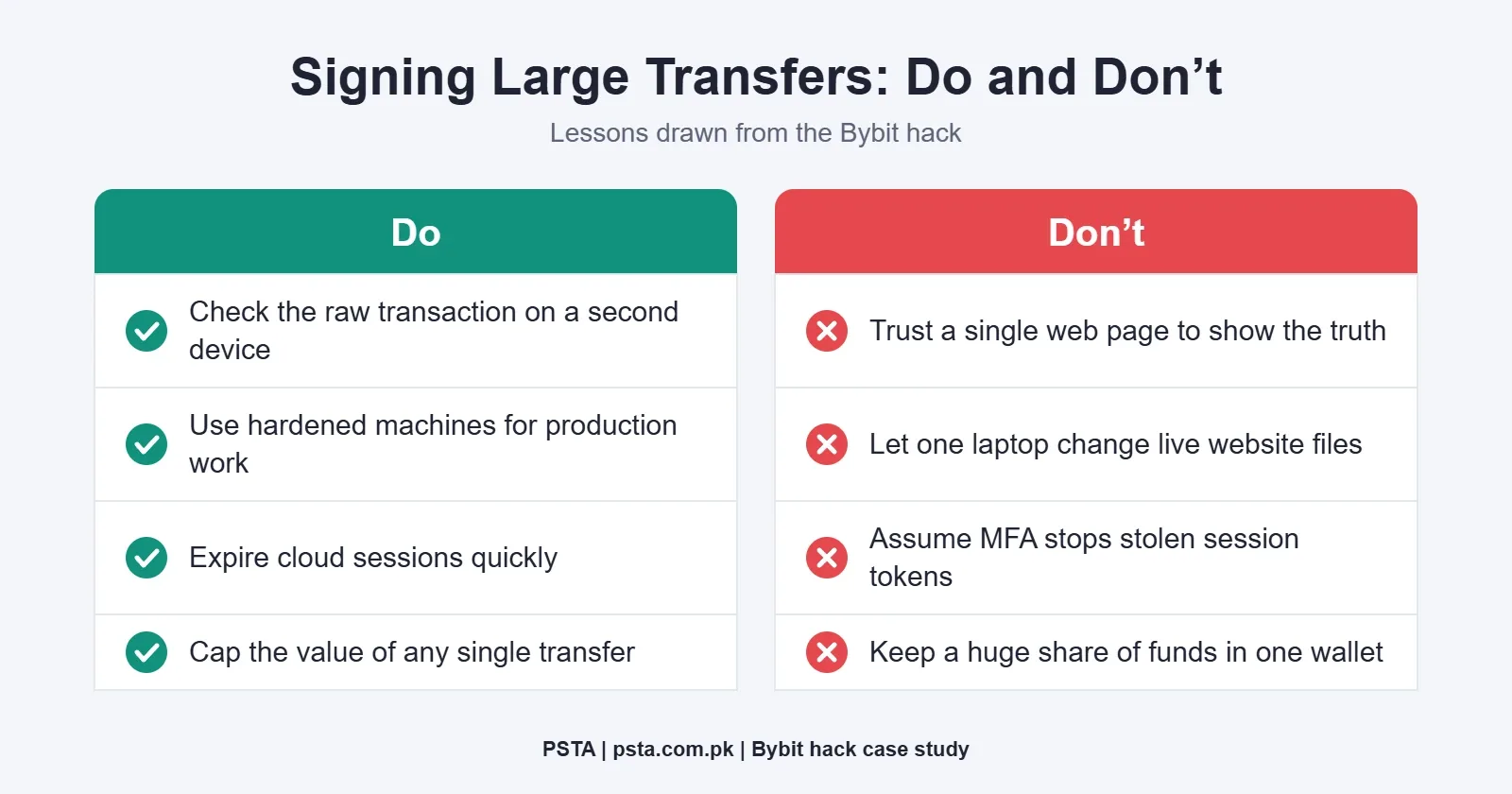
- Verify what you sign. Check the raw transaction on a second, independent device or tool before approving. Never rely on a single web page.
- Lock down developer access. Use separate, hardened machines for production work, and limit who can change live files.
- Shorten and bind sessions. Expire cloud sessions quickly and tie them to known devices, so a stolen token loses value fast.
- Watch your front end. Monitor served JavaScript for changes and alert on any file that does not match an approved build.
- Treat suppliers as part of your attack surface. Ask how your wallet, hosting and software providers detect tampering.
- Limit the blast radius. Split large holdings and cap the value of any single transfer.
- Plan the bad day. Prepare liquidity, communication and freeze requests in advance, as Bybit's quick response showed.
Turning Case Studies Like Bybit Into Practical Skills at PSTA
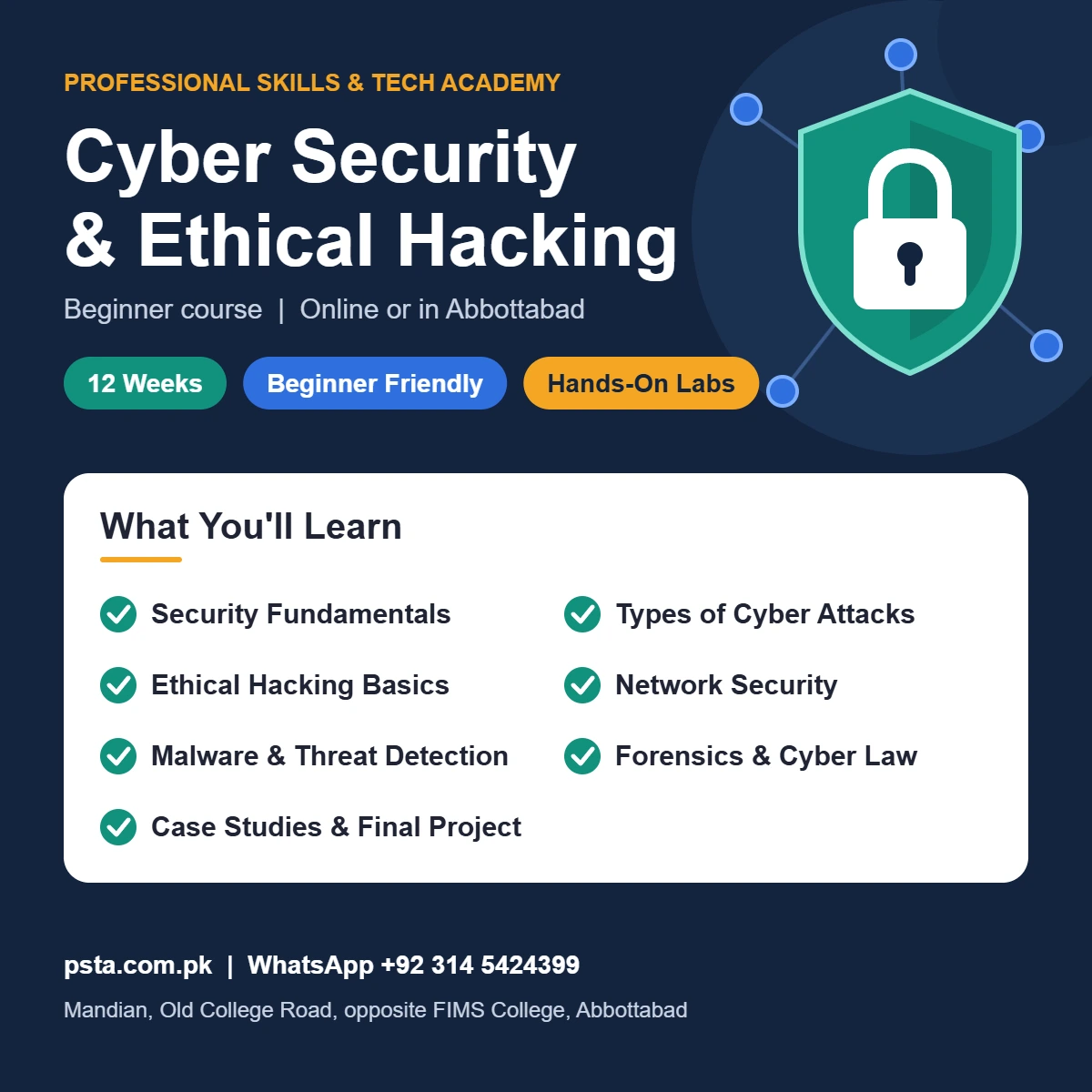
Reading about a breach is useful. Working through one in a lab is better. PSTA's Cyber Security and Ethical Hacking course runs for 12 weeks and starts at beginner level. You can study on our Abbottabad campus or join live online classes from anywhere in Pakistan.
The course has seven modules. Module 2 covers phishing and social engineering, the starting point for the Safe developer's infection. Module 5 covers malware analysis, threat intelligence and incident response, and Module 7 is built around real-world case studies and a final security project. You practice building timelines and writing findings a manager can act on.
If you already have the basics and want to test systems the way attackers do, with permission, PSTA's Advanced Ethical Hacking and Penetration Testing program is the next track. To plan certifications alongside either course, see our cyber security certifications for beginners guide.
Before You Sign Anything Again
The Bybit theft did not need a stolen password. It needed people to trust a screen. This week, pick one crypto or banking app you use. Find out how it lets you confirm a transfer outside the main screen, such as a device prompt or an address whitelist. Turn it on if it is off.
Want to take apart incidents like this with an instructor? Drop us a WhatsApp message and ask when the next cyber security batch starts.
Frequently asked questions
Was any Bybit customer's password stolen in the hack?
No source reviewed for this article reports stolen customer passwords. The attackers targeted the signing process for Bybit's own cold wallet. They tampered with code on Safe{Wallet}'s website so that Bybit's signers approved a harmful transaction. Customer accounts were not the entry point, and Bybit kept withdrawals open after the theft.
Is a hardware or cold wallet still safe to use after the Bybit hack?
Yes, a cold wallet still protects keys well, but the Bybit case shows its limits. The keys stayed offline, yet the signers approved a harmful transaction shown on a tampered page. Use a wallet that displays full transaction details on the device itself, and read them carefully before you confirm anything.
What is blind signing in crypto?
Blind signing means approving a transaction without seeing or understanding its real contents. You trust a summary shown by an app or website instead. In the Bybit hack, signers saw a normal-looking transfer, while the data they signed changed the wallet's logic. Checking raw details on a separate device reduces this risk.
Did Bybit customers lose money because of the hack?
Bybit's CEO told clients their money was safe. The exchange used bridge loans, purchases and deposits to replace the missing Ether, and Ben Zhou said the gap was closed by February 24, 2025. Withdrawals stayed open throughout, and more than $5.3 billion left the exchange within a day.
How did investigators link the Bybit hack to North Korea?
The FBI issued a public alert on February 26, 2025 naming North Korea and its TraderTraitor activity. Safe{Wallet} and Mandiant reached the same view in their forensic review. Blockchain analysts, including TRM Labs and Elliptic, pointed to wallet links with earlier thefts tied to the Lazarus Group.
Can stolen crypto from a hack like this be recovered?
Some of it can, but usually only a small share. Exchanges and token issuers can freeze funds that reach their platforms, and bounties reward people who help. In Bybit's case, the CEO said about 3% had been frozen by March 4, 2025, while 20% had already gone dark.
What should a beginner study to understand attacks like the Bybit hack?
Start with how phishing and social engineering work, since one infected laptop opened the door here. Then learn basic network and cloud security, incident response and how to build a timeline from evidence. A structured course with lab work and real case studies helps you connect these topics.
Sources & references
- FBI IC3: North Korea Responsible for $1.5 Billion Bybit Hack ic3.gov
- Reuters via Insurance Journal: Bybit Hit by Crypto's Worst Hack insurancejournal.com
- The Hacker News: Bybit Confirms Record-Breaking Theft thehackernews.com
- The Hacker News: Safe{Wallet} Confirms North Korean TraderTraitor Hackers thehackernews.com
- The Block: Sygnia Findings on Safe Developer Machine Compromise theblock.co
- Decrypt: Bybit Closes Ethereum Deficit After Hack decrypt.co
- The Block: Bybit CEO Says 20% of Stolen Funds Have Gone Dark theblock.co
- Dawn: Regulatory Body Formed to Oversee Digital Assets dawn.com
Last reviewed & updated on by Umar Qureshi. Written by the PSTA team in Abbottabad, Pakistan.

Umar Qureshi
Cyber Security & Ethical Hacking Course in Abbottabad - PSTA
Turn this guide into a career: hands-on training with real projects, online across Pakistan or on-campus in Abbottabad · 12 Weeks.
Comments
No comments yet — ask a question or share your experience.