Quick answer
Choose C++ first if your university's Programming Fundamentals course uses it or you want games, robotics or systems work. Choose Java first for Android, banking or enterprise back ends. Both sit in TIOBE's top four in November 2026, and loops, functions and OOP transfer between them, so your first pick is never wasted.
Key takeaways
- • The language your first-year Programming Fundamentals course uses is the strongest reason to pick one first.
- • C++ compiles to native machine code; Java compiles to bytecode that runs on the JVM.
- • C++ makes you manage memory, while Java's garbage collector frees it for you.
- • In November 2026, TIOBE rated Java at 8.89% and C++ at 8.35%, so both remain in the top four.
- • C++ leads in games, embedded devices and contest programming; Java leads in Android and enterprise back ends.
- • Learn one language well, build small projects, master OOP, then pick up the other by studying differences.
Table of contents 14 sections
- What Do the 2026 Rankings and Releases Tell You?
- How Does Each Language Run Your Code?
- C++ vs Java Side by Side
- One Small Program Written in Both
- Memory: Who Cleans Up After Your Program?
- Which Language Will Your University Expect?
- Strengths and Weak Spots of Each
- Where C++ Is Strong
- Where Java Is Strong
- Where Each Language Leads: Careers and Projects
- Myths That Confuse the Choice
- Is It Worth Learning Both, and in What Order?
- Starting C++ at PSTA Before Your First Semester
- Try This Before You Decide
For most Pakistani students, the C++ vs Java decision comes down to the language your first programming course uses. Pick C++ first if your Programming Fundamentals lab teaches it or you're drawn to games, robotics or systems work. Pick Java first if you're aiming at Android apps, banking software or large company back ends. Popularity won't settle it for you: the November 2026 TIOBE index puts Java at 8.89% and C++ at 8.35%, less than a percentage point apart.
In this comparison, you'll find:
- What happens between typing your code and seeing it run, and why that shapes everything else
- The real differences in memory handling, syntax and speed, with one small program written in both
- What the 2026 rankings and the C++26 and Java 25 releases mean for someone starting out
- Which language suits your degree, job target or side projects
- A sensible order to follow if you want both in the end
What Do the 2026 Rankings and Releases Tell You?
Every few months a headline announces that one of these languages has "overtaken" the other. November 2026 was Java's turn. According to TechRepublic's report on the November 2026 TIOBE index, Java climbed from 8.41% in October to 8.89%, while C++ slipped from 8.87% to 8.35%. Java took third place, behind Python and C.
TIOBE tracks how widely a language is discussed and searched online. It doesn't count jobs, and a swing of half a point tells you very little about how to settle C++ vs Java for yourself. What it does show is that both languages sit firmly in the top four, year after year.
Survey data adds a useful twist. In the Stack Overflow Developer Survey 2025, 29.4% of all respondents used Java and 23.5% used C++. Among people still learning to code, the order flips: 44.6% used C++ and 40.8% used Java. Students meet C++ early, often in a university lab, while working developers use Java more on the job.
| Signal (source) | C++ | Java |
|---|---|---|
| TIOBE rating, November 2026 | 8.35% (4th) | 8.89% (3rd) |
| TIOBE rating, October 2026 | 8.87% | 8.41% |
| Used by all developers, Stack Overflow 2025 | 23.5% | 29.4% |
| Used by people learning to code, Stack Overflow 2025 | 44.6% | 40.8% |
| Latest standard or long-term release | C++26 (technical work finished March 2026) | Java 25 LTS (September 2025) |
Both languages are also still moving forward. Herb Sutter, who chairs the ISO C++ committee, reported in his March 2026 trip report that C++26 was technically complete, approved by a vote of 114 to 12 with 3 abstentions. Its headline additions are reflection, contracts, a hardened standard library with less undefined behavior, and std::execution for asynchronous code. On the Java side, the Oracle Java SE Support Roadmap lists Java 25 as the newest long-term support (LTS) release, with Premier Support until September 2030. Java 29 is the next planned LTS, due in September 2027.
For a beginner, none of the new features matter in month one. What matters is that you install a recent toolset: a current GCC, Clang or MSVC compiler for C++, and JDK 21 or 25 for Java.
How Does Each Language Run Your Code?
This is the difference that explains most of the others. A C++ compiler translates your source file straight into machine code for one operating system and processor. On Windows you get an .exe file that runs on its own, with no extra software needed.
Java takes a two-step route. The javac compiler turns your code into bytecode, stored in .class files. That bytecode runs inside the Java Virtual Machine (JVM), which translates the busiest parts into machine code while the program runs. The same .class file works on Windows, Linux or macOS, as long as a JVM is installed.
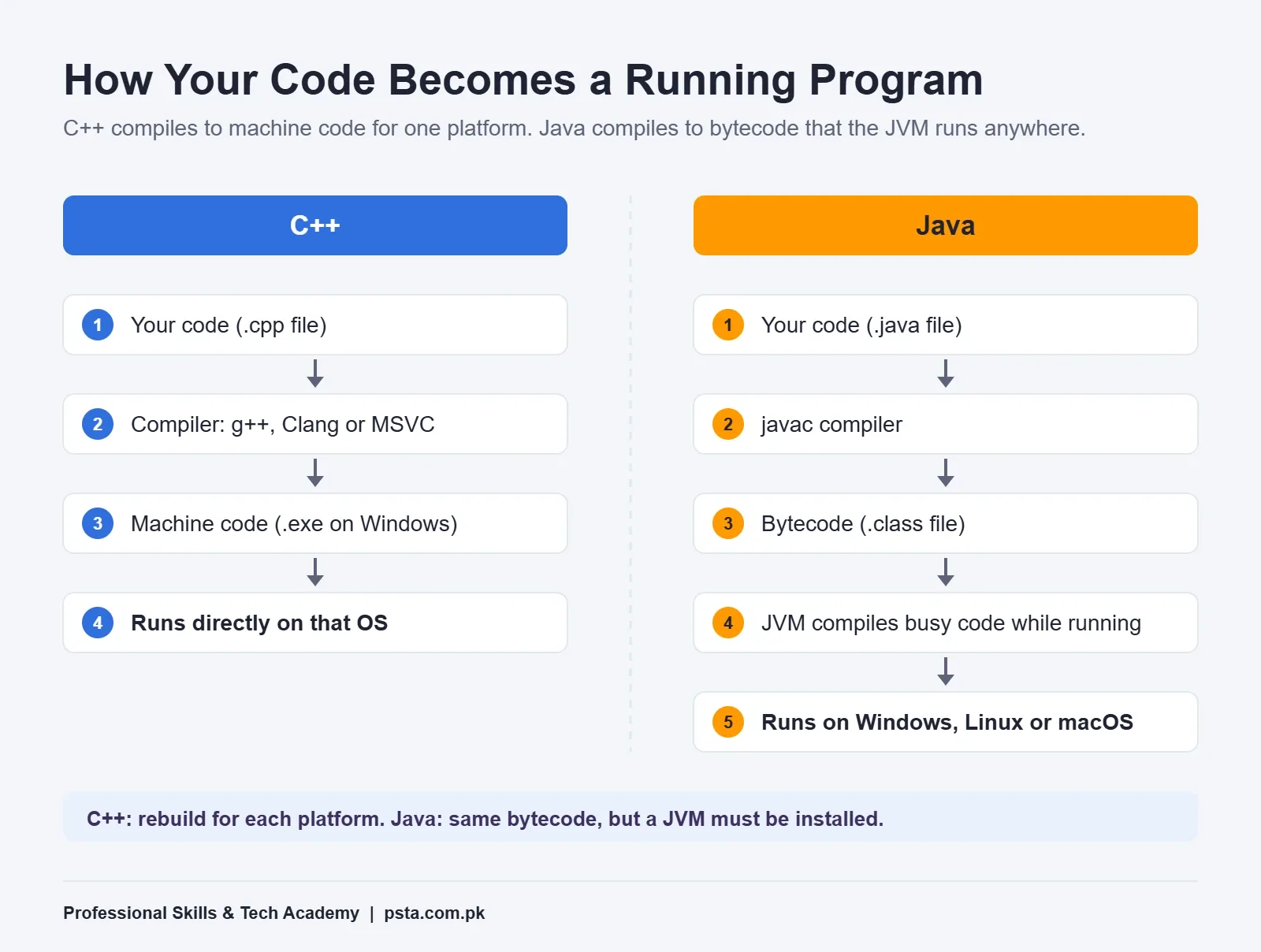
So C++ gives you direct control and a lean final program, but you rebuild it for each platform. Java gives you portability and a safety layer, at the cost of shipping or installing a runtime. Neither approach is better in general. They suit different jobs.
C++ vs Java Side by Side
Here's how C++ vs Java compares on the points that change your daily experience as a learner.
| Point | C++ | Java |
|---|---|---|
| Output of the compiler | Native machine code (.exe on Windows) | Bytecode (.class) run by the JVM |
| Memory cleanup | Your job, helped by destructors and smart pointers | Automatic, through the garbage collector |
| Pointers | Full pointers, including pointer arithmetic | References only, no pointer arithmetic |
| Inheritance | A class can inherit from several classes | One parent class, plus any number of interfaces |
| Code outside classes | Allowed; main() is a plain function | Everything lives inside a class |
| Running on another OS | Recompile for that platform | Same bytecode runs on any JVM |
| Release rhythm | A new ISO standard roughly every three years | A release every six months, LTS every two years |
| Typical first tools | VS Code with g++, Code::Blocks, Visual Studio | IntelliJ IDEA Community, Eclipse, VS Code with a JDK |
The release rhythm row comes from the Oracle roadmap above: Java 26 arrived in March 2026, Java 27 in September 2026, and LTS versions land every second September.
One Small Program Written in Both
Seeing the same task in each language says more about C++ vs Java than any list. This program asks for three subject marks and prints the average.
C++
#include <iostream>
using namespace std;

int main() {
    double a, b, c;
    cout << "Enter three marks: ";
    cin >> a >> b >> c;
    cout << "Average: " << (a + b + c) / 3 << endl;
    return 0;
}
Java
import java.util.Scanner;

public class Average {
    public static void main(String[] args) {
        Scanner in = new Scanner(System.in);
        System.out.print("Enter three marks: ");
        double a = in.nextDouble(), b = in.nextDouble(), c = in.nextDouble();
        System.out.println("Average: " + (a + b + c) / 3);
    }
}
Notice three things. Java wraps even this tiny program in a class, so you meet words like public, static and class on day one, before you know what they mean. C++ lets you write a bare main() function and add classes later. And the Java file must be saved as Average.java to match the class name, a rule that trips up many first-week students.
If you want to try the C++ version right now, our guide on how to run C++ in VS Code walks through the setup.
Memory: Who Cleans Up After Your Program?
When a program creates data while running, that data takes up memory. Someone has to release it afterwards.
In C++, that someone is you. Modern C++ makes it far less painful than it used to be: objects clean up after themselves when they go out of scope, and smart pointers such as std::unique_ptr release memory automatically. Still, raw pointers exist, and beginners regularly hit two classic bugs. A memory leak happens when you forget to free memory. A dangling pointer happens when you use memory after it has already been freed.
In Java, a garbage collector finds objects your program no longer uses and frees them. You never call delete. The common beginner error shifts instead: the NullPointerException, which appears when you use a reference that points to nothing.
Here's the trade-off in teaching terms. C++ forces you to understand what the computer is doing with memory, which pays off later in data structures and operating systems courses. Java lets you spend that same energy on designing classes and organizing larger programs. Both lessons are valuable. The question is which you'd rather learn first.
Which Language Will Your University Expect?
This is the most practical question for anyone heading into BSCS, BSSE or BSIT, and it often settles the C++ or Java for BSCS debate on its own. As one example, the University of the Punjab's BS Computer Science curriculum for Fall 2026 places Programming Fundamentals, with its lab, in Semester I and Object Oriented Programming in Semester II, with Programming Fundamentals as the prerequisite.
The language named in those course outlines varies by department and sometimes by teacher. Before you start practicing, do two things:
- Download your department's scheme of studies and read the Programming Fundamentals outline, including the recommended textbook.
- Ask two or three senior students which language the lab exams actually used last year.
If the answer is C++, learning it before your first semester gives you a real head start, because you'll spend lab time solving problems instead of fighting syntax. If your department starts with another language, the logic you build in C++ still carries over almost line for line.
Strengths and Weak Spots of Each
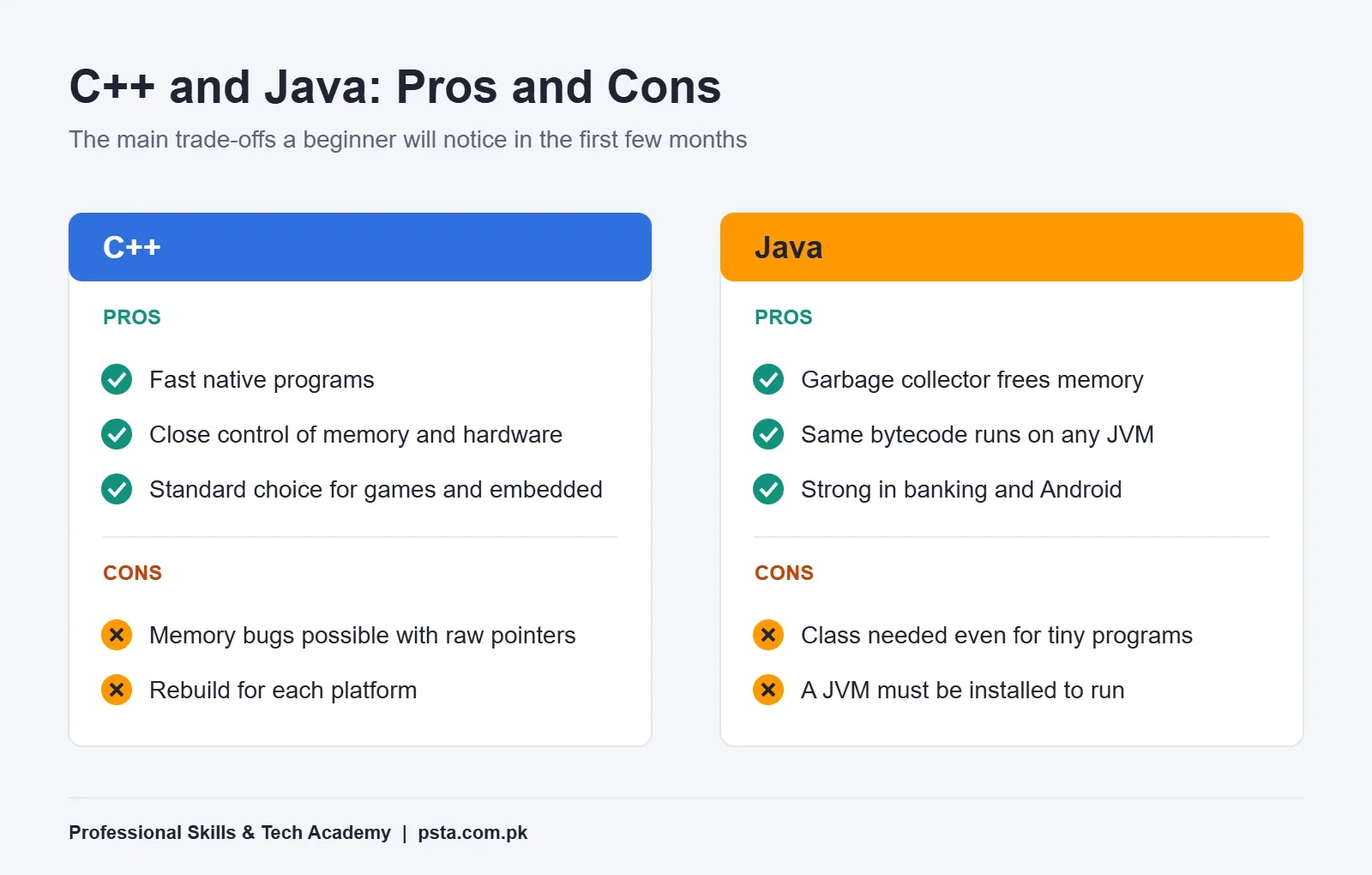
Neither language wins everywhere, and any honest Java vs C++ for beginners comparison has to admit that. This summary puts the main trade-offs on one page.
Where C++ Is Strong
C++ shines where speed and close hardware control matter: game engines, embedded devices, robotics, simulation and high-frequency systems. Arduino sketches are written in a C++ dialect, which makes it a natural fit for electronics students. Competitive programmers also lean on it for its fast execution and the Standard Template Library.
Where Java Is Strong
Java's home ground is large, long-lived business software: banking systems, enterprise back ends built with Spring, and Android, where Java is still supported alongside Kotlin. Its strict structure helps teams of dozens of developers keep a big codebase readable, and the garbage collector removes a whole class of memory bugs.
Where Each Language Leads: Careers and Projects
Think about the work you'd enjoy doing in three years, then work backwards.
| If you want to build... | Lean towards | Why |
|---|---|---|
| Games or game engines | C++ | Major engines such as Unreal are written in C++ |
| Arduino, robotics or embedded devices | C++ | Runs with tiny memory and no runtime |
| Contest problems and data structures practice | C++ | Fast programs and a rich standard library |
| Android apps | Java (then Kotlin) | Android's tools and libraries grew up around Java |
| Banking or enterprise back ends | Java | Spring and the JVM dominate long-running business systems |
| Websites and freelancing quickly | Neither first | JavaScript or Python gets you to paid work sooner |
That last row deserves honesty. If your main goal is earning from web projects within a year, neither C++ nor Java is the shortest path. Our JavaScript course or Advanced Python course will usually get you there faster. We compared one of those routes in detail in C++ vs Python for beginners.
Myths That Confuse the Choice
A few ideas about C++ vs Java come up in almost every admission counseling session. They're worth clearing away before you decide.
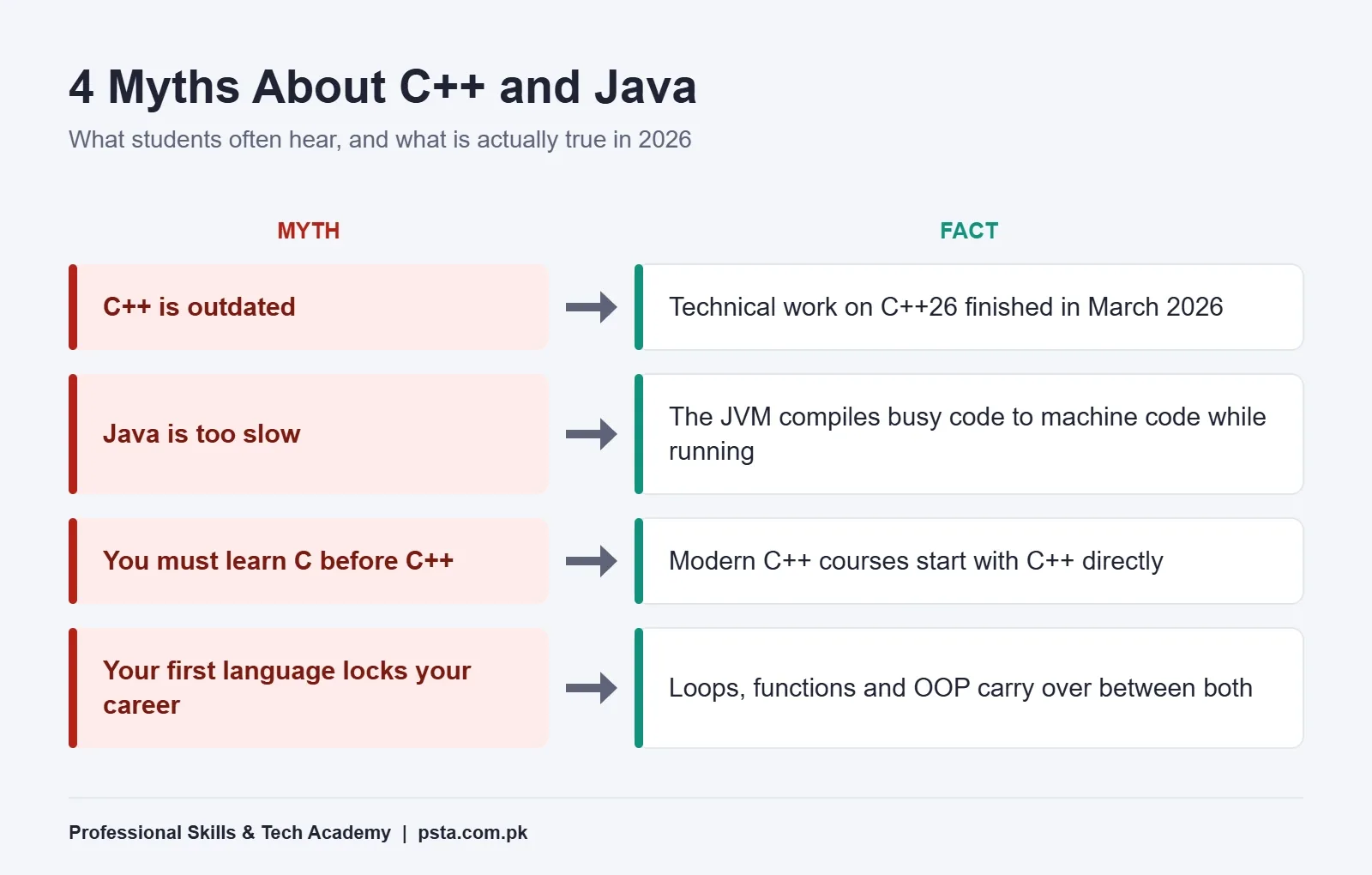
The "C++ is dying" claim doesn't survive contact with the data. Technical work on a brand-new standard, C++26, finished in March 2026, and close to a quarter of developers in the Stack Overflow survey still use it. The "Java is slow" myth dates from the 1990s, before the JVM learned to compile hot code paths while the program runs. And you don't need C before C++: modern C++ courses start with C++ directly.
Is It Worth Learning Both, and in What Order?
Most computer science graduates end up using both at some point, so the real C++ vs Java question is sequence, not either-or. This order works well for students we teach:
- Master one language's fundamentals. Variables, conditions, loops, functions and arrays, in whichever language your course uses. Give it 8 to 12 weeks of steady practice.
- Build three small console programs. A grade calculator, a simple bank account menu and a quiz game are enough. Our list of C++ projects for beginners has more ideas.
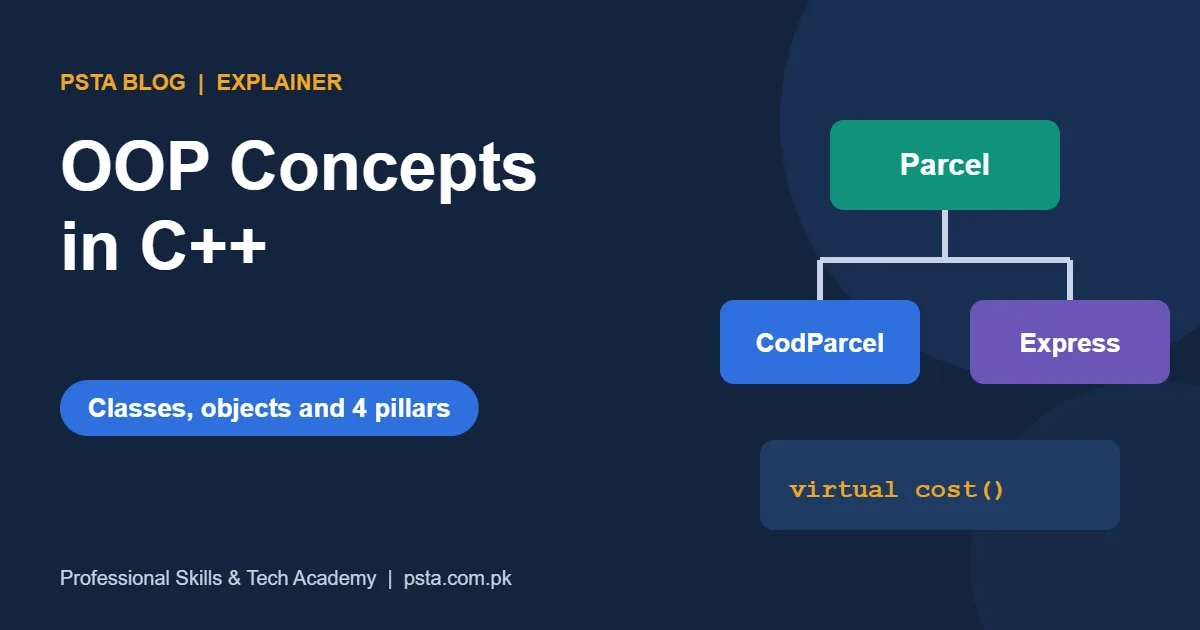
- Learn object-oriented programming properly. Classes, objects, constructors, inheritance and polymorphism. These ideas are nearly identical in both languages.
- Pick up the second language by studying differences. Focus on memory handling, the class-only rule in Java and the build process. Most students who know one well can read the other within a few weeks.
- Specialize. Choose a track, such as Android, game development or data structures for interviews, and go deep in the language that track uses.
When you reach the job stage, our C++ interview questions guide covers what technical interviewers commonly ask freshers.
Starting C++ at PSTA Before Your First Semester
PSTA's C++ Programming Course for Beginners is built for exactly this stage. The course lasts 12 weeks, is pitched at complete beginners and assumes no computer science background. The eight modules move from installing a compiler and printing your first line with cout, through decisions, loops, functions, arrays and strings, to an introduction to classes and objects. It finishes with a small project you build from scratch.
The fee shown on the course page is Rs. 12,000 (listed down from Rs. 16,000). You can sit in class at the Abbottabad campus in Mandian (Old College Road, across from FIMS College), study live online from any city in Pakistan, or combine both. Fresh batches open monthly, and classes run Monday through Saturday, with slots from 9:00 AM until 9:30 PM.
PSTA doesn't run a separate Java course at the moment, and we'd rather tell you that plainly. The OOP module in the C++ course covers the same core concepts you'll need in Java later. Every PSTA program is listed side by side on our courses page, see the steps on the admission page, or message us on WhatsApp at +92 314 5424399 if you'd like help matching a course to your university plan.
Try This Before You Decide
Install a C++ compiler and a JDK this evening, then type the average-marks program above in both languages. Don't copy and paste. Time yourself, note which errors you hit and which version you'd rather keep extending. Ten minutes of your own C++ vs Java test will tell you more about which programming language to learn first than another hour of reading opinions.
Frequently asked questions
Is C++ harder than Java for a complete beginner?
C++ usually feels harder in the first few months because you handle memory yourself and meet pointers early. Java hides memory cleanup behind its garbage collector but makes you write a class for even the smallest program. Most students find that the difficulty evens out once they understand functions and objects, so pick based on your course and goals.
Can I learn Java after C++ easily?
Yes. Loops, conditions, functions, classes, inheritance and polymorphism work almost the same way in both languages. After a solid grounding in C++, most students can read Java code within a few weeks. The main things to relearn are Java's rule that all code lives inside classes, its standard library and the fact that you no longer free memory yourself.
Which is better for Android app development, C++ or Java?
Java is the better starting point for Android. Android's tools and libraries grew up around Java, and Google now also promotes Kotlin, which runs on the same platform and is easy to pick up after Java. C++ is used on Android mainly for performance-heavy parts such as game engines, through a separate native toolkit.
Do Pakistani universities teach C++ or Java in the first semester?
It depends on the department. Many BSCS schemes, such as the University of the Punjab's Fall 2026 curriculum, place Programming Fundamentals in Semester I and Object Oriented Programming in Semester II, but the language is set in each course outline. Check your department's scheme of studies and ask senior students what the lab exams used.
Is C++ still worth learning in 2026?
Yes. Technical work on the C++26 standard finished in March 2026, adding reflection, contracts and a hardened standard library. TIOBE rated C++ at 8.35% in November 2026, fourth overall, and it remains the main language for game engines, embedded systems and competitive programming. It also teaches you how computers handle memory.
Which Java version should a beginner install?
Install a long-term support release. Oracle's roadmap lists Java 25, released in September 2025, as the newest LTS, with Premier Support until September 2030. Java 21 is also a safe choice. Avoid very old versions found in outdated tutorials, because newer features make beginner code shorter and clearer.
How many weeks do the basics of C++ or Java usually take?
With steady daily practice, most beginners cover variables, conditions, loops, functions and arrays in 8 to 12 weeks. Object-oriented programming takes another month or two to feel comfortable. PSTA's beginner C++ course runs for 12 weeks and ends with a small project you build from scratch.
Sources & references
- TIOBE Index for November 2026 (TechRepublic) techrepublic.com
- TIOBE Index Top 10 Programming Languages, November 2026 (TechRepublic) techrepublic.com
- Stack Overflow Developer Survey 2025: Technology survey.stackoverflow.co
- Oracle Java SE Support Roadmap oracle.com
- C++26 Is Done: March 2026 ISO C++ Trip Report (Herb Sutter) herbsutter.com
- BS Computer Science Curriculum, Fall 2026 (University of the Punjab) pu.edu.pk
Last reviewed & updated on by Umar Qureshi. Written by the PSTA team in Abbottabad, Pakistan.

Umar Qureshi
Best C++ Programming Course for Beginners in Pakistan
Turn this guide into a career: hands-on training with real projects, online across Pakistan or on-campus in Abbottabad · 12 Weeks.
Comments
No comments yet — ask a question or share your experience.