Quick answer
Start with common phrasal verbs you will actually hear, such as wake up, run out of, follow up, look into, go over, give up and put up with. Learn them in situation groups, not from A to Z. Put a pronoun between a separable verb and its particle (turn it off), and use neutral ones freely in formal writing.
Key takeaways
- • Learn phrasal verbs by situation (home, work, class, feelings) instead of in alphabetical order.
- • EF's 2026 index gives Pakistan 485 for speaking and 463 for listening, the skills where phrasal verbs matter most.
- • A pronoun goes between a separable verb and its particle: turn it off, not turn off it.
- • Verbs like look after, and three-part verbs like put up with, never split.
- • Cambridge notes that most phrasal verbs are neutral, so carry out and point out suit reports and emails.
Table of contents 16 sections
- What Is a Phrasal Verb, in Plain Terms?
- Why Do Phrasal Verbs Feel Hard for Pakistani Learners?
- Common Phrasal Verbs at Home and in Your Daily Routine
- Phrasal Verbs for Office Work, Calls and Email
- Phrasal Verbs for Study, Classes and Exams
- Phrasal Verbs for Problems, Plans and Feelings
- Where Does the Object Go? Separable and Inseparable Rules
- Rule 1: Some Verbs Can Split Around a Noun
- Rule 2: A Pronoun Must Go in the Middle
- Rule 3: Some Verbs Never Split
- Rule 4: Three-Part Verbs Stay Together
- Are Phrasal Verbs Too Informal for Emails and Reports?
- One Verb, Many Meanings: Reading "Put Off" Correctly
- How Should You Memorize Common Phrasal Verbs?
- Practicing Phrasal Verbs in PSTA's Spoken English Classes
- Start With Five Verbs You'll Use Tomorrow
Which common phrasal verbs should you learn first, when dictionaries list thousands of them? Students ask some version of this in almost every spoken English batch we teach. The Oxford Phrasal Verbs Dictionary alone covers over 6,000 British and American phrasal verbs, and nobody needs all of them to hold a normal conversation.
The better question is which ones you'll hear this week, at home, in the office and in class. This phrasal verbs list answers that with 40 verbs sorted by situation, each with an Urdu meaning and a sentence you could say tomorrow.
By the end of this guide, you will know:
- What makes a phrasal verb different from an ordinary verb plus a preposition
- 40 common phrasal verbs grouped into four everyday situations, with Urdu meanings
- Where the object and the pronoun go, so you stop saying "switch off it"
- Which phrasal verbs are safe in emails, reports and formal writing
- A four-week plan to move these verbs from a list into your speaking
What Is a Phrasal Verb, in Plain Terms?
A phrasal verb is a verb joined to one or two small words called particles, such as up, off, out or after. The British Council's LearnEnglish grammar page gives a neat example: call means to telephone, but call off means to cancel.
That change in meaning is the whole difficulty. You may know give and you may know up, yet give up (to stop trying) can't be worked out from the two words. You have to learn it as one unit, the same way you learned a new word in Urdu as a child.
Phrasal verbs come in two sizes:
- Two-part verbs: a verb plus one particle, such as grow up or look after.
- Three-part verbs: a verb plus two particles, such as look forward to or put up with.
Urdu does something similar with compound verbs. ہار ماننا isn't just "defeat" plus "accept". Thinking of phrasal verbs this way makes them feel less strange.
Why Do Phrasal Verbs Feel Hard for Pakistani Learners?
Most of us learned English from textbooks and exam papers, where writers prefer single formal verbs like postpone, tolerate and investigate. Then we watch a video, join a call with a foreign client or start a job, and people say put off, put up with and look into instead.
EF's 2026 English Proficiency Index fact sheet for Pakistan shows this gap clearly. Pakistan ranks 58th with a score of 496, above the global average of 485. But the skill scores are uneven: reading 524, writing 508, speaking 485 and listening 463.
In other words, Pakistani learners on average read English better than they hear it. Phrasal verbs live mostly in spoken English, so they sit right inside the weakest skills. Learning common phrasal verbs is one of the quickest ways to understand calls, lectures and videos without pausing to translate.
Common Phrasal Verbs at Home and in Your Daily Routine
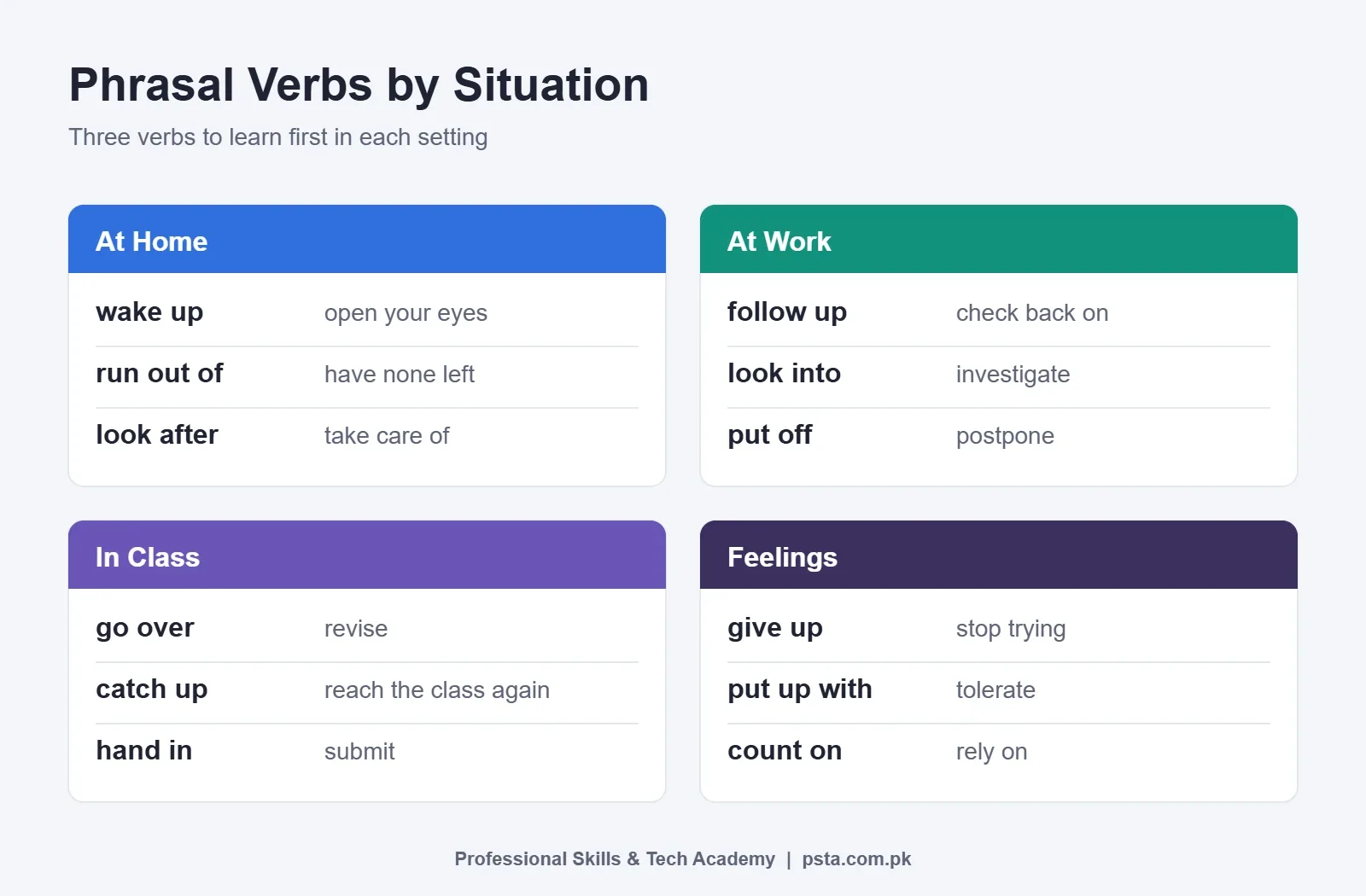
Each of the four tables below gives phrasal verbs with Urdu meanings and one example sentence. Start with the verbs you can use before you even leave the house. You'll hear these in family conversations, dramas and short videos every day.
| Phrasal Verb | Urdu Meaning | Example Sentence |
|---|---|---|
| wake up | جاگنا | I wake up at six on weekdays. |
| get up | بستر سے اٹھنا | I wake up early but get up late in winter. |
| switch on | چلانا، آن کرنا | Switch on the geyser before Fajr. |
| turn off | بند کرنا | Turn off the fan when you leave the room. |
| put on | پہننا | Put on a jacket. It's cold outside. |
| take off | اتارنا | Please take off your shoes at the door. |
| look after | دیکھ بھال کرنا | My sister looks after our grandmother. |
| run out of | ختم ہو جانا | We've run out of sugar again. |
| pick up | لینے جانا، اٹھانا | I'll pick you up from the bus stand at five. |
| clean up | صفائی کرنا | Let's clean up before the guests arrive. |
Notice the difference between wake up and get up. You wake up when your eyes open. You get up when you actually leave the bed. Many learners use them as if they meant the same thing.
Phrasal Verbs for Office Work, Calls and Email
These common phrasal verbs are the ones you'll meet in meetings, on phone calls and in WhatsApp groups at work. If you are preparing for your first job, learn this group well. Our guide to English phrases for office pairs nicely with it.
| Phrasal Verb | Urdu Meaning | Example Sentence |
|---|---|---|
| call back | واپس فون کرنا | Can I call you back after the meeting? |
| hold on | رکیے، انتظار کیجیے | Hold on, I'll check the file. |
| fill in | (فارم) بھرنا | Please fill in the leave form by Friday. |
| set up | ترتیب دینا، طے کرنا | Could you set up a call with the client? |
| follow up | دوبارہ رابطہ کر کے پوچھنا | I'm following up on the invoice I sent last week. |
| look into | جانچ پڑتال کرنا | We'll look into the billing error today. |
| carry out | انجام دینا | The team carried out a stock count on Monday. |
| bring up | (بات) چھیڑنا | She brought up the salary issue in the meeting. |
| put off | ملتوی کرنا | They put off the launch until March. |
| call off | منسوخ کرنا | The manager called off the Saturday shift. |
Two of these, follow up and look into, are worth extra practice. A client who writes "I'm following up" wants an answer, not a long apology. A reply that says "We're looking into it" shows that someone is working on the problem.
Phrasal Verbs for Study, Classes and Exams
Teachers, tutors and online lecturers lean on these verbs. If you are preparing for IELTS or the Duolingo English Test, you'll also hear several of them in the listening sections.
| Phrasal Verb | Urdu Meaning | Example Sentence |
|---|---|---|
| look up | (لغت میں) تلاش کرنا | Look up any word you can't guess from context. |
| go over | دہرانا، نظرثانی کرنا | Let's go over chapter three before the test. |
| catch up | پیچھے رہ جانے کے بعد برابر آنا | I missed two classes, so I need to catch up. |
| keep up with | ساتھ ساتھ چلنا | He works hard to keep up with the class. |
| figure out | سمجھ لینا، حل نکالنا | I finally figured out the formula. |
| write down | لکھ لینا | Write down three new verbs after each lesson. |
| hand in | جمع کروانا | Hand in your assignment by Thursday. |
| point out | نشاندہی کرنا | The teacher pointed out two spelling errors. |
| come up with | (خیال یا حل) سوچ نکالنا | Our group came up with a better project idea. |
| drop out | پڑھائی چھوڑ دینا | He dropped out in second year to support his family. |
Phrasal Verbs for Problems, Plans and Feelings
This last group of common phrasal verbs carries emotion and decisions. It's the group most likely to make your conversation sound natural instead of memorized.
| Phrasal Verb | Urdu Meaning | Example Sentence |
|---|---|---|
| give up | ہار ماننا، چھوڑ دینا | Don't give up after one bad mock test. |
| turn down | انکار کرنا، ٹھکرانا | She turned down the offer because of the commute. |
| get over | (صدمے یا بیماری سے) سنبھلنا | It took him a week to get over the flu. |
| put up with | برداشت کرنا | I can't put up with this noise any longer. |
| look forward to | شدت سے انتظار کرنا | I look forward to hearing from you. |
| break down | خراب ہو جانا | The van broke down near Havelian. |
| work out | حل نکلنا، ٹھیک ہو جانا | Don't worry, things will work out. |
| find out | پتا لگانا | I'll find out the exam date and tell you. |
| count on | بھروسہ کرنا | You can count on me for Saturday. |
| calm down | پرسکون ہونا | Calm down and read the question again. |
One grammar point hides in look forward to. Here to works as a preposition rather than the start of an infinitive, which is why the verb after it ends in -ing: "I look forward to hearing from you," never "to hear from you." This error appears in a lot of job application emails. If you write those often, see our common English mistakes guide too.
Where Does the Object Go? Separable and Inseparable Rules
This is where most Pakistani speakers slip, because Urdu word order gives no help. The British Council's multi-word verbs reference sets out the patterns. Here are the rules for separable phrasal verbs, and for the ones that never split, in classroom terms.
Rule 1: Some Verbs Can Split Around a Noun
With verbs like give back, turn off and call off, a noun object can sit in either place. "Turn off the fan" and "Turn the fan off" are both correct.
Rule 2: A Pronoun Must Go in the Middle
When the object is it, him, her or them, the pronoun goes between the verb and the particle. Say "Turn it off," not "Turn off it." The British Council marks "She gave back it" as wrong for exactly this reason.
Rule 3: Some Verbs Never Split
Verbs like look after, get over and count on stay together, even with a pronoun. You say "She looks after him," never "She looks him after." Verbs with no object at all, like get up, can't split either, because there's nothing to put in the middle.
Rule 4: Three-Part Verbs Stay Together
Verbs with two particles, such as put up with and look forward to, are never separated. The object comes after both particles: "I can't put up with it."
A good dictionary tells you which pattern a verb follows. Oxford's learner entries, for example, write put something off, which shows you that the object can go in the middle.
| Verb Type | Example | With a Noun | With a Pronoun |
|---|---|---|---|
| Separable | turn off | turn off the fan / turn the fan off | turn it off |
| Inseparable | look after | look after the kids | look after them |
| No object | get up | Not used with an object | Not used with an object |
| Three-part | put up with | put up with the noise | put up with it |
Are Phrasal Verbs Too Informal for Emails and Reports?
Many students in Pakistan were told at school to avoid phrasal verbs in formal writing. That advice goes too far. Cambridge Dictionary's blog notes that most phrasal verbs are neutral, and many are formal.
The same Cambridge post lists verbs that work well in reports and academic writing. A few you can use straight away:
- carry out research, a survey or a review
- point out a problem or someone's argument
- account for a rise or a fall in numbers
- consist of three parts or sections
- narrow down a list of options
- phase in a new procedure gradually
What does sound casual in a formal email is a chatty verb like mess up or hang out. So the real rule is about register, not about phrasal verbs as a group. In a complaint to a bank, "We have looked into your account" is fine. "We totally messed up your account" is not.

One Verb, Many Meanings: Reading "Put Off" Correctly
Common phrasal verbs often carry several meanings, and the context decides which one you hear. The Oxford Learner's Dictionaries entry for put off lists six senses. Four of them come up regularly:
- Postpone: "They put off the meeting until next week." (ملتوی کرنا)
- Make someone dislike something: "The rude receptionist put me off that clinic." (بددل کرنا)
- Distract someone who is concentrating: "Stop tapping, you're putting me off."
- Cancel a meeting with someone: "I had to put off the plumber again."
The adjective off-putting comes from the second meaning. So when a friend says a course fee is "off-putting", they mean it discourages them, not that it was postponed.
This is why lists with one Urdu meaning per verb only take you so far. When a sentence doesn't make sense, check the full dictionary entry before you assume you've misheard.
How Should You Memorize Common Phrasal Verbs?
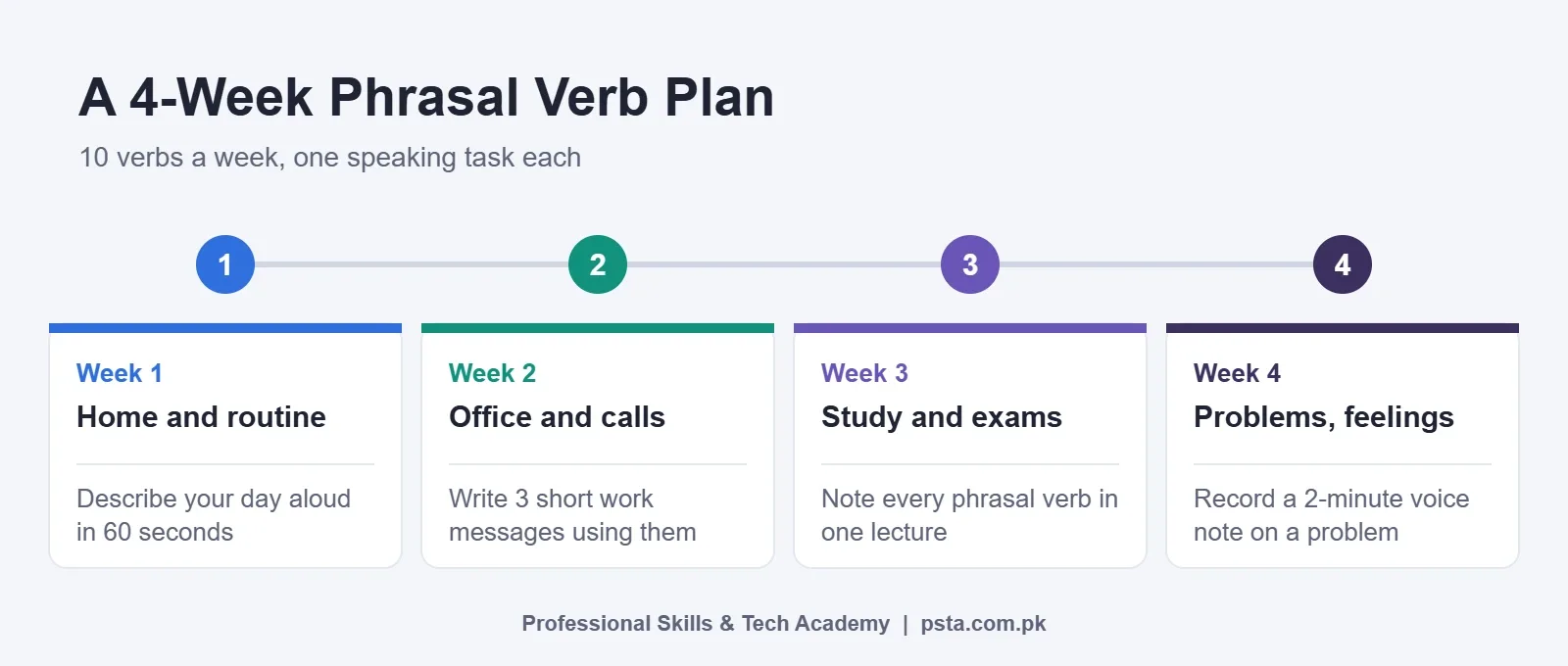
A list of 40 common phrasal verbs read once is forgotten by Friday. What works in our classes is short, spaced practice built around situations, not alphabetical order. Here's a four-week plan that fits around a job or college.
- Week 1, home and routine: Learn the first group of 10. Each evening, describe your day aloud in 60 seconds using at least five of them.
- Week 2, office and calls: Learn the second group. Write three short WhatsApp-style work messages that use follow up, look into and put off.
- Week 3, study and exams: Learn the third group. Watch one English lecture or tutorial and write down every phrasal verb you hear.
- Week 4, problems and feelings: Learn the last group. Record a two-minute voice note about a problem you solved, then listen back for errors in object position.
Keep a notebook with three columns: the verb, the sentence where you met it, and your own sentence. Your own sentence is the part that moves a verb from recognition into speaking. If you also want a structured way to practice talking at home, our 30-day speaking plan fits alongside this one.
Practicing Phrasal Verbs in PSTA's Spoken English Classes
Reading a list helps, but most learners need someone to listen and correct them in real time. Our English Spoken & Grammar Course is a 12-week beginner program. Its modules cover situational vocabulary, the gap between formal and informal English, role plays, group discussions, and writing emails, CVs and messages.
Common phrasal verbs come up naturally in those role plays, from rescheduling a meeting to handling a complaint call. At the time of writing, spoken English costs Rs. 12,000 for the full three months. Classes run on campus in Abbottabad (Mandian, Old College Road, opposite FIMS College), as a live online batch for learners anywhere in Pakistan, or as a hybrid of the two, and fresh batches open monthly.
If you also need faster typing for office work, the English and Urdu typing course pairs well with spoken English. Every program is listed side by side on the courses page. The admission page explains how enrollment works, and questions about timings are welcome on WhatsApp (+92 314 5424399).
Start With Five Verbs You'll Use Tomorrow
Don't try to learn all 40 tonight. Pick five from the tables that match tomorrow's plans, maybe wake up, pick up, call back, go over and find out. Write one sentence about your own day with each, then say them aloud twice.
Tomorrow, use at least two of them in a real conversation. That one small step does more for your spoken English than another hour of reading word lists.
Frequently asked questions
Which phrasal verbs should a beginner learn first?
Begin with verbs tied to your own day, because you will hear and repeat them often. Good first picks are wake up, get up, put on, run out of, pick up, call back, look into, go over, find out and give up. Learn them in small groups by situation, and say one sentence of your own with each before you add new ones.
How many phrasal verbs do I need for normal conversation?
You do not need thousands. Start with a working set of everyday verbs, such as the 40 in this guide, chosen for the situations you actually face at home, at work and in class. Learn ten at a time, use them in speech for a week, and only then add the next group. Depth beats a long list you cannot use.
Can I use phrasal verbs in a job application or office email?
Yes. Most phrasal verbs are neutral, and some, like carry out, point out and follow up, read well in professional writing. Avoid slangy ones such as mess up or hang out in formal messages. A line like "I am following up on my application" is polite and clear, and hiring managers see it every day.
Why is "switch off it" wrong?
When the object of a separable phrasal verb is a pronoun such as it, him or them, the pronoun must sit between the verb and the particle. So you say "switch it off" or "pick them up". With a noun you can choose either order, as in "switch off the light" or "switch the light off".
What does "put off" mean in Urdu?
Its most common meaning is to postpone, which is ملتوی کرنا in Urdu: "They put off the exam." It can also mean to make someone lose interest, close to بددل کرنا, as in "The noise put me off." Context tells you which meaning is intended, so check the full sentence before you translate.
How long does it take to start using phrasal verbs naturally?
It varies with how much you speak, but a steady routine shows results within weeks. Learning about ten verbs a week and using each one aloud in your own sentences works better than reading long lists. Recording short voice notes and listening back helps you catch word order mistakes early.
Does PSTA teach phrasal verbs in its spoken English course?
Yes. PSTA's 12-week English Spoken and Grammar Course includes situational vocabulary, formal and informal English, role plays and group discussions, where everyday phrasal verbs come up naturally. Classes are available on campus in Abbottabad, live online across Pakistan, or in a hybrid format, with a new batch starting each month.
Sources & references
- EF EPI 2026 Fact Sheet: Pakistan ef.com
- Phrasal verbs (B1-B2 grammar), British Council LearnEnglish learnenglish.britishcouncil.org
- Multi-word verbs, British Council LearnEnglish learnenglish.britishcouncil.org
- put off (phrasal verb), Oxford Learner's Dictionaries oxfordlearnersdictionaries.com
- They carried out an experiment: phrasal verbs in formal writing, Cambridge Dictionary blog dictionaryblog.cambridge.org
- Oxford Phrasal Verbs Dictionary for Learners of English, Oxford University Press india.oup.com
Last reviewed & updated on by Umar Qureshi. Written by the PSTA team in Abbottabad, Pakistan.

Umar Qureshi

English Spoken & Grammar Course in Pakistan – Build Confidence, Speak Fluently (Online & Campus)
Turn this guide into a career: hands-on training with real projects, online across Pakistan or on-campus in Abbottabad · 12 Weeks.
Comments
No comments yet — ask a question or share your experience.