Quick answer
Use in for long periods and large or enclosed spaces (in March, in Lahore), on for days, dates, surfaces, streets and buses (on Monday, on the desk), and at for clock times, addresses and exact points (at 9:00, at the gate). Use no preposition before this, next, last, today, tomorrow or yesterday.
Key takeaways
- • In covers long periods and big or enclosed spaces: years, months, seasons, mornings, cities, rooms and cars.
- • On covers single days, dates, surfaces, streets, rivers and public transport such as buses and trains.
- • At covers clock times, noon, night, addresses and places linked to an activity, like at work or at home.
- • Drop the preposition before this, next, last, today, tomorrow and yesterday.
- • On time means punctual; in time means early enough. At the end needs "of"; in the end means finally.
Table of contents 19 sections
- What Are Prepositions of Time and Place?
- The Pyramid Rule: From Big to Small
- Prepositions of Time: In, On and At With Examples
- In for Months, Years, Seasons and Parts of the Day
- On for Days and Dates
- At for Clock Times and Short Points
- At Night or In the Night?
- Prepositions of Place: In, On and At With Examples
- In for Enclosed Spaces and Large Areas
- On for Surfaces, Lines and Public Transport
- At for Exact Points and Places Linked to an Activity
- Is It In the Bus or On the Bus?
- When Do You Use No Preposition at All?
- Where Do Urdu Speakers Go Wrong Most Often?
- On Time or In Time? Four Phrases Worth Learning
- How Do You Pick the Right Preposition in Five Seconds?
- A Seven-Day Practice Plan
- Practising Grammar Out Loud in PSTA's English Class
- Tonight: Fix Ten Sentences From Your Own Chats
A lot of students in Pakistan believe that prepositions of time and place have no logic, so the only way to get them right is to memorize hundreds of phrases. That belief costs them years of guessing. Most uses of in, on and at follow one size rule: in for big or long things, on for days and surfaces, and at for exact points. The phrases that break the rule fit on one short list.
Work through this guide and you will be able to:
- Pick in, on or at for any time expression with one simple question
- Use the same rule for places, from a country down to a house number
- Spot the time words that take no preposition at all
- Fix the swaps Urdu speakers make most often, with corrected sentences
- Follow a seven-day plan that turns the rule into a speaking habit
What Are Prepositions of Time and Place?
A preposition is a small word that links a noun to the rest of a sentence. Prepositions of time answer the question "when?" Prepositions of place answer "where?" English has plenty of both, such as before, after, during, under, behind and between. Still, three short words carry most of the daily load: in, on and at.
Urdu handles the same ideas in a different way. Words like mein, par and ko come after the noun, and they don't line up neatly with English. Mein can turn into in or at. Par can turn into on or at. That mismatch, not a lack of effort, is why the same errors come back in emails, interviews and WhatsApp messages.
The good news is that English is more consistent here than it first looks. Once you see the pattern, you stop translating word by word and start choosing by size.
The Pyramid Rule: From Big to Small
Picture an upside-down pyramid. The wide top holds the biggest and longest units. The narrow tip at the bottom holds the smallest and most exact ones. Each of the three prepositions owns one layer.
- In (the top layer): long periods and large or enclosed areas. In 2026, in March, in winter, in the morning. In Pakistan, in Abbottabad, in the classroom.
- On (the middle layer): single days and surfaces or lines. On Monday, on 23 March. On the desk, on the wall, on Jinnah Road.
- At (the tip): exact clock times and exact points. At 9:30, at noon. At the gate, at House 12, Street 4.
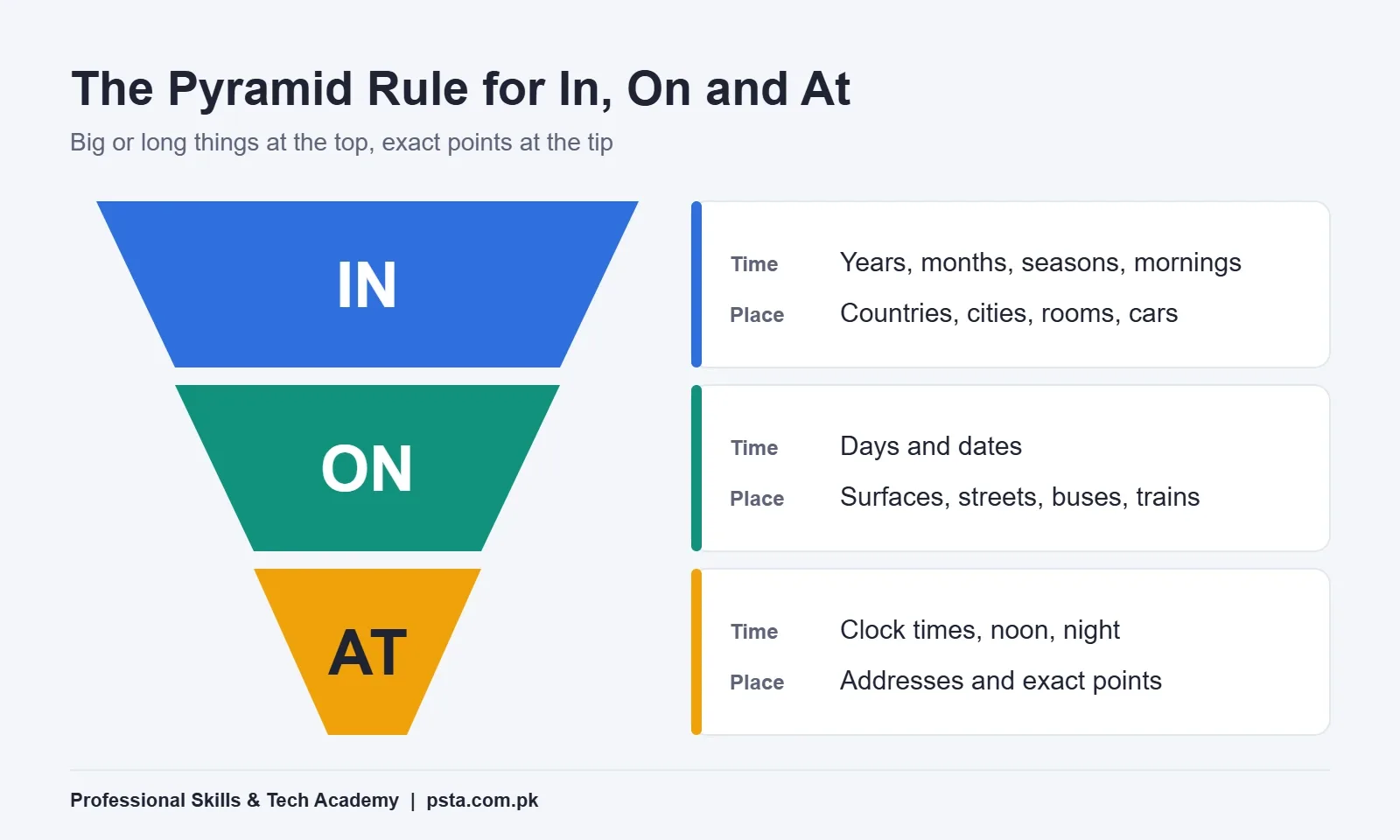
The pyramid works for prepositions of time and place alike. When you're unsure, ask one question: how big or how long is this? A whole year is wide, so it takes in. A single date is narrower, so it takes on. A clock time is a single point, so it takes at. The rest of this guide fills in the details and the exceptions.
Prepositions of Time: In, On and At With Examples
The British Council's LearnEnglish lesson on prepositions of time groups the rules in almost the same way as the pyramid. Here is how each layer works in practice.
In for Months, Years, Seasons and Parts of the Day
Use in with months, seasons, years, decades and centuries. You also use it with the morning, the afternoon and the evening, and with the past and the future.
- Our new batch starts in January.
- She finished her degree in 2024.
- Electricity bills go up in summer.
- I revise vocabulary in the evening.
In also has a second time meaning. With a future form, it tells you how long from now something will happen. "The class starts in ten minutes" means ten minutes from now, not within the next ten minutes. The British Council's grammar reference on time and dates gives the same rule.
On for Days and Dates
Use on with days of the week, dates and special single days.
- The test is on Thursday.
- Results come out on 14 August.
- We met on my birthday.
If something happens every week, make the day plural: "I go to the gym on Saturdays." In casual American English, people often drop the on in this pattern, so you may hear "I work Saturdays" in films.
At for Clock Times and Short Points
Use at with clock times, with noon and midnight, and with mealtimes and breaks.
- The interview is at 11:15.
- Let's call the client at noon.
- I'll reply at lunchtime.
Two fixed phrases also take at: at night and at the weekend. At the weekend is British usage. American speakers usually say on the weekend, and both are correct. Pick one and stay consistent within a document.
At Night or In the Night?
Both exist, with a small difference in meaning. At night describes the whole night or a habit: "He drives a cab at night." In the night points to one moment during a particular night: "The baby woke up twice in the night."
| Time Expression | Preposition | Example Sentence |
|---|---|---|
| Year, decade, century | in | He started freelancing in 2023. |
| Month | in | Admissions close in March. |
| Season | in | Roads in Galiyat get busy in summer. |
| Morning, afternoon, evening | in | I study in the morning. |
| Amount of time from now | in | The webinar starts in five minutes. |
| Day of the week | on | Classes are on Monday. |
| Date | on | The result came on 2 May. |
| Single special day | on | We celebrated on her birthday. |
| Clock time | at | The bus leaves at 7:45. |
| Noon, midnight | at | The shop closes at midnight. |
| Mealtime or break | at | Call me at lunchtime. |
| Night (habit) | at | She works at night. |
| Weekend (British) | at | I visit my parents at the weekend. |
Prepositions of Place: In, On and At With Examples
The same three words describe location. The British Council's lesson on prepositions of place sums them up as inside a space, on a surface, and at a point or activity.
In for Enclosed Spaces and Large Areas
Use in when something is inside a bigger space with limits around it. That covers a box, a room, a building, a city and a country. It also covers water, natural areas like mountains, valleys and forests, and a car or taxi.
- The certificates are in the drawer.
- My cousin lives in Karachi.
- We camped in the Kaghan Valley.
- Don't leave your phone in the taxi.
On for Surfaces, Lines and Public Transport
Use on for surfaces such as a desk, a wall, a floor or a sofa. Use it for lines too: streets, rivers and borders. Larger public transport, such as a bus, a train or a plane, also takes on.
- Your laptop is on the table.
- The academy is on Old College Road.
- Attock sits on the Indus River.
- I'm on the train, so I'll call later.
At for Exact Points and Places Linked to an Activity
Use at for addresses and exact positions, and for places you visit for a purpose. At work, at home, at school, at the bank and at a wedding all follow this pattern. Purdue University's Online Writing Lab describes at as marking a general vicinity, as in "at the corner."
- I'm at work until five.
- Wait for me at the main gate.
- Our office is at House 9, Street 2.
Sometimes two answers are both correct. "We played cricket in the park" stresses being inside the park's area. "We played cricket at the park" simply names the place. The British Council team confirms both are acceptable, so don't lose marks worrying about it.
Is It In the Bus or On the Bus?
This is one of the most common questions in our English classes, and the answer is on the bus. Buses, trains, planes and ships take on. Cars and taxis take in.
A practical way to remember it: if you can stand up and walk around inside the vehicle, use on. If you have to bend down to get in and stay seated, use in. A Daewoo coach and a Metro bus both pass the walking test, so "on the bus" is right for both. A Suzuki Mehran does not, so you sit in the car.
Bikes and motorbikes follow the surface idea. You sit on top of them, so you ride on a bike, not in one.
When Do You Use No Preposition at All?
Many short guides to prepositions of time and place skip this rule, yet it trips up even confident speakers. Before certain time words, English uses no preposition. According to the British Council's grammar reference, these include today, tomorrow and yesterday, and phrases with this, next and last.
- Wrong: I submitted the form on last Monday. Right: I submitted the form last Monday.
- Wrong: The batch starts from next week. Right: The batch starts next week.
- Wrong: We have a quiz in this Friday. Right: We have a quiz this Friday.
- Wrong: I will join at tomorrow. Right: I will join tomorrow.
The reason is simple. Words like last, next and this already tell the listener which week or day you mean, so a preposition adds nothing. If you translate "pichle Monday ko" word by word, you get an extra on. Train yourself to delete it.
Where Do Urdu Speakers Go Wrong Most Often?
Preposition errors are a well-known problem in Pakistani classrooms, not just a feeling. A 2015 study in the International Journal of English Linguistics by Saeed, Hussain and Fatima examined compositions and essays from 26 HSSC students in Pakistan. The authors reported that learners still struggle with prepositions in their writing.
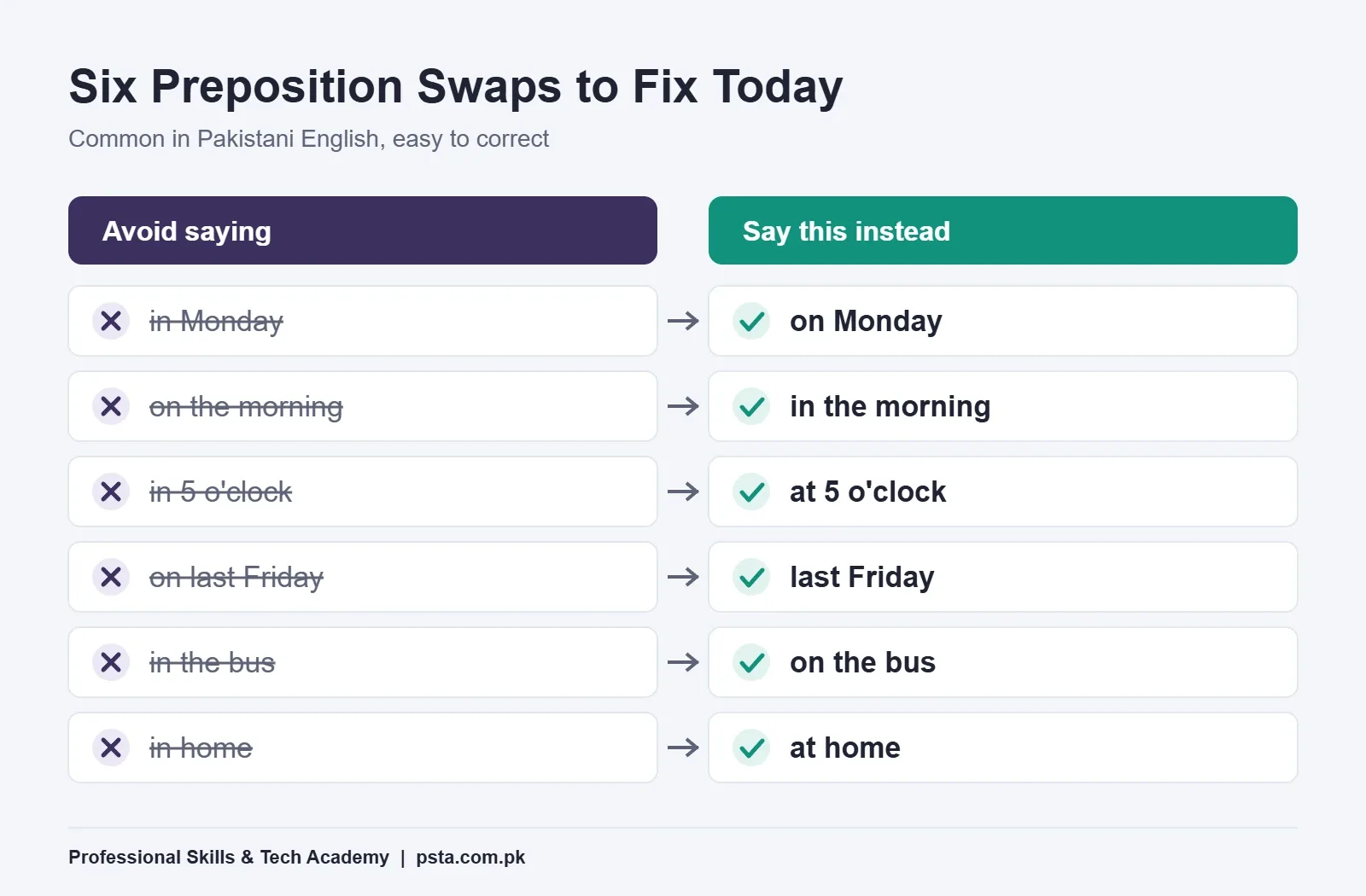
In our own classes, the same handful of preposition mistakes come up again and again. Here they are with fixes.
| What People Say | What to Say Instead | Why |
|---|---|---|
| in Monday | on Monday | Days take on |
| on the morning | in the morning | Parts of the day take in |
| in 5 o'clock | at 5 o'clock | Clock times take at |
| on night | at night | Fixed phrase |
| on last Friday | last Friday | No preposition before last |
| in the bus | on the bus | Public transport takes on |
| on the car | in the car | Cars and taxis take in |
| in home | at home | Place linked to an activity |
On Time or In Time? Four Phrases Worth Learning
A few fixed phrases look alike but mean different things. Mixing them up won't stop people understanding you, but it does sound careless in a job email. The explanation on Test-English separates them clearly.
- On time means at the planned time, not late. "The meeting started on time."
- In time means early enough, before it's too late. It often takes for or to after it. "I reached the hall in time to find a seat."
- At the end means the final part of a place or a period, usually followed by of. "Fees are due at the end of the month."
- In the end means finally, after some difficulty or change. "We argued for an hour, but in the end we chose the cheaper laptop."
Just in time is a useful extra. It means at the last possible moment: "I submitted the assignment just in time."
How Do You Pick the Right Preposition in Five Seconds?
Speed matters when you're speaking. You can't stop mid-sentence to look up a rule. This short check for prepositions of time and place, run in order, gives the right answer for almost every everyday sentence.
- Does the phrase contain this, next, last, today, tomorrow or yesterday? Use no preposition.
- Is it a clock time, an address or an exact point? Use at.
- Is it a day, a date, a surface, a street, or a bus, train or plane? Use on.
- Is it a month, year, season, part of the day, city, country, enclosed space or car? Use in.
- Still not sure? Check your fixed-phrase list: at night, at the weekend, at home, at work.
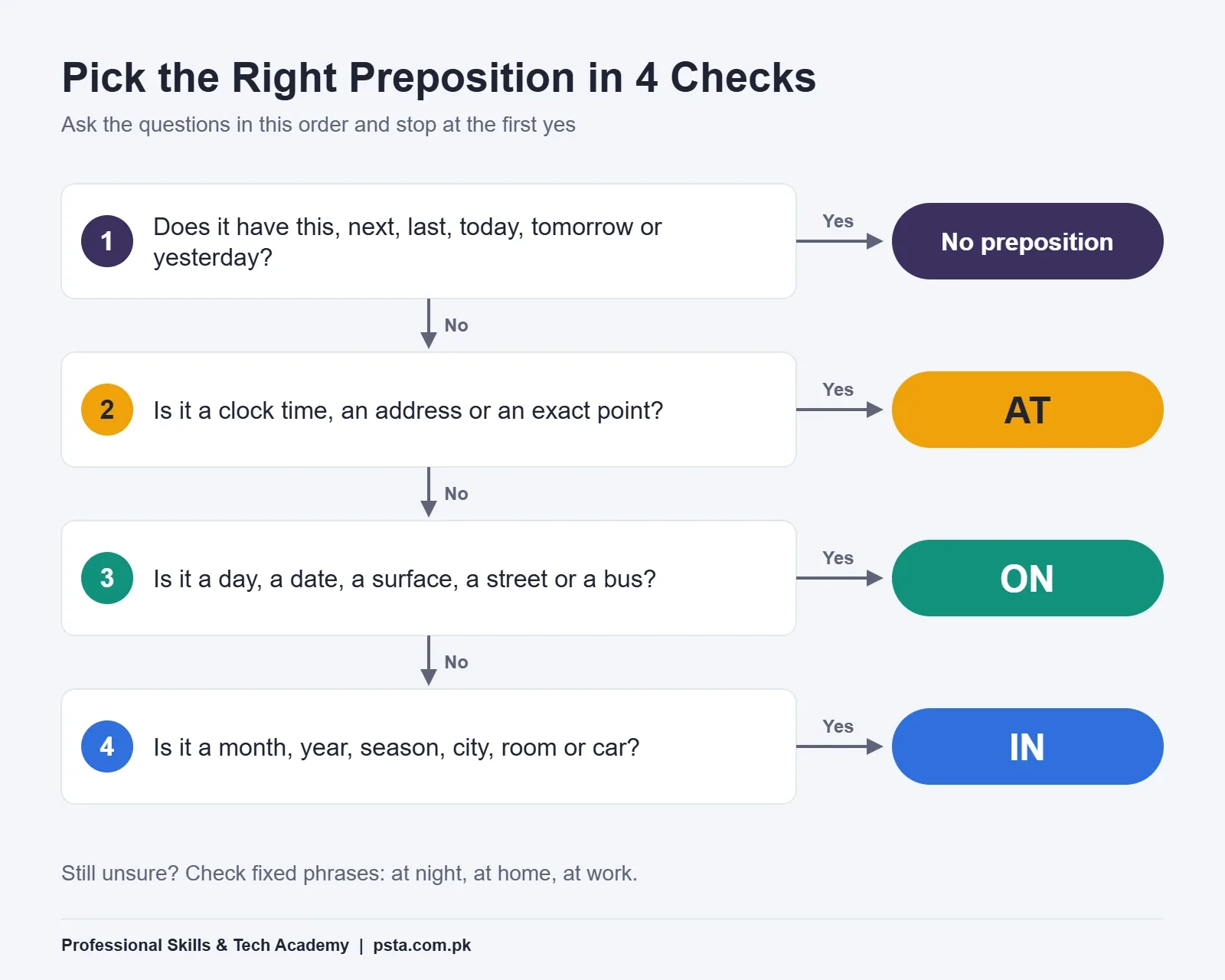
Notice the order. The no-preposition check comes first because it overrides everything else. "Next Monday" is a day, but it still takes no on.
A Seven-Day Practice Plan
Reading rules for prepositions of time and place is the easy part. Using them while you talk is the real skill. Spend 15 minutes a day on this plan and keep your sentences short.
- Day 1: Write 10 sentences about your daily routine using in the morning, at 8:00 and on weekdays.
- Day 2: Describe your home and street. Use in for rooms, on for surfaces and the street, at for your address.
- Day 3: Write five sentences with last, next and this. Read them aloud and check that no preposition crept in.
- Day 4: Plan an imaginary trip to Naran. Mention the vehicle, the valley, the date and the departure time.
- Day 5: Practice the four fixed phrases: on time, in time, at the end and in the end. Use each one twice.
- Day 6: Read one English news story and underline every in, on and at. Sort them into the pyramid layers.
- Day 7: Record a one-minute voice note about your week. Play it back and count the mistakes.
If you'd like a broader reference while you practice, our English tenses chart pairs well with this plan, and the guide to common English mistakes covers errors beyond prepositions.
Practising Grammar Out Loud in PSTA's English Class
Small grammar points, such as prepositions of time and place, stick faster when someone corrects you in the moment. That is the main idea behind the English Spoken & Grammar Course at PSTA. It is a three-month program of spoken English and English grammar for beginners, and it runs on campus in Abbottabad and online for students across Pakistan.
Sentence building and parts of speech come early in the syllabus. Later modules move on to using tenses while speaking, fluency drills, role plays, group discussions, and writing emails, CVs and messages. You finish by giving a presentation, which is followed by an assessment for the certificate. When we checked the course page for this guide, the fee shown was Rs. 12,000 against a crossed-out Rs. 14,000, so check the page or ask on WhatsApp before you pay.
If your goal is office work, you may also want speed on the keyboard. The English & Urdu Typing Course runs for four weeks. You can compare options on the all courses page, read our tips to improve English speaking, or keep a list of English phrases for the office next to your desk. To join a batch, fill in the online admission form, or send your questions on WhatsApp at +92 314 5424399.
Tonight: Fix Ten Sentences From Your Own Chats
Open your WhatsApp or email and find the last ten English messages you sent. Highlight every time or place phrase. Check each one against the pyramid and the no-preposition rule, then rewrite the wrong ones. Your own sentences are the ones you'll say again tomorrow, so they are the best place to start. Do this once a week and prepositions of time and place will stop feeling like guesswork.
Frequently asked questions
Is it "in the weekend", "on the weekend" or "at the weekend"?
Never use "in the weekend". British English says "at the weekend", while American English usually says "on the weekend". Both are correct, so choose the one that matches the rest of your writing. What matters most is consistency: pick one form and keep it the same throughout an email, an essay or a CV.
Do we say "in the morning" or "at the morning"?
Say "in the morning", and the same goes for "in the afternoon" and "in the evening". Night is the exception: the fixed phrase is "at night" when you mean the whole night or a habit. Use "in the night" only for a moment during one particular night, as in "I woke up twice in the night."
Is it correct to say "on last Monday"?
No. Words like last, next and this already point to a specific day, so English drops the preposition. Say "last Monday", "next week" and "this Friday". The same rule applies to today, tomorrow and yesterday. Many Urdu speakers add an extra on because they translate "pichle Monday ko" word by word.
Should I say "in the office" or "at the office"?
Both can be right. "At the office" names the place where you work, much like "at work" or "at school". "In the office" stresses being inside the building or room. In daily speech and emails, "I'm at the office" is the more natural way to tell someone where you are right now.
Why do we say "in a car" but "on a bus"?
English treats buses, trains, planes and ships as platforms you stand and walk on, so they take on. Cars and taxis are small enclosed spaces you sit inside, so they take in. A quick test is to ask whether you could walk around inside the vehicle. If yes, use on; if not, use in.
What is the difference between "on time" and "in time"?
"On time" means at the planned time, not late: "The train left on time." "In time" means early enough to do something, and it is often followed by for or to: "We arrived in time to get good seats." "Just in time" means at the last possible moment before it would have been too late.
Sources & references
- Prepositions of time: at, in, on (British Council LearnEnglish) learnenglish.britishcouncil.org
- Prepositions of place: in, on, at (British Council LearnEnglish) learnenglish.britishcouncil.org
- When: time and dates (British Council grammar reference) learnenglish.britishcouncil.org
- Prepositions for Time, Place, and Introducing Objects (Purdue OWL) owl.purdue.edu
- Prepositional Errors in the Writings of Pakistani ESL Students (International Journal of English Linguistics, 2015) ccsenet.org
- On time vs in time, at the end vs in the end (Test-English) test-english.com
Last reviewed & updated on by Umar Qureshi. Written by the PSTA team in Abbottabad, Pakistan.

Umar Qureshi

English Spoken & Grammar Course in Pakistan – Build Confidence, Speak Fluently (Online & Campus)
Turn this guide into a career: hands-on training with real projects, online across Pakistan or on-campus in Abbottabad · 12 Weeks.
Comments
No comments yet — ask a question or share your experience.